
Gems and Jewelry Market Summary:
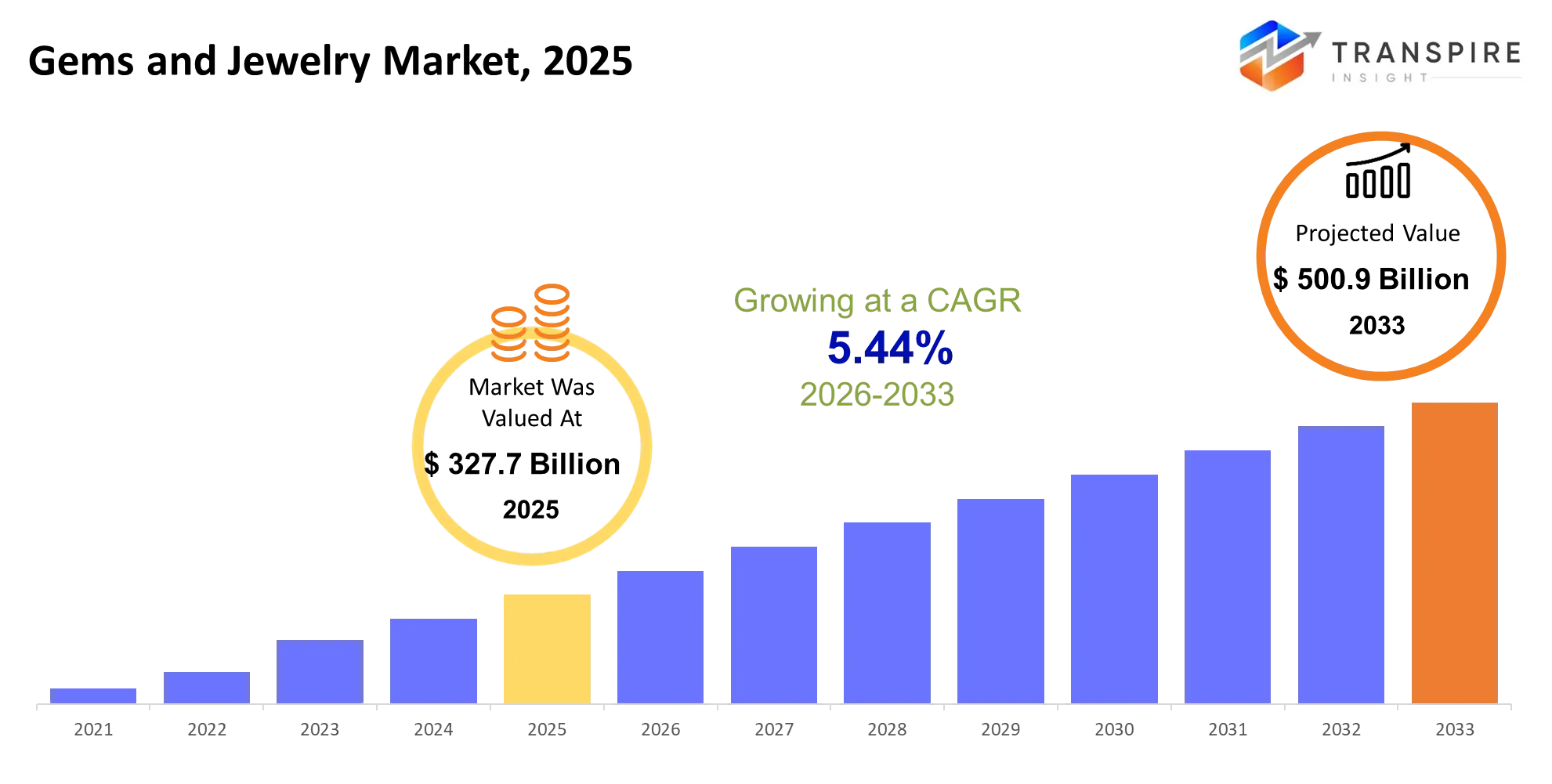
As per Transpire Insight, the Gems and Jewelry Market size is estimated at USD 327.7 billion in 2025 and is anticipated to reach USD 500.9 billion by 2033, growing at a CAGR of 5.44% from 2026 to 2033.
The international gems and jewelry industry is changing due to the convergence of traditional buying approaches and online purchasing options in conjunction with customised design and selection of materials. In recent years, the gems and jewelry market has moved clearly toward selling online, making custom jewelry and using alternative materials, while big brands have made their online presence stronger. The growth of e-commerce has been a trigger for the gems and jewelry market, making it easier for shoppers to find items, compare looks read about the products and buy from far away. At the time, shoppers in the gems and jewelry market want more unique styles, personalised pieces and items that show clear information about the materials and where they come from. These shifts are pushing jewelry companies to expand online shopping in the gems and jewelry market and to widen their collections. More use of methods changes in fashion taste, and steady interest in both old and new jewelry are helping the gems and jewelry market grow in many groups of people and in many places.
Gems and Jewelry Market Size & Forecast:
- Market Size 2025: USD 327.7 Billion
- Expected Market Value (2033): USD 500.9 Billion
- Forecast CAGR (2026-2033): 5.44%
- Leading Region in 2025: Asia Pacific
- Fastest Growing Region: Middle East & Africa
- Key Company Profiles: LVMH, Richemont, Chow Tai Fook, Signet Jewelers, Pandora, Kering, Titan Company, Chow Sang Sang, Malabar Gold & Diamonds, De Beers, Graff, Tiffany & Co., Cartier, Swarovski, Bulgari
Key Market Insights:
In the world of gems and jewelry, the trend has been towards consumers’ choices, online shopping and customisation of products. The trend among companies has been the fusion of technology and online selling with traditional skills in making jewelry.
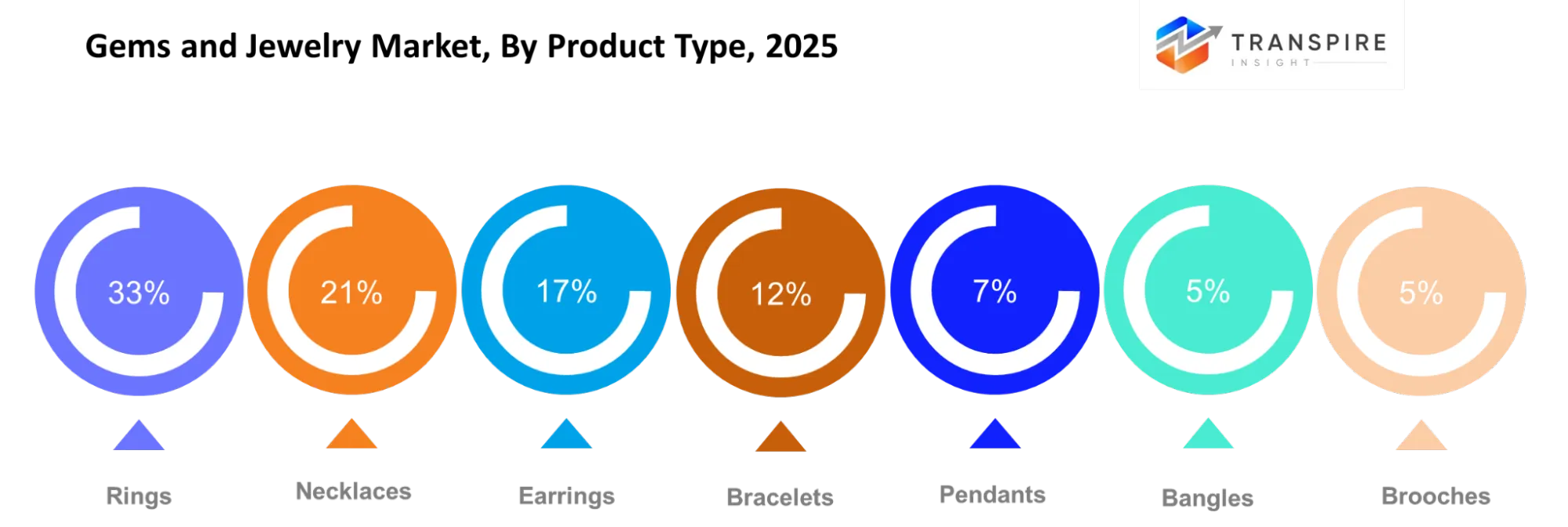
- The rings are the dominant segment, accounting for 33.02%, due to high demand for engagement rings, wedding bands, gifting, and general jewellery.
- The necklaces form 21% of the products and are the fastest-growing product segment, recording a growth rate of 6.19% CAGR, thanks to personalised and fashionable designs.
- Earrings make up 17% of the products and are seeing more brands introducing lightweight and trendy earrings based on different occasions.
- Bracelets form 12% of the products, helped by modern designs, personalisation, and growing online product searches.
- The pendants make up 7% of the products, taking advantage of high demand for small-sized, versatile and personalized jewelry.
- The bangles make up 5% of the products, where cultural buying patterns have been incorporated with trendy designs to appeal to young consumers.
What are the Key Drivers, Restraints, and Opportunities in the Gems and Jewelry Market?
Drivers:
Growth in the market is being driven by the trend of buying jewelry items online, personalisation, and access to modern-day product offerings. Online portals provide an opportunity for jewelry companies to engage with customers outside of brick-and-mortar stores, while the personalisation factor assists customers in picking the designs that match their choices and preferences.
Restraints:
The challenge is preserving consumer confidence in terms of product quality, material, price, and provenance. All of these factors become especially relevant in cases when customers buy expensive jewelry through the Internet but do not have the possibility to check the product beforehand. Hence, trust and reliable product information still need to be considered as the major components of the structure.
Opportunities:
Opportunities include the combination of modern digital technology and personalized jewelry retailing. In particular, it becomes possible to make product selection more interesting and interactive through the use of virtual visualisation, digital personalisation, and recommendation algorithms. The development of the online channel in the Asia Pacific region and other developing countries opens new perspectives for targeting different customers.
What Has the Impact of Artificial Intelligence Been on the Gems and Jewelry Market?
The use of Artificial Intelligence technology has brought about some transformations in terms of the way jewelry companies handle product design, customer behaviour, and even retail activities. With the help of recommendation algorithms, jewellery companies can use information on customer browsing and buying behaviours in order to come up with customised recommendations for products. Besides, AI is utilised for jewelry design development purposes, allowing brands to learn about new customer preferences and develop a product concept. In the area of retail operations, there are different ways AI can help to automate various processes such as inventory planning, demand forecasting, product categorisation, and customer service. With predictive capabilities, AI can help jewelry companies manage their inventory by providing recommendations on what products might become popular in certain periods or occasions. The integration of AI technologies into already existing jewelry companies requires large investments in software and infrastructure. The accuracy of AI predictions is dependent on customer data, and when it is limited or inconsistent, the predictions might become inaccurate. Therefore, as the utilisation of AI becomes widespread, jewelry companies will have to combine automation with the skills of professionals in areas like craftsmanship, design, and gemstone assessment, and important customer relationships are concerned.
Instance:
In April 2025, Malabar Gold & Diamonds partnered with Accenture for its business transformation through AI. This initiative makes use of a digitally empowered AI-based and cloud-enabled core in sectors like manufacturing, supply chain, finance, and retail with the objective of enhancing forecasting, efficiency, and customer experience in the jewelry industry.
Key Market Trends
The market of gemstones and jewelry is increasingly moving towards a digital and personalised mode of shopping experience. Though traditional methods of retail remain indispensable, recent trends are impacting the way in which gemstones and jewelry are being marketed and sold.
- Retail growth in digital channels. The process of buying jewelry has slowly shifted from offline buying to e-commerce and allows customers easy access to wide product lines.
- Personalised jewellery. There is a growing tendency for customers to buy jewelry that matches their personal preferences, which stimulates brands to provide customisation options.
- Product search online. People use digital channels to compare products in terms of design, material, price, and other characteristics.
- Visual representation of product with help of technology: Digital representations of products allow customers to visualise the jewellery product before purchase.
- Interest in alternative materials. Growing interest in man-made diamonds makes jewelry companies think about widening the range of materials used in production.
- Change in preferences towards design. Preferences of younger people play a role in growing preference for modern, light, and flexible jewelry pieces.
Gems and Jewelry Market Segmentation
By Product Type:
Rings hold the majority of the market with a 33.02% share due to high demand for engagement rings, wedding, gift, and daily use jewelry. The necklaces segment has a share of 21% and has been growing at the fastest pace at a CAGR of 6.19%, owing to personalised and fashion-oriented designs. Earrings have a share of 17%, while bracelets make up 12%, pendants constitute 7%, bangles are 5%, brooches 2%, and the rest are 2.98%.
By Material:
Precious metals are still relevant because of the high value of those materials and their premium status. Diamonds and gemstones still contribute to the manufacture of fine and luxury jewelry, and pearls are still used to make classic jewelry. Base metals, artificial diamonds, and synthetic gemstones add other options that are available for customers at different price ranges. Future development will depend on new materials, affordability, transparency of sourcing, and changing customer preferences.
By Category:
Fine jewelry is still fashionable owing to the high level of craftsmanship and use of precious materials in the production process. Luxury and bridal jewelry continue to be profitable owing to the presence of marriages, special occasions, exclusivity, and expensive purchases. Fashion and costume jewelry make jewelry affordable with fashion changes.
By End User:
Women form one of the largest consumer groups in fashion, bridal, gifting, and regular jewelry. Men are becoming important consumers via exclusive contemporary jewelry, while children continue to be vital for gifting purposes. Couples form an end-user base for engagement, wedding, and anniversary purchases, whereas collectors prefer unique jewelry. Future potential will arise from creating products based on consumer requirements and events.
By Distribution Channel:
Off-line distribution channel will continue to be important as customers prefer trying out jewelry in person before making any purchase. Brand store, department store, speciality store, and luxury boutique channels allow the customer direct contact with the product, while direct sales help build better customer relations. Online distribution is becoming increasingly important with the advent of convenience, choice, customisation, and technology.
By Price Ranges:
The jewelry meant for affordable use by consumers falls under mass and entry level jewelry. Mid-range and high end jewelry provides balance between design and affordability. The premium and ultra-luxury jewelry are aimed at providing exclusivity and craftsmanship, while investment jewelry is used by consumers who look for both uses. Growth of future collections will depend on unique jewelry that caters for changing demands.
By Occasions:
The most important occasions are weddings and engagements since jewelry is closely related to ceremony and celebration. Festival occasions and gift occasions create purchasing opportunities during certain seasons, while everyday occasions facilitate the purchase of more flexible designs. Business occasions and fashion occasions are other applications of jewelry. Future collections will concentrate on jewelry made for different occasions.
What are the Key Use Cases Driving the Gems and Jewelry Market?
The demand for rings forms one of the important use cases in the international market for gemstones and jewelry. Rings are worn for the purposes of marriage, engagements, anniversaries, as gifts or on other occasions in life. The wide range of applications of rings is such that it becomes easier for the manufacturer to innovate and remain creative with his designs. Necklaces, earrings, bracelets, pendants and bangles used for fashioning, gift-giving, celebrations and daily purposes have created a new market. It has become essential for consumers to seek versatility in such items, which can be used in different situations. New use cases are arising in the form of customized jewelry, online shopping, corporate gifts, and collector-oriented buying of jewellery. Online shopping portals are also helping customers find custom-made designs and specialised collections of jewellery.
|
Report Metrics |
Details |
|
Market size value in 2025 |
USD 327.7 Billion |
|
Market size value in 2026 |
USD 345.7 Billion |
|
Revenue forecast in 2033 |
USD 500.9 Billion |
|
Growth rate |
CAGR of 5.44% from 2026 to 2033 |
|
Base year |
2025 |
|
Historical data |
2021 - 2024 |
|
Forecast period |
2026 - 2033 |
|
Report coverage |
Revenue forecast, competitive landscape, growth factors, and trends |
|
Regional scope |
United States; Canada; Mexico; United Kingdom; Germany; France; Italy; Spain; Denmark; Sweden; Norway; China; Japan; India; Australia; South Korea; Thailand; Brazil; Argentina; South Africa; Saudi Arabia; United Arab Emirates |
|
Key company profiled |
LVMH, Richemont, Chow Tai Fook, Signet Jewelers, Pandora, Kering, Titan Company, Chow Sang Sang, Malabar Gold & Diamonds, De Beers, Graff, Tiffany & Co., Cartier, Swarovski, Bulgari |
|
Customization scope |
Free report customization (country, regional & segment scope). Avail customized purchase options to meet your exact research needs. |
|
Report Segmentation |
By Product Type (Rings, Necklaces, Earrings, Bracelets, Pendants, Bangles, Brooches, Others); By Material (Precious Metals, Base Metals, Diamonds, Gemstones, Pearls, Lab-grown Diamonds, Synthetic Gemstones, Others); By Category (Fine Jewelry, Fashion Jewelry, Bridal Jewelry, Luxury Jewelry, Costume Jewelry, Men's Jewelry, Children's Jewelry, Others); By End User (Women, Men, Children, Couples, Collectors, Corporate Buyers, Tourists, Others); By Distribution (Offline Retail, Online Retail, Brand Stores, Department Stores, Specialty Stores, Luxury Boutiques, Direct Sales, Others); By Price Range (Mass, Mid-range, Premium, Luxury, Ultra-luxury, Entry-level, Investment-grade, Others); By Occasion (Wedding, Engagement, Festivals, Gifting, Everyday Wear, Corporate, Fashion Events, Others) |
Which Regions are Driving the Gems and Jewelry Market Growth?
North America:
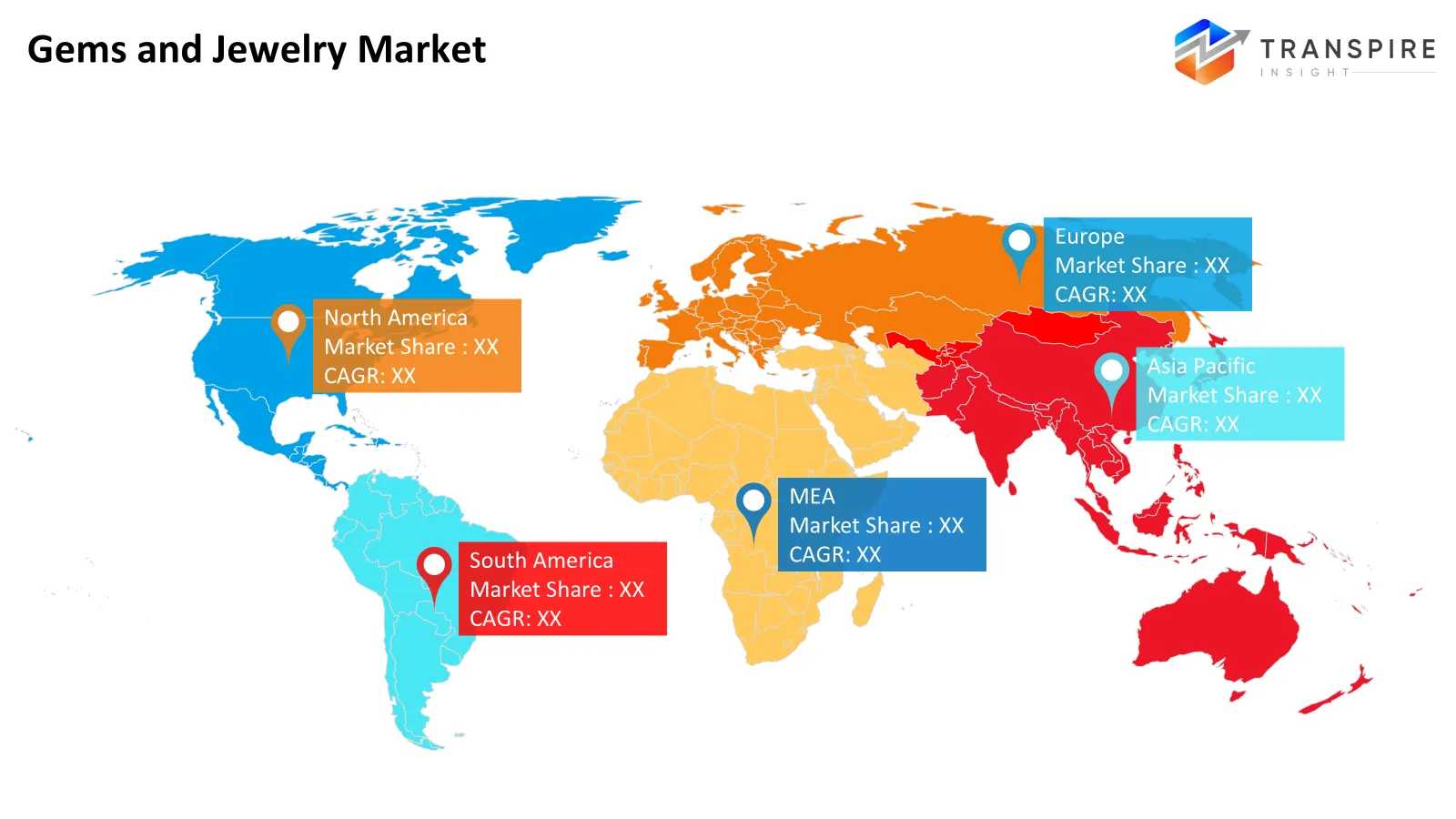
North America accounts for 21.53% of the overall market and boasts a sophisticated jewelry ecosystem in terms of branding, retailing, and e-commerce. North America is more inclined towards online shopping, customisation, high-end items, and omnichannel strategy than the Asia Pacific region. The above characteristics provide stability and motivate businesses to enhance their digital and customer experience strategies.
In September 2025, Zales and TOGETHXR have unveiled “The Line Up,” which is the new jewelry capsule collection with Flau’jae Johnson. This collection has been released through the online portals of Zales and TOGETHXR, indicating the focus of the region on new jewelry ideas, collaboration, and online retailing.
Europe:
Europe represents 20.60% of the market share and has established luxury brands, skilled craftsmanship, influence of fashion, and quality jewelry. There is still an opportunity for companies offering heritage products and responsible sourcing in this particular market segment. The Middle East and Africa together represent 10.36% of the total market and experience growth at a CAGR of 6.88%.
In August 2025, Pandora unveiled the collections of Pandora Talisman and Pandora Minis collections with the use of recycled sterling silver, gold plating, various metals, and artificial mother-of-pearl for creating new charms and jewelry pieces. It reflects the product innovations by a major European jewelry company.
Asia Pacific:
Asia Pacific is the most dominant market in terms of regional share, accounting for 38.74%. This is possible owing to the presence of a rich jewellery-buying culture, the growth of distribution channels, and the increasing availability of online transactions. The region is well placed in terms of consumer demand and increasing online penetration.
In February 2025, the Indian jewelry brand MISHO has released its first high-jewellery collection, “JAIPUR”, that uses rubies and sapphires from Jaipur’s legendary Johri Bazaar. The launch represents the heritage jewellery craftsmanship tradition with contemporary luxury in the region.
Who are the Key Players in the Gems and Jewellery Marketand how do they compete?
The competition in the international gems and jewelry market consists of existing brands and diversified jewelry companies competing based on product differentiation, brand positioning, digital retail, store growth, and customer experience. More and more companies integrate their physical retail and digital retailing while updating their collections to cater to changing preferences for wedding, fashion, luxury, and every day's jewelry. Some of the recent moves in the industry reveal increased focus on brand differentiation and digital experiences. Signet Jewelers is implementing the Grow Brand Love strategy in its KAY, Zales, and Jared brands. The strategy focuses on differentiation of the brands, merchandise refreshes, better digital experience, and store experience upgrades. Signet also utilises its range of brands to meet the needs of various customers. Pandora relies on design recognition, customisation, retail coverage, and innovative materials. Pandora expanded its products by adding jewelry made of platinum plating. In addition, the company highlights recycled precious metals in the product line as part of its product and sustainable development strategy.
Gems and Jewelry Market companies
- LVMH
- Richemont
- Chow Tai Fook
- Signet Jewelers
- Pandora
- Kering
- Titan Company
- Chow Sang Sang
- Malabar Gold & Diamonds
- De Beers
- Graff
- Tiffany & Co.
- Cartier
- Swarovski
- Bulgari
Recent Development News
- In February 2026, Pandora debuted its platinum-plated line of jewelry which used an innovative plating technology to extend its range of precious metals. The company was expected to do a phased launch of the new products to give consumers an additional choice as part of its diversification efforts. https://pandoragroup.com/media/press-releases/pandora-enters-exclusive-platinum-plated-jewellery
- In June 2025, De Beers Group introduced the jewelry line, "Ombré Desert Diamonds," and the "ORIGIN De Beers Group" collection of polished diamonds. This was done to increase the appeal of natural diamonds to consumers by offering more traceability and technological assistance. https://www.debeersgroup.com/news-insights/latest-group-news/2025/de-beers-launches-ombre-desert-diamonds-jewellery-beacon-and-origin-de-beers-group-polished-diamonds
What Strategic Insights Define the Future of the Gems and Jewelry Market?
The international gems and jewelry industry is evolving towards a technology-driven retail model that is characterised by transparency and personalisation. It means that companies must find the right balance between craftsmanship and e-commerce, customisation, visualisation of products online and engagement of customers via data analysis. The rise of laboratory diamonds also affects the way of positioning and pricing of products, whereas natural diamonds remain unique due to their rarity, origin, and emotions attached to them. An under-the-radar risk is margin compression because of decreasing costs for the production of laboratory diamonds and increasing ease of comparison of prices. A developing opportunity in the industry consists of merging traceability, responsible sourcing, personalisation, and digital retailing. It will allow increasing customer trust. The company may grow thanks to customised collections, an omnichannel strategy and a digitalised product discovery process.
Key Segmentations are:
By Product Type
- Rings
- Necklaces
- Earrings
- Bracelets
- Pendants
- Bangles
- Brooches
- Others
By Material
- Precious Metals
- Base Metals
- Diamonds
- Gemstones
- Pearls
- Lab-grown Diamonds
- Synthetic Gemstones
- Others
By Category
- Fine Jewelry
- Fashion Jewelry
- Bridal Jewelry
- Luxury Jewelry
- Costume Jewelry
- Men's Jewelry
- Children's Jewelry
- Others
By End User
- Women
- Men
- Children
- Couples
- Collectors
- Corporate Buyers
- Tourists
- Others
By Distribution
- Offline Retail
- Online Retail
- Brand Stores
- Department Stores
- Specialty Stores
- Luxury Boutiques
- Direct Sales
- Others
By Price Range
- Mass
- Mid-range
- Premium
- Luxury
- Ultra-luxury
- Entry-level
- Investment-grade
- Others
By Occasion
- Wedding
- Engagement
- Festivals
- Gifting
- Everyday Wear
- Corporate
- Fashion Events
- Others
By Regional Analysis
North America
- US
- Canada
- Mexico
Europe
- Germany
- UK
- France
- Italy
- Spain
- Russia
- Rest of Europe
Asia Pacific
- China
- Japan
- India
- South Korea
- Australia
- Rest of Asia Pacific
South America
- Brazil
- Argentina
- Rest of South America
Middle East & Africa
- UAE
- Saudi Arabia
- Qatar
- South Africa
- Rest of the Middle East & Africa
Frequently Asked Questions
Find quick answers to common questions.
The gems and jewelry market size was valued at USD 327.7 billion in 2025 and is poised to reach USD 500.9 billion by 2033, expanding at a 5.44% CAGR.
Key segments for the gems and jewelry market are By Product Type (Rings, Necklaces, Earrings, Bracelets, Pendants, Bangles, Brooches, Others); By Material (Precious Metals, Base Metals, Diamonds, Gemstones, Pearls, Lab-grown Diamonds, Synthetic Gemstones, Others); By Category (Fine Jewelry, Fashion Jewelry, Bridal Jewelry, Luxury Jewelry, Costume Jewelry, Men's Jewelry, Children's Jewelry, Others); By End User (Women, Men, Children, Couples, Collectors, Corporate Buyers, Tourists, Others); By Distribution (Offline Retail, Online Retail, Brand Stores, Department Stores, Specialty Stores, Luxury Boutiques, Direct Sales, Others); By Price Range (Mass, Mid-range, Premium, Luxury, Ultra-luxury, Entry-level, Investment-grade, Others); By Occasion (Wedding, Engagement, Festivals, Gifting, Everyday Wear, Corporate, Fashion Events, Others).
Growth is primarily driven by increasing disposable income, increasing need for luxury and wedding jewelry, growth in e-commerce, change in consumer preference for customized jewelry, and increasing requirement for diamonds and precious stones.
The market is led by major manufacturers including LVMH, Richemont, Chow Tai Fook, Signet Jewellers, Pandora, Kering, Titan Company, Chow Sang Sang, Malabar Gold & Diamonds, De Beers, Graff, Tiffany & Co., Cartier, Swarovski, Bulgari.
The Asia Pacific region accounts for 38.74% of the world market share of gems and jewelry due to increased disposable income, consumer demand for gold and diamond jewelry, growth in online sales, and a well-developed jewelry manufacturing industry in countries like India and China. Additionally, an increase in demand for wedding and luxury jewelry products has added to the dominance of the region in markets.
Opportunities in the international gems and jewellery industry include increased e-commerce sales of jewellery, increased popularity of laboratory-created diamonds, increased demand for custom jewelry and customized jewelry, increased demand for sustainable and responsibly sourced products, and increased consumption of high-end and luxury jewelry in developing economies.
- LVMH
- Richemont
- Chow Tai Fook
- Signet Jewelers
- Pandora
- Kering
- Titan Company
- Chow Sang Sang
- Malabar Gold & Diamonds
- De Beers
- Graff
- Tiffany & Co.
- Cartier
- Swarovski
- Bulgari
About the Authors

Chetan Dhatrak
I’m Chetan Dhatrak, a Senior Research Analyst at Transpire Insight, specializing in the Consumer Goods, Foods and Beverages industry. I focus on analyzing market trends, consumer behavior, competitive landscapes, and industry developments to deliver accurate, data-driven insights. My research at Transpire Insight is built on credible sources and in-depth analysis, helping businesses and readers better understand market dynamics, emerging opportunities, and evolving consumer preferences. I’m committed to creating reliable, well-researched content that supports informed decision-making and reflects the latest developments in the consumer goods and food & beverage sectors.

Chakradhar Khansole
Chakradhar serves as the Research Director at Transpire Insight, bringing over 8 years of experience in technology, innovation, and strategic market intelligence. He specializes in transforming complex market data into actionable business insights that enable organizations to make informed, growth-oriented decisions. Recognized for his strategic vision and analytical expertise, Chakradhar leads high-impact research initiatives, delivering comprehensive market assessments, competitive intelligence, and forward-looking industry analysis.
Recently Published Reports
-
Apr 2026
Bottled Water Market
Bottled Water Market Size, Share & Analysis Report By Product Type (Still Bottled Water, Carbonated Bottled Water, Functional Bottled Water, and Others), By Packaging (PET, Cans, and Others), By Sales Channel (Supermarkets/Hypermarkets, Convenience Stores/Drug Stores, Grocery Stores/Club Stores, Foodservice, and Others) and Geography (North America, Europe, Asia-Pacific, Middle East and Africa, South and Central America), 2021 - 2032
-
Apr 2026
Color Cosmetic Packaging Market
Color Cosmetic Packaging Market Size, Share & Analysis Report By Application (Mascara Packaging, Liquid Packaging, and Liquid Face), By Type (Tubes & Bottles, Pens & Markers, Compacts & Containers, and Droppers & Pumps), and Geography (North America, Europe, Asia-Pacific, Middle East and Africa, South and Central America), 2021 - 2031
-
Apr 2026
External Microphone For Camera Market
External Microphone For Camera Market Size, Share & Analysis Report By Type (Shotgun Microphone, Lavalier Microphone, and Others), By Application (Digital Camera, Professional Video Camera, and Others), and Geography (North America, Europe, Asia-Pacific, Middle East and Africa, South and Central America), 2021 - 2031
-
Apr 2026
Foot Orthotic Insoles Market
Foot Orthotic Insoles Market Size, Share & Analysis Report By Type (Pre-fabricated, and Custom-made), By Material (Thermoplastic, Composite Carbon Fiber, and Others), By Distribution Channel (Drug Stores, Hospitals & Clinics, and Others), and Geography (North America, Europe, Asia-Pacific, Middle East and Africa, South and Central America), 2021 - 2031