
France Patient Lift Market Size & Forecast:
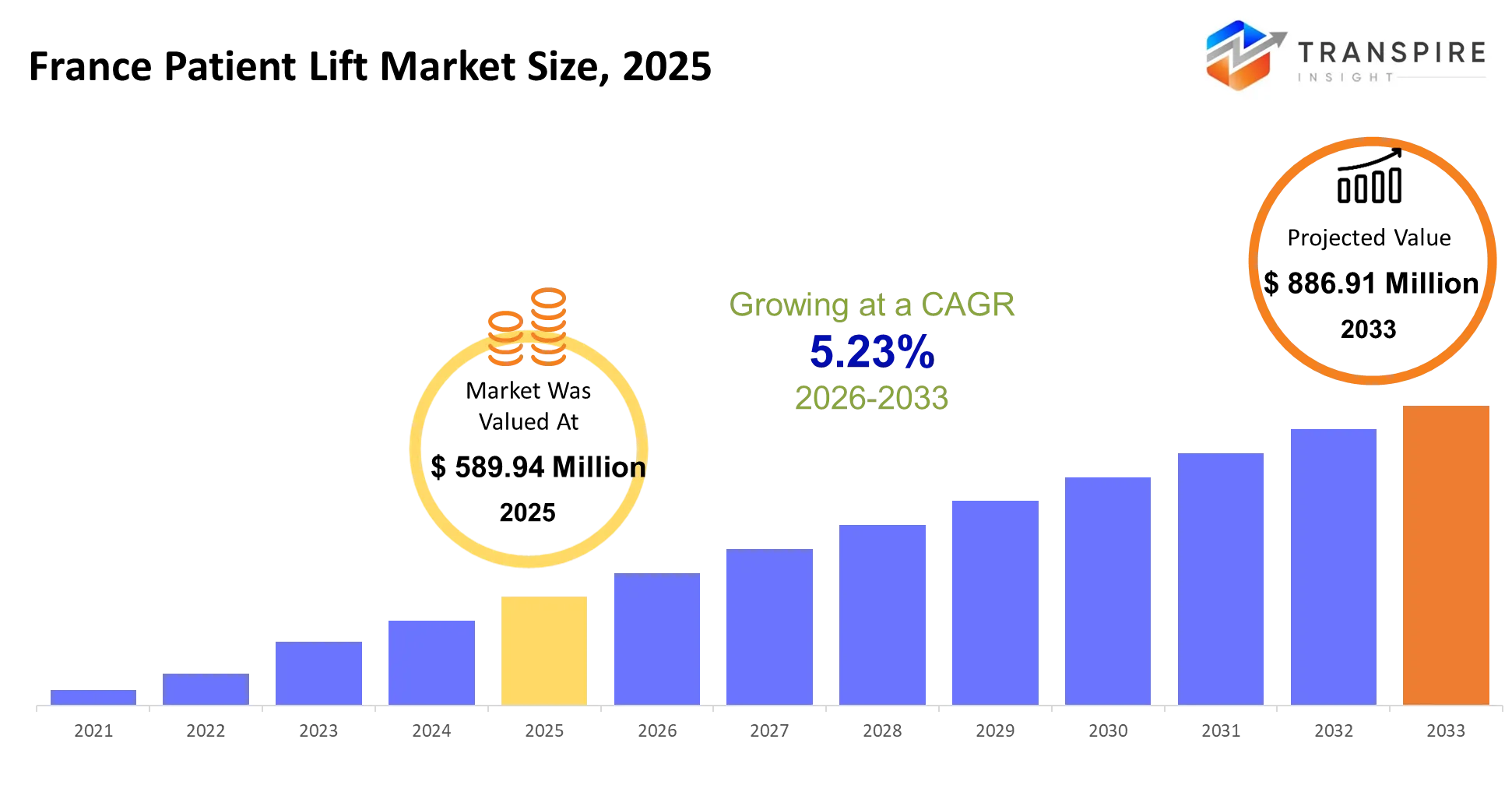
- France Patient Lift Market Size 2025: USD 589.94 Million
- France Patient Lift Market Size 2033: USD 886.91 Million
- France Patient Lift Market CAGR: 5.23%
- France Patient Lift Market Segments: By Type (Manual Lifts, Powered Lifts, Ceiling Lifts, Sit-to-Stand Lifts, Others); By Application (Patient Transfer, Rehabilitation, Mobility Support, Elderly Care, Bariatric Care, Others); By End-User (Hospitals, Homecare, Elderly Care Centers, Rehabilitation Centers, Clinics, Others); By Operation (Electric, Hydraulic, Battery-powered, Others)
To learn more about this report,  Download Free Sample Report
France Patient Lift Market Summary
The France Patient Lift Market was valued at USD 589.94 Million in 2025. It is forecast to reach USD 886.91 Million by 2033. That is a CAGR of 5.23% over the period.
In the France patient lift market, it matters a lot for easing physical strain when patients get moved around across hospitals , rehabilitation centers, and long-term care facilities. Basically, these lift solutions let caregivers relocate individuals with limited mobility between beds, wheelchairs, surgical units and even bathing areas, and in doing so they reduce the chance of musculoskeletal injuries in staff. Over the past five years, things have definitely moved on from basic manual lifting tools toward powered mobile lifts plus ceiling-mounted setups that come with digital safety controls and a bit more “smart” oversight.
This change sped up after COVID-19, because staffing gaps showed up hard and then the eldercare infrastructure in France felt extra pressure. Healthcare providers then started leaning into gear that boosts caregiver productivity, while also reducing patient handling incidents, which is the whole point really. At the same time, tighter workplace safety rules , and more obesity-related mobility complications, kept pushing demand for higher level lifting systems. And now, as medical institutions modernize older infrastructure, while home healthcare keeps expanding, manufacturers are also building steadier recurring income via maintenance contracts, smart monitoring upgrades, and tailored mobility solutions aimed at chronic care settings.
Key Market Insights
- The France Patient Lift Market is expected to climb to around USD 886.91 million by 2033, mainly backed by healthcare infrastructure modernization and also the aging population, trend which keeps going on and on, pretty much.
- In 2025 Northern France held close to 38% market share, because the region has concentrated hospital networks, and honestly the long-term elderly care spending is just higher there.
- Western France looks like the fastest moving regional market through 2033 as home health care penetration keeps rising across semi-urban communities, with more service coverage over time.
- Powered patient lifts stayed in front, taking more than 46% share in 2025, since hospitals tended to swap out manual handling setups after workplace injury claims came up.
- Ceiling mounted lift systems became the fastest growing segment since 2022, mostly due to space optimization advantages in rehabilitation wards and intensive care units, the layout really helps.
- Bariatric patient handling equipment gained noticeable traction, as obesity related mobility complications increased across French healthcare facilities after 2021, so demand followed.
- Acute care hospitals generated nearly 52% of France Patient Lift Market revenue, because big facilities accelerated equipment replacement cycles after the pandemic period.
- Home healthcare applications also expanded quickly between 2023 and 2026, as France increased reimbursement support for aging-in-place treatment models, so providers could scale faster.
- Key players including Arjo, Hillrom (Baxter), Invacare, Handicare Group, and Joerns Healthcare pushed their competitive positioning forward with powered lift innovation and caregiver safety technologies, of the practical kind.
- Manufacturers have been pairing up with rehabilitation centers and elderly care providers more often, to lock in long term service contracts and recurring maintenance revenue streams, not just one off sales.
- Smart patient transfer systems, with sensor based weight monitoring and emergency stop functions, started getting adopted more widely across premium healthcare facilities after 2024, and it kept rolling in.
What are the Key Drivers, Restraints, and Opportunities in the France Patient Lift Market?
The main thing pushing the France patient lift market forward is basically the big, ongoing change in how elderly care is delivered across hospitals and residential healthcare spaces . France keeps seeing more stress on the long-term care setup because the population over 65 keeps growing, and chronic mobility disorders show up more often too. And this really got more intense after the pandemic, when caregiver shortages became painfully obvious, plus the rates of workplace injuries tied to manual patient handling went up. So healthcare operators kind of answered by spending more capex on powered lifting systems, which in practice lower staff fatigue, make transfers more efficient, and also help reduce the compensation spending connected with musculoskeletal injuries . Because of that, hospitals and rehabilitation centers started pushing their equipment replacement cycles faster , especially for older lifting units, which directly boosts sales volume and also supports steadier long-term servicing revenue.
The biggest limiting factor still seems to be the steep installation and integration cost for advanced ceiling-mounted systems, including bariatric lifting options. This is a structural problem, because lots of older French facilities were not built with reinforced ceiling infrastructure in mind, or with digital mobility integration in mind either. Retrofitting buildings can mean construction changes, temporary ward closures , and specialized engineering help, and all of that makes procurement decisions slower , while also discouraging smaller care centers that have tighter budgets.
A clear opportunity is also showing up in connected home healthcare mobility solutions. France is gradually expanding public support for home-based elderly care, so the overall environment looks better for compact smart lifts that include remote diagnostics and fall-prevention monitoring .
What Has the Impact of Artificial Intelligence Been on the France Patient Lift Market?
Artificial intelligence and more advanced digital technologies are slowly, maybe a bit unevenly, changing how patient lift operations happen across French healthcare facilities. It seems to help with equipment reliability, caregiver efficiency, and patient safety at the same time, mostly because the newest systems work more smoothly than before. For example modern powered lifting systems often include AI-supported sensors that can watch weight distribution, lifting angles, and even patient movement in real time. then the whole setup tends to automatically tweak the lifting speed and positioning, which is meant to lower transfer mistakes, while also keeping injury risks lower for both patients and caregivers. Hospitals are also rolling out centralized fleet monitoring platforms, those platforms keep track of equipment usage, battery health, and compliance records across several departments. In the end administrators can optimize where assets go, and reduce downtime, or at least that’s the idea.
Machine learning models are also starting to matter a lot for predictive maintenance. Connected patient lift systems can look at motor stress patterns, actuator performance, and charging behavior, and from there they can flag likely failure risks before a breakdown really happens. This proactive method can help healthcare providers lower emergency repair costs and keep the equipment available longer, especially in high-dependency care environments where everything is more urgent. Some rehabilitation centers have even adopted digital mobility analytics platforms, evaluating how often patients are transferred, and how heavy the caregiver workload feels, so operational planning and staffing efficiency can be improved without as much guesswork.
Still, even with all these improvements, AI adoption is not completely straightforward because integration costs are high, and interoperability is tricky with older hospital infrastructure. Lots of healthcare facilities continue using legacy mobility equipment, equipment that doesn’t have standardized digital connectivity. that limits how far intelligent patient handling ecosystems can scale across France.
Key Market Trends
- After 2021 French hospitals sort of accelerated replacement of manual lifts and did it mostly to cut down on caregiver injury claims, and also to make patient transfers faster in practice.
- Ceiling mounted systems got used more and more, as rehabilitation centers tried to better use the floor area and rework infection control routines after the pandemic shakeups, kinda like adapting where everything went.
- Also bariatric lift demand climbed in a steady way from 2022 to 2025 because mobility treatment needs linked to obesity kept rising across long term care facilities.
- Meanwhile home healthcare providers started leaning toward portable powered lifts, as France pushed more reimbursement support for aging in place, especially for elderly patients.
- Manufacturers then added sensor based safety controls and digital monitoring add ons so patient handling accuracy could improve, and operational incidents could be reduced.
- Healthcare groups increasingly went for multi year equipment servicing agreements rather than one time purchasing deals, mainly to keep maintenance costs more predictable.
- Battery powered lifting systems also started replacing hydraulic alternatives across premium facilities, since operators favored lower maintenance complexity and quieter operation, which matters day to day.
- Arjo and Invacare expanded their smarter mobility catalogs with digitally assisted transfer technologies after 2023, so they could cover more workflows.
- Regional care networks consolidated procurement work too, meaning bigger suppliers often got stronger pricing leverage and more chances for after sales service.
- Finally AI enabled predictive maintenance platforms showed up in advanced rehabilitation centers, to reduce equipment downtime, and to help caregiver scheduling run more efficiently.
France Patient Lift Market Segmentation
By Type
Powered Lifts basically keep the top spot in the market, mainly because hospitals and long-term care facilities are now putting caregiver safety first and they want more efficient patient-moving workflows. These electric powered mobility systems help lower the physical strain that comes from repetitive lifting, and they also make the transfer motion more precise for bariatric people or for patients who can not move well. On top of that, big healthcare buyers keep purchasing at a steady rate, so equipment gets swapped out on a regular basis and maintenance contracts keep running for the long haul. Manufacturers also keep pushing more investment into sensor-integrated controls, smarter positioning features, and smaller mobility layouts that fit ICU and rehab settings, pretty directly.
Ceiling Lifts still hold a noticeable market share because rehabilitation centers, plus large capacity hospitals, often need fixed transfer systems that save room footprint and also limit risks from floor clutter or obstruction. Because adoption stays pretty consistent in critical care units , demand for installations becomes easier to forecast even if the building changes cost more upfront. Sit-to-Stand Lifts keep growing too, mostly through wider use in physiotherapy and assisted mobility education programs, where some kind of partial support is still required. Manual Lifts and other low-cost options stay somewhat relevant for smaller clinics and for facilities watching their budgets closely, but over the forecast period the long term appetite is expected to gradually tilt toward automated solutions with digital connectivity in the patient transfer space.

To learn more about this report, Download Free Sample Report
By Application
Patient Transfer is basically the leading application slice because healthcare facilities do this kind of routine, high-frequency movement stuff daily, moving people between beds, wheelchairs, operating rooms, and bathing units too. There is this constant operational reliance on safe transfer systems, and that creates strong, repeated demand across hospitals, elderly care institutions, and rehabilitation centers. Standards meant for preventing workplace injuries, plus ongoing staffing shortages, also push more spending toward powered mobility equipment meant for repetitive patient handling jobs. Product teams now tend to zero in on ergonomic lift mechanisms and built-in safety monitoring features, which help them run faster and smoother during high-volume transfer procedures.
Rehabilitation applications keep solid market relevance because physiotherapy centers and neurological recovery programs need controlled mobility assistance throughout recovery sessions. Mobility Support systems are also picking up momentum in homecare environments, where compact and portable lifting solutions let patients move more independently. The Elderly Care and Bariatric Care segments are growing pretty fast as aging demographics, plus obesity-related mobility limits, increase the load on long-term healthcare infrastructure across France. Other niche uses, like post-surgical recovery support and chronic disability management, are likely to open the door for tailored lifting technologies and AI-assisted patient positioning systems during the forecast period.
By End-User
Hospitals sort of dominate the end-user space, because the big acute care facilities end up handling the greatest patient transfer flows, and they also have stronger budget muscle for capital outlays compared with smaller providers. Intensive care units , surgical wards and emergency departments, basically lean on advanced mobility systems to lower caregiver injuries and speed up the patient handling routine. Long term procurement agreements, plus more structured upkeep contracts keep showing up, so stable revenue keeps getting propped up in institutional healthcare settings. On top of that, digital integration options and infection control compliance are starting to affect purchasing choices, especially across large hospital networks.
Homecare keeps expanding, kind of steady, since France pushes aging in place programs harder and aims to cut reliance on longer hospital stays for chronic mobility patients. Elderly Care Centers stay visible too, mainly because assisted living facilities need ongoing lifting help for residents with limited physical mobility. Rehabilitation Centers are also taking more ceiling mounted solutions, along with sit to stand systems, designed for physiotherapy sessions and neurological recovery tracks. Clinics and other smaller healthcare providers are expected to create more selective demand for portable, space efficient mobility systems, so they can keep operational flexibility, while still benefiting from lower installation costs through the forecast period.
By Operation
Electric patient lift systems keep taking the biggest market share, mostly because healthcare providers kinda lean more toward automated mobility tools that help with transfer accuracy and also reduce caregiver fatigue. The newer electric setups give a more controlled lift motion, programmable positioning routines, and better overall safety performance across hospitals, plus rehabilitation centers where precision matters. Also, when digital monitoring features start showing up more often, and predictive maintenance gets added, it kinda makes the whole thing more attractive for long term use in higher end healthcare facilities. Manufacturers are still working on quieter motors, lighter frames , and energy saving lifting technologies, so day to day reliability improves and patients feel more comfortable too.
Battery powered systems are picking up real momentum, because portable healthcare equipment is taking on a larger role in homecare and other decentralized care environments. Wireless operation and flexible movement options make it easier for staff to use the devices across elderly care facilities and multi room settings where mobility is still a constant need. Hydraulic systems still hold a fairly selective demand in budget-sensitive facilities, mainly due to lower buying costs and mechanical simplicity, but the maintenance load keeps them from expanding everywhere. Other operational approaches, like hybrid powered mobility solutions and smart charging infrastructure, are expected to open up new opportunities for companies that focus on connected patient handling solutions.
What are the Key Use Cases Driving the France Patient Lift Market?
Hospitals are pretty much the biggest application area for patient lift systems in France, since intensive care units , surgical recovery wards, and geriatric departments deal with lots of patients who can’t move much , every day. Powered floor lifts and ceiling-mounted setups help cut caregiver injuries during those same repetitive transfer routines, and they also boost patient safety for bed-to-chair shifts and toileting motions. So, this day-to-day operational reality makes acute care facilities the main revenue driver, like without question.
Rehabilitation centers and long-term elderly care facilities are also taking up bariatric lifts and sit-to-stand systems at a faster pace. In these places, patients get repositioned very often during physiotherapy, mobility re- training sessions and assisted bathing procedures. At the same time, home healthcare providers are rolling out compact portable lifts too, because France is pushing more support for aging-in-place treatment models.
What’s starting to show up next are use cases that are a bit more advanced , like AI-enabled transfer monitoring systems and robotic-assisted mobility platforms for neurological rehabilitation. Smart lifting systems that plug into remote diagnostics are beginning to gain traction as well, especially in digitally connected homecare environments, where people want quick maintenance updates and better oversight.
|
Report Metrics |
Details |
|
Market size value in 2025 |
USD 589.94 Million |
|
Market size value in 2026 |
USD 620.59 Million |
|
Revenue forecast in 2033 |
USD 886.91 Million |
|
Growth rate |
CAGR of 5.23% from 2026 to 2033 |
|
Base year |
2025 |
|
Historical data |
2021 - 2024 |
|
Forecast period |
2026 - 2033 |
|
Report coverage |
Revenue forecast, competitive landscape, growth factors, and trends |
|
Regional scope |
France |
|
Key company profiled |
Invacare, Arjo, Hill-Rom, Drive DeVilbiss, Prism Medical, Joerns Healthcare, Guldmann, Etac, GF Health Products, Medline, Handicare, Savaria, OpeMed, Bestcare, Human Care |
|
Customization scope |
Free report customization (country, regional & segment scope). Avail customized purchase options to meet your exact research needs. |
|
Report Segmentation |
By Type (Manual Lifts, Powered Lifts, Ceiling Lifts, Sit-to-Stand Lifts, Others); By Application (Patient Transfer, Rehabilitation, Mobility Support, Elderly Care, Bariatric Care, Others); By End-User (Hospitals, Homecare, Elderly Care Centers, Rehabilitation Centers, Clinics, Others); By Operation (Electric, Hydraulic, Battery-powered, Others) |
Which Regions are Driving the France Patient Lift Market Growth?
Northern France still comes out on top as the dominant regional market, mostly because there is a big cluster of large public hospitals, rehabilitation centers and elderly care institutions, all together. Paris and the surrounding urban healthcare networks keep putting more money into patient handling modernization too, aimed at meeting occupational safety requirements, and to curb staff injury claims, or at least limit how often they happen. It also helps that reimbursement frameworks are quite solid, and that advanced healthcare procurement budgets are easier to access. On top of that, there’s a fairly mature ecosystem of distributors, maintenance providers, and medical technology suppliers, so the long-term market standing stays reinforced.
Western France is more like a steady, dependable revenue contributor. Here, healthcare providers have been growing long-term elderly care capacity in a consistent way, instead of chasing rapid equipment swap cycles. If you compare it to Northern France, the pace of growth is less tied to big hospital procurement programs, and more connected with community health expansion. Regional care facilities increasingly favor portable, home-compatible lifting systems, mostly to support decentralized patient management. And because assisted living services keep getting funding in a consistent rhythm, procurement demand looks predictable for both public operators and private operators too.
Southern France is now showing up as the fastest-growing regional market. That’s driven by retirement migration that keeps moving upward, and by stronger pressure on chronic care capacity. Several regional healthcare authorities sped up modernization initiatives after 2023, largely to deal with mobility assistance infrastructure shortfalls in elderly care facilities. Private rehabilitation clinics, along with home healthcare providers, are quickly moving toward powered lift technologies, to improve caregiver productivity, and to handle higher patient volumes without losing much efficiency.
Who are the Key Players in the France Patient Lift Market and How Do They Compete?
Competition in the France patient lift market stays, sort of moderately consolidated , with global mobility equipment manufacturers taking a big chunk of the premium healthcare installations. Most firms tend to fight on tech integration, caregiver safety results, after-sales servicing, and customization options, more than on straightforward pricing. The long-standing suppliers keep defending share using long-term procurement agreements with hospitals and elderly care networks, while smaller specialists lean toward more narrow rehabilitation as well as homecare use cases.
Arjo kinda stands out with advanced powered transfer systems made to reduce caregiver strain, especially in high-dependency hospital spaces. It broadened its lineup after the Maxi Move 5 launch, which folds in motion-assisted transfer technology plus digital positioning controls. Invacare instead leans hard into portable, and home-compatible mobility systems, so it’s well placed in decentralized elderly care markets. Its growth plan, at least lately , combines mobility equipment with integrated seating and patient support technologies
Hillrom (Baxter) competes using connected hospital infrastructure approaches, where patient handling gets stitched into wider smart care environments. Guldmann has built momentum around ceiling-mounted lift systems aimed at rehabilitation facilities, with ergonomic workplace compliance in mind too. Handicare Group differentiates through tailored accessibility solutions, and stronger penetration in residential mobility, particularly within aging-in-place care programs.
Company List
- Invacare
- Arjo
- Hill-Rom
- Drive DeVilbiss
- Prism Medical
- Joerns Healthcare
- Guldmann
- Etac
- GF Health Products
- Medline
- Handicare
- Savaria
- OpeMed
- Bestcare
- Human Care
Recent Development News
In April 2025, Arjo launched the Maxi Move 5 patient floor lift with motion-assisted transfer technology and powered dynamic positioning controls. The launch strengthened Arjo’s patient handling portfolio and expanded its advanced mobility system footprint across hospitals and long-term care facilities.http://www.arjo.com
In June 2025, Invacare America announced a collaboration between Freedom Designs and Matrx to develop integrated mobility and seating solutions. The partnership improved personalized mobility support capabilities and strengthened Invacare’s position in complex patient handling applications.http://invacareamerica.com
What Strategic Insights Define the Future of the France Patient Lift Market?
France's patient lift market seems to be drifting, bit by bit, toward digitally connected mobility ecosystems, where powered transfer systems , predictive maintenance software, and remote patient support kind of all get stitched together. You can feel this shift happening because of long running demographic pressure, plus caregiver shortages that do not really ease up. Also there’s this gradual move from centralized hospital treatment to home based chronic care management, so the whole “lift” conversation is not just about the device anymore. Over the next five to seven years, the suppliers that can tie mobility equipment into data driven healthcare workflows should end up with stronger pricing power, and more recurring service revenue as well.
There is one risk though that gets talked about less than it should, which is how much these programs lean on public healthcare reimbursement structures. If budgets get tighter, or reimbursement approvals are delayed, procurement cycles for advanced lifting technologies could get slowed down, especially for smaller regional care facilities. Meanwhile, AI enabled home mobility platforms are turning into a real opportunity, as France keeps expanding support for aging in place healthcare models.
So market participants should really focus on interoperable smart lift systems and subscription based servicing strategies , rather than leaning only on hardware sales. Firms that can build solid regional maintenance networks and add digital monitoring capabilities will likely be better placed to win long term institutional contracts.
France Patient Lift Market Report Segmentation
By Type
- Manual Lifts
- Powered Lifts
- Ceiling Lifts
- Sit-to-Stand Lifts
- Others
By Application
- Patient Transfer
- Rehabilitation
- Mobility Support
- Elderly Care
- Bariatric Care
- Others
By End-User
- Hospitals
- Homecare
- Elderly Care Centers
- Rehabilitation Centers
- Clinics
- Others
By Operation
- Electric
- Hydraulic
- Battery-powered
- Others
Frequently Asked Questions
Find quick answers to common questions.
The approximate France Patient Lift Market size for the market will be USD 886.91 Million in 2033.
Key segments for the France Patient Lift Market are By Type (Manual Lifts, Powered Lifts, Ceiling Lifts, Sit-to-Stand Lifts, Others); By Application (Patient Transfer, Rehabilitation, Mobility Support, Elderly Care, Bariatric Care, Others); By End-User (Hospitals, Homecare, Elderly Care Centers, Rehabilitation Centers, Clinics, Others); By Operation (Electric, Hydraulic, Battery-powered, Others).
Major France Patient Lift Market players are Invacare, Arjo, Hill-Rom, Drive DeVilbiss, Prism Medical, Joerns Healthcare, Guldmann, Etac, GF Health Products, Medline, Handicare, Savaria, OpeMed, Bestcare, Human Care.
The France Patient Lift Market size is USD 589.94 Million in 2025.
The France Patient Lift Market CAGR is 5.23% from 2026 to 2033.
- Invacare
- Arjo
- Hill-Rom
- Drive DeVilbiss
- Prism Medical
- Joerns Healthcare
- Guldmann
- Etac
- GF Health Products
- Medline
- Handicare
- Savaria
- OpeMed
- Bestcare
- Human Care
Recently Published Reports
-
Apr 2026
AI in Diabetic Retinopathy Market
AI in Diabetic Retinopathy Market Size, Share & Analysis Report By Type (Screening AI Systems, Diagnostic AI Systems, and Predictive AI Models), By Application Segment (Hospitals, Ophthalmology Clinics, Diagnostic Centers, and Research and Development), and Geography (North America, Europe, Asia-Pacific, Middle East and Africa, South and Central America), 2021 - 2031
-
Apr 2026
Psychometric Tests Market
Psychometric Tests Market Size, Share & Analysis Report By Type (Personality Tests, Ability/Aptitude Tests, Skill/Knowledge Tests, and Others), By Application (Talent Acquisition and Talent Management), and Geography (North America, Europe, Asia-Pacific, Middle East and Africa, South and Central America), 2021 – 2031
-
Apr 2026
Rare Biological Sample Collection Market
Rare Biological Sample Collection Market Size, Share & Analysis Report By Type (Isolation Kits & Reagent, Blood Collection Tubes, and Others), By Application (Oncology, Transcriptomics, Pharmacogenomics, and Others), and Geography (North America, Europe, Asia-Pacific, Middle East and Africa, South and Central America), 2021 – 2031
-
Apr 2026
Patient Lift Pendant Market
Patient Lift Pendant Market By Product Type (Wired Pendants, Wireless, Programmable), By Operation Type(Manual, Electric), By End-Users (Healthcare Professionals, Patients), By Application (Hospitals, Homecare, Rehabilitation Centers, Others), By Industry Analysis, Size, Share, Growth, Trends, and Forecasts 2021-2033
Our Clients
.jpg)