

France Organic Chicken Market Size & Forecast:
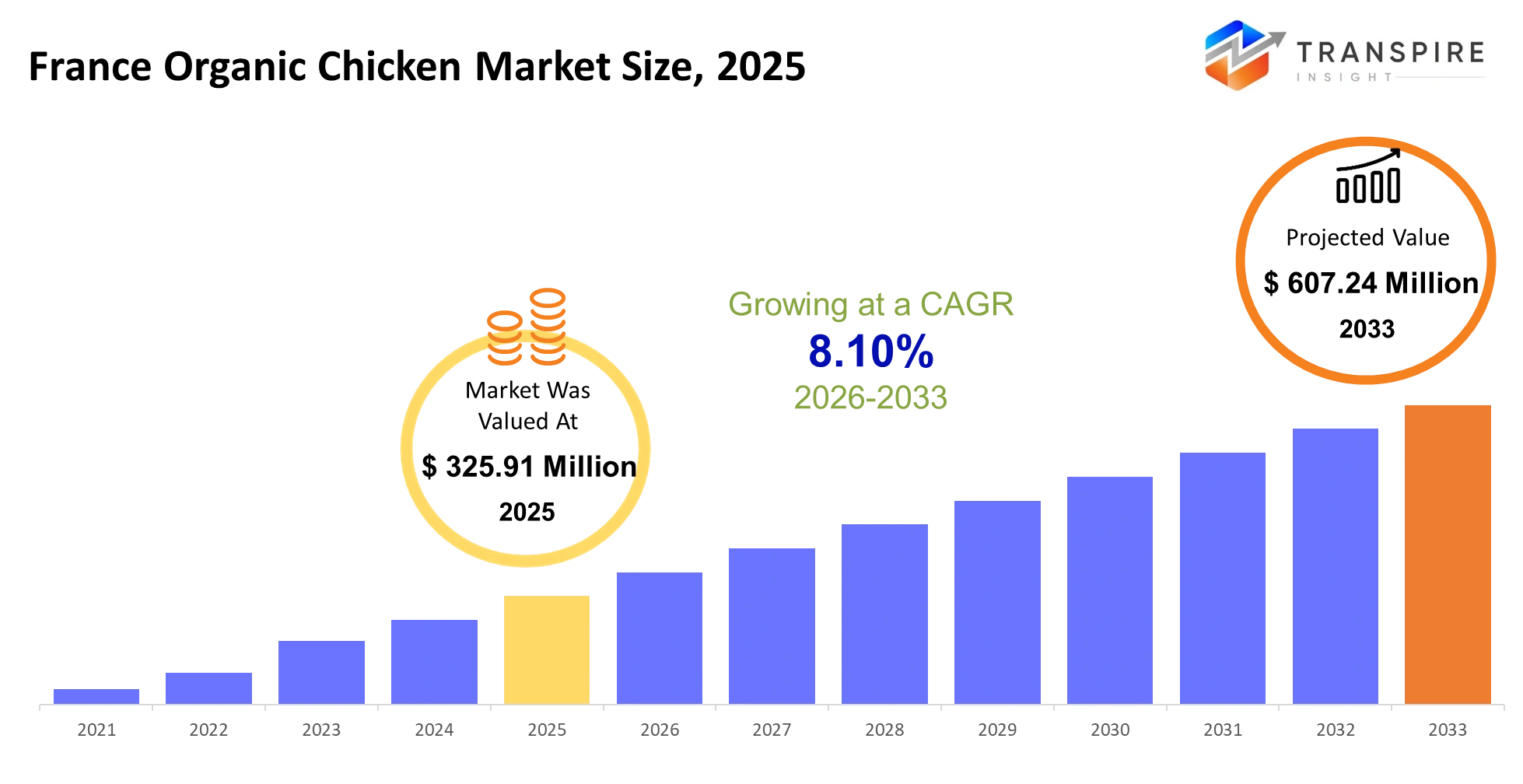
- France Organic Chicken Market Size 2025: USD 325.91 Million
- France Organic Chicken Market Size 2033: USD 607.24 Million
- France Organic Chicken Market CAGR: 8.10%
- France Organic Chicken Market Segments: By Type (Whole Chicken, Processed Chicken, Cuts, Others); By Application (Household Consumption, Food Service, Retail, Export, Others); By End-User (Consumers, Restaurants, Retailers, Food Industry, Others); By Distribution (Supermarkets, Wet Markets, Online, Others).
To learn more about this report,  Download Free Sample Report
France Organic Chicken Market Summary
The France Organic Chicken Market was valued at USD 325.91 Million in 2025. It is forecast to reach USD 607.24 Million by 2033. That is a CAGR of 8.10% over the period.
The France organic chicken market functions as a premium protein supply system which connects certified farms with processors and retail networks to deliver poultry that meets strict organic farming standards. This system enables consumers to find meat products which contain no chemicals while retailers use it to fulfill their growing sustainability and animal treatment standards. The market underwent structural changes during the past three to five years because EU organic certification enforcement throughout Farm to Fork policies artificialized stricter organic certification standards which increased producer compliance requirements and made it harder to use small-scale production methods.
The COVID-19 supply chain disruption together with the global grain shortages caused feed cost volatility which led producers to adopt vertically integrated contract-based farming systems. Retailers chose to use certified supply because of its reliability which led producers to develop controlled production systems that would protect their profit margins and maintain business operations. The current market expansion results from both regulatory enforcement and supply chain consolidation which produces different outcomes than basic changes in consumer preferences.
Key Market Insights
- The French organic chicken market experiences substantial growth in its premium food segment which results from merchants following organic labeling standards and customers trusting systems that enable them to trace their meat products.
- The premium protein market in France sees organic poultry products create a major niche because supermarkets offer private-label organic items.
- The certified free-range organic chicken segment represents the fastest-growing market segment which will continue its growth until 2033 because of new animal welfare regulations.
- Supermarkets control distribution channels because they obtain a market share of approximately 55 to 60 percent through their centralized purchasing system and their use of standardized organic certification processes.
- The foodservice sector experiences continuous growth because restaurants add certified organic chicken to their menu items which generate high profits.
- Household retail consumption drives end-user demand while institutional catering emerges as a rapidly expanding business in urban areas.
- The companies use digital traceability systems together with organic feed development and contract agricultural partnerships to create reliable supply networks.
- The company expands its organic farm operations in Brittany and Pays de la Loire to enhance their ability to grow products and achieve certification requirements.
What are the Key Drivers, Restraints, and Opportunities in the France Organic Chicken Market?
The French organic chicken market depends on EU regulations which require tighter organic certification and animal welfare rules that producers need to follow. The market regulatory changes have resulted in increased revenue because retailers now choose certified suppliers who meet their requirements for shelf space while preventing non-certified businesses from entering the market. Companies now use structured procurement contracts together with vertically integrated farming systems to achieve revenue stability while ensuring reliable supply.
Producers face their main challenge because organic feed costs and the scarcity of certified farmland and the need for regulatory compliance create high production expenses. The market for organic feed products maintains higher costs because of their reliance on non-GMO grain supply systems which suffer from international commodity price changes. The cost problem remains unsolvable because certification requirements ban synthetic feed options which results in limited market growth and restricted price competition against traditional poultry products.
The growth of domestic organic poultry farming clusters in western France creates a significant opportunity for development in Brittany and Pays de la Loire which possess agricultural infrastructure that enables expansion. The implementation of precision livestock farming systems together with certified feed innovation investments will lead to operational efficiency improvements. Retailers and producers will establish long-term supply agreements which will create steady demand patterns and drive capacity development at certified farms.
What Has the Impact of Artificial Intelligence Been on the France Organic Chicken Market?
Artificial intelligence is gradually transforming the France organic chicken market because it enhances production efficiency and improves traceability and enables better supply chain management between certified poultry systems. AI-powered monitoring systems on farms track poultry health through multiple indicators which include feed intake and movement patterns and temperature exposure to achieve optimum animal welfare standards for organic farming. The process results in reduced mortality rates and consistent yield improvement while the company maintains compliance with all required regulations.
The agricultural sector increasingly implements predictive analytics tools to forecast feed requirements and enhance breeding efficiency and minimize waste throughout organic farming operations. Machine learning models also support demand forecasting for retailers, which enables suppliers to match their production levels with seasonal demand and limit overstocking issues in premium poultry products. AI-powered supply chain platforms improve inventory management for logistics, which leads to better distribution operations throughout retail distribution networks.
The high expenses required for system integration together with inadequate digital systems on small organic farms, create barriers to system implementation. The lack of real-time data connections and standard sensor systems among producers leads to decreased model performance in rural areas. Organic farming practices create inconsistent data patterns, which decrease the reliability of predictive systems compared to traditional poultry farming methods. The sector undergoes gradual digital transformation which creates better operational visibility while it establishes foundations for future efficiency improvements.
Key Market Trends
- The 2024 EU Farm to Fork regulations increased organic certification requirements which resulted in new supply chain compliance requirements for the entire French market.
- Retailers increased their private-label organic chicken sourcing by more than 20 percent during the period between 2023 and 2025 because they wanted to maintain control over product pricing and quality standards.
- Farmers in the organic poultry industry adopted contract farming systems which helped them achieve better supply reliability while decreasing their exposure to market price fluctuations.
- The Brittany region experienced a major increase in certified organic chicken farms during 2025 because agricultural subsidies and infrastructure development created a more favorable environment for farmers.
- Supermarket consolidation created stronger procurement systems which enabled supermarkets to negotiate better deals with organic producers who operated in a disorganized market.
- Package contents need to show traceability because consumers now prefer poultry that meets welfare certification standards.
- Feed supply disruptions between 2022 and 2024 forced producers to adopt organic grain sourcing methods that focused on local suppliers.
- Mid-sized poultry producers adopted digital traceability systems to meet their retailer audit requirements.
- The food service industry in urban France began to grow as restaurants used organic chicken to create special menu items that separated them from their competitors.
France Organic Chicken Market Segmentation
By Type
The France organic chicken market by type is strongly shaped by differences in consumption behavior between traditional and convenience-driven poultry formats. Whole chicken maintains its top market position because it matches French cooking traditions and festive cooking customs. Retailers prefer this format because it generates consistent sales while requiring minimal processing work and fulfilling all organic certification requirements. Supermarkets and local grocery networks distribute whole chicken throughout their stores because it represents their most popular product which customers continuously seek.
The processed chicken market and chicken cuts market operate as the most innovative segment which experiences fast development. Urban consumers and restaurant operators now choose these formats because they offer quick meal preparation and controlled serving sizes with shorter cooking durations. Processed organic chicken products like marinated and ready-to-cook items enable fast meal preparation, while chicken cuts provide restaurants and households with multiple cooking options. The other category which consists of specialty and premium organic products maintains its small market presence but it continues to expand within upscale retail markets. The market is moving from traditional whole products toward poultry formats which offer value-added features and convenience for consumers.
By Application
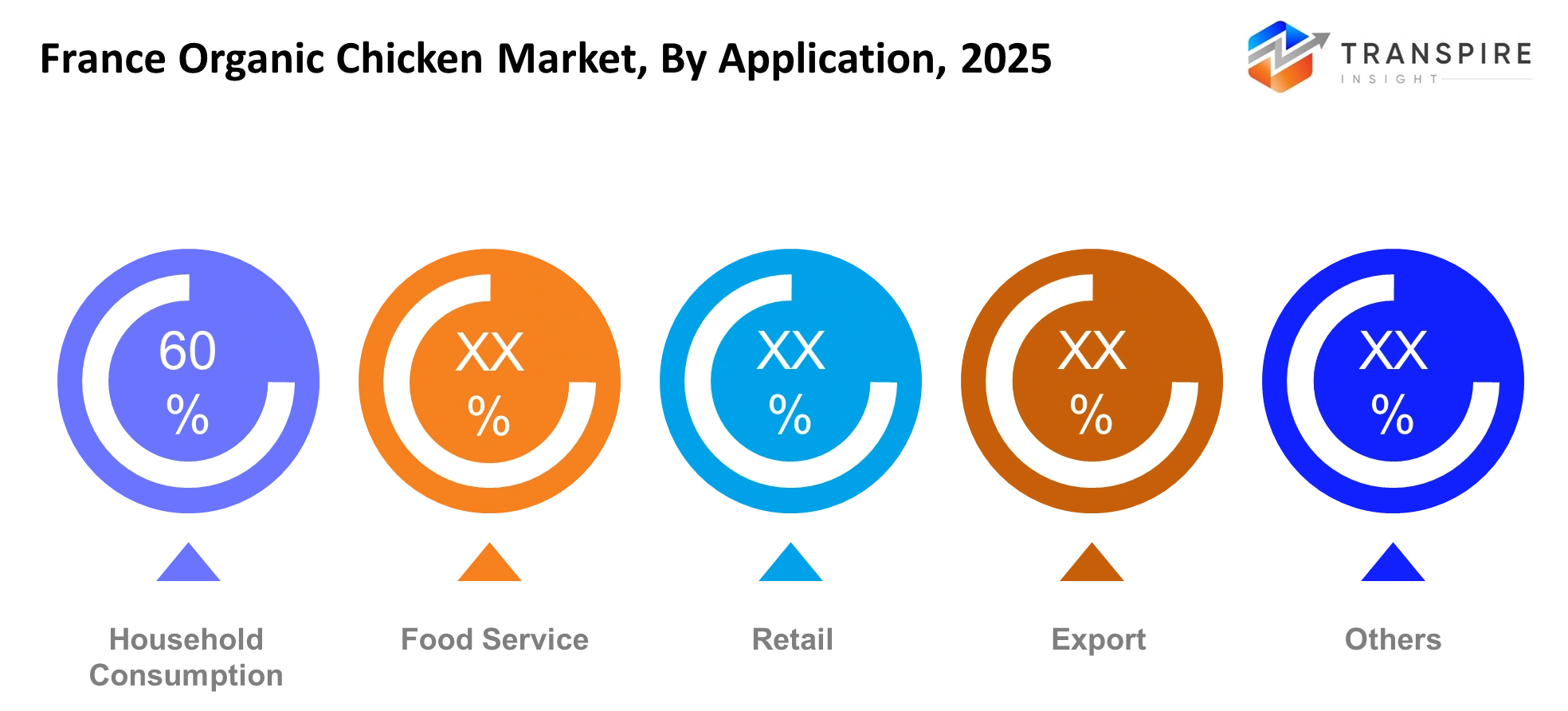
The France organic chicken market by application is primarily driven by household consumption which forms the largest demand base. Strong consumer preference for traceable chemical-free protein sources leads to home cooking which uses organic chicken as its main ingredient. Retail supermarkets play a central role in supplying this segment; they maintain continuous product distribution while their products receive standardized certification. Organic poultry now has established itself as a regular dietary item for households which results in constant demand for the product.
Organic chicken usage has developed into food service and retail markets through restaurants, hotels and supermarkets which offer it for their high-end menu items and exclusive store brand products. Food service providers use organic poultry to meet rising customer expectations for ethical and sustainable sourcing. The market experiences export demand which brings slight market activity because European buyers are interested in French-certified organic products. The sustainability-focused purchasing policies of institutional and specialty procurement have caused the others category to increase. The application trends show that there will be more widespread use of products which will be used for both regular domestic use and high-end commercial purposes.
To learn more about this report, Download Free Sample Report
By End-User
The France organic chicken market by end-user is led by consumers because household demand functions as the main factor driving organic poultry sales. Consumers purchase organic chicken products in supermarkets and local stores because they value health benefits and product safety and animal welfare practices. Retailers establish both product availability and pricing structures which enable consumers to access certified poultry products.
Restaurants and food industry users are adopting organic chicken to improve their menu offerings while meeting their sustainability requirements. Premium dining and institutional catering show strong adoption of this practice because they require high standards for ingredient sourcing. Retailers control all procurement and distribution activities while using centralized supply chains and private-label expansion strategies. The "others" category which includes healthcare and institutional buyers is increasing in size because of new nutritional and regulatory requirements. The behavior of end-users demonstrates a preference for organized procurement methods which increase their use of organic poultry across residential and business channels.
By Distribution
Supermarkets act as the main distribution channel which controls the France organic chicken market. Supermarkets establish their market power through standardized pricing and certified product assurance and their extensive product availability.Centralized procurement systems maintain their supply chain through certified producers, which enables them to sustain their market leadership. The operation of wet markets in regional areas exists to support traditional methods, which people use for purchasing poultry.
However, their relevance in the organic segment remains constrained due to certification and traceability challenges. Urban consumers who seek home delivery services through digital grocery platforms and meal-kit services drive the online channels as the fastest-growing distribution format. The "others" category, which includes specialty stores and direct farm sales, serves niche markets that demand premium and locally sourced organic poultry. The distribution patterns of the market show that organized retail and digital platforms have become more important while traditional market structures have decreased their importance.
What are the Key Use Cases Driving the France Organic Chicken Market?
French supermarkets use certified organic chicken to create their premium product lines which serve as the main distribution channel for organic chicken to French households who consume organic chicken in their daily lives. Consumers select organic chicken products because they want to trace the product's origin and observe the enhanced animal welfare standards and believe the product will be safer to consume so they prefer to buy organic chicken from stores.
Foodservice and institutional catering are expanding use cases especially in hotels, corporate cafeterias and health-focused restaurants. Restaurants use organic chicken to create unique menu options while following procurement guidelines that require them to use certified sustainable sources.
Online grocery services and meal-kit delivery platforms now provide organic poultry-based meal kits which include pre-measured portions. The urban population increasingly prefers this service because it provides them with convenient access to nutrition that has been certified through official channels which shows that people now prefer to buy high-quality food through digital distribution systems.
|
Report Metrics |
Details |
|
Market size value in 2025 |
USD 325.91 Million |
|
Market size value in 2026 |
USD 352.11 Million |
|
Revenue forecast in 2033 |
USD 607.24 Million |
|
Growth rate |
CAGR of 8.10% from 2026 to 2033 |
|
Base year |
2025 |
|
Historical data |
2021 - 2024 |
|
Forecast period |
2026 - 2033 |
|
Report coverage |
Revenue forecast, competitive landscape, growth factors, and trends |
|
Regional scope |
France |
|
Key company profiled |
Perdue Farms, Tyson Foods, Sanderson Farms, Pilgrim’s Pride, Maple Leaf Foods, Foster Farms, Koch Foods, Wayne Farms, Bell & Evans, Coleman Natural, Amadori, LDC Group, Doux Group, Groupe Avril, Plukon Food Group. |
|
Customization scope |
Free report customization (country, regional & segment scope). Avail customized purchase options to meet your exact research needs. |
|
Report Segmentation |
By Type (Whole Chicken, Processed Chicken, Cuts, Others); By Application (Household Consumption, Food Service, Retail, Export, Others); By End-User (Consumers, Restaurants, Retailers, Food Industry, Others); By Distribution (Supermarkets, Wet Markets, Online, Others). |
Which Regions are Driving the France Organic Chicken Market Growth?
The organic chicken market of Western France depends on its agricultural development in Brittany and Pays de the Loire which creates a strong farming foundation. The poultry farming industry of these areas operates through its extensive poultry farming facilities and its complete organic certification systems. Organic farming incentives which receive government backing result in increased producer participation. Processing facilities located nearby help decrease logistics expenses while delivering dependable supply which strengthens the area's market position.
The consumption center of Northern France depends on Île-de-France which functions as its main market. The area achieves its main strength through its demand from high-income urban residents who purchase products through their local retail outlets. The region experiences slower development because its growth depends on stable domestic farming region import flows instead of its production capacity. The retail market in Paris has achieved consolidation which leads to consistent revenue growth for businesses.
The Occitanie region of Southern France represents the fastest-growing area because it has developed organic agricultural conversion programs during recent years. The agricultural sector has expanded since 2024 because sustainable farming infrastructure receives investment and EU-backed rural development funds. The production shift toward decentralized operations will establish new supply routes which decrease western France dependency while enabling new businesses to enter the market.
Who are the Key Players in the France Organic Chicken Market and How Do They Compete?
The French organic chicken market has achieved moderate consolidation because local companies dominate the market and compete with international poultry companies that pursue certified supply contracts. The market operates through three key factors which include certification requirements and supply chain management and ability to track products throughout their distribution pathway. Established producers safeguard their market share through contracts that extend over multiple years with retailers while mid-sized companies establish themselves in the market through their ability to obtain specialized organic certifications and their exclusive rights to particular regional organic products.
LDC Group secures its market position through its European poultry operations which enable the company to manage all aspects of production from feed production to farm management and processing operations and maintain reliable organic certification standards. The company derives its competitive edge from its ability to provide dependable supplies while maintaining close business ties with European grocery stores. The geographically secured production facilities of Doux Group enable the company to export its poultry products through its certified production facilities which deliver consistent operational effectiveness.
Plukon Food Group expands through cross-border integration in European poultry markets, using acquisitions to strengthen organic and free-range product capacity. Groupe Avril differentiates itself from competitors by developing new feed products and reducing environmental impact through sustainable agricultural practices which create certified ecosystems for poultry farming. Bell & Evans competes in premium organic positioning with high animal welfare standards and strict production protocols, targeting niche retail and foodservice segments. The companies grow their operations through establishing retail partnerships and implementing incremental expansion instead of using strong price cutting tactics.
Company List
- Perdue Farms
- Tyson Foods
- Sanderson Farms
- Pilgrim’s Pride
- Maple Leaf Foods
- Foster Farms
- Koch Foods
- Wayne Farms
- Bell & Evans
- Coleman Natural
- Amadori
- LDC Group
- Doux Group
- Groupe Avril
- Plukon Food Group
Recent Development News
In February 2026, LDC Group announced plans to construct a new poultry processing facility alongside its France Poultry acquisition. The investment aims to expand processing capacity and align production with growing domestic consumption of certified poultry products.
Source: https://www.processalimentaire.com
In April 2026, LDC Group reported strong FY2026 revenue growth driven by sustained poultry demand, pricing adjustments, and acquisition-led expansion across its French operations. The results reflect stronger consumption of poultry products and improved supply chain integration.
Source: https://www.foodbusinessmea.com
What Strategic Insights Define the Future of the France Organic Chicken Market?
The France organic chicken market is moving toward more unified operations among its certified producers, retailers, and feed suppliers because of ongoing EU sustainability framework regulations which will be enforced for an extended period. Over the next 5–7 years, production will concentrate further in certified agricultural clusters, while digital traceability systems become a standard requirement for retail access.
The organic feed supply chain depends on organic feed supply chains which face two major threats from global grain price changes and import restrictions. The combination of stable demand and increasing operational costs will lead to reduced profit margins for the company.
The application of precision livestock farming through sensor-based welfare monitoring systems will create compliance cost savings and enhance certification processing speed. Regions in western France are positioned to lead this transition. To obtain long-term retail contracts market participants need to establish vertical integration with feed producers while developing traceability systems which will decrease their certification risk.
France Organic Chicken Market Report Segmentation
By Type
- Whole Chicken
- Processed Chicken
- Chicken Cuts
- Others
By Application
- Household Consumption
- Food Service
- Retail
- Export
- Others
By End-User
- Consumers
- Restaurants
- Retailers
- Food Industry
- Others
By Distribution
- Supermarkets
- Wet Markets
- Online Channels
- Others
Frequently Asked Questions
Find quick answers to common questions.
The confirmed 2033 market size figure in USD 607.24 Million.
Key segments for the France Organic Chicken Market are By Type (Whole Chicken, Processed Chicken, Cuts, Others); By Application (Household Consumption, Food Service, Retail, Export, Others); By End-User (Consumers, Restaurants, Retailers, Food Industry, Others); By Distribution (Supermarkets, Wet Markets, Online, Others).
Major France Organic Chicken Market players are Perdue Farms, Tyson Foods, Sanderson Farms, Pilgrim’s Pride, Maple Leaf Foods, Foster Farms, Koch Foods, Wayne Farms, Bell & Evans, Coleman Natural, Amadori, LDC Group, Doux Group, Groupe Avril, Plukon Food Group.
The France Organic Chicken Market size is USD 325.91 Million in 2025.
The France Organic Chicken Market CAGR is 8.10% from 2026 to 2033.
- Perdue Farms
- Tyson Foods
- Sanderson Farms
- Pilgrim’s Pride
- Maple Leaf Foods
- Foster Farms
- Koch Foods
- Wayne Farms
- Bell & Evans
- Coleman Natural
- Amadori
- LDC Group
- Doux Group
- Groupe Avril
- Plukon Food Group
Recently Published Reports
-
Apr 2026
Baby Infant Formula Market
Baby Infant Formula Market Size, Share & Analysis Report By ype (Infant Milk, Follow On Milk, Specialty Baby Milk, Growing-Up Milk), By Ingredient (Carbohydrate, Fat, Protein, Minerals, Vitamins, and Others), By Product Form (Powder, Liquid, and Ready-to-feed), By Distribution Channels (Supermarket/Hypermarket, Specialty Store, Pharmacies, Online Retail, and Others), and Geography (North America, Europe, Asia-Pacific, Middle East and Africa, South and Central America), 2021 - 2031
-
Apr 2026
Edible Insects for Animal Feed Market
Edible Insects for Animal Feed Market Size, Share & Analysis Report By Type (Insect Powder, Insect Meal, Insect Bar, Insect Paste, Insect Oil, and Others), By Insect Type (Beetles, Cricket, Caterpillar, Hymenoptera, Orthoptera, Tree Bugs, and Others), By Application (Livestock, Pet Food, and Aquaculture), By Livestock Type (Poultry, Swine, and Others), and Geography (North America, Europe, Asia-Pacific, Middle East and Africa, South and Central America), 2021 - 2031
-
Apr 2026
Food Industry Disinfection and Bacterial Control Market
Food Industry Disinfection and Bacterial Control Market Size, Share & Analysis Report By Type (Chemical Disinfectants, Physical Disinfectants, and Biocides and Antimicrobials), By Application (Food Processing Equipment Surface Disinfection, Food Preparation Areas Surface Disinfection, Storage Areas Surface Disinfection, Anti-microbial Coatings Food Preservation, and Preservative Solutions Food Preservation), By End User (Meat and Poultry Processing, Dairy Processing, Seafood Processing, Bakery and Confectionery, Restaurants and Commercial Kitchens, and Food Service Providers), By Sales Channel (Online, Offline), and Geography (North America, Europe, Asia-Pacific, Middle East and Africa, South and Central America), 2021 - 2031
-
Apr 2026
Freeze Dried Food Market
Freeze Dried Food Market Size, Share & Analysis Report By Product Type (Fruits, Vegetables, Freeze-Dried Dairy Products, Freeze-Dried Meat and Seafood, Freeze-Dried Pet Food, and Prepared Meal), By Nature (Organic, and Conventional), By Form (Powdered, Granules, and Diced), By End Use (Breakfast Cereals, Dairy Products, Bakery & Confectionery, Nutritional Bars & Supplements, Powdered Beverages, Snacks, and Retail (Household)), and Geography (North America, Europe, Asia-Pacific, Middle East and Africa, South and Central America), 2021 - 2031