
France Hazardous Waste Management Market Size & Forecast:
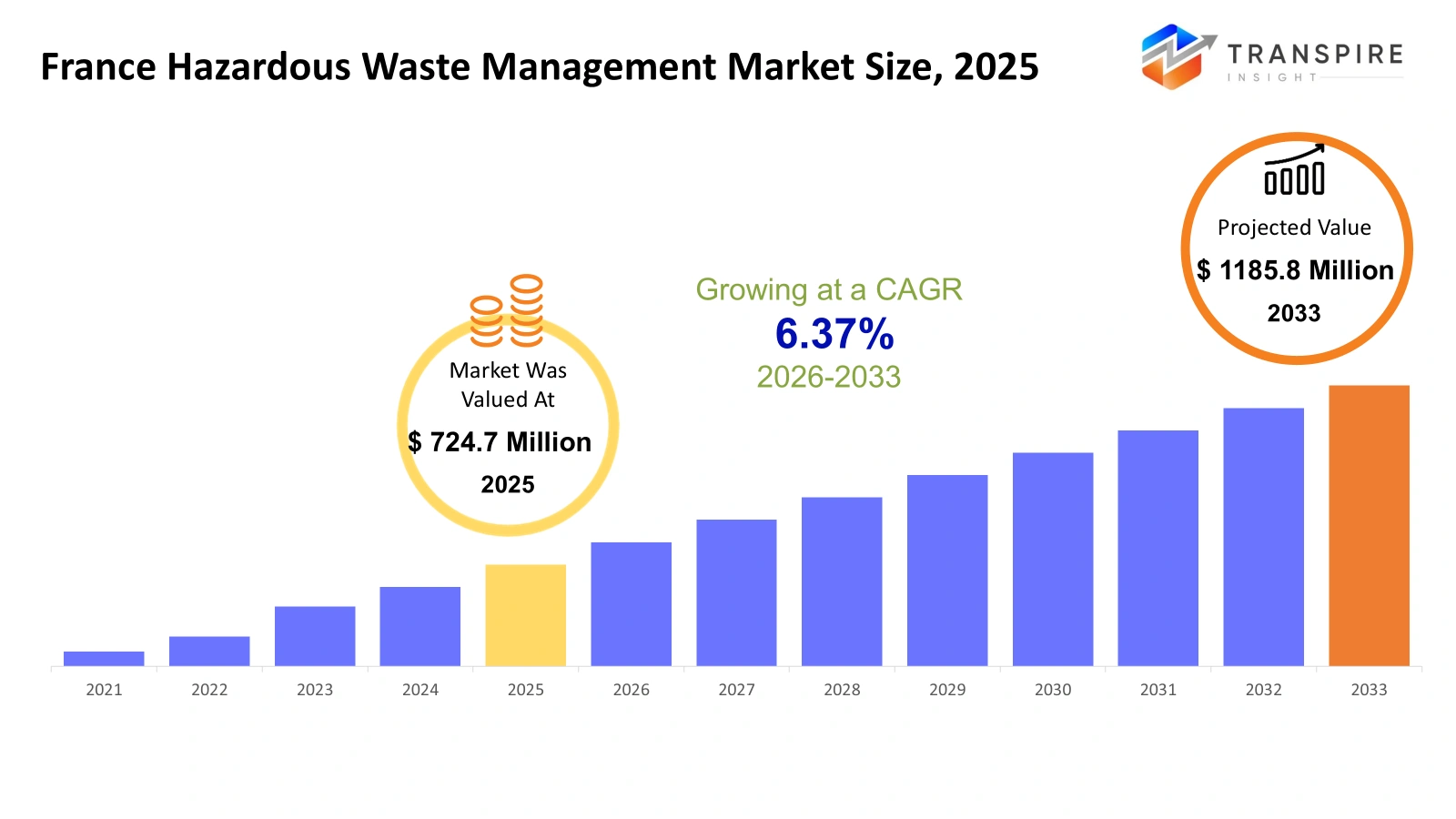
- France Hazardous Waste Management Market Size 2025: USD 724.7 Million
- France Hazardous Waste Management Market Size 2033: USD 1185.8 Million
- France Hazardous Waste Management Market CAGR: 6.37%
- France Hazardous Waste Management Market Segments: By Waste Type (Chemical Waste, Biomedical Waste, Industrial Hazardous Waste), By Treatment Method (Recycling, Incineration, Landfill).
To learn more about this report,  Download Free Sample Report
France Hazardous Waste Management Market Summary:
France Hazardous Waste Management Market size was estimated at USD 724.7 Million in 2025 and is anticipated to reach USD 1185.8 Million by 2033, growing at a CAGR of 6.37% from 2026 to 2033.
The hazardous waste management market in France essential for the country's environmental services sector will manage dangerous materials which endanger both public health and environmental protection efforts. The sector will operate through tightly monitored collection networks, treatment facilities, and secure disposal systems which national and European policies establish as mandatory requirements. Strict regulatory enforcement will establish operational standards which require service providers to implement safe transport methods and advanced containment technologies. The specialized waste handlers who work with the chemical and healthcare and heavy manufacturing sectors will help these industries meet regulatory requirements while safeguarding nearby residential areas.
Waste generators will select certified disposal partners based on changing consumer awareness about environmental safety which will drive demand for transparent waste tracking and responsible waste handling methods. The implementation of digital monitoring tools and automated segregation systems together with thermal treatment innovations will enhance processing accuracy while lowering environmental pollution. The regulatory changes will impose stricter landfill requirements which will promote recovery methods that prevent long-term ecological harm. The need for organized waste management systems in France will increase due to urban growth and industrial development, which will drive service providers to adopt advanced routing technologies and updated treatment facilities.
Key Market Trends & Insights:
- The France Hazardous Waste Management Market operates under stringent environmental regulations which require ongoing environmental assessments through monitoring systems. The national waste disposal regulations establish procedures for the secure handling of hazardous substances throughout their entire lifecycle from collection to transportation to treatment and final disposal. The established compliance standards drive companies to obtain certified methods of handling their materials which results in better accountability and product tracking and environmental protection while enabling market growth.
- The combination of chemical production facilities and healthcare services and metal manufacturing operations and power generation activities creates continuous hazardous waste generation. Industrial zones produce various hazardous waste materials which require special treatment methods to manage them. The expansion of production capabilities drives the necessity for secure waste disposal options and modern containment technology and effective waste management systems throughout different processing sections.
- Contemporary waste treatment facilities utilize automated systems together with digital surveillance technologies and high-temperature waste incineration units to enhance their operational security and productivity. The recycling process together with solvent recovery operations and secure landfill design processes become essential components of sustainability efforts. Environmental protection through waste separation and contamination control and emission reduction technologies enables businesses to operate sustainably while maintaining dependable long-term service delivery.
- Environmental targets establish requirements that drive organizations to reduce waste and recover materials and produce energy from hazardous byproducts. Public and private institutions invest in cleaner processing systems that limit landfill dependence. Circular economy planning promotes reuse of treated residues in industrial applications, which decreases ecological impact while organizations achieve resource efficiency and cost optimization objectives.
- The nation improves its waste management capabilities through the development of dedicated treatment facilities and storage sites and secure transportation systems. Regional service providers improve collection coverage for small and medium enterprises requiring compliant disposal solutions. The organization achieves operational readiness through its strategic partnerships and logistics improvements and safety training initiatives, which establish reliable processes for hazardous material management.
France Hazardous Waste Management Market Segmentation
By Waste Type :
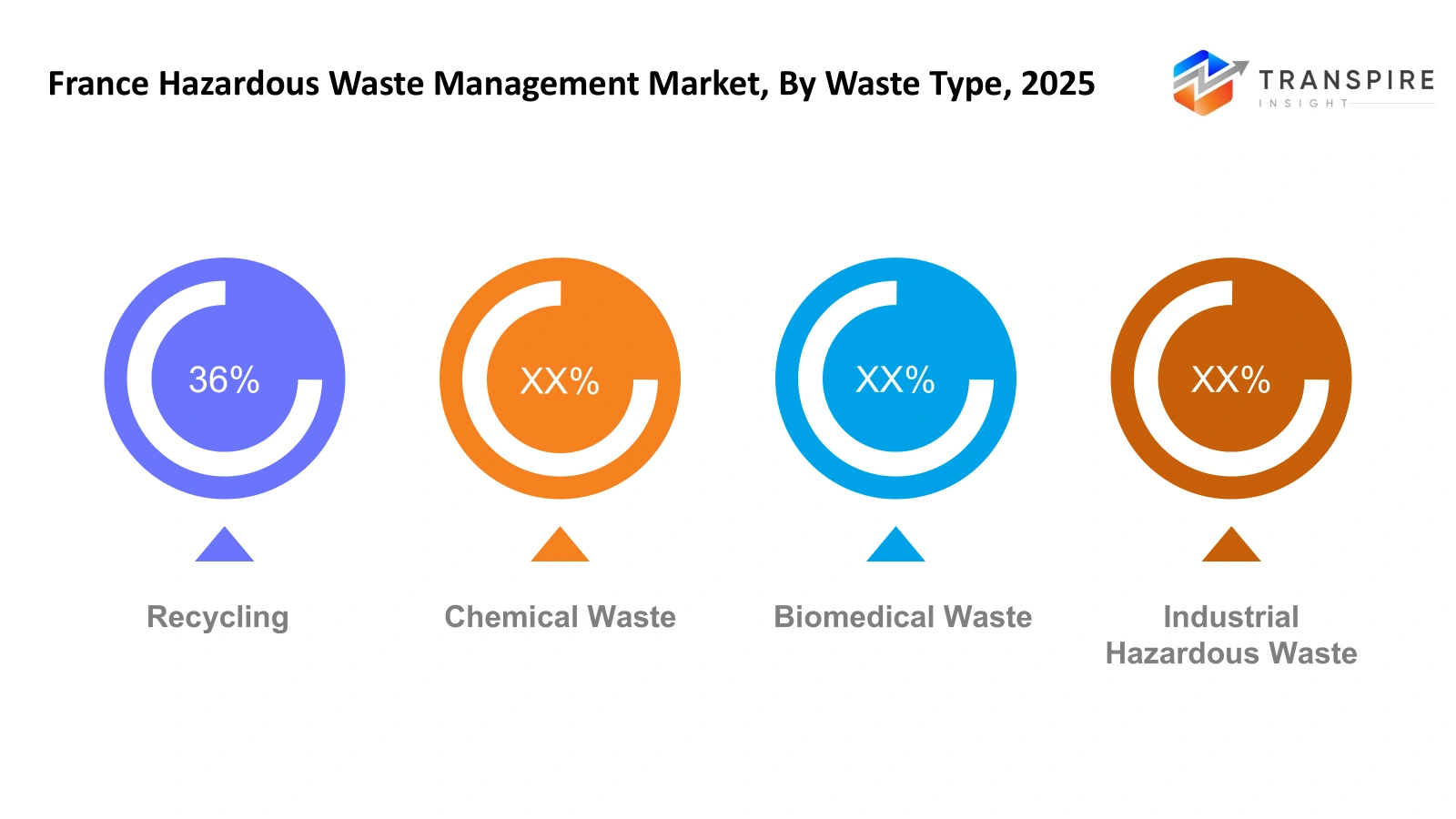
- Chemical Waste: Chemical waste includes solvents, acids, pesticides, laboratory residues, and by-products from manufacturing units. Strict handling rules govern storage, labeling, transport, and neutralization processes. Treatment facilities focus on reducing toxicity, preventing soil contamination, and limiting groundwater damage. France Hazardous Waste Management Market supports safe processing through advanced containment systems and controlled treatment chains.
- Biomedical Waste: Biomedical waste emerges from hospitals, clinics, laboratories, and research centers, including contaminated equipment, pathological remains, sharps, and pharmaceutical residues. Segregation, disinfection, and specialized packaging remain essential for infection control. High-temperature treatment and sterilization technologies reduce biological risks. France Hazardous Waste Management Market promotes structured collection networks and compliant disposal systems for public health protection.
- Industrial Hazardous Waste: Industrial hazardous waste originates from refineries, metal processing plants, chemical factories, and energy production sites. Materials include toxic sludge, flammable residues, corrosive substances, and heavy metal by-products. Monitoring systems, secure containers, and regulated transit prevent environmental release. France Hazardous Waste Management Market encourages waste tracking programs and engineered storage solutions for industrial risk reduction.
- Recycling: Recycling processes recover usable materials from hazardous streams through purification, chemical treatment, and thermal recovery techniques. Metals, solvents, oils, and specialized compounds undergo separation and reprocessing for industrial reuse. Controlled recycling lowers landfill pressure and conserves natural resources. France Hazardous Waste Management Market advances closed-loop recovery systems supported by regulatory compliance and safety auditing.
To learn more about this report, Download Free Sample Report
By Treatment Method :
- Incineration: Incineration uses high-temperature combustion to destroy toxic organic components and significantly reduce waste volume. Specialized furnaces, emission filters, and gas cleaning systems limit atmospheric pollution. Energy recovery units convert heat into usable power for industrial operations. France Hazardous Waste Management Market relies on modern incineration infrastructure designed for controlled destruction and environmental safety.
- Landfill: Landfill disposal involves engineered containment sites designed with protective liners, leachate control systems, and gas monitoring networks. Stabilized hazardous residues undergo solidification before burial to prevent chemical migration. Continuous inspection ensures long-term environmental protection and regulatory adherence. France Hazardous Waste Management Market utilizes secure landfill facilities for materials unsuitable for recycling or thermal treatment.
Country Insights
- This governmental framework together with environmental rules in France controls the operations of the French Hazardous Waste Management Market. The national laws together with regional enforcement and industrial responsibility rules create a continual requirement for businesses to offer disposal services that meet established standards. Public agencies support environmental safety through their work on waste tracking systems and monitoring systems which handle waste that moves between different countries.
- The industrial sector produces hazardous waste because it operates chemical plants and pharmaceutical facilities and automobile production sites and energy power plants throughout its primary industrial regions. The manufacturing and research activities of Paris and Lyon lead to greater waste generation which results from their industrial activities. The waste treatment facilities are updating their operations through modern incineration methods and chemical waste treatment processes and safe landfill operations and recycling facilities that support circular economic systems.
- The European environmental regulations together with government sustainability goals promote investments in safer waste treatment technologies and waste-to-energy plants. The industrial and medical sectors use transportation systems and certified storage facilities and authorized processing facilities to establish organized waste collection systems. The increasing focus on pollution control together with soil protection and water quality preservation creates additional service requirements while driving organized market growth throughout the country.
Recent Development News
Capacity Expansion Roadmap for Hazardous Waste at Veolia (via third‑party report)
Veolia presented plans to boost hazardous waste treatment capacity by ~50 % by 2030 under its GreenUp strategy, showing an industry response to regulatory and environmental demand, including technologies targeting PFAS.
Times of India Reports Veolia Hazardous Waste Expansion Plans Linked to France
Times of India reported that France‑based Veolia plans to significantly increase hazardous waste treatment capacity by 2030 to meet global industrial demands, highlighting international expansion.
|
Report Metrics |
Details |
|
Market size value in 2025 |
USD 724.7 Million |
|
Market size value in 2026 |
USD 769.4 Million |
|
Revenue forecast in 2033 |
USD 1185.8 Million |
|
Growth rate |
CAGR of 6.37% from 2026 to 2033 |
|
Base year |
2025 |
|
Historical data |
2021 - 2024 |
|
Forecast period |
2026 - 2033 |
|
Report coverage |
Revenue forecast, competitive landscape, growth factors, and trends |
|
Country scope |
France |
|
Key company profiled |
Veolia, SUEZ, Clean Harbors, Waste Management, Republic Services, Stericycle, Remondis, Covanta, Biffa, US Ecology, FCC Environment, Enva, GFL Environmental, Cleanaway Waste Management, Herambiente. |
|
Customization scope |
Free report customization (country, regional & segment scope). Avail customized purchase options to meet your exact research needs. |
|
Report Segmentation |
By Waste Type (Chemical Waste, Biomedical Waste, Industrial Hazardous Waste),By Treatment Method (Recycling, Incineration, Landfill). |
Key France Hazardous Waste Management Company Insights
- The hazardous waste management sector in France continues to develop due to its commitment to environmental responsibility, its expanding industrial base, and its enforcement of regulations. The service providers will focus on two main areas, which include establishing safety standards, implementing advanced methods for waste disposal and developing methods for transparent waste documentation to comply with both national and international waste management standards. Public authorities and private operators will establish effective waste monitoring systems to enable them to control waste disposal in an environmentally friendly manner.
- Hazardous waste treatment companies will increase their investments in environmentally friendly treatment methods due to rising industrial production and their commitment to sustainability. The environmental protection initiatives will gain strength through three specific activities, which include emission control, landfill reduction and recycling technology development. The French industrial sectors will achieve better operational efficiency through three key elements, which include their long-term infrastructure development and policy backing and technology advancements for hazardous materials management.
France Hazardous Waste Management Market Companies:
- Veolia
- SUEZ
- Clean Harbors
- Waste Management
- Republic Services
- Stericycle
- Remondis
- Covanta
- Biffa
- US Ecology
- FCC Environment
- Enva
- GFL Environmental
- Cleanaway Waste Management
- Herambiente
France Hazardous Waste Management Market Segmentation
By Waste Type
- Chemical Waste
- Biomedical Waste
- Industrial Hazardous Waste
By Treatment Method
- Recycling
- Incineration
- Landfill
Frequently Asked Questions
Find quick answers to common questions.
The approximate France Hazardous Waste Management Market size for the market will be USD 1185.8 Million in 2033.
Key segments for the France Hazardous Waste Management Market are By Waste Type (Chemical Waste, Biomedical Waste, Industrial Hazardous Waste), By Treatment Method (Recycling, Incineration, Landfill).
Major France Hazardous Waste Management Market players are Veolia, SUEZ, Clean Harbors, Waste Management, Republic Services, Stericycle, Remondis, Covanta, Biffa, US Ecology, FCC Environment, Enva, GFL Environmental, Cleanaway Waste Management, Herambiente.
The France Hazardous Waste Management Market size is USD 724.7 Million in 2025.
The France Hazardous Waste Management Market CAGR is 6.37%.
- Veolia
- SUEZ
- Clean Harbors
- Waste Management
- Republic Services
- Stericycle
- Remondis
- Covanta
- Biffa
- US Ecology
- FCC Environment
- Enva
- GFL Environmental
- Cleanaway Waste Management
- Herambiente
Recently Published Reports
-
Apr 2026
Active Power Filter Market
Active Power Filter Market Size, Share & Analysis Report By Type (Shunt Active Power Filters, Series Active Power Filter, Hybrid Active Power Filter), By Application (Harmonics Mitigation, Reactive Power Compensation, Voltage Regulation, Power Factor Correction), By Phase (Single Phase, Three Phase), By End-User Industry (Manufacturing, Healthcare, Commercial, Automotive, Oil and Gas, Others), and Geography (North America, Europe, Asia-Pacific, Middle East and Africa, South and Central America), 2021 - 2031
-
Apr 2026
Electrical Transformer Market
Electrical Transformer Market Size, Share & Analysis Report By Core (Closed, Shell, and Berry), By Insulation (Gas, Oil, Solid, Air, and Other), By Phase (Single, and Three), By Rating (100 MVA to 500 MVA, 501 MVA to 800 MVA, and 801 MVA to 1200 MVA), and Geography (North America, Europe, Asia-Pacific, Middle East and Africa, South and Central America), 2021 – 2031
-
Apr 2026
Hydraulic Piston Pumps Market
Hydraulic Piston Pumps Market Size, Share & Analysis Report By Type (Axial Piston Pumps, Radial Piston Pumps), By Operating Pressure (Low Pressure, Medium Pressure, High Pressure), By Application (Construction, Mining, Agriculture, Automotive, Oil & Gas, Industrial Machinery, Others), By End-User (OEMs, Aftermarket), and Geography (North America, Europe, Asia-Pacific, Middle East and Africa, South and Central America), 2021 – 2031
-
Apr 2026
Laboratory Gas Generators Market
Laboratory Gas Generators Market Size, Share & Analysis Report By Product (Nitrogen Gas Generator, Hydrogen Gas Generator, Zero Air Gas Generator, Purge Gas Generator, TOC Gas Generators, Others), By Application (Gas Chromatography, Liquid Chromatography-mass Spectrometry (LC-MS), Gas Analyzers, Others), By End-user (Life Science, Chemical & Petrochemical, Food & Beverage, Others), and Geography (North America, Europe, Asia-Pacific, Middle East and Africa, South and Central America), 2021 – 2031