
France Creator Economy Market Size & Forecast:
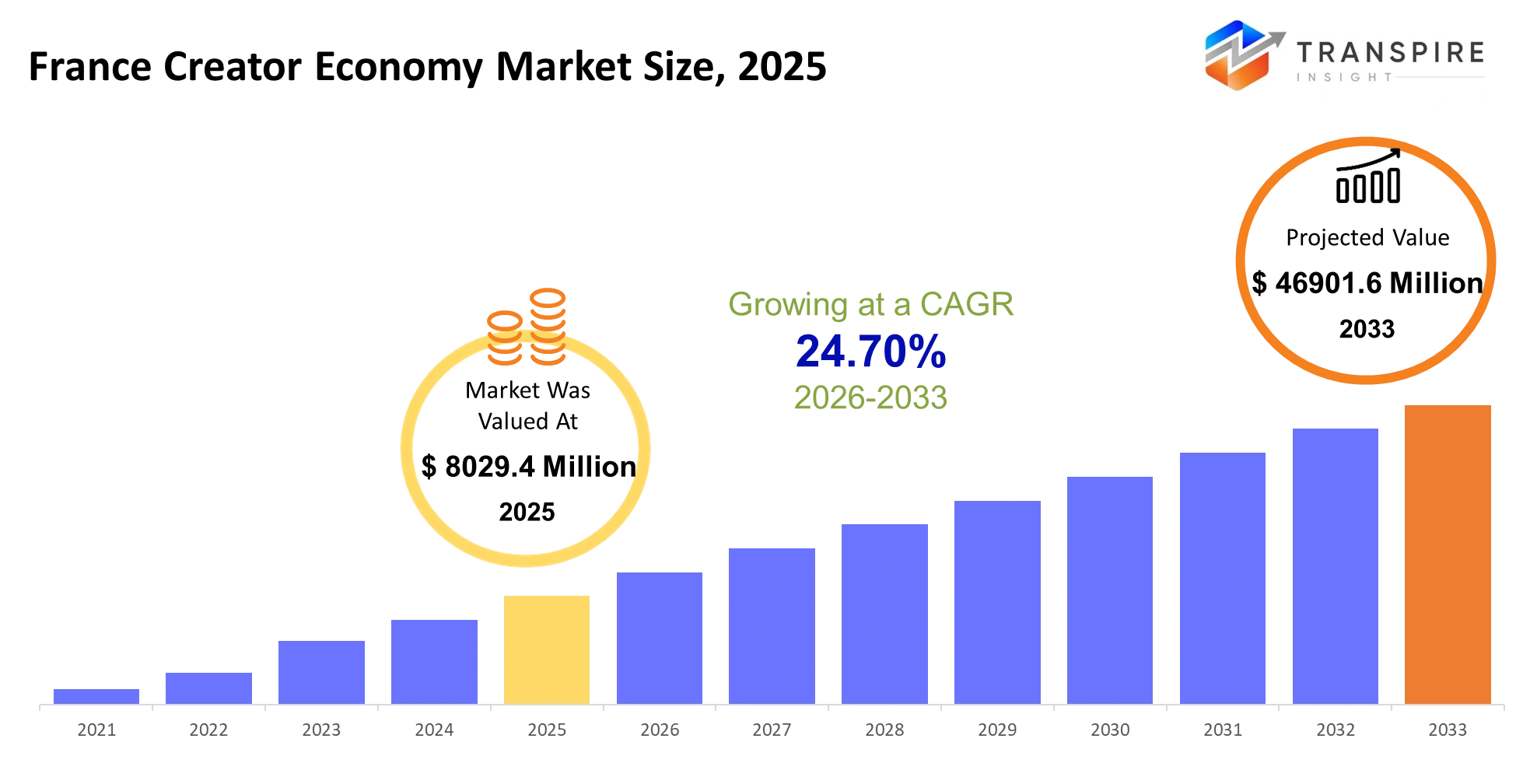
- France Creator Economy Market Size 2025: USD 8029.4 Million
- France Creator Economy Market Size 2033: USD 46901.6 Million
- France Creator Economy Market CAGR: 24.70%
- France Creator Economy Market Segments:By Type (Content Creation, Influencer Marketing, Digital Assets, Others); By Application (Social Media, Video Platforms, Streaming, E-commerce, Others); By End-User (Creators, Brands, Agencies, Platforms, SMEs, Others); By Platform (YouTube, Instagram, TikTok, Twitch, Others).
To learn more about this report,  Download Free Sample Report
France Creator Economy Market Summary
The France Creator Economy Market was valued at USD 8029.4 Million in 2025. It is forecast to reach USD 46901.6 Million by 2033. That is a CAGR of 24.70% over the period.
The France Creator Economy Market functions as the main force which enables individuals and small teams to transform content into revenue through various social platforms and video channels and digital storefronts. The system enables brands to connect with specific customer groups through genuine voices while it provides creators with tools for creating and sharing their work and making money from it without needing traditional media channels. The industry has undergone a major transformation during the last three years because companies have shifted from dependency on advertising revenue to building multiple revenue sources which include subscriptions and live commerce and digital products. The COVID-19 pandemic pushed both consumers and businesses to adopt online habits which resulted in increased creator-led engagement strategies.
Brands started to cut their digital ad expenses when they noticed that their return on investment from traditional ads had decreased so they began to spend money on influencer partnerships and their own creator platforms. The platform capabilities together with creator tools development have created a cycle which generates better monetization results that attract additional creators who subsequently increase platform earnings and advertiser engagement.
Key Market Insights
- The France Creator Economy Market in 2025 sees Northern France controlling 36 percent of the market because Paris functions as a central hub for both agencies and tech companies and brand offices.
- Southern France experiences its fastest growth rate until 2033 because creator communities and remote work and digital entrepreneurship all continue to expand.
- Brand marketers use influencer marketing as their second most popular advertising method because they need to reach specific audiences while tracking return on investment from their campaigns.
- Digital Assets become the most rapidly expanding market segment during the period from 2026 to 2033 because of the success of NFTs and subscription services and exclusive content monetization methods.
- About 48 percent of audience engagement and monetization activities in 2025 currently take place on social media platforms which remain the main channels for these activities.
- Live commerce and affiliate links and creator-led storefronts together create the fastest-growing application which leads to increased adoption of e-commerce integration.
- The France Creator Economy Market in 2025 shows creators controlling 40 percent of the market because more content creators establish their independent businesses.
- The fastest-growing market group consists of brands and SMEs who expand their spending on influencer partnerships and direct-to-consumer online business methods.
- The use of strategic partnerships between brands and creators helps to broaden campaign reach while improving audience targeting methods.
- Platforms create their expansion plans which include regional growth and localized approaches to reach new creator communities throughout France.
- Platforms achieve better content visibility and creator earnings through technology improvements that include AI-driven analytics and recommendation engines.
What are the Key Drivers, Restraints, and Opportunities in the France Creator Economy Market?
The France Creator Economy Market experiences its main growth driver from platforms which develop monetization tools that work inside their systems. The past two years have seen YouTube and TikTok establish new revenue sources through their advertising systems and live gifting features and subscription services and built-in shopping functions. The platforms established this change because they wanted to keep creators on their platforms while decreasing their use of third-party advertising systems. The platforms enable creators to make money through their systems which leads to more content creation and higher user activity. The process creates new revenue streams for platforms which lead to increased brand spending on creator-driven projects which optimizes the entire revenue generation process.
The main revenue generation problem for the system arises because it relies on specific revenue sources and automated systems. The top creators who make up a small percentage of the industry control most of the market revenue while most creators face difficulties gaining visibility because of unclear content recommendation systems. The current situation proves hard to fix because platform algorithms favor content which generates higher user interaction levels than content which produces revenue for the platform. The system enables new creators to join but it decreases their ability to earn money which makes them less likely to turn their work into long lasting businesses. The market loses potential earnings because of mid-tier and emerging creators who need sustainable growth.
The e-commerce industry will experience major growth when it enters creator-driven retail systems. Platforms like Instagram are expanding in-app shopping features which enable creators to sell products directly to followers. The model is becoming popular in regions that have developed their digital payment systems and logistics networks. Creators develop into micro-brands which create additional revenue paths beyond advertising that drive the market toward its next stage of growth through commercial activities.
What Has the Impact of Artificial Intelligence Been on the France Creator Economy Market?
The France Creator Economy Market undergoes transformation through artificial intelligence which automates content creation and audience targeting together with monetization processes. YouTube and TikTok use AI-driven recommendation systems which automatically distribute content to their most likely viewers while decreasing the need for creators to promote their work. AI tools now handle video editing tasks together with caption generation and thumbnail creation which allows creators to produce more content while decreasing their production expenses.
Organizations now depend on predictive abilities to achieve their performance enhancement goals. Machine learning models evaluate viewer behavior patterns together with engagement trends and viewing duration to predict content success before its actual release. The content strategies of creators and brands can improve conversion rates together with campaign ROI through this method. AI-driven analytics assist brands in locating their most effective creators who help brands establish better partnerships while decreasing their customer acquisition expenses.
These technologies enhance operational performance through both better engagement and improved monetization processes which result in content creators achieving greater audience reach and more stable income streams. The system currently depends on organizations to provide large amounts of top-notch data for its operation. AI systems become less accurate when smaller creators lack enough data signals which results in decreased performance and less access to advanced systems.
Key Market Trends
- The revenue-sharing models on platforms such as YouTube and TikTok have created new income streams which allow creators to move away from their traditional dependency on sponsorships since the year 2021.
- Between 2020 and 2024 brands decreased their use of digital advertisements by more than 25 percent as they redirected their marketing budgets toward influencer programs which provided them with measurable results for both engagement and conversion.
- Content optimization tools powered by AI technology went through strong expansion after 2022 because these tools allowed content creators to automate the processes of editing and caption creation and audience targeting which resulted in shorter production times and better content consistency.
- Social media platforms adopted live commerce features after 2021 because Instagram developed shopping functions which enabled users to turn their social media interactions into actual product purchases.
- Between 2022 and 2025 creator subscription models experienced substantial growth because platforms launched special content tiers which decreased their need for unstable advertising income.
- The period after 2020 saw a dramatic increase in short video viewership which made content creators change their production methods to generate more viewer interest while maintaining visibility in platform algorithms.
- Mid-level creators acquired new value for strategic work after 2023 because brands found greater success when they changed their promotional strategies from famous actors to specialized influencers who could connect better with specific audience groups.
- The years 2021 through 2025 saw platforms increase their competition which resulted in platforms developing new capabilities such as tipping and memberships and analytics tools which they used to keep their top creators.
- The enforcement of GDPR regulations led to higher data privacy scrutiny which required platforms to change their advertising targeting methods while making it harder for advertisers to track campaign results.
France Creator Economy Market Segmentation
-
By Type
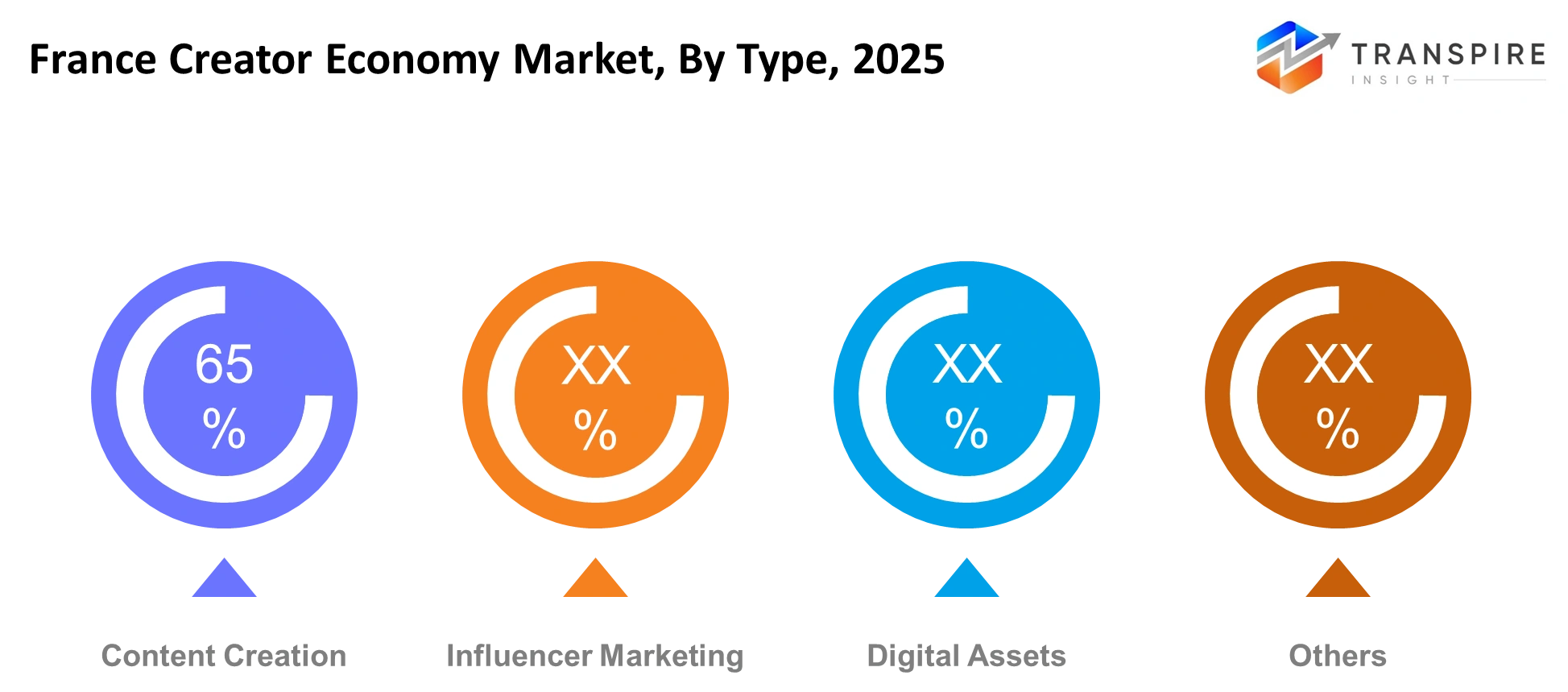
- The Type segment in the France Creator Economy Market is led by content creation which holds the largest share because it serves as the base for all digital interactions. The industry experienced a transformation from static content formats to high-frequency video production during the last two years because of the increasing use of mobile devices and the distribution patterns created by algorithms. Influencer marketing has strengthened as the second major component because brands now want to measure their advertising results instead of using traditional marketing methods. Digital assets have become a rapidly expanding sector because modern creators can use subscription models and direct monetization tools to earn continuous revenue streams.
- The Type segment will develop into multiple revenue streams which allow creators to earn money through their owned digital assets and through income from their audience engagement. This shift will influence how platforms design monetization features and how investors evaluate creator businesses. Content creation will remain central but digital assets together with direct-to-consumer models will create new ways to measure revenue stability and business valuation.
To learn more about this report, Download Free Sample Report
-
By Application
- You train on data which extends to the month of October in the year 2023. The social media platform controls the Application segment because it delivers the primary method for users to find content and interact with audiences while enabling monetization. Video-based platforms have established stronger market positions because their viewers show higher engagement levels which generate better advertising and membership revenue streams. The period after 2020 has brought rapid growth to streaming and e-commerce applications because audiences now experience content through real-time interactive features which enable them to shop directly from their streaming experiences.
- The upcoming growth in this market segment will occur through better ways to connect content with commercial activities which will happen through in-app purchasing and live commerce. The platforms will develop user experiences which enable customers to move seamlessly through their entire journey from watching content to making purchases. The application ecosystems will develop into complete digital marketplaces which provide more services than basic content distribution.
-
By End-User
- Creators dominate the End-User segment because they can easily enter the market while various monetization tools have become more accessible. The number of people who use content creation as their main way to earn money has increased substantially during the past several years. The brands together with SMEs have increased their brand presence through creator partnerships which enable them to reach specific audiences while tracking their results more effectively than their previous advertising methods.
- The segment will develop into a more organized structure because businesses will establish continuous partnerships with creators instead of using them for single marketing efforts. Agencies and platforms will continue to function as enablers through their provision of analytics tools and campaign management systems and monetization infrastructure. The ecosystem will become more professional with performance-based business models which will outline their revenue generation methods.
-
By Platform
- The Platform segment currently operates under established companies who use their extensive user bases together with their developed monetization systems to maintain market supremacy. The market has evolved to prefer platforms which provide short videos and use algorithms to deliver content, with TikTok emerging as a major competitor because of its ability to drive user engagement and make content easily accessible. Twitch and other live streaming services have remained relevant to specific audience segments because they enable users to participate in live events.
- The competition for this segment will become more intense because platforms plan to spend resources on developing monetization features and providing incentives for creators and creating content that matches local markets. The capacity to keep creators active on platforms through consistent financial support will serve as the main factor that distinguishes platforms from each other. Platforms will need to develop new methods for analyzing data which links to their commerce systems while creating better ways for users to interact with their content.
What are the Key Use Cases Driving the France Creator Economy Market?
The primary function of this system supports brand-oriented digital marketing activities which require creators to develop specific content that increases audience interest and generates immediate sales. Companies increasingly use Instagram and YouTube platforms as tools to attract specific audience segments while maintaining measurable business results. This method produces the highest demand because it combines storytelling elements with data-driven targeting methods which enable brands to enhance their advertising campaigns and achieve better financial returns.
The current situation shows that live streaming and social commerce solutions of social media platforms are becoming more popular among small and medium sized enterprises and digital native companies. TikTok functions as a platform that enables users to promote products in real time while making instant purchases through content that directly leads to sales. Agencies use creator networks to handle their campaigns which helps them reach different audience groups through multiple outreach methods.
The current situation shows that creator-led education and subscription communities and virtual experiences have emerged as new use cases. These models enable creators to generate profit from their knowledge while establishing sustainable business income through recurring revenue streams. As platform tools develop these applications will become more popular while bringing in new income streams that will not rely on advertising revenue.
|
Report Metrics |
Details |
|
Market size value in 2025 |
USD 8029.4 Million |
|
Market size value in 2026 |
USD 10004.3 Million |
|
Revenue forecast in 2033 |
USD 46901.6 Million |
|
Growth rate |
CAGR of 24.70% from 2026 to 2033 |
|
Base year |
2025 |
|
Historical data |
2021 - 2024 |
|
Forecast period |
2026 - 2033 |
|
Report coverage |
Revenue forecast, competitive landscape, growth factors, and trends |
|
Regional scope |
France |
|
Key company profiled |
YouTube, Meta, TikTok, Twitch, Patreon, Substack, Shopify, Adobe, Canva, Snap, Pinterest, OnlyFans, Kajabi, Teachable, Gumroad. |
|
Customization scope |
Free report customization (country, regional & segment scope). Avail customized purchase options to meet your exact research needs. |
|
Report Segmentation |
By Type (Content Creation, Influencer Marketing, Digital Assets, Others); By Application (Social Media, Video Platforms, Streaming, E-commerce, Others); By End-User (Creators, Brands, Agencies, Platforms, SMEs, Others); By Platform (YouTube, Instagram, TikTok, Twitch, Others). |
Which Regions are Driving the France Creator Economy Market Growth?
Northern France experiences economic development because Paris and its nearby cities attract advertising spending and media companies and technology professionals. Digital advertising and data protection rules provide strong regulatory guidance which enables businesses to execute their advertising campaigns and participate in brand activities. The system operates at full capacity because multiple platforms and creator studios and analytics companies work together to create content and achieve monetization success. Domestic and international investors actually choose to invest in this ecosystem which strengthens the region's existing power.
The main cities of Nantes and Rennes work together to create stable growth which Western France provides through its dedicated business operations. The region experiences growth through small and medium-sized enterprises that develop local marketing strategies based on creator partnerships because of their lower dependency on major agencies. The region maintains consistent digital infrastructure and trustworthy internet access which enables content distribution and audience engagement activities. The area generates consistent income because its programs deliver stable results to users.
Southern France experiences its fastest growth because lifestyle content and tourism promotion and independent creators are expanding their activities. Digital entrepreneurship programs have expanded their reach while funding access improvements have made it easier for content-driven businesses to operate their activities. Regional creators have gained more visibility because TikTok and other platforms are increasingly being used by people. From 2026 to 2033 this growth creates investment opportunities that platforms can use to enter developing creator networks.
Who are the Key Players in the France Creator Economy Market and How Do They Compete?
The France Creator Economy Market shows moderate consolidation at platform level, whereas its tool and service and monetization layer components remain divided among different providers. The major platforms establish their competitive edge through better algorithms and bigger creator payments and their complete e-commerce functionalities, whereas the smaller platforms establish their unique value through specialized functions and user-based development methods. Creators now compete through their ability to generate income because they consider stable income streams to be more important than reaching a larger audience. Existing companies maintain their market share by developing new in-app monetization features, while startups create market disruption through their specialized products including newsletters and educational materials and digital goods.
YouTube provides creators with a reliable income stream through its established advertising revenue sharing system and its ability to monetize long-form videos, which also delivers detailed performance insights. Meta develops its business model through Instagram and Facebook, which allow brands and creators to transform audience engagement into actual product sales through integrated commercial activities. The recommendation engine of TikTok provides users with immediate content recommendations, which enables new users to develop their content presence more quickly than they would on other conventional platforms.
Patreon and Substack compete through subscription-based models that give creators ownership of audience relationships and recurring revenue. Shopify opens new competitive pathways in e-commerce by allowing creators to establish their own independent online stores, which diminishes their dependence on platform-based revenue methods. These companies expand through partnerships, feature innovation, and ecosystem integration, positioning themselves as essential infrastructure for creator-led businesses.
Company List
- YouTube
- Meta
- TikTok
- Twitch
- Patreon
- Substack
- Shopify
- Adobe
- Canva
- Snap
- OnlyFans
- Kajabi
- Teachable
- Gumroad
Recent Development News
In January 2026, YouTube announced new AI-driven content creation and TV-format expansion features. The update enhances creator monetization and positions the platform closer to premium digital broadcasting.
Source: https://blog.youtube
In April 2026, TikTok partnered with Visa to launch a creator-focused debit card. This initiative improves payout speed and financial access, strengthening monetization efficiency for creators.
Source: https://www.theguardian.com
What Strategic Insights Define the Future of the France Creator Economy Market?
The France Creator Economy Market is developing creator businesses which merge content creation with community engagement and commercial activities into one operational framework. The market development exists because platforms improve their monetization solutions to retain creators while brands focus on generating direct sales instead of building brand awareness. The market shift started when Shopify and Patreon started giving creators control over their income sources which extend beyond platform advertising.
The main danger which people overlook exists because platforms need creators to depend on their systems. The main threat exists because mid-tier creators face limitations because only a few platforms exist.
Creators can exploit new opportunities because AI technologies now enable them to create unique content. The market entry point for organizations requires them to create their own distribution channels through newsletters and mobile applications and online stores because this strategy helps them achieve better profit margins while gaining customer loyalty through subscription-based revenue.
France Creator Economy Market Report Segmentation
By Type
- Content Creation
- Influencer Marketing
- Digital Assets
- Others
By Application
- Social Media
- Video Platforms
- Streaming
- E-commerce
- Others
By End-User
- Creators
- Brands
- Agencies
- Platforms
- SMEs
- Others
By Platform
- YouTube
- TikTok
- Twitch
- Others
Frequently Asked Questions
Find quick answers to common questions.
The confirmed 2033 market size figure in USD 46901.6 Million.
Key segments for the France Creator Economy Market are By Type (Content Creation, Influencer Marketing, Digital Assets, Others); By Application (Social Media, Video Platforms, Streaming, E-commerce, Others); By End-User (Creators, Brands, Agencies, Platforms, SMEs, Others); By Platform (YouTube, Instagram, TikTok, Twitch, Others).
Major France Creator Economy Market players are YouTube, Meta, TikTok, Twitch, Patreon, Substack, Shopify, Adobe, Canva, Snap, Pinterest, OnlyFans, Kajabi, Teachable, Gumroad.
The France Creator Economy Market size is USD 8029.4 Million in 2025.
The France Creator Economy Market CAGR is 24.70% from 2026 to 2033.
- YouTube
- Meta
- TikTok
- Twitch
- Patreon
- Substack
- Shopify
- Adobe
- Canva
- Snap
- OnlyFans
- Kajabi
- Teachable
- Gumroad
Recently Published Reports
-
Apr 2026
3D Optical Profiler Market
3D Optical Profiler Market Size, Share & Analysis Report By Type (Desktop 3D Optical Profiler, and Portable 3D Optical Profiler), By Technology (Confocal Technology, and White Light Interference), By End-Use Industry (Manufacturing, Research Institutions, Automotive, Aerospace and Defense, Medical Devices, and Other), and Geography (North America, Europe, Asia-Pacific, Middle East and Africa, South and Central America), 2021 - 2031
-
Apr 2026
Depth Sensor Market
Depth Sensor Market Size, Share & Analysis Report By Type (Infrared Depth Sensors, Time-of-Flight (ToF) Sensors, Stereo Vision Sensors, Structured Light Sensors, Ultrasonic Depth Sensors), By Application (Automotive, Robotics, Gaming, Consumer Electronics, Industrial Automation, Healthcare, Security & Surveillance, Others), By End Users (Automotive Manufacturers, Consumer Electronics Companies, Healthcare Providers, Industrial Companies, Security Agencies, Gaming Companies, Robotics Companies, Others), and Geography (North America, Europe, Asia-Pacific, Middle East and Africa, South and Central America), 2021 – 2031
-
Apr 2026
Digital Manufacturing Market
Digital Manufacturing Market Size, Share & Analysis Report By Component (Hardware, Software, and Services), By Technology (Robotics, 3D Printing, Internet of Things (IoT), and Others), By Application (Automotive and Transportation, Aerospace and Defense, Consumer Electronics, Industrial Machinery, and Others), By Process Type (Computer-Based Designing, Computer-Based Simulation, Computer 3D Visualization, Analytics, and Others), and Geography (North America, Europe, Asia-Pacific, Middle East and Africa, South and Central America), 2021 – 2031
-
Apr 2026
Digital Visa Services Market
Digital Visa Services Market Size, Share & Analysis Report By Type (Individual Travelers, Group Travelers), By Application (Tourism, Business Travel, Others), and Geography (North America, Europe, Asia-Pacific, Middle East and Africa, South and Central America), 2021 – 2031