
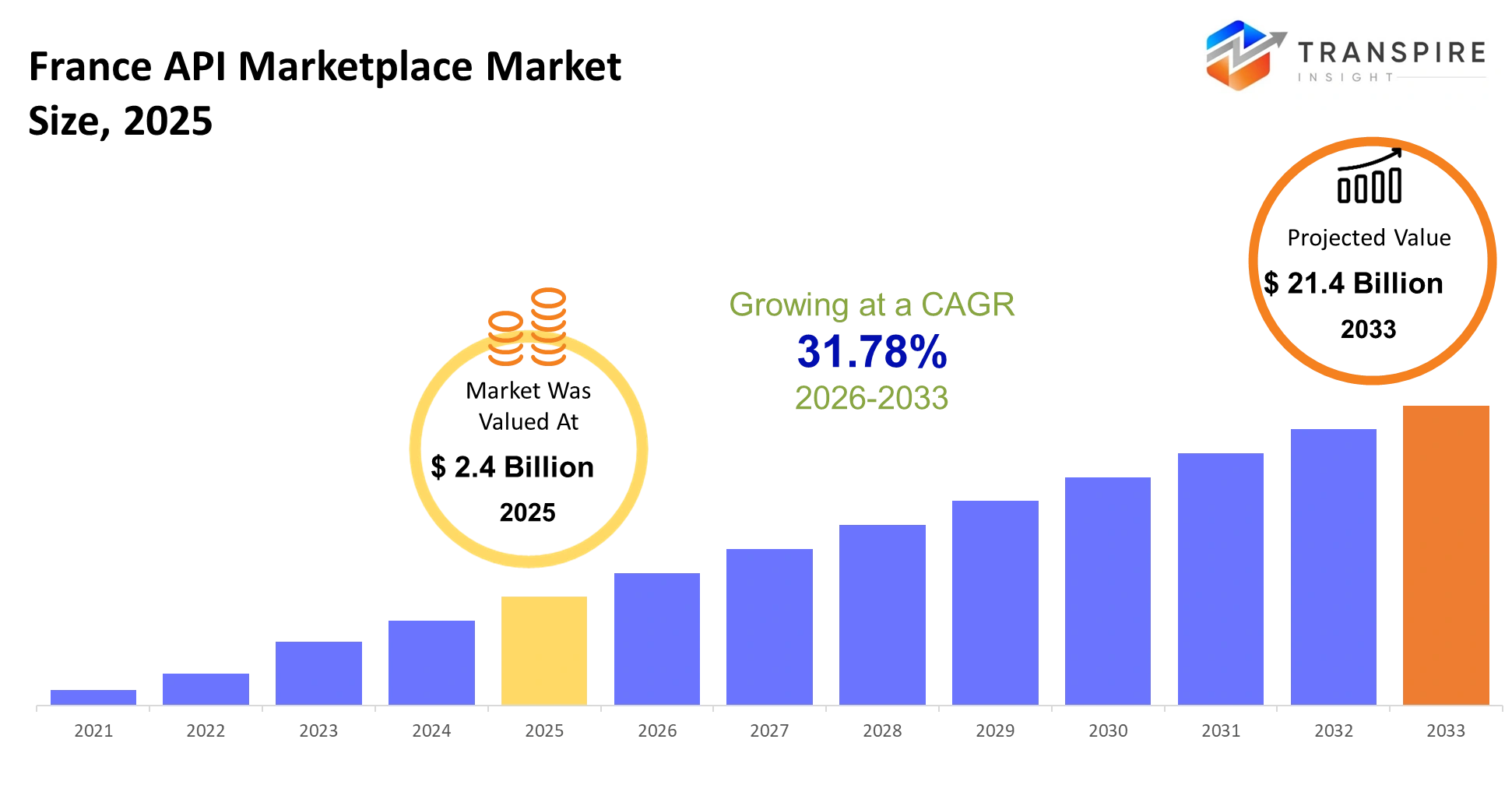
France API Marketplace Market Size & Forecast:
- France API Marketplace Market Size 2025: USD 2.4 Billion
- France API Marketplace Market Size 2033: USD 21.4 Billion
- France API Marketplace Market CAGR: 31.78%
- France API Marketplace Market Segments:By Type (Public APIs, Private APIs, Partner APIs, Others); By Application (Payments, Social Media Integration, Maps & Location, Data Services, Others); By End-User (Enterprises, Developers, SMEs, Startups, Others); By Deployment (Cloud, On-premise, Hybrid, Others)
To learn more about this report,  Download Free Sample Report
France API Marketplace Market Summary
The France API Marketplace Market was valued at USD 2.4 Billion in 2025. It is forecast to reach USD 21.4 Billion by 2033. That is a CAGR of 31.78% over the period.
The French API market enables businesses and fintech solutions and healthcare organizations and retail companies and manufacturing businesses to share digital products and data and software functions through common application programming interfaces without the need to develop all system features in-house. The platforms enable organizations to decrease their software integration expenses while they accelerate product introduction and establish connections between payment solutions and logistics systems and identity authentication methods and cloud computing and artificial intelligence systems within their intricate digital networks. The market underwent fundamental changes during the past five years because companies began to use third-party developer platforms to create monetized API ecosystems instead of relying on in-house API management systems.
European open banking regulations and the widespread implementation of cloud-native systems created a requirement for financial institutions and businesses to upgrade their outdated technology components which resulted in accelerated system modernization. The pandemic period drove more people to use online services which created higher requirements for continuous internet access and systems that could connect remote platforms. API marketplace providers experience financial advantages through recurring subscription revenue and transaction-based monetization and the growth of enterprise integration agreements as businesses pursue faster application deployment and system compatibility.
Key Market Insights
- Île-de-France supplied 41 percent of France API Marketplace Market share during 2025 because enterprises widely adopted cloud services and fintech companies established their operations there.
- Through 2033 Southern France will develop into the fastest-growing regional market because technology startups increasingly adopt API-first development frameworks.
- Through developer accessibility and scalable integration models Open APIs constituted the largest market segment in 2025 which generated more than 48 percent of market revenue.
- Enterprise-to-enterprise data exchange environments which regulated industries needed for secure operations became the reason Partner APIs held the second-largest market share.
- Organizations automated their analytics functions and customer support tasks and workflow orchestration processes through AI-integrated APIs which became the fastest-growing category after 2023.
- PSD2-driven open banking implementation established banking and financial services as the leading application segment which controlled almost 35 percent of market share.
- Through interoperable patient data and digital diagnostics integration healthcare and telemedicine platforms achieved the highest adoption growth between 2024 and 2026.
- The primary end-user group included large enterprises which needed centralized API governance and monitoring capabilities to manage their intricate multi-cloud environments.
- SMEs are adopting low-code API integration platforms rapidly as subscription-based pricing reduces infrastructure and software deployment barriers.
What are the Key Drivers, Restraints, and Opportunities in the France API Marketplace Market?
The France API marketplace market experiences its most rapid growth because enterprises shift their operations toward cloud-native infrastructure and platform-based digital business solutions. The open banking regulations from PSD2 require financial institutions to make their secure APIs available for third-party service access, which results in businesses using APIs for monetization and system compatibility. Retailers and insurers together with logistics providers and healthcare organizations adopted this change because it helped them deliver better digital services to customers while reducing their time for software development. The French technology ecosystem experienced direct revenue growth through platform subscription services and increased API usage.
Enterprise organizations face their main challenge through the difficult process of connecting their APIs to existing legacy systems. The IT systems of large organizations developed throughout many years, which creates substantial challenges for safe system connection between different parts of their network. The deployment of financial and healthcare-related systems gets hindered by data privacy and cybersecurity and digital sovereignty regulations that enterprises must comply with. The existing structural obstacles make enterprises take longer to adopt new systems while mid-sized businesses without IT support struggle to implement APIs.
The AI-enabled API marketplaces create a significant opportunity because they unify machine learning services with automation tools and low-code development frameworks into complete digital ecosystems. The growing sovereign cloud investments and public digital transformation initiatives in France create optimal conditions for domestic API platform development. The businesses that adopt generative AI services in their customer support and analytics and workflow management systems will produce important benefits.
What Has the Impact of Artificial Intelligence Been on the France API Marketplace?
The French API marketplace experiences transformation through artificial intelligence which streamlines the processes of API discovery and integration management and cybersecurity monitoring and workflow orchestration throughout enterprise software environments. API management platforms increasingly use AI models to classify traffic patterns and detect anomalies and optimize performance through automated processes. The systems provide enterprises with a solution which simplifies their operations when they handle more than 1000 API connections that connect different applications across cloud and fintech and retail and healthcare systems.
API performance monitoring and cybersecurity risk assessment both rely on machine learning algorithms to deliver predictive analytics. AI-driven observability tools detect latency risks while they predict server load changes and offer traffic distribution solutions which prevent operational problems from impacting enterprise systems. Large cloud providers and API management vendors increasingly integrate automated code generation tools that accelerate software deployment and reduce development costs for enterprise clients. The technologies enhance system availability while they improve compliance monitoring and they decrease the time required for application integration in multi-cloud environments.
Developer ecosystems now face transformation through generative AI which allows automated API documentation and chatbot integration and development of intelligent testing environments. The adoption of AI technology encounters challenges which stem from two main factors: enterprises having disjointed data systems and businesses needing to connect their outdated technology platforms. Data governance standards which lack consistency establish precision and security issues which prevent the complete implementation of self-sufficient API management systems in regulated sectors.
Key Market Trends
- French banks increased their API deployment efforts during 2022 because PSD2 compliance requirements led to changes in their digital payment and fintech partnership approaches.
- Enterprises adopted cloud-native API gateways at higher rates from 2023 until 2025 when they began moving their operations to modern infrastructure.
- Healthcare providers increasingly adopted interoperable APIs to support telemedicine platforms which include patient data exchange and digital diagnostics integration.
- AI-enabled API monitoring tools expanded rapidly after cybersecurity incidents increased enterprise focus on anomaly detection and automated governance systems.
- Postman and MuleSoft created new automation tools for developers which help European businesses to streamline their integration processes.
- Software vendors shifted their revenue model from one-time licensing structures to subscription-based API monetization models because they wanted to generate recurring platform revenue.
- French SMEs adopted low-code and no-code integration platforms because deployment costs dropped and developer shortages spread throughout the country.
- Sovereign cloud initiatives strengthened domestic API ecosystem investments as enterprises prioritized data localization and regulatory compliance requirements.
- Retail and logistics companies increasingly integrated real-time inventory payment and delivery APIs to support their omnichannel commerce operations.
- API security platforms experienced stronger procurement activity after ransomware attacks exposed vulnerabilities within interconnected enterprise software ecosystems.
France API Marketplace Market Segmentation
By Type
Public APIs maintain their status as the leading market choice because digital banking platforms and e-commerce operators and cloud software providers now rely on open integration frameworks for their third-party connectivity and developer engagement needs. The industry experiences substantial growth because organizations have adopted API-first application design together with subscription-based software development which enables them to process vast quantities of transactions that support payment processing and authentication and communication systems. Technology companies also prioritize public APIs to accelerate external innovation and reduce internal software development timelines which creates strong recurring monetization opportunities for API platform providers.
Private APIs maintain a stable market position because large enterprises require secure internal communication between cloud systems and their legacy infrastructure and operational software environments. The financial institutions and healthcare providers and logistics operators who control data exchange in regulated ecosystems maintain their controlled data exchange requirements through partner API expansion. The "others" category which includes composite and industry-specific APIs will experience growth throughout the forecast period because AI-driven automation and industrial IoT connectivity and sector-focused digital platforms require more specialized integration solutions.
By Application
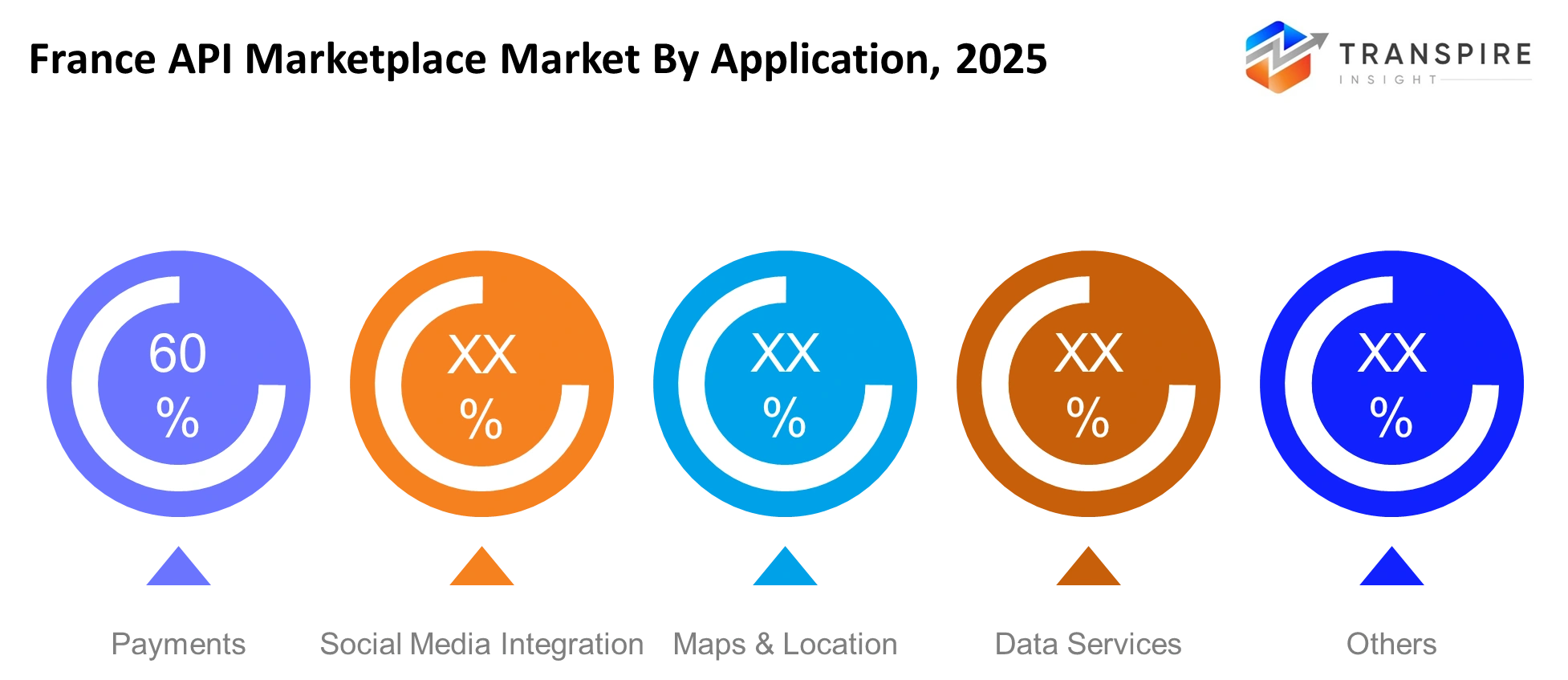
The payments sector stands as the top application segment because open banking rules and digital commerce growth drive financial system API transaction volumes. Financial systems use standardized API frameworks to build secure systems for real-time payment processing and fraud detection and account authentication. Financial institutions and fintech companies spend large amounts of money to develop API monetization systems which help them recruit new customers and connect services across different platforms.
Social media platforms use API systems to manage customer interactions and advertising campaigns and verify digital identities which helps them maintain a strong position in the market. The demand for maps and location services continues to grow because mobility platforms and logistics operators and retail applications require geospatial data and route optimization tools. Data services applications are becoming popular because AI analytics and cloud storage and enterprise reporting systems need permanent access to real-time structured information throughout their digital environments. The “others” category, which includes communication APIs and cybersecurity integration services, will experience growth during the forecast period because enterprises expand their digital transformation efforts and need to comply with new regulations.
To learn more about this report, Download Free Sample Report
By End-User
Multinational organizations use API ecosystems to connect their cloud infrastructure, customer applications, and payment systems with their operational software environments, which makes enterprises the main end-user group. Large enterprises maintain significant spending power for API governance, cybersecurity monitoring, and multi-cloud integration platforms capable of supporting complex digital operations. The segment experiences revenue stability because customers enter into long-term service agreements and they purchase software through recurring subscription models.
Developers maintain a strong market position because modern application deployment increasingly relies on reusable APIs that accelerate coding efficiency and reduce infrastructure complexity. Small and medium enterprises continue to expand their adoption of low-code integration platforms because these platforms and cloud-native API management services provide affordable deployment solutions which need less technical expertise. Startups are emerging as one of the fastest-growing user categories due to strong demand for scalable infrastructure, embedded finance tools, and AI-enabled digital services that require rapid software integration. Digital governance initiatives and connected service platforms will become more common across France which will result in steady growth for the "others" category that includes public-sector organizations and educational institutions.
By Deployment
The market receives its current leading position from Cloud deployment because enterprise customers now value three main features which include scalable infrastructure and remote access solutions and subscription-based software delivery systems. The cloud-native API management platforms enable organizations to decrease their need for hardware resources while they make software updates easier and they achieve faster deployment times in their distributed enterprise networks. The segment experiences growing procurement activities because organizations make substantial investments in both sovereign cloud infrastructure and AI-driven automation systems.
The market position of on-premise deployment remains unchanged because financial institutions and government agencies and healthcare organizations need stronger security systems to protect their data. Organizations require hybrid deployment models which allow them to combine private infrastructure with public cloud resources while staying compliant with regulations during their sensitive operations. The forecast period will see increased growth for the "others" category which includes edge-based and decentralized deployment environments because industrial IoT systems and smart city projects and real-time analytics platforms need to process data with shorter delays while staying close to their processing sites.
What are the Key Use Cases Driving the France API Marketplace Market?
The France API marketplace market has its primary use case dedicated to banking digital payment services and financial service integration work. Open banking frameworks require financial institutions to create safe links between their systems and third-party applications which handle payment processing and account verification and fraud detection and customer onboarding processes. Banks need faster digital service deployment to meet regulatory requirements which creates strong enterprise spending for their integration projects.
The secondary applications of telemedicine platforms are now being used in healthcare and retail and logistics operations. Telemedicine platforms increasingly rely on APIs for patient record exchange, appointment scheduling, and remote diagnostics integration. Retailers and e-commerce companies also use API marketplaces to connect inventory systems, payment gateways, customer analytics, and delivery tracking platforms across omnichannel operations.
The upcoming use cases will make use of both generative AI technology and industrial IoT systems. Enterprises are beginning to deploy AI-powered APIs for automated customer support, predictive analytics, and workflow orchestration. Manufacturing operators are also exploring industrial API ecosystems that connect sensors, robotics systems, and supply chain monitoring platforms within smart factory environments.
|
Report Metrics |
Details |
|
Market size value in 2025 |
USD 2.4 Billion |
|
Market size value in 2026 |
USD 3.1 Billion |
|
Revenue forecast in 2033 |
USD 21.4 Billion |
|
Growth rate |
CAGR of 31.78% from 2026 to 2033 |
|
Base year |
2025 |
|
Historical data |
2021 - 2024 |
|
Forecast period |
2026 - 2033 |
|
Report coverage |
Revenue forecast, competitive landscape, growth factors, and trends |
|
Regional scope |
France |
|
Key company profiled |
Google, Amazon, Microsoft, IBM, MuleSoft, RapidAPI, Postman, Kong, Oracle, SAP, Tyk, Software AG, WSO2, Apigee, Boomi |
|
Customization scope |
Free report customization (country, regional & segment scope). Avail customized purchase options to meet your exact research needs. |
|
Report Segmentation |
By Type (Public APIs, Private APIs, Partner APIs, Others); By Application (Payments, Social Media Integration, Maps & Location, Data Services, Others); By End-User (Enterprises, Developers, SMEs, Startups, Others); By Deployment (Cloud, On-premise, Hybrid, Others) |
Which Regions are Driving the France API Marketplace Market Growth?
The Île-de-France region holds the top position in the France API marketplace market because Paris serves as the main center for digital finance and cloud computing and enterprise technology in the country. The financial institutions and telecommunications firms and international corporations maintain their strong commitment to developing API-based systems which enable them to transform their operations and meet regulatory requirements. The area contains a widespread network of hyperscale cloud providers and startup accelerators and cybersecurity companies and developer communities which drive ongoing development of their platforms. The region secures its position as a leader in enterprise API deployment through substantial public and private funding dedicated to sovereign cloud systems and AI technology implementation.
The Auvergne-Rhône-Alpes region functions as a dependable secondary market which develops through industrial digitalization and enterprise software modernization efforts without relying on financial services. The cities of Lyon and Grenoble enable extensive API use through their implementation of manufacturing technology and healthcare advancements and logistics systems. The local businesses in the area need secure API management and interoperability solutions because they want to achieve operational reliability and maintain infrastructure functions for extended periods. Industrial operators and technology service providers consistently invest in this area which helps maintain its status as a reliable source of recurring enterprise software income.
The Provence-Alpes-Côte d’Azur region has become the fastest expanding market because its startup ecosystem and smart city initiatives and digital tourist infrastructure experienced rapid development after 2023. The regional authorities and private investors decided to boost their financial support for cloud-native application development and connected mobility platforms which resulted in increased need for API integrations.
Who are the Key Players in the France API Marketplace Market and How Do They Compete?
The France API marketplace maintains its competitive nature because global cloud providers and API management vendors and developer platform companies compete with their enterprise integration and security and scalability and developer experience solutions. The current market competition shifts from basic API hosting services to focus on AI-driven automation and low-code integration systems and multi-cloud compatibility. Large technology firms defend market share through ecosystem expansion and bundled cloud services while specialized API vendors create market differentiation through their developer-focused tools and flexible deployment models and cybersecurity capabilities.
Google competes with its Apigee platform which provides API management together with AI analytics and cloud-native scalability and enterprise security features. Google Cloud infrastructure integration enables enterprises to monitor application traffic and handle monetization and governance across their multiple distributed application networks. Microsoft strengthens its position through Azure API Management and deep integration with enterprise productivity ecosystems which make it easier for organizations already using Microsoft infrastructure to adopt their services. Postman establishes its uniqueness through its developer collaboration tools and API testing environments and AI-native workflows which enable faster application deployment.
MuleSoft provides enterprise integration and hybrid cloud solutions to assist large organizations in updating their outdated systems without the need for complete system replacements. Kong generates market competition through its open-source API gateway framework and its ability to provide high-speed microservices connections which are optimized for cloud-native environments. Boomi develops its business through low-code integration platforms which help mid-sized businesses streamline their API management processes.
Company List
- Amazon
- Microsoft
- IBM
- MuleSoft
- RapidAPI
- Postman
- Kong Inc.
- Oracle Corporation
- SAP SE
- Tyk Technologies
- Software AG
- WSO2
- Apigee
- Boomi
Recent Development News
In April 2026, Postman entered a partnership with Microsoft to integrate Azure API Management and AI model workflows into the Postman platform. The collaboration strengthened enterprise API governance and accelerated AI-native application development across cloud environments.https://prtimes.jp/main/html/rd/p/000000001.000182150.html (Business Wire).
In January 2026, Postman announced the acquisition of Fern. The acquisition expanded Postman’s API documentation and SDK generation capabilities, strengthening developer experience and enterprise API adoption.https://blog.postman.com
In March 2026, Postman launched AI-native capabilities and a new API Catalog platform for enterprise API lifecycle management. The launch improved workflow automation, API discovery, and developer collaboration across large-scale cloud ecosystems.https://blog.postman.com
What Strategic Insights Define the Future of the France API Marketplace Market?
The France API marketplace market is structurally moving toward AI-driven, interoperable digital ecosystems where APIs function as monetizable infrastructure assets rather than simple integration tools. Enterprises increasingly treat APIs as core business products that support automation, platform partnerships, and real-time data exchange across finance, healthcare, manufacturing, and retail environments. Sovereign cloud investments, generative AI deployment, and low-code enterprise integration will reshape competitive dynamics across the French digital economy during the upcoming five-to-seven-year period.
One hidden risk involves growing dependence on a small group of hyperscale cloud providers that increasingly control API infrastructure, developer ecosystems, and AI integration frameworks. Enterprises that operate across multiple cloud environments face two major problems because the concentration of resources reduces their ability to negotiate prices and impacts their capacity to achieve long-term system compatibility.
Sector-specific API marketplaces centered on healthcare, industrial IoT, and public-sector digital services present emerging opportunities because compliance requirements necessitate trusted data exchange ecosystems and localized infrastructure. Market participants should prioritize API security, AI governance, and multi-cloud interoperability partnerships to strengthen long-term positioning as enterprise software environments become increasingly decentralized and automated.
France API Marketplace Market Report Segmentation
By Type
- Public APIs
- Private APIs
- Partner APIs
- Others
By Application
- Payments
- Social Media Integration
- Maps & Location
- Data Services
- Others
By End-User
- Enterprises
- Developers
- SMEs
- Startups
- Others
By Deployment
- Cloud
- On-premise
- Hybrid
- Others
Frequently Asked Questions
Find quick answers to common questions.
The confirmed 2033 market size figure in USD 21.4 Billion.
Key segments for the France API Marketplace Market are By Type (Public APIs, Private APIs, Partner APIs, Others); By Application (Payments, Social Media Integration, Maps & Location, Data Services, Others); By End-User (Enterprises, Developers, SMEs, Startups, Others); By Deployment (Cloud, On-premise, Hybrid, Others).
Major France API Marketplace Market players are Google, Amazon, Microsoft, IBM, MuleSoft, RapidAPI, Postman, Kong, Oracle, SAP, Tyk, Software AG, WSO2, Apigee, Boomi
The France API Marketplace Market size is USD 2.4 Billion in 2025.
The France API Marketplace Market CAGR is 31.78% from 2026 to 2033.
- Amazon
- Microsoft
- IBM
- MuleSoft
- RapidAPI
- Postman
- Kong Inc.
- Oracle Corporation
- SAP SE
- Tyk Technologies
- Software AG
- WSO2
- Apigee
- Boomi
Recently Published Reports
-
Apr 2026
3D Optical Profiler Market
3D Optical Profiler Market Size, Share & Analysis Report By Type (Desktop 3D Optical Profiler, and Portable 3D Optical Profiler), By Technology (Confocal Technology, and White Light Interference), By End-Use Industry (Manufacturing, Research Institutions, Automotive, Aerospace and Defense, Medical Devices, and Other), and Geography (North America, Europe, Asia-Pacific, Middle East and Africa, South and Central America), 2021 - 2031
-
Apr 2026
Depth Sensor Market
Depth Sensor Market Size, Share & Analysis Report By Type (Infrared Depth Sensors, Time-of-Flight (ToF) Sensors, Stereo Vision Sensors, Structured Light Sensors, Ultrasonic Depth Sensors), By Application (Automotive, Robotics, Gaming, Consumer Electronics, Industrial Automation, Healthcare, Security & Surveillance, Others), By End Users (Automotive Manufacturers, Consumer Electronics Companies, Healthcare Providers, Industrial Companies, Security Agencies, Gaming Companies, Robotics Companies, Others), and Geography (North America, Europe, Asia-Pacific, Middle East and Africa, South and Central America), 2021 – 2031
-
Apr 2026
Digital Manufacturing Market
Digital Manufacturing Market Size, Share & Analysis Report By Component (Hardware, Software, and Services), By Technology (Robotics, 3D Printing, Internet of Things (IoT), and Others), By Application (Automotive and Transportation, Aerospace and Defense, Consumer Electronics, Industrial Machinery, and Others), By Process Type (Computer-Based Designing, Computer-Based Simulation, Computer 3D Visualization, Analytics, and Others), and Geography (North America, Europe, Asia-Pacific, Middle East and Africa, South and Central America), 2021 – 2031
-
Apr 2026
Digital Visa Services Market
Digital Visa Services Market Size, Share & Analysis Report By Type (Individual Travelers, Group Travelers), By Application (Tourism, Business Travel, Others), and Geography (North America, Europe, Asia-Pacific, Middle East and Africa, South and Central America), 2021 – 2031