

Filter Paper Market Summary:
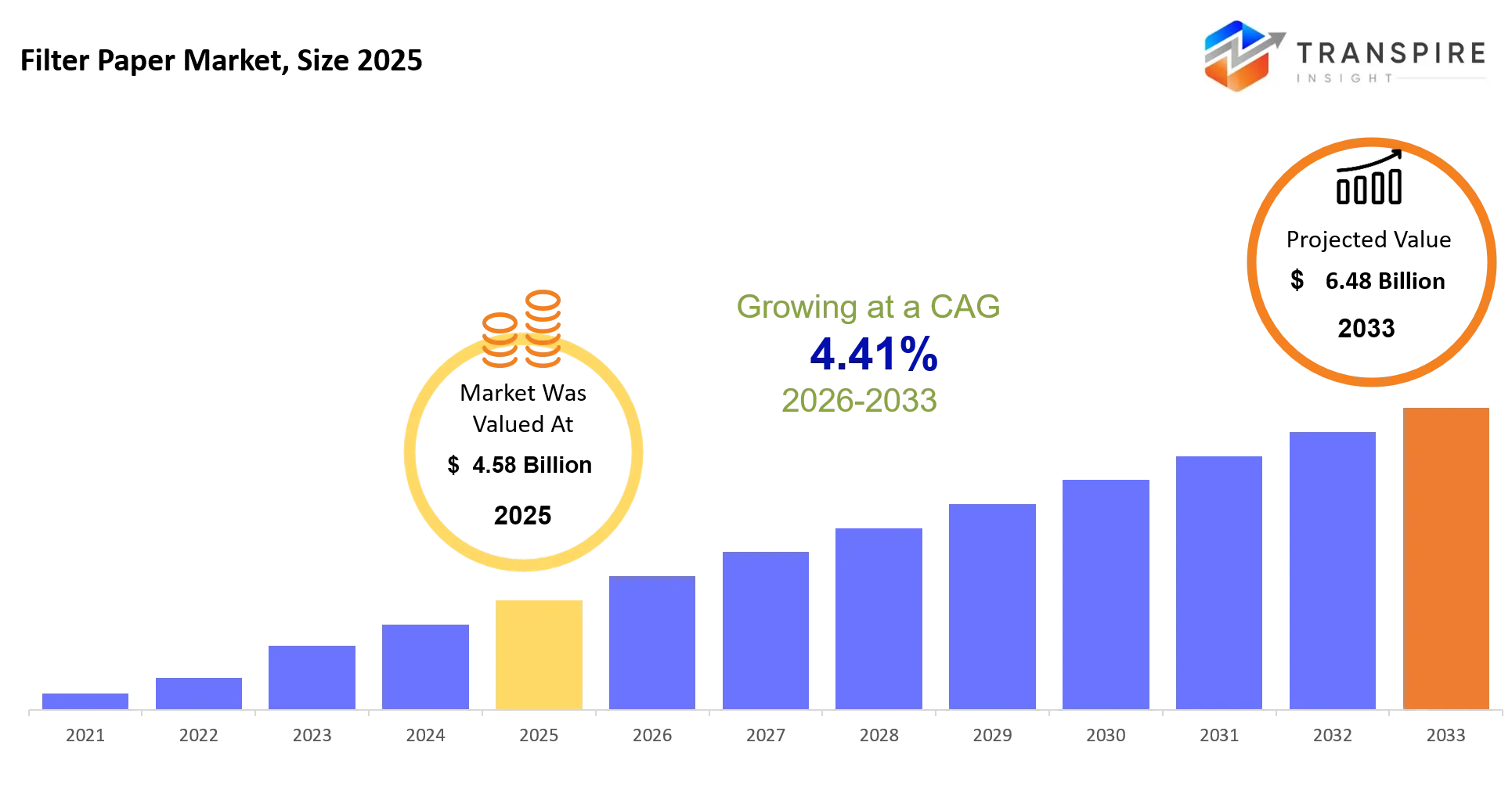
As per Transpire Insight Analysis, The Filter Paper Market size is estimated at USD 4.58 billion in 2025 and is anticipated to reach USD 6.48 billion by 2033, growing at a CAGR of 4.41% from 2026 to 2033.
The global filter paper industry produces engineered porous media allowing solids to be separated from liquids or gases in laboratories, pharmaceutical manufacturing, municipal water treatment, food processing, chemical production, and industrial filtration. Over the last three to five years, the industry experienced a paradigm shift toward bio-based fibres, recycled cellulose, and chlorine-free bleaching processes in response to tightening environmental regulations and corporate ESG commitments. The trigger for the push to quality, compliant media production happened in the reference countries when tighter PFAS controls and food-contact material regulations hit the pavement, requiring widespread use of premium, compliant filtration papers in beverage, food, and pharmaceutical applications. Industry growth is a cause-and-effect chain: increasingly stringent standards for quality, environment and industrial compliance require more efficient filtration, driving laboratory and manufacturing converting operations to replace low-performance papers with cellulose and membrane based media to enhance finished product quality, reliability and regulatory compliance.
Filter Paper Market Size & Forecast:
- Global Market Size 2025: USD 4.58 Billion
- Expected Market Value (2033): USD 6.48 Billion
- Forecast CAGR (2026–2033): 4.41%
- Leading Region in 2025: North America (37%)
- Fastest Growing Region: Asia Pacific (25% & CAGR 17.3%)
- Key Company Profiles: Cytiva, Sartorius, Merck Millipore, Ahlstrom, Macherey-Nagel, Whatman, Advantec, Hahnemühle, Filtration Group, GE Healthcare, Thermo Fisher Scientific, Pall Corporation, Eaton, Munktell, Membrane Solutions.
Key Filter Paper Market Insights:
Regulatory tightening and ESG requirements are changing the way the market is buying pulp, with a move from commodity pulp grades to high-purity, application-specific media. Sustainable fibres, antimicrobial coatings and sensorized formats for predictive maintenance in automotive and industrial filters are the focus of innovation.
- The dominant product is cellulose, at 39%, as companies such as Ahlstrom switch to oxygen-bleached, FSC-certified pulp, as required by eco-procurement measures.
- Membrane at 9% with 16.4% CAGR is growing with the introduction of sterile and low protein binding grades by Cytiva and Sartorius.
- Filtration Group's high-temperature media for emissions sampling under Euro 7 expand with Glass fiber at 21%.
- Rapid-qualification formats are being adopted in semiconductor QC labs, with 16% qualitative and 10% quantitative papers.
- Merck Millipore launches ultra-low background analytical papers, as a specialty at 3% and ashless grades take hold.
- Beverage filters push 41% compostable product launches, and 65% of premium coffee brands take to eco-friendly media.
- North America at 37% leads via direct-sales and online B2B channels, helping to shorten lab procurement cycles.
- Asia Pacific at 25% with 17.3% CAGR, is gaining momentum due to the local production of bamboo and recycled-fibre papers for cost-sensitive markets.
What are the Key Drivers, Restraints, and Opportunities in the Filter Paper Market?
Driver:
Growth is accelerated by the expansion of pharmaceutical R&D, batch-release testing and semiconductor fabrication, which is being instigated by more stringent controls on particulate limits; and the requirement for fast, uniform QC procedures to meet ISO 14644 cleanroom guidelines and SEMI specifications. Increased ASPs and stable repeat business from more capable rapid-qualification and cleanroom-competent grades result from labs and faps putting compliance and yield preservation above cost and securing multi-year supply arrangements.
Restraint:
Volatility in raw cellulose pulp prices continues amid a structural issue of falling supply associated with a reduction in mill installations and stronger demand for wood-fibre from the packaging and tissue sector. This reduces the margins for commodity grades and elongates the lead time for specialty paper as tight inventories and feedstock bottlenecks hold back producers from concentrating on high-value customers.
Opportunity:
Sensor-enabled paper formats and antimicrobial filter media hold the potential to stimulate growth in automotive cabin air and extended-service oil filter markets. Euro 7 demands are driving investment in multi-stage biodegradable media based on cellulose filter media for diesel particulate and HVAC systems, as OEMs seek to tighten SPN10 limits and optimize in-cabin air quality. These advanced media formats carry a premium price and potential OEM contracts to offset commodity margin erosion.
What Has the Impact of Artificial Intelligence Been on the Filter Paper Market?
AI is used to enhance filtration processes through predictive maintenance and process control, turning filters from a passive, consumable device to an active, strategic diagnostic tool. Industrial operators use ML algorithms to monitor flow-rate or pressure-drop signals to predict clogging and determine forecasted lifetime, allowing filters to be changed just-in-time and reducing not only downtime but also unplanned shutdowns by as much as 30%. AI-powered image analysis is used to identify defects of fibres as well as pore-size variability in real time, reducing reject rates and ensuring batch-to-batch consistency.
Operational efficiencies-automating pulp-blend changes to consistently deliver desired porosity, iteratively accelerating backwash cycles, and reducing filtration rates to cut energy consumption and effluent-will rapidly accelerate. Implementation costs and gaps in data quality in older plants could constrain accuracy, particularly in small-to-mid manufacturers without an Internet of Things sensor network and a common data pipeline. Emerging cloud-based predictive platforms can fill the gap in real-time insights. Yet adoption varies by region and size of enterprise, widening the digital-solution lead of the incumbents.
In April 2026, ANGEL launched smart water systems for the foodservice industry, enabling commercial operators to upgrade safety standards and optimize water treatment performance.
Key Filter Paper Market Trends:
The market is shifting towards high-performance filtration solutions that meet the increasingly demanding quality requirements in regulated industries. Customized filtration products that meet automation, sustainability, and precision-based industrial needs are becoming a growing priority for manufacturers.
- Laboratories are replacing standard papers with filters that are unique to each application and achieve greater analytical accuracy.
- Increasingly, pharmaceutical manufacturers are referencing certified filter papers for validated production and quality control processes.
- The commercial preference for microbiological and sterile testing applications has increased for membrane filtration technologies.
- Investment in biodegradable cellulose and recyclable filtration materials has been increasing with sustainable manufacturing.
- New automated laboratory systems demand filter papers that can be used with high-throughput analytical instruments.
- Real-time defect detection and optimisation of processes have led to greater production consistency with digital quality monitoring.
- Speciality filter products are becoming more common in water treatment projects to help achieve stricter environmental compliance standards.
- The regional manufacturing growth in Asia-Pacific is bolstering the regional supply chain and decreasing reliance on imported lab filtration materials.
Filter Paper Market Segmentation
By Product Type:
Cellulose Filter Paper accounts for 39% of the global market because of its versatility, affordability, and widespread use across laboratory, food testing, and environmental applications. Glass Fibre Filter Paper holds 21%, benefiting from superior particle retention and high-temperature resistance in industrial filtration. Qualitative Filter Paper contributes 16%, supporting routine laboratory analysis, while Quantitative Filter Paper represents 10% through precise gravimetric testing. Membrane Filter Paper, although representing 9% of market share, is projected to expand at the fastest CAGR of 16.4% due to rising pharmaceutical, microbiological, and biotechnology testing requirements. Specialty Filter Paper captures 3%, with Others contributing 2% through niche industrial applications.
By Application:
Laboratory filtration continues to generate the majority of revenue for the industry as research, pharmaceutical testing, and analytical laboratory activity continues to grow around the globe. Water filtration is set to be reinforced with new drinking water standards, while demand for food and beverage, pharmaceutical, chemical, air and industrial filtration will be spurred on by increasingly specialized performance needs.
By End User:
Test laboratories will sustain their position as a major market segment for the foreseeable future. They can do so through their regular, stringent analytical testing, which is followed by the purchasing of validated filtration systems by pharmaceutical outfits. Users include food and beverage producers, chemists, water treatment facilities, and research organizations.
By Material:
Cellulose remains the dominant choice of material on the basis of economy and maximum compatibility; GLASS fibre is used for high-end industrial use. Polyfluorinated, self-cross-linking materials like PTFE, nylon, polyester, blend fibres, and other engineered fibres are gradually gaining popularity in applications that demand chemical resistance, sterility, or durability above and beyond traditional filtration.
By Distribution Channel:
Industrial direct sales continue to be the favoured means of purchasing for business-to-industry, which has large industrial customers, although laboratory distributors are providing technical support for research institutes. Online B2B platforms, which provide services to large industrial customers, and wholesalers, exporters and specialist distributors, are taking advantage of the opening up of markets within developing countries.
What are the Key Use Cases Driving the Filter Paper Market?
The laboratory filtration customer is the traditional core application, centred around the qualitative and quantitative grade for typical chemical and environmental analysis, in which clarity and removal of particles is essential to accurate results.
Growing application areas comprise the Semiconductor cleanroom environment and pharmaceutical dissolution testing, where quick-qualification grades allow operating within tighter particle limits and protect delicate instrumentation.
Emerging use cases include sensor-embedded automotive oil filters for longer intervals, which use online oil-quality testing to refine maintenance programs. Antimicrobial cabin-air papers for Euro 7 compliance and health-safety, which lower bioburden in HVAC systems without affecting flow rate. These formats demand premium prices and perpetual OEM contracts.
|
Report Metrics |
Details |
|
Market size value in 2025 |
USD 4.58 Billion |
|
Market size value in 2026 |
USD 4.79 Billion |
|
Revenue forecast in 2033 |
USD 6.48 Billion |
|
Growth rate |
CAGR of 4.41% from 2026 to 2033 |
|
Base year |
2025 |
|
Historical data |
2021 - 2024 |
|
Forecast period |
2026 - 2033 |
|
Report coverage |
Revenue forecast, competitive landscape, growth factors, and trends |
|
Regional scope |
United States; Canada; Mexico; United Kingdom; Germany; France; Italy; Spain; Denmark; Sweden; Norway; China; Japan; India; Australia; South Korea; Thailand; Brazil; Argentina; South Africa; Saudi Arabia; United Arab Emirates |
|
Key companies profiled |
Cytiva, Sartorius, Merck Millipore, Ahlstrom, Macherey-Nagel, Whatman, Advantec, Hahnemühle, Filtration Group, GE Healthcare, Thermo Fisher Scientific, Pall Corporation, Eaton, Munktell, Membrane Solutions. |
|
Customization scope |
Free report customization (country, regional & segment scope). Avail customized purchase options to meet your exact research needs. |
|
Report Segmentation |
By Product Type (Qualitative Filter Paper, Quantitative Filter Paper, Glass Fiber Filter Paper, Cellulose Filter Paper, Membrane Filter Paper, Specialty Filter Paper, Ashless Filter Paper, Others); By Application (Laboratory Filtration, Water Filtration, Food & Beverage, Pharmaceutical Filtration, Chemical Processing, Air Filtration, Industrial Filtration, Others); By End User (Laboratories, Pharmaceutical Companies, Food & Beverage Industry, Chemical Industry, Water Treatment Plants, Research Institutes, Others); By Material (Cellulose, Glass Fiber, PTFE, Nylon, Polyester, Mixed Fibers, Others); By Distribution Channel (Direct Sales, Laboratory Distributors, Online B2B Platforms, Wholesalers, Exporters, Others) |
Which Regions are Driving the Filter Paper Market Growth?
North America accounts for 37% of the world market, owing to tough pharmaceutical QC requirements, semiconductor cleanroom standards, and a sophisticated laboratory infrastructure. Incentives provided by EPA air-quality directives and food-safety regulations accelerate the demand for high-purity cellulose and membrane grades. An extensive network of laboratory distributors and online B2B services catalyses the quick distribution of certified filtration media. This infrastructure sustains premium prices and repeat sales of niche products. In May 2026, Thermo Fisher Scientific acquired the purification and filtration business of Solventum Inc. This strategic acquisition expanded its biopharmaceutical production and laboratory separation capabilities, reinforcing the regional dominance of certified media.
Europe's 31% share is stable based on Euro 7 emissions compliance and enforcement of circular-economy requirements around biodegradable media. Whereas North American demand is driven by automotive cabin-air and industrial air filtration, Europe's growth is based around lab-backed demand; for replacement based on eco-partners, plants, EU/USEPA LF equipment investments measured against baseline FSC certification, chlorine-free bleaching, etc., assuring supply chain lock- in for sustainable pulp providers.
Asia Pacific is the fastest growing at 25% share and 17.3% CAGR, driven by expansion of semiconductor fab capacity and local manufacturing of bamboo and recycled fibre papers in the region. Trends include regional manufacturing facilities to reduce reliance on imports and to reduce lead time for high-volume grades. A larger opportunity for the next decade is in developing antimicrobial and sensor-enabled papers for use in automotive and healthcare sectors to meet the needs of the growing middle class. In June 2026, BambooOrigin launched biodegradable bamboo-based packaging films and anti-static tape for specialized industrial use. This reduces reliance on petroleum plastics and localises high-volume green supply chains.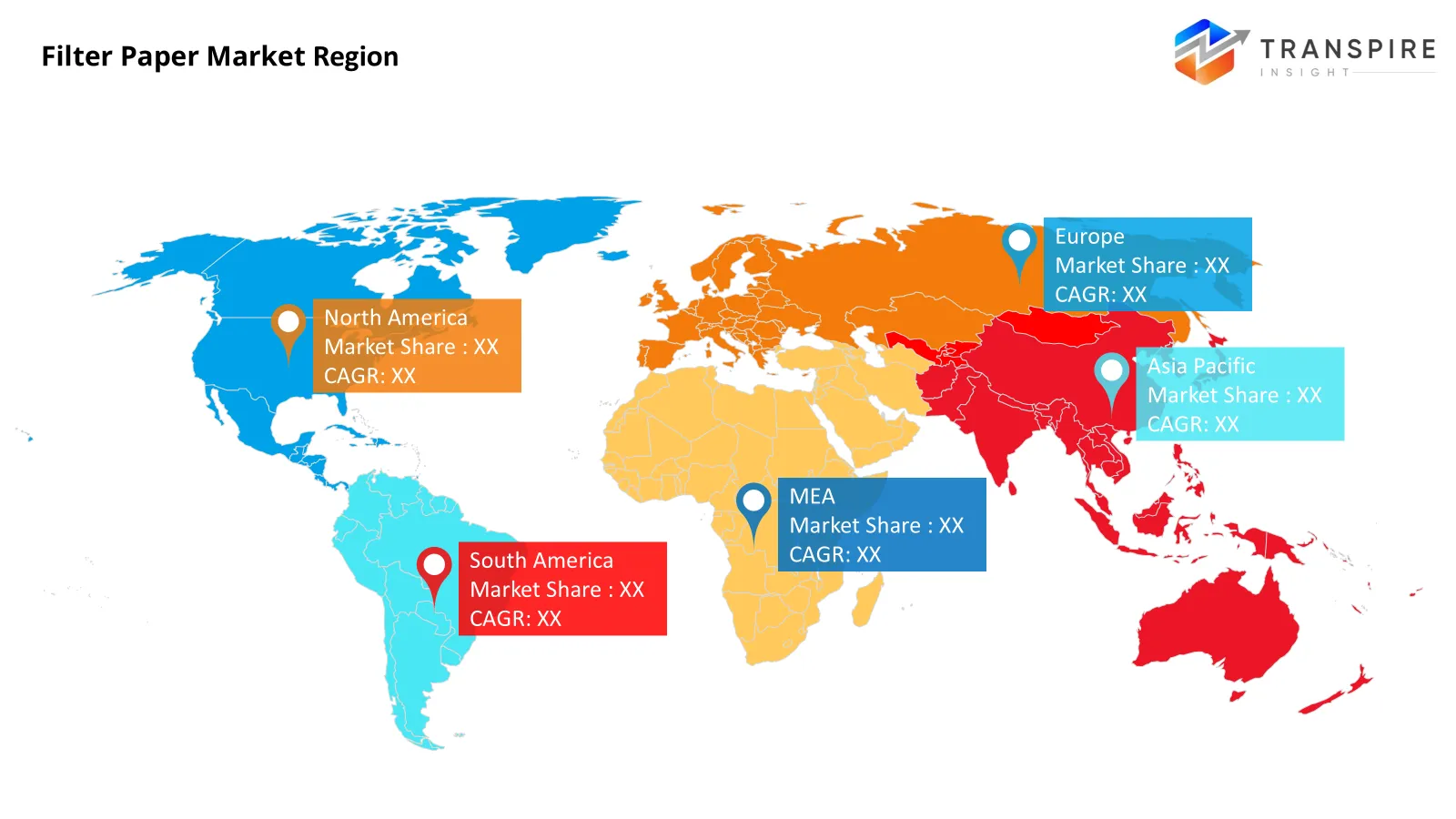
Who are the Key Players in the Filter Paper Market and how do they Compete?
The Filter Paper Market is moderately consolidated; competition in this market tends to focus on innovations in material qualities and applications, rather than just competing on price. The main level-1 companies, Ahlstrom-Munksjö, Hollingsworth & Vose, and GE Healthcare control just over 30% of the market through deployment of nanofiber technology and eco-friendliness.
Cytiva and Sartorius apply an innovation-driven approach, launching low-protein-binding membrane papers for biopharma sterile filtration at high ASP within recurring revenues. Merck Millipore and Whatman Cytiva leverage ultra-low-background analytical grades for trace-metal testing, capturing pharma QC business. Ahlstrom and Hahnemühle lean on sustainable cellulose-oxygen-bleached and bamboo-fibre-lines, winning through Asian-Pacific ESG procurement mandates. Macherey-Nagel and Advantec address lab-niche segments- rapid qualification and ultra-high-purity papers- for the semiconductor QC market, leveraging APAC's 42%. Filtration Group Eaton for automotive and industrial air filtration and oil coatings, antimicrobial and sensor-ready media for Euro 7. Thermo Fisher/Pall Corporation focuses on direct sales and technical support to gain long-term pharma and biotech accounts. Munktell and Membrane Solutions focus on low-cost, regionally manufactured grades for Asia Pacific high-volume or low-margin markets.
Key Players are:
- Cytiva
- Sartorius
- Merck Millipore
- Ahlstrom
- Macherey-Nagel
- Whatman
- Advantec
- Hahnemühle
- Filtration Group
- GE Healthcare
- Thermo Fisher Scientific
- Pall Corporation
- Eaton
- Munktell
- Membrane Solutions
Recent Development News
- In May 2026, Ahlstrom launched an advanced glass microfiber media platform for HVAC filtration. This product rollout delivers a PFAS-free filtration material that reduces initial pressure drop by up to 20% while providing energy savings across commercial and industrial environments.
- In July 2026, Sartorius appointed Avantor India as its exclusive distributor of filter papers in India. This partnership strengthens its filtration portfolio and enhances access for academic, quality control, pharmaceutical, and industrial laboratories through an established distribution network.
https://www.biospectrumindia.com
- In June 2026, MeVaChi secured an exclusive strategic partnership with global filtration leader Hollingsworth & Vose. This collaboration was launched to combine H&V's advanced filtration media engineering with MeVaChi's systems to redefine premium indoor air quality.
What Strategic Insights Define the Future of the Filter Paper Market?
The global filter-paper industry is shifting to high-purity, sustainable, intelligent filtration media as the tightening of regulations and the rising performance requirements in pharma, automotive, and industrial sectors become apparent. An underappreciated threat is pulp-price volatility, caused by supply limits and competition from packaging and tissue markets, which could squeeze commodity grades and derail supply chains. An imminent opportunity exists in sensor-fitted and antimicrobial papers for automotive cabin-air and healthcare applications, propelled by Euro 7 and infection-control requirements for real-time analysis and bioburden reduction. Focus R&D energy on bio-based fibres of bamboo, abaca, recycled cellulose and IoT-enabled formats with integrated pressure drop and clogging sensors for predictive maintenance. It secures high-end segments spending premium on standards while hedging raw-material cost shocks through supply diversification to renewable feedstocks. First-to-deploy FSC-certified supply chains with captured sensor Intellectual Property protect cement long-term Pharma, Biotech and OEM supply contracts to generate sustainable revenue.
Key Players are:
By Product Type
- Qualitative Filter Paper
- Quantitative Filter Paper
- Glass Fiber Filter Paper
- Cellulose Filter Paper
- Membrane Filter Paper
- Speciality Filter Paper
- Ashless Filter Paper
- Others
By Application
- Laboratory Filtration
- Water Filtration
- Food & Beverage
- Pharmaceutical Filtration
- Chemical Processing
- Air Filtration
- Industrial Filtration
- Others
By End User
- Laboratories
- Pharmaceutical Companies
- Food & Beverage Industry
- Chemical Industry
- Water Treatment Plants
- Research Institutes
- Others
By Material
- Cellulose
- Glass Fiber
- PTFE
- Nylon
- Polyester
- Mixed Fibers
- Others
By Distribution Channel
- Direct Sales
- Laboratory Distributors
- Online B2B Platforms
- Wholesalers
- Exporters
- Others
Regional Outlook
North America
- US
- Canada
- Mexico
- US
- Canada
Europe
- Germany
- UK
- France
- Italy
- Spain
- Rest of Europe
Asia Pacific
- China
- Japan
- India
- South Korea
- Australia
- Rest of Asia Pacific
South America
- Brazil
- Argentina
- Rest of South America
Middle East & Africa
- UAE
- Saudi Arabia
- Qatar
- South Africa
- Rest of the Middle East & Africa
Frequently Asked Questions
Find quick answers to common questions.
The Filter Paper Market size was valued at USD 4.58 billion in 2025 and is poised to reach USD 6.48 billion by 2033, expanding at a 4.41% CAGR.
Key segments for the Filter Paper Market are Type By Product Type (Qualitative Filter Paper, Quantitative Filter Paper, Glass Fiber Filter Paper, Cellulose Filter Paper, Membrane Filter Paper, Specialty Filter Paper, Ashless Filter Paper, Others); By Application (Laboratory Filtration, Water Filtration, Food & Beverage, Pharmaceutical Filtration, Chemical Processing, Air Filtration, Industrial Filtration, Others); By End User (Laboratories, Pharmaceutical Companies, Food & Beverage Industry, Chemical Industry, Water Treatment Plants, Research Institutes, Others); By Material (Cellulose, Glass Fiber, PTFE, Nylon, Polyester, Mixed Fibers, Others); By Distribution Channel (Direct Sales, Laboratory Distributors, Online B2B Platforms, Wholesalers, Exporters, Others).
Growth is primarily driven by regulatory tightening on emissions and water quality, expansion of pharmaceutical QC and semiconductor cleanroom testing, and rising demand for sustainable, bio-based filtration media in beverage and automotive segments.
The Filter Paper Market is led by major manufacturers including Cytiva, Sartorius, Merck Millipore, Ahlstrom, Macherey-Nagel, Whatman, Advantec, Hahnemühle, Filtration Group, GE Healthcare, Thermo Fisher Scientific, Pall Corporation, Eaton, Munktell, Membrane Solutions.
North America holds a 37% share, driven by stringent pharmaceutical QC norms, semiconductor cleanroom standards, and a mature laboratory infrastructure with dense direct-sales and online B2B channels shortening procurement cycles.
Opportunities include sensor-integrated and antimicrobial papers for Euro 7 automotive cabin-air and oil filters, bio-based fiber innovation (bamboo, recycled pulp), and premium compostable beverage filters targeting specialty coffee and RTD segments.
- Cytiva
- Sartorius
- Merck Millipore
- Ahlstrom
- Macherey-Nagel
- Whatman
- Advantec
- Hahnemühle
- Filtration Group
- GE Healthcare
- Thermo Fisher Scientific
- Pall Corporation
- Eaton
- Munktell
- Membrane Solutions
About the Authors

Pankaj Ghogare Patil
I am Pankaj Ghogare Patil, a Senior Research Analyst at Transpire Insight, specializing in the Pharmaceutical, Chemicals & Materials, Healthcare IT, and Biotechnology industry. My expertise lies in conducting comprehensive market research, analyzing industry trends, evaluating competitive landscapes, and translating complex data into actionable insights. At Transpire Insight, I closely follow emerging technologies, regulatory developments, and market innovations to create accurate, well-researched, and informative content that helps businesses and professionals make informed decisions. I am committed to producing credible, evidence-based articles that reflect industry best practices while making technical topics accessible and valuable for a broad audience.

Chakradhar Khansole
Chakradhar serves as the Research Director at Transpire Insight, bringing over 8 years of experience in technology, innovation, and strategic market intelligence. He specializes in transforming complex market data into actionable business insights that enable organizations to make informed, growth-oriented decisions. Recognized for his strategic vision and analytical expertise, Chakradhar leads high-impact research initiatives, delivering comprehensive market assessments, competitive intelligence, and forward-looking industry analysis.
Recently Published Reports
-
May 2026
Healthcare Polymer Packaging Market
Healthcare Polymer Packaging Market Size, Share & Analysis Report By Packaging Type (Syringes, IV Bottles and Pouches, Clamshells, Blisters, Bottles & Jars, Containers, Tubes, IV Parental Packaging, Others), By Type (Regulated, Non-regulated), By Polymer Type (LDPE (Low-Density Polyethylene), HDPE (High-Density Polyethylene), Homo-polymer (Homo), Random Copolymer (Random), Block Copolymer (Block), PET, Polystyrene, Polyvinyl Chloride, Polyamide/EVOH, Others), and Geography (North America, Europe, Asia-Pacific, Middle East and Africa, South and Central America), 2021 - 2031
-
Apr 2026
Hydrophilic Tape (Waterstop) Market
Hydrophilic Tape (Waterstop) Market Size, Share & Analysis Report By Type (Bentonite-Based Hydrophilic Tape, Rubber-Based Hydrophilic Tape), By Application (Residential Buildings, Commercial Buildings, Infrastructure Projects), and Geography (North America, Europe, Asia-Pacific, Middle East and Africa, South and Central America), 2021 - 2031
-
Apr 2026
Metalens Market
Metalens Market Size, Share & Analysis Report By Type (Visible Light Metalens, and Infrared Metalens), By Application (Consumer Electronics, Automotive Electronics, Industrial, Medical, and Others), and Geography (North America, Europe, Asia-Pacific, Middle East and Africa, South and Central America), 2021 - 2031
-
Apr 2026
PBT Resin Market
PBT Resin Market Size, Share & Analysis Report By Type (Reinforced PBT Resin, Unreinforced PBT Resin), By Processing Method (Injection Molding, Extrusion, Blow Molding, Others), By End-User (Automotive, Electrical & Electronics, Consumer Appliances, Industrial Machinery, Medical Devices, Packaging, Others), and Geography (North America, Europe, Asia-Pacific, Middle East and Africa, South and Central America), 2021 - 2031