
Europe Wire Harness Market Size & Forecast:
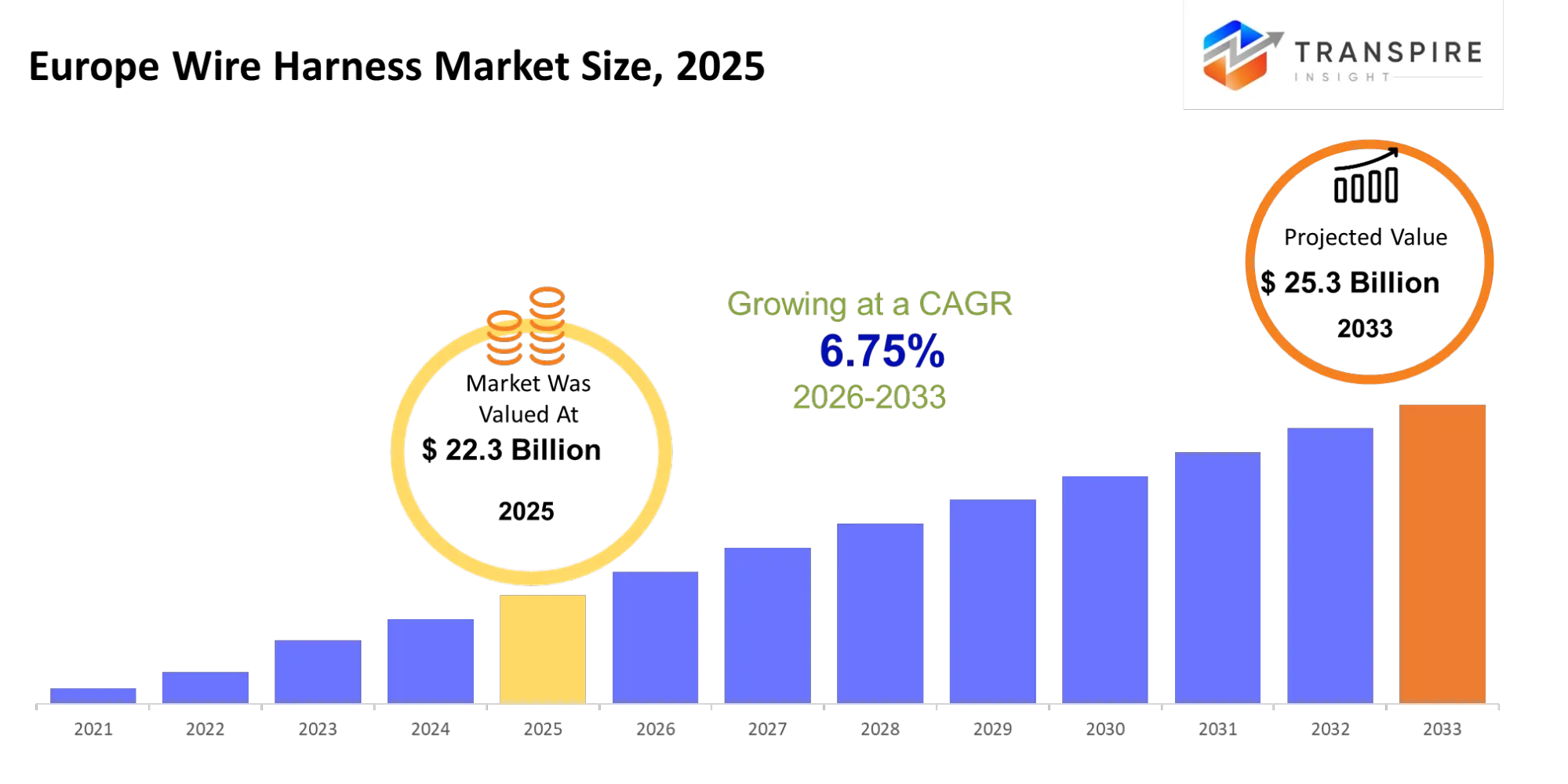
- Europe Wire Harness Market Size 2025: USD 22.3 Billion
- Europe Wire Harness Market Size 2033: USD 25.3 Billion
- Europe Wire Harness Market CAGR: 6.75%
- Europe Wire Harness Market Segments: By Type (Engine Harness, Body Harness, Chassis Harness, HVAC Harness, Others); By Application (Automotive, Aerospace, Electronics, Industrial Equipment, Others); By End-User (OEMs, Aftermarket, Others); By Material (Copper, Aluminum, Fiber Optics, Others)
To learn more about this report,  Download Free Sample Report
Europe Wire Harness Market Summary
The Europe Wire Harness Market was valued at USD 22.3 Billion in 2025. It is forecast to reach USD 25.3 Billion by 2033. That is a CAGR of 6.75% over the period.
The Europe wire harness market kind of underpins the electrical backbone of today’s vehicles, industrial gear , and the broader connected transport world by letting power move properly , signals get carried, and data be exchanged between different electronic modules. In auto production, wire harness systems don’t just sit there, they affect vehicle safety outcomes, battery steadiness, infotainment usability, and also advanced driver-assistance tasks. In the last five years, the market has been moving away from the usual low-voltage style designs toward high-voltage, data hungry setups, built for electric cars and software-defined vehicles. And yes, this change picked up speed once the European Union tightened emissions rules , plus national EV rollout goals pushed automakers to rethink their platforms around electrification.
Meanwhile, supply chain turbulence during the semiconductor shortage, along with geopolitical friction, highlighted how risky it is to depend too much on far-away sourcing routes. Because of that, manufacturers have been widening production capacity across Eastern Europe. At the same time, electric vehicles need more wiring and deeper electronic integration per car , which then boosts average harness value and makes the engineering part more intricate , also more time sensitive. So overall, electrification together with more localized making, plus a digital vehicle architecture, is reworking what suppliers invest in, and it’s opening up extra possibilities for higher-performance connectivity solutions.
Key Market Insights
- Western Europe sort of dominated the Europe Wire Harness Market, holding over 45% share in 2025, largely because EV production looked strong and the automotive manufacturing ecosystems stayed more advanced than most other places.
- Northern Europe then popped up as the fastest-growing regional market between 2026 and 2033, backed by battery investments and pretty aggressive zero emission transportation policies , yes.
- In 2025, engine harness systems kept the largest market portion, mostly because hybrid as well as performance vehicles still need dense powertrain electrical connectivity solutions, in practice.
- Body harness systems meanwhile showed the quickest growth trajectory after 2024 since automakers kept pushing infotainment integration, smart lighting and even advanced driver assistance technologies .
- Automotive use cases made up more than 60% of overall industry demand in 2025, driven by rising electronic content per electric and connected vehicle platform.
- Aerospace along with industrial equipment also created emerging demand, mainly for lightweight and heat resistant wiring systems able to work in harsh environments, without drama.
- For end users, OEMs dominated the demand picture with nearly 70% share, because automakers more and more require customized high voltage harness integration during vehicle production.
- Aftermarket demand accelerated after 2023, due to aging vehicle fleets and EV servicing needs, so replacement and retrofit wiring system installations increased across Europe.
- Leoni AG expanded automated manufacturing operations in Eastern Europe, trying to reduce labor dependency and improve supply chain responsiveness for German automakers.
- And Aptiv PLC gained a competitive edge through zonal architecture systems and high speed data harness technologies, which back software defined vehicle platforms.
What are the Key Drivers, Restraints, and Opportunities in the Europe Wire Harness Market?
The strongest driver for the Europe wire harness market is basically the rapid shift towards electric , and also software-defined vehicles across the regional auto landscape. At the same time European Union emissions rules, paired with bold EV production goals from automakers like Volkswagen , BMW, and Mercedes-Benz, have noticeably boosted the demand for high-voltage wiring architectures plus more advanced connectivity systems. In general modern electric vehicles need far more electronic content than older conventional cars, meaning more than just the usual , since you get battery management systems, sensors, infotainment modules , and even driver assistance technologies. So this whole change makes harnesses more complicated, increases material usage, and raises the average revenue per vehicle platform in a very direct way.
The biggest restraint still comes from how labor‑intensive wire harness manufacturing is , along with the fact automation is not always easy to scale in highly customized assembly settings. Because routing is complex, connector integration is involved, and every vehicle has its own configurations, manufacturers still rely on plenty of manual work especially when production is low volume or when it’s premium models. Meanwhile rising labor costs in Europe, and ongoing shortages of skilled assembly workers, keep squeezing supplier margins, and also slow down any attempt at faster production expansion. On top of that, supply chain risk—like copper price fluctuations, and semiconductor shortages—keeps creating operational instability.
A major future opportunity is showing up through zonal vehicle architecture and lightweight material innovation, in parallel. Automakers are increasingly reworking their electrical layouts, trying to reduce wiring length, cut vehicle weight , and lower energy consumption in next‑generation EV platforms.Eastern Europe seems to be pulling more capital into automated high-voltage wiring bundle making, basically, like plants that run with less human touch, and that is making it easier for suppliers who focus on aluminum conductors, fiber optic interlinks and, not to mention, improved thermal regulation systems. Overall conditions feel pretty favorable, so the whole thing keeps moving.
What Has the Impact of Artificial Intelligence Been on the Europe Wire Harness Market?
Artificial intelligence and advanced digital technologies are changing wire harness manufacturing, and vehicle integration across Europe, kind of all at once, via automation predictive analytics and continuous real-time quality monitoring. In practice, automotive suppliers are more often using AI enabled machine vision systems to check harness routing connector positioning and crimping precision while the assembly is running, so the manual inspection effort shrinks and defect rates drop in big volume production. And then, digital twin technology is getting more attention with automotive OEMs and harness manufacturers, because they can run a simulation of electrical architecture performance before the actual vehicle production even starts. This can lower the number of redesign loops, boost manufacturing exactness, and speed up overall development schedules especially for electric and software defined vehicles.
At the same time machine learning models are supporting predictive maintenance on automated assembly lines by spotting equipment wear trends, connector strain signs, and temperature irregularities early, before a failure shows up. Some suppliers that use predictive analytics have mentioned better production uptime and less downtime tied to maintenance, especially in plants focused on high voltage EV harness systems. There are also AI driven supply chain platforms that help manufacturers fine tune raw material sourcing and inventory plans, even when copper prices swing and semiconductor supply stays inconsistent. Still, uptake is not effortless, because the integration fees can be high and training the AI systems is complicated, particularly when harness configurations are extremely customized and can vary a lot between vehicle platforms and production batches.
Key Market Trends
- Since 2022 ,European automakers sorta went up in appetite for high voltage harness systems , especially as EV output kept accelerating in Germany,France, and those Nordic manufacturing pockets.
- Leoni AG and Aptiv PLC then expanded more automation spending , partly because labor shortages made production costs jump for those pretty complex harness assembly steps across Eastern Europe.
- Between 2023 and 2026 , vehicle manufacturers started moving away from fully centralized wiring architectures toward zonal setups, to cut vehicle mass and also boost data efficiency in a more practical way.
- Copper price volatility meanwhile kinda nudged suppliers toward aluminum based harness development, most notably for electric commercial vehicles that need longer driving range and less overall mass.
- European OEMs also leaned into nearshoring harness sourcing to Poland, Romania, and Slovakia, after semiconductor disruptions basically made the dependence on Asian manufacturing networks harder to ignore.
- Since 2024, software defined vehicle platforms have increased the need for fiber optic and high speed data transmission harness technologies across the premium auto segments, a lot more than before.
- Samvardhana Motherson International Limited accelerated acquisition activity from 2024 to 2026, to reinforce high voltage connectivity and tighten up regional OEM integration abilities.
- EU emissions rules pushed automakers toward lightweight HVAC and chassis harness systems , which in turn support energy efficiency inside battery electric vehicle platforms.
- Also aerospace and industrial automation sectors increased their uptake of heat resistant plus vibration resistant harness systems, as electrification kept spreading beyond passenger transportation applications.
- And the Nordic countries strengthened demand for advanced thermal management wiring , after battery manufacturing investment rose and EV infrastructure deployment sped up during 2025 and 2026.
Europe Wire Harness Market Segmentation
By Type:
Engine harness systems still capture a major share of industry revenue, simply because internal combustion, hybrid, and high performance vehicles, still need dense electrical routing around the powertrain components. There’s solid demand coming from premium automotive manufacturing in Germany and France, that really keeps this segment steady. It’s especially visible in hybrid vehicle platforms where combustion engines run alongside battery systems. Key points like heat resistance, vibration durability, and a compact design stay pretty crucial , and they’re what separate engine harness applications from the other harness categories in practice.
Body harness systems are picking up pace too, as vehicle interiors keep becoming more digital, and more electronically connected. The push is tied to higher integration of infotainment systems, lighting modules, sensors, smart seating, and driver assistance technologies across passenger cars. Chassis harness demand is moving upward as well because electronic braking systems and suspension control technologies are becoming more common , particularly within electric vehicles. HVAC harness systems are expected to grow fairly steadily, since many automakers are leaning into energy efficient climate control, which helps both battery performance and cabin comfort inside electric mobility platforms.
By Application:
Automotive applications represent the biggest slice of market demand. This is mostly because electric vehicles are expanding quickly, and connected mobility systems, plus advanced vehicle electronics, are becoming the norm across Europe. Passenger vehicle manufacturers want wiring architectures that are increasingly intricate to handle battery management, infotainment integration, and even autonomous driving functions. On top of that, production scale and regulatory pressure aimed at emissions reduction continue to lock in automotive dominance across the broader electrical connectivity landscape.
Aerospace and industrial equipment applications are, sort of, creating more growth chances from the demand for lightweight and high-reliability electrical systems, and yes. Aircraft electrification projects plus smart manufacturing equipment need specialized harness configurations that can run in high-temperature and high-vibration environments. Electronics use-cases are getting bigger too, since consumer and industrial devices now lean more and more on compact, fast connectivity systems. Over time, this kind of growth is expected to push suppliers to put money into miniaturization, heat management substances, and newer signal relaying technologies.

To learn more about this report, Download Free Sample Report
By End User:
OEMs show up as the dominant end user group, because vehicle manufacturers increasingly blend customized wiring architectures directly into production platforms. The long-term supply contracts between automakers and harness manufacturers keep procurement volumes more or less stable. They also encourage joint development of high-voltage connection systems. Then there are strict quality requirements, and the need for design integration, which really reinforces OEM preference for suppliers that are already proven, meaning they have strong engineering and testing capabilities.
Aftermarket demand keeps rising, driven by vehicle repair, replacement, and retrofit work across Europe’s older automotive fleet. Electric vehicle servicing, plus advanced electronics swapping, is forming new revenue pockets for aftermarket harness suppliers focused on diagnostics-compatible systems. Growth in connected commercial fleets and industrial machinery maintenance is also backing up aftermarket momentum. In the forecast window, more vehicle intricacy is likely to lift demand for specialized repair-grade harness solutions and certified replacement components, even when budgets are tight.
By Material:
Copper stays the dominant material segment , mostly because of strong electrical conductivity, durability, and how well it plays with high-performance automotive plus industrial applications. A lot of vehicle manufacturers keep leaning on copper wiring for power distribution and electronic system stability, particularly across high-voltage electric vehicle platforms. That said , higher copper prices along with supply chain volatility are really adding pressure on manufacturers to cut back overall wiring weight and reduce material reliance, sort of like finding better balance without losing performance.
Meanwhile aluminum harness systems are getting more attention, as automakers look for lightweight substitutes that can lift vehicle energy efficiency and stretch driving range. Fiber optic materials are also showing up more often in high-speed data transmission roles, especially in autonomous driving scenarios and software-defined vehicle designs. With that in mind, demand for advanced communication systems is expected to pick up, which should boost investment into hybrid material solutions that mix lightweight benefits with improved signal behavior. So, material innovation is probably going to turn into a major differentiator for suppliers aiming at next-generation mobility plus industrial automation.
What are the Key Use Cases Driving the Europe Wire Harness Market?
Passenger vehicles remain the primary use case driving demand in the Europe wire harness market because modern electric and hybrid vehicles require extensive electrical distribution, battery connectivity, and advanced driver-assistance integration. Increasing electronic content per vehicle continues to raise harness complexity and unit demand across European automotive production lines.
Commercial vehicles and industrial transportation systems are expanding adoption as fleet operators invest in electrified buses, delivery vans, and connected logistics vehicles. Demand is also rising in agricultural and construction equipment, where manufacturers require durable harness systems capable of supporting telematics, automation, and harsh operating environments.
Emerging applications are developing around autonomous mobility platforms and next-generation software-defined vehicles that depend on high-speed data transmission architectures. Aerospace electrification projects and smart charging infrastructure systems are also creating long-term opportunities for lightweight, heat-resistant, and high-voltage wiring technologies across Europe.
|
Report Metrics |
Details |
|
Market size value in 2025 |
USD 22.3 Billion |
|
Market size value in 2026 |
USD 23.7 Billion |
|
Revenue forecast in 2033 |
USD 25.3 Billion |
|
Growth rate |
CAGR of 6.75% from 2026 to 2033 |
|
Base year |
2025 |
|
Historical data |
2021 - 2024 |
|
Forecast period |
2026 - 2033 |
|
Report coverage |
Revenue forecast, competitive landscape, growth factors, and trends |
|
Regional scope |
Europe (Germany, United Kingdom, France, Italy, Spain, Rest of Europe) |
|
Key company profiled |
Yazaki, Sumitomo Electric, Aptiv, Leoni, Furukawa Electric, Lear Corporation, PKC Group, Nexans, TE Connectivity, Molex, Amphenol, Delphi Technologies, Kromberg & Schubert, Samvardhana Motherson, LS Cable & System |
|
Customization scope |
Free report customization (country, regional & segment scope). Avail customized purchase options to meet your exact research needs. |
|
Report Segmentation |
By Type (Engine Harness, Body Harness, Chassis Harness, HVAC Harness, Others); By Application (Automotive, Aerospace, Electronics, Industrial Equipment, Others); By End-User (OEMs, Aftermarket, Others); By Material (Copper, Aluminum, Fiber Optics, Others) |
Which Regions are Driving the Europe Wire Harness Market Growth?
Western Europe stays the leading region in the Europe wire harness market , if you look closely its still basically a mix of a solid auto manufacturing base, aggressive electrification push, and really capable industrial automation know how. Germany, France, and the United Kingdom keep pulling demand forward thanks to large output of premium electric and hybrid vehicles, these cars tend to need pretty intricate wiring architectures. On top of that, the area has a well established network of OEMs , semiconductor providers, connector manufacturers, and engineering consultancies that kind of speed up product development and systems integration. Also the strict EU emissions rules , plus the whole vehicle safety framework keep pressing for more high voltage and data heavy harness solutions across both passenger and commercial vehicles, so the momentum doesn’t really stop.
Eastern Europe kind of plays another part, more like the fabrication backbone of the regional supply chain instead of the tech driving seat. Places such as Poland, Romania, Hungary, and Slovakia draw companies with lower labor expenses, close geography to Western European assembly sites, and industrial policies that keep exports moving. This region has grown more relevant for labor intensive wire harness assembly work , where you need scale and operational adaptability. Even when Western Europe slows down on vehicle demand, the steady arrival of supplier capital , plus the growth of nearshoring activities, helps protect revenue levels.
Northern Europe is showing up as the quickest mover of all , driven by fast EV adoption, the expansion of battery related ecosystems, and increasing investment in smart mobility infrastructure.Sweden and Norway, especially, have sped up demand for light weight, high performance wiring systems, driven by pretty firm government incentives tied to zero-emission transportation, and well, more domestic battery manufacturing capacity. In the same region, there is also rising work around software-defined vehicles and autonomous mobility platforms, and those things call for more advanced data transmission harnesses . Between 2026–2033, this whole movement is likely to open up interesting chances for suppliers who focus on high-voltage connectivity, thermal management wiring, and the next generation vehicle electronics integration .
Who are the Key Players in the Europe Wire Harness Market and How Do They Compete?
The Europe wire harness market still feels moderately consolidated, like not totally, competition is mostly around automotive electrification, manufacturing efficiency, and plain proximity to OEM production centers. Big multinational suppliers keep defending their place with long term agreements with European automakers, while the smaller specialists are getting more attention in high voltage EV systems and in lightweight wiring know how. Sure cost competitiveness matters, but increasingly the whole market is being shaped by engineering capability, automated production lines, and also the ability to support rather complex electronic architectures for electric and autonomous vehicles. Even the suppliers with regional manufacturing networks across Eastern Europe are benefiting, because automakers are actively looking for shorter supply chains, and less geopolitical exposure , or at least that’s how it appears.
Leoni AG sort of differentiates itself via lightweight wiring systems, and energy efficient harness architectures built for premium European EV platforms. It also keeps expanding its Eastern European manufacturing presence, to catch the nearshoring demand from German automakers, while investing in automated assembly to reduce labor intensive production costs. Yazaki Corporation competes with large scale production efficiency and with deeper integration into automotive OEM supply chains. Their approach leans on modular harness platforms that cut down vehicle assembly complexity while pushing higher scalability for EV output.
Aptiv PLC is positioning around high speed data transmission and zonal architecture systems, which support software defined vehicles. Its edge comes from combining connectivity hardware with advanced vehicle electronics expertise.Sumitomo Electric Industries Ltd. seems to keep the focus on high reliability harness systems for both hybrid and electric cars, and it does so by leaning heavily on solid materials engineering , plus those thermally resistant wiring methods that stay steady when temperatures rise. Meanwhile Samvardhana Motherson International Limited keeps pushing growth in Europe via acquisitions that kind of tighten its high voltage harness lineup and, at the same time, make it easier to tap into local OEM programs.
Company List
- Yazaki
- Sumitomo Electric
- Aptiv
- Leoni
- Furukawa Electric
- Lear Corporation
- PKC Group
- Nexans
- TE Connectivity
- Molex
- Amphenol
- Delphi Technologies
- Kromberg & Schubert
- Samvardhana Motherson
- LS Cable & System
Recent Development News
“In April 2026, Nexans announced the acquisition of Republic Wire, Inc.. The transaction expanded Nexans’ low-voltage wire manufacturing capacity and reinforced its strategic positioning across energy-transition and electrification infrastructure markets.https://www.wirecable.in
“In February 2026, Yazaki Innovations launched its first prefabricated home wiring system for the residential market. The launch highlighted the growing diversification of wire harness technologies beyond automotive applications and accelerated demand for modular electrical connectivity systems.https://finance.yahoo.com
What Strategic Insights Define the Future of the Europe Wire Harness Market?
The Europe wire harness market is, kind of, structurally shifting toward high voltage, lightweight and software integrated harness designs as vehicle electrification , advanced driver assistance systems , and zonal vehicle electronics redefine what automakers prioritize in their design plans over the next five to seven years. The main growth driver isn’t just EV adoption. It’s also the steadily rising electronic complexity per vehicle which is pushing more need for data transmission and thermal-resistant connection solutions.
A more understated risk is the growing concentration of copper supply along with semiconductor-linked connector parts inside a small set of supplier networks, and this can create fragility to geopolitical disruption and pricing swings. Even though overall demand stays strong.
An emerging opportunity might be in Eastern Europe, where nearshoring is becoming more prominent for EV wiring systems. This is supported by EU industrial policy incentives and additional battery manufacturing investment. Market participants should really focus on investments in automated harness assembly and recyclable lightweight materials to ease labor dependency , bolster margin resilience, and stay aligned with tightening European sustainability rules.
Europe Wire Harness Market Report Segmentation
By Type
- Engine Harness
- Body Harness
- Chassis Harness
- HVAC Harness
- Others
By Application
- Automotive
- Aerospace
- Electronics
- Industrial Equipment
- Others
By End-User
- OEMs
- Aftermarket
- Others
By Material
- Copper
- Aluminum
- Fiber Optics
- Others
Frequently Asked Questions
Find quick answers to common questions.
The Europe Wire Harness Market size is USD 25.3 Billion in 2033.
Key segments for the Europe Wire Harness Market are By Type (Engine Harness, Body Harness, Chassis Harness, HVAC Harness, Others); By Application (Automotive, Aerospace, Electronics, Industrial Equipment, Others); By End-User (OEMs, Aftermarket, Others); By Material (Copper, Aluminum, Fiber Optics, Others)
Major Europe Wire Harness Market players are Yazaki, Sumitomo Electric, Aptiv, Leoni, Furukawa Electric, Lear Corporation, PKC Group, Nexans, TE Connectivity, Molex, Amphenol, Delphi Technologies, Kromberg & Schubert, Samvardhana Motherson, LS Cable & System
The Europe Wire Harness Market size is USD 22.3 Billion in 2025.
The Europe Wire Harness Market CAGR is 6.75% from 2026 to 2033.
- Yazaki
- Sumitomo Electric
- Aptiv
- Leoni
- Furukawa Electric
- Lear Corporation
- PKC Group
- Nexans
- TE Connectivity
- Molex
- Amphenol
- Delphi Technologies
- Kromberg & Schubert
- Samvardhana Motherson
- LS Cable & System
Recently Published Reports
-
Apr 2026
ATV & UTV Market
ATV & UTV Market Size, Share & Analysis Report By Type (ATV, and UTV), By Variants (Less Than 400 CC, 400 CC To 800 CC, and More Than 800 CC), and Geography (North America, Europe, Asia-Pacific, Middle East and Africa, South and Central America), 2021 - 2031
-
Apr 2026
Automotive Central Gateway Module Market
Automotive Central Gateway Module Market Size, Share & Analysis Report By Type (Ethernet Central Gateway Module, CAN Central Gateway Module, LIN Central Gateway Module, and FlexRay), By Application (Powertrain Control, Body Control, Infotainment System, Advanced Driver Assistance Systems (ADAS), and Others), By End User (Passenger Vehicles, and Commercial Vehicles), and Geography (North America, Europe, Asia-Pacific, Middle East and Africa, South and Central America), 2021 - 2031
-
Apr 2026
Automotive Engine Oil Filter Market
Automotive Engine Oil Filter Market Size, Share & Analysis Report By Filter Type (Fuel Filter, Engine Oil Filter, Hydraulic Oil Filter, and Others), By Filter Media (Cellulose, Synthetic, and Micro), By Sales Channel (OEMs, and Aftermarket), By Vehicle Type (Passenger Cars, Light Commercial Vehicles, Heavy Duty Trucks, Buses and Coaches, and Off-road Vehicles), and Geography (North America, Europe, Asia-Pacific, Middle East and Africa, South and Central America), 2021 - 2031
-
Apr 2026
Automotive Parts Aluminium Die Casting Market
Automotive Parts Aluminium Die Casting Market Size, Share & Analysis Report By Production Process (Pressure Die Casting, Vacuum Die Casting, Squeeze Die Casting, Gravity Die Casting), By Application (Body Parts, Engine Parts, Transmission Parts, Battery And Related Components, Other Application Types), and Geography (North America, Europe, Asia-Pacific, Middle East and Africa, South and Central America), 2021 - 2031
Our Clients