

Europe US Action Camera Market Size & Forecast:
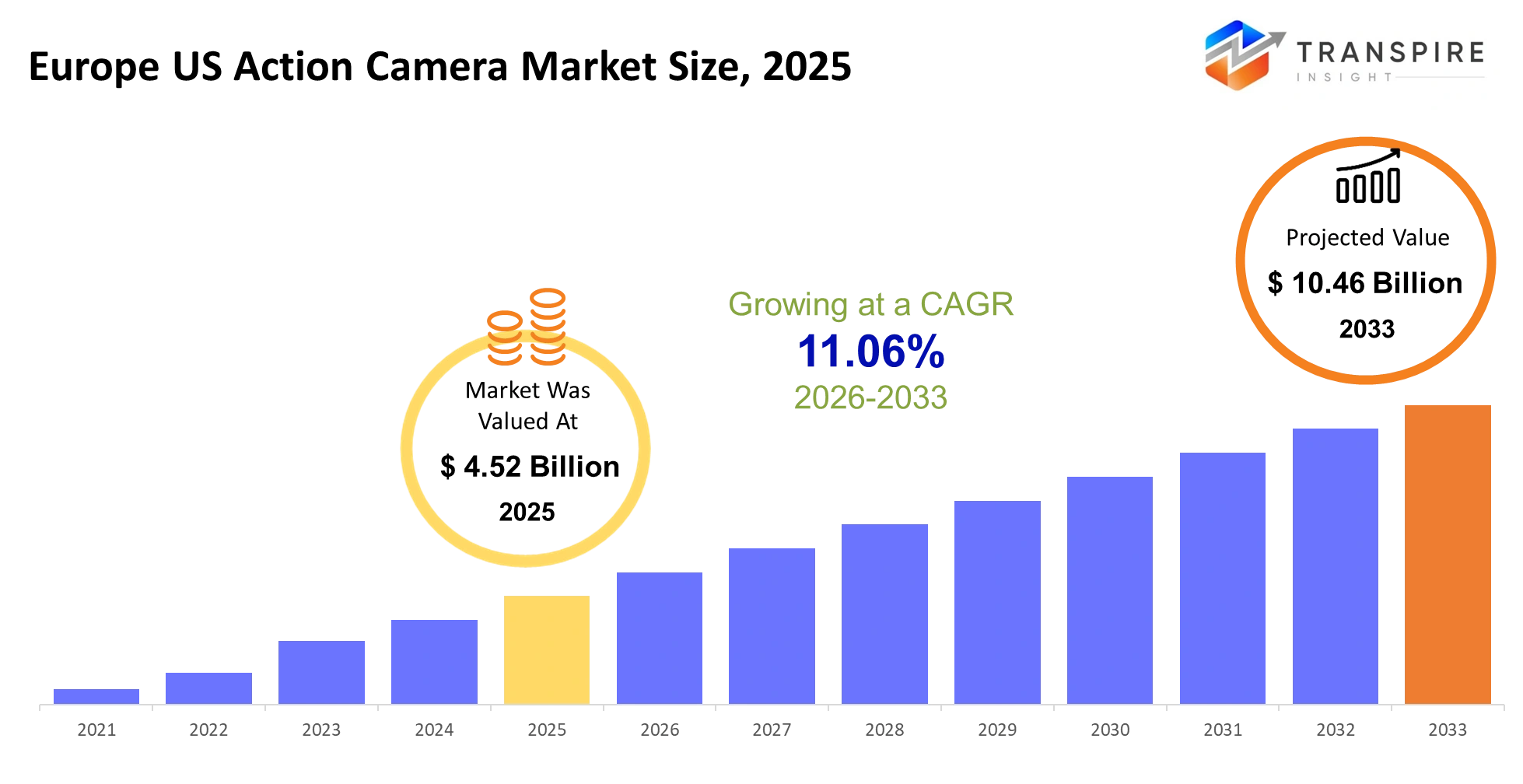
- Europe US Action Camera Market Size 2025: USD 4.52 Billion
- Europe US Action Camera Market Size 2033: USD 10.46 Billion
- Europe US Action Camera Market CAGR: 11.06%
- Europe US Action Camera Market Segments: By Type (HD Cameras, 4K Cameras, 5K Cameras, 360 Cameras, Waterproof Cameras, Others); By Application (Sports, Travel, Surveillance, Vlogging, Adventure, Others); By End-User (Consumers, Professionals, Content Creators, Athletes, Others); By Distribution (Online, Retail Stores, Brand Stores, Electronics Stores, Others).
To learn more about this report,  Download Free Sample Report
Europe US Action Camera Market Summary
The Europe US Action Camera Market was valued at USD 4.52 Billion in 2025. It is forecast to reach USD 10.46 Billion by 2033. That is a CAGR of 11.06% over the period.
The US and European markets use action cameras to record high-definition video content which can endure challenging environments that require operators to document their work without using their hands while facing dangerous situations. The market has evolved during the past three to five years from consumer video recording products to enterprise wearable systems which use artificial intelligence for stabilization and process information at the edge while providing access to real-time collaborative work through their cloud storage system that contains audit-ready footage. The need for continuous visual documentation became necessary for companies because European and US safety compliance demands and supply chain problems and pandemic remote inspection needs created new requirements which high-risk industries had to meet for their operational processes. Organizations that make action cameras part of their standard operating procedures experience increased adoption of this technology according to their actual usage needs.
Key Market Insights
- North America controls 42% of the European US Action Camera Market which will reach this level in 2025 because defense and enterprise users respectively adopt the technology.
- The European market experiences its fastest growth during the period from 2026 to 2030 because industrial safety regulations and maritime inspection processes adopt digital technologies.
- The Europe US Action Camera Market experiences rising cross-border demand because businesses adopt standardized compliance procedures and use remote monitoring systems.
- The market for helmet-mounted action cameras holds a 38% market share because these devices are now used in various industrial and tactical applications.
- The second largest market segment consists of handheld rugged cameras which businesses use for conducting inspections and performing field reporting operations.
- The segment of wearable AI-enabled cameras shows the highest growth rate until 2030 because these devices incorporate real-time analytics technology.
- The Europe US Action Camera Market uses industrial inspection as its main application which accounts for 35% of market share because safety requirements and audit requirements demand this application.
- The body-worn evidence recording system enables defense and law enforcement applications to achieve their fastest growth rate.
- Action cameras are now used in maritime operations to track compliance and monitor remote assets.
- Industrial enterprises account for approximately 40% of end-user share because they require predictive maintenance services and operational documentation.
What are the Key Drivers, Restraints, and Opportunities in the Europe US Action Camera Market?
The rapid adoption of wearable imaging technologies into industrial safety and operational documentation systems serves as the main driving force behind the Europe US Action Camera Market. The implementation of strict workplace safety regulations in Europe and the United States requires construction and energy and defense industries to produce validated visual documentation for their hazardous operations. AI-based stabilization systems and compact sensor technologies now allow action cameras to function more efficiently than before because of their reduced operational demands. Companies have begun to adopt enterprise solutions because they can now use recorded footage for compliance audits and remote supervision and training purposes which creates predictable hardware replacement schedules and continuous software revenue generation.
The Europe US Action Camera Market faces a significant obstacle because enterprise-grade rugged devices require high expenses to acquire and different industries have developed their own individual integration standards. Many organizations still operate legacy inspection systems that do not easily sync with modern cloud-based video platforms. The structural adoption gap affects mid-sized industrial firms which need to invest in digital infrastructure but lack the necessary information about system interoperability and future expenses that will arise from their digital transition process.
Organizations now have an opportunity to develop edge-AI powered action cameras which enable real-time data analysis in operational field activities. Defense agencies and offshore energy operators are testing new devices which can analyze video footage to identify security breaches without needing permanent internet access to cloud services. The US Department of Defense procurement system and European offshore wind projects are increasingly adopting this new shift because intelligent onboarding systems help them overcome their challenges with connectivity and delay issues.
What Has the Impact of Artificial Intelligence Been on the Europe US Action Camera Market?
The Europe US Action Camera Market undergoes a significant transformation because artificial intelligence uses rugged video devices to create intelligent monitoring systems that operate in industrial and maritime environments. AI-enabled cameras according to their installation in scrubber performance systems and marine emission control systems automate visual inspection of exhaust gas cleaning technology which decreases the need for manual inspections while enabling continuous compliance monitoring. The computer vision system now enables fleet operators to monitor operational parameters while identifying leaks and corrosion and automatically documenting essential evidence needed for regulatory compliance which helps with audit preparation and decreases the need for manual inspections.
Machine learning models now improve predictive maintenance capabilities through their ability to assess visual and sensor-based recordings which helps users predict equipment deterioration in propulsion systems and scrubbers and deck machinery. The shift enables operators to forecast emissions while optimizing performance because maintenance now depends on equipment condition instead of reactive maintenance. Multiple companies achieved substantial reductions in inspection duration through their various deployments which resulted in decreased operational delays that enhanced cost efficiency throughout their fleet management processes.
The ecosystem faces challenges with AI adoption because real-time connectivity at sea remains insufficient which prevents cloud processing and increases the time needed for data synchronization. The expenses of integration remain excessively high because organizations must integrate their existing maritime systems with contemporary AI video technologies while machine learning models continue to suffer from limited training data which affects their performance in offshore conditions.
Key Market Trends
- The European and US Action Camera Market experienced an industrial shift after 2022, because businesses started using continuous wearable video systems instead of manual inspection methods.
- After 2021, AI stabilization and edge processing technologies developed into tools which reduce motion distortion while enhancing industrial and maritime environment performance.
- Since 2020, US and EU regulatory authorities required construction, energy, and defense sectors to implement visual compliance recording equipment in their operational processes.
- After 2023, enterprise buyers started to reject consumer-grade devices, because they preferred to use ruggedized systems which GoPro and DJI produced.
- Between 2022 and 2025, cloud-integrated workflows experienced rapid growth which allowed field teams to monitor operations in real time while maintaining centralized audit trails.
- The adoption of predictive maintenance grew after 2023 because AI video analytics developed the ability to detect equipment wear during industrial inspections.
- Maritime operators adopted hybrid offline-AI systems because their offshore facilities provided insufficient connectivity for fleet monitoring system deployment.
- Insta360 and Sony began to compete in the market after they launched their AI-powered imaging functionalities which were designed for enterprise and defense applications.
- The Europe US Action Camera Market experienced supply chain normalization after 2023, which resulted in better component availability for businesses and decreased product development time and faster purchasing processes.
Europe US Action Camera Market Segmentation
By Type:
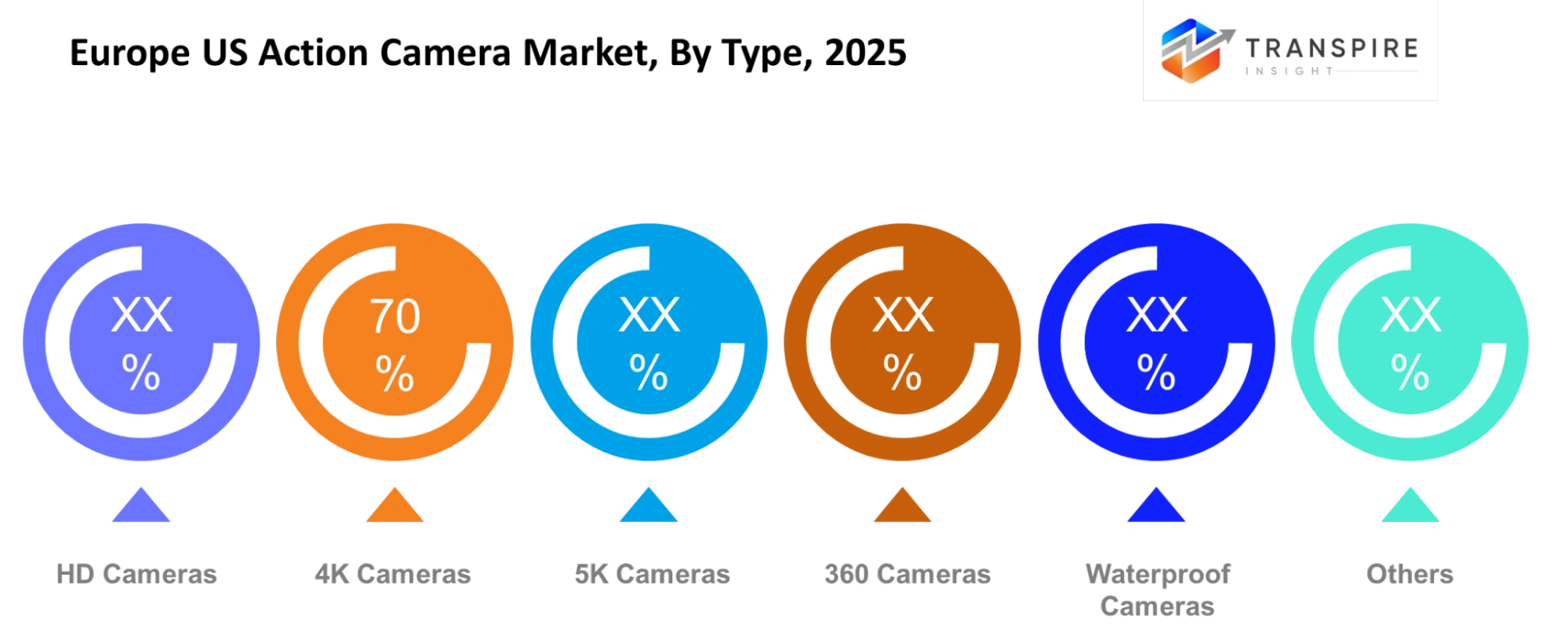
HD cameras remain essential to both the European and US Action Camera Market because of their affordable prices which allow use in basic industrial work and recreational activities. Yet enterprises now select products based on their ability to provide high-resolution imaging for inspection and surveillance tasks which require precise detail verification. 4K cameras have strengthened their market position by providing a cost-effective solution which delivers high-quality video content for field documentation and maritime inspection work.
Organizations now embrace 5K and 360 cameras because they need to record immersive content for training purposes and remote diagnostic processes. AI-based stabilization and spatial mapping technologies enable industrial facilities to analyze multiple camera angles which has become a key driver for business growth. Waterproof cameras serve as critical tools for offshore operations and defense missions because their construction allows them to function in demanding environmental situations. The market will shift toward 4K and 360 formats which will lead manufacturers to develop products with built-in AI capabilities and multiple sensor systems while diminishing the requirement for standard HD products.
To learn more about this report, Download Free Sample Report
By Application:
The Europe US Action Camera Market maintains a wide user base for sports and adventure activities which now shows stronger growth toward surveillance and industrial documentation applications. Sports usage remains stable due to consumer demand yet it no longer drives innovation cycles. Organizations now use surveillance technology to conduct continuous visual monitoring which helps them maintain safety standards and validate incidents through documented evidence.
Vlogging has reached stable development after it experienced rapid growth during the early 2020s because enterprise-grade applications now handle all new market interest. Content creators still influence design features, particularly portability and connectivity, but industrial buyers determine revenue expansion. Future growth will concentrate in surveillance and adventure safety applications, where regulatory and risk management requirements will shape product development and software integration priorities.
By End-User:
The consumer segment continues to have the largest installed user base because people have historically adopted action cameras for sports and travel recording. The share of these consumers in the Europe US Action Camera Market has decreased because businesses and professional users now purchase more cameras for their operational needs. The demand for durability and integrated analytics now pushes professionals working in inspection and defense and field services to make higher-value purchases.
Content creators and athletes maintain steady demand for high-performance cameras with advanced stabilization and connectivity features. Yet platform compatibility now plays a more significant role in purchasing decisions for these groups than the development of new hardware features. Professional users will drive future growth because organizations will start using action cameras as regular tools which will create ongoing equipment updates and software-based revenue streams for manufacturers.
By Distribution :
Online channels have become the primary distribution method because they provide customers with price information and allow worldwide access to products while customers can quickly compare different camera models in the European and United States Action Camera Market. Retailers continue to operate in markets where customers need to test products before buying, which is especially true for expensive durable equipment. Customers use brand stores and electronics stores to experience products although these locations do not function as their main retail outlets.
Digital marketplaces have strengthened control over entry-level and mid-range segments, while enterprise procurement increasingly bypasses retail entirely through direct vendor agreements. This shift reflects growing customization needs and integration requirements in industrial deployments. Future distribution will tilt further toward direct and online enterprise channels, which will decrease retail dependence and increase manufacturer control over pricing and product lifecycle and service contract management.
What are the Key Use Cases Driving the Europe US Action Camera Market?
The main application that drives the Europe US Action Camera Market needs industrial inspection and compliance documentation as its primary use case. Construction sites, energy plants, and maritime fleets depend on rugged cameras to record visual evidence which they use to fulfill US and EU safety and audit requirements. The highest demand occurs in locations where manual inspections become both expensive and dangerous and time-consuming.
Defense surveillance operations and field maintenance workflows both experience increased adoption of adjacent technology. Military and law enforcement organizations use body-worn cameras to document evidence while industrial service workers employ them to conduct remote machine diagnostics on offshore wind farms and shipping vessels. Technical training content creators generate secondary demand through their development of procedural documentation.
The new use cases that have emerged now include AI-based remote diagnostics and autonomous monitoring for equipment at offshore energy facilities. The initial tests which took place in smart ports and hydrogen-powered vessels use action cameras that combine with edge analytics technology to identify faults as they occur. The current applications continue to evolve while demonstrating substantial potential for future development.
|
Report Metrics |
Details |
|
Market size value in 2025 |
USD 4.52 Billion |
|
Market size value in 2026 |
USD 5.02 Billion |
|
Revenue forecast in 2033 |
USD 10.46 Billion |
|
Growth rate |
CAGR of 11.06% from 2026 to 2033 |
|
Base year |
2025 |
|
Historical data |
2021 - 2024 |
|
Forecast period |
2026 - 2033 |
|
Report coverage |
Revenue forecast, competitive landscape, growth factors, and trends |
|
Regional scope |
Europe (Germany, United Kingdom, France, Italy, Spain, Rest of Europe) |
|
Key company profiled |
GoPro, Sony, DJI, Garmin, Nikon, Panasonic, Canon, Olympus, Insta360, SJCAM, AKASO, Ricoh, Veho, Xiaomi, Drift Innovation. |
|
Customization scope |
Free report customization (country, regional & segment scope). Avail customized purchase options to meet your exact research needs. |
|
Report Segmentation |
By Type (HD Cameras, 4K Cameras, 5K Cameras, 360 Cameras, Waterproof Cameras, Others); By Application (Sports, Travel, Surveillance, Vlogging, Adventure, Others); By End-User (Consumers, Professionals, Content Creators, Athletes, Others); By Distribution (Online, Retail Stores, Brand Stores, Electronics Stores, Others). |
Which Regions are Driving the Europe US Action Camera Market Growth?
The US Action Camera Market in Europe sees North America as its leading region because defense procurement programs proceed with advanced safety regulations and oil, gas and construction applications of technology remain widely implemented. The United States requires companies to maintain comprehensive workplace documentation which has resulted in organizations implementing continuous video monitoring systems within dangerous work environments. Existing digital systems together with business financial resources enable fast deployment of artificial intelligence-based wearable imaging technologies. The technology ecosystem which includes both technology providers and service integrators creates ongoing demand for industrial applications and security systems.
The European revenue base maintains stability because European Union rules create regulatory consistency which is further strengthened by established maritime governance systems. The defense sector accounts for a smaller portion of industrial inspection and offshore wind energy and transport safety compliance growth in this region compared to North America. Germany and Norway and the Netherlands have established environmental monitoring systems which require organizations to maintain operational transparency. The Europe US Action Camera Market experiences steady growth because shipowners and infrastructure operators continuously invest in their operations.
The Asia Pacific region serves as the fastest expanding area because of its swift port development and implementation of digital technologies in fleet operations and growth of its offshore energy sector. The recent investments in smart ports across China and South Korea and India have accelerated the implementation of AI-based imaging systems which provide logistics and vessel monitoring solutions. The government-led maritime safety improvements and industrial automation initiatives have boosted the adoption rate of these technologies. This region provides a market entry point which offers investors maximum potential benefits from 2026 until 2033 because of its scalability.
Who are the Key Players in the Europe US Action Camera Market and How Do They Compete?
The Europe US Action Camera Market shows moderate consolidation at its top levels while mid-tier competition becomes more active as software integration and AI features now hold greater importance than hardware capabilities. Established companies use ecosystem lock-in to protect their market share while new businesses create disruptions through their development of computational imaging technology and their creation of compact devices. The main competition elements of the market now require AI-based stabilization systems and cloud-based access and industrial-grade workflow solutions to operate in both industrial applications and defense operations.
GoPro uses its ecosystem strength to compete because it provides subscription-based cloud storage together with mobile editing tools that help retain customers. The company establishes its unique market position through its integrated hardware-software system which operates effectively in rugged sports and field documentation applications while its industrial inspection partnerships pilot programs enable enterprise expansion. Sony uses its market-leading imaging sensors to create products with superior low-light performance which professional security and broadcast applications require while expanding its business through partnerships with security device manufacturers.
DJI uses its advanced stabilization technology together with drone-camera systems to develop aerial and ground imaging workflows which infrastructure inspections use. Insta360 uses its 360-degree capture technology together with its AI-powered stitching software to create differentiation which operates based on its industrial training and simulation user base. Garmin enhances its rugged outdoor and marine deployment capabilities by merging GPS tracking systems with robust imaging technology while expanding its business into specialized defense and navigation application areas.
Company List
- GoPro
- Sony
- DJI
- Garmin
- Nikon
- Panasonic
- Canon
- Olympus
- Insta360
- SJCAM
- AKASO
- Ricoh
- Veho
- Xiaomi
- Drift Innovation
Recent Development News
In April 2025, Insta360 announced the launch of its X5 360-degree action camera featuring larger sensors and improved low-light performance. The upgrade strengthens immersive capture capabilities for industrial inspection and sports applications, enhancing real-time reframing and analytics integration.
Source: https://www.insta360.com
What Strategic Insights Define the Future of the Europe US Action Camera Market?
The Europe US Action Camera Market is transforming its business model through embedded intelligence which enables cameras to operate as continuous data collection devices within industrial and defense systems. The system now requires continuous visual monitoring because it combines edge AI with strict safety rules and increased demand for visual monitoring during dangerous activities. The next 5 to 7 years will see value creation transform into a process that needs software layers and predictive analytics and enterprise asset management system connectivity for success instead of needing only hardware advancements.
The platform concentration danger exists because technology companies restrict cloud storage and AI processing and firmware system access to their cloud storage services. Industrial users will encounter dependency risks which will delay procurement processes if data governance rules or pricing changes occur. The market becomes vulnerable to disruptions when decentralized processing methods establish themselves as standard solutions.
The development of AI-powered autonomous inspection systems presents an opportunity for inspection work in offshore renewable energy facilities and smart port systems throughout Northern Europe and the US Gulf Coast. The deployments exist as pilot projects which currently evolve into compliance with decarbonization objectives and workforce automation development. The market participants need to focus on developing modular camera systems which use API connections to function with industrial AI systems because this approach enables them to secure contracts before industry standards establish full market presence.
Europe US Action Camera Market Report Segmentation
By Type
- HD Cameras
- 4K Cameras
- 5K Cameras
- 360 Cameras
- Waterproof Cameras
- Others
By Application
- Sports
- Travel
- Surveillance
- Vloggin
- Adventure
- Others
By End-User
- Consumers
- Professionals
- Content Creators
- Athletes
- Others
By Distribution
- Online
- Retail Stores
- Brand Stores
- Electronics Stores
- Others
Frequently Asked Questions
Find quick answers to common questions.
The Europe US Action Camera Market size is USD 10.46 Billion in 2033.
Key segments for the Europe US Action Camera Market are By Type (HD Cameras, 4K Cameras, 5K Cameras, 360 Cameras, Waterproof Cameras, Others); By Application (Sports, Travel, Surveillance, Vlogging, Adventure, Others); By End-User (Consumers, Professionals, Content Creators, Athletes, Others); By Distribution (Online, Retail Stores, Brand Stores, Electronics Stores, Others).
Major Europe US Action Camera Market players are GoPro, Sony, DJI, Garmin, Nikon, Panasonic, Canon, Olympus, Insta360, SJCAM, AKASO, Ricoh, Veho, Xiaomi, Drift Innovation.
The Europe US Action Camera Market size is USD 4.52 Billion in 2025.
The Europe US Action Camera Market CAGR is 11.06% from 2026 to 2033.
- GoPro
- Sony
- DJI
- Garmin
- Nikon
- Panasonic
- Canon
- Olympus
- Insta360
- SJCAM
- AKASO
- Ricoh
- Veho
- Xiaomi
- Drift Innovation
Recently Published Reports
-
Apr 2026
Bottled Water Market
Bottled Water Market Size, Share & Analysis Report By Product Type (Still Bottled Water, Carbonated Bottled Water, Functional Bottled Water, and Others), By Packaging (PET, Cans, and Others), By Sales Channel (Supermarkets/Hypermarkets, Convenience Stores/Drug Stores, Grocery Stores/Club Stores, Foodservice, and Others) and Geography (North America, Europe, Asia-Pacific, Middle East and Africa, South and Central America), 2021 - 2032
-
Apr 2026
Color Cosmetic Packaging Market
Color Cosmetic Packaging Market Size, Share & Analysis Report By Application (Mascara Packaging, Liquid Packaging, and Liquid Face), By Type (Tubes & Bottles, Pens & Markers, Compacts & Containers, and Droppers & Pumps), and Geography (North America, Europe, Asia-Pacific, Middle East and Africa, South and Central America), 2021 - 2031
-
Apr 2026
External Microphone For Camera Market
External Microphone For Camera Market Size, Share & Analysis Report By Type (Shotgun Microphone, Lavalier Microphone, and Others), By Application (Digital Camera, Professional Video Camera, and Others), and Geography (North America, Europe, Asia-Pacific, Middle East and Africa, South and Central America), 2021 - 2031
-
Apr 2026
Foot Orthotic Insoles Market
Foot Orthotic Insoles Market Size, Share & Analysis Report By Type (Pre-fabricated, and Custom-made), By Material (Thermoplastic, Composite Carbon Fiber, and Others), By Distribution Channel (Drug Stores, Hospitals & Clinics, and Others), and Geography (North America, Europe, Asia-Pacific, Middle East and Africa, South and Central America), 2021 - 2031