
Europe Tubeless Tire Market Size & Forecast:
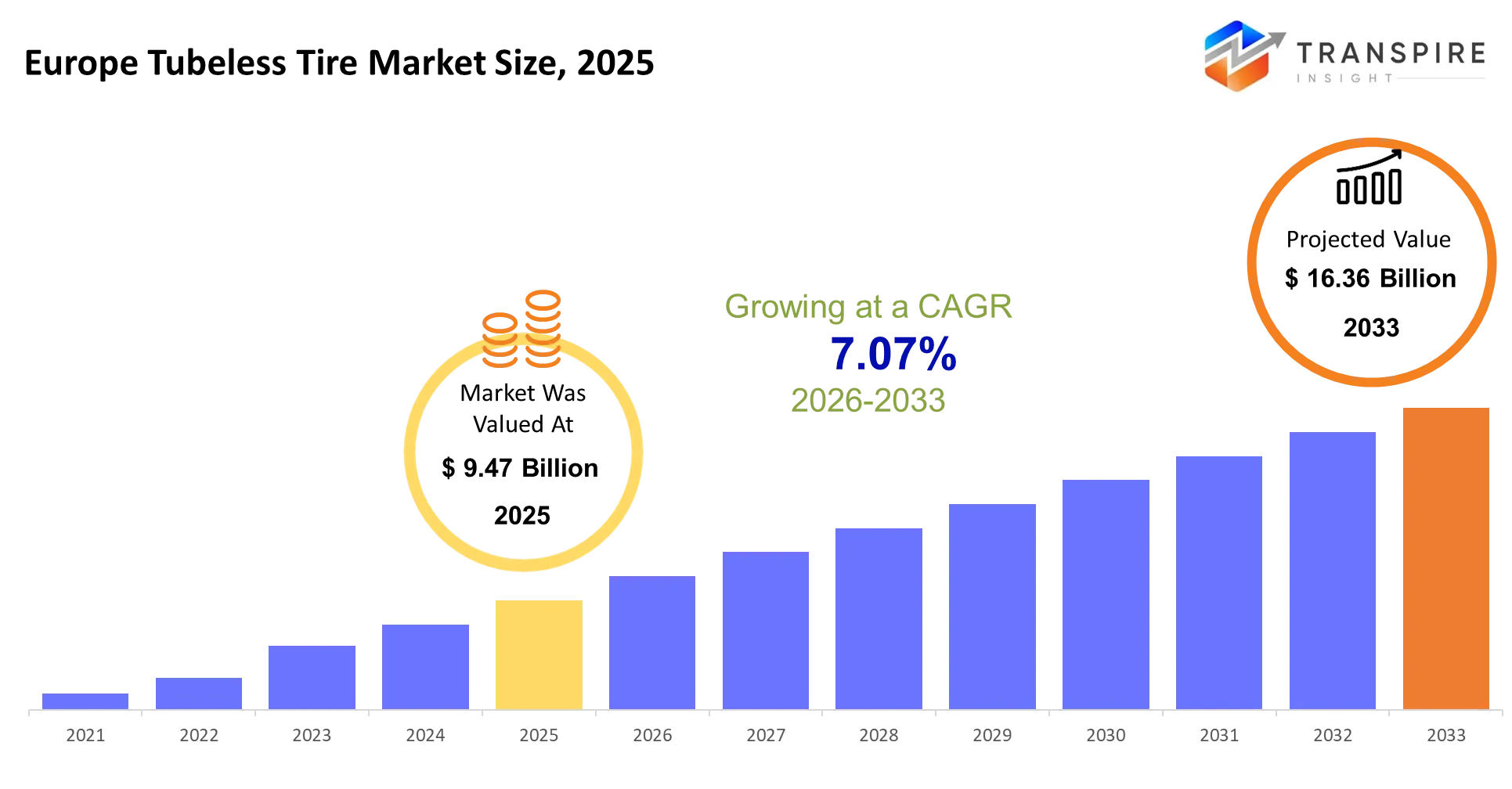
- Europe Tubeless Tire Market Size 2025: USD 9.47 Billion
- Europe Tubeless Tire Market Size 2033: USD 16.36 Billion
- Europe Tubeless Tire Market CAGR: 7.07%
- Europe Tubeless Tire Market Segments: By Type (Radial Tubeless Tires, Bias Tubeless Tires, Others); By Application (Passenger Vehicles, Commercial Vehicles, Two-wheelers, Others); By End-User (OEMs, Aftermarket, Fleet Operators, Others); By Distribution (Online, Retail, Dealers, Others)
To learn more about this report,  Download Free Sample Report
Europe Tubeless Tire Market Summary
The Europe Tubeless Tire Market was valued at USD 9.47 Billion in 2025. It is forecast to reach USD 16.36 Billion by 2033. That is a CAGR of 7.07% over the period.
The tubeless tire market in Europe creates safer and more efficient vehicle transportation through its development of air-retaining tire systems which decrease blowout dangers and increase fuel efficiency and enhance load stability for passenger vehicles and commercial truck fleets and electric vehicle charging stations. The design process for original equipment manufacturers requires them to develop vehicle systems which enable operational testing of vehicle range and durability and compliance with European Union regulations in high-speed transportation environments.
The automotive industry has undergone a complete transformation because electric vehicle systems now require tubeless radial tires which can support increased battery weight and provide reduced rolling resistance for their electric vehicle platforms which they developed during the last three to five years. The European Union emissions standards created more difficult requirements for automakers, which led to a need for them to build their efficiency improvements into all vehicle components instead of depending solely on engine enhancements. The pandemic disruptions to supply chains created raw material sourcing weaknesses, which led manufacturers to establish local production needs and create new ways to acquire materials.
The industry faces both positive and negative business challenges, which the ongoing need for OEM specifications has started to turn into two distinct business streams that operate separate from each other. The tire industry now spends substantial resources to create electric vehicle specific products and advanced digital tire tracking technologies, which will help them build enduring business agreements, while also creating dependable income streams that will benefit the entire European transportation network.
Key Market Insights
- The Europe Tubeless Tire Market sees Western Europe controlling almost half of the market because of its established OEM centers and European Union emission control standards which will be in effect until 2025.
- The fastest expanding area in Eastern Europe will experience rapid growth until 2030 because Poland and Hungary will become new centers for automotive production.
- The market share for radial tubeless tires will exceed 70% in 2025 because electric vehicles (EVs) require these tires and they provide better performance than bias tires.
- Passenger vehicles make up the main application market with 55% share because electric vehicles (EVs) show high adoption rates and urban European cities experience regular vehicle replacement.
- The commercial fleet market now builds its strongest segment because logistics growth together with predictive maintenance system usage has increased.
- OEMs maintain their position as the primary end-user group because they control more than 60% of the market because they use tire specifications during their design process for electric vehicle platforms.
- Fleet operators become an important customer base which experiences rapid growth because telematics-based tire monitoring together with lifecycle cost optimization methods.
- Michelin enhances its market presence through its development of EV-optimized tire platforms and its creation of sustainable materials used in European OEM contracts.
- Continental AG develops intelligent tire systems which operate with vehicle connectivity and predictive analytics to improve fleet performance.
- Bridgestone Corporation uses its premium certifications together with low rolling resistance solutions to attract customers in the high-end automotive market.
What are the Key Drivers, Restraints, and Opportunities in the Europe Tubeless Tire Market?
The European tubeless tire market experiences its main growth driver through two combined factors which include fast electric vehicle adoption and European Union greenhouse gas emissions regulations together with efficiency standards. The requirement for OEMs to create new vehicle platforms has emerged because of their need to develop vehicle designs that use tires which enable low rolling resistance characteristics while supporting heavier electric vehicle battery weights. The automotive industry now requires tubeless radial systems which use advanced compound materials as standard equipment for all new passenger and light commercial vehicle models. The transition results in two main effects which include increased tire volumes supplied through OEM connections and enhanced permanent demand between automobile manufacturers and tire producers.
The structural dependency of the system on unstable raw material supply systems which include synthetic rubber and performance polymers that limited global suppliers deliver causes a main constraint. The manufacturing industry faces ongoing cost volatility problems which they cannot solve through pricing strategies because their contracts with OEMs create unbreakable pricing constraints. The impact results in delayed margin expansion and limited investment capacity for developing next-generation tire technologies at mid-tier producers who lack vertical control over their operations.
Fleet operators in Northern and Western Europe are now implementing connected mobility ecosystems which provide them with an important opportunity to combine tire telematics with insurance and predictive maintenance solutions. The pilot programs in Germany and the Netherlands use real-time tire information to create better routes which decrease downtime caused by tire wear. The systems will create new revenue streams based on services as they expand their operations while product sales will decrease because of the transition to data-based tire lifecycle management solutions.
What Has the Impact of Artificial Intelligence Been on the Europe Tubeless Tire Market?
The tire manufacturing industry across Europe adopts artificial intelligence and digital technology systems for their comprehensive operations which include manufacturing, fleet management systems, and performance monitoring systems of their tubeless tire production network. The manufacturing sector uses AI-controlled production systems to enhance curing operations while they identify micro defects in radial tire designs and decrease material usage during their high production processes. Digital platforms in fleet operations use connected tire sensors to gather data which enables automatic compliance monitoring and real-time tread wear assessment and maintenance schedule adjustments that enhance visibility throughout logistics operations.
Commercial fleets use machine learning models for predictive maintenance to analyze tire pressure and temperature and vibration data which enables them to anticipate potential equipment failures before actual breakdowns happen. The system maintains optimal rolling resistance conditions which leads to decreased unplanned downtime in commercial fleets and better fuel efficiency. European logistics operators achieve directional gains between 8 to 12 percent when they use active predictive systems because it helps them extend tire life and decrease their fuel usage.
The high costs of integration together with variable data quality issues in mixed fleet systems create barriers that prevent organizations from implementing the system. The deployment of standardized sensors across many legacy vehicles remains impossible because these vehicles do not possess essential sensor compatibility. AI advantages exist only for premium original equipment manufacturer-linked fleets but they do not extend to users of aftermarket products across different sectors.
Key Market Trends
- The OEM market began to adopt tubeless radial tires for electric vehicles after 2024 because automakers decided to focus on efficient design solutions instead of enabling design modifications through aftermarket products.
- Continental and Michelin expanded their sensor-based tire systems throughout European electric vehicle markets which created competition for their digital vehicle solutions that use built-in technology.
- German and French fleet operators started using predictive maintenance systems after 2025 because they wanted to decrease their dependence on emergency tire replacement procedures.
- The European Union implemented stricter sustainability regulations in 2025 which led to increased demand for low rolling resistance materials used in both passenger and commercial vehicle applications.
- The manufacturing industry in Eastern Europe expanded during the period after 2024 which led to changes in tire sourcing practices that favored economical production centers located in European Union supply networks.
- Goodyear and Hankook developed their OEM connections in 2025 which demonstrated their transition from selling individual products to creating agreements for extended maintenance solutions.
- The unpredictable pricing of raw materials used in synthetic rubber manufacturing during 2025 forced producers to create new purchasing methods while establishing multiple new supplier connections.
- The market for online tire sales started to grow steadily after 2024 but tire dealers maintained their market leadership because they could offer both installation services and fleet maintenance support.
- The implementation of smart tire technology into connected mobility pilot projects reached new heights during 2026 because of autonomous vehicle testing operations and telematics systems used for insurance purposes.
Europe Tubeless Tire Market Segmentation
By Type:
The European tubeless tire market is mainly dominated by radial tubeless tires because these tires offer better durability and higher fuel efficiency and they can be used with both high-speed vehicles and electric vehicle systems. The strong OEM preference for passenger and commercial vehicle production leads to ongoing dominance of this technology because radial construction produces both lower rolling resistance and extended tire lifespan. The market share of bias tubeless tires remains limited because these tires are used in specific cost-sensitive applications that require heavy-duty performance but need to minimize initial expenses. The market for advanced tire constructions remains restricted but specialty mobility applications show an increasing demand for these types of products.
Electrification and EU efficiency standards which promote energy-efficient operations with lower greenhouse gas emissions drive the expansion of radial technology. The performance-based procurement models which fleet operators and OEMs adopt impose structural obstacles for bias tires. The development of smart radial systems and eco-friendly materials enables this segment to maintain its market leadership position.
The European market will experience increasing adoption of EVs which will lead to radial tubeless tires establishing their market dominance throughout the forecast period. The development process will involve manufacturers focusing on creating advanced radial designs which will incorporate both sensor technology and low-rolling resistance materials. Technology-based radial developments will provide investors with better financial returns when compared to traditional bias manufacturing operations.
By Application:
The application categories which include passenger vehicles, commercial vehicles, two-wheelers and other vehicles show their distribution from their respective areas of application. The passenger vehicle category holds the most market share because Western Europe contains many vehicles and manufacturers operate extensive production facilities. The segment maintains constant demand because businesses replace equipment andbecause government regulations require better fuel efficiency. The commercial vehicle market follows the passenger vehicle market because EU border freight operations and logistics network growth drive demand. The two-wheeler market and other markets maintain their presence in urban mobility zones which exist throughout different regions.
Electric vehicle development depends on passenger vehicle growth because tubeless systems provide essential performance and safety requirements. Fleet operators drive commercial vehicle requirements because they need to balance equipment life with their need to perform maintenance tasks. The light commercial vehicle market experiences growth because urban areas face traffic problems and because deliveries to final destinations have become more common.
The future market demand will move toward intelligent tire systems which will become necessary for both passenger and commercial vehicle sectors. The logistics industry will create stable revenue through its operations while passenger electric vehicles will bring new technological developments. Manufacturers will increasingly align product development with fleet telematics and energy efficiency requirements.
To learn more about this report, Download Free Sample Report
By End-User:
The customers of the company include original equipment manufacturers and aftermarket businesses and fleet operators and other groups. OEMs hold the leading position because they use tubeless tires as a fundamental component for their vehicle designs which need to meet government regulations. Automotive manufacturers in Germany, France and Italy control specification standards to create continuous demand from their manufacturing processes. The market for aftermarket products maintains its importance but it operates as a secondary market because customers require replacements after their products experience normal usage. Fleet operators represent a growing strategic segment with structured procurement behavior.
The demand from OEMs increases because they establish electric vehicle platforms while they work together with tire manufacturers on joint development projects. Fleet operators improve their market power through their use of centralized procurement methods and data-based systems for equipment upkeep. The aftermarket sector depends on two factors which include the size of the vehicle parc and the times when vehicles need to be replaced instead of new product developments.
The main method for creating tire innovations will shift to tire manufacturers working together with original equipment manufacturers. Fleet operators will acquire more negotiating strength because they will use predictive analytics and their business operations will expand. Investors will increasingly focus on OEM-linked contracts for stable long-term returns.
By Distribution:
The dealers handle most of the distribution process because they maintain strong connections with OEM-aligned suppliers and fleet maintenance networks. The retail channels continue to exist as a valid method for passengers to obtain vehicle replacements in both urban and suburban areas. The online channel for distributing products shows limited reach at present but it is starting to grow for standardized tire products. The other channels have a minimal impact on acquiring specialized products or making bulk purchases.
The dealer strength derives from three core elements: service integration, installation support, and OEM certification alignment. Retail channels benefit from two factors: products that customers can access immediately and their trust in physical product inspection. Online growth happens because customers see clear pricing details and experience easy shipment processes for fixed tire products.
The future distribution system will develop into a hybrid model that combines dealer services with online ordering systems. Fleet buyers will bypass traditional retail in favor of direct and contract-based procurement. Digital penetration will change how businesses price their products but it will not eliminate service-based distribution methods.
What are the Key Use Cases Driving the Europe Tubeless Tire Market?
The primary application in Europe involves passenger vehicles and light commercial vehicles which use tubeless tires as standard equipment because they provide better safety and fuel efficiency and enable safe high-speed highway travel. The strong OEM integration which exists among German French and Italian automotive manufacturerswill create ongoing market requirements because electric vehicle adoptionwill growand manufacturers need low rolling resistance tire systems to achieve longer driving distances.
The logistics sector and last-mile delivery services are now using secondary adoption which allows them to operate their vehicles while minimizing downtime and maintaining high fuel efficiency. Fleet operators are now choosing tubeless radial designs which come with built-in monitoring systems because these features help them minimize equipment downtime and enhance their predictive maintenance capabilities. The market for premium SUV and performance vehicles continues to expand because European customers demand vehicles that offer comfort and precise handling and the ability to drive in various European weather conditions.
The new use cases involve connected tires which have sensor systems that enable telematics-based mobility servicesand driverless vehicle testing operations. The industrial electric mobility sector within ports and logistics hubs is starting to implement advanced tubeless systems which provide durability for their heavy-duty operating cycles.
|
Report Metrics |
Details |
|
Market size value in 2025 |
USD 9.47 Billion |
|
Market size value in 2026 |
USD 10.14 Billion |
|
Revenue forecast in 2033 |
USD 16.36 Billion |
|
Growth rate |
CAGR of 7.07% from 2026 to 2033 |
|
Base year |
2025 |
|
Historical data |
2021 - 2024 |
|
Forecast period |
2026 - 2033 |
|
Report coverage |
Revenue forecast, competitive landscape, growth factors, and trends |
|
Regional scope |
Europe (Germany, United Kingdom, France, Italy, Spain, Rest of Europe) |
|
Key company profiled |
Michelin, Bridgestone, Goodyear, Continental, Pirelli, Yokohama, Hankook, Kumho, Apollo Tyres, CEAT, Toyo Tires, Nokian Tyres, Sumitomo Rubber, Cooper Tire, MRF |
|
Customization scope |
Free report customization (country, regional & segment scope). Avail customized purchase options to meet your exact research needs. |
|
Report Segmentation |
By Type (Radial Tubeless Tires, Bias Tubeless Tires, Others); By Application (Passenger Vehicles, Commercial Vehicles, Two-wheelers, Others); By End-User (OEMs, Aftermarket, Fleet Operators, Others); By Distribution (Online, Retail, Dealers, Others) |
Which Regions are Driving the Europe Tubeless Tire Market Growth?
The European tubeless tire market continues to operate its main business activities from Western Europe because the region has multiple original equipment manufacturers and a complete automotive development system. The countries of Germany, France, and Benelux together produce vehicles at high rates which creates an essential need for tubeless radial tires used in original equipment manufacturing. The EU establishes strict emissions limits together with efficiency standards which compel automotive companies to widely implement tire systems designed for low rolling resistance and electric vehicle operation. The region establishes a benefit from its established research and development network together with its complete supplier system which drives faster product development and early technology adoption for advanced tire systems.
Northern Europe acts as a stable and predictable revenue contributor rather than a high-growth leader. The Nordics together with specific UK regions experience extended replacement periods because of their structured fleet management systems and their uniform equipment upkeep procedures. The extreme weather conditions create constant demand for both passenger and commercial all-season and winter-ready tubeless tires which require high performance. People in this area maintain their vehicles during economic downturns because they possess strong regulatory compliance practices and high vehicle ownership levels.
Eastern Europe exhibits its highest growth rates because manufacturers increase their production capabilities and distribution networks at a fast pace. The countries of Poland, Hungary and Romania provide automotive production companies with better labor cost advantages together with their access to Western EU supply routes. The recent improvements to highway and industrial corridor systems have enhanced freight transportation which results in higher commercial tire usage. The region's growth acceleration creates a strategic entry opportunity for tire manufacturers and investors who want to achieve volume growth through original equipment manufacturer partnerships until 2033.
Who are the Key Players in the Europe Tubeless Tire Market and How Do They Compete?
The Europe tubeless tire market is moderately consolidated, dominated by a few global manufacturers that control most OEM supply.Competition between companies now centers on technology integration whereas companies previously relied on product price as their main competitive factor. Incumbents defend share through OEM collaboration and fleet service ecosystems, while challengers pressure margins with faster product cycles and cost-efficient production.
Michelin uses high-efficiency compound technology and EV-specific tire platforms as its unique business approach because these products enhance vehicle range and tire longevity. Michelin strengthens its position through deep OEM integration in Europe, co-developing sensor-enabled tire systems for EV safety and efficiency. Continental AG relies on tight collaboration with European automakers, embedding intelligent tire systems into EV platforms. Bridgestone Corporation focuses on premium approvals and sustainable material development, securing access to high-value vehicle programs.
Goodyear Tire & Rubber Company expands through European fleet partnerships that bundle tires with predictive maintenance services, which create ongoing income streams for the company. Hankook Tire & Technology gains share by targeting OEM contracts and transferring motorsport technology into consumer tires, which FIA-linked innovation exposure helps to establish its premium market position.
Company List
- Michelin
- Bridgestone
- Goodyear
- Continental
- Pirelli
- Yokohama
- Hankook
- Kumho
- Apollo Tyres
- CEAT
- Toyo Tires
- Nokian Tyres
- Sumitomo Rubber
- Cooper Tire
- MRF
Recent Development News
In January 2026, Goodyear Tire & Rubber Company announced the extension of its long-standing partnership with TIP Group for a further five years. The agreement strengthens Goodyear’s role in supplying commercial fleet tires across Europe, with increasing emphasis on sustainability and advanced tire performance solutions used in fleet operations that commonly include tubeless truck tire systems.https://news.goodyear.eu
In January 2026, Hankook Tire & Technology became a Global Partner of the FIA, reinforcing its motorsport and mobility innovation strategy across Europe. The partnership focuses on sustainable and high-performance tire development, including advanced racing and road tire technologies that feed into consumer and performance segments where tubeless radial systems are widely used.https://www.hankooktire-mediacenter.com
What Strategic Insights Define the Future of the Europe Tubeless Tire Market?
The Europe tubeless tire market is undergoing a fundamental change which establishes technology as the primary driver for creating efficient tire systems. this change results from two main factors which are the electrification of transportation and the European Union's stricter sustainability standards that mandate tires to have low rolling resistance and high durability and reduced environmental impact throughout their entire lifespan. The adoption process during the next 5 to 7 years will experience more influence from original equipment manufacturer specification choices which electric and premium vehicle platforms implement than from replacement cycles. The default design of tubeless advanced radial systems transforms into standard equipment which manufacturers will deploy within their vehicle systems. The danger exists that raw material prices will fluctuate because of political control over synthetic rubber and high-performance polymer production. This situation will create price instability for these materials even when their demand continues to increase. The development of smart tire sensor systems which work with predictive maintenance tools presents a new market opportunity. This technology remains limited to certain areas in Europe but it will gain traction because of increased demand for connected fleets and insurance-based telematics systems. Tire manufacturers need to focus their strategic efforts on establishing joint development projects with original equipment manufacturers which will lead to electric vehicle platform development. This process will create comprehensive design solutions that vehicle manufacturers will implement before market pressures cause product standardization.
Europe Tubeless Tire Market Report Segmentation
By Type
- Radial Tubeless Tires
- Bias Tubeless Tires
- Others
By Application
- Passenger Vehicles
- Commercial Vehicles
- Two-wheelers
- Others
By End-User
- OEMs
- Aftermarket
- Fleet Operators
- Others
By Distribution
- Online
- Retail
- Dealers
- Others
Frequently Asked Questions
Find quick answers to common questions.
The Europe Tubeless Tire Market size is USD 16.36 Billion in 2033.
Key Segments for the Europe Tubeless Tire Market are By Type (Radial Tubeless Tires, Bias Tubeless Tires, Others); By Application (Passenger Vehicles, Commercial Vehicles, Two-wheelers, Others); By End-User (OEMs, Aftermarket, Fleet Operators, Others); By Distribution (Online, Retail, Dealers, Others).
Major Europe Tubeless Tire Market Players are Michelin, Bridgestone, Goodyear, Continental, Pirelli, Yokohama, Hankook, Kumho, Apollo Tyres, CEAT, Toyo Tires, Nokian Tyres, Sumitomo Rubber, Cooper Tire, MRF.
The Current Europe Tubeless Tire Market size is USD 9.47 Billion in 2025.
The Europe Tubeless Tire Market CAGR is 7.07% from 2026 to 2033.
- Michelin
- Bridgestone
- Goodyear
- Continental
- Pirelli
- Yokohama
- Hankook
- Kumho
- Apollo Tyres
- CEAT
- Toyo Tires
- Nokian Tyres
- Sumitomo Rubber
- Cooper Tire
- MRF
Recently Published Reports
-
Apr 2026
ATV & UTV Market
ATV & UTV Market Size, Share & Analysis Report By Type (ATV, and UTV), By Variants (Less Than 400 CC, 400 CC To 800 CC, and More Than 800 CC), and Geography (North America, Europe, Asia-Pacific, Middle East and Africa, South and Central America), 2021 - 2031
-
Apr 2026
Automotive Central Gateway Module Market
Automotive Central Gateway Module Market Size, Share & Analysis Report By Type (Ethernet Central Gateway Module, CAN Central Gateway Module, LIN Central Gateway Module, and FlexRay), By Application (Powertrain Control, Body Control, Infotainment System, Advanced Driver Assistance Systems (ADAS), and Others), By End User (Passenger Vehicles, and Commercial Vehicles), and Geography (North America, Europe, Asia-Pacific, Middle East and Africa, South and Central America), 2021 - 2031
-
Apr 2026
Automotive Engine Oil Filter Market
Automotive Engine Oil Filter Market Size, Share & Analysis Report By Filter Type (Fuel Filter, Engine Oil Filter, Hydraulic Oil Filter, and Others), By Filter Media (Cellulose, Synthetic, and Micro), By Sales Channel (OEMs, and Aftermarket), By Vehicle Type (Passenger Cars, Light Commercial Vehicles, Heavy Duty Trucks, Buses and Coaches, and Off-road Vehicles), and Geography (North America, Europe, Asia-Pacific, Middle East and Africa, South and Central America), 2021 - 2031
-
Apr 2026
Automotive Parts Aluminium Die Casting Market
Automotive Parts Aluminium Die Casting Market Size, Share & Analysis Report By Production Process (Pressure Die Casting, Vacuum Die Casting, Squeeze Die Casting, Gravity Die Casting), By Application (Body Parts, Engine Parts, Transmission Parts, Battery And Related Components, Other Application Types), and Geography (North America, Europe, Asia-Pacific, Middle East and Africa, South and Central America), 2021 - 2031
Our Clients