

Europe Traction Inverter Market Size & Forecast:
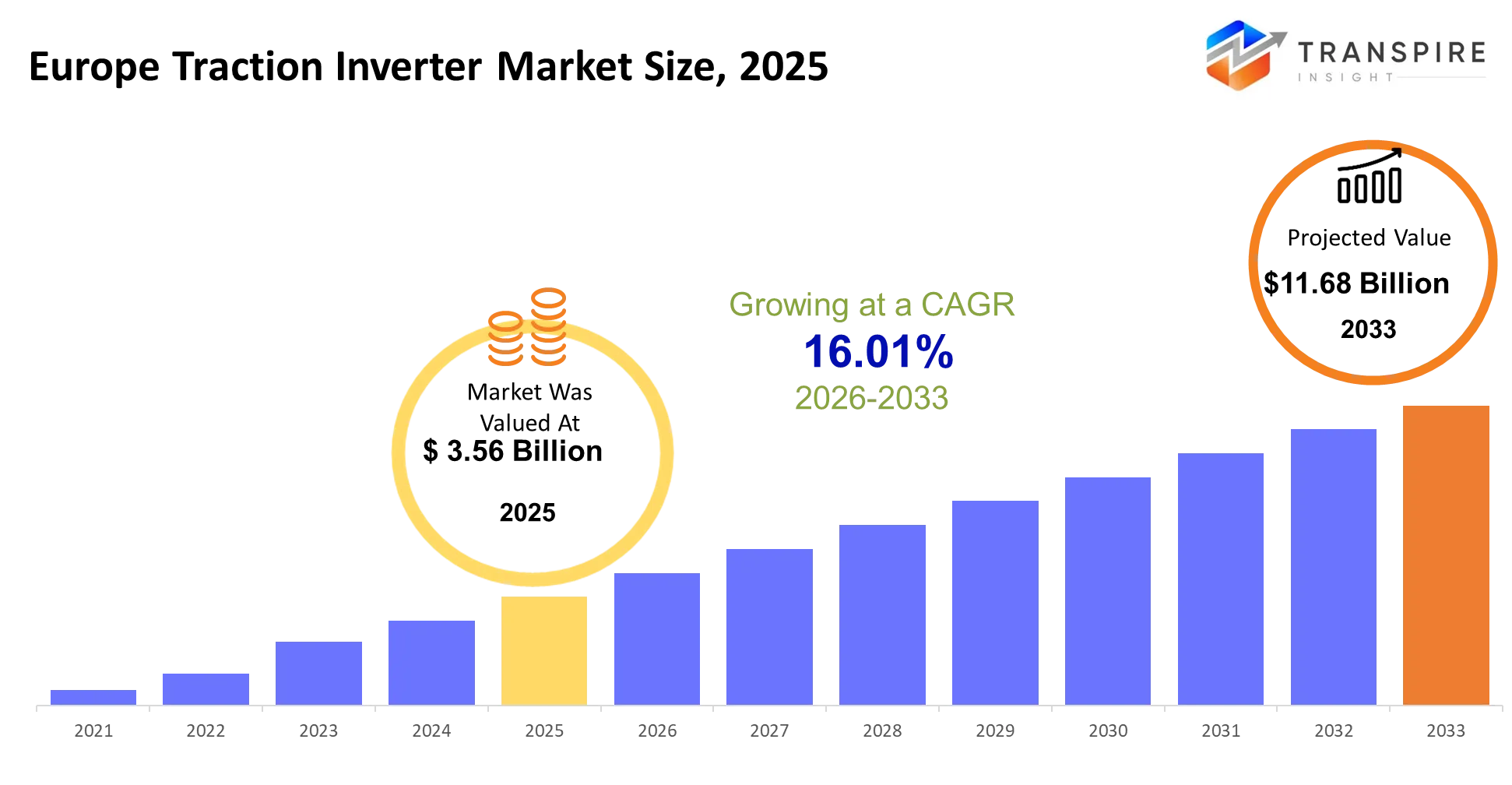
- Europe Traction Inverter Market Size 2025: USD 3.56 Billion
- Europe Traction Inverter Market Size 2033: USD 11.68 Billion
- Europe Traction Inverter Market CAGR: 16.01%
- Europe Traction Inverter Market Segments: By Type (IGBT-based, SiC-based, MOSFET-based, Others); By Application (Electric Vehicles, Railways, Industrial Drives, Others); By End-User (Automotive OEMs, Railway Operators, Industrial Firms, Others); By Power Rating (Low, Medium, High, Others)
To learn more about this report,  Download Free Sample Report
Europe Traction Inverter Market Summary
The Europe Traction Inverter Market was valued at USD 3.56 Billion in 2025. It is forecast to reach USD 11.68 Billion by 2033. That is a CAGR of 16.01% over the period.
The traction inverter market in Europe depends on power electronics systems which control and optimize electric motor operation for rail systems and electric vehicles and heavy industrial machinery. The systems evaluate their performance through two factors which include their ability to make trains move faster and their need for electric power to make trains operate. The market has moved away from silicon-based designs during the last three to five years because companies now use silicon carbide (SiC) and high-voltage systems to achieve better energy efficiency and thermal management. The European Union Green Deal and stricter emissions regulations have sped up the development of electric systems for rail and transportation networks whereas the 2022 energy crisis which emerged from the Russia Ukraine war forced operators to use energy-efficient systems to save money and decrease their need for electricity. Forces which operate in the market have caused original equipment manufacturers to spend more on inverter systems which has resulted in faster product updates and increased business development throughout Europe.
Key Market Insights
- Western Europe controls 45 to 50 percent of the Europe Traction Inverter Market in 2025 because its advanced rail infrastructure and electric vehicle usage.
- The fastest growth in Eastern Europe occurs during the 2025 to 2030 period because rail fleet modernization and EU-sponsored electrification projects proceed.
- The core revenue sources for the Europe Traction Inverter Market stem from Germany France and the UK which maintain robust OEM networks.
- The rail system IGBT-based traction inverters represent 55 percent of the market share which will exist in 2025.
- The silicon carbide SiC inverters segment holds the second biggest market share which is expanding in high-efficiency electric vehicle and metro system uses.
- The SiC traction inverter segment will experience its fastest growth until 2030 because of 20 to 30 percent efficiency improvements and better thermal performance.
- The Europe Traction Inverter Market operates mainly through rail transportation which holds 60 percent market share that benefits from metro system growth and high-speed rail system development.
- The zero-emission city transport mandates drive the electric buses and commercial electric vehicle fleets to become the fastest-growing application segment.
- The Europe Traction Inverter Market receives more than 50 percent market share from operators who update their fleets through ongoing modernization initiatives.
- Electric vehicle manufacturers represent the fastest-growing end-user group because EU emission targets and battery-electric platform expansion drive their growth.
What are the Key Drivers, Restraints, and Opportunities in the Europe Traction Inverter Market?
The European traction inverter market grows because rail systems and commercial transportation systems have started to implement electric technologies at a higher pace. The EU has established strict emissions standards which push operators to switch from diesel-powered systems towards electric traction systems. The industry now demands more high-efficiency inverters especially for SiC-based systems which help reduce energy losses while boosting train operation time. The traction system order books from original equipment manufacturers in Germany France and Nordic countries show growth which provides suppliers with improved long-term revenue forecasting capabilities.
The Europe Traction Inverter Market faces its primary constraint through the difficulties which companies encounter when they try to integrate and certify their traction power electronics systems. The systems need to comply with multiple safety requirements which include both electromagnetic compatibility and rail interoperability standards that differ between nations thus extending their development period. The structural barrier prevents commercial operations from starting while it raises testing expenses and it hinders new companies from using their latest semiconductor advancements to get their products into the market. The strong demand for products leads to revenue delays which occur because companies must first build their market presence.
The rapid growth of silicon carbide traction inverter technology provides an emerging business opportunity because it enables future rail and electric bus network development. The countries of France and the UK are spending large amounts of money to develop metro systems and create zero-emission public transport routes which will help their cities build sustainable transport solutions. The current modernization initiatives in Paris and London which require lightweight high-efficiency inverter systems create a distinct growth opportunity for technology-driven suppliers operating in the Europe Traction Inverter Market.
What Has the Impact of Artificial Intelligence Been on the Europe Traction Inverter Market?
The Europe Traction Inverter Market experiences operational intelligence transformation through artificial intelligence and advanced digital systems which convert propulsion and power control units into data-driven systems that replace their existing static hardware. AI-enabled controllers in rail and industrial traction applications now operate automatic inverter load balancing that adjusts torque output and voltage conversion based on route gradients and passenger load and energy recovery conditions. This system achieves better performance through decreased need for manual control while maintaining system capacity to adapt to different operating situations.
The organization implements machine learning models for predictive maintenance tasks which use inverter telemetry data to identify early signs of semiconductor degradation and thermal stress and harmonic distortion. Users of these systems reported directional enhancements which included unplanned downtime reductions between 10 and 15 percent and energy efficiency improvements that resulted from better switching cycle management. AI-based analytics in fleet operations help optimize performance by predicting energy consumption patterns which enable better scheduling and reduce peak load strain on power infrastructure throughout rail networks.
The process of adoption faces a major obstacle because organizations encounter difficulties when they need to implement systems which require complex integration while actual data from their operations shows unpredictable quality. The majority of existing traction systems cannot use standardized sensor frameworks because they require their current systems to operate. The existing system experiences two major challenges because it needs continuous data flow which faces interruptions at rail junctions and emergency situations and needs real-time data to function correctly. The Europe Traction Inverter Market experiences deployment challenges which stem from model training accuracy issues and operational deployment delays which affect older fleet modernization initiatives.
Key Market Trends
- The use of IGBT-based traction systems has decreased since 2020 because Siemens Mobility and ABB developed new rail systems which use silicon carbide technology instead of IGBT systems.
- The EU Green Deal regulations established after 2021 require rail operators to purchase complete electric traction systems instead of diesel hybrid systems for major rail corridors.
- Between 2022 and 2025 Siemens Mobility and Alstom developed new modular digital traction systems which replaced their existing inverter systems.
- The 2022 energy crisis forced operators to focus on efficiency improvements which led to faster implementation of traction inverter system updates throughout Western European train systems.
- ABB established predictive maintenance systems after 2023 which use sensor-linked inverter equipment to decrease operational interruptions in high-frequency metro system operations.
- Rail manufacturers began to use lifecycle efficiency models for their procurement process after 2021 which led to increased interest in low-loss inverter solutions.
- Eastern European countries introduced rail modernization funding in 2022 which enabled regional networks to adopt advanced traction inverter technologies for the first time.
- Hitachi Energy and Mitsubishi Electric expanded their R&D spending on silicon carbide modules because they want to establish a presence in high-efficiency traction technology markets since 2023.
- Traction systems started to use digital twin technology after 2024 which allowed operators to test inverter systems through simulation before actual installation which resulted in lower maintenance expenses.
Europe Traction Inverter Market Segmentation
By Type:
The IGBT-based traction inverters maintain their market leadership in Europe because they have been used in rail and industrial propulsion systems for a long time which accounts for almost 50 percent of current installed systems. Their position as market leaders has been strengthened by established OEM supply chains which demonstrate their ability to function reliably under extreme conditions that exist in traditional rail systems used by Germany France and Italy.
The SiC-based systems represent the most dynamic growth path because they achieve efficiency improvements of 30 percent and they deliver better thermal performance. The 2022 energy price fluctuations demonstrated that these systems provide lower lifetime expenses which led rail operators and electric vehicle producers to start buying them. The MOSFET-based systems and niche architectures can only operate at reduced power levels because they face difficulties when trying to expand their capacity for high traction power systems.
The market forecast indicates that SiC technology will progressively reduce IGBT market share during new rail and electric mobility platform developments. To compete successfully in the European traction inverter market manufacturers must focus on developing new semiconductor technologies and establishing local production facilities.
By Application:
The Europe Traction Inverter Market sees railways make up the largest share because of extensive metro system development together with high-speed rail projects and current fleet upgrades. Public funding combined with asset replacement cycles that last for extended periods creates strong support for this market dominance throughout Western Europe.
The fastest-growing application area for electric vehicles exists because regulations ban internal combustion engine sales while commercial fleets undergo quick electrification. Industrial drives maintain constant demand but experience slower growth because users implement incremental efficiency upgrades instead of deploying system-wide changes.
The future expansion of urban mobility projects will focus on electrifying public transportation systems especially through electric buses and regional rail corridors. Inverter manufacturers must develop systems which can be installed on both rail and road systems because this European Traction Inverter Market requires them to create modular systems that can be expanded.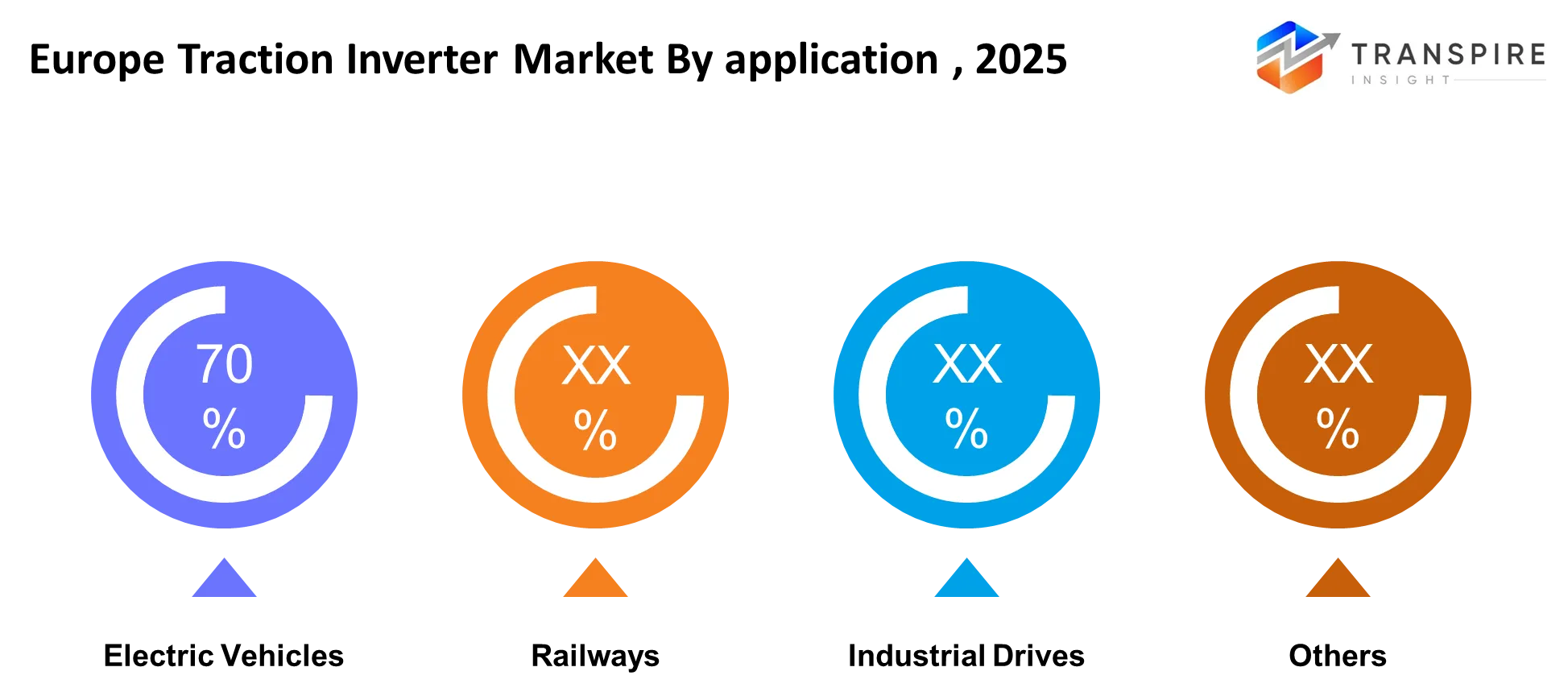
To learn more about this report, Download Free Sample Report
By End-User:
The Europe Traction Inverter Market maintains its largest end-user segment through railway operators who continue to invest in rail electrification while they require replacement parts for their aging rolling stock. The long-term procurement contracts between established OEMs and this segment create stability for the market.
The automotive OEMs in Germany France and Central Europe have increased their market share because electric vehicle production scales up. Industrial firms show moderate adoption, primarily focused on energy efficiency upgrades in heavy machinery and automated logistics systems.
The gap between automotive manufacturers and railway operators will decrease because electric vehicle systems will standardize their traction inverter designs. The European Traction Inverter Market will experience increased supplier competition because suppliers will develop products that work across different industries.
The Power Rating:
The Europe Traction Inverter Market finds its primary usage through medium and high-power traction inverters which operate in rail systems and heavy electric mobility applications. The segments require infrastructure-scale deployments which need high torque together with their capacity to maintain load performance over extended periods.
Low-power systems function in specific applications which require light electric vehicles and auxiliary industrial systems to have compact design and cost-efficient performance instead of achieving maximum output. The market for these products continues to grow at a constant pace because users choose to deploy them in forceful traction systems.
The demand for high-power inverters will grow substantially because high-speed rail systems and freight electrification projects will expand throughout Europe. Manufacturers will need to develop new cooling methods together with wide-bandgap semiconductor technologies to achieve superior performance and reliability in their upcoming systems.
What are the Key Use Cases Driving the Europe Traction Inverter Market?
The main reason people adopt rail transport technology because electrified metro systems and high-speed trains and regional rail networks need traction inverters to achieve exact motor control and power saving. Rail electrification has become the most essential method because public funds and European Union emissions regulations force operators to remove their diesel train systems.
Electric buses and commercial vehicle fleets represent expanding applications, particularly among automotive OEMs and urban transit authorities. Cities such as Paris and Berlin have accelerated zero-emission bus deployments, increasing reliance on compact, high-efficiency inverter systems for stop-and-go urban duty cycles.
Advanced inverters enable hydrogen-powered trains and hybrid rail systems to handle energy input from both fuel cells and batteries. Eastern European countries project strong electrification growth for freight rail despite current infrastructure conditions.
|
Report Metrics |
Details |
|
Market size value in 2025 |
USD 3.56 Billion |
|
Market size value in 2026 |
USD 4.13 Billion |
|
Revenue forecast in 2033 |
USD 11.68 Billion |
|
Growth rate |
CAGR of 16.01% from 2026 to 2033 |
|
Base year |
2025 |
|
Historical data |
2021 - 2024 |
|
Forecast period |
2026 - 2033 |
|
Report coverage |
Revenue forecast, competitive landscape, growth factors, and trends |
|
Regional scope |
Europe (Germany, United Kingdom, France, Italy, Spain, Rest of Europe) |
|
Key company profiled |
Infineon, Mitsubishi Electric, Hitachi, Toshiba, ABB, Siemens, Bosch, Denso, NXP, STMicroelectronics, Renesas, Fuji Electric, ON Semiconductor, Texas Instruments, Danfoss |
|
Customization scope |
Free report customization (country, regional & segment scope). Avail customized purchase options to meet your exact research needs. |
|
Report Segmentation |
By Type (IGBT-based, SiC-based, MOSFET-based, Others); By Application (Electric Vehicles, Railways, Industrial Drives, Others); By End-User (Automotive OEMs, Railway Operators, Industrial Firms, Others); By Power Rating (Low, Medium, High, Others) |
Which Regions are Driving the Europe Traction Inverter Market Growth?
Western Europe leads the regional landscape due to a tightly enforced policy environment and mature rail electrification infrastructure. The implementation of strict emissions targets by Germany, France, and the UK requires all rail networks to switch to electric propulsion systems. The existing fleet of metro trains, high-speed trains, and regional trains requires continuous replacement of advanced traction inverter systems. The industry maintains its competitive advantage through a strong network of original equipment manufacturers and component suppliers who work with public funding initiatives to speed up their development of new technologies.
Northern Europe operates as a stable contributor because its performance depends more on steady operations than on high output levels. The countries of Sweden and the Netherlands work to achieve long-term energy efficiency goals through their efforts to create integrated energy systems, which result in consistent demand for advanced inverter technologies. This area maintains its current electrified systems through the use of digital monitoring tools and predictive maintenance systems, which Western Europe uses to expand its network. Northern Europe generates dependable income streams because its infrastructure financing practices follow a structured regulatory system.
Eastern Europe shows the fastest growth momentum, driven by recent rail modernization programs and EU-backed infrastructure funding after 2022. Poland and Romania have increased their electrification efforts to upgrade their outdated rail systems, which has resulted in new requirements for advanced traction technologies. The industry has moved away from its reliance on diesel engines to adopt widespread electric transportation. The region will experience strong business opportunities from new companies and technology providers who will develop cost-effective solutions that can expand their operations between 2026 and 2033.
Who are the Key Players in the Europe Traction Inverter Market and How Do They Compete?
The Europe Traction Inverter Market displays moderate consolidation because major engineering companies operate rail and industrial projects while small firms concentrate on specific electrification solutions. The existing companies maintain market control through their established relationships with original equipment manufacturers and their certified products which fulfill all European railway requirements. Businesses now compete primarily through superior technology which includes advancements in semiconductor performance and thermal control systems and unified digital systems. The certification process presents high entry challenges for newcomers; however, some companies succeed by creating new components and establishing manufacturing operations in their local areas.
Siemens Mobility achieves technological integration through its traction inverter system, which incorporates digital monitoring capabilities for both predictive maintenance functions and real-time performance assessment. Siemens uses this method to create distinctiveness through service contracts that extend throughout the entire product lifecycle instead of selling equipment to customers as single purchases. ABB creates power electronics that achieve maximum efficiency by using its grid system knowledge to build inverters which minimize energy waste during extensive rail operations. ABB develops its business through partnerships which link rail electrification systems with existing energy distribution networks.
Alstom develops its systems by placing traction inverters inside complete train sets which guarantee operational compatibility and performance consistency among different train models. Hitachi Energy sets itself apart from competitors through its development of high-efficiency silicon carbide modules which use advanced semiconductor technology. Mitsubishi Electric develops small yet efficient inverter solutions while expanding its European presence through partnerships with rail OEMs who develop lightweight and energy-efficient propulsion systems.
Company List
- Infineon
- Mitsubishi Electric
- Hitachi
- Toshiba
- ABB
- Siemens
- Bosch
- Denso
- NXP
- STMicroelectronics
- Renesas
- Fuji Electric
- ON Semiconductor
- Texas Instruments
- Danfoss
Recent Development News
In April 2026, Siemens AG announced acquisition. Siemens AG acquired a minority stake in a European power electronics startup specializing in high-efficiency traction inverters to strengthen its eMobility portfolio and accelerate EV drivetrain innovation.https://press.siemens.com
In March 2026, Valeo announced acquisition. Valeo completed the acquisition of a European inverter technology firm focused on silicon carbide (SiC) modules to enhance its electric powertrain systems and expand its traction inverter capabilities.https://www.valeo.com
What Strategic Insights Define the Future of the Europe Traction Inverter Market?
The Europe Traction Inverter Market is moving toward high-voltage, semiconductor-driven architectures built around silicon carbide and integrated digital control. This direction exists because people need to decrease energy expenses throughout product lifecycles while they build extensive electrified transportation systems for railways and commercial vehicle operations. The next five to seven years will see system-level efficiency and software-enabled performance becoming more important than hardware enhancements which operate independently.
A less visible risk exists because semiconductor supply chains depend too much on specific regions which create problems for both silicon carbide wafers and silicon carbide modules. The low European manufacturing capacity for semiconductors will create pricing instability for OEMs while geopolitical conflicts will disrupt their access to essential materials which will result in extended project delays despite existing policy backing.
The market opportunity for traction inverters exists because they can be integrated with onboard energy management systems on hydrogen and hybrid rail platforms. Early pilot projects in France and the Netherlands signal future demand. Market participants should invest in vertically integrated design capabilities that combine power electronics, software, and thermal management to secure long-term contracts and reduce dependency on external component suppliers.
Europe Traction Inverter Market Report Segmentation
By Type
- IGBT-based
- SiC-based
- MOSFET-based
- Others
By Application
- Electric Vehicles
- Railways
- Industrial Drives
- Others
By End-User
- Automotive OEMs
- Railway Operators
- Industrial Firms
- Others
By Power Rating
- Low
- Medium
- High
- Others
Frequently Asked Questions
Find quick answers to common questions.
The Europe Traction Inverter Market size is USD 11.68 Billion in 2033.
Key segments for the Europe Traction Inverter Market are By Type (IGBT-based, SiC-based, MOSFET-based, Others); By Application (Electric Vehicles, Railways, Industrial Drives, Others); By End-User (Automotive OEMs, Railway Operators, Industrial Firms, Others); By Power Rating (Low, Medium, High, Others).
Major Europe Traction Inverter Market players are Infineon, Mitsubishi Electric, Hitachi, Toshiba, ABB, Siemens, Bosch, Denso, NXP, STMicroelectronics, Renesas, Fuji Electric, ON Semiconductor, Texas Instruments, Danfoss.
The Europe Traction Inverter Market size is USD 3.56 Billion in 2025.
The Europe Traction Inverter Market CAGR is 16.01% from 2026 to 2033.
- Infineon
- Mitsubishi Electric
- Hitachi
- Toshiba
- ABB
- Siemens
- Bosch
- Denso
- NXP
- STMicroelectronics
- Renesas
- Fuji Electric
- ON Semiconductor
- Texas Instruments
- Danfoss
Recently Published Reports
-
Apr 2026
Active Power Filter Market
Active Power Filter Market Size, Share & Analysis Report By Type (Shunt Active Power Filters, Series Active Power Filter, Hybrid Active Power Filter), By Application (Harmonics Mitigation, Reactive Power Compensation, Voltage Regulation, Power Factor Correction), By Phase (Single Phase, Three Phase), By End-User Industry (Manufacturing, Healthcare, Commercial, Automotive, Oil and Gas, Others), and Geography (North America, Europe, Asia-Pacific, Middle East and Africa, South and Central America), 2021 - 2031
-
Apr 2026
Electrical Transformer Market
Electrical Transformer Market Size, Share & Analysis Report By Core (Closed, Shell, and Berry), By Insulation (Gas, Oil, Solid, Air, and Other), By Phase (Single, and Three), By Rating (100 MVA to 500 MVA, 501 MVA to 800 MVA, and 801 MVA to 1200 MVA), and Geography (North America, Europe, Asia-Pacific, Middle East and Africa, South and Central America), 2021 – 2031
-
Apr 2026
Hydraulic Piston Pumps Market
Hydraulic Piston Pumps Market Size, Share & Analysis Report By Type (Axial Piston Pumps, Radial Piston Pumps), By Operating Pressure (Low Pressure, Medium Pressure, High Pressure), By Application (Construction, Mining, Agriculture, Automotive, Oil & Gas, Industrial Machinery, Others), By End-User (OEMs, Aftermarket), and Geography (North America, Europe, Asia-Pacific, Middle East and Africa, South and Central America), 2021 – 2031
-
Apr 2026
Laboratory Gas Generators Market
Laboratory Gas Generators Market Size, Share & Analysis Report By Product (Nitrogen Gas Generator, Hydrogen Gas Generator, Zero Air Gas Generator, Purge Gas Generator, TOC Gas Generators, Others), By Application (Gas Chromatography, Liquid Chromatography-mass Spectrometry (LC-MS), Gas Analyzers, Others), By End-user (Life Science, Chemical & Petrochemical, Food & Beverage, Others), and Geography (North America, Europe, Asia-Pacific, Middle East and Africa, South and Central America), 2021 – 2031