

Europe Socks Market Size & Forecast:
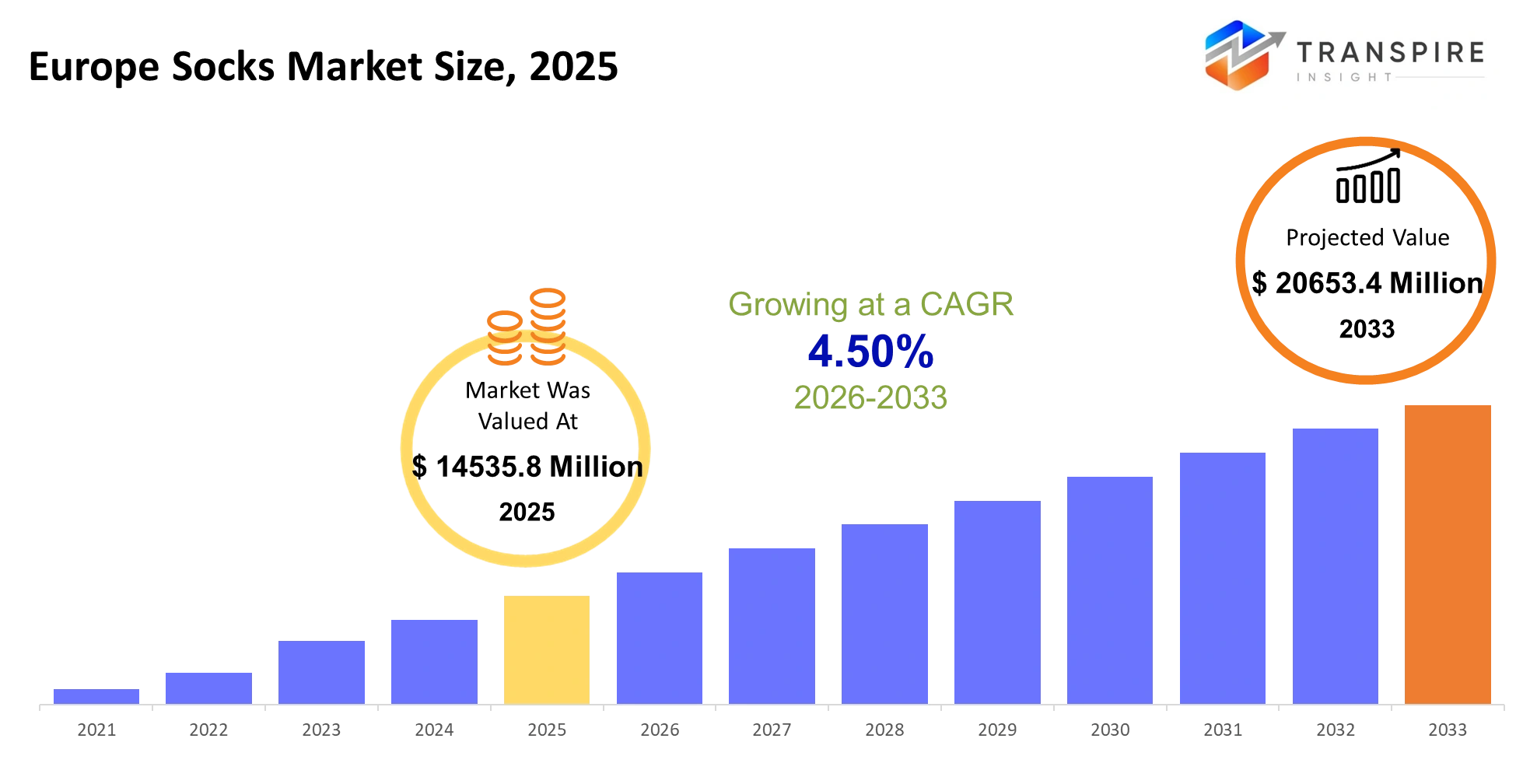
- Europe Socks Market Size 2025: USD 14535.8 Million
- Europe Socks Market Size 2033: USD 20653.4 Million
- Europe Socks Market CAGR: 4.50%
- Europe Socks Market Segments: By Type (Casual Socks, Sports Socks, Compression Socks, Thermal Socks, Others), By Application (Daily Wear, Sports, Medical Use, Winter Wear, Others), By End-User (Men, Women, Kids, Athletes, Others), By Distribution (Online, Retail Stores, Brand Stores, Others).
To learn more about this report,  Download Free Sample Report
Europe Socks Market Summary:
The Europe Socks Market size is estimated at USD 14535.8 Million in 2025 and is anticipated to reach USD 20653.4 Million by 2033, growing at a CAGR of 4.50% from 2026 to 2033. The Europe socks market operates as an essential component that serves various purposes beyond its primary function as clothing. Socks provide hygiene and comfort and temperature control and foot protection for people who use them in their daily activities and sports activities and medical settings and industrial workplaces. Performance socks which contain moisture control and compression and durability properties have become essential components of workplace safety and wellness programs in construction and logistics and athletic sectors. The market has transitioned during the past five years from fast fashion which depends on volume sales to products which focus on technical design and environmental sustainability. The European Union established a circular textile strategy which requires manufacturers to implement recycled materials and maintain trackable supply chains and create durable products.
The pandemic together with supply chain disruptions accelerated this transition because it revealed to Europe that it relied on imported textile materials and faced unpredictable cotton market prices. Hybrid lifestyles and athleisure fashion created a new market for socks which provide comfortable footwear that also delivers performance benefits. The premium and specialized product segments enable companies to achieve higher revenue per unit which drives competition based on material development instead of price competition.
Key Market Insights
- The European Socks Market for 2025 has Germany as its top country because it controls almost 24% of the market through its excellent retail system and high-end fashion sales.
- The textile industry in Eastern Europe will experience its highest growth rate until 2030 because manufacturers will find lower production expenses and the region will increase its textile export activities.
- Italy maintains a significant share in luxury and fashion socks production, supported by premium textile manufacturing capabilities.
- The Nordic countries show increasing demand for sustainable socks which use recycled cotton and bamboo fibers and organic wool blends as raw materials.
- The European socks market reaches its largest size through athletic and performance socks which generate more than 38% of industry revenue between 2025 and 2025 because people increasingly adopt fitness and athleisure fashion.
- Private-label retailers are expanding their affordable multi-pack casual and everyday socks through distribution channels that include supermarkets and e-commerce platforms, which makes this segment the second-largest market segment.
- The industry expects compression and medical socks to become the fastest-growing market segment because more people in the world will become elderly and healthcare facilities will adopt preventive medical practices.
- Sustainable socks that use recycled yarns and biodegradable fibers have achieved a strong market presence because they attract environmentally aware customers who prefer these products.
- Sports and fitness applications accounted for nearly 35% market share in 2025, supported by growing participation in running, gym training, and outdoor activities.
- European hospitals and wellness facilities are adopting diabetic and compression socks at a rapid pace because these two products serve as vital resources for their healthcare operations.
- The logistics and manufacturing and construction sectors have expanded their industrial workwear requirements because organizations now enforce stricter safety regulations throughout their workplace environments.
What are the Key Drivers, Restraints, and Opportunities in the Europe Socks Market?
The strongest force driving the Europe socks market forward first originated from the growing trend which connects performance-based athletic wear with normal daily clothing. The shift toward fitness-based apparel gained traction after the pandemic changed how people spent money. The major sportswear brands developed new technical sock collections which included compression features and moisture control abilities and antimicrobial materials. Retailers expanded their retail space for athletic and wellness socks because hybrid work patterns created a demand for casual and sports-inspired clothing. The premiumization of products generated revenue growth because it increased customer repeat purchases and enhanced profit margins for physical retail and e-commerce operations.
The European market faces its main structural limitation because it relies on imported cotton and synthetic yarns and Asian textile processing capabilities. European manufacturers experience persistent financial difficulties because energy costs and shipping unpredictability and labor expenses differ between regions. The need to move supply chains requires companies to spend substantial money on developing local textile manufacturing facilities and automation systems which makes it impossible to achieve fast changes. The brand experiences two negative effects which create lower profit margins and extend production times that prevent them from meeting inventory needs during peak seasonal periods.
The combination of smart textiles with healthcare and sports performance applications creates a major business opportunity which will continue to generate revenue for an extended period. Companies are making more investments in sensor-enabled socks which provide the ability to track pressure distribution and circulation and movement patterns. The integration of advanced wearable technology systems with healthcare digitization has established Germany and Nordic countries as major centers for innovation.
What Has the Impact of Artificial Intelligence Been on the Europe Socks Market?
European sock markets experience transformation through artificial intelligence and modern digital technologies which enhance their production accuracy and stock management and distribution network flexibility. European textile manufacturers employ AI-powered knitting machines and computer vision systems to automate defect identification during their production processes. The systems detect stitching errors and fabric tension problems and color variations through their ability to monitor production processes in real time which results in decreased material waste and decreased product rejection rates in high-volume manufacturing operations. Manufacturers use IoT-compatible machinery together with predictive maintenance systems to track equipment vibration and temperature and operational performance. Machine learning models process production data to identify maintenance requirements which helps factories increase machine uptime while reducing their unplanned maintenance expenses.
Retail operations undergo transformation through the implementation of digital demand forecasting systems. Brands use AI models to analyze seasonal purchasing behavior, regional fashion trends, and e-commerce traffic patterns to optimize stock allocation and reduce excess inventory. This process enhances the fulfillment process while decreasing both warehousing expenses and product depreciation expenses. Direct-to-consumer sales channels experience faster order processing through the implementation of automated warehouse systems.
The European textile industry encounters multiple barriers that hinder its capability to adopt artificial intelligence technologies. The majority of small and mid-sized sock producers operate outdated equipment which does not work with modern analytics systems. The digital transformation process in large organizations proceeds at a slow pace because organizations face high integration expenses and disjointed manufacturing processes and they struggle to obtain sufficient training data.
Key Market Trends
- European retailers have been increasing shelf space for performance socks since 2021 because hybrid work and fitness-based lifestyles have created lasting changes in how people buy clothing.
- The manufacturers in Italy and Germany began using recycled yarn blends after the European Union introduced its circular textile policies which required companies to meet stricter waste reduction and traceability standards starting in 2023.
- The athletic sock market gained better ability to set prices because Nike and Adidas introduced new moisture-control and compression products to their existing product lines.
- Between 2022 and 2025 Eastern European production centers became more attractive to textile investors because brands started to create their own supply chains which included production facilities outside of Asian manufacturing centers.
- The automated factories implemented AI-powered knitting and inspection systems which decreased textile defects and material waste while enhancing their operational efficiency and production reliability since 2022.
- The European apparel industry saw its direct-to-consumer sock market grow faster after its brands established e-commerce fulfillment systems and developed data-driven inventory forecasting methods during the pandemic.
- Health providers recommended circulation-support products to aging populations for preventive care and post-surgical recovery which led to increased adoption of compression and wellness socks in this demographic group.
- The textile dyeing and finishing industry faced higher operational costs because energy prices became unstable after the Russia-Ukraine conflict which harmed mid-sized manufacturers across Europe.
- The luxury fashion industry adopted limited-edition sock collections and personalized sock designs to enhance profit margins while decreasing their reliance on standard retail market competition.
- Scandinavian brands introduced new biodegradable and bamboo-fiber sock collections between 2021 and 2025 as consumers began to use sustainability metrics for determining their apparel purchasing decisions.
Europe Socks Market Segmentation
By Type
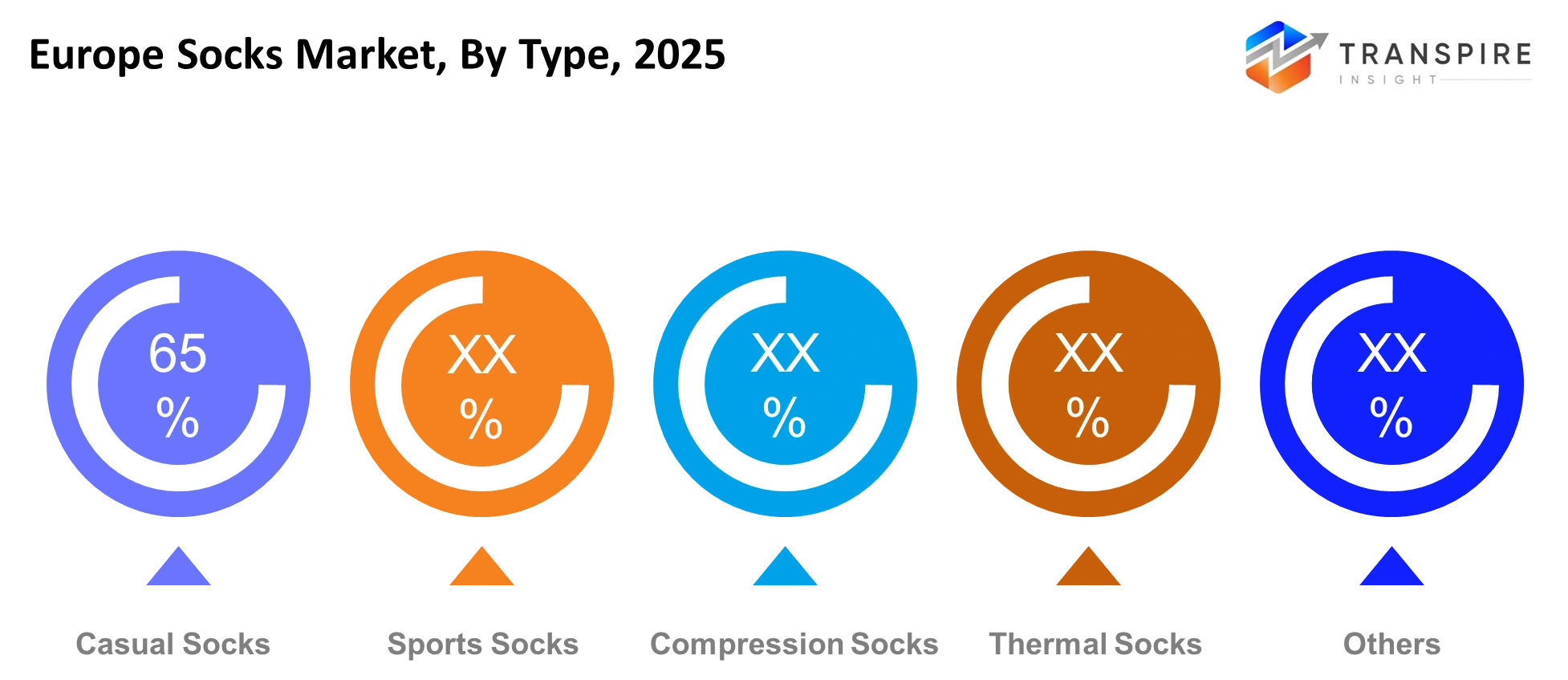
The primary market for casual socks sustains its dominant status because customers purchase them regularly from supermarkets and apparel stores and online platforms. The demand for sports socks has increased because people who participate in fitness activities and wear athleisure clothing create a market for premium products that urban consumers buy. The healthcare industry needs compression socks and thermal socks which have increased their demand among aging populations and people who live in colder regions of Northern and Central Europe.
Product innovation increasingly focuses on moisture management and seamless knitting and antimicrobial fabrics and recycled yarn integration. The current manufacturing methods produce more profitable technical products which companies now choose to manufacture instead of producing standard commodities in bulk. Through this transition established brands achieve better profitability while specialized textile producers gain access to new market opportunities. Future competition will increasingly depend on functional differentiation material sourcing transparency and automated production efficiency instead of price-driven volume expansion.
To learn more about this report, Download Free Sample Report
By Application
The largest market share for daily wear applications exists because socks represent an essential clothing item that people from all consumer groups need to replace frequently. The sports market has increased its influence because people now demand performance products which provide cushioning and breathability in their fitness activities and hybrid work routines. The medical field now develops compression socks as a standard treatment option which helps patients with circulation problems and diabetes management and post-operative recovery. European colder regions need winter wear products which create seasonal demand through their wool-based and insulated sock categories.
People buy products based on their specific lifestyle needs rather than following temporary fashion trends. The sports industry and occupational safety field and wellness sector require manufacturers to develop specialized product lines which meet their specific needs. The healthcare market attracts investor interest because technical textile capabilities and healthcare product development offer better pricing control and protection against fast-fashion market fluctuations.
By End-User
Men serve as primary end-user group because their formal wear and workwear and sportswear consumption rates exceed all other user groups. The female demographic grows as fashion products and wellness items and high-end lifestyle collections receive more consumer spending from women. Kids' socks remain in steady demand because children require new socks throughout their development and for school activities.
The market for athlete-specific products keeps growing because professional sports running culture and gym memberships create needs for compression garments and moisture-wicking clothes and impact-resistant equipment. People now choose to buy products based on their comfort and durability and fabric performance instead of their visual appeal. Brands now organize their product collections based on three criteria which include activity level and health advantages and climate adaptability to enhance customer loyalty. The companies that succeed in upcoming growth periods will combine fashion trends with innovative textile development and customized consumer experiences.
By Distribution
Consumers show a strong preference for retail stores because they want to assess fabric quality and elasticity and fit before buying premium and medical products. The growth of online distribution channels has accelerated since 2020 because apparel brands established improved digital merchandising and subscription services and direct-to-consumer delivery methods. Brands use physical stores to establish their premium brand identity because luxury and sportswear companies depend on storefronts to build customer loyalty and present their latest technical advancements. Multiple distribution channels, which include pharmacies and specialty sports retailers, assist in delivering compression and performance socks to their targeted customer base.
Companies today use digital platforms together with local stock control systems and quick delivery networks to create their distribution methods. Companies are investing heavily in AI-based demand forecasting systems and omnichannel distribution solutions to optimize their inventory management and peak season handling capabilities. Companies will need to combine supply chain flexibility with customer data integration and physical storefronts and scalable online operations to achieve market leadership in the future.
What are the Key Use Cases Driving the Europe Socks Market?
The primary purpose of socks in Europe results from their daily usage which leads to frequent purchases that keep retail stores operating. Office professionals, schoolwear consumers, and industrial workers demonstrate high demand for durable cotton and blended fabric products which provide comfort throughout their extended work hours.
The usage of sports and wellness products is increasing at fitness centers and running communities and professional training environments. Compression socks are becoming more popular in healthcare and rehabilitation centers especially for elderly patients and those who need circulation support during their recovery and prevention treatment.
The development of smart textile socks that contain biometric monitoring sensors allows athletes to track their performance and elderly individuals to receive care. Outdoor tourism operators and environmentally conscious apparel retailers in Northern Europe show interest in sustainable thermal socks made from recycled fibers and biodegradable materials.
|
Report Metrics |
Details |
|
Market size value in 2025 |
USD 14535.8 Million |
|
Market size value in 2026 |
USD 15175.3 Million |
|
Revenue forecast in 2033 |
USD 20653.4 Million |
|
Growth rate |
CAGR of 4.50% from 2026 to 2033 |
|
Base year |
2025 |
|
Historical data |
2021 - 2024 |
|
Forecast period |
2026 - 2033 |
|
Report coverage |
Revenue forecast, competitive landscape, growth factors, and trends |
|
Regional scope |
Europe (Germany, United Kingdom, France, Italy, Spain and Rest of Europe) |
|
Key company profiled |
Nike, Adidas, Puma, Under Armour, Hanesbrands, Jockey, Burlington, Falke, Happy Socks, Asics, Decathlon, Uniqlo, Marks & Spencer, Tommy Hilfiger, Calvin Klein. |
|
Customization scope |
Free report customization (country, regional & segment scope). Avail customized purchase options to meet your exact research needs. |
|
Report Segmentation |
By Type (Casual Socks, Sports Socks, Compression Socks, Thermal Socks, Others), By Application (Daily Wear, Sports, Medical Use, Winter Wear, Others), By End-User (Men, Women, Kids, Athletes, Others), By Distribution (Online, Retail Stores, Brand Stores, Others). |
Which Regions are Driving the Europe Socks Market Growth?
The regional market is dominated by Western Europe because it has developed robust apparel retail systems and it operates advanced textile production methods while enforcing strict environmental standards. The French fashion industry together with German and Italian production centers generates substantial output which enables ongoing design development and high-end brand creation. The area benefits from its extensive transportation systems which include modern textile production plants and its widespread use of organized retail stores and online shopping systems. Consumers who prefer to buy high-quality clothing products enable sock manufacturers to maintain elevated prices for their performance and luxury and wellness-oriented sock products.
Northern Europe stands as the second most important regional market because sustainable purchasing behaviors drive market stability while manufacturing capacity affects market stability. Scandinavian countries maintain consistent demand for thermal, organic, and recycled-fiber socks because environmental certification standards strongly influence retail purchasing decisions. The area shows consumers who select premium products because they want to use items for extended periods through both product durability and product lifespan value. The region and international brands benefit from fixed revenue streams which arise from consistent disposable income and the ongoing implementation of circular textile regulations.
Eastern Europe has become the fastest-growing region because investments in textile manufacturing have increased after European supply chain interruptions revealed the continent's need for Asian manufacturing partners. The Czech Republic and Romania and Poland developed their manufacturing industries through their ability to provide affordable labor and their improved industrial infrastructure and their geographic closeness to Western European markets.
Who are the Key Players in the Europe Socks Market and How Do They Compete?
The Europe socks market maintains a state of moderate fragmentation because global sportswear companies and luxury fashion houses and regional textile manufacturers compete in multiple pricing and performance segments. The industry now competes through advanced fabric development which obtains sustainable product certification and manages supply chain operations instead of relying on price-based competition. Major companies maintain their market presence through high-end product development and direct-to-consumer distribution, while new businesses focus on specific markets which include medical compression socks and environmentally sustainable fibers and personalized sports equipment. Brands establish their competitive advantage through automated production systems that enable them to manufacture products locally while decreasing their delivery time and production unpredictability.
The company develops socks which depend on moisture control and cushioning technologies and recycled polyester materials for their performance capabilities. The company establishes its product credibility through strong alliances with professional sports organizations, which enable quick product adoption among consumers who prioritize fitness. PUMA
The brand presents itself as a fashion sports crossover label because its collections combine athletic performance with contemporary streetwear design. The company develops its business through online sales platforms and partnerships with fashion influencers which help it connect with younger audiences in European city markets.
The company competes through its superior product quality, which results from its expert craftsmanship and its state-of-the-art knitting technology, especially in the luxury and travel and compression sock markets. The company achieves better quality management through its production facilities in Germany, which help it implement premium pricing methods for European retail operations.
Company List
- Nike
- Adidas
- Puma
- Under Armour
- Hanesbrands
- Jockey
- Burlington
- Falke
- Happy Socks
- Asics
- Decathlon
- Uniqlo
- Marks & Spencer
- Tommy Hilfiger
- Calvin Klein
Recent Development News
In November 2025, Dockers expands into European socks & hosiery segment via Orbico partnership: Dockers entered a major European distribution deal with Orbico Group. The agreement includes socks and hosiery among key categories, strengthening Dockers’ footprint in European fashion retail channels.
Source: https://fashionunited.uk
In October 2025, United Brands Group expands sock leadership through Wiges integration: United Brands Group strengthens its European socks portfolio after fully integrating Swedish sock specialist Wiges. The deal expands its reach across fashion, sports, and sustainable sock production, positioning it as one of Europe’s largest sock suppliers.
Source: https://wiges.se/
What Strategic Insights Define the Future of the Europe Socks Market?
The Europe socks market is going through a structural transformation which will create a premium technology integrated clothing system that uses functional performance and sustainability standards and supply chain capabilities to determine which companies will succeed in the future. The next five to seven years will produce most of its growth from technical product categories which include compression and sports recovery and smart textile products instead of traditional sock products. The shift is occurring because European countries have implemented stricter textile traceability regulations while companies are investing in automation and consumers are demanding durable and health-focused clothing.
The main danger exists because companies depend on specific raw materials and face challenges with obtaining recycled fibers. The growing number of manufacturers who adopt certified sustainable yarns will lead to increased competition for compliant cotton wool and recycled polyester materials which will raise procurement expenses and reduce profit margins for mid-sized manufacturers who lack purchasing power.
The development of sensor-enabled socks for elderly care monitoring and sports biomechanics tracking creates new business opportunities which are most prominent in German and Nordic healthcare systems. Companies operating in the market should focus their investment resources on creating automated manufacturing facilities and developing unique textile production methods which will help them decrease supply chain risks while establishing strong competitive advantages through their premium product offerings.
Europe Socks Market Report Segmentation
By Type
- Casual Socks
- Sports Socks
- Compression Socks
- Thermal Socks
- Others
By Application
- Daily Wear
- Sports
- Medical Use
- Winter Wear
- Others
By End-User
- Men
- Women
- Kids
- Athletes
- Others
By Distribution
- Online
- Retail Stores
- Brand Stores
- Others
Frequently Asked Questions
Find quick answers to common questions.
The approximate Europe Socks Market size for the market will be USD 20653.4 Million in 2033.
The key segments of the Europe Socks Market are By Type (Casual Socks, Sports Socks, Compression Socks, Thermal Socks, Others), By Application (Daily Wear, Sports, Medical Use, Winter Wear, Others), By End-User (Men, Women, Kids, Athletes, Others), By Distribution (Online, Retail Stores, Brand Stores, Others).
Major players in the Europe Socks Market are Nike, Adidas, Puma, Under Armour, Hanesbrands, Jockey, Burlington, Falke, Happy Socks, Asics, Decathlon, Uniqlo, Marks & Spencer, Tommy Hilfiger, Calvin Klein.
The current market size of the Europe Socks Market is USD 14535.8 Million in 2025.
The Europe Socks Market CAGR is 4.50%.
- Nike
- Adidas
- Puma
- Under Armour
- Hanesbrands
- Jockey
- Burlington
- Falke
- Happy Socks
- Asics
- Decathlon
- Uniqlo
- Marks & Spencer
- Tommy Hilfiger
- Calvin Klein
Recently Published Reports
-
Apr 2026
Bottled Water Market
Bottled Water Market Size, Share & Analysis Report By Product Type (Still Bottled Water, Carbonated Bottled Water, Functional Bottled Water, and Others), By Packaging (PET, Cans, and Others), By Sales Channel (Supermarkets/Hypermarkets, Convenience Stores/Drug Stores, Grocery Stores/Club Stores, Foodservice, and Others) and Geography (North America, Europe, Asia-Pacific, Middle East and Africa, South and Central America), 2021 - 2032
-
Apr 2026
Color Cosmetic Packaging Market
Color Cosmetic Packaging Market Size, Share & Analysis Report By Application (Mascara Packaging, Liquid Packaging, and Liquid Face), By Type (Tubes & Bottles, Pens & Markers, Compacts & Containers, and Droppers & Pumps), and Geography (North America, Europe, Asia-Pacific, Middle East and Africa, South and Central America), 2021 - 2031
-
Apr 2026
External Microphone For Camera Market
External Microphone For Camera Market Size, Share & Analysis Report By Type (Shotgun Microphone, Lavalier Microphone, and Others), By Application (Digital Camera, Professional Video Camera, and Others), and Geography (North America, Europe, Asia-Pacific, Middle East and Africa, South and Central America), 2021 - 2031
-
Apr 2026
Foot Orthotic Insoles Market
Foot Orthotic Insoles Market Size, Share & Analysis Report By Type (Pre-fabricated, and Custom-made), By Material (Thermoplastic, Composite Carbon Fiber, and Others), By Distribution Channel (Drug Stores, Hospitals & Clinics, and Others), and Geography (North America, Europe, Asia-Pacific, Middle East and Africa, South and Central America), 2021 - 2031