

Europe Reverse Osmosis Films Market Summary
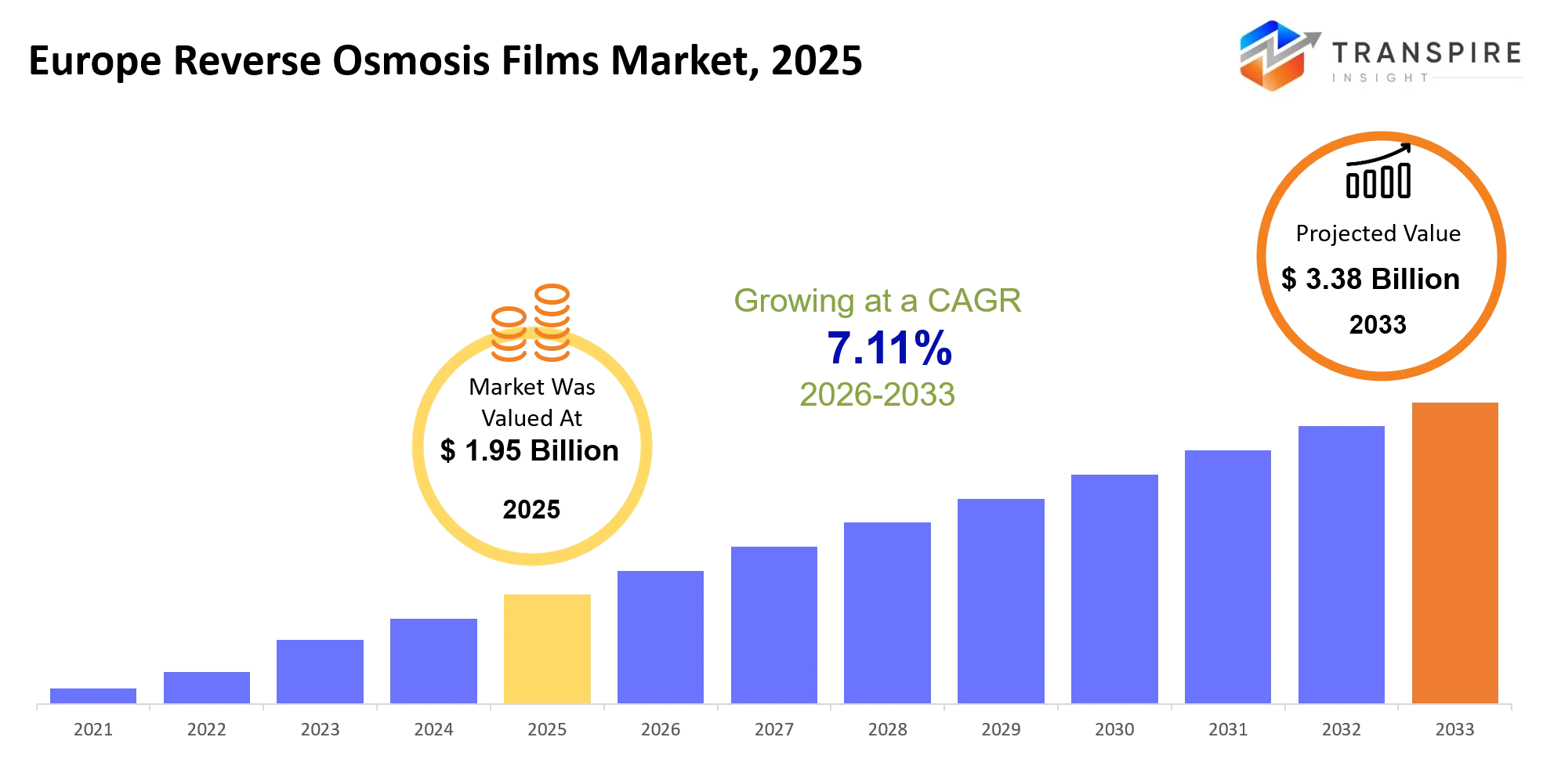
As per Transpire Insight Analysis the Europe Reverse Osmosis Films Market size is estimated at USD 1.95 Billion in 2025 and is anticipated to reach USD 3.38 Billion by 2033, growing at a CAGR of 7.11% from 2026 to 2033.
Reverse osmosis films clean water by stopping salts, grit, and other dissolved bits in the feed. This helps cities, industrial plants, wastewater reuse, and desalination. In many areas, water rules are tight, reuse targets have to be hit, and factories need steady output. Because of that, membrane systems get more focus.
Over the past three to five years, buyers have shown more interest in thin film composite and polyamide membranes. Firms are trying to design membranes that trap more contaminants. They also want these membranes to work with less pressure and to foul less. Changes in Europe and stricter wastewater treatment limits have added more support for membrane setups.Other issues also matter. Water stress is rising in some regions. Power prices stay high. Supply delays can slow projects. So operators care more about how long a membrane lasts in service. They prefer fewer replacements and less downtime. The market was around USD 1.95 billion in 2025. It is forecast to reach about USD 3.38 billion by 2033.Most of the growth should come from membrane upgrades. Growth should also come from wastewater reuse work, added capacity for industrial treatment, and new desalination plants.
Europe Reverse Osmosis Films Market Size & Forecast:
- Europe Reverse Osmosis Films Market Size 2025: USD 1.95 Billion
- Expected Market Value 2033: USD 3.38 Billion
- Forecast CAGR: 7.11%
- Leading region in 2025:Germany
- Fastest Growing region:Italy and Spain
- Key Profile: DuPont Water Solutions, Toray Industries, LG Chem, Hydranautics, SUEZ, Veolia, Koch Separation Solutions, Pentair, NX Filtration, LANXESS, Synder Filtration, Toray Membrane, Alfa Laval, Aquaporin, Membranium
Key Market Insights
- Germany is still one of the top market players in Europe. The country has long-standing water treatment setups. It also enforces tough rules on water quality.
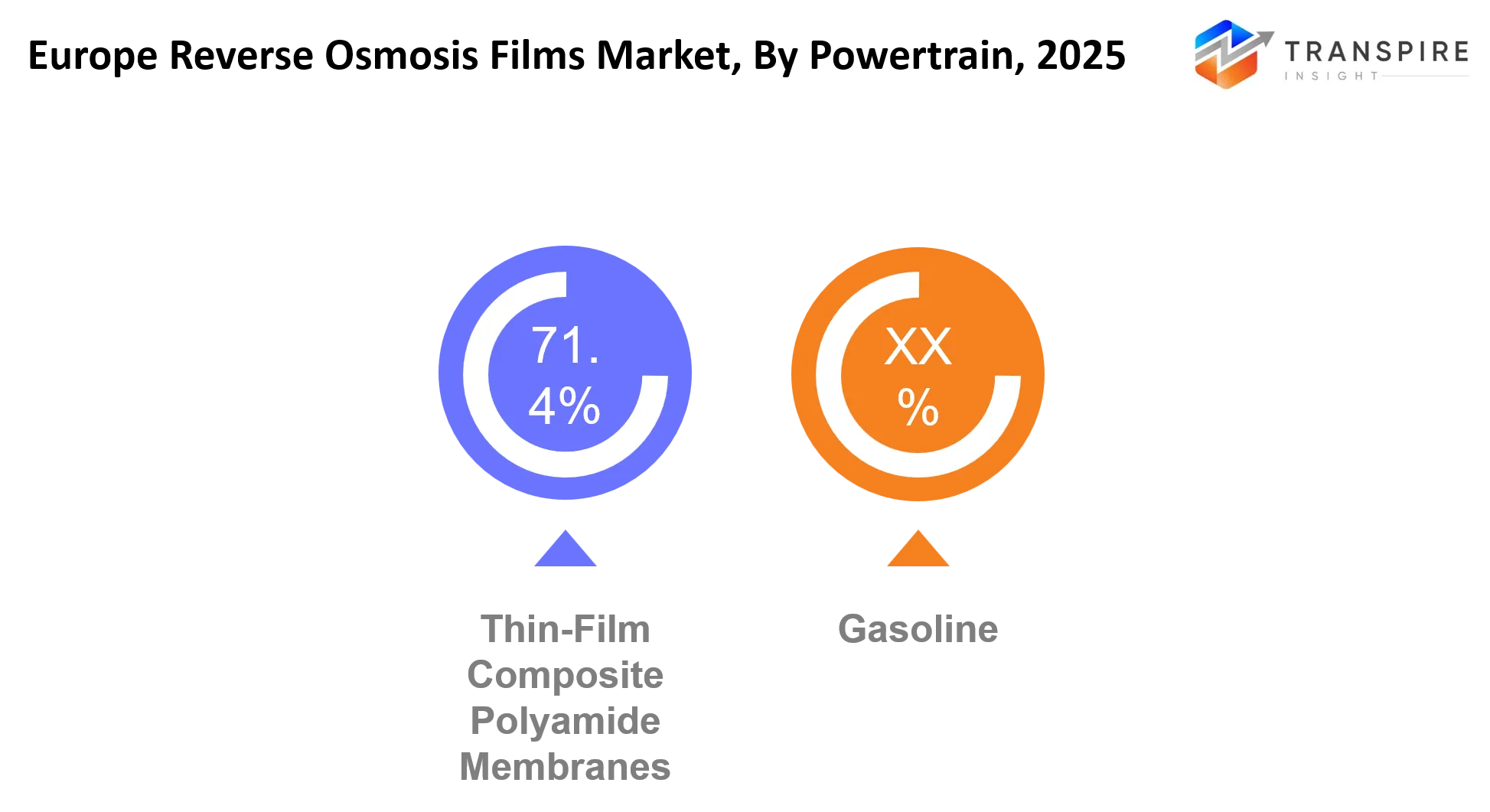
- Thin-film composite membranes are the most sold RO option worldwide. In 2025, they made up 81.90% of revenue share. Buyers like their salt rejection and permeability.
- Spiral-wound units led the market in 2025 as well. They held 69.60% of global share. These systems are already common in city plants and in industry.
- Municipal and desalination utilities drove a large portion of RO membrane revenue. In 2025 they accounted for 37.85%. This shows how much revenue links to water treatment use.
- Polyamide-based films keep taking over from older membrane designs. Customers care about salt rejection. They also want higher output, better chemical stability, and longer run times.
- Wastewater reuse is changing its role. It is moving past basic add-on treatment. Now it is becoming part of main water supply plans. That shift can mean more membrane swaps and more capacity needs.
- Manufacturers are also pairing membranes with added tools. Sensors, analytics, and digital checks help spot fouling early. The goal is to catch problems before performance drops too far.
- DuPont rolled out an AI-enabled RO Operations Advisor in 2026. It is meant to support predictive maintenance. It also helps guide membrane change timing, track system output, and manage treated water costs.
- More sectors want stricter water-quality control. Pharmaceutical sites, electronics makers, food processors, and power plants are among them. This creates demand for membranes with high rejection and lower fouling risk.
- European suppliers are trying to stand out from competitors. They focus on product differences, local service coverage, and longer membrane life. They also form partnerships tied to water reuse.
What are the Key Drivers, Restraints, and Opportunities in the Europe Reverse Osmosis Films Market?
Driver: Tighter rules in Europe on water quality and wastewater are pushing cities and factories to upgrade treatment systems. Many are not relying on basic filtration by itself anymore. The biggest pull in the market comes from jobs that need dependable contaminant removal, water reuse, and steadier process water. When membrane units are involved, sales can rise in two ways. New modules are sold for upgrades. Parts are also replaced more often because membrane output drops over time due to fouling, scaling, and exposure to chemicals. Germany is often cited as a clear case, since industry, plus water and sewage treatment, shows major RO membrane demand in country estimates.
Restraint: Energy use is still a hard limit. RO needs high pressure. On top of that, the full setup involves pretreatment steps, cleaning chemicals, pumps, and membrane swaps. Those items raise day to day costs. Some newer films work at lower pressure and can raise throughput. Even so, a full treatment-line change still needs large funds and careful technical work. Smaller towns and smaller plants may delay upgrades when money is tight or when power prices stay high. Those pauses can delay revenue work even if long term rules keep backing membrane use.
Opportunity: AI tools may help move these systems toward better outcomes. DuPont rolled out an AI-enabled RO Operations Advisor in April 2026 to give guidance tied to each system. The focus includes cleaning steps and when to plan membrane replacement. At the same time, European research is working on sensors that can spot fouling earlier. The Excalibur effort, backed by the European Commission, aims at real time fouling checks. The plan is to cut downtime by as much as 60% and reduce costs by 20%
What Has the Impact of Artificial Intelligence Been on the Europe Reverse Osmosis Films Market?
AI tools are shifting how plants handle membranes. Instead of fixed schedules, they look at the current state. In practice, machine-learning models can take in feedwater data like temperature, pressure, conductivity, turbidity, flow rate, and membrane age. They also use operating history. With that, the models can flag fouling trends. They can then suggest cleaning times or small operating changes. Studies have also shown machine learning for RO fouling forecasts, process tuning, salt rejection trends, and remaining life estimates. One 2026 paper made an AI model to estimate RO membrane remaining useful life. It reported an R² of 0.984. The inputs included silt density index, water temperature, pump speed, and membrane age.
Digital tools can help with day-to-day choices too. They can spot signs like abnormal transmembrane pressure, dropping permeate flow, and shifts in feed conditions. The goal is to catch problems before big performance loss. DuPont’s 2026 RO Operations Advisor uses past plant data and AI models. It supports both cleaning decisions and membrane replacement planning. The stated aim is more uptime and lower costs for treated water. Other European work points to nanoscale fouling sensors, plus AI-backed monitoring. Still, the biggest issue is data quality. Plant models need enough past operating records. They also need sensors that give stable readings, SCADA logs that are consistent, and retraining for each site.
Key Market Trends
- Thin film composite systems have helped companies keep a strong position in the market. Buyers want membranes that reject more, pass less, and handle tough operating conditions.
- Polyamide membranes are also moving ahead. Treatment teams prefer them when they need cleaner water and fewer tradeoffs in system pressure.
- Spiral wound units are still the most common choice. Even so, hollow fiber setups are getting more notice, mainly where space is tight or where the use case is narrow.
- In Europe, wastewater reuse is getting more attention. That shift is pushing more work on membrane polishing steps and higher quality recycled water.
- Many industrial buyers look at total lifetime costs now. They care more about how often units must be cleaned and how long the systems stay in service than about the first bill.
- Sensors and software have grown beyond simple alerts. Teams now use trend views to spot early fouling patterns, estimate future output, and plan upkeep.
- By 2026, AI assisted optimization had progressed. Some vendor tools started turning past site records into suggested schedules for cleaning and part changes.
- Desalination plans are also changing. Operators more often link membrane upgrades with steps that cut energy use to lower costs and keep production steadier.
- For semiconductor and electronics wastewater, the need for tuned RO performance keeps rising. New work has relied on 17,880 hours of full scale operating records to refine settings.
- Suppliers are trying to stand out in several ways. They are offering films built to resist fouling, adding digital support, making modules for specific uses, and forming partnerships across the water treatment sector.
Europe Reverse Osmosis Films Market Segmentation
By Membrane Type
Thin-Film Composite Membranes are a top choice in many RO setups. They combine strong flow through the membrane with good salt rejection, so they fit well in city water, factories, and desalination lines.
Cellulose Acetate Membranes still get used where people want membrane chemistry that is already familiar. Operators often like the way these systems run day to day. Polyamide Membranes also stay common in the market. The polyamide chemistry helps with keeping out many contaminants and supports steady water output. Nanocomposite Membranes are drawing more attention. Studies and vendors point to better transport behavior and the chance of less fouling over time.
Forward Osmosis Membranes are aimed at cases where lower pressure is useful. They also show up in certain water recovery workflows. Low-Pressure RO Membranes work for plants that want reduced energy use. They can also help keep operating costs down. High-Rejection RO Membranes are chosen when product water must be very clean. This is often tied to use in pharmaceuticals, electronics, and some special industrial steps. Fouling-Resistant Membranes matter when the feed has more trouble makers. That can include organics, biological growth, or extra particles. In 2025, Thin-film composite membranes made up 81.90% of global RO membrane revenue. That share can be used as a clear reference point for how dominant these advanced composite designs are
By Material
Polyamide still matters a lot. It blocks salts well, and it is easy to find in many product lines, so reverse osmosis use keeps growing.Cellulose Acetate is still used in older, proven setups. It fits best when the plant conditions match the usual membrane chemistry.Polyethersulfone and Polysulfone show up in more specialized membrane work. They hold up in harsh chemistry and stay strong when stressed. That makes them useful when pretreatment is part of the process.Graphene related materials get a lot of attention in labs. The small scale of their structure could help both flow and separation, though results vary by setup.Ceramics are aimed at tougher duties. They can handle heat and chemicals better than many options. Even so, the cost to make them is high, so most plants do not switch in a big way.Composites are built for better performance. They mix polymers with other added materials to tune how the membrane behaves.Other polymer options exist for special needs. Some are chosen for contact with harsh chemicals. Others are picked for high pressure, high temperature, or for better resistance to fouling.Today, membrane work often tries to strike a balance. Teams look at water flow, salt rejection, lifespan, how well the membrane tolerates cleaning, and what it costs to manufacture. They do not aim to win on just one metric
By Application
Municipal Water Treatment still ranks high. Many European utilities need steady treatment so they can make safe drinking water and meet water-quality rules. Industrial Water Treatment covers process-water needs at chemical sites, factories, and other industrial plants.In coastal areas and places with low water supply, Desalination is a key option. Wastewater Reuse is also growing. More water-efficiency goals are pushing this need.
Food and Beverage plants often rely on RO membranes. They use them for ingredient water, for concentrating streams, and for purifying process water. Pharma uses very tight water specs for both making products and cleaning equipment. That drives demand for membranes with high rejection.For Power Generation, utilities use treated water for boilers and related process use. Electronics plants need very clean process water for making semiconductors and other parts.Across many industrial settings, operators want membrane output that stays stable. Bad water quality can throw off production results. It can also harm equipment performance and final product quality. Industry reports also point to water and wastewater treatment, plus industrial processing, as major end uses for RO membranes in Europe.
By Configuration
Spiral-wound units are still the most common choice. People pick them because they pack well, the modules are already standard, and they are easy to find in the market for big projects.Hollow-fiber units can provide a lot of surface area in a small footprint. That is why some teams look at them when space is tight and the plan is compact treatment.Tubular modules fit feeds that contain more solids or higher fouling risk. Plate-and-frame units work well when you want easier access, plus more room for cleaning. Disc-tube systems are aimed at tough wastewater cases, where strong flow paths help handle difficult feeds.Flat-sheet designs are used in lab setups, pilot work, and other niche membrane uses. Compact modules are for sites with limited space and fixed flow needs. Specialty modules are made for specific industrial tasks and high-purity work, where the operating details matter.In 2025, spiral-wound products made up 69.60% of the global RO membrane market. That result points to how strong the approach remains in real purchasing.
By End User
Municipalities still buy these products. Their public water systems need treatment capacity that holds steady over time. They also have to meet rules and keep infrastructure working without gaps.Industrial firms buy RO films to handle process water. They use them for wastewater treatment too. Many also rely on RO setups to support day-to-day production.Water utilities run big treatment networks. They keep spending comes back. Membranes get swapped on a schedule. Some sites add capacity, and others modernize older systems.Pharmaceutical manufacturers need water with tight control. They depend on purification that performs well in regulated plants. Any drop in quality can cause problems.Food makers use RO for ingredient water and process water. Power plants use purified water for steam cycles and equipment needs. Electronics companies want very clean water for semiconductor lines and other precision work.Commercial sites make up a smaller mix of buyers. That includes offices, hotels, health care buildings, and schools. Across these groups, people weigh lifecycle cost. They also look at how long membranes last. Maintenance load matters, and stable water quality affects decisions.
By Region
Germany is a big market in Europe. It has strong industry that needs treatment, good water plant systems, and clear environmental rules. That mix helps RO membrane sales grow. France also looks solid because cities have treatment capacity and industry must meet water-control duties. Italy and Spain have strong chances too. Water stress is a key driver there, along with desalination work and reuse programs. The UK keeps membrane demand steady. It has water quality rules, ongoing wastewater spending, and continued industrial treatment needs.
The Netherlands offers a favorable setup for newer water treatment. Industrial reuse efforts and push for better resource use make room for new membrane options. Norway supports RO use through industrial water needs and tighter environmental oversight. Denmark backs adoption with water-efficiency projects and reliable treatment infrastructure. In country-level market figures, Germany is one of the biggest RO membrane buyers in Europe. Reported numbers show German RO membrane revenue rising from USD 126.8 million in 2024 to USD 134.3 million in 2025.
What are the Key Use Cases Driving the Europe Reverse Osmosis Films Market?
City water systems still rely on membrane treatment. Many European utilities must reliably strip salts and other dissolved contaminants. Some compounds are hard to treat with older filtration methods. RO helps make safe drinking water, supports advanced wastewater cleaning, and helps meet water-quality rules when basic filters fall short. Replacement work also keeps demand steady. Over time the membranes weaken as fouling and scaling build up. Aging can also reduce performance.
More industries are also using RO for reuse and treatment. This includes drug makers, food plants, electronics lines, and power stations. In pharma and electronics, water must stay within tight quality limits. In food production, purified water is used directly in process steps. Industrial sites often choose membranes with high rejection and better resistance to fouling. That choice helps keep product water quality stable. It can also lower the number of shutdowns needed for upkeep.
Longer projects are growing in desalination and water recovery. This is especially true in parts of the Mediterranean region, including Spain and Italy. Adoption can rise as systems get better at managing fouling. Sensors can track conditions, and predictive tools can flag likely buildup. Low-pressure membrane designs can reduce energy needs. New composite materials may also help. Research programs in Europe that focus on predictive fouling monitoring suggest fewer downtime events. They also point to lower operating costs for membranes.
|
Report Metrics |
Details |
|
Market size value in 2025 |
USD 1.95 Billion |
|
Market size value in 2026 |
USD 2.09 Billion |
|
Revenue forecast in 2033 |
USD 3.38 Billion |
|
Growth rate |
CAGR of 7.11% from 2026 to 2033 |
|
Base year |
2025 |
|
Historical data |
2021 - 2024 |
|
Forecast period |
2026 - 2033 |
|
Report coverage |
Revenue forecast, competitive landscape, growth factors, and trends |
|
Regional scope |
Europe |
|
Key company profiled |
DuPont Water Solutions, Toray Industries, LG Chem, Hydranautics, SUEZ, Veolia, Koch Separation Solutions, Pentair, NX Filtration, LANXESS, Synder Filtration, Toray Membrane, Alfa Laval, Aquaporin, Membranium |
|
Customization scope |
Free report customization (country, regional & segment scope). Avail customized purchase options to meet your exact research needs. |
|
Report Segmentation |
By Membrane Type (Thin-Film Composite Membranes, Cellulose Acetate Membranes, Polyamide Membranes, Nanocomposite Membranes, Forward Osmosis Membranes, Low-Pressure RO Membranes, High-Rejection RO Membranes, Fouling-Resistant Membranes); By Material (Polyamide, Cellulose Acetate, Polyethersulfone, Polysulfone, Graphene-Based Materials, Ceramic Materials, Composite Materials, Other Polymers); By Application (Municipal Water Treatment, Industrial Water Treatment, Desalination, Wastewater Reuse, Food & Beverage, Pharmaceuticals, Power Generation, Electronics); By Configuration (Spiral-Wound, Hollow-Fiber, Tubular, Plate-and-Frame, Disc-Tube, Flat-Sheet, Compact Modules, Specialty Modules); By End User (Municipalities, Industrial Companies, Water Utilities, Pharmaceutical Companies, Food Manufacturers, Power Plants, Electronics Manufacturers, Commercial Facilities); By Region (Spain, Italy, Germany, France, UK, Netherlands, Norway, Denmark) |
Which Regions are Driving the Europe Reverse Osmosis Films Market Growth?
Germany is the top market in Europe. The country has a solid industrial sector and long-standing water treatment systems. It also enforces tough rules on the environment. Because of this, factories keep needing membrane-based treatment for process water. Cities and utilities also have ongoing replacement and upgrade work. There is a wide mix of engineering groups, membrane makers, utilities, and system integrators. That set of players helps Germany stay in a strong spot.
France is growing in a different way. Its momentum is tied more to big municipal water networks and wastewater work. It relies less on the heavy industrial mix seen in Germany. France has well known water and waste operators, including SUEZ and Veolia. With them in the market, project work and new technology rollouts happen more often. European wastewater rules also push utilities to add higher level treatment. Micropollutant removal is part of that shift.
Spain has a fast moving market. Water stress stays high in many areas. Because of that, desalination and wastewater reuse carry real economic weight. These options are not just “extra” projects. In the Mediterranean regions, water programs are opening doors for newer membrane systems. Both industrial users and municipal users want steady supplies. They increasingly look past older sources of freshwater. From 2026 to 2033, new entrants and investors can find chances in desalination, reuse, membrane improvements, and special high efficiency film products.
Who are the Key Players in the Europe Reverse Osmosis Films Market and How Do They Compete?
In Europe, reverse osmosis film competition mostly comes down to technology. Big suppliers push ahead with better membrane output, lower energy use, stronger resistance to fouling, and practical technical help. They also try to fit solutions to each use case. DuPont Water Solutions, Toray Industries, LG Chem, SUEZ, Veolia, and Koch Separation Solutions blend membrane know-how with engineering or service teams. Because of that, customer ties and support over the full project life matter as much as price. Smaller tech firms add pressure too. They aim at advanced filtration, water reuse, and modular treatment setups.
DuPont stands out with a wide range of RO membrane options plus digital tools. It points to an April 2026 RO Operations Advisor that draws on past operating records and AI-based models. The aim is to guide cleaning plans and decide when to replace membranes. Toray competes with membrane design work. Its TBW-XHR low-pressure RO elements target recycled wastewater and ultrapure water output. The company says they can remove urea about twice as well as older membrane types.Water desalination equipment LG Chem puts heavy focus on high performance desalination membranes and on growing projects across countries. It backs these steps with work in manufacturing and R&D.
NX Filtration shows up as a tech focused challenger. It leans on hollow-fiber nanofiltration and works with system integrators. In 2025, it said it grew its OEM partner pipeline to 180 partners. It also cites work with European utilities and engineering groups to help wider adoption. This approach can favor niche suppliers in reuse and advanced treatment. At the same time, large incumbents still hold an edge in mature RO sites where scale counts most.
Company List
- DuPont Water Solutions
- Toray Industries
- LG Chem
- Hydranautics
- SUEZ
- Veolia
- Koch Separation Solutions
- Pentair
- NX Filtration
- LANXESS
- Synder Filtration
- Toray Membrane
- Alfa Laval
- Aquaporin
- Membranium
Recent Development News
"In April 2026, DuPont Water Solutions launched the RO Operations Advisor. The AI-enabled tool analyzes historical operating data to provide system-specific cleaning and membrane replacement guidance, targeting lower downtime, longer membrane life, and lower treated-water costs.https://www.dupont.com/news/dupont-launches-ai-enabled-digital-advisor-to-help-customers-optimize-the-operations-of-reverse-osmosis-water-treatment-systems.html
"In June 2026, NX Filtration entered a partnership with Haskoning. The collaboration integrates hollow-fiber nanofiltration into Nereda Verdygo Package Plants to strengthen decentralized wastewater treatment and high-quality water reuse capabilities.https://nxfiltration.com/knowledge-base/publications/haskoning-partners-with-nx-filtration-to-enhance-water-reuse-solutions-for-nereda-verdygo-package-plants
"In August 2025, NX Filtration partnered with Eau d’Azur for advanced micropollutant treatment in Nice. The pilot at the Haliotis wastewater treatment plant supports preparation for stricter European wastewater requirements and expands advanced membrane applications in France.https://nxfiltration.com/knowledge-base/publications/nx-filtration-and-eau-dazur-partner-for-advanced-micropollutant-treatment-in-nice
What Strategic Insights Define the Future of the Europe Reverse Osmosis Films Market?
Europe is shifting from simple membrane swaps to water treatment choices driven by performance. Buyers now look at how much energy a system uses, how long membranes last, how well fouling is held back, and how well the plant can be tuned with data. Behind this change are tougher wastewater rules. At the same time, utilities and factories face pressure to get more usable water from the water they already have. There is also a risk that is easy to miss. Some key suppliers for advanced membrane materials and specific manufacturing inputs are limited in number. If supply is disrupted, projects may face delays or pay more for parts, even if the project plans did not change.
One newer opening is AI in membrane care. The idea is to link predictive fouling tools to sensors on site and to the maintenance systems that staff use every day. DuPont’s 2026 RO Operations Advisor is one example of this shift. It shows a move away from stand alone membrane products toward operating support that uses data. So, market players should focus on membranes that perform well and pair them with monitoring tools. They should also build local ties with utilities, engineering firms, and OEMs. This can help them land ongoing replacement and upgrade work.
Europe Reverse Osmosis Films Market Report Segmentation
By Membrane Type
- Thin-Film Composite Membranes
• Cellulose Acetate Membranes
• Polyamide Membranes
• Nanocomposite Membranes
• Forward Osmosis Membranes
• Low-Pressure RO Membranes
• High-Rejection RO Membranes
• Fouling-Resistant Membranes
By Material
- Polyamide
• Cellulose Acetate
• Polyethersulfone
• Polysulfone
• Graphene-Based Materials
• Ceramic Materials
• Composite Materials
• Other Polymers
By Application
- Municipal Water Treatment
• Industrial Water Treatment
• Desalination
• Wastewater Reuse
• Food & Beverage
• Pharmaceuticals
• Power Generation
• Electronics
By Configuration
- Spiral-Wound
• Hollow-Fiber
• Tubular
• Plate-and-Frame
• Disc-Tube
• Flat-Sheet
• Compact Modules
• Specialty Modules
By End User
- Municipalities
• Industrial Companies
• Water Utilities
• Pharmaceutical Companies
• Food Manufacturers
• Power Plants
• Electronics Manufacturers
• Commercial Facilities
By Region
- Spain
• Italy
• Germany
• France
• UK
• Netherlands
• Norway
• Denmark
Frequently Asked Questions
Find quick answers to common questions.
The expected Europe Reverse Osmosis Films Market size for the market will be USD 3.38 Billion in 2033.
Key segments for the Europe Reverse Osmosis Films Market are By Membrane Type (Thin-Film Composite Membranes, Cellulose Acetate Membranes, Polyamide Membranes, Nanocomposite Membranes, Forward Osmosis Membranes, Low-Pressure RO Membranes, High-Rejection RO Membranes, Fouling-Resistant Membranes); By Material (Polyamide, Cellulose Acetate, Polyethersulfone, Polysulfone, Graphene-Based Materials, Ceramic Materials, Composite Materials, Other Polymers); By Application (Municipal Water Treatment, Industrial Water Treatment, Desalination, Wastewater Reuse, Food & Beverage, Pharmaceuticals, Power Generation, Electronics); By Configuration (Spiral-Wound, Hollow-Fiber, Tubular, Plate-and-Frame, Disc-Tube, Flat-Sheet, Compact Modules, Specialty Modules); By End User (Municipalities, Industrial Companies, Water Utilities, Pharmaceutical Companies, Food Manufacturers, Power Plants, Electronics Manufacturers, Commercial Facilities); By Region (Spain, Italy, Germany, France, UK, Netherlands, Norway, Denmark)
Major Europe Reverse Osmosis Films Market players are DuPont Water Solutions, Toray Industries, LG Chem, Hydranautics, SUEZ, Veolia, Koch Separation Solutions, Pentair, NX Filtration, LANXESS, Synder Filtration, Toray Membrane, Alfa Laval, Aquaporin, Membranium
The Europe Reverse Osmosis Films Market size is USD 1.95 Billion in 2025
The Europe Reverse Osmosis Films Market CAGR is 7.11% from 2026 to 2033.
- DuPont Water Solutions
- Toray Industries
- LG Chem
- Hydranautics
- SUEZ
- Veolia
- Koch Separation Solutions
- Pentair
- NX Filtration
- LANXESS
- Synder Filtration
- Toray Membrane
- Alfa Laval
- Aquaporin
- Membranium
About the Authors

Pankaj Ghogare Patil
I am Pankaj Ghogare Patil, a Senior Research Analyst at Transpire Insight, specializing in the Pharmaceutical, Chemicals & Materials, Healthcare IT, and Biotechnology industry. My expertise lies in conducting comprehensive market research, analyzing industry trends, evaluating competitive landscapes, and translating complex data into actionable insights. At Transpire Insight, I closely follow emerging technologies, regulatory developments, and market innovations to create accurate, well-researched, and informative content that helps businesses and professionals make informed decisions. I am committed to producing credible, evidence-based articles that reflect industry best practices while making technical topics accessible and valuable for a broad audience.

Chakradhar Khansole
Chakradhar serves as the Research Director at Transpire Insight, bringing over 8 years of experience in technology, innovation, and strategic market intelligence. He specializes in transforming complex market data into actionable business insights that enable organizations to make informed, growth-oriented decisions. Recognized for his strategic vision and analytical expertise, Chakradhar leads high-impact research initiatives, delivering comprehensive market assessments, competitive intelligence, and forward-looking industry analysis.
Recently Published Reports
-
May 2026
Healthcare Polymer Packaging Market
Healthcare Polymer Packaging Market Size, Share & Analysis Report By Packaging Type (Syringes, IV Bottles and Pouches, Clamshells, Blisters, Bottles & Jars, Containers, Tubes, IV Parental Packaging, Others), By Type (Regulated, Non-regulated), By Polymer Type (LDPE (Low-Density Polyethylene), HDPE (High-Density Polyethylene), Homo-polymer (Homo), Random Copolymer (Random), Block Copolymer (Block), PET, Polystyrene, Polyvinyl Chloride, Polyamide/EVOH, Others), and Geography (North America, Europe, Asia-Pacific, Middle East and Africa, South and Central America), 2021 - 2031
-
Apr 2026
Hydrophilic Tape (Waterstop) Market
Hydrophilic Tape (Waterstop) Market Size, Share & Analysis Report By Type (Bentonite-Based Hydrophilic Tape, Rubber-Based Hydrophilic Tape), By Application (Residential Buildings, Commercial Buildings, Infrastructure Projects), and Geography (North America, Europe, Asia-Pacific, Middle East and Africa, South and Central America), 2021 - 2031
-
Apr 2026
Metalens Market
Metalens Market Size, Share & Analysis Report By Type (Visible Light Metalens, and Infrared Metalens), By Application (Consumer Electronics, Automotive Electronics, Industrial, Medical, and Others), and Geography (North America, Europe, Asia-Pacific, Middle East and Africa, South and Central America), 2021 - 2031
-
Apr 2026
PBT Resin Market
PBT Resin Market Size, Share & Analysis Report By Type (Reinforced PBT Resin, Unreinforced PBT Resin), By Processing Method (Injection Molding, Extrusion, Blow Molding, Others), By End-User (Automotive, Electrical & Electronics, Consumer Appliances, Industrial Machinery, Medical Devices, Packaging, Others), and Geography (North America, Europe, Asia-Pacific, Middle East and Africa, South and Central America), 2021 - 2031