
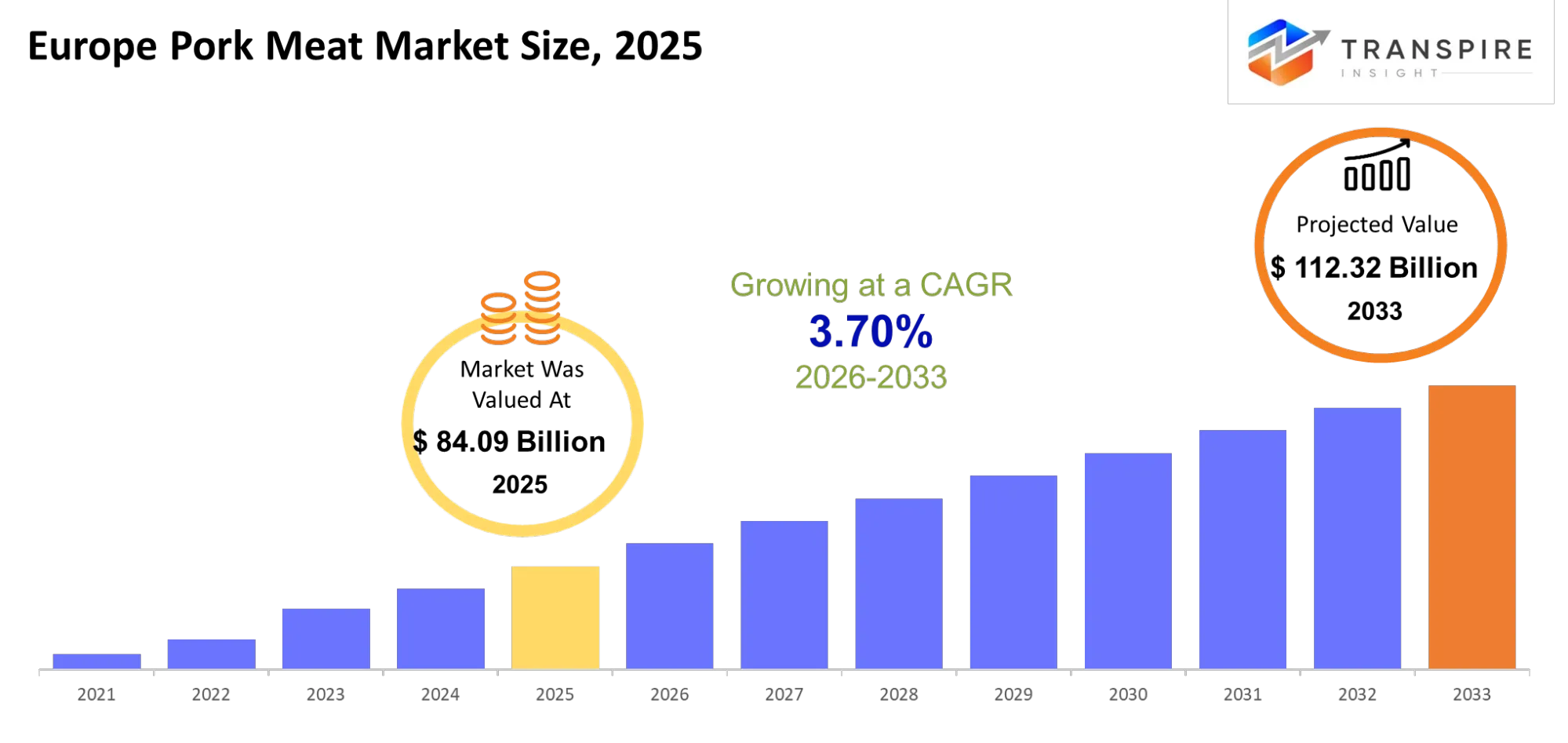
Europe Pork Meat Market Size & Forecast:
- Europe Pork Meat Market Size 2025: USD 84.09 Billion
- Europe Pork Meat Market Size 2033: USD 112.32 Billion
- Europe Pork Meat Market CAGR: 3.70%
- Europe Pork Meat Market Segments: By Type (Fresh Pork, Frozen Pork, Processed Pork, Organic Pork, Others); By Application (Household Consumption, Food Service, Retail, Processed Food, Catering, Others); By End-User (Consumers, Restaurants, Retailers, Food Industry, Hotels, Others); By Distribution (Supermarkets, Wet Markets, Online, Convenience Stores, Others)
To learn more about this report,  Download Free Sample Report
Europe Pork Meat Market Summary
The Europe Pork Meat Market was valued at USD 84.09 Billion in 2025. It is forecast to reach USD 112.32 Billion by 2033. That is a CAGR of 3.70% over the period.
The European pork meat market handles all operations from production through slaughtering and processing to distribution of pork products which serve both homes and food service businesses and processed food producers throughout the area. The system successfully links livestock farmers with both retail stores and industrial processors which allows them to provide continuous protein supply while maintaining high quality and safety requirements.
The market has restructured itself during the past three to five years because producers now follow stricter EU animal welfare and sustainability regulations which require them to implement tighter biosecurity measures and digital traceability systems and require them to consolidate their operations. The Ukraine conflict combined with African swine fever outbreaks created disruptions in feed supply chains which resulted in increased production costs that changed both production methods and export patterns. Producers have responded to market pressures by investing in efficiency improvements which led to increased vertical integration while they shifted their business operations toward premium market segments and developed secure supply chains instead of relying on production volume.
Key Market Insights
-
Western Europe will control 45 percent of the European pork market by 2025 because of high meat consumption rates in Germany France and Spain.
-
The fastest expanding area in Eastern Europe benefits from decreased production expenses and increasing capacity for pig farming that focuses on exports.
-
The fresh pork market segment dominates the European pork market with a market share of 52 percent in 2025 because household cooking creates demand for this product.
-
The second largest market segment in processed pork products exists because deli meats and sausages and packaged convenience foods drive its growth.
-
The food processing industry controls almost 48 percent of the market because pork functions as a fundamental component in both packaged meat products and bakery items.
-
Supermarkets throughout Europe increase their chilled and frozen pork products which helps retail consumption maintain its current levels.
-
The Europe Pork Meat Market shows 55 percent market share for household retail consumers because they consume domestic pork products at high rates.
-
The foodservice sector experiences its fastest growth through quick-service restaurants while the hospitality industry begins its recovery process.
-
Meat processors and other industrial users sustain their demand by establishing extensive procurement agreements.
-
Retailers now use sustainability programs and carbon reduction goals as essential points of difference when trying to win long-term contracts with retailers.
What are the Key Drivers, Restraints, and Opportunities in the Europe Pork Meat Market?
The Europe Pork Meat Market develops through three powerful forces which determine its growth path and its existing structural constraints.
The key driver is the rapid expansion of integrated supply chains combined with stricter EU traceability and animal welfare regulations. The regulations required producers to implement digital tracking systems together with controlled farming systems because of the recurring disease outbreaks that included African swine fever. The large processors use certified sourcing and contract-based retail supply to achieve revenue stability which decreases market volatility and enhances buyer trust throughout the Europe Pork Meat Market.
The main restraint comes from persistent feed cost inflation and dependency on imported soybean and grain inputs. The structural problem requires European countries to find ways to increase domestic feed production because their current capacity fails to meet basic requirements. The advanced producers in the industry face challenges because they cannot quickly reduce their dependency on imports which results in diminished profits and extended times for making expansion choices especially for mid-sized farms that face financial limitations.
The strongest opportunity exists through precision livestock farming and automated production systems which operate in Denmark and the Netherlands. The implementation of sensor-based health monitoring together with AI-driven feed optimization technologies enables better yield efficiency and lower mortality rates. The Danish Crown company uses these technologies at scale which indicates that data-driven livestock management will create new productivity growth opportunities for the European Pork Meat Market.
What Has the Impact of Artificial Intelligence Been on the Europe Pork Meat Market?
European Pork Meat Market operations experience operational efficiency improvements through artificial intelligence and advanced digital technologies which specifically enhance processing logistics and cold-chain monitoring and export-oriented production systems. In large-scale operations, AI-enabled automation now operates as a monitoring solution for quality control lines while it optimizes slaughterhouse throughput and manages equipment sanitation cycles to decrease manual work and maintain hygiene standards.
Predictive analytics is increasingly applied to anticipate equipment failures in refrigeration units and processing machinery which enables operators to schedule maintenance before breakdowns occur. Machine learning models also support demand forecasting and inventory optimization which helps processors align supply with retail and foodservice demand cycles more accurately which reduces waste and stabilizes margins across volatile price periods.
The operational implementation of these technologies has produced measurable results which include reduced energy usage in cold storage facilities and increased operational time for automated cutting lines and better transport routing which results in decreased logistical expenses. Some integrated processors report double-digit reductions in unplanned downtime after adopting predictive maintenance systems which also improve their ability to monitor compliance with EU food safety standards.
The fragmented data ecosystems that exist in AI systems create a fundamental barrier which prevents organizations from implementing AI technologies. Many mid-sized facilities lack standardized digital infrastructure which makes it difficult to develop accurate training models that apply to their complete production processes. The bigger companies in the industry keep on developing their intelligent production networks while data inconsistency creates obstacles to their complete expansion.
Key Market Trends
- The European Union implemented traceability regulations which required processors to use blockchain tracking systems throughout their entire pork supply chains after the 2022 disease outbreaks.
- The African swine fever outbreaks since 2021 forced producers to merge their operations which led to decreased Western European production from smallholder farmers.
- The automation of digital slaughterhouses reached its most rapid growth period after 2023 because it enhanced processing line productivity while decreasing staffing needs for German and Danish facilities.
- The Ukrainian conflict which began in 2022 caused feed price fluctuations which forced companies to change their procurement methods by increasing their use of alternative protein feed products.
- Retailers shifted toward contract-based procurement models after 2023 which resulted in stable price systems that protected them from the risks associated with spot market price changes.
- The temporary drop in export shipments to Asia between 2022 and 2023 led European producers to increase their sales of processed pork products within the European Union.
- The 2024 sustainability reporting requirements led French and Dutch pork processors to implement carbon tracking systems throughout their operations.
- The implementation of AI-based predictive maintenance systems increased after 2023 which decreased refrigeration system failures and enhanced cold chain system performance throughout meat processing facilities.
- Consumer demand for pork products shifted from bulk cuts to processed meats during the period from 2021 to 2025 because urbanization led to this change.
Europe Pork Meat Market Segmentation
By Type:
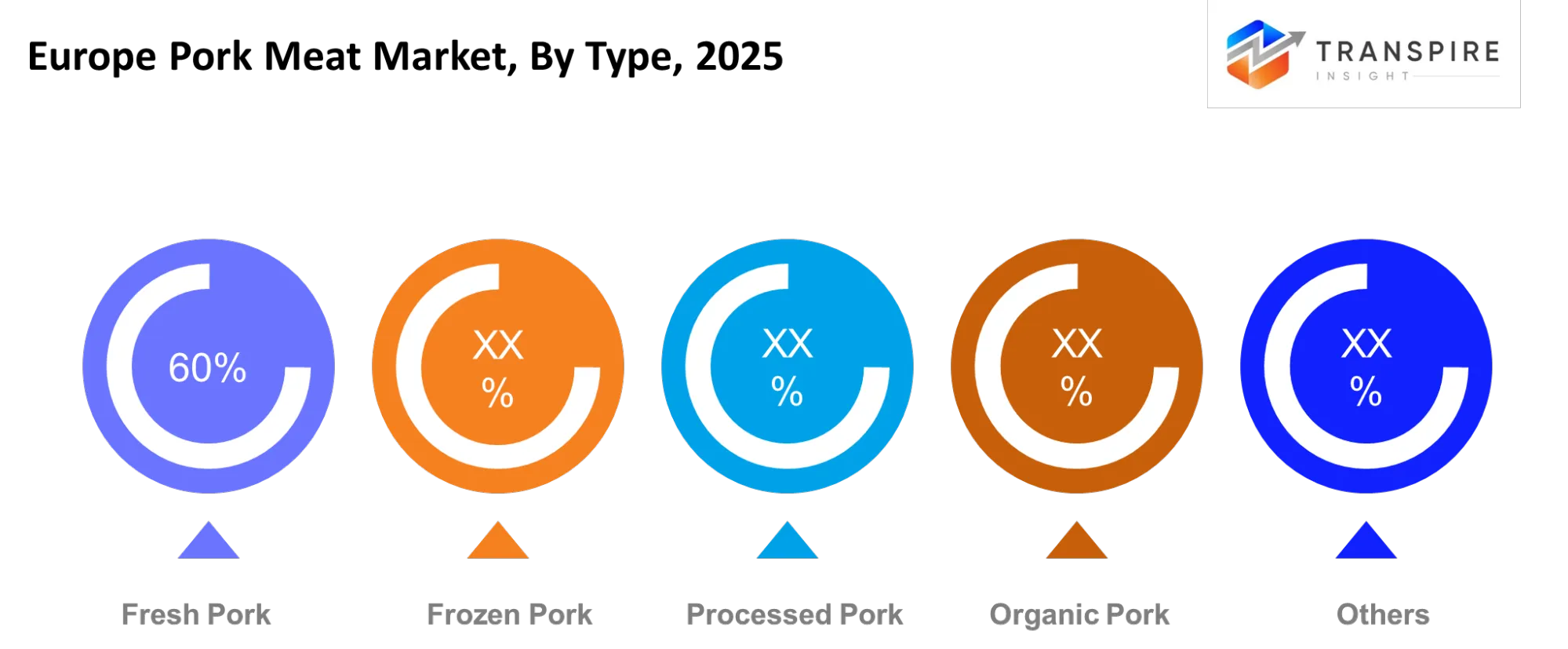
Fresh pork maintains its dominant market share in the European Pork Meat Market because German Spanish and French households continue to prepare meals at home. The product leads the market because customers need to purchase it at retail outlets and its production expenses are lower than those of value-added products. Frozen pork maintains its stable market position because export logistics and long-distance storage requirements drive its distribution to both intra-EU and Asian markets.
The processed pork segment experiences the most rapid expansion because urban consumers choose ready-to-eat foods and convenient products. Food manufacturers increasingly depend on processed formats because these products help them decrease preparation time while maintaining consistent quality throughout their distribution networks. Organic pork maintains its status as a niche market which continues to expand because Northern European customers accept premium prices for products that comply with European Union welfare labeling requirements.
The processed and organic market segments will achieve market share growth during the forecast period because customers now prefer products which offer both convenience and product traceability. Product developers will dedicate their efforts to developing advanced preservation methods and clean-label product formulations while investors will concentrate their attention on processed products that generate higher profits.
To learn more about this report, Download Free Sample Report
By Application:
The Europe Pork Meat Market operates through multiple application segments but Household consumption stands as the primary market segment because domestic cooking practices and traditional food habits support its growth. Retail channels enable this market segment to maintain its lead position through their extensive product distribution system and their pricing methods which achieve balance between supermarket chains and neighborhood retail outlets. The food service sector maintains high market presence because it tracks the ongoing recovery process which enables people to eat at restaurants throughout metropolitan areas.
The strongest market expansion for processed foods occurs because consumers increasingly demand packaged meals and ready-to-eat products that contain meat-based components. The catering sector expanded its operations after 2023 because institutional food demands from corporate clients and healthcare facilities increased. These changes demonstrate how people nowadays prefer to consume products which provide them with easier access to food.
The upcoming growth period will focus on processed food and food service markets because these sectors provide better opportunities for profit growth and operational efficiency. The production facilities will develop standardized product lines which meet the needs of institutional customers and quick-service restaurant chains.
By End-User:
The Europe Pork Meat Market shows its most substantial consumer base through households which show continuous demand while people in Europe prefer traditional pork dishes. Retailers function as essential middlemen who manage product selection and price determination throughout their distribution networks. Food industry buyers maintain significant influence through their bulk purchasing power which they use to acquire processed and packaged meat products.
Restaurants show their most rapid pace of transformation through their growing need for prepackaged and premeasured pork items which help them reduce staff expenses while maintaining product quality. The hospitality sector experiences its most consistent growth through hotels and catering businesses which benefit from increased tourist activity and standardized menu offerings in major hotel chains. The new practice shows that businesses prefer to streamline their work processes which help them efficiently prepare food.
The food industry and restaurant sectors will experience faster growth than household dining because they can expand their operations. The food service industry will require suppliers to create portion-controlled ready-to-cook products designed specifically for professional kitchen environments.
By Distribution:
The Europe Pork Meat Market establishes supermarkets as the primary distribution channel because of their advanced cold-chain systems and their centralized procurement methods. Wet markets still retain relevance in parts of Southern and Eastern Europe, although their share has gradually declined due to hygiene regulations and urban retail expansion. Convenience stores maintain steady demand for packaged processed pork products.
Online distribution has emerged as the fastest-growing channel, driven by digital grocery platforms and improved refrigerated logistics networks. The channel expansion process reached its peak after 2022 when consumers started using home delivery services for fresh and processed meat products. Retailers increasingly integrate omnichannel strategies to maintain competitiveness.
The online and supermarket channels will drive future growth because their integrated logistics systems and data-based inventory management systems increase operational efficiency. Suppliers will focus on digital shelf display and direct-to-consumer delivery capabilities as their main strategies to understand changes in customer buying patterns.
What are the Key Use Cases Driving the Europe Pork Meat Market?
Household cooking remains the dominant use case in the Europe Pork Meat Market, where fresh pork supports daily meal preparation across major consuming countries such as Germany, Spain, and France. The need for products arises from cultural dietary habits together with the fact that supermarkets offer affordable protein products which people need for their everyday meals.
Restaurants and processed food manufacturing represent new markets which are growing because dining establishments and fast food restaurants use pre-cut and pre-marinated pork to decrease cooking staff needs while making their food production process more uniform. Food industry buyers also integrate pork into ready-to-eat meals and packaged products, reflecting efficiency-driven procurement strategies.
New use cases have emerged because subscription services offer online meat delivery while AI systems develop meal planning solutions, which create personalized nutrition plans that include pork products. Healthcare and corporate sectors are changing their institutional catering operations because automated procurement systems help to control food portions while decreasing waste over time.
|
Report Metrics |
Details |
|
Market size value in 2025 |
USD 84.09 Billion |
|
Market size value in 2026 |
USD 87.12 Billion |
|
Revenue forecast in 2033 |
USD 112.32 Billion |
|
Growth rate |
CAGR of 3.70% from 2026 to 2033 |
|
Base year |
2025 |
|
Historical data |
2021 - 2024 |
|
Forecast period |
2026 - 2033 |
|
Report coverage |
Revenue forecast, competitive landscape, growth factors, and trends |
|
Regional scope |
Europe (Germany, United Kingdom, France, Italy, Spain, Rest of Europe) |
|
Key company profiled |
WH Group, Tyson Foods, JBS, Danish Crown, Smithfield Foods, Hormel Foods, BRF, Vion Food Group, Tönnies, Maple Leaf Foods, Marfrig, Perdue Farms, Seaboard Foods, Olymel, Clemens Food Group |
|
Customization scope |
Free report customization (country, regional & segment scope). Avail customized purchase options to meet your exact research needs. |
|
Report Segmentation |
By Type (Fresh Pork, Frozen Pork, Processed Pork, Organic Pork, Others); By Application (Household Consumption, Food Service, Retail, Processed Food, Catering, Others); By End-User (Consumers, Restaurants, Retailers, Food Industry, Hotels, Others); By Distribution (Supermarkets, Wet Markets, Online, Convenience Stores, Others) |
Which Regions are Driving the Europe Pork Meat Market Growth?
The European Pork Meat Market allows Western Europe to establish market dominance because its industrialized livestock operations comply with EU food safety regulations and animal welfare standards. The three countries maintain their production base because they operate advanced slaughtering facilities and complete cold-chain delivery systems. The market maintains steady demand through widespread supermarket distribution and certification systems which allow products to be exported. The system enables supply chain elements to achieve high output levels while maintaining continuous income flow.
Northern Europe contributes stable support to the system but operates with different structural characteristics which lead to distinct results. The three countries of Denmark Sweden and the Netherlands focus their operations on efficiency and biosecurity measures while producing high-value goods instead of increasing production volumes. This region demands disease control protocols which protect human health and maintain the high standards of its pork export operations. The established cooperatives maintain their production capacity through ongoing investment while they manage their operations according to scheduled regulatory processes. The region delivers stable service which meets the requirements of European retailers and food processors who need long-term contracts.
Eastern Europe has become the fastest expanding area because agricultural investments have risen and farm consolidation has increased and export infrastructure has improved since 2022. Poland and Hungary have developed modernization programs which enhance their breeding facilities and processing capabilities through operational upgrades. The combination of lower production costs and better access to EU markets has created incentives that drive companies to expand their business operations. The region offers investors and new businesses a chance to gain substantial growth through increased production capacity and development of export-based operations until 2033.
Who are the Key Players in the Europe Pork Meat Market and How Do They Compete?
The European Pork Meat Market shows moderate consolidation because Western European countries have large integrated processors and farmer cooperatives that control the market while Eastern European countries have small scattered production companies. The competition primarily relies on cost efficiency as well as complete EU compliance and the establishment of long-term retail supply contracts instead of increasing sales volume. Established companies maintain their profit margins through vertical integration and advanced processing automation and export certification capabilities which enable them to maintain steady access to high-end retail and foodservice markets.
Danish Crown uses farmer ownership with its cooperative-based cost leadership model to create a stable raw material supply through its integrated slaughtering networks that operate throughout Denmark and Germany. Vion Food Group differentiates itself from competitors through its operations which span the Netherlands and Germany while it develops food safety certification and traceable sourcing programs that help premium retailers. Westfleisch enhances its competitive position by establishing regional procurement hubs throughout Germany which help streamline logistics operations while the company develops strong partner relationships with supermarket chains.
Tönnies Group uses processing automation together with central production facilities in Germany to decrease production costs while boosting operational efficiency. WH Group achieves its urgent need for competitive expansion through its worldwide operations which connect European pork production to Asian distribution networks that enable them to meet export demands. The companies of this industry expand their operations through specific facility enhancements and essential supply contracts and planned capacity development which enables them to face feed price fluctuations and increasing regulatory requirements in the Europe Pork Meat Market.
Company List
- WH Group
- Tyson Foods
- JBS
- Danish Crown
- Smithfield Foods
- Hormel Foods
- BRF
- Vion Food Group
- Tönnies
- Maple Leaf Foods
- Marfrig
- Perdue Farms
- Seaboard Foods
- Olymel
- Clemens Food Group
Recent Development News
In September 2025, JBS S.A. signaled expanded acquisition intent in Europe, highlighting the region as a key growth area for future meat industry consolidation. The company indicated that fragmented ownership structures in European pork processing create opportunities for scale expansion through targeted takeovers, especially where antitrust constraints are less restrictive than in North America. https://www.reuters.com
In January 2026, Smithfield Foods announced the acquisition of Nathan’s Famous in a $450 million deal, securing long-term control over its licensed hot dog production rights. The transaction strengthens Smithfield’s branded processed meat portfolio and expands its presence in high-margin convenience food categories across Europe-linked export channels. https://www.smithfieldfoods.com
What Strategic Insights Define the Future of the Europe Pork Meat Market?
The Europe Pork Meat Market is evolving into a combined compliance-driven system which requires businesses to achieve competitive advantage through their ability to demonstrate operational scale and product traceability and their use of digital technologies. European Union sustainability regulations will require producers to implement complete control over their feed production and processing and distribution systems during the next 5 to 7 years because of rising costs of production materials. The market will benefit large processing companies which have the ability to manage their operational costs while sustaining product availability to meet contract requirements from retail and foodservice customers.
The market industry faces hidden dangers because a few leading processors are increasing their market share which will prompt government agencies to enforce stricter antitrust laws that will affect how companies pursue growth through acquisitions. The industry faces a structural risk because it relies on imported feed materials which create financial threats because geopolitical events disrupt supply chains that companies fail to predict during their strategic planning.
The Eastern European region presents a new business opportunity because it enables farmers to implement precision livestock farming at scale through its inexpensive land and European Union financial assistance programs which support the use of sensor-based herd management systems. The area has the potential to become a center for producing goods designed for international markets. The market participants need to invest their resources into data-driven agricultural collaborations and establish processing facilities throughout Eastern Europe because these investments will provide them with competitive advantages and help them adhere to governmental regulations while growing their businesses.
Europe Pork Meat Market Report Segmentation
By Type
- Fresh Pork
- Frozen Pork
- Processed Pork
- Organic Pork
- Others
By Application
- Household Consumption
- Food Service
- Retail
- Processed Food
- Catering
- Others
By End-User
- Consumers
- Restaurants
- Retailers
- Food Industry
- Hotels
- Others
By Distribution
- Supermarkets
- Wet Markets
- Online
- Convenience Stores
- Others
Frequently Asked Questions
Find quick answers to common questions.
The Europe Pork Meat Market size is USD 112.32 Billion in 2033.
Key segments for the Europe Pork Meat Market are By Type (Fresh Pork, Frozen Pork, Processed Pork, Organic Pork, Others); By Application (Household Consumption, Food Service, Retail, Processed Food, Catering, Others); By End-User (Consumers, Restaurants, Retailers, Food Industry, Hotels, Others); By Distribution (Supermarkets, Wet Markets, Online, Convenience Stores, Others).
Major Europe Pork Meat Market players are WH Group, Tyson Foods, JBS, Danish Crown, Smithfield Foods, Hormel Foods, BRF, Vion Food Group, Tönnies, Maple Leaf Foods, Marfrig, Perdue Farms, Seaboard Foods, Olymel, Clemens Food Group.
The Europe Pork Meat Market size is USD 84.09 Billion in 2025.
The Europe Pork Meat Market CAGR is 3.70% from 2026 to 2033.
- WH Group
- Tyson Foods
- JBS
- Danish Crown
- Smithfield Foods
- Hormel Foods
- BRF
- Vion Food Group
- Tönnies
- Maple Leaf Foods
- Marfrig
- Perdue Farms
- Seaboard Foods
- Olymel
- Clemens Food Group
Recently Published Reports
-
Apr 2026
Baby Infant Formula Market
Baby Infant Formula Market Size, Share & Analysis Report By ype (Infant Milk, Follow On Milk, Specialty Baby Milk, Growing-Up Milk), By Ingredient (Carbohydrate, Fat, Protein, Minerals, Vitamins, and Others), By Product Form (Powder, Liquid, and Ready-to-feed), By Distribution Channels (Supermarket/Hypermarket, Specialty Store, Pharmacies, Online Retail, and Others), and Geography (North America, Europe, Asia-Pacific, Middle East and Africa, South and Central America), 2021 - 2031
-
Apr 2026
Edible Insects for Animal Feed Market
Edible Insects for Animal Feed Market Size, Share & Analysis Report By Type (Insect Powder, Insect Meal, Insect Bar, Insect Paste, Insect Oil, and Others), By Insect Type (Beetles, Cricket, Caterpillar, Hymenoptera, Orthoptera, Tree Bugs, and Others), By Application (Livestock, Pet Food, and Aquaculture), By Livestock Type (Poultry, Swine, and Others), and Geography (North America, Europe, Asia-Pacific, Middle East and Africa, South and Central America), 2021 - 2031
-
Apr 2026
Food Industry Disinfection and Bacterial Control Market
Food Industry Disinfection and Bacterial Control Market Size, Share & Analysis Report By Type (Chemical Disinfectants, Physical Disinfectants, and Biocides and Antimicrobials), By Application (Food Processing Equipment Surface Disinfection, Food Preparation Areas Surface Disinfection, Storage Areas Surface Disinfection, Anti-microbial Coatings Food Preservation, and Preservative Solutions Food Preservation), By End User (Meat and Poultry Processing, Dairy Processing, Seafood Processing, Bakery and Confectionery, Restaurants and Commercial Kitchens, and Food Service Providers), By Sales Channel (Online, Offline), and Geography (North America, Europe, Asia-Pacific, Middle East and Africa, South and Central America), 2021 - 2031
-
Apr 2026
Freeze Dried Food Market
Freeze Dried Food Market Size, Share & Analysis Report By Product Type (Fruits, Vegetables, Freeze-Dried Dairy Products, Freeze-Dried Meat and Seafood, Freeze-Dried Pet Food, and Prepared Meal), By Nature (Organic, and Conventional), By Form (Powdered, Granules, and Diced), By End Use (Breakfast Cereals, Dairy Products, Bakery & Confectionery, Nutritional Bars & Supplements, Powdered Beverages, Snacks, and Retail (Household)), and Geography (North America, Europe, Asia-Pacific, Middle East and Africa, South and Central America), 2021 - 2031