

Europe Pay TV Market Size & Forecast:
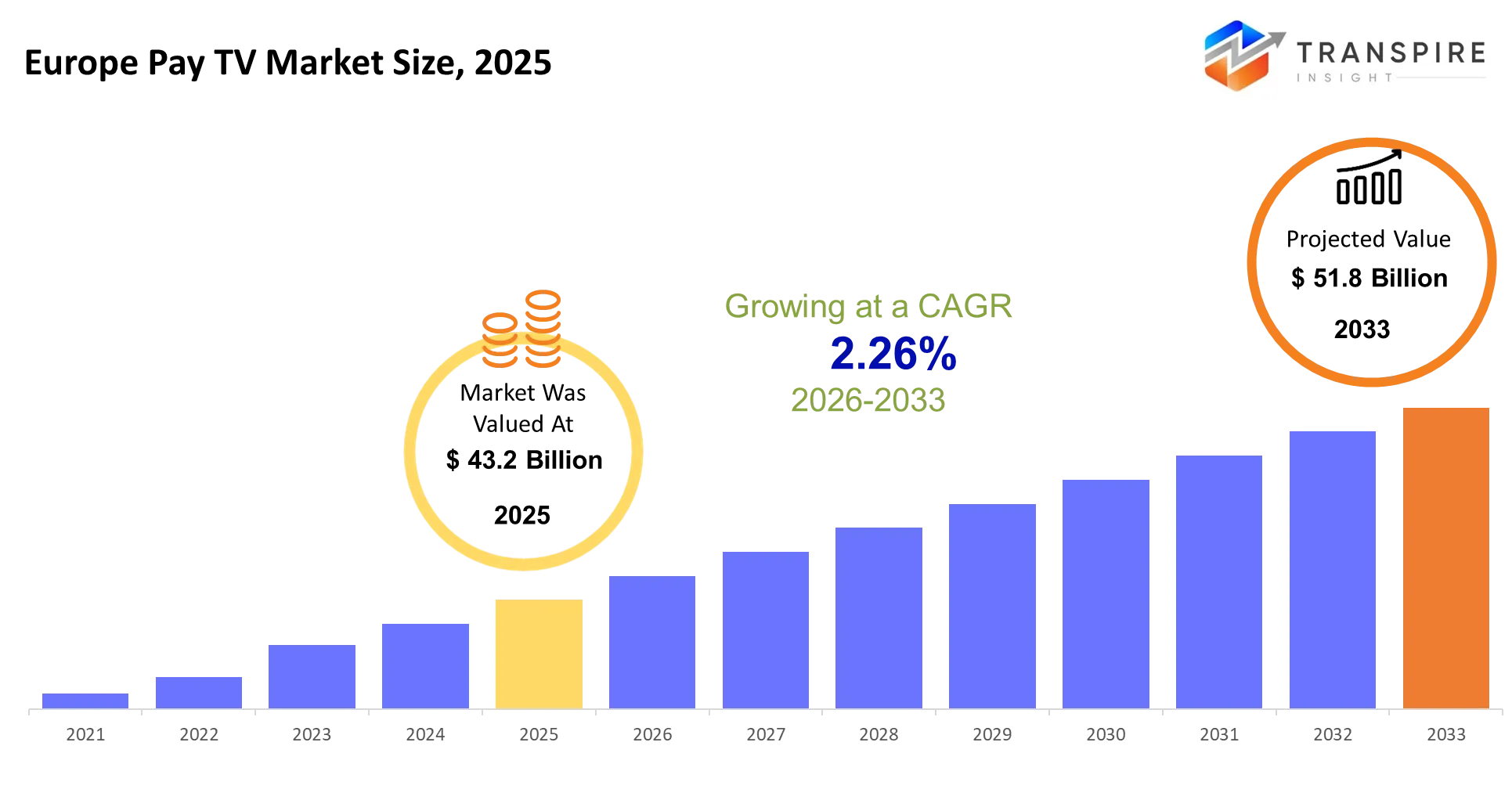
- Europe Pay TV Market Size 2025: USD 43.2 Billion
- Europe Pay TV Market Size 2033: USD 51.8 Billion
- Europe Pay TV Market CAGR: 2.26%
- Europe Pay TV Market Segments: By Type (Cable TV, Satellite TV, IPTV, OTT-based TV, Others), By Application (Residential, Commercial, Hospitality, Others), By End-User (Households, Hotels, Enterprises, Institutions, Others), By Distribution (Direct, Bundled Services, Online Platforms, Others).
To learn more about this report,  Download Free Sample Report
Europe Pay TV Market Summary:
The Europe Pay TV Market size is estimated at USD 43.2 Billion in 2025 and is anticipated to reach USD 51.8 Billion by 2033, growing at a CAGR of 2.26% from 2026 to 2033. The Europe Pay TV market delivers curated live television, premium sports, and bundled entertainment through cable, satellite, and growing IPTV platforms to European households. The service provides aggregated content which streaming services cannot fully deliver to customers who need dependable content for live events and national broadcasts.
The market has shifted from its previous distribution model to a new distribution system which combines pay TV with streaming and broadband through hybrid systems. Operators now position pay TV as part of a connectivity bundle rather than a standalone product. The expansion of fiber networks and better broadband service have enabled IPTV development because IPTV systems require less internet bandwidth than traditional broadcasting methods.
The rapid post-pandemic increase in streaming usage led into a viewing trend which resulted in people preferring on-demand content instead of scheduled shows.
The current growth pattern focuses on revenue generation which results from offer multiple services and high-value content and increased customer spending. The market now establishes its worth through digital ecosystem partnerships instead of exclusive access to particular channels.
Key Market Insights
- Western Europe will control 55% of the European Pay TV Market which will reach its peak in 2025 because of its superior broadband systems and its growing demand for high-quality content.
- The growth of Eastern Europe will reach its highest point until 2030 because of urban areas receiving fiber internet connections and increasing IPTV usage.
- IPTV leads the market with a 45% market share in 2025 because people shift their viewing habits toward internet streaming and complete digital service packages.
- Satellite TV operates as the second most important market section because it maintains a 30% market share through its ability to serve remote areas and its existing customer base.
- The market for OTT-integrated pay TV bundles represents the most dynamic segment which will experience significant growth from 2025 until 2030 because different platforms will start to share their content.
- The home market will account for 80% of usage in 2025 because families choose to combine entertainment, internet service, and live sports streaming into their home packages.
- The commercial sector shows the most rapid expansion through its use of smart TV and IPTV solutions in fields such as hospitality and public space management.
- The Europe Pay TV Market shows its highest demand from individual households which want to watch exclusive sports and news programs and local content.
- The most rapidly expanding sector includes multi-dwelling units and enterprise users who benefit from centralized IPTV systems and their associated service agreements.
What are the Key Drivers, Restraints, and Opportunities in the Europe Pay TV Market?
The Europe Pay TV Market currently experiences its strongest growth because customers now favor subscription packages which provide television content through both IPTV and broadband and streaming services. Western Europe and Eastern Europe achieved their current digital internet capacity because both regions received comprehensive fiberoptic network deployments together with decreasing costs for high-speed internet access. Telecom operators now package pay TV with broadband contracts turning television into a value-added service which they sell to customers who already have broadband. The basic service customers select will result in higher total monthly expenses because they opt for pricier packages which provide multiple services through a single invoice. Users who have multiple services from the same provider will experience lower churn rates because they find it harder to change their service provider.
The most significant barrier exists because traditional linear TV consumption has declined throughout all age groups especially among younger viewers. The shift represents a permanent change because people now prefer to watch on-demand content through platforms that offer flexible viewing options. The current satellite and cable systems need extensive funding to complete their system upgrades. The operators cannot boost their revenues through price increases because they have lost subscribers in their core business operations. Business restrictions will delay the next-generation platforms until they achieve their complete revenue potential.
The main opportunity exists through advanced IPTV systems which use cloud delivery technology and AI-based content aggregation to operate. The Eastern European markets which show increasing fiber installation rates present businesses with excellent growth opportunities. Telecom operators who implement Android-based television systems will be able to create combined viewing experiences through their ability to merge international streaming services with regional broadcast channels. This method improves user interaction with the platform and generates additional revenue streams through advertisements and data product sales.
What Has the Impact of Artificial Intelligence Been on the Europe Pay TV Market?
European pay television systems experience transformation through artificial intelligence and advanced digital technologies which automate the process of managing networks together with delivering content. The operators use AI-enabled control systems to track streaming performance through direct monitoring while they handle network traffic which results from signal drop issues throughout IPTV systems. The system decreases the need for personnel to control broadcast operations while it maintains service availability during important live broadcasting periods. The system uses AI technology to track content licensing and regional broadcasting compliance requirements which results in precise distribution without any operational interruptions.
Machine learning models enable predictive capabilities across infrastructure and customer management. The providers utilize these models to predict future network congestion while they assess upcoming set-top box hardware failures and determine optimal bandwidth distribution. The organization uses predictive methods to enhance system availability while minimizing interruptions which helps to maintain customer base and reinforce revenue generation. AI technology in advertising improves targeting accuracy which leads to higher conversion ratios and more effective revenue generation for operators.
The technologies improve operational performance by decreasing network outages while they decrease maintenance expenses and enhance the regularity of streaming performance. The primary challenge which exists today concerns the expensive process of connecting traditional cable and satellite systems with contemporary artificial intelligence systems. The implementation process for intelligent systems becomes obstructed because many operators maintain uncoordinated systems which prevent them from achieving all performance advantages.
Key Market Trends
- The major operators Sky Group and Vodafone Group made a transition from offering single TV subscriptions to providing combined broadband-TV packages which resulted in longer customer commitment periods for their contracts.
- The period from 2021 to 2025 saw IPTV adoption reach 60% of new subscriptions across Western Europe which marked a significant shift from satellite and cable systems.
- The younger audience segment cut their linear TV viewing by more than 30% since 2019 which compelled providers to develop on-demand services and modify their user interface design for application-based navigation.
- After 2020, content strategy development introduced new exclusive sports rights and regional programming as essential elements to compete against global streaming services.
- Telecom-led pay TV providers in Eastern Europe established operations since 2022 by using their fiber network expansion to attract urban residents who wanted to experience IPTV for the first time.
- After 2021, operators adopted hybrid set-top boxes that contained built-in applications because these devices enabled users to access multiple services through one unified platform.
- From 2021 onwards, advertising models transitioned to addressable TV because this approach enabled advertisers to create specific campaigns which resulted in higher advertising revenue than conventional broadcast methods.
- The European media directives established content localization requirements which became more stringent after 2020, which forced operators to increase their expenditures on developing and acquiring regional content.
- Churn management strategies evolved through the development of AI-powered recommendation systems which began operating after 2022 to deliver customized viewing options that boost subscriber retention rates.
Europe Pay TV Market Segmentation
By Type
The IPTV system stands as the top solution because operators have begun to use internet-based delivery systems that operate through their expanding fiber networks and enhanced broadband system. The combination of cable and satellite TV services maintains a substantial customer base which exists particularly in rural areas and in older markets where replacing infrastructure takes extended time and high expenses. Traditional providers who develop hybrid offerings that include streaming services have turned OTT-based TV into a secondary option which exists alongside their main products.
The patterns of demand demonstrate that customers choose IPTV because it provides them with flexible viewing options that work on multiple devices and allow them to watch content whenever they want, which causes IPTV usage to grow while pure linear formats face rapid decline. Operators will develop unified interfaces which use cloud delivery to create more advanced platform systems. The shift requires manufacturers and service providers to focus on their software capabilities, while investors emphasize scalable distribution models which operate through IP-based systems.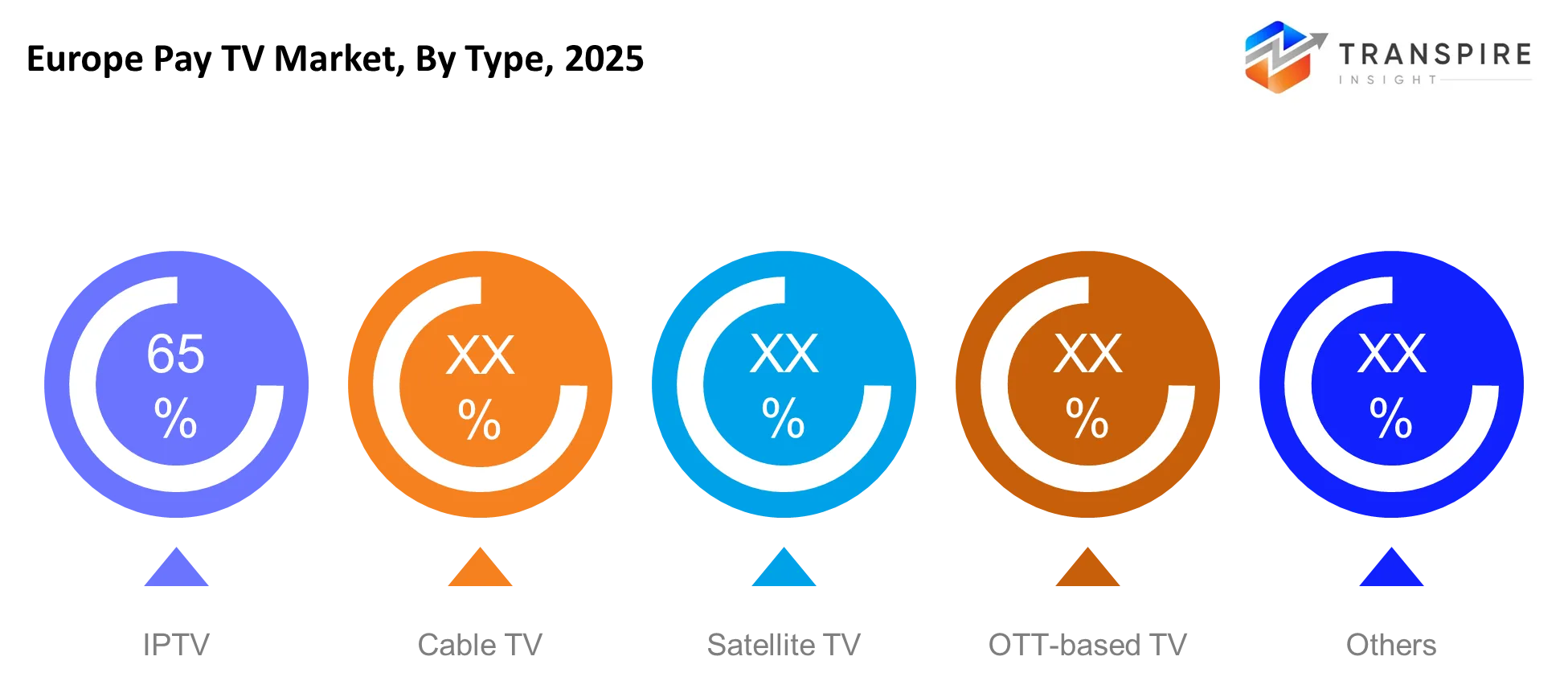
To learn more about this report, Download Free Sample Report
By Application
The primary residential sector uses its services because home users want to watch live sports and news programs and theirTV bundles. The commercial and hospitality sectors have lower market shares, yet they develop through the implementation of smart IPTV systems in hotels offices and public spaces. The spaces need centralized management together with tailored content distribution and expandable systems because these requirements differ from what individual users need.
The rise in tourist and business traveler activity across Europe has led hotels to update their guest room entertainment systems, which results in continuous growth for this market. The future will see providers create content packages that meet particular environmental needs, which will increase both the customization and service integration of their offerings. The current trend leads solution providers to create versatile platforms that meet both entertainment and business operation requirements for their users.
By End-User
The largest market sector of End-User customers comes from households who show increased demand for premium content and select bundled services. Enterprises and hotels and institutions form an expanding market segment which remains smaller because their adoption depends on infrastructure improvements and their unique service offerings. The need for centralized distribution systems exists in multi-dwelling units and shared living spaces because these systems lower operational costs and make service delivery easier.
Different purchasing patterns exist in each category because households buy products which provide them both value and easy access while commercial users need products which deliver consistent performance and extended capacity. The upcoming growth phase will result from enterprises and institutions implementing digital infrastructure improvements. The operators are responding to this market shift by creating new services for business customers while establishing service agreements with clients.
By Distribution
The telecom industry uses bundled services to maintain customer loyalty and generate consistent income because operators offer television content with their broadband and mobile service packages. The direct-to-home models operate on traditional systems but are experiencing a gradual decline because they require extensive maintenance and do not provide operational adaptability.
The distribution of content through online platforms and app-based systems allows users to view content on multiple devices without needing traditional hardware. The current distribution changes reflect new consumer demands for accessible content which provides a smooth viewing experience. The future development of digital ecosystems will establish digital systems that use integrated platforms for content delivery and billing and customer management. The evolution process requires providers to build cloud systems and digital customer interfaces while it creates easier access to content and better viewing control for customers.
What are the Key Use Cases Driving the Europe Pay TV Market?
The primary function of pay television exists as the main entertainment option for households which provides live sports broadcasts together with national news programs and premium television channels through its bundled broadband services. The highest user demand exists because people need dependable real-time access to live events which streaming services fail to provide throughout their entire service duration. Telecom-led bundles enable customers to understand their billing process better, which leads to increased value perception, resulting in customers maintaining their subscription to residential services.
The hospitality sector and commercial spaces are two fields that show rapid growth for IPTV technology. Corporate offices and public venues also use pay TV for news broadcasting and live event screening, which helps them offer distinct services that enhance their customer satisfaction.
The development of interactive advertising together with AI-powered content personalization based on user data represents the newest application of technology. Smart city projects and connected living ecosystems are beginning to integrate pay TV interfaces into broader digital services, which indicates that these two systems will eventually come together.
|
Report Metrics |
Details |
|
Market size value in 2025 |
USD 43.2 Billion |
|
Market size value in 2026 |
USD 44.3 Billion |
|
Revenue forecast in 2033 |
USD 51.8 Billion |
|
Growth rate |
CAGR of 2.26% from 2026 to 2033 |
|
Base year |
2025 |
|
Historical data |
2021 - 2024 |
|
Forecast period |
2026 - 2033 |
|
Report coverage |
Revenue forecast, competitive landscape, growth factors, and trends |
|
Regional scope |
Europe (Germany, United Kingdom, France, Italy, Spain and Rest of Europe) |
|
Key company profiled |
Sky, Comcast, Vodafone, BT Group, Orange, Telefonica, Liberty Global, Canal+, Dish Network, AT&T, Verizon, Tata Play, Foxtel, Astro, Airtel |
|
Customization scope |
Free report customization (country, regional & segment scope). Avail customized purchase options to meet your exact research needs. |
|
Report Segmentation |
By Type (Cable TV, Satellite TV, IPTV, OTT-based TV, Others), By Application (Residential, Commercial, Hospitality, Others), By End-User (Households, Hotels, Enterprises, Institutions, Others), By Distribution (Direct, Bundled Services, Online Platforms, Others) |
Which Regions are Driving the Europe Pay TV Market Growth?
The market in Western Europe maintains its leading position because of its advanced digital infrastructure and widespread broadband access together with its media regulations that mandate local content creation. The established telecom systems in the UK Germany and France enable their users to access pay TV through fiber networks and mobile services. The regulatory frameworks create a competitive environment while maintaining content standards and regional diversity which helps build customer trust for long-term subscriptions. The advertising market has reached maturity while the premium sports licensing system creates financial stability which enables operators to maintain their market position.
Southern Europe shows different growth patterns because of continuous economic improvements and ongoing investments in telecommunications infrastructure. Italian and Spanish markets demonstrate stable subscriber growth because operators use bundled services to keep existing customers instead of trying to expand their user base. The consumer equation with pay TV services depends heavily on sports broadcasting rights which maintain high viewer interest. This region generates stable income streams because of its consistent demand patterns and its slow transition to digital technology which does not cause significant disturbances.
The development of urban areas and fiber networks makes Eastern Europe the fastest expanding region. Telecom companies in Poland and Romania have boosted IPTV adoption through their network upgrades of outdated systems. The recent broadband access and digital service developments have created new subscriber categories which include mid-income urban residents. The period from 2026 to 2033 will develop strong market entry paths for operators and technology providers who want to build their scalable IP-based platforms. The development of urban areas and fiber networks makes Eastern Europe the fastest expanding region.
The European Pay TV Market shows moderate consolidation through the presence of multiple telecom and media companies who control major subscriber bases while smaller regional operators serve specific markets. Incumbents use television bundling with broadband and mobile services to defend their market share because this strategy creates high switching expenses which help them maintain their customer base. The basis of competition has shifted from pricing toward service integration, content exclusivity, and platform experience. New entrants, particularly streaming-first aggregators, continue to disrupt viewing behavior, which forces traditional networks to transform into digital service providers instead of existing as traditional broadcasters.
Sky Group maintains its market position through its exclusive sports rights and original content, which drive customer retention in the UK and Italy. The company expands through app integration and flexible subscription models that combine satellite and streaming access. Canal+ Group uses its content ownership and regional production capabilities to build its distribution footprint through European and African market acquisitions, which help the company obtain exclusive programming rights.
Deutsche Telekom uses its fiber infrastructure to provide IPTV services which customers receive as part of their high-speed broadband packages, thus creating a technological advantage that improves service delivery and system dependability. Vodafone Group uses its bundled service packages and streaming service partnerships to construct a single customer interface, which helps the company retain customers. Liberty Global uses its regional cable strength to support its development of advanced set-top boxes, which combine OTT content with other services to enhance its unified digital ecosystem presence.
Company List
- Sky
- Comcast
- Vodafone
- BT Group
- Orange
- Telefonica
- Liberty Global
- Canal+
- Dish Network
- AT&T
- Verizon
- Tata Play
- Foxtel
- Astro
- Airtel
Recent Development News
In April 2026, RTL wins unconditional EU antitrust approval for Sky Deutschland acquisition: In April 2026, the European Commission unconditionally approved RTL Group’s acquisition of Sky Deutschland, a major consolidation move in the European pay-TV and streaming sector. The regulator confirmed that the deal does not raise competition concerns, paving the way for one of Europe’s largest TV combinations.
Source: https://www.reuters.com
In April 2026, FranceTV expands digital distribution via YouTube partnership: France Télévisions announced a new partnership with YouTube to expand distribution of its content, reflecting a strategic shift among European broadcasters toward hybrid Pay TV + digital streaming models. This move strengthens broadcaster reach while adapting to declining traditional Pay TV subscriptions.
Source: https://videoweek.com
What Strategic Insights Define the Future of the Europe Pay TV Market?
The Europe Pay TV Market is moving toward complete digital service ecosystem because television now operates through broadband-based platforms. The operators will achieve their growth targets through data-driven monetization and targeted advertising and platform stickiness. The main driver of this system functions because fiber networks and cloud delivery systems have reached their complete development, which enables users to access all content types through one unified platform.
Dependency on platforms creates an invisible danger for the business. The operators face threats to their customer links and data because they increasingly depend on outside streaming services and operating systems, which gives global technology companies greater control over these assets, thus decreasing their future pricing abilities. The increased user engagement will lead to higher operating costs, which create a risk of financial loss.
The TV advertising industry shows potential for growth through addressable and programmatic advertising, which AI and household data integration bring to markets that are developing their IPTV systems. The business needs to allocate resources toward proprietary aggregation platforms and data ownership development, which will allow them to manage all aspects of user experience and analytics and monetization channels.
Europe Pay TV Market Report Segmentation
By Type
- Cable TV
- Satellite TV
- IPTV
- OTT-based TV
- Others
By Application
- Residential
- Commercial
- Hospitality
- Others
By End-User
- Households
- Hotels
- Enterprises
- Institutions
- Others
By Distribution
- Direct
- Bundled Services
- Online Platforms
- Others
Frequently Asked Questions
Find quick answers to common questions.
The Approximate Europe Pay TV Market size for the Market will be USD 51.8 Billion in 2033.
The key Segments of the Europe Pay TV Market are By Type (Cable TV, Satellite TV, IPTV, OTT-based TV, Others), By Application (Residential, Commercial, Hospitality, Others), By End-User (Households, Hotels, Enterprises, Institutions, Others), By Distribution (Direct, Bundled Services, Online Platforms, Others).
Major Players in the Europe Pay TV Market are Sky, Comcast, Vodafone, BT Group, Orange, Telefonica, Liberty Global, Canal+, Dish Network, AT&T, Verizon, Tata Play, Foxtel, Astro, Airtel.
The Current Market size of the Europe Pay TV Market is USD 43.2 Billion in 2025.
The Europe Pay TV Market CAGR is 2.26%.
- Sky
- Comcast
- Vodafone
- BT Group
- Orange
- Telefonica
- Liberty Global
- Canal+
- Dish Network
- AT&T
- Verizon
- Tata Play
- Foxtel
- Astro
- Airtel
Recently Published Reports
-
Apr 2026
3D Optical Profiler Market
3D Optical Profiler Market Size, Share & Analysis Report By Type (Desktop 3D Optical Profiler, and Portable 3D Optical Profiler), By Technology (Confocal Technology, and White Light Interference), By End-Use Industry (Manufacturing, Research Institutions, Automotive, Aerospace and Defense, Medical Devices, and Other), and Geography (North America, Europe, Asia-Pacific, Middle East and Africa, South and Central America), 2021 - 2031
-
Apr 2026
Depth Sensor Market
Depth Sensor Market Size, Share & Analysis Report By Type (Infrared Depth Sensors, Time-of-Flight (ToF) Sensors, Stereo Vision Sensors, Structured Light Sensors, Ultrasonic Depth Sensors), By Application (Automotive, Robotics, Gaming, Consumer Electronics, Industrial Automation, Healthcare, Security & Surveillance, Others), By End Users (Automotive Manufacturers, Consumer Electronics Companies, Healthcare Providers, Industrial Companies, Security Agencies, Gaming Companies, Robotics Companies, Others), and Geography (North America, Europe, Asia-Pacific, Middle East and Africa, South and Central America), 2021 – 2031
-
Apr 2026
Digital Manufacturing Market
Digital Manufacturing Market Size, Share & Analysis Report By Component (Hardware, Software, and Services), By Technology (Robotics, 3D Printing, Internet of Things (IoT), and Others), By Application (Automotive and Transportation, Aerospace and Defense, Consumer Electronics, Industrial Machinery, and Others), By Process Type (Computer-Based Designing, Computer-Based Simulation, Computer 3D Visualization, Analytics, and Others), and Geography (North America, Europe, Asia-Pacific, Middle East and Africa, South and Central America), 2021 – 2031
-
Apr 2026
Digital Visa Services Market
Digital Visa Services Market Size, Share & Analysis Report By Type (Individual Travelers, Group Travelers), By Application (Tourism, Business Travel, Others), and Geography (North America, Europe, Asia-Pacific, Middle East and Africa, South and Central America), 2021 – 2031