
Europe Multi-Agent System (MAS) Platform Market Size & Forecast:
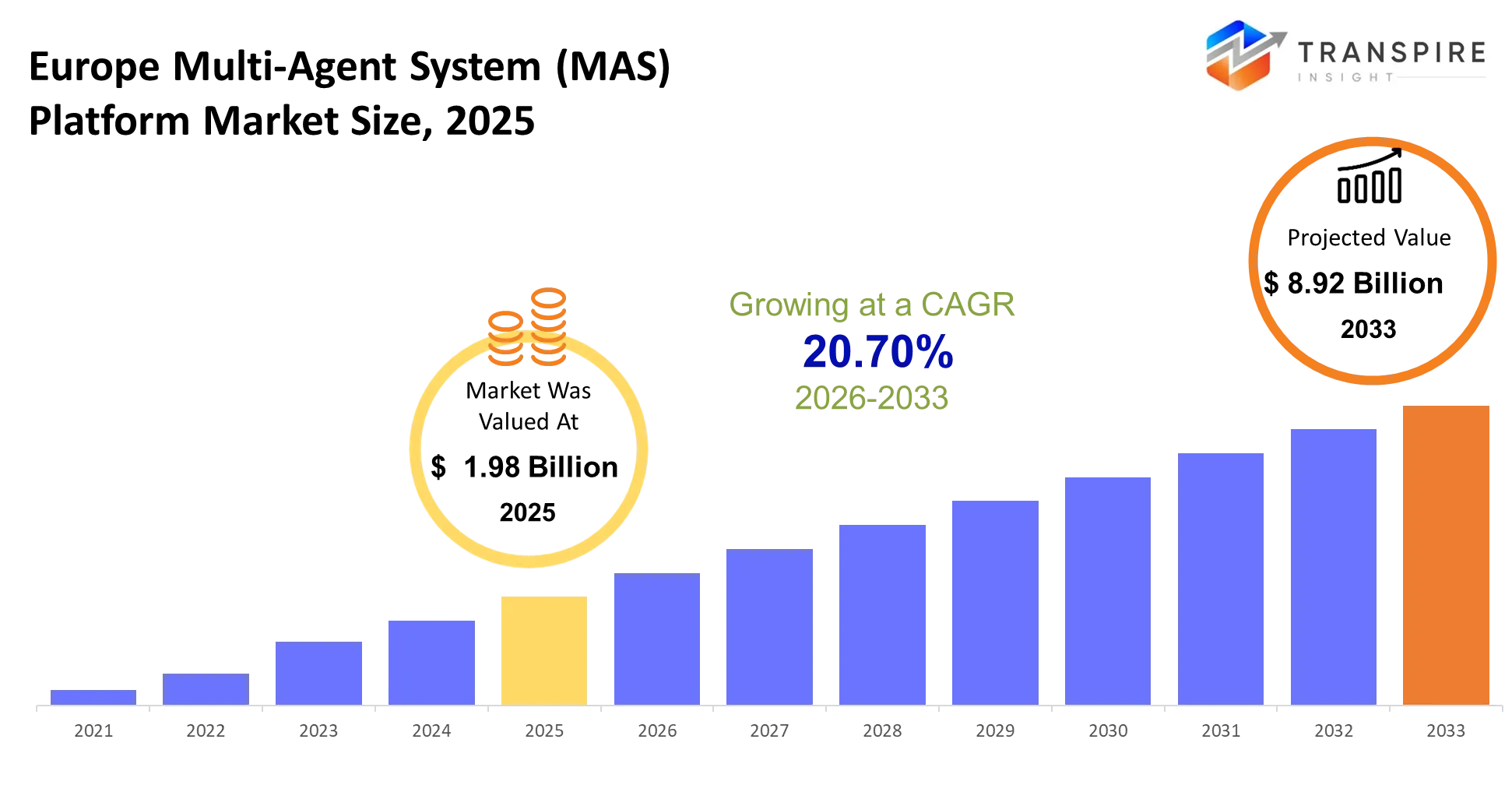
- Europe Multi-Agent System (MAS) Platform Market Size 2025: USD 1.98 Billion
- Europe Multi-Agent System (MAS) Platform Market Size 2033: USD 8.92 Billion
- Europe Multi-Agent System (MAS) Platform Market CAGR: 20.70%
- Europe Multi-Agent System (MAS) Platform Market Segments: By Type (Software Platforms, Frameworks, Development Tools, Simulation Tools, Others); By Application (Robotics, Autonomous Systems, Smart Grids, Traffic Management, Industrial Automation, Others); By End-User (Enterprises, Research Institutes, Government, Automotive Companies, Industrial Firms, Others); By Deployment (Cloud-based, On-premise, Edge Computing, Hybrid, Others)
To learn more about this report,  Download Free Sample Report
Europe Multi-Agent System (MAS) Platform Market Summary:
The Europe Multi-Agent System (MAS) Platform Market size is estimated at USD 1.98 Billion in 2025 and is anticipated to reach USD 8.92 Billion by 2033, growing at a CAGR of 20.70% from 2026 to 2033. Market trends in the europe mas platform industry in artificial intelligence and enterprise software will see more emphasis on autonomous distributed decision-making systems which have traditionally relied on human intervention and collaboration. Software is going to be required by businesses throughout Europe to negotiate, adapt, and cooperate in real time due to rising pressures for quicker operation and less human supervision. Technical innovations in edge computing and frameworks for software interoperability will help define how these platforms are constructed, whereas stringent data regulations in the European Union will affect agent-based processing of information.
What Has the Impact of Artificial Intelligence Been on the Europe Multi-Agent System (MAS) Platform Market?
The artificial intelligence technology is slowly transforming the europe multi-agent system (mas) platform market through intelligent learning, adaptation and coordination of decision-making without any significant human interventions. The incorporation of AI technologies in europe multi-agent system (mas) platform markets has increased the level of research in the markets through analyzing large data streams in real-time. This has been made possible since machine learning technologies have been incorporated in agent-based systems, which allow for data analysis, simulation and strategizing in real-time.
Artificial intelligence impacts in the europe multi-agent system (mas) platform markets can be seen in predicting future demands and identifying the latest market trends. Intelligent agents in the market can help in predicting changes in customer needs, detecting any irregularities in the markets and adapting workflows in response to changes. Smart automation in such systems has enabled better production cycles through eliminating the need for human interventions while ensuring precision.
In addition to efficiency, AI is playing an important role in optimizing the supply chains and managing the cost on the europe multi-agent system (mas) platform market. The use of autonomous agents makes negotiations easier, manages the logistics, and provides fast action against any disturbance. It reduces the cost of operations along with providing space for innovations and customization. Using AI technology in the europe multi-agent system (mas) platform market helps firms stay ahead by offering personalized services and being proactive against changes in business environments.
Key Market Trends & Insights:
- The market for europe multi-agent system (mas) platform is growing steadily, as companies adopt more artificial intelligence-based coordination systems within their operations in finance, healthcare, and manufacturing.
- With the integration of smart automation and machine learning into operations, companies are enjoying improved decision-making speeds, with operational delays falling by up to 25-30%.
- The adoption of decentralization is facilitating agent collaboration in real time, contributing to scalability and adaptability of enterprise architecture.
- Western Europe holds 40%+ market share in 2025, led by major countries like Germany, France, and the United Kingdom due to their established infrastructures.
- North Europe is set to be the most rapidly developing region over the coming decade, growing at 20% + CAGR up till 2030.
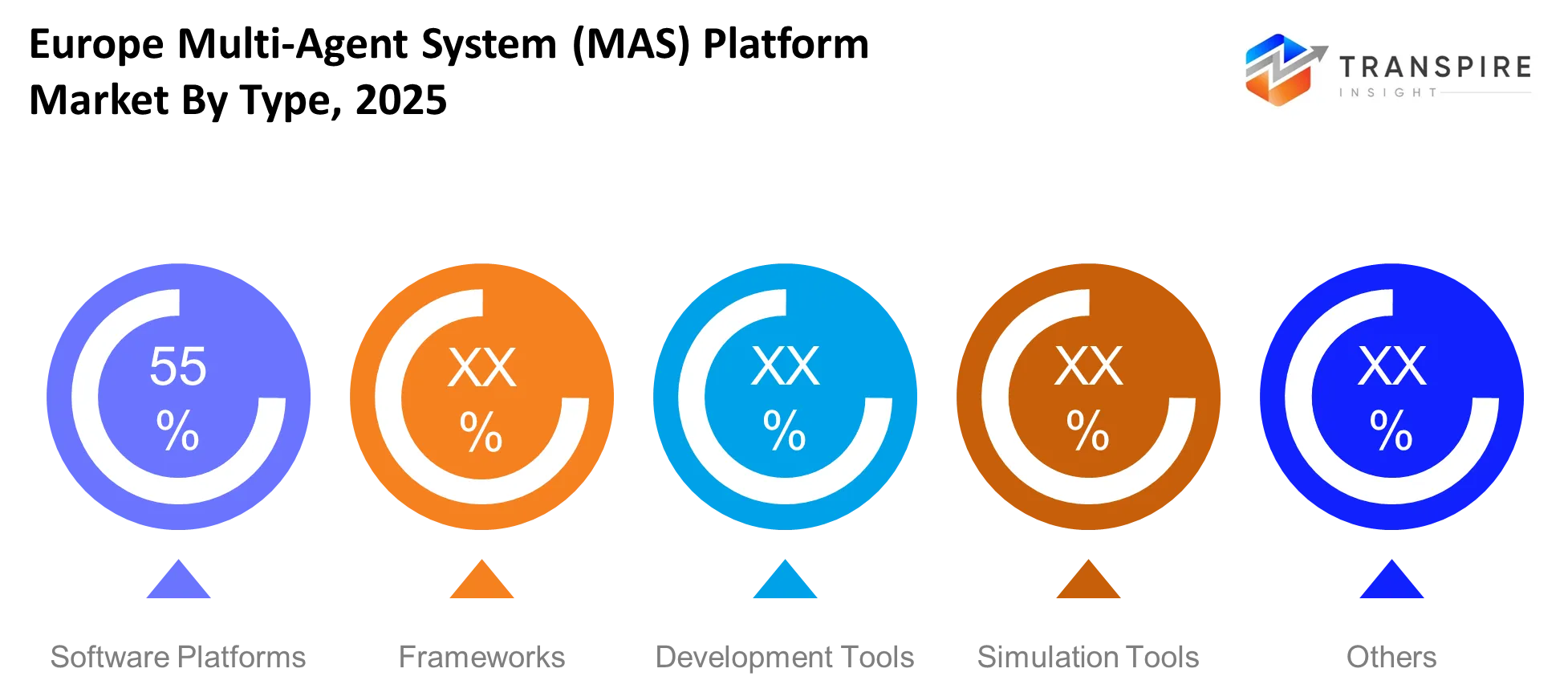
- The platform software solutions category takes the lead, accounting for almost 55% of the market as customers seek agent orchestration systems.
- Cloud-based MAS platforms are emerging as the most rapidly growing category, set for major growth through 2030 due to flexibility and lower costs.
- Enterprise automation applications are dominating the market, with over 35% of the market driven by improved process management.
- Supply chain optimization stands out as the fastest-growing application, as companies seek real-time logistics optimization capabilities.
Europe Multi-Agent System (MAS) Platform Market Segmentation
By Type
The software platforms would provide the foundation of cooperation among various agents by making sure that the communication is well organized in their activities. Developers would have access to architectural frameworks that ease the development process. The tools for developing would center on testing and debugging in order to make the whole process smoother. Simulation tools would ensure a safer environment for testing multiple agents before putting them to use.
These four types of tool categories would become more popular in line with the need for flexible and scalable solutions for various companies. Platforms would become more popular due to the ease of customizing, whereas the frameworks would be chosen by people looking for faster solutions. The development tools would help developers in increasing their efficiency due to automation.
To learn more about this report, Download Free Sample Report
By Application
The field of robotics will be using agent-based coordination in the performance of precise and adaptable tasks in ever-changing environments. The autonomous systems will also be dependent on agents when making their decisions, since they have to perform independently, especially in the transportation and defense sectors. Agent technology will also be used in smart grids in order to balance supply and demands for electricity. Real-time coordination among agents will help in traffic management.
Automation in industry will also keep adopting agents in their processes, as they help in achieving efficiency in the operations. There will be efficiency in each of the above applications as the agents coordinate amongst themselves in order to achieve success. Robotics and autonomous systems will spearhead the use of this technology, while smart grids and traffic systems will be looking at efficiency.
By End-User
Organizations will deploy agent systems to increase efficiency and decision making within different organizations. Research institutions will utilize them to experiment with new algorithms and complex coordination methods. Governments will target public utilities, deploying agents systems in intelligent city concepts and automating processes via government directives. Automobile manufacturers will employ agents systems in building smart connected and autonomous cars.
Manufacturing companies will incorporate agents systems in their manufacturing process to increase flexibility and minimize downtime. Every user type will contribute to how solutions are developed by presenting unique challenges and requirements. Organizations and industrial manufacturers will look at efficiency, whereas research institutions will be driven by innovation. Other types of end users will take advantage of such systems because of unique applications.
By Deployment
Cloud-based deployment will be scalable and remotely accessible, thus best suited for businesses dealing with massive amounts of data. On-premise deployments will provide better control and security for companies that have more stringent data requirements. With edge computing, decision-making processes can be made nearer the point where data is collected, and thus processing will be much faster. Hybrid deployments will provide a blend between cloud-based deployments and on-premise deployments.
The choice of deployment will depend on cost, time, and security considerations. Cloud deployment will be more common due to its flexibility. But, on-site deployment will continue to be preferred by security-minded businesses. Edge computing will gain popularity as an important means of providing fast computing services, especially in industries like automatic control systems and traffic control systems.
What are the Main Challenges for the Europe Multi-Agent System (MAS) Platform Market Growth?
It should be noted that there are several technical and operational difficulties associated with the europe multi-agent system (mas) platform market which hinder its further development. Stability becomes an issue because of the interaction of several agents within the same environment, which leads to various unpredictable results. In addition, performance problems may emerge due to the network scalability of such agents within extensive data processing, causing delays. Overall, these problems faced by the europe multi-agent system (mas) platform market call for more robust architecture design and protocol standardization.
Apart from technical difficulties, there is also the issue of manufacturing and commercialization obstacles that hamper the europe multi-agent system (mas) platform market. First of all, high development costs are an obstacle as it is hard to integrate machine learning models into current IT infrastructures. What is more, there are several regulatory constraints concerning the operation within the European Union. Indeed, strict laws on data privacy and AI management are a major challenge that hinders rapid product development.
Issues that continue to affect the europe multi-agent system (mas) platform market include the adoption issues that have been identified, which are mainly related to inadequate infrastructures and a lack of experienced personnel. Most companies do not possess the knowledge necessary for using agent-based systems. The funding issues, especially in smaller firms, also contribute to the slow pace of adoption. Other market issues like poor awareness levels and difficulties in integrating systems lower the adoption rate.
Another issue affecting the europe multi-agent system (mas) platform market is competition from other forms of automation technologies. Conventional systems and AI technologies provide easier-to-use alternatives that may prove cheaper and faster.
Country Insights
North America will have a dominant position because of early adoption of advanced AI solutions and huge investment in automation in enterprise. This will ensure continued innovation and quicker development cycles in this area. The demand for scalability and adaptability of intelligent systems will be the reason behind sustained growth of North America MAS market.
The strong infrastructure and availability of highly qualified professionals will ensure smooth implementation of agent-based solutions. Research and development activities will help the regions improve their positions and gain momentum in terms of performance and reliability of systems.
Europe will experience balanced growth as its regulatory framework is extremely strong. All industries will implement intelligent systems based on compliance issues that will influence the way they are deployed and developed in Europe.
Digital transformation investments will stimulate adoption of intelligent systems in manufacturing, automotive, and public infrastructure industries in Europe. Innovation in Europe MAS platform market will become an outcome of enterprise cooperation and research institutions' activities.
Asia Pacific is likely to experience growth due to its fast-paced industrialization and high demand for automation. The growth in technology eco-systems coupled with governments’ interest in implementing projects in smart infrastructure would help adopt the use of highly advanced agent-based systems.
Increasing digital connections and investments in businesses would offer scope for scalability of the solutions. Businesses would become more concerned about efficiency and would look forward to using the solutions for managing operations in an effective manner.
Latin America will see moderate growth owing to greater understanding and application of automation and digitalization. Companies will investigate agent-based systems to optimize operations and minimize manual tasks within various sectors.
Constraints posed by economic factors and inadequate infrastructure will be barriers, but slow progress will ensure steady adoption. Increased attention on new technologies will fuel growth as firms strive for an edge in dynamic environments.
Recent Development News
In April 2026, SoundHound AI announced acquisition of LivePerson. The deal will create an integrated conversational AI and enterprise messaging platform to strengthen agent-based automation capabilities.https://fintech.global
In April 2026, ServiceNow reported acquisition of Armis. The acquisition will enhance AI-driven security and autonomous system monitoring by integrating real-time cyber risk detection into its platform ecosystem.https://www.itpro.com
|
Report Metrics |
Details |
|
Market size value in 2025 |
USD 1.98 Billion |
|
Market size value in 2026 |
USD 2.39 Billion |
|
Revenue forecast in 2033 |
USD 8.92 Billion |
|
Growth rate |
CAGR of 20.70% from 2026 to 2033 |
|
Base year |
2025 |
|
Historical data |
2021 - 2024 |
|
Forecast period |
2026 - 2033 |
|
Report coverage |
Revenue forecast, competitive landscape, growth factors, and trends |
|
Regional scope |
Europe (Germany, United Kingdom, France, Italy, Spain, Rest of Europe) |
|
Key company profiled |
IBM, Microsoft, Google, Oracle, SAP, NVIDIA, Siemens, Bosch, ABB, Honeywell, Rockwell Automation, Dassault Systèmes, AnyLogic, NetLogo, JADE |
|
Customization scope |
Free report customization (country, regional & segment scope). Avail customized purchase options to meet your exact research needs. |
|
Report Segmentation |
By Type (Software Platforms, Frameworks, Development Tools, Simulation Tools, Others); By Application (Robotics, Autonomous Systems, Smart Grids, Traffic Management, Industrial Automation, Others); By End-User (Enterprises, Research Institutes, Government, Automotive Companies, Industrial Firms, Others); By Deployment (Cloud-based, On-premise, Edge Computing, Hybrid, Others) |
How Can New Companies Establish a Strong Foothold in the Europe Multi-Agent System (MAS) Platform Market?
One way to establish a dominant presence among other companies operating in the europe multi-agent system (mas) platform market is through developing specific use cases instead of creating platforms. Startups could focus on areas like health care management systems, smart cities traffic solutions, and industrial automation to fill particular operational needs. The reason for this is that the trend in the industry favors specific outcomes instead of general platforms. Through finding solutions to problems like decision-making delays or inefficient resource allocation, startups can offer their customers more tangible value.
Technology innovation strategies will be one of the primary means for distinguishing new firms from other players. The most interesting solutions would include using machine learning combined with decentralized agent approaches. For instance, such startups as Fetch.ai are developing agent-based solutions in the field of logistics and financial services, while MindAI specializes in explaining decision-making processes. These examples illustrate the idea that technology differentiation is an important element to attract customers in a rapidly growing market.
Strategic partnerships can provide additional support for gaining access to the europe multi-agent system (mas) platform market. Working together with cloud companies, enterprise software providers, or research organizations will add credibility and accelerate the process. On the other hand, compliance with regulations in all of Europe will minimize obstacles to implementation and foster trust among enterprise customers.
Successful long-term development is contingent upon ongoing optimization and scalability. Companies which will adopt flexible structures, data protection technologies, and integration options will have a competitive advantage. In view of rising demand for automated systems, new competitors who will integrate specific know-how with technological innovations will be able to occupy a firm position in this market segment.
Key Europe Multi-Agent System (MAS) Platform Market Company Insights
Continual innovation is set to give the company an edge through increased system intelligence and adaptability. Machine learning and predictive capabilities are likely to lead to improved performance through various applications. Innovation is also expected to foster quick responses and coordination among different parts of the system.
Investments in research and development will be necessary to retain a technological edge relative to rivals. Features and updates will make products appealing to enterprises looking for advanced options. Innovation will help keep up-to-date as technological expectations increase.
Technology that is different from that of others will enable businesses to be distinguishable amid fierce competition in the market. Advanced functions like real-time analytics and adaptive systems will attract more high-end customers. Differentiation will also be beneficial for retaining customers.
Emphasis will be placed on scalability and flexibility as key qualities of usable technology. Improved performance of the system will enhance its trustworthiness and efficiency. Technology-based differentiation will prove to be a critical ingredient for sustaining competitiveness.
A focus on expansion into other industries and regions will characterize growth strategies. There will be a high demand for automation and smart systems in diverse markets. Well-thought-out plans will facilitate efficient scaling-up of business activities.
Company List
- IBM
- Microsoft
- Oracle
- SAP
- NVIDIA
- Siemens
- Bosch
- ABB
- Honeywell
- Rockwell Automation
- Dassault Systèmes
- AnyLogic
- NetLogo
- JADE
What are the Key Use-Cases Driving the Growth of the Europe Multi-Agent System (MAS) Platform Market?
The europe multi-agent system (mas) platform market is growing due to successful case studies that involve the need for decentralized decision-making and immediate coordination. The use of multi-agent platforms in manufacturing has been able to enhance scheduling through effective interaction among machines, and therefore increasing production and efficiency in factories, hence making the platforms valuable tools in manufacturing sectors. Such applications are aiding in the growth of the europe multi-agent system (mas) platform market.
For the automotive and mobility segment, the europe multi-agent system (mas) platform market is fueled by the applications in autonomous vehicles and traffic management solutions. Agent technologies are being applied in managing traffic flow by optimizing routes and facilitating efficient communications between vehicles in the cities, thus enhancing safety in the cities.
The health care sector is another major field where the Europe multi-agent system (mas) platform market is making significant progress. The use of agent-based systems in the healthcare sector assists in managing patient information, resource allocation in hospitals, and decision-making in diagnostic and therapeutic procedures. This results in more efficient management and positive patient outcomes.
The enterprise sector can also benefit from using these platforms in tasks such as demand forecasting and supply chain management. Multi-agent systems can predict consumer behavior and provide faster responses to customers' needs. These applications will drive future growth in the market.
Europe Multi-Agent System (MAS) Platform Market Report Segmentation
By Type
- Software Platforms
- Frameworks
- Development Tools
- Simulation ToolS
- Others
By Application
- Robotics
- Autonomous Systems
- Smart Grids
- Traffic Management
- Industrial Automation
- Others
By End-User
- Enterprises
- Research Institutes
- Government
- Automotive Companies
- Industrial Firms
- Others
By Deployment
- Cloud-based
- On-premise
- Edge Computing
- Hybrid
- Others
Frequently Asked Questions
Find quick answers to common questions.
The approximate Europe Multi-Agent System (MAS) Platform Market size for the market will be USD 8.92 Billion in 2033.
Key segments for the Europe Multi-Agent System (MAS) Platform Market are By Type (Software Platforms, Frameworks, Development Tools, Simulation Tools, Others); By Application (Robotics, Autonomous Systems, Smart Grids, Traffic Management, Industrial Automation, Others); By End-User (Enterprises, Research Institutes, Government, Automotive Companies, Industrial Firms, Others); By Deployment (Cloud-based, On-premise, Edge Computing, Hybrid, Others).
Major Europe Multi-Agent System (MAS) Platform Market players are IBM, Microsoft, Google, Oracle, SAP, NVIDIA, Siemens, Bosch, ABB, Honeywell, Rockwell Automation, Dassault Systèmes, AnyLogic, NetLogo, JADE.
The Europe Multi-Agent System (MAS) Platform Market size is USD 1.98 Billion in 2025.
The Europe Multi-Agent System (MAS) Platform Market CAGR is 20.70%.
- IBM
- Microsoft
- Oracle
- SAP
- NVIDIA
- Siemens
- Bosch
- ABB
- Honeywell
- Rockwell Automation
- Dassault Systèmes
- AnyLogic
- NetLogo
- JADE
Recently Published Reports
-
Apr 2026
3D Optical Profiler Market
3D Optical Profiler Market Size, Share & Analysis Report By Type (Desktop 3D Optical Profiler, and Portable 3D Optical Profiler), By Technology (Confocal Technology, and White Light Interference), By End-Use Industry (Manufacturing, Research Institutions, Automotive, Aerospace and Defense, Medical Devices, and Other), and Geography (North America, Europe, Asia-Pacific, Middle East and Africa, South and Central America), 2021 - 2031
-
Apr 2026
Depth Sensor Market
Depth Sensor Market Size, Share & Analysis Report By Type (Infrared Depth Sensors, Time-of-Flight (ToF) Sensors, Stereo Vision Sensors, Structured Light Sensors, Ultrasonic Depth Sensors), By Application (Automotive, Robotics, Gaming, Consumer Electronics, Industrial Automation, Healthcare, Security & Surveillance, Others), By End Users (Automotive Manufacturers, Consumer Electronics Companies, Healthcare Providers, Industrial Companies, Security Agencies, Gaming Companies, Robotics Companies, Others), and Geography (North America, Europe, Asia-Pacific, Middle East and Africa, South and Central America), 2021 – 2031
-
Apr 2026
Digital Manufacturing Market
Digital Manufacturing Market Size, Share & Analysis Report By Component (Hardware, Software, and Services), By Technology (Robotics, 3D Printing, Internet of Things (IoT), and Others), By Application (Automotive and Transportation, Aerospace and Defense, Consumer Electronics, Industrial Machinery, and Others), By Process Type (Computer-Based Designing, Computer-Based Simulation, Computer 3D Visualization, Analytics, and Others), and Geography (North America, Europe, Asia-Pacific, Middle East and Africa, South and Central America), 2021 – 2031
-
Apr 2026
Digital Visa Services Market
Digital Visa Services Market Size, Share & Analysis Report By Type (Individual Travelers, Group Travelers), By Application (Tourism, Business Travel, Others), and Geography (North America, Europe, Asia-Pacific, Middle East and Africa, South and Central America), 2021 – 2031