
Europe Life Cycle Assessment [LCA] Software Market Summary
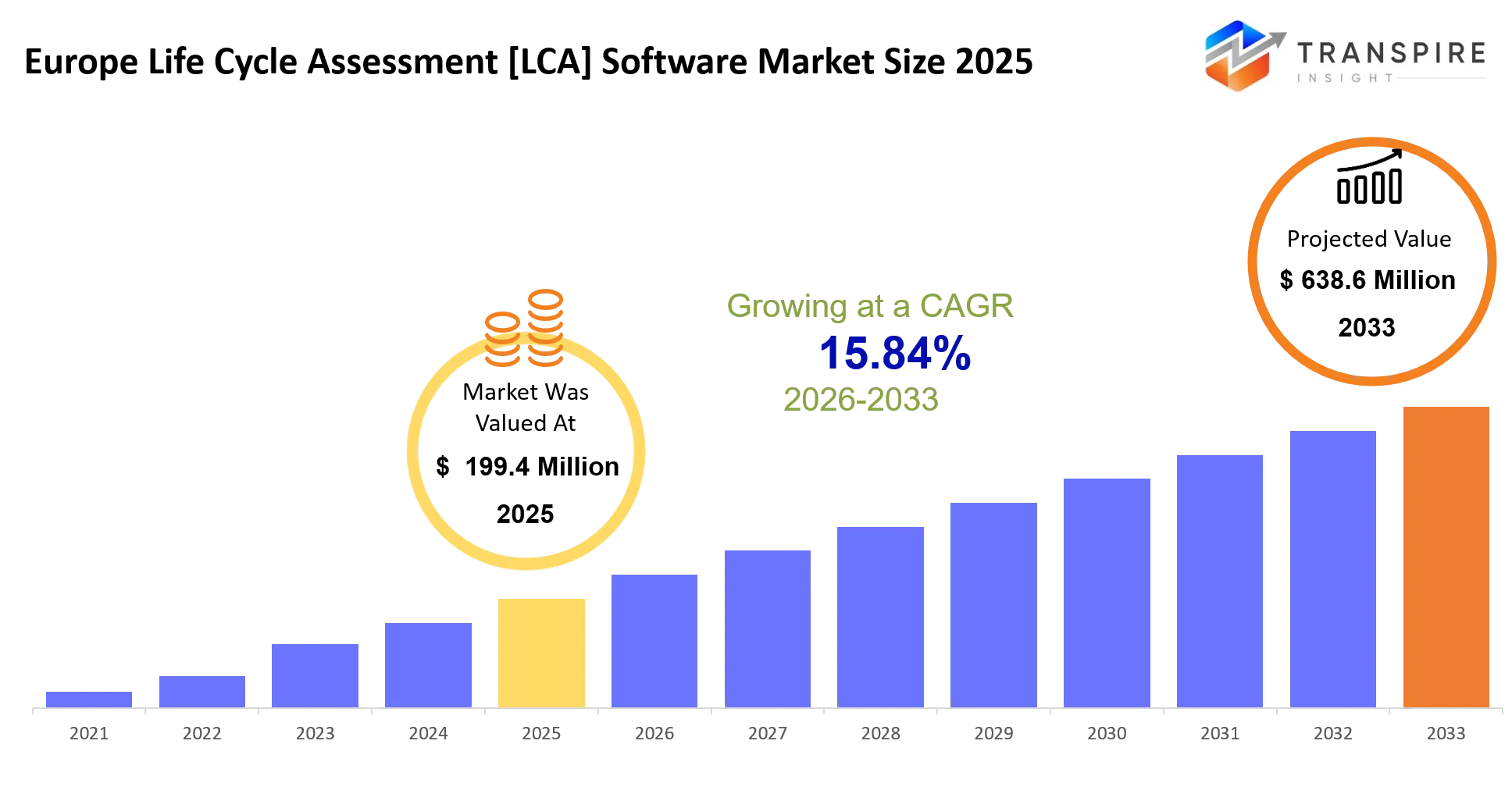
As per Transpire Insight Analysis, the Europe Life Cycle Assessment [LCA] Software Market size is estimated at USD 199.4 Million in 2025 and is anticipated to reach USD 638.6 Million by 2033, growing at a CAGR of 15.84% from 2026 to 2033.
The Europe Life Cycle Assessment Software Market helps manufacturers, product designers and sustainability teams measure how products affect the environment. This happens across every stage from getting materials and making products to transporting them using them and disposing of them at the end. These platforms let businesses find where their products have an environmental impact. They can compare design options, report to regulators and use resources more efficiently. All this while meeting what customers and investors expect.
Over the few to five years the market has changed. It used to be about tools for environmental assessments. Now it's about platforms that connect with systems like enterprise resource planning and ESG reporting.The European Unions rules like the Corporate Sustainability Reporting Directive and the Carbon Border Adjustment Mechanism have made environmental data crucial. This is for following rules and for trade across borders. So companies need information on product emissions. This has led to investment in advanced Life Cycle Assessment software.This investment creates chances for recurring revenue. It also encourages vendors to improve their software. They add automation, better data integration and analysis that is specific to industries. The Europe Life Cycle Assessment Software Market is growing. It helps businesses, in Europe make sustainable choices.
Europe Life Cycle Assessment [LCA] Software Market Size & Forecast:
- Europe Life Cycle Assessment [LCA] Software Market Size 2025: USD 199.4 Million
- Europe Life Cycle Assessment [LCA] Software Market Size 2033: USD 638.6 Million
- Europe Life Cycle Assessment [LCA] Software Market CAGR: 15.84%
- Europe Life Cycle Assessment [LCA] Software Market Segments: By Deployment (Cloud-Based, On-Premise, Hybrid, Private Cloud, SaaS, Hosted, Multi-Cloud, Others); By Component (Software, Services, Consulting, Analytics, Data Management, Reporting Tools, Support Services, Others); By Application (Carbon Footprint Analysis, Product Design, Sustainability Reporting, Supply Chain Assessment, Regulatory Compliance, Energy Assessment, Waste Management, Others); By End User (Manufacturing, Automotive, Chemicals, Construction, Food & Beverage, Energy, Government, Others); By Enterprise Size (Large Enterprises, Medium Enterprises, Small Enterprises, Startups, NGOs, Academic Institutes, Public Agencies, Others)
Key Market Insights
- The Europe Life Cycle Assessment Software Market is getting bigger because companies need to report on sustainability and reduce their carbon footprint. This is now a part of how businesses work.
- The Europe Life Cycle Assessment Software Market will keep growing because of new rules like CSRD CBAM and companies wanting to be more sustainable.
- The Europe Life Cycle Assessment Software Market is driven by the need for companies to be more transparent about the lifecycle of their products.
- Western Europe has the share of the Europe Life Cycle Assessment Software Market with over 55% in 2025. This is because Western Europe has industries and strict environmental rules.
- Central and Eastern Europe will grow the fastest until 2033 because manufacturers need to report more on social issues. The Europe Life Cycle Assessment Software Market will help them with this.
- Cloud-based Life Cycle Assessment software is the popular with over 50% of the market in 2025. This is because it is easy to scale, costs and works well with other company systems.
- On-premise software is the most popular, especially among big manufacturers who want more control over sensitive data. The Europe Life Cycle Assessment Software Market offers options for companies.
- Life Cycle Assessment platforms that use intelligence and are based in the cloud will grow the fastest. They help automate tasks analyze scenarios and model emissions. The Europe Life Cycle Assessment Software Market is becoming more advanced.
- Manufacturing applications make up over 40% of the market in 2025. This is because companies need to design products that're sustainable report on carbon emissions and follow regulations. The Europe Life Cycle Assessment Software Market helps with this.
- Supply chain sustainability and assessing Scope 3 emissions are becoming more important. Companies want to know the impact of their whole value chain. The Europe Life Cycle Assessment Software Market is helping companies with this.
- Big companies hold 65% of the market in 2025. This is because they have money to invest and have to report on sustainability. However smaller companies are growing the fastest. The Europe Life Cycle Assessment Software Market is used by companies of all sizes.
- Companies like Sphera, Siemens, Dassault Systèmes, One Click LCA, SAP and iPoint Systems are competing with each other. They are using intelligence innovating in the cloud partnering with others and integrating with other platforms. The Europe Life Cycle Assessment Software Market is competitive.
- These companies are getting ahead by innovating, buying companies following regulations and expanding to new areas. This helps their customers do lifecycle assessments, report, on sustainability and manage carbon emissions. The Europe Life Cycle Assessment Software Market is always evolving.
What are the Key Drivers, Restraints, and Opportunities in the Europe Life Cycle Assessment [LCA] Software Market?
Drivers
The main thing that is driving the Europe Life Cycle Assessment Software Market is that Europe has made some rules about being sustainable. These rules are called the Corporate Sustainability Reporting Directive and the Carbon Border Adjustment Mechanism. Because of these rules companies have to give detailed information about how their products affect the environment. They also have to report their emissions in a way.This means that companies have to follow these rules to do business so they are investing in Life Cycle Assessment platforms that can automatically calculate their carbon footprint and make reporting more accurate. These platforms can also work with systems that companies use. As a result more companies are subscribing to this software. Using consulting services. They are also using these platforms for a time.
Restraints
One big problem is that it is hard to get data about the whole life cycle of a product especially when it comes from all over the world. Many companies still get information from their suppliers in formats and they have to report it manually. This makes it hard to implement the software quickly and accurately. It also costs money, especially for small and medium-sized companies that do not have a lot of digital resources. So it takes longer for companies to adopt this software. That means the companies that make the software do not get paid as quickly.
Opportunity
There is an opportunity for software that uses artificial intelligence to model the life cycle of products and automatically collect environmental data. This can make data collection faster and more accurate. It can give companies a better idea of how sustainable their products are in real time. As companies invest more in manufacturing and managing the life cycle of their products it creates a good environment, for Life Cycle Assessment software that uses artificial intelligence. This software can help companies design products follow the rules and reduce their carbon footprint across their supply chains in Europe.
What Has the Impact of Artificial Intelligence Been on the Europe Life Cycle Assessment [LCA] Software Market?
Artificial intelligence and advanced digital technologies are changing Life Cycle Assessment software. They automate collecting data, modeling lifecycles and reporting sustainability across complex industrial value chains.
AI algorithms. Sort data from systems like enterprise resource planning, product lifecycle management and supplier systems. This reduces data entry and makes assessments more consistent. Automated workflows also speed up calculations of carbon footprints, product comparisons and regulatory reporting. This helps organizations environmental assessments more efficiently and reduces administrative work.Machine learning models make predictions better by estimating product emissions when supplier data's incomplete. They forecast lifecycle impacts of material changes. Evaluate alternative manufacturing scenarios before production starts. These capabilities help optimize product design use resources efficiently and comply with regulations like the Corporate Sustainability Reporting Directive and the Carbon Border Adjustment Mechanism.
AI-driven analytics improve supply chain visibility by identifying high-emission processes. They suggest actions that reduce reporting costs and speed up decision-making. However many organizations face challenges in adopting AI due to inconsistent supplier data, fragmented digital infrastructure and high integration costs.
Limited access to lifecycle datasets also reduces model accuracy, for highly specialized products. This requires continued validation before environmental results can be used for regulatory reporting or strategic investment decisions.
Key Market Trends
- Since 2022 companies that buy from businesses have started checking how their products affect the environment all the time. They do this by using software that works with their ERP and PLM systems.
- The new rules called CSRD. Cbam made companies adopt software faster. This is because they need to report the emissions of their products in detail and make sustainability reports in a way.
- Cloud-based LCA software has become more popular since 2021. Companies want to set it up have it work for many users and make it easy for different sites to work together.
- More and more companies are using AI to model the lifecycle of their products. This helps them collect data automatically estimate emissions and analyze scenarios. It also reduces the work needed to assess products.
- Manufacturers now want to know the emissions of their suppliers. They do not just use databases. This makes the assessment more accurate but also makes suppliers report their emissions digitally.
- Companies like **Sphera One Click LCA, Dassault Systèmes, Siemens and SAP** have made their software better. They added AI. Connected it to other enterprise software.
- Teams that design products now check how products affect the environment earlier. They do this to find materials that produce carbon before making final decisions.
- Making supply chains sustainable is now a priority. Companies analyze the lifecycle of their products. Include emissions from their suppliers in their reports.
- The competition is now about creating a system, for sustainability. This system combines checking the lifecycle of products reporting ESG, managing carbon and automating compliance.
Europe Life Cycle Assessment [LCA] Software Market Segmentation
By Deployment
The Cloud-Based deployment is very popular because it is easy to scale and does not need a lot of money to start. This helps companies manage their sustainability data from locations. On-Premise deployment is still important for businesses that need to control their information. Hybrid deployment is an option because it is flexible and helps with data management. This makes it suitable for companies that want to balance cloud efficiency with security. Private Cloud solutions are liked by industries that have to follow rules and regulations.
SaaS platforms make it easy to update software manage subscriptions and work together between departments. Hosted deployment is still used by companies that want someone else to manage their infrastructure. Multi-Cloud strategies help make systems more resilient. Reduce dependence on one technology provider. There are customized deployment models that are designed for special operational or regulatory requirements.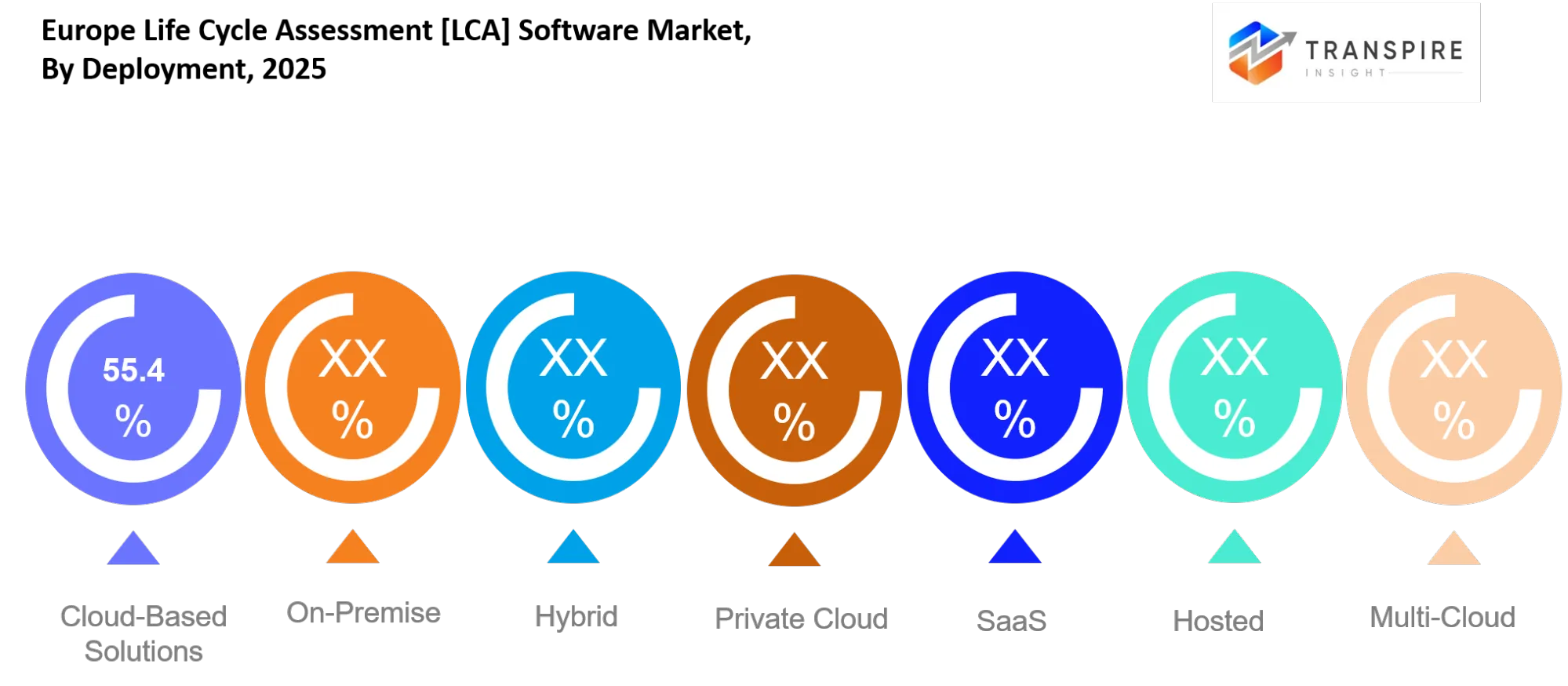
By Component
Software is the component because it is needed to calculate lifecycles, model emissions and assess environmental impacts. Services help with implementation, customization, integration and optimization of the software. Consulting is very helpful because it assists companies in meeting regulations and sustainability goals. Analytics tools help turn environmental data into useful business insights that support informed decision making.
Data Management solutions improve the quality of information by organizing data in a format. Reporting Tools make it easy to disclose information and follow changing sustainability regulations. Support Services help maintain software performance through assistance, maintenance and training. There are also modules that are designed for industry-specific environmental assessment requirements.
By Application
Carbon Footprint Analysis is the leading application because companies need to calculate their emissions. Product Design uses lifecycle information to compare materials and manufacturing methods. Sustainability Reporting helps companies disclose information transparently. Supply Chain Assessment identifies impacts across sourcing, logistics, manufacturing and distribution activities.
Regulatory Compliance is becoming more important as companies have to follow environmental reporting rules. Energy Assessment helps reduce emissions by using resources more efficiently. Waste Management supports circular economy initiatives by finding ways to recover materials and reduce waste. There are also environmental assessments designed for unique industrial processes and product categories.
By End User
Manufacturing is the end-user segment because product development and production require detailed lifecycle evaluations. Automotive companies use lifecycle software to compare vehicle materials and manufacturing processes. Chemical manufacturers evaluate materials and environmental impacts while meeting regulatory standards. Construction companies apply lifecycle analysis during material selection and sustainable building development.
Food and Beverage companies assess packaging, transportation and production impacts to improve performance. Energy companies analyze emissions to support decarbonization strategies. Government organizations use lifecycle assessments to support procurement decisions and environmental policy implementation. Other industries also use environmental evaluation tools to improve operations and follow regulations.
By Enterprise Size
Large Enterprises adopt lifecycle assessment software the most because they have operations and need advanced environmental data management. Medium Enterprises are also investing in software as digital sustainability initiatives become more structured. Small Enterprises are adopting platforms that reduce costs and improve environmental reporting efficiency. Startups are introducing lifecycle solutions that use automation, artificial intelligence and cloud-based delivery.
NGOs use lifecycle assessment tools to support research and sustainability initiatives. Academic Institutes use software, for research programs and environmental innovation. Public Agencies rely on lifecycle assessments to plan infrastructure make procurement decisions and implement public sustainability programs. Other organizations are also adopting environmental assessment tools to improve transparency and long-term planning.
What are the Key Use Cases Driving the Europe Life Cycle Assessment [LCA] Software Market?
The main thing that companies use carbon footprint analysis for is to follow rules like CSRD and CBAM. This is because they need to know how much their products are hurting the environment. They use this information to make reports create products and decide where to invest their money. This is the reason why companies are using this kind of software.
Lots of companies are now looking at how they can be more sustainable. This includes companies that make cars, chemicals, build houses and make food and drinks. They want to know how much their suppliers are hurting the environment and how they can make their products in a way that's better for the planet. They also want to follow the rules and make sure they are doing everything they can to protect the environment.
There are some ways that companies are using this kind of software. For example they are using it to plan how they can make their products in a way that's better for the environment. They are also using it to get ready for rules, in Europe. Some companies are even using computers to help them make their products more sustainable. This means they can make changes to their products quickly and make sure they are being sustainable.
|
Report Metrics |
Details |
|
Market size value in 2025 |
USD 199.4 Million |
|
Market size value in 2026 |
USD 228.2 Million |
|
Revenue forecast in 2033 |
USD 638.6 Million |
|
Growth rate |
CAGR of 15.84% from 2026 to 2033 |
|
Base year |
2025 |
|
Historical data |
2021 - 2024 |
|
Forecast period |
2026 - 2033 |
|
Report coverage |
Revenue forecast, competitive landscape, growth factors, and trends |
|
Regional scope |
Europe |
|
Key company profiled |
Sphera, Siemens, Dassault Systèmes, One Click LCA, Ecochain, iPoint Systems, Wolters Kluwer, PRé Sustainability, SAP, IBM, Schneider Electric, Autodesk, Intelex, Benchmark ESG, Anthesis |
|
Customization scope |
Free report customization (country, regional & segment scope). Avail customized purchase options to meet your exact research needs. |
|
Report Segmentation |
By Deployment (Cloud-Based, On-Premise, Hybrid, Private Cloud, SaaS, Hosted, Multi-Cloud, Others); By Component (Software, Services, Consulting, Analytics, Data Management, Reporting Tools, Support Services, Others); By Application (Carbon Footprint Analysis, Product Design, Sustainability Reporting, Supply Chain Assessment, Regulatory Compliance, Energy Assessment, Waste Management, Others); By End User (Manufacturing, Automotive, Chemicals, Construction, Food & Beverage, Energy, Government, Others); By Enterprise Size (Large Enterprises, Medium Enterprises, Small Enterprises, Startups, NGOs, Academic Institutes, Public Agencies, Others) |
Which Regions are Driving the Europe Life Cycle Assessment [LCA] Software Market Growth?
Western Europe is the leader in this market because it has strict rules to protect the environment and a strong industrial base with good digital infrastructure. Countries like Germany, France and the Netherlands are using lifecycle assessment software a lot because they have to follow rules like CSRD, CBAM and ESG reporting. The manufacturing, automotive and chemical sectors in these countries need to analyze the impact of their products all the time. There are companies that make software, consulting firms, research institutions and technology providers that work together to help Western Europe stay ahead.
Northern Europe is the biggest region for this market and it is not just because of its size. Countries like Sweden, Finland and Denmark are investing a lot in sustainability. They have plans to reduce carbon emissions in the long term. They are also using technology and working together with industries to make this happen. Companies in these countries use lifecycle assessment when they develop products and make decisions about what to buy. This creates an environment for software companies to make money and keep updating their products.
Central and Eastern Europe are going to grow fast from 2026 to 2033 because industries are modernizing and using digital technology more. Many companies are setting up manufacturing units. They have to follow ESG reporting rules. They are also becoming part of supply chains which is making them invest in lifecycle assessment platforms. Now it is easier for smaller companies to use cloud-based software which is helping them to start reporting on sustainability. This is an opportunity, for software companies, partners and investors who want to expand into new markets that are growing fast.
Who are the Key Players in the Europe Life Cycle Assessment [LCA] Software Market and How Do They Compete?
Competition in the Europe Life Cycle Assessment (LCA) Software Market is moderately consolidated, with established enterprise software providers competing alongside specialized sustainability technology companies. The market competes primarily on database quality, regulatory compliance capabilities, AI-driven analytics, cloud integration, and connectivity with enterprise resource planning and product lifecycle management systems rather than price. Incumbents continue to strengthen platform capabilities through acquisitions and product development, while niche providers focus on faster implementation, industry-specific expertise, and simplified compliance workflows. This competitive environment encourages continuous innovation and long-term customer retention through integrated sustainability ecosystems.
Sphera focuses on enterprise-scale sustainability management by combining lifecycle assessment with ESG reporting, operational risk management, and regulatory compliance in a unified platform. One Click LCA differentiates through construction-specific lifecycle assessment tools, extensive environmental product declaration databases, and strong alignment with European building regulations. Dassault Systèmes integrates lifecycle assessment directly into product design and digital engineering workflows, allowing manufacturers to evaluate environmental impacts during product development instead of after production.
Siemens expands lifecycle capabilities through integration with digital manufacturing and industrial automation platforms, enabling organizations to connect environmental analysis with operational performance. SAP strengthens competitive positioning by embedding lifecycle assessment into enterprise resource planning and supply chain management applications, allowing businesses to combine sustainability data with financial and operational information. These strategies help vendors increase customer retention, expand recurring software revenue, and address evolving European regulatory requirements through continuous platform innovation.
Company List
- Sphera
- Siemens
- Dassault Systèmes
- One Click LCA
- Ecochain
- iPoint Systems
- Wolters Kluwer
- PRé Sustainability
- SAP
- IBM
- Schneider Electric
- Autodesk
- Intelex
- Benchmark ESG
- Anthesis
Recent Development News
In January 2026, Sphera entered a partnership with Rolls-Royce Power Systems. The collaboration delivers verified Environmental Product Declarations using Sphera's LCA software, strengthening lifecycle assessment capabilities and regulatory compliance for industrial products. Source URL:https://sphera.com
In September 2025, One Click LCA announced the acquisition of PRé Sustainability and SimaPro. The acquisition combined One Click LCA's scalable platform with SimaPro's scientific LCA expertise, creating one of the world's largest lifecycle assessment software platforms and expanding AI, compliance, and data capabilities. Source URL:https://oneclicklca.com
In April 2025, Sphera launched the Supplier Product Carbon Footprint (PCF) Calculator. The new solution automates supplier carbon data collection and strengthens Scope 3 emissions reporting, helping organizations improve regulatory compliance and lifecycle assessment accuracy. Source URL:https://sphera.com
What Strategic Insights Define the Future of the Europe Life Cycle Assessment [LCA] Software Market?
The Europe Life Cycle Assessment (LCA) Software Market is expected to evolve into a core component of enterprise digital infrastructure as lifecycle intelligence becomes embedded within product development, procurement, manufacturing, and sustainability reporting. This transition will be driven by expanding European environmental regulations, digital product passport initiatives, and growing demand for verified product-level emissions data across global supply chains. A less visible risk is increasing market concentration, where a small number of software vendors control critical lifecycle databases and regulatory content, potentially raising integration costs and limiting interoperability for customers. An emerging opportunity lies in AI-powered automated lifecycle data collection that combines industrial IoT, supplier platforms, and digital twins to generate near real-time environmental assessments. Companies should invest in open data standards, API-based platform integration, and strategic partnerships with ERP, PLM, and supply chain software providers to strengthen long-term competitiveness while reducing implementation complexity for enterprise customers.
Europe Life Cycle Assessment [LCA] Software Market Report Segmentation
-
By Deployment
- Cloud-Based
- On-Premise
- Hybrid
- Private Cloud
- SaaS
- Hosted
- Multi-Cloud
- Others
-
By Component
- Software
- Services
- Consulting
- Analytics
- Data Management
- Reporting Tools
- Support Services
- Others
-
By Application
- Carbon Footprint Analysis
- Product Design
- Sustainability Reporting
- Supply Chain Assessment
- Regulatory Compliance
- Energy Assessment
- Waste Management
- Others
-
By End User
- Manufacturing
- Automotive
- Chemicals
- Construction
- Food & Beverage
- Energy
- Government
- Others
-
By Enterprise Size
- Large Enterprises
- Medium Enterprises
- Small Enterprises
- Startups
- NGOs
- Academic Institutes
- Public Agencies
- Others
Frequently Asked Questions
Find quick answers to common questions.
The Expected Europe Life Cycle Assessment [LCA] Software Market size for the Market will be USD 638.6 Million in 2033.
Key segments for the Europe Life Cycle Assessment [LCA] Software Market are By Deployment (Cloud-Based, On-Premise, Hybrid, Private Cloud, SaaS, Hosted, Multi-Cloud, Others); By Component (Software, Services, Consulting, Analytics, Data Management, Reporting Tools, Support Services, Others); By Application (Carbon Footprint Analysis, Product Design, Sustainability Reporting, Supply Chain Assessment, Regulatory Compliance, Energy Assessment, Waste Management, Others); By End User (Manufacturing, Automotive, Chemicals, Construction, Food & Beverage, Energy, Government, Others); By Enterprise Size (Large Enterprises, Medium Enterprises, Small Enterprises, Startups, NGOs, Academic Institutes, Public Agencies, Others).
Major Europe Life Cycle Assessment [LCA] Software Market players are Sphera, Siemens, Dassault Systèmes, One Click LCA, Ecochain, iPoint Systems, Wolters Kluwer, PRé Sustainability, SAP, IBM, Schneider Electric, Autodesk, Intelex, Benchmark ESG, Anthesis.
The Current Europe Life Cycle Assessment [LCA] Software Market size is USD 199.4 Million in 2025.
The Europe Life Cycle Assessment [LCA] Software Market CAGR is 15.84% from 2026 to 2033.
- Sphera
- Siemens
- Dassault Systèmes
- One Click LCA
- Ecochain
- iPoint Systems
- Wolters Kluwer
- PRé Sustainability
- SAP
- IBM
- Schneider Electric
- Autodesk
- Intelex
- Benchmark ESG
- Anthesis
About the Authors

Mayur Shinde
I am Mayur Shinde, a Senior Research Analyst at Transpire Insight, specializing in the Automotive & Transportation and Information & Communication Technology (ICT) Industry. My work focuses on analyzing emerging market trends, technological advancements, competitive landscapes, and industry developments to deliver accurate, data-driven insights. I am passionate about transforming complex market information into clear, actionable content that helps businesses, professionals, and decision-makers stay informed and make confident strategic decisions.

Chakradhar Khansole
Chakradhar serves as the Research Director at Transpire Insight, bringing over 8 years of experience in technology, innovation, and strategic market intelligence. He specializes in transforming complex market data into actionable business insights that enable organizations to make informed, growth-oriented decisions. Recognized for his strategic vision and analytical expertise, Chakradhar leads high-impact research initiatives, delivering comprehensive market assessments, competitive intelligence, and forward-looking industry analysis.
Recently Published Reports
-
Apr 2026
3D Optical Profiler Market
3D Optical Profiler Market Size, Share & Analysis Report By Type (Desktop 3D Optical Profiler, and Portable 3D Optical Profiler), By Technology (Confocal Technology, and White Light Interference), By End-Use Industry (Manufacturing, Research Institutions, Automotive, Aerospace and Defense, Medical Devices, and Other), and Geography (North America, Europe, Asia-Pacific, Middle East and Africa, South and Central America), 2021 - 2031
-
Apr 2026
Depth Sensor Market
Depth Sensor Market Size, Share & Analysis Report By Type (Infrared Depth Sensors, Time-of-Flight (ToF) Sensors, Stereo Vision Sensors, Structured Light Sensors, Ultrasonic Depth Sensors), By Application (Automotive, Robotics, Gaming, Consumer Electronics, Industrial Automation, Healthcare, Security & Surveillance, Others), By End Users (Automotive Manufacturers, Consumer Electronics Companies, Healthcare Providers, Industrial Companies, Security Agencies, Gaming Companies, Robotics Companies, Others), and Geography (North America, Europe, Asia-Pacific, Middle East and Africa, South and Central America), 2021 – 2031
-
Apr 2026
Digital Manufacturing Market
Digital Manufacturing Market Size, Share & Analysis Report By Component (Hardware, Software, and Services), By Technology (Robotics, 3D Printing, Internet of Things (IoT), and Others), By Application (Automotive and Transportation, Aerospace and Defense, Consumer Electronics, Industrial Machinery, and Others), By Process Type (Computer-Based Designing, Computer-Based Simulation, Computer 3D Visualization, Analytics, and Others), and Geography (North America, Europe, Asia-Pacific, Middle East and Africa, South and Central America), 2021 – 2031
-
Apr 2026
Digital Visa Services Market
Digital Visa Services Market Size, Share & Analysis Report By Type (Individual Travelers, Group Travelers), By Application (Tourism, Business Travel, Others), and Geography (North America, Europe, Asia-Pacific, Middle East and Africa, South and Central America), 2021 – 2031