
Europe Hydro Generators Market Size & Forecast:
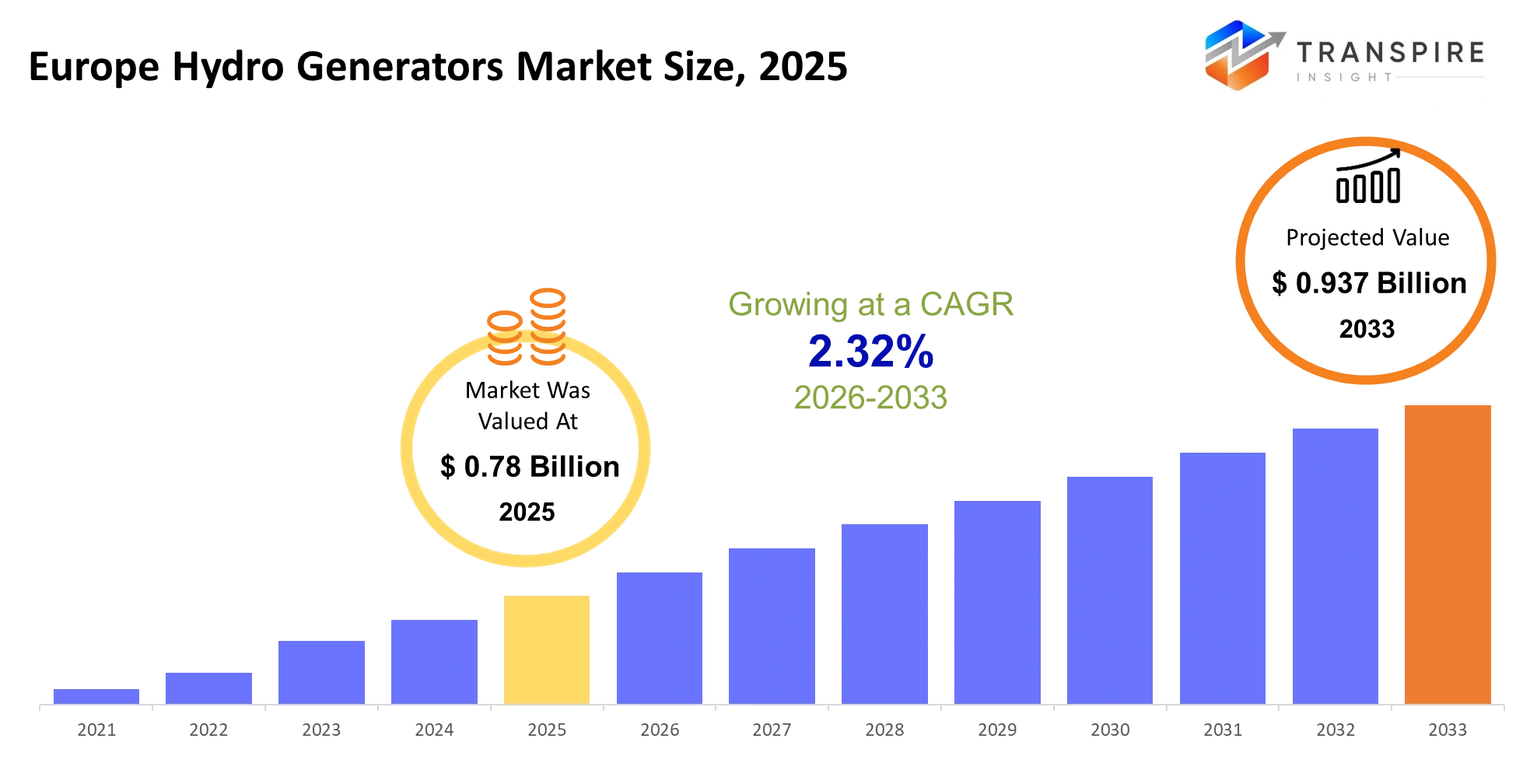
- Europe Hydro Generators Market Size 2025: USD 0.78 Billion
- Europe Hydro Generators Market Size 2033: USD 0.937 Billion
- Europe Hydro Generators Market CAGR: 2.32%
- Europe Hydro Generators Market Segments: By Type (Synchronous Generators, Asynchronous Generators, Others), By Application (Large Hydro Plants, Small Hydro Plants, Pumped Storage, Renewable Energy Projects, Grid Stability, Others), By End-User (Utilities, Power Companies, Government, Industrial Sector, Energy Producers, Others), By Capacity (Below 10 MW, 10–100 MW, Above 100 MW, Others).
To learn more about this report,  Download Free Sample Report
Europe Hydro Generators Market Summary:
The Europe Hydro Generators Market size is estimated at USD 0.78 Billion in 2025 and is anticipated to reach USD 0.937 Billion by 2033, growing at a CAGR of 2.32% from 2026 to 2033. The hydro generators in Europe use flowing water to produce dependable electricity which utilities and industrial facilities and remote infrastructure depend on to maintain power supply during times of grid instability and fuel shortages. The system provides energy security through its capacity to generate both steady base load power and adaptable peak load power while using domestic resources.
The market has changed during the past three to five years because it now prefers modern technologies and small-scale projects instead of large dam construction. Hydropower operators are establishing modern digital control systems and high-efficiency turbine technology and grid-compatible systems to enhance their existing hydropower systems. The European Union has implemented decarbonization initiatives which accelerated this transition while the energy crisis that occurred after Russia invaded Ukraine revealed weaknesses in gas supply systems.
The investment has shifted away from centralized systems toward funding equipment upgrades and establishing decentralized hydro power facilities. The company generates income through both new product launches and its activities which include equipment upgrades and system maintenance and machine-to-machine system integration which develop additional revenue streams that extend beyond basic equipment distribution.
Key Market Insights
- Western European countries control almost half of the European Hydro Gas Market which they expect to achieve in 2024 because of their existing hydropower systems.
- The Nordic nations show the highest growth rate until 2030 because they possess extra hydropower resources and expand their cross-border electricity sales.
- The European market for big hydro generators will reach more than 50% share by 2024 because of existing power plants and the need to renovate them.
- The second largest market share belongs to medium-scale generators because they provide power solutions for both regional and municipal electricity development projects.
- The small hydro generator market segment shows the fastest growth rate because decentralized energy systems drive its expansion until 2030.
- Utility-scale power generation leads with approximately 60% share, as grid stability and baseload supply remain critical across Europe.
- The industrial sector grows its captive power business most quickly because companies use this system to manage energy expenses while meeting environmental regulations.
- Public utilities dominate the Europe Hydro Generators Market, contributing over 55% share in 2024 due to large-scale infrastructure ownership.
- The independent power producer sector experiences its fastest growth period because companies enhance their project portfolios through small hydro and hybrid renewable energy initiatives.
What are the Key Drivers, Restraints, and Opportunities in the Europe Hydro Generators Market?
The existing hydropower assets need to undergo modernization because of the policy-driven requirement, which acts as the main driver that propels the Europe Hydro Generators Market forward. The EU decarbonization targets combined with taxonomy regulations, which force plants to undergo upgrades, make it impossible to construct new dam facilities. The industry adopted this shift after new emission rules became mandatory and the requirement to develop renewable energy sources appeared, which would provide power during times when wind and solar energy production does not work. The utilities make expenditures to acquire advanced generators and modernize their control systems and enhance their automation functions. The company generates income through its repair work and extended service contracts and its projects that enhance system performance, which exists apart from its fresh system deployments.
Hydropower development faces its greatest challenge because of existing structural limitations which prevent new projects. The combination of environmental regulations and complex permitting processes and public resistance against big dam projects results in approval procedures that require more than ten years to complete. The solution to this constraint remains difficult because it involves both environmental protection regulations and land use disputes among different areas. The market growth gets restricted because the company lacks new project opportunities, which compels them to rely on existing customers while their total operational capacity grows at a slow pace.
The integration of small modular hydro systems with hybrid renewable grids creates a significant business opportunity. The development of low-head turbine technology together with standardized generator systems now makes it possible to deploy these units at sites which were formerly untested, including irrigation canals and municipal water distribution networks. Eastern European and Balkan nations are increasing their investments in such decentralized projects, which will create a pipeline for scalable installations and open new revenue streams for equipment suppliers and system integrators.
What Has the Impact of Artificial Intelligence Been on the Europe Hydro Generators Market?
AI systems together with sophisticated digital technology are transforming operations for hydro generator fleets which serve European nations. AI-based control systems now enable utilities to handle turbine operations and voltage control and grid management through automatic systems which let plants handle sudden changes in wind and solar energy. The systems operate through automatic load balancing and water flow control which maintains system stability and decreases the need for human control throughout multiple plant operations.
The vibration data and temperature data and historical failure data provide machine learning models with predictive capabilities for analysis. The models enable operators to predict rotor and bearing and stator component wear patterns up to several weeks in advance. The approach leads to decreased unexpected outages which helps increase plant operational time between 3 to 5 percent while maintenance expenses decrease because of precise maintenance work which replaces the need for full system inspections.
Digital twins enable performance optimization through their ability to recreate plant operations during different hydrological conditions and grid operational scenarios. The system provides better energy output predictions while meeting grid balancing standards which boosts revenue generation from open electricity markets.
The process of adopting new systems faces obstacles because high costs and incomplete existing systems create challenges for organizations. The majority of older hydropower facilities do not have unified data systems which makes it impossible to create precise AI models or implement scalable digital solutions without costly initial expenses.
Key Market Trends
- Utilities have redirected their funding from large dam projects to upgrade their existing hydropower facilities which will extend their operational capacity by 20 to 30 years.
- European operators expedited hydro upgrades after the 2022 energy crisis to decrease their natural gas usage which resulted in increased project approvals for refurbishment work throughout Germany France and Italy.
- Voith Group and Andritz AG have developed digital turbine products that permit customers to add automated systems and analytical tools to their existing generator infrastructures.
- The number of small hydro installations under 10 MW started to increase in Eastern Europe after 2021 because authorities implemented faster permit procedures and the projects required less financial investment.
- Hydro plants must now create operational systems which meet real-time control needs because grid operators want more adaptable energy generation sources which help manage power fluctuations and support grids that use renewable energy sources.
- Since 2019 predictive maintenance has become more common because AI-based monitoring systems help modern facilities achieve up to 5% better uptime performance.
- Environmental regulations have become more stringent between 2019 and 2024 which has postponed the initiation of new large hydro projects while developers now concentrate on developing low-impact modular generation systems.
- Since 2022 European OEMs have decreased their dependence on overseas component suppliers to enhance their delivery schedules and project success rate.
- Utilities have formed more strategic alliances with companies such as Siemens Energy to develop long-term service agreements which focus on enhancing digital performance.
Europe Hydro Generators Market Segmentation
By Type
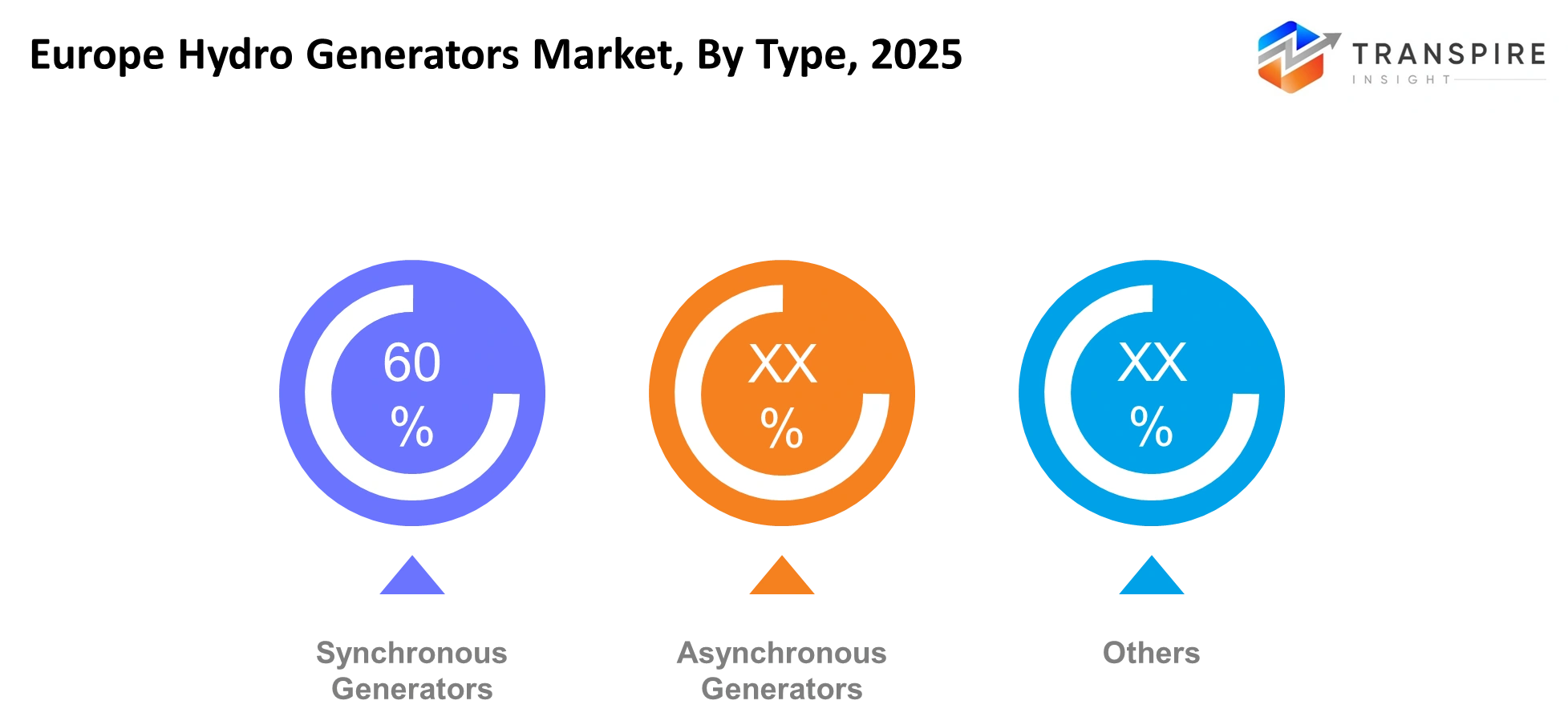
Synchronous generators dominate European power grids because they provide superior grid stability and maintain consistent frequency operation. Synchronous systems receive preference from utilities when managing extensive power facilities because those systems deliver both voltage control and system inertia which remains essential for handling rising renewable energy sources. The market share of asynchronous generators remains limited because their technology serves specific requirements in small hydro projects which prioritize cost-effective solutions with basic design elements.
The present enhancements of digital synchronous machines combine advanced monitoring systems with control technologies. The current trend in manufacturing involves companies using automated systems with embedded sensors to achieve better operational efficiency and extended equipment lifespan. Synchronous platforms will maintain their position as the primary demand through upcoming years while hybrid systems and intelligent control solutions will generate new possibilities for companies that specialize in equipment upgrades and performance enhancement.
To learn more about this report, Download Free Sample Report
By Application
The operational needs of Western European countries make large hydro plants the primary choice because of their existing hydroelectric facilities and the extended duration of their operational viability. The existing facilities produce more than half of the total hydroelectric power output while investors choose to improve these sites instead of developing new projects. Grid operators have recognized pumped storage as an essential resource because they need to find solutions that can help them manage the erratic nature of renewable power production.
Eastern European countries experience steady growth in small hydro plants and renewable energy projects because they have simpler permitting processes and need less financial backing. Hydropower now plays a vital role in grid stability because it enables frequency control and peak load management. The future development of the industry will focus on implementing flexible systems which include pumped storage and distributed hydro technologies, which will result in technology providers creating modular systems and sophisticated control systems.
By End-User
The market is dominated by public utilities and large power companies because they control vast hydropower resources and possess financial resources to upgrade their systems. Government-backed entities play an important role in areas where hydropower contributes to national energy security operations. The industrial sector has not yet entered the market, but its presence grows as energy-intensive industries develop hydro solutions for cost-effective electricity production.
Independent energy producers are growing their business through acquisitions and small hydro development projects in markets that do not have regulatory control. End users now choose operational efficiency as their top priority which digital monitoring systems and extended service contracts provide. Manufacturers need to create integrated solutions which bundle equipment with analytics and lifecycle services because of this industry trend which moves beyond generator sales.
By Capacity
The current electricity supply in the area depends on existing hydropower facilities which produce more than 100 MW of power capacity. The 10-100 MW range serves as an effective mid-range solution which fulfills requirements for both regional power grids and modernizing infrastructure projects. Decentralized energy systems together with decreased development costs for power producers drive the rapid expansion of units that operate under 10 MW capacity.
The European hydro market attracts developers to small-capacity systems because these systems enable quick project approval and fast construction completion. Environmental restrictions will drive upcoming investment trends towards smaller and mid-sized power capacities because these restrictions make it hard to implement extensive power generation facilities. The manufacturing sector will establish common product specifications which will lead to cost reductions while enabling producers to implement their solutions across various locations.
What are the Key Use Cases Driving the Europe Hydro Generators Market?
The main application of this technology emerges from hydropower plants that operate at utility scale and deliver both baseload and balancing power to national electricity grids. The installations create maximum demand because they maintain constant frequency control while delivering dependable power that supports intermittent solar and wind energy production.
Pumped storage systems and industrial captive power systems have become the new applications for expanded use. Grid operators use pumped storage to manage peak demand and store excess renewable energy while energy-intensive industries adopt small hydro systems to reduce exposure to volatile electricity prices.
The development of new use cases occurs in canal-based and low-head hydro projects that connect to municipal water systems. The power plants use existing infrastructure to produce electricity, which receives support from regional policies that promote decentralized and low-impact renewable energy deployment.
|
Report Metrics |
Details |
|
Market size value in 2025 |
USD 0.78 Billion |
|
Market size value in 2026 |
USD 0.798 Billion |
|
Revenue forecast in 2033 |
USD 0.937 Billion |
|
Growth rate |
CAGR of 2.32% from 2026 to 2033 |
|
Base year |
2025 |
|
Historical data |
2021 - 2024 |
|
Forecast period |
2026 - 2033 |
|
Report coverage |
Revenue forecast, competitive landscape, growth factors, and trends |
|
Regional scope |
Europe (Germany, United Kingdom, France, Italy, Spain and Rest of Europe) |
|
Key company profiled |
GE Renewable Energy, Siemens Energy, Voith, Andritz, ABB, Toshiba, Hitachi Energy, Mitsubishi Electric, Alstom, WEG, Hyundai Electric, Crompton Greaves, Kirloskar Electric, BHEL, Harbin Electric. |
|
Customization scope |
Free report customization (country, regional & segment scope). Avail customized purchase options to meet your exact research needs. |
|
Report Segmentation |
By Type (Synchronous Generators, Asynchronous Generators, Others), By Application (Large Hydro Plants, Small Hydro Plants, Pumped Storage, Renewable Energy Projects, Grid Stability, Others), By End-User (Utilities, Power Companies, Government, Industrial Sector, Energy Producers, Others), By Capacity (Below 10 MW, 10–100 MW, Above 100 MW, Others). |
Which Regions are Driving the Europe Hydro Generators Market Growth?
The market shows Western Europe as its leading region because of its large existing hydropower capacity and its regulatory requirements that mandate renewable energy sources. Norway and France and Austria use their hydroelectric facilities to maintain operational stability for their electricity grids which depend heavily on wind and solar energy. The existing ecosystem of original equipment manufacturers and engineering companies together with digital solution providers enables organizations to perform regular updates and manage product lifecycles. The combination of existing policy frameworks and accessible green funding options maintains consistent financial backing for refurbishment projects and efficiency enhancement initiatives.
The secondary region of Central and Eastern Europe maintains stability through its ongoing infrastructure development which produces economic growth that surpasses its existing system capacities. The Czech Republic and Poland concentrate their efforts on developing mid-sized hydroelectric facilities while they work to modernize their outdated Soviet Union-built power plants. The combination of economic strength and EU funding systems creates consistent project development schedules that remain stable throughout different periods unlike the unpredictable nature of emerging markets. The region generates dependable income for utilities which choose to implement small-scale improvements instead of making major expensive infrastructure investments.
The Balkans together with specific regions of Southeastern Europe experience their highest growth rates after governments implemented new policies and businesses began investing more resources into different economic sectors. The government established simpler procedures for obtaining permits which small hydro projects require while creating financial incentives that encourage independent power producers to enter the market. The development of grid interconnections, together with rural electrification projects has created new businesses which can develop at locations that existed before as impossible to develop. This growth creates entry opportunities for equipment suppliers and investors targeting scalable, decentralized hydro projects between 2026 and 2033.
Who are the Key Players in the Europe Hydro Generators Market and How Do They Compete?
The European hydro generator market maintains moderate competition because engineering companies operate most of the market while retaining control over major contract work and ongoing service contracts. Established companies maintain their market position because they created strong ties with both utility companies and government organizations, while smaller companies take advantage of their expertise to provide specialized services and digital technology solutions. Businesses now compete based on their ability to deliver reliable service and operational efficiency improvements which include equipment maintenance costs and operational performance advantages. Organizations now choose suppliers who can help them extend their equipment lifespan while increasing their production capacity and connecting their power systems to modern renewable energy sources.
Voith Group creates its market distinction through its high-efficiency turbine-generator systems which work together with advanced control technologies to provide operational flexibility for power facilities. The company extends its business reach through digital service platforms while executing retrofit projects on Western European aging power plant systems. The Andritz AG organization specializes in creating upgrade systems which enable utilities to make operational improvements through controlled equipment updates that decrease operational interruptions and financial costs. The organization uses this method to develop its business in Eastern European markets, where businesses seek cost-effective solutions for equipment upgrades instead of purchasing new systems.
The GE Vernova system uses digital twin technology and predictive analytics to enhance generator efficiency which generates revenue through maintenance agreements that depend on data analysis. Siemens Energy builds its market advantage through its grid connection knowledge which enables hydro systems to match renewable energy production changes. The two companies enter into utility partnerships to create permanent service contracts which will establish continuous income streams while they implement cutting-edge control systems throughout their existing hydropower systems.
Company List
- GE Renewable Energy
- Siemens Energy
- Voith
- Andritz
- ABB
- Toshiba
- Hitachi Energy
- Mitsubishi Electric
- Alstom
- WEG
- Hyundai Electric
- Crompton Greaves
- Kirloskar Electric
- BHEL
- Harbin Electric
Recent Development News
In April 2026, ANDRITZ expands hydropower footprint via multiple hydro turbine project wins: While not a corporate acquisition, ANDRITZ secured a record €3.6 billion order intake in Q1 2026, driven by multiple hydropower turbine contracts and modernization projects across Europe and Asia.
Source: https://www.andritz.com
In February 2026, Siemens Energy expands US turbine & grid manufacturing: Siemens Energy is investing $1 billion in expanding U.S. power equipment manufacturing, including turbine and grid systems used in hydro and renewable power infrastructure.This expansion strengthens its global generator and turbine production capacity, indirectly supporting European hydroelectric projects that rely on Siemens’ generator systems. The move is driven by surging electricity demand from AI data centers.
Source: https://www.reuters.com
What Strategic Insights Define the Future of the Europe Hydro Generators Market?
The European hydro generator market is undergoing changes that will establish a service-based digital system when operators start delivering value through their whole asset lifecycle instead of selling equipment. The existing path has emerged because the power grid operates unpredictably after the introduction of renewable energy sources which need operational hydropower systems that can adapt to changing demand instead of creating new plant capacity. The market will see revenue growth during the next five to seven years because suppliers who provide hardware with their analytics and automation systems and extended service agreements will take more market share.
The risk of technology substitution from battery storage and grid storage systems makes up the hidden danger because both technologies deliver better performance at lower costs. As these alternatives mature, some flexibility roles traditionally served by hydropower could erode, particularly in markets with limited refurbishment budgets.
The hybrid renewable hubs in Southeastern Europe create a new opportunity for hydro generators because the region develops its grid network. Market participants should invest in modular, digitally enabled solutions that integrate seamlessly with storage and solar assets, positioning themselves as system partners rather than standalone equipment providers.
Europe Hydro Generators Market Report Segmentation
By Type
- Synchronous Generators
- Asynchronous Generators
- Others
By Application
- Large Hydro Plants
- Small Hydro Plants
- Pumped Storage
- Renewable Energy Projects
- Grid Stability
- Others
By End-User
- Utilities
- Power Companies
- Government
- Industrial Sector
- Energy Producers
- Others
By Capacity
- Below 10 MW
- 10–100 MW
- Above 100 MW
- Others
Frequently Asked Questions
Find quick answers to common questions.
The approximate Europe Hydro Generators Market size for the market will be USD 0.937 Billion in 2033.
The key segments of the Europe Hydro Generators Market are By Type (Synchronous Generators, Asynchronous Generators, Others), By Application (Large Hydro Plants, Small Hydro Plants, Pumped Storage, Renewable Energy Projects, Grid Stability, Others), By End-User (Utilities, Power Companies, Government, Industrial Sector, Energy Producers, Others), By Capacity (Below 10 MW, 10–100 MW, Above 100 MW, Others).
Major players in the Europe Hydro Generators Market are GE Renewable Energy, Siemens Energy, Voith, Andritz, ABB, Toshiba, Hitachi Energy, Mitsubishi Electric, Alstom, WEG, Hyundai Electric, Crompton Greaves, Kirloskar Electric, BHEL, Harbin Electric.
The current market size of the Europe Hydro Generators Market is USD 0.78 Billion in 2025.
The Europe Hydro Generators Market CAGR is 2.32%.
- GE Renewable Energy
- Siemens Energy
- Voith
- Andritz
- ABB
- Toshiba
- Hitachi Energy
- Mitsubishi Electric
- Alstom
- WEG
- Hyundai Electric
- Crompton Greaves
- Kirloskar Electric
- BHEL
- Harbin Electric
Recently Published Reports
-
Apr 2026
Active Power Filter Market
Active Power Filter Market Size, Share & Analysis Report By Type (Shunt Active Power Filters, Series Active Power Filter, Hybrid Active Power Filter), By Application (Harmonics Mitigation, Reactive Power Compensation, Voltage Regulation, Power Factor Correction), By Phase (Single Phase, Three Phase), By End-User Industry (Manufacturing, Healthcare, Commercial, Automotive, Oil and Gas, Others), and Geography (North America, Europe, Asia-Pacific, Middle East and Africa, South and Central America), 2021 - 2031
-
Apr 2026
Electrical Transformer Market
Electrical Transformer Market Size, Share & Analysis Report By Core (Closed, Shell, and Berry), By Insulation (Gas, Oil, Solid, Air, and Other), By Phase (Single, and Three), By Rating (100 MVA to 500 MVA, 501 MVA to 800 MVA, and 801 MVA to 1200 MVA), and Geography (North America, Europe, Asia-Pacific, Middle East and Africa, South and Central America), 2021 – 2031
-
Apr 2026
Hydraulic Piston Pumps Market
Hydraulic Piston Pumps Market Size, Share & Analysis Report By Type (Axial Piston Pumps, Radial Piston Pumps), By Operating Pressure (Low Pressure, Medium Pressure, High Pressure), By Application (Construction, Mining, Agriculture, Automotive, Oil & Gas, Industrial Machinery, Others), By End-User (OEMs, Aftermarket), and Geography (North America, Europe, Asia-Pacific, Middle East and Africa, South and Central America), 2021 – 2031
-
Apr 2026
Laboratory Gas Generators Market
Laboratory Gas Generators Market Size, Share & Analysis Report By Product (Nitrogen Gas Generator, Hydrogen Gas Generator, Zero Air Gas Generator, Purge Gas Generator, TOC Gas Generators, Others), By Application (Gas Chromatography, Liquid Chromatography-mass Spectrometry (LC-MS), Gas Analyzers, Others), By End-user (Life Science, Chemical & Petrochemical, Food & Beverage, Others), and Geography (North America, Europe, Asia-Pacific, Middle East and Africa, South and Central America), 2021 – 2031