
Europe Fluid Catalyst Cracking Market Summary
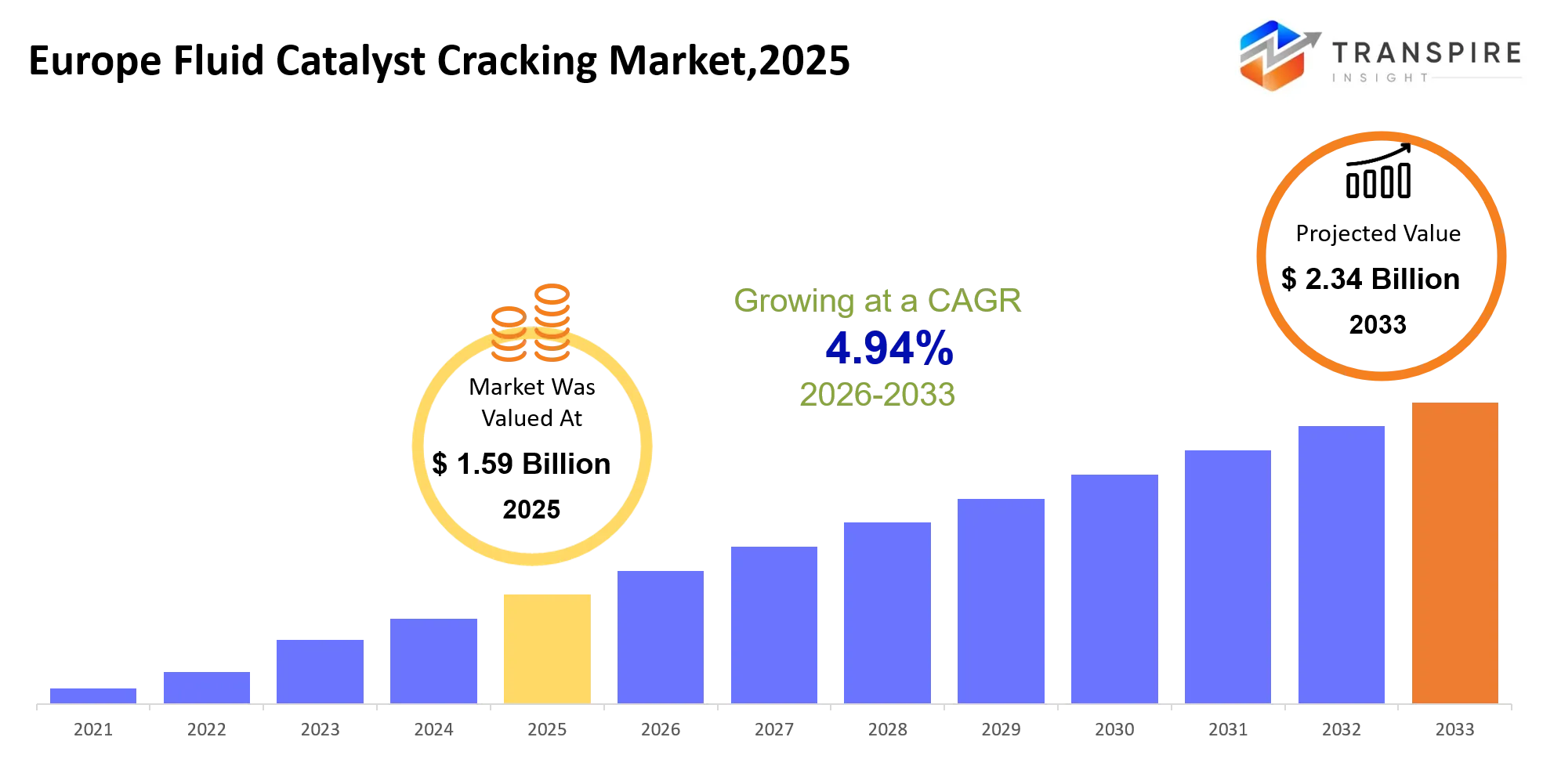
As per Transpire Insight Analysis the Europe Fluid Catalyst Cracking Market size is estimated at USD 1.59 Billion in 2025 and is anticipated to reach USD 2.34 Billion by 2033, growing at a CAGR of 4.94% from 2026 to 2033.
FCC units help refineries deal with heavier hydrocarbon streams. They convert these lower value inputs into products such as gasoline, LPG, and propylene. This can lift refinery profitability. A key point is that the main processing hardware does not need to be replaced. Because of that, refiners keep FCC capacity running when they want better conversion results and more use of the plant they already have.
Over the last few years, priorities have shifted. Many firms want more output for petrochemicals. They also want plants that can handle more than one type of feed. At the same time, there is more focus on cutting emissions. BASF and other companies have worked on ways to process mixed inputs. Examples include waste oils, animal fats, and biomass related materials. Catalyst makers are also changing formulations to raise olefin yields and limit coke formation. In Europe, environmental rules have become stricter. Prices for crude oil and power have also shown large swings. For these reasons, some operators favor catalyst refreshes and small unit upgrades rather than new refinery builds.
Europe Fluid Catalyst Cracking Market Size & Forecast:
- Europe Fluid Catalyst Cracking Market Size 2025: USD 1.59 Billion
- Expected Market Value 2033: USD 2.34 Billion
- Forecast CAGR: 4.94%
- Leading country in 2025: Germany
- Fastest Growing country: Netherlands
- Key Profile: BASF, W. R. Grace, Albemarle, Axens, Johnson Matthey, Honeywell UOP, Shell Catalysts & Technologies, Clariant, Haldor Topsoe, Chevron Lummus Global, ExxonMobil, Sinopec, CNPC, Criterion Catalysts, W.R. Grace Davison
Key Market Insights
- Europe’s outlook for fluid catalytic cracking is tilting toward catalysts made for tighter performance. They are picked to raise conversion, improve what products come out, and help refinery profit.
- Germany is the main driver in Europe. Demand stays strong there because the refining base is large, industry activity is steady, and catalyst delivery is well set up.
- The Netherlands is moving fastest right now. Rotterdam has been a key factor, with refinery upgrades underway and links growing between refineries and petrochemical plants. Catalyst supply and distribution also benefit from this push.
- At the same time, feedstocks are changing. Refineries handle heavier blends and feeds that vary more than before. That shift boosts the need for FCC catalysts that can handle metals and deal with residues.
- In product terms, propylene and other light olefins are getting more attention. Refiners are tying FCC units closer to petrochemical output, so those streams matter more in day to day planning.
- Operations are also changing. Better control systems, machine learning, and catalyst testing data are making FCC runs less about occasional tuning. The goal is steady optimization over time.
- Some refiners are also looking at circular inputs. BASF backs co-processing in FCC using used oils, animal fats, and biomass pyrolysis oils. This also includes waste derived pyrolysis oils.
- New catalyst work is under way too. Ketjen’s SaFeGuard is aimed at iron poisoning. In a commercial trial, the report notes 77% better accessibility, using a 50% swap in catalyst inventory.
- There is also an industrial-data angle. A 2025 study handled more than 102,000 samples. It reported a 2.66% average error for real time green CO₂ tracking.
- Competition among suppliers is shifting. More firms now package catalyst chemistry with technical support, digital analytics, and feedstock handling help. Price alone is no longer the main selling point.
What are the Key Drivers, Restraints, and Opportunities in the Europe Fluid Catalyst Cracking Market?
Refinery teams in Europe are being pushed on two fronts. They need better unit economics. They also have tighter rules on emissions. That makes a strong case for catalyst upgrades. The goal is to raise product yields that matter, without tearing out and rebuilding whole units. Newer FCC catalyst packages can shift product selectivity, handle metals better, and help with different feed types. BASF, for instance, backs FCC co-processing for used vegetable oils, waste oils, animal fats, and oils from biomass pyrolysis.
At the same time, change is not quick. Big projects need high capital, and new FCC steps take years to get qualified. Operators cannot swap catalysts just because a brochure says it is better. They must test how the catalyst works with the exact feed chemistry they have. They also have to match the equipment limits and the setpoints on their lines. Because of this, the formal qualification work slows down switching to a new major approach. It can also stretch the time before a new supplier sees real revenue.
Still, there is a clear path forward. Tighter links between refinery operations and petrochemicals can expand output where it counts. Axens points to higher severity FCC approaches, dedicated risers, and its FlexEne route to raise light olefins and propylene from existing FCC trains. For European sites that already run petrochemical units, that can turn the same conversion step into more total value. It opens room for specialized catalysts, additives, process changes, and digital optimization work.
What Has the Impact of Artificial Intelligence Been on the Europe Fluid Catalyst Cracking Market?
AI is changing how FCC units are run. Instead of relying only on fixed control rules, teams are using forecasts and cost-focused choices. In this setup, learning models help estimate values that are hard to measure directly. These can include feed traits, coke behavior, conversion levels, and product yields. When the feed quality shifts, the control software can react faster and tune the operating settings.
A study in 2025 looked at machine learning plus advanced optimization for FCC service. The results showed better economic output. They also reported steadier control behavior than older deterministic methods.
AI work is also showing up in catalyst handling. Using live FCC process data, researchers tried models such as Random Forest, XGBoost, Gaussian Process Regression, and LSTM. The goal was to track catalyst condition and pick changeout timing. In the tested setup, the reported numbers were close to 25% less catalyst use. Normalized operating costs were also about 16% lower.
Another area is emissions tracking. A commercial effort used over 102,000 plant samples. It trained a model to estimate biogenic CO2. The average gap was 2.66% compared with lab results.One key issue still shows up: tying AI into the plant. For reliable use, the data must be clean. The control system must work with the added tools. The refinery also needs its own checks before any automated advice can affect how the unit runs.
Key Market Trends
- Refiners in Europe used to focus on swapping catalysts. Now they are building blends that handle heavier feed and more metals. The inputs also vary more than before.
- Linking refining with petrochemical units has picked up speed. Because of that, FCC plant teams are aiming for more propylene and light olefins. They still must produce gasoline at the same time.
- Better digital control is spreading across refineries. Newer systems are being tied to catalyst behavior. They also feed into planning tools that aim for better economics.
- Work on other feed types is no longer only trial runs. BASF is helping FCC units co-process waste oils, animal fats, and oils made from biomass.
- Catalyst makers have been working harder on metals handling. This matters more now because some opportunity crudes bring higher iron and nickel. They also carry extra contaminants.
- Ketjen ran a SaFeGuard trial in 2025. It showed a 77% rise in accessibility. It also held up better when iron poisoning was present.
- Catalyst life support is becoming more important in strategy. Refiners want regeneration and recycling. They also want to use catalysts more efficiently so they last longer.
- AI efforts have moved ahead. It is no longer only lab work and basic models. Now it is used for factory tasks like emissions estimates. It also supports catalyst health checks and process tuning.
- Germany keeps a strong role in regional work. The Netherlands gains from the setup around Rotterdam. There is both refining and petrochemical support in the same area.
- Supplier rivalry is increasingly judged by refinery results. Buyers look at yield changes, less coke, wider feed tolerance, and steadier operations.
Europe Fluid Catalyst Cracking Market Segmentation
By Catalyst Type
Zeolite catalysts are used because they have acid sites. Those sites help cut large hydrocarbon molecules into smaller ones. Fluidized catalysts circulate through two main areas. They travel from the reactor to the regenerator, then back again. This lets cracking run in a steady way, while the catalyst is cleaned and reused.
Rare-earth catalysts are chosen for stability. They can hold up better over time. They also help keep activity during ongoing refinery work. Y-zeolite catalysts push strong conversion. They are also common in FCC units. In many refineries, they are tied to gasoline production. USY catalysts are valued for heat resistance. They work well when conditions are tough. They still support efficient conversion.
Metal-tolerant catalysts are built for dirty feeds. They help deal with contaminants like nickel, vanadium, and iron. Residue FCC catalysts handle very heavy refinery streams. They also help limit coke buildup. They can slow catalyst loss during operation. High-activity FCC catalysts aim for more conversion. They tend to improve product yields. The right catalyst choice depends on the feed. It also depends on the products you want. And it depends on how the refinery is run.
By Feedstock
Vacuum gas oil is often sent to an FCC unit. It helps make lighter products. Cracking can break down heavier parts into gasoline, LPG, and olefins.Heavy gas oil is tougher to handle. It needs catalysts that push conversion higher. At the same time, coke has to be kept in check.Atmospheric residue can be used for heavy-feed work. Still, the catalysts must deal with metals well. Heat control matters too.
Hydrocracked gas oil is usually cleaner. In the right FCC setup, it can support cracking with less trouble.Deasphalted oil is used for still heavier material. It also cuts down some contaminants that show up in raw residue.Heavy residue needs strong catalyst performance. Operators must manage metals and coke closely.Mixed feedstock lets a refinery adjust when crude quality shifts. It also helps when feed supplies change.Renewable feedstock can include used oils. It can also include oils from biomass. Some FCC units can process these options.BASF backs FCC work on several alternative feedstocks.
By Product
Gasoline is a major FCC output. It happens when heavy refinery feed gets cracked. The goal is to make gasoline range material.
LPG is also a key light product. It can go to fuel use. It also fits petrochemical needs.Propylene matters more than before. Petrochemical lines can bring better returns than fuel work by itself.Light cycle oil is a middle distillate stream. Refineries can treat it again. They can also blend it into other cuts.Heavy cycle oil is a lower tier byproduct. It can still be sent back for more refining. It can also be blended.Dry gas brings less value than many FCC outputs. That pushes refiners to avoid too much dry gas making.
By Process Configuration
Side-by-side FCC puts the reactor and regenerator in separate units. It fits well with many common refinery plans.Stacked FCC puts the main equipment close together. This often cuts down the space needed for the unit.Resid FCC is built for heavier refinery feeds. It needs catalysts that can deal with metals and coke.Deep catalytic cracking runs under harsher conversion conditions. It aims to make more light products and more olefins.High-severity FCC pushes conversion harder. It can raise output of propylene and light olefins.
Low-severity FCC uses gentler operating conditions. Refinery goals here are often gasoline quality, longer catalyst life, and steady operation.Integrated FCC links the cracking steps with other refinery or petrochemical work. The goal is better overall product value.Advanced FCC uses newer catalysts and updated process controls. It also uses equipment changes to improve flexibility and product targeting.
By Application
Gasoline output stays a key FCC use. It helps turn thick refinery streams into useful gasoline parts.Petrochemical feedstock output is getting more attention. Refineries are working more with chemical plants, so the link is tighter.Propylene output matters too. It supports makers of polymers and other chemicals that use propylene.Refinery upgrades also play a role. They boost how much gets converted and the final product amounts. This can happen without tearing out old refinery equipment.
Fuel output keeps showing up in FCC setups. This is true for both big linked refineries and stand alone ones.Residue processing helps refineries pull more value from heavy streams. Without it, many of these streams would sell for less.Chemical feedstock output is another path. It lets FCC units send materials to later chemical steps.Renewable fuel output is newer and still growing. It can use waste oils and biomass based feedstocks.BASF backs alternative feed processing. This fits into lower carbon refinery plans.
By End User
Oil refineries are major users. They run FCC units that turn thick refinery streams into products worth more.Petrochemical firms also use FCC results. They take outputs like propylene and LPG olefins to feed their chemical lines.
Some integrated energy groups link many parts together. They tie refining, petrochemical steps, and fuel work so the crude inputs earn more value.Chemical manufacturers rely on FCC-derived materials too. They use olefins and other FCC outputs for later chemical production.Fuel producers look to FCC units for better results. They aim to raise conversion and keep product quality steady.
Independent refiners usually weigh the business side first. They look at catalyst costs, stable running, and likely margins before they spend on FCC.National oil companies often use FCC tech inside big complexes. These sites combine refining and related energy operations.Research teams back this work with trials and models. They study new catalysts, run process modeling, test ways to cut emissions, and explore alternate feed options.Machine learning also supports FCC research
What are the Key Use Cases Driving the Europe Fluid Catalyst Cracking Market?
Gasoline is still a big target for FCC units. These units take heavier refinery cuts and turn them into products that sell for more as gasoline-range streams. This also helps keep the rest of the refinery running well since the existing equipment gets more use. Operators can fine tune catalysts and set harsher or milder operating conditions. They do this based on what comes in and what they need to earn from the final mix.
Another area is growing inside integrated refineries. Petrochemical feedstock is being used more often, and propylene matters more too. By running at higher severity and using catalysts that favor specific reactions, refiners can raise output of light olefins. Changes like adding or tuning certain process steps also help tie refining output to chemical needs.
There is also a newer angle tied to lower-carbon goals. Some refineries are looking at co-processing renewable feeds in FCC units. Materials such as waste oils, animal fats, and biomass-based pyrolysis oils can be routed into selected FCC operations. This gives refiners another path to meet lower-carbon product plans while still using the conversion setup they already have.
|
Report Metrics |
Details |
|
Market size value in 2025 |
USD 1.59 Billion |
|
Market size value in 2026 |
USD 1.67 Billion |
|
Revenue forecast in 2033 |
USD 2.34 Billion |
|
Growth rate |
CAGR of 4.94% from 2026 to 2033 |
|
Base year |
2025 |
|
Historical data |
2021 - 2024 |
|
Forecast period |
2026 - 2033 |
|
Report coverage |
Revenue forecast, competitive landscape, growth factors, and trends |
|
Regional scope |
Europe |
|
Key company profiled |
BASF, W. R. Grace, Albemarle, Axens, Johnson Matthey, Honeywell UOP, Shell Catalysts & Technologies, Clariant, Haldor Topsoe, Chevron Lummus Global, ExxonMobil, Sinopec, CNPC, Criterion Catalysts, W.R. Grace Davison |
|
Customization scope |
Free report customization (country, regional & segment scope). Avail customized purchase options to meet your exact research needs. |
|
Report Segmentation |
By Catalyst Type (Zeolite Catalysts, Fluidized Catalysts, Rare-Earth Catalysts, Y-Zeolite Catalysts, USY Catalysts, Metal-Tolerant Catalysts, Residue FCC Catalysts, High-Activity FCC Catalysts); By Feedstock (Vacuum Gas Oil, Heavy Gas Oil, Atmospheric Residue, Hydrocracked Gas Oil, Deasphalted Oil, Heavy Residue, Mixed Feedstock, Renewable Feedstock); By Product (Gasoline, LPG, Propylene, Light Cycle Oil, Heavy Cycle Oil, Dry Gas, Coke, Naphtha); By Process Configuration (Side-by-Side FCC, Stacked FCC, Resid FCC, Deep Catalytic Cracking, High-Severity FCC, Low-Severity FCC, Integrated FCC, Advanced FCC); By Application (Gasoline Production, Petrochemical Feedstock, Propylene Production, Refinery Upgrading, Fuel Production, Residue Processing, Chemical Feedstock, Renewable Fuel Production); By End User (Oil Refineries, Petrochemical Companies, Integrated Energy Companies, Chemical Manufacturers, Fuel Producers, Independent Refiners, National Oil Companies, Research Organizations) |
Which Regions are Driving the Europe Fluid Catalyst Cracking Market Growth?
Germany sits at the top in the region. Much of this is due to big refining capacity, active chemical output, and well known catalyst production. BASF has a strong local role, which helps bring skills and reliable supply into the area. There is also tight industry link-up. Refineries, petrochemical units, and chemical makers work closely together.
The Netherlands is built on a slightly different base. Rotterdam drives a large cluster of refining, petrochemicals, and logistics. The port connections matter a lot. They move feedstock, ship finished products, and support catalyst supply across the Benelux area and nearby markets. Because refining and petrochemicals are linked, the base stays steady for advanced FCC work.
The Netherlands is also moving fast versus other European markets. Refinery updates, cleaner fuel production, and new process investments are key drivers. This pace can open doors for catalyst vendors, technology licensors, and firms that focus on process support and digital tuning. Many will target upgrades to existing plants, not full greenfield builds. From 2026 through 2033, being close to these integrated industrial clusters should still help new players and investors enter the market.
Who are the Key Players in the Europe Fluid Catalyst Cracking Market and How Do They Compete?
Suppliers hold a fairly tight grip on this market. They often have their own catalyst chemistry. They also bring refinery testing credentials and strong technical help. BASF, W. R. Grace, Albemarle with Ketjen, Axens, and Johnson Matthey go after customers by focusing on catalyst results, how wide a feed they can handle, and how well they support a specific site. They also claim they can work around local limits at refineries.
Getting in is not easy. Refinery teams want long and careful tests before they swap catalyst types. On the supplier side, they must show clear gains. The usual proof points are higher conversion, better selectivity, less coke, and more stable operation.BASF stands out with a wide FCC range. It covers both standard feeds and residue. It also offers digital catalyst analytics. It supports co-processing for alternate feeds as well. It has also rolled out Fourtiva, aimed at more valuable product output. The goal is less coke and less dry gas.
R. Grace leans hard on catalyst performance and carbon efficiency. It points to European refinery trial work that improved profit by using a better catalyst mix. Ketjen takes a different route. It focuses on managing contaminants in the feed. Its SaFeGuard line targets iron poisoning when the feed is heavy.
Axens is pushing ahead with process tie-ins and catalyst service work. In February 2026 it bought Eurecat. That deal added more coverage for catalyst regeneration, recycling, rejuvenation, and metals reuse across Europe and other places. Albemarle also adjusted its setup in 2026. It finished selling the controlling stake in Ketjen, but it kept its Performance Catalyst Solutions business. Overall, these actions point to a bigger move toward lifecycle services. The shift is not just about selling catalyst.
Company List
- BASF
- W. R. Grace
- Albemarle
- Axens
- Johnson Matthey
- Honeywell UOP
- Shell Catalysts & Technologies
- Clariant
- Haldor Topsoe
- Chevron Lummus Global
- ExxonMobil
- Sinopec
- CNPC
- Criterion Catalysts
- W.R. Grace Davison
Recent Development News
In February 2026, Axens completed the acquisition of Eurecat. The transaction gave Axens full ownership of Eurecat and strengthened catalyst regeneration, recycling, rejuvenation, ex-situ activation and metals-reuse capabilities across Europe and other major refining markets. http://www.axens.net/resources-events/news/axens-completes-acquisition-eurecat-enhance-global-catalyst-service ([Axens]).
In March 2026, Albemarle completed the sale of a controlling stake in Ketjen's refining catalyst business to KPS Capital Partners. The transaction separated Ketjen's refining catalyst operations from Albemarle's core structure while supporting a new ownership platform for catalyst innovation and growth.http://investors.albemarle.com/news-and-events/news/news-details/2026/Albemarle-Completes-Sale-of-Controlling-Stake-in-Ketjen-to-KPS-Capital-Partners/default.aspx ([Albemarle]).
In March 2026, Ketjen entered a joint development agreement with Saudi Aramco Technologies Company. The collaboration targets next-generation FCC catalysts and additives designed to improve gasoline and propylene yields while reducing environmental impact, reinforcing the industry's shift toward performance-focused catalyst innovation.http://www.ketjen.com/news/ketjen-and-aramco-collaborate-to-support-the-development-of-next-generation-fcc-catalyst-innovation/ ([Ketjen]).
What Strategic Insights Define the Future of the Europe Fluid Catalyst Cracking Market?
The market is shifting away from chasing fuel output alone. More emphasis is being placed on conversion value. Decisions on FCC upgrades are being shaped by how well a plant links petrochem work, makes the right olefins, handles new feed types, and runs tighter control. Digital process control and practical integration are starting to decide whether new FCC spending pays back. Buyers also want help that ties catalyst know-how to real plant operations, not just lab results.
There is also a risk that gets missed. Feeds and catalysts do not always match well. Crude sources can swing more than before, and renewable blends can add metals, oxygen groups, and other unwanted components. These can push catalyst aging faster or break the steady way a unit has been run. In those cases, operators may burn through more catalyst and spend more to re-qualify. This can happen even if overall market earnings look fine.
A new opening is showing up in FCC tuning that uses AI. It can be paired with co-processing of renewable feeds. Studies have shown that emissions can be estimated in near real time from big FCC plant records. At the same time, service vendors are growing digital support tied to catalyst performance. Refineries that want to move early should build models that fit their own unit. They should use performance checks that track how the catalyst is changing. They also need formulations that can handle shifting feed makeup. If done well, this can lead to ongoing service work and better refinery numbers. It can also lower the risk of rolling out new technology.
Europe Fluid Catalyst Cracking Market Report Segmentation
By Catalyst Type
- Zeolite Catalysts
• Fluidized Catalysts
• Rare-Earth Catalysts
• Y-Zeolite Catalysts
• USY Catalysts
• Metal-Tolerant Catalysts
• Residue FCC Catalysts
• High-Activity FCC Catalysts
By Feedstock
- Vacuum Gas Oil
• Heavy Gas Oil
• Atmospheric Residue
• Hydrocracked Gas Oil
• Deasphalted Oil
• Heavy Residue
• Mixed Feedstock
• Renewable Feedstock
By Product
- Gasoline
• LPG
• Propylene
• Light Cycle Oil
• Heavy Cycle Oil
• Dry Gas
• Coke
• Naphtha
By Process Configuration
- Side-by-Side FCC
• Stacked FCC
• Resid FCC
• Deep Catalytic Cracking
• High-Severity FCC
• Low-Severity FCC
• Integrated FCC
• Advanced FCC
By Application
- Gasoline Production
• Petrochemical Feedstock
• Propylene Production
• Refinery Upgrading
• Fuel Production
• Residue Processing
• Chemical Feedstock
• Renewable Fuel Production
By End User
- Oil Refineries
• Petrochemical Companies
• Integrated Energy Companies
• Chemical Manufacturers
• Fuel Producers
• Independent Refiners
• National Oil Companies
• Research Organizations
Frequently Asked Questions
Find quick answers to common questions.
The expected Europe Fluid Catalyst Cracking Market size for the market will be USD 2.34 Billion in 2033.
Key segments for the Europe Fluid Catalyst Cracking Market are By Catalyst Type (Zeolite Catalysts, Fluidized Catalysts, Rare-Earth Catalysts, Y-Zeolite Catalysts, USY Catalysts, Metal-Tolerant Catalysts, Residue FCC Catalysts, High-Activity FCC Catalysts); By Feedstock (Vacuum Gas Oil, Heavy Gas Oil, Atmospheric Residue, Hydrocracked Gas Oil, Deasphalted Oil, Heavy Residue, Mixed Feedstock, Renewable Feedstock); By Product (Gasoline, LPG, Propylene, Light Cycle Oil, Heavy Cycle Oil, Dry Gas, Coke, Naphtha); By Process Configuration (Side-by-Side FCC, Stacked FCC, Resid FCC, Deep Catalytic Cracking, High-Severity FCC, Low-Severity FCC, Integrated FCC, Advanced FCC); By Application (Gasoline Production, Petrochemical Feedstock, Propylene Production, Refinery Upgrading, Fuel Production, Residue Processing, Chemical Feedstock, Renewable Fuel Production); By End User (Oil Refineries, Petrochemical Companies, Integrated Energy Companies, Chemical Manufacturers, Fuel Producers, Independent Refiners, National Oil Companies, Research Organizations)
Major Europe Fluid Catalyst Cracking Market players are BASF, W. R. Grace, Albemarle, Axens, Johnson Matthey, Honeywell UOP, Shell Catalysts & Technologies, Clariant, Haldor Topsoe, Chevron Lummus Global, ExxonMobil, Sinopec, CNPC, Criterion Catalysts, W.R. Grace Davison
The Europe Fluid Catalyst Cracking Market size is USD 1.59 Billion in 2025.
The Europe Fluid Catalyst Cracking Market CAGR is 4.94% from 2026 to 2033.
- BASF
- W. R. Grace
- Albemarle
- Axens
- Johnson Matthey
- Honeywell UOP
- Shell Catalysts & Technologies
- Clariant
- Haldor Topsoe
- Chevron Lummus Global
- ExxonMobil
- Sinopec
- CNPC
- Criterion Catalysts
- W.R. Grace Davison
About the Authors

Avinash Kumar
I’m Avinash Kumar, a Senior Research Analyst at Transpire Insight, with expertise in the Electronics and Semiconductor and Energy & Power industry. My work focuses on analyzing emerging technologies, market trends, industry developments, and innovation across these sectors. I specialize in transforming complex technical and market insights into clear, research-backed content that helps professionals, businesses, and decision-makers stay informed. Through continuous industry research and data-driven analysis, I strive to deliver accurate, reliable, and practical perspectives on the latest advancements shaping the semiconductor and energy landscape.

Chakradhar Khansole
Chakradhar serves as the Research Director at Transpire Insight, bringing over 8 years of experience in technology, innovation, and strategic market intelligence. He specializes in transforming complex market data into actionable business insights that enable organizations to make informed, growth-oriented decisions. Recognized for his strategic vision and analytical expertise, Chakradhar leads high-impact research initiatives, delivering comprehensive market assessments, competitive intelligence, and forward-looking industry analysis.
Recently Published Reports
-
Apr 2026
Active Power Filter Market
Active Power Filter Market Size, Share & Analysis Report By Type (Shunt Active Power Filters, Series Active Power Filter, Hybrid Active Power Filter), By Application (Harmonics Mitigation, Reactive Power Compensation, Voltage Regulation, Power Factor Correction), By Phase (Single Phase, Three Phase), By End-User Industry (Manufacturing, Healthcare, Commercial, Automotive, Oil and Gas, Others), and Geography (North America, Europe, Asia-Pacific, Middle East and Africa, South and Central America), 2021 - 2031
-
Apr 2026
Electrical Transformer Market
Electrical Transformer Market Size, Share & Analysis Report By Core (Closed, Shell, and Berry), By Insulation (Gas, Oil, Solid, Air, and Other), By Phase (Single, and Three), By Rating (100 MVA to 500 MVA, 501 MVA to 800 MVA, and 801 MVA to 1200 MVA), and Geography (North America, Europe, Asia-Pacific, Middle East and Africa, South and Central America), 2021 – 2031
-
Apr 2026
Hydraulic Piston Pumps Market
Hydraulic Piston Pumps Market Size, Share & Analysis Report By Type (Axial Piston Pumps, Radial Piston Pumps), By Operating Pressure (Low Pressure, Medium Pressure, High Pressure), By Application (Construction, Mining, Agriculture, Automotive, Oil & Gas, Industrial Machinery, Others), By End-User (OEMs, Aftermarket), and Geography (North America, Europe, Asia-Pacific, Middle East and Africa, South and Central America), 2021 – 2031
-
Apr 2026
Laboratory Gas Generators Market
Laboratory Gas Generators Market Size, Share & Analysis Report By Product (Nitrogen Gas Generator, Hydrogen Gas Generator, Zero Air Gas Generator, Purge Gas Generator, TOC Gas Generators, Others), By Application (Gas Chromatography, Liquid Chromatography-mass Spectrometry (LC-MS), Gas Analyzers, Others), By End-user (Life Science, Chemical & Petrochemical, Food & Beverage, Others), and Geography (North America, Europe, Asia-Pacific, Middle East and Africa, South and Central America), 2021 – 2031