

Europe Direct Attached AI Storage System Market Size & Forecast:
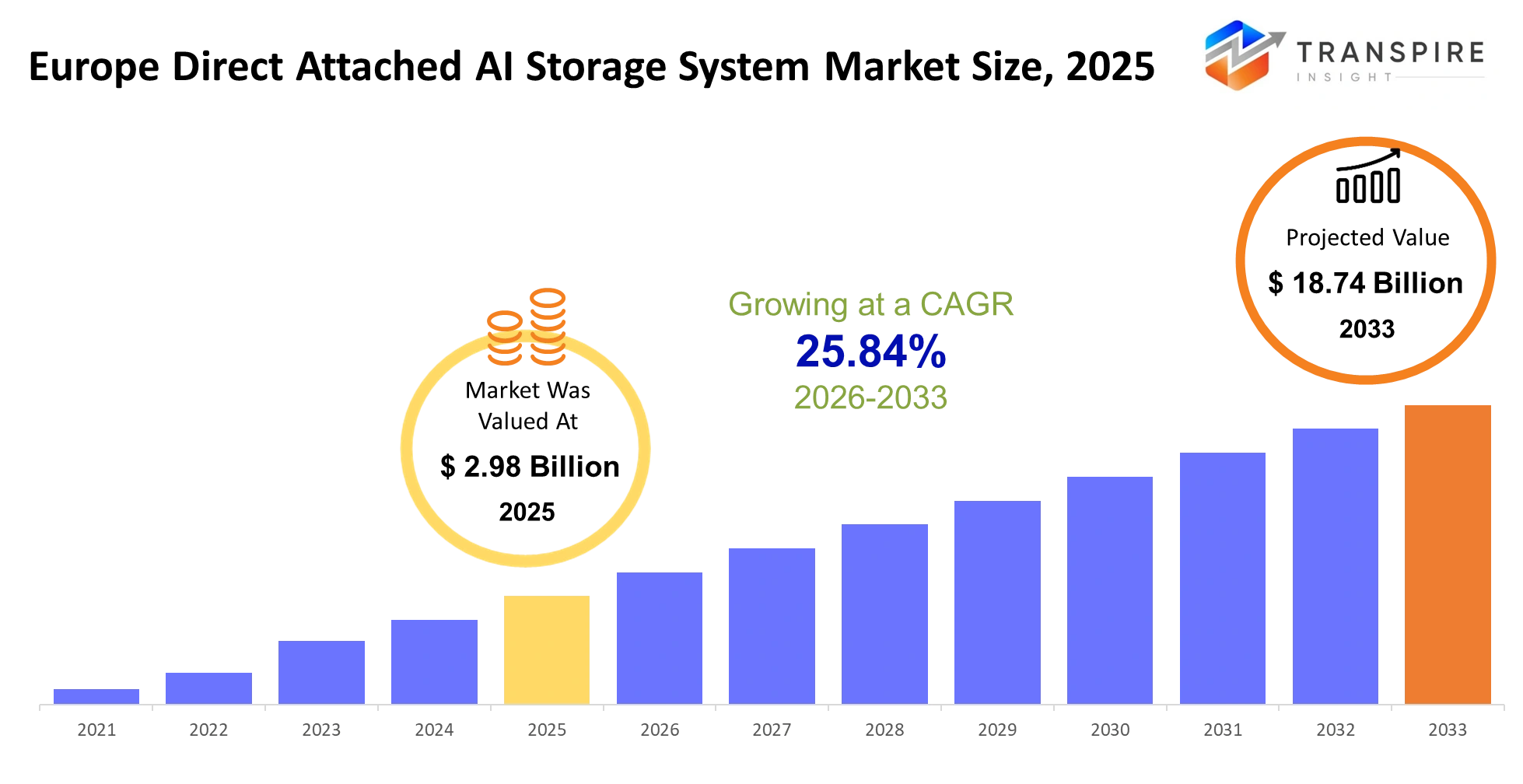
- Europe Direct Attached AI Storage System Market Size 2025: USD 2.98 Billion
- Europe Direct Attached AI Storage System Market Size 2033: USD 18.74 Billion
- Europe Direct Attached AI Storage System Market CAGR: 25.84%
- Europe Direct Attached AI Storage System Market Segments: By Type (SSD Storage, HDD Storage, Hybrid Storage, Others); By Application (AI Training, Data Analytics, Machine Learning, Others); By End-User (Enterprises, Data Centers, Research Institutes, Others); By Deployment (On-premise, Edge, Others).
To learn more about this report,  Download Free Sample Report
Europe Direct Attached AI Storage System Market Summary
The Europe Direct Attached AI Storage System Market was valued at USD 2.98 Billion in 2025. It is forecast to reach USD 18.74 Billion by 2033. That is a CAGR of 25.84% over the period.
Direct-attached AI storage systems solve a practical bottleneck in modern computing environments by placing high-speed storage directly alongside GPUs and AI processors. The system enables uninterrupted data flow from extensive datasets to training and inference processes which holds particular significance for industries that depend on immediate data processing to achieve their operational goals. The system architecture prevents network latency together with bandwidth restrictions from causing delays during model training and decreases the effectiveness of computing systems.
The past three to five years have produced a new tendency which leads away from centralized storage networks and toward storage systems that provide direct integration with GPU processing capabilities. Traditional storage systems faced challenges during the post-2023 generative AI workload expansion because organizations needed to shift from conventional storage methods. European data sovereignty regulations forced businesses to establish their AI infrastructure within local contexts instead of depending on remote cloud systems.
The current economic environment has changed consumer purchasing patterns. Organizations now see storage as an essential system element which affects their entire operations thus driving them to acquire more extensive systems while implementing tighter connections between their AI computing frameworks and storage needs.
Key Market Insights
- The European Direct Attached AI Storage System Market for 2025 shows Western Europe as the leading market with a 48% share which results from its advanced data center systems and its national AI funding programs.
- The fastest-expanding region until 2032 will be Eastern Europe because AI infrastructure investments will grow at over 20% every year while businesses continue their digital transformation projects.
- The market in 2025 shows SSD storage as the leading technology with a market share exceeding 55% because AI workloads need GPUs to handle data at high speeds while maintaining low latency.
- Enterprises use direct-attached storage solutions to support their operations because high-speed storage systems require storage solutions that provide approximately 45% of their capacity.
- The Edge AI Hybrid storage segment stands as the second-largest part of the market because it enables organizations to combine SSDs with HDDs for their AI and analytics work.
- The all-flash NVMe-based systems market represents the fastest-growing section because companies will need performance optimization between 2026 and 2032.
- AI training dominates the field while real-time analytics work as the main application which will grow rapidly because industrial automation projects and smart infrastructure projects started their development in 2024.
- The data center industry controls over 40% of the market because hyperscale AI systems and centralized computing resources drive its growth.
- The fastest market segment for enterprise AI systems grows because organizations begin processing their own data through internal systems to improve control over information and maintain regulations.
- Lenovo partners with AI chipmakers to develop budget-friendly storage products which deliver high efficiency to European businesses.
What are the Key Drivers, Restraints, and Opportunities in the Europe Direct Attached AI Storage System Market?
The primary driver is the shift to GPU-dense AI infrastructure which enterprises use to handle their growing needs for generative AI training systems which appeared after 2023. Enterprises experienced model training delays together with increased computing expenses because they discovered that networked storage systems created both latency issues and bandwidth conflicts. Direct-attached architectures solve this problem because they connect high-throughput storage systems directly to GPUs which results in higher data feed rates and better cluster performance. The business now considers storage as a performance-critical investment because it has transformed storage into a capacity purchase which results in higher average deal values and faster enterprise system upgrades.
The most significant restraint is the structural mismatch between legacy data estates and AI-ready storage pipelines. Organizations face migration challenges because their Petabyte-scale datasets exist in multiple formats across SAN, NAS, and object storage systems which stop them from moving data into direct-attached systems. Organizations need to complete three activities which require skilled personnel and equipment downtime to execute their necessary reformatting and data movements and application refactoring processes. The approved AI infrastructure budgets experience both a adoption delay and a revenue decrease because of friction which stops organizations from using their budgets.
A major opportunity is emerging at the edge which requires industrial AI systems to operate with high-speed storage and compact computing. The manufacturing centers in Central and Eastern Europe are implementing machine vision and robotics systems which need to function without cloud latency issues. Vendors that deliver rugged, low-power, direct-attached systems paired with software-defined management can capture this wave and establish early design wins.
What Has the Impact of Artificial Intelligence Been on the Europe Direct Attached AI Storage System Market?
Music fans now use artificial intelligence technology to create personalized experiences through automatic music generation and real-time performance evaluation. The development of AI-powered orchestration tools permits automatic execution of workload distribution and cache management and data storage tiering processes, which diminishes the need for human operators in environments that require optimal performance. Dell Technologies and other vendors use telemetry analytics to distribute storage resources in response to GPU usage patterns, which leads to better system performance and reduced inactive storage areas in enterprise AI clusters.
Machine learning models use storage performance metrics and failure patterns to build predictive capabilities. The models can predict when a disk or controller will fail, which enables organizations to perform maintenance work that decreases unplanned outages by 30% in large-scale operations. Predictive data placement algorithms enhance AI training throughput because they increase processing power and decrease model training time. The optimizations lead to improvements in system uptime and energy efficiency, which enterprises can measure.
High integration complexity continues to be a major obstacle that prevents progress in integration. The deployment process becomes more time-consuming and expensive for organizations that need to connect AI-based storage management systems with their existing IT infrastructure.
Key Market Trends
- The transition to direct-attached systems from shared network storage by businesses since 2023 has resulted in 40 percent lower latency during AI training.
- The implementation of all-flash SSD systems has experienced rapid growth since 2024 because Pure Storage and other vendors have developed solutions that boost data transfer rates for AI workloads.
- After the introduction of European data sovereignty regulations post-2022 organizations began implementing on-premise AI storage systems which decreased their dependence on public cloud services.
- Dell Technologies and Hewlett Packard Enterprise have moved their business focus toward selling complete AI infrastructure packages instead of offering separate products.
- The years 2024 to 2026 will see OEMs and NVIDIA chip manufacturers create new storage systems that achieve optimal performance with GPU technology through their collaborative partnerships.
- Since 2025 manufacturing and finance companies have expanded their edge AI operations by 25 percent which has increased the need for small direct-attached storage solutions.
- Organizations choose hybrid storage systems because they want to combine the speed of solid-state drives with the affordable storage capacity of hard disk drives for their mixed AI and analytics activities.
- Starting in 2025 NetApp and other companies developed software-defined storage platforms which enable users to move their workloads between on-site locations and hybrid AI systems.
- The rising energy costs that have affected Europe since 2023 have compelled buyers to select storage solutions that consume less energy which has resulted in changes to their purchasing choices and the product development plans of vendors.
Europe Direct Attached AI Storage System Market Segmentation
By Type:
The usage of SSD storage has become essential for AI workloads because it provides superior speed and low latency which enables fast data retrieval. Organizations choose SSD direct-attached storage systems because these systems help them achieve better performance in GPU-based computing environments. HDD storage functions as the secondary storage solution which most often serves its purpose in economical bulk data storage situations that do not require high performance. Hybrid storage solutions now become popular because they use the fast speed of SSDs together with the storage capacity of HDDs to create a system that delivers both performance and cost savings.
The demand for SSD storage has surged because artificial intelligence training requirements need multiple high-speed input-output operations to function. The expansion of HDD technology faces restrictions because of its latency issues whereas hybrid systems gain advantages from businesses that require adaptable deployment options. The adoption of SSD technology will increase throughout the projection period because their prices will decrease while people expect better performance from them. Developers of products and investors should direct their efforts toward enhancing flash storage systems to perform better with artificial intelligence research tasks.
By Application:
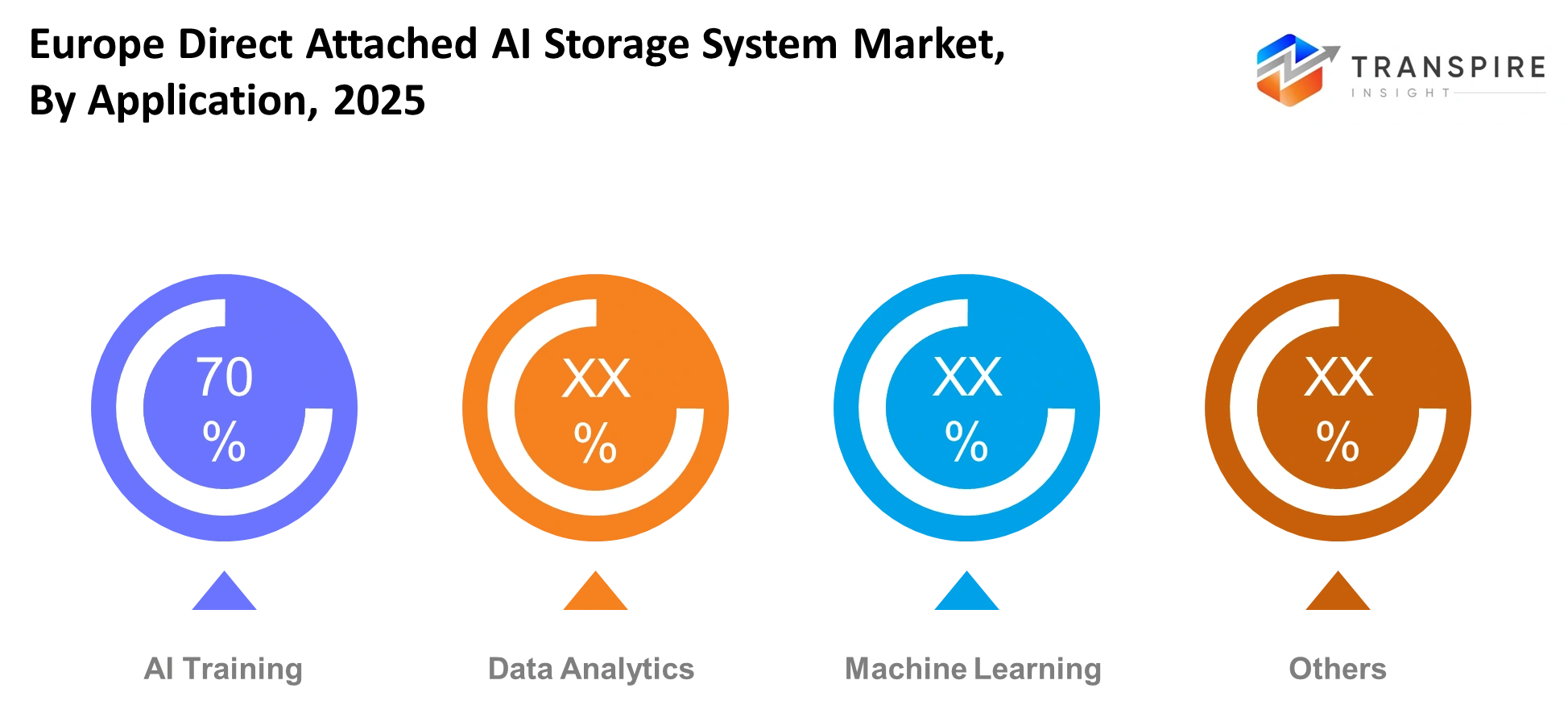
The largest share of AI training applications operates through the development of large-scale models which need immediate access to extensive dataset resources. The segment maintains its leading position because businesses now implement generative AI together with deep learning technologies. Data analytics and machine learning follow because these technologies provide real-time insights for operational efficiency in finance and manufacturing industries. The applications depend on steady data flow and minimal delay times to handle intricate data processing tasks.
The increasing demand for computational power and data storage capabilities drives the growth of AI training while enterprise digital transformation initiatives support the expansion of analytics solutions. The need for companies to implement automated systems which use machine learning models drives the rise of machine learning technologies. Unified storage systems will become necessary because integrated AI pipelines will create application boundaries that use different storage requirements. The system vendors need to build their systems so that different workloads can operate inside one unified system.
To learn more about this report, Download Free Sample Report
By End-User:
Hyperscale and enterprise data center deployments which support centralized AI workloads create the biggest data center market share. Enterprises follow closely, adopting direct-attached storage for in-house AI processing and data control. Research institutes represent a smaller but significant segment, particularly in scientific computing and advanced simulations. Each group prioritizes performance and scalability but differs in deployment scale and budget constraints.
AI infrastructure development and cloud service expansion drive the growth of data centers. Organizations implement AI workloads at their private data centers which increases enterprise adoption. Research institutes drive demand for high-performance systems in specialized applications. Future growth will see enterprises and research institutions increase investment, creating opportunities for tailored storage solutions.
By Deployment:
The deployment methods which organizations select depend on their data sovereignty requirements and their need to connect with AI computing systems. Organizations choose to implement systems locally because it enables them to safeguard sensitive information while achieving faster response times for essential business operations. The edge deployment market is becoming a major sector because industrial automation and smart infrastructure demand real-time processing capabilities. The existing deployment methods provide limited options which organizations can use to implement specific use cases.
The advantages of performance and regulatory compliance requirements create benefits for on-premise systems while edge deployment expands because organizations develop AI applications which use decentralized processing. Edge environments need small-sized storage solutions which deliver high performance and work together with their nearby computing systems. The edge deployment market will experience major growth during the forecast period because industries begin using real-time AI solutions. Market participants should develop solutions which allow organizations to operate their systems from central locations and remote sites.
What are the Key Use Cases Driving the Europe Direct Attached AI Storage System Market?
The AI model training process at enterprise data centers uses high-throughput storage systems which connect directly to GPU clusters because this configuration serves as their primary operational requirement. The system enables fast data intake together with simultaneous data handling which big language models and computer vision technology and financial risk assessment tools require. On-premise infrastructure remains the most popular choice among industries that include finance and advanced manufacturing because these fields need to protect sensitive data while delivering maximum performance. Healthcare imaging and industrial automation research represent two fields that need expanding research applications. Hospitals use direct-attached AI storage to process high-resolution diagnostic scans in real time while manufacturing firms use it to enable machine vision and predictive quality control throughout their production facilities. The local processing solution enables these use cases to function because it delivers quick response times while keeping data within their designated locations.
The new applications focus on using edge AI technology for smart city operations and defense analytics functions. Municipal systems and security networks are beginning to adopt compact high-performance storage to support real-time decision making which indicates that the market will experience substantial future growth.
|
Report Metrics |
Details |
|
Market size value in 2025 |
USD 2.98 Billion |
|
Market size value in 2026 |
USD 3.75 Billion |
|
Revenue forecast in 2033 |
USD 18.74 Billion |
|
Growth rate |
CAGR of 25.84% from 2026 to 2033 |
|
Base year |
2025 |
|
Historical data |
2021 - 2024 |
|
Forecast period |
2026 - 2033 |
|
Report coverage |
Revenue forecast, competitive landscape, growth factors, and trends |
|
Regional scope |
Europe (Germany, United Kingdom, France, Italy, Spain, Rest of Europe) |
|
Key company profiled |
Dell Technologies, HPE, IBM, NetApp, Pure Storage, Lenovo, Cisco, Oracle, Huawei, Inspur, Fujitsu, Hitachi Vantara, Western Digital, Seagate, Micron. |
|
Customization scope |
Free report customization (country, regional & segment scope). Avail customized purchase options to meet your exact research needs. |
|
Report Segmentation |
By Type (SSD Storage, HDD Storage, Hybrid Storage, Others); By Application (AI Training, Data Analytics, Machine Learning, Others); By End-User (Enterprises, Data Centers, Research Institutes, Others); By Deployment (On-premise, Edge, Others). |
Which Regions are Driving the Europe Direct Attached AI Storage System Market Growth?
The market operates under Western European control because digital infrastructure combines with artificial intelligence adoption programs that Germany France and the Netherlands implement to drive growth. Enterprises and governments allocate substantial resources towards developing sovereign data capabilities, which creates a rising need for direct-attached storage solutions that meet high-performance requirements while maintaining AI workloads within secure on-premise environments. The area advantages from its extensive collection of hyperscale data centers and research facilities and enterprise IT companies, which enable fast AI infrastructure installation. The combination of policy backing together with technical development enables Western Europe to maintain its leadership status in the region.
Northern Europe succeeds as an active and dependable member because its people value energy efficiency together with sustainable data center practices. AI infrastructure investments flow into Sweden and Finland because of their renewable energy resources together with their ability to maintain optimal cooling conditions, which enable organizations to minimize storage costs. The area, which covers Western Europe, witnesses demand growth through infrastructure development that lasts over time instead of seeking instant growth. This creates a predictable investment environment that supports steady adoption of direct-attached AI storage systems.
The digital economy and European AI programs have created Eastern Europe as the fastest-growing area within Europe. The countries of Poland and the Czech Republic have been expanding their data center and AI research capabilities since the start of 2024. The EU funding programs together with enterprise workload shifts towards cheaper operational centers support this transition.The region’s growth creates a clear opportunity for vendors and investors to establish early presence and capture demand between 2026 and 2033.
Who are the Key Players in the Europe Direct Attached AI Storage System Market and How Do They Compete?
The Europe Direct Attached AI Storage System Market shows its competitive landscape through multiple international infrastructure providers, yet AI demand changes continue to transform vendor selection processes. Incumbents still control most enterprise contracts, but competition has shifted away from raw capacity toward performance density, GPU proximity, and software integration. Vendors now compete primarily on technology architecture and the ability to deliver low-latency, high-throughput storage that aligns tightly with AI compute stacks. Companies now use system design as a method to create unique products, instead of depending on price as their only competitive advantage.
Dell Technologies focuses on tightly integrated AI storage systems that align with GPU clusters, using its PowerScale architecture to deliver parallel throughput for large training workloads. Businesses use this solution to expand their operations because it enables them to create one unified space that handles all their data processing needs. Hewlett Packard Enterprise emphasizes hybrid architecture by combining direct-attached performance with cloud-managed services through its GreenLake platform, allowing enterprises to scale AI storage without overprovisioning hardware.
NetApp uses its software-defined storage system, which runs on high-performance hardware, to enable users to move data between on-premise AI systems and cloud environments. Pure Storage establishes its market position through all-flash systems, which deliver low-latency performance for AI pipelines, while the company emphasizes energy-efficient operations and reliable performance during demanding tasks. Lenovo expands through partnerships with AI chipmakers and focuses on cost-efficient, high-performance systems tailored for European enterprise and research institutions.
Company List
- Dell Technologies
- HPE
- IBM
- NetApp
- Pure Storage
- Lenovo
- Cisco
- Oracle
- Huawei
- Inspur
- Fujitsu
- Hitachi Vantara
- Western Digital
- Seagate
- Micron
Recent Development News
“In March 2026, Dell Technologies launched its next-generation PowerScale all-flash storage systems optimized for AI workloads. The platform enhances high-throughput data access for GPU clusters, strengthening Dell’s position in AI-driven direct-attached and near-edge storage deployments.
Source: https://www.dell.com
“In January 2026, NetApp introduced new AI-optimized storage solutions under its ONTAP platform. The release focuses on accelerating data processing speeds and simplifying AI workload management, supporting enterprise adoption of direct-attached and hybrid AI storage architectures.
Source: https://www.netapp.com
What Strategic Insights Define the Future of the Europe Direct Attached AI Storage System Market?
The Europe Direct Attached AI Storage System Market is moving toward tightly coupled, high-performance storage architectures which direct system storage to work with AI computations. Enterprises require reduced latency and energy consumption because they need to run multiple training and inference operations which process large volumes of data at locations near their data centers. The upcoming five to seven years will see rising demand for storage systems which offer modular GPU-based solutions that deliver superior throughput while supporting edge operations instead of centralized storage capacity.
The less visible threat which organizations face today stems from organizations using advanced technologies to replace their existing systems through the development of modern storage solutions which eventually eliminate their need for direct-attached storage systems. The current business model which relies heavily on hardware solutions will create financial challenges for vendors who have committed significant resources to this field. The industrial sector and autonomous systems market access new business opportunities through edge AI technology which needs compact storage solutions with quick processing power.
Market participants should prioritize hybrid architectures which combine direct-attached performance with scalable software-defined flexibility to maintain their competitive position across upcoming deployment patterns.
Europe Direct Attached AI Storage System Market Report Segmentation
By Type
- SSD Storage
- HDD Storage
- Hybrid Storage
- Others
By Application
- AI Training
- Data Analytics
- Machine Learning
- Others
By End-User
- Enterprises
- Data Centers
- Research Institutes
- Others
By Deployment
- On-premise
- Edge
- Others
Frequently Asked Questions
Find quick answers to common questions.
The Europe Direct Attached AI Storage System Market size is USD 18.74 Billion in 2033.
Key segments for the Europe Direct Attached AI Storage System Market are By Type (SSD Storage, HDD Storage, Hybrid Storage, Others); By Application (AI Training, Data Analytics, Machine Learning, Others); By End-User (Enterprises, Data Centers, Research Institutes, Others); By Deployment (On-premise, Edge, Others).
Major Europe Direct Attached AI Storage System Market players are Dell Technologies, HPE, IBM, NetApp, Pure Storage, Lenovo, Cisco, Oracle, Huawei, Inspur, Fujitsu, Hitachi Vantara, Western Digital, Seagate, Micron.
The Europe Direct Attached AI Storage System Market size is USD 2.98 Billion in 2025.
The Europe Direct Attached AI Storage System Market CAGR is 25.84% from 2026 to 2033.
- Dell Technologies
- HPE
- IBM
- NetApp
- Pure Storage
- Lenovo
- Cisco
- Oracle
- Huawei
- Inspur
- Fujitsu
- Hitachi Vantara
- Western Digital
- Seagate
- Micron
Recently Published Reports
-
Apr 2026
3D Optical Profiler Market
3D Optical Profiler Market Size, Share & Analysis Report By Type (Desktop 3D Optical Profiler, and Portable 3D Optical Profiler), By Technology (Confocal Technology, and White Light Interference), By End-Use Industry (Manufacturing, Research Institutions, Automotive, Aerospace and Defense, Medical Devices, and Other), and Geography (North America, Europe, Asia-Pacific, Middle East and Africa, South and Central America), 2021 - 2031
-
Apr 2026
Depth Sensor Market
Depth Sensor Market Size, Share & Analysis Report By Type (Infrared Depth Sensors, Time-of-Flight (ToF) Sensors, Stereo Vision Sensors, Structured Light Sensors, Ultrasonic Depth Sensors), By Application (Automotive, Robotics, Gaming, Consumer Electronics, Industrial Automation, Healthcare, Security & Surveillance, Others), By End Users (Automotive Manufacturers, Consumer Electronics Companies, Healthcare Providers, Industrial Companies, Security Agencies, Gaming Companies, Robotics Companies, Others), and Geography (North America, Europe, Asia-Pacific, Middle East and Africa, South and Central America), 2021 – 2031
-
Apr 2026
Digital Manufacturing Market
Digital Manufacturing Market Size, Share & Analysis Report By Component (Hardware, Software, and Services), By Technology (Robotics, 3D Printing, Internet of Things (IoT), and Others), By Application (Automotive and Transportation, Aerospace and Defense, Consumer Electronics, Industrial Machinery, and Others), By Process Type (Computer-Based Designing, Computer-Based Simulation, Computer 3D Visualization, Analytics, and Others), and Geography (North America, Europe, Asia-Pacific, Middle East and Africa, South and Central America), 2021 – 2031
-
Apr 2026
Digital Visa Services Market
Digital Visa Services Market Size, Share & Analysis Report By Type (Individual Travelers, Group Travelers), By Application (Tourism, Business Travel, Others), and Geography (North America, Europe, Asia-Pacific, Middle East and Africa, South and Central America), 2021 – 2031