
Europe Cargo E-Bike Market Size & Forecast:
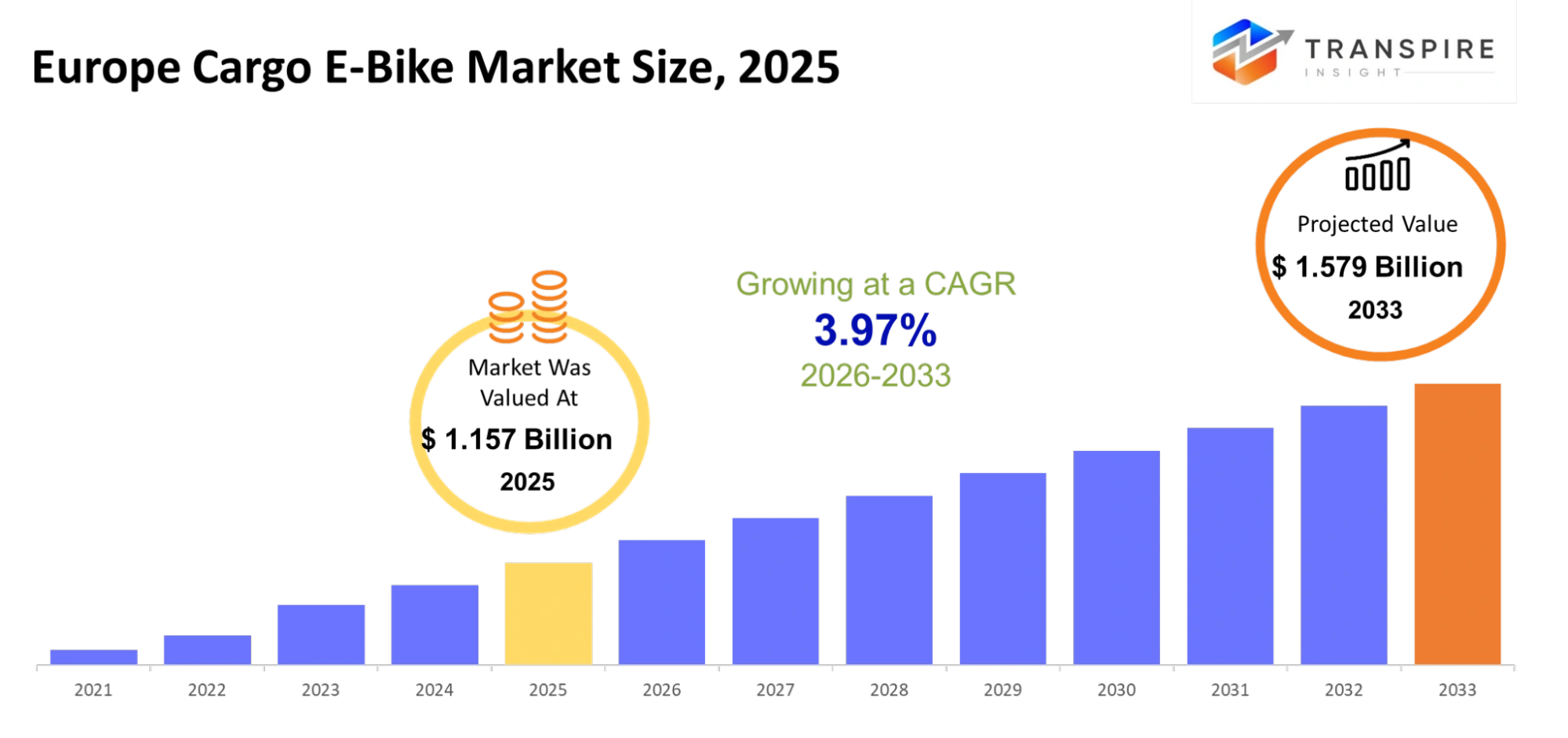
- Europe Cargo E-Bike Market Size 2025: USD 1.157 Billion
- Europe Cargo E-Bike Market Size 2033: USD 1.579 Billion
- Europe Cargo E-Bike Market CAGR: 3.97%
- Europe Cargo E-Bike Market Segments: By Type (Two-Wheeler, Three-Wheeler), By Application (Logistics, Personal Use), By End-User (Commercial, Individuals).
To learn more about this report,  Download Free Sample Report
Europe Cargo E-Bike Market Summary:
Europe Cargo E-Bike Market size was estimated at USD 1.157 Billion in 2025 and is anticipated to reach USD 1.579 Billion by 2033, growing at a CAGR of 3.97% from 2026 to 2033.
The cargo e-bike market in Europe operates within the urban mobility and electric vehicle sector because city life needs efficient last-mile transportation. The market will attract more interest because businesses and households need better street access solutions than traditional van systems. Customers demand delivery services that produce less noise and environmental pollution while small businesses and gig economy workers prefer delivery methods that minimize their need to use fuel-based vehicles. The option which was previously regarded as
The present state has been shaped by steady advances in battery range and lightweight frame design and smart connectivity which will enable easier route planning and load management. The regulations which European countries have established will support low-emission transport systems because they provide financial incentives that will drive higher adoption rates among users. The changing consumer demand for faster deliveries and environmentally friendly solutions will force logistics companies to adopt new operating models which will create space for cargo e-bikes to become part of city transportation networks.
Key Market Trends & Insights:
- The European Cargo E-Bike Market shows continuous expansion because cities are increasingly adopting delivery methods that produce lower greenhouse gas emissions. Businesses operating in urban areas will switch to using cargo e-bikes because this choice helps them save money on fuel and meet new environmental regulations. Cities which advocate for environmentally friendly last-mile delivery methods will create higher demand for their services.
- The European Cargo E-Bike Market will experience growth because people increasingly shop online. Businesses which operate retail and logistics services will use cargo e-bikes to handle their short-distance delivery requirements. Urban distribution networks will achieve widespread integration because faster delivery times and lower congestion effects and decreased operational costs make it more efficient to operate.
- The European Cargo E-Bike Market will develop through supportive policies which will create new business opportunities. Electric cargo bike adoption will increase because businesses will receive financial support through subsidies and tax benefits and urban mobility regulations. The establishment of dedicated bike lanes together with vehicle access restrictions which apply to regular vehicles will enhance the adoption of cargo e-bikes.
- The European Cargo E-Bike Market will achieve better efficiency through innovative battery system development and lightweight material creation. Improved range, faster charging, and better load capacity will make cargo e-bikes more reliable for commercial use. The combination of smart tracking systems and fleet management systems will enhance operational efficiency.
- The European Cargo E-Bike Market will receive substantial funding from logistics companies and mobility technology startups. Companies will increase their vehicle fleets while creating specialized cargo e-bike solutions which serve various business sectors. The combination of strategic partnerships and pilot projects will drive adoption in urban areas that experience delivery vehicle operational challenges.
Europe Cargo E-Bike Market Segmentation
By Type :
- Two-Wheeler: The compact design of two-wheeler cargo e-bikes enables drivers to maneuver through tight urban environments. The lightweight design of the product enables users to move through traffic while carrying midrange loads. Delivery workers prefer such models for food and parcel transport, as maintenance remains simple and parking requires less space.
- Three-Wheeler: Three-wheeler cargo e-bikes provide businesses with better weight distribution capabilities because their three-wheel design enhances vehicle stability for delivering heavy cargo loads. The stable frame structure allows bulk goods to be transported without compromising control of the vehicle. The majority of grocery supply companies and industrial transport businesses select this option because it provides better safety during loading and unloading than two-wheel loading and unloading systems.
By Application :
- Logistics: Urban delivery requirements which increase because of rising online shopping demand drive logistics operations to expand their services. The use of cargo e-bikes produces lower fuel costs while enabling quicker travel through crowded urban areas. Electric cargo bikes help companies achieve better last-mile delivery results because they deliver three main benefits: cost reductions, lower carbon emissions, and consistent operational capacity on short-distance routes.
- Personal Use: Families and individuals who need practical daily transport solutions increasingly use cargo e-bikes for their personal transportation needs. Families can complete grocery shopping and school transportation and small goods delivery without needing to use cars. People choose to use electric bicycles because they save money on fuel and maintenance expenses and the electric bike system enables them to ride comfortably with their additional weight.

To learn more about this report, Download Free Sample Report
By End-User :
- Commercial: The main reason commercial users make up a large market share is because urban delivery solutions need to become more efficient. Businesses use cargo e-bikes because they help reduce operating expenses and enable companies to achieve their sustainability targets. Retailers and courier services and food delivery operators use these vehicles to provide prompt service while they bypass traffic and parking difficulties.
- Individuals: Individuals show rising interest as awareness about sustainable transport increases. Daily commuting combined with utility benefits attracts urban residents. Cargo e-bikes support eco-friendly lifestyles while offering flexibility for carrying goods. Non-commercial users increasingly adopt the technology because it provides affordable solutions which require simple operation.
Country Insights
- The cargo e-bikes market maintains its demand because of two factors which include strong urban logistics networks and strict emission goals. Local businesses increasingly prefer electric cargo cycles for last-mile delivery because the vehicles provide cost savings and enable delivery to low-emission zones. The combination of cycling lanes and government incentives will support adoption throughout major metropolitan areas. Delivery services and small retailers show increasing interest in cargo e-bikes because of the rising fuel costs and the need for sustainable transportation solutions. London and other urban environments provide ideal conditions for developing compact electric transportation systems. The introduction of pilot programs and policy support will increase usage among both food delivery services and parcel distribution companies.
- Government subsidies and eco-friendly mobility campaigns push the shift toward cargo e-bikes in cities like Paris and Lyon. The combination of a strong cycling culture and infrastructure development enables businesses to switch to electric cargo transportation. The Europe Cargo E-Bike Market receives ongoing support from municipal programs which promote environmentally friendly and silent delivery methods. The combination of narrow city streets and historic urban design creates operational advantages for cargo e-bikes used in city delivery operations. Small enterprises use these vehicles to travel through crowded areas with high efficiency. The Europe Cargo E-Bike Market grows at a steady pace because more people understand the operational savings and environmental advantages of cargo e-bikes.
- Cargo e-bike usage rises in Madrid and Barcelona because both e-commerce business growth and urban sustainable development initiatives support its implementation. Local governments promote cleaner delivery options to reduce congestion and pollution. The European Cargo E-Bike Market experiences steady growth which businesses in urban areas develop through their positive market responses.
Recent Development News
Cargo e-bikes becoming core to last-mile delivery
- Cargo e-bikes are now widely used in urban logistics and last-mile delivery services, replacing vans in dense cities. Their ability to navigate traffic and reduce delivery times is driving adoption among logistics providers. This shift is also supported by stricter emission regulations in European cities.
New cargo e-bike models targeting car replacement
- Manufacturers are launching advanced cargo e-bikes designed to fully replace cars for urban users. For example, the Benno RemiDemi XL supports heavy loads and family transport use cases. These models focus on durability, modular accessories, and high load capacity, making them suitable for daily errands and school runs.
|
Report Metrics |
Details |
|
Market size value in 2025 |
USD 1.157 Billion |
|
Market size value in 2026 |
USD 1.202 Billion |
|
Revenue forecast in 2033 |
USD 1.579 Billion |
|
Growth rate |
CAGR of 3.97% from 2026 to 2033 |
|
Base year |
2025 |
|
Historical data |
2021 - 2024 |
|
Forecast period |
2026 - 2033 |
|
Report coverage |
Revenue forecast, competitive landscape, growth factors, and trends |
|
Country scope |
Europe (Germany, United Kingdom, France, Italy, Spain, Rest of Europe) |
|
Key company profiled |
Riese & Müller, Urban Arrow, Yuba Bikes, Tern Bicycles, Rad Power Bikes, Douze Cycles, Babboe, Bullitt, Xtracycle, Gazelle, Trek, Giant, Cube Bikes, Accell Group, Pedego. |
|
Customization scope |
Free report customization (country, regional & segment scope). Avail customized purchase options to meet your exact research needs. |
|
Report Segmentation |
By Type (Two-Wheeler, Three-Wheeler), By Application (Logistics, Personal Use), By End-User (Commercial, Individuals). |
Key Europe Cargo E-Bike Company Insights
- The Europe Cargo E-Bike Market shows steady progress as cities shift toward cleaner and more practical transport options for goods movement. The need to decrease traffic congestion together with emission reductions has led companies to use cargo e-bikes for their last-mile delivery operations. Logistics companies have adopted these vehicles because urban areas with narrow streets and strict environmental regulations make them the most efficient choice. The demand for solutions exists because companies want cost-saving options that decrease fuel use while keeping their delivery operations running smoothly. The government provides support through incentives and infrastructure development, which helps to increase adoption rates. The Europe Cargo E-Bike Market gains advantages from rising awareness among small businesses and large delivery networks, where reliability and low operating costs remain important factors. Technological improvements in battery capacity and vehicle design have made cargo e-bikes more durable and suitable for heavier loads, which supports broader use across different industries.
- The key companies which operate in the Europe Cargo E-Bike Market use their dedication to innovation and product quality, and strategic partnerships to create their market presence. Both established manufacturers and new companies are developing higher load capacity, longer battery life, and enhanced safety features to satisfy rising customer expectations. Through partnerships with logistics firms and retail companies, businesses have developed stronger distribution networks and enhanced their capacity to market products. Companies today are conducting research to create lightweight frames and high-performance motor systems, which will lead to better product performance and improved user experiences. Businesses use their competitive strategies to develop regional markets, create tailored solutions for their commercial customers, and provide post-purchase assistance, which helps them establish enduring customer partnerships. Investors and mobility solution providers keep focusing on the Europe Cargo E-Bike Market because European countries maintain a strong demand for environmentally friendly transportation alternatives.
Europe Cargo E-Bike Market Companies:
- Riese & Müller
- Urban Arrow
- Yuba Bikes
- Tern Bicycles
- Rad Power Bikes
- Douze Cycles
- Babboe
- Bullitt
- Xtracycle
- Gazelle
- Trek
- Giant
- Cube Bikes
- Accell Group
- Pedego
Europe Cargo E-Bike Market Segmentation
By Type
- Two-Wheeler
- Three-Wheeler
By Application
- Logistics
- Personal Use
By End-User
- Commercial
- Individuals
Frequently Asked Questions
Find quick answers to common questions.
The approximate Europe Cargo E-Bike Market size for the market will be USD 1.579 Billion in 2033.
Key segments for the Europe Cargo E-Bike Market are By Type (Two-Wheeler, Three-Wheeler), By Application (Logistics, Personal Use), By End-User (Commercial, Individuals).
Major Europe Cargo E-Bike Market players are Riese & Müller, Urban Arrow, Yuba Bikes, Tern Bicycles, Rad Power Bikes, Douze Cycles, Babboe, Bullitt, Xtracycle, Gazelle, Trek, Giant, Cube Bikes, Accell Group, Pedego.
The Europe Cargo E-Bike Market size is USD 1.157 Billion in 2025.
The Europe Cargo E-Bike Market CAGR is 3.97%.
- Riese & Müller
- Urban Arrow
- Yuba Bikes
- Tern Bicycles
- Rad Power Bikes
- Douze Cycles
- Babboe
- Bullitt
- Xtracycle
- Gazelle
- Trek
- Giant
- Cube Bikes
- Accell Group
- Pedego
Recently Published Reports
-
Apr 2026
ATV & UTV Market
ATV & UTV Market Size, Share & Analysis Report By Type (ATV, and UTV), By Variants (Less Than 400 CC, 400 CC To 800 CC, and More Than 800 CC), and Geography (North America, Europe, Asia-Pacific, Middle East and Africa, South and Central America), 2021 - 2031
-
Apr 2026
Automotive Central Gateway Module Market
Automotive Central Gateway Module Market Size, Share & Analysis Report By Type (Ethernet Central Gateway Module, CAN Central Gateway Module, LIN Central Gateway Module, and FlexRay), By Application (Powertrain Control, Body Control, Infotainment System, Advanced Driver Assistance Systems (ADAS), and Others), By End User (Passenger Vehicles, and Commercial Vehicles), and Geography (North America, Europe, Asia-Pacific, Middle East and Africa, South and Central America), 2021 - 2031
-
Apr 2026
Automotive Engine Oil Filter Market
Automotive Engine Oil Filter Market Size, Share & Analysis Report By Filter Type (Fuel Filter, Engine Oil Filter, Hydraulic Oil Filter, and Others), By Filter Media (Cellulose, Synthetic, and Micro), By Sales Channel (OEMs, and Aftermarket), By Vehicle Type (Passenger Cars, Light Commercial Vehicles, Heavy Duty Trucks, Buses and Coaches, and Off-road Vehicles), and Geography (North America, Europe, Asia-Pacific, Middle East and Africa, South and Central America), 2021 - 2031
-
Apr 2026
Automotive Parts Aluminium Die Casting Market
Automotive Parts Aluminium Die Casting Market Size, Share & Analysis Report By Production Process (Pressure Die Casting, Vacuum Die Casting, Squeeze Die Casting, Gravity Die Casting), By Application (Body Parts, Engine Parts, Transmission Parts, Battery And Related Components, Other Application Types), and Geography (North America, Europe, Asia-Pacific, Middle East and Africa, South and Central America), 2021 - 2031
Our Clients