
Europe Carbon Footprint Management Market Size & Forecast:
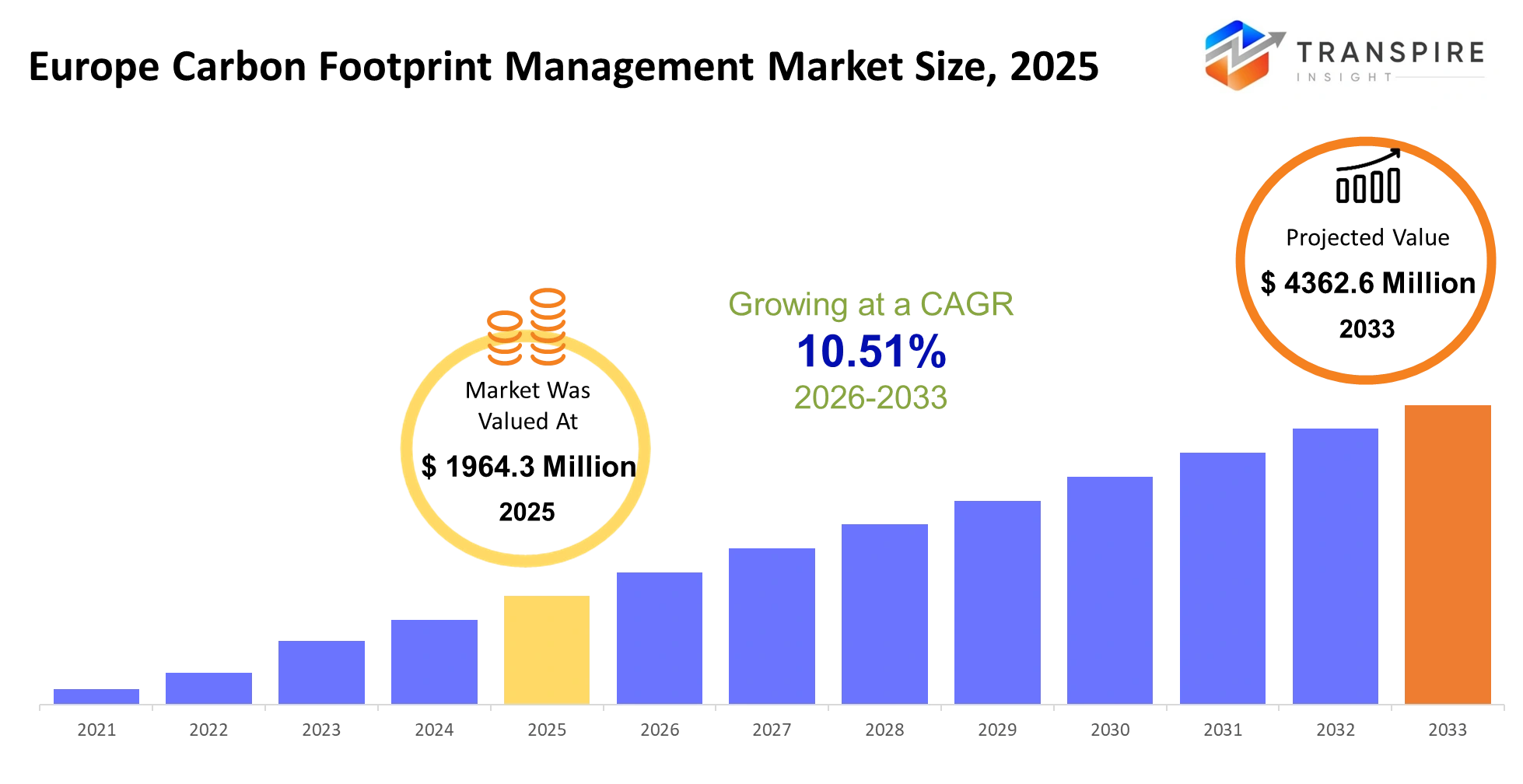
- Europe Carbon Footprint Management Market Size 2025: USD 1964.3 Million
- Europe Carbon Footprint Management Market Size 2033: USD 4362.6 Million
- Europe Carbon Footprint Management Market CAGR: 10.51%
- Europe Carbon Footprint Management Market Segments: By Type (Software, Services, Platforms, Analytics Tools, Others); By Application (Emissions Tracking, Reporting, Compliance, Energy Management, Sustainability Planning, Others); By End-User (Enterprises, Government, Manufacturing, Energy Sector, Retail, Others); By Deployment (Cloud, On-premise, Hybrid, Others).
To learn more about this report,  Download Free Sample Report
Europe Carbon Footprint Management Market Summary
The Europe Carbon Footprint Management Market was valued at USD 1964.3 Million in 2025. It is forecast to reach USD 4362.6 Million by 2033. That is a CAGR of 10.51% over the period.
The Europe carbon footprint management market provides industrial operators and logistics firms and maritime players with tools to measure their emissions which they can track and reduce throughout their entire value chain. The system transforms operational data through its capacity to analyze fuel consumption and energy usage and supplier input data to produce verifiable carbon emissions results which companies use to fulfill regulatory requirements and secure contracts and prevent financial penalties.
The market has transitioned from using reporting tools which produce results at specific times to using software systems that enable continuous monitoring throughout all business operations. The EU regulations have tightened which results from two developments namely emissions trading expansion and maritime inclusion rules which both require companies to measure their emissions with greater accuracy.
Regulatory pressure establishes a direct connection between compliance risk and financial performance. The market for automated platforms has grown because companies want to establish permanent operations which now leads to increased software revenue and deeper integration of carbon management into essential business functions.
Key Market Insights
- The European Carbon Footprint Management Market operates through Western Europe which holds a market share of approximately 48% in 2025 because of the strict EU compliance frameworks.
- Northern Europe emerges as the fastest-growing region through 2030 because it establishes ambitious net-zero targets and uses carbon accounting technologies.
- More than 55% of software solutions control the market because businesses need to monitor their emissions and create automated reports for their entire operational activities.
- The services segment maintains its position as the second-largest market segment because businesses require consulting services and verification services and regulatory compliance expertise.
- The market for cloud-based carbon management platforms represents the fastest-growing segment which will develop quickly until 2030 because of its ability to scale and integrate different systems.
- The manufacturing sector maintains its leading position with approximately 35% market share because of its requirement to manage complicated supply chains and complete emissions accountability.
- The maritime and logistics sector experiences the fastest growth because of new EU shipping emission regulations and fuel monitoring requirements which have been established.
- Large enterprises dominate the Europe Carbon Footprint Management Market with over 60% share due to regulatory exposure and ESG reporting obligations.
- Small and medium enterprises show rapid growth through 2030 as affordable SaaS platforms lower adoption barriers.
- The process of cloud integration and enterprise software bundling helps businesses improve their competitive advantage while increasing their ability to generate recurring revenue.
What are the Key Drivers, Restraints, and Opportunities in the Europe Carbon Footprint Management Market?
Driver:
The European Carbon Footprint Management Market grows because of European Union regulations which require emissions trading system expansion and companies to disclose their entire Scope 3 emissions. The policy updates which changed carbon accounting from voluntary disclosure to mandatory compliance created this transformation. Companies now face direct financial exposure through carbon pricing and penalties for inaccurate reporting. Enterprises are implementing automated carbon management systems which provide audit-ready information to protect against regulatory compliance problems. The regulatory push results in faster procurement processes while energy-intensive industries and multinational corporations maintain their software subscription revenue streams.
Restraint:
Carbon measurement systems face structural challenges because supply chains are divided into multiple parts which need to be connected together. Many organizations still rely on inconsistent supplier data, legacy IT systems, and manual reporting processes. The solution to this problem requires a lengthy process because it needs suppliers to establish standards and organizations to share information across borders while their entire systems undergo digital changes. The result is delayed adoption among mid-sized firms and incomplete emissions visibility, which suppresses the full revenue potential of advanced carbon management solutions.
Opportunity:
The integration of carbon management into enterprise resource planning systems creates a major business opportunity. Companies including SAP now combine carbon tracking with their financial and operational systems which enables organizations to use carbon data for their daily business decisions. The combination of these two systems enables organizations to calculate their emissions costs in real-time while developing carbon-conscious procurement methods which create new revenue channels for platform vendors.
What Has the Impact of Artificial Intelligence Been on the Europe Carbon Footprint Management Market?
Artificial intelligence enables carbon footprint management in industrial and maritime operations to progress from static reporting systems toward real-time control systems. AI-powered systems enable operators to automate scrubber monitoring along with exhaust gas cleaning system operations because the system adjusts flow rates and chemical dosing and pressure levels to maintain emissions limits without requiring manual operation. Historical fuel consumption data and weather information and engine load statistics are used by machine learning models to predict emissions and determine the best routes and optimal speeds for operation. The predictive layer enables shipping companies to achieve measurable reductions in fuel consumption while they maintain accurate compliance with EU maritime regulations.
Advanced analytics systems assist predictive maintenance programs because they detect equipment degradation in marine emission control systems before it becomes critical. Companies achieve directional improvements through AI implementation in fleet management workflows which results in better vessel uptime and stricter compliance and reduced fuel expenses for their operations.
Adoption encounters definite boundaries. Many vessels operate with intermittent connectivity because it prevents them from transferring data in real time which decreases their ability to operate their models accurately. The process of connecting AI systems to existing onboard systems in older fleets demands substantial initial costs and technical synchronization, which results in slow implementation across these aged fleets.
Key Market Trends
- The European Union emissions regulations which began in 2021 now include maritime operations and Scope 3 emissions reporting.
- This change requires companies to implement ongoing emissions measurement systems which replace their previous annual emissions reporting processes.
- More than half of organizations now use automated carbon tracking systems which they link to their ERP systems through AI-powered platforms instead of traditional spreadsheets.
- Today's buyers prefer vendors who provide audit-ready data which meets regulatory requirements because they want to protect themselves from potential financial risks instead of promoting sustainability through branding.
- Since 2022, cloud deployment has become more popular than on-premise solutions because businesses need SaaS platforms that provide real-time emissions data from their suppliers and logistics operations.
- SAP and Microsoft developed carbon management software packages which allow users to access emissions information through their financial and operational business processes.
- The demand for supply chain transparency has increased because large manufacturers need emissions information from more than 70 percent of their first-tier suppliers by the year 2024.
- EU shipping regulations led maritime operators to implement fuel and emissions monitoring systems, which resulted in fleet management activities turning toward methods that optimize operations through compliance requirements.
- Companies started viewing emissions as a cost factor because carbon pricing became unstable after 2022.
- The introduction of budget and procurement decision-making processes which use carbon metrics appeared after mid-sized businesses started using SaaS carbon management tools in 2023.
Europe Carbon Footprint Management Market Segmentation
By Type:
The software category has achieved market dominance because enterprises need automated emissions tracking systems and audit-ready reporting systems. The platforms market segment operates through unified systems which synchronize operational data throughout their entire infrastructure, while the services market segment establishes deep roots through its consulting and compliance verification functions. The companies now adopt analytics tools because they want to develop predictive capabilities which extend beyond traditional reporting.
The software industry experiences growth because regulatory bodies mandate organizations to monitor their activities continuously instead of submitting periodic reports. Platforms expand due to the need for centralized data across supply chains, while services remain essential for navigating complex EU compliance frameworks. The adoption of analytics tools increases because businesses want to integrate their emissions data with their financial and operational decision-making processes.
Platform-based solutions will achieve future growth because they integrate software and analytics and advisory functions into a single package. The product developers will create systems that enable different products to work together while providing real-time information. The investors who focus on scalable SaaS models will concentrate on business models that generate recurring revenue streams.
By Application:
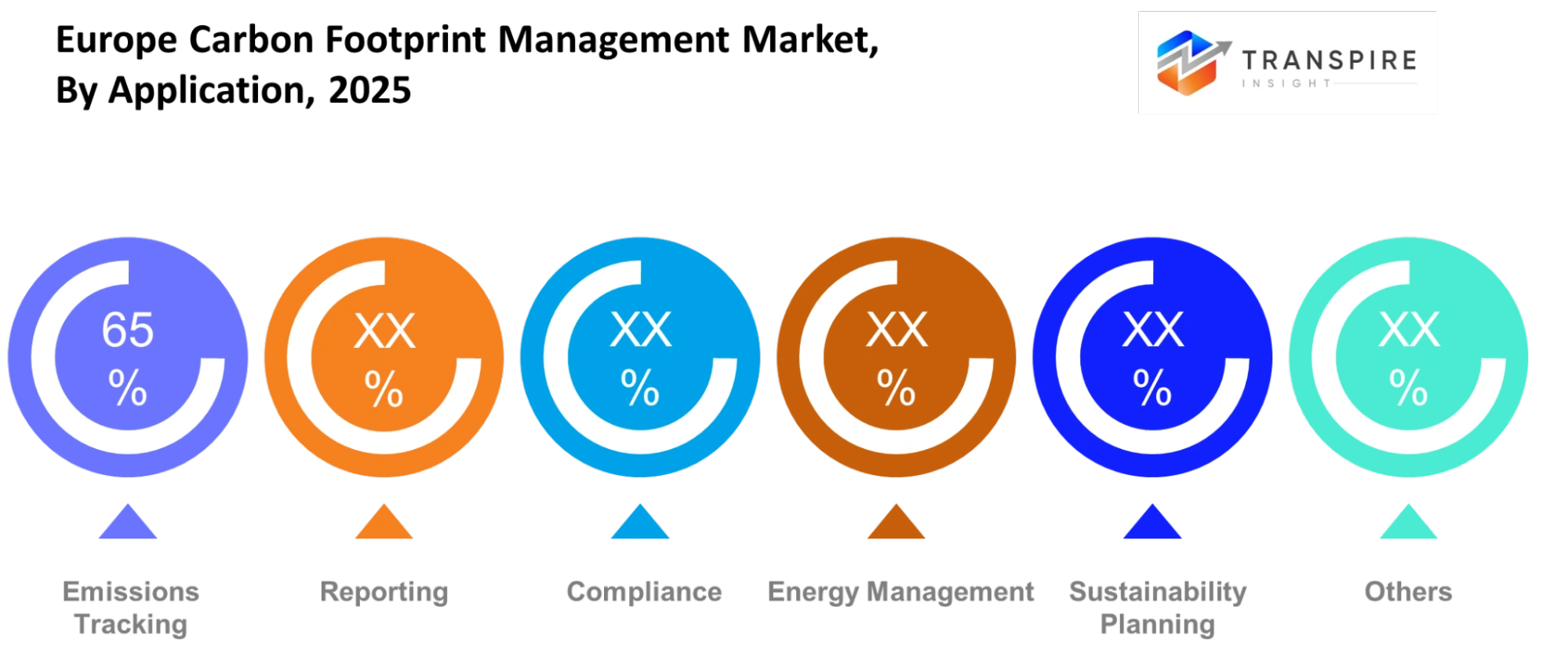
Emissions tracking dominates application usage, accounting for the largest share due to mandatory measurement requirements across industries. The industry reporting and compliance requirements exist because regulatory bodies demand standardized disclosures and verification. Energy management and sustainability planning are emerging as strategic applications rather than compliance functions.
The European Union has established emissions tracking requirements that mandate organizations to collect their emissions data through detailed real-time monitoring systems. The need for compliance applications increases because organizations face higher fines when they submit incorrect emissions data while energy management systems become more popular because companies discover that they can decrease expenses through better emissions management. Companies develop their sustainability programs because they want to achieve their carbon emission targets together with their overall business objectives.
Companies will need integrated systems which provide tracking and forecasting and optimization functions instead of using separate reporting software.Companies will need systems which enable them to link their emissions data with their operational results and financial performance.
To learn more about this report, Download Free Sample Report
By End-User:
Large enterprises lead technology adoption because their operations require them to comply with regulations and they need to manage their complicated business operations. The manufacturing and energy industries lead industry adoption because their operations produce high emissions and they need to meet regulatory requirements. Government entities play a supporting role through monitoring and policy enforcement while retail adoption is gradually increasing.
Enterprises increase their growth rate when they face direct financial consequences from carbon pricing and regulatory fines. Manufacturing and energy sectors invest heavily in tracking systems to manage emissions across production and supply chains. Retail expansion reflects pressure from stakeholders to disclose and reduce supply chain emissions.
The adoption of affordable SaaAS solutions will drive mid-sized enterprises to experience faster growth during the upcoming years. Investors will discover business possibilities through solutions which address the particular requirements of manufacturing and energy-intensive sector needs.
By Deployment:
The deployment process handles the systems through cloud deployment which establishes itself as the primary method because organizations need to scale their operations while accessing systems remotely and integrating data in real-time. The data control requirements of highly regulated industries maintain the present importance of on-premise systems. Organizations that want to update their old systems are using hybrid models as their preferred solution.
The growth of cloud computing services requires companies to create systems which can connect their greenhouse gas emission records from multiple locations and throughout their entire supply chain. Organizations continue to use on-premise systems because they need protection against data breaches and data sovereignty violations. The adoption of hybrid deployment approaches is increasing because companies need to achieve flexibility while they work with their current infrastructure.
The upcoming trends in deployment will establish cloud-first strategies as the primary method while hybrid models will function as temporary measures throughout the organization's digital transformation process. Technology providers will develop secure cloud platforms which allow different systems to work together while buyers will seek solutions which provide smooth data sharing between different networks.
What are the Key Use Cases Driving the Europe Carbon Footprint Management Market?
Emissions tracking remains the core use case driving the Europe Carbon Footprint Management Market, as companies must continuously measure fuel use, energy consumption, and supply chain outputs to meet EU compliance requirements. Manufacturing and maritime operations represent the highest demand segment because real-time visibility enables organizations to decrease both regulatory and financial risks.
The industry observes rapid growth in reporting and compliance management for both large enterprises and energy operators who require adherence to EU emissions trading rules and mandatory disclosure standards. Sustainability-linked procurement now experiences increased adoption in retail and logistics because suppliers face evaluation based on authentic carbon information that spans their distribution systems.
Organizations now develop AI-based emissions forecasting systems which work together with automated carbon budgeting solutions that exist within enterprise planning software. Shipping fleets and industrial plants are beginning to test predictive optimization tools that adjust operations based on carbon cost signals which indicates a transition from monitoring activities to active emissions management.
|
Report Metrics |
Details |
|
Market size value in 2025 |
USD 1964.3 Million |
|
Market size value in 2026 |
USD 2166.7 Million |
|
Revenue forecast in 2033 |
USD 4362.6 Million |
|
Growth rate |
CAGR of 10.51% from 2026 to 2033 |
|
Base year |
2025 |
|
Historical data |
2021 - 2024 |
|
Forecast period |
2026 - 2033 |
|
Report coverage |
Revenue forecast, competitive landscape, growth factors, and trends |
|
Regional scope |
Europe (Germany, United Kingdom, France, Italy, Spain, Rest of Europe) |
|
Key company profiled |
SAP, IBM, Microsoft, Salesforce, Oracle, Schneider Electric, Siemens, ENGIE, Accenture, Deloitte, Sphera, Enablon, Persefoni, Plan A, Watershed. |
|
Customization scope |
Free report customization (country, regional & segment scope). Avail customized purchase options to meet your exact research needs. |
|
Report Segmentation |
By Type (Software, Services, Platforms, Analytics Tools, Others); By Application (Emissions Tracking, Reporting, Compliance, Energy Management, Sustainability Planning, Others); By End-User (Enterprises, Government, Manufacturing, Energy Sector, Retail, Others); By Deployment (Cloud, On-premise, Hybrid, Others). |
Which Regions are Driving the Europe Carbon Footprint Management Market Growth?
The Carbon Footprint Management Market in Europe experiences its highest growth because Western Europe implements strict regulatory measures and first adopted emissions trading systems. The countries of Germany France and the Netherlands operate effective compliance systems which international organizations recognize due to their digital systems and established industrial capabilities. The manufacturing centers and port facilities generate ongoing requirements for monitoring supply chain emissions in real time. Organizations need to report their carbon emissions because this requirement matches European Union climate goals which they must follow.
Northern Europe presents a stable market which uses advanced technology because its businesses follow operational procedures instead of depending on governmental regulations. The countries of Sweden Denmark and Finland dedicate themselves to sustainable development through digital technologies and public-private partnerships. The region experiences corporate growth through voluntary ESG initiatives and the implementation of green shipping solutions and energy-efficient industrial technologies which further develop their operations. The maritime and energy sectors in this area maintain a stable revenue stream through their continuous investment in optimization solutions which operate independently from major policy changes.
The region of Southern and Eastern Europe displays its most rapid growth because new regulations and upgraded infrastructure systems create new pathways for technology adoption. The European Union recently provided funding to support industrial decarbonization and port electrification projects which resulted in emissions monitoring systems being implemented across Italy Spain and Poland. The process of fleet upgrades and increased EU compliance framework integration creates new requirements for carbon platforms that need to grow their operational capabilities.The region provides growth opportunities which will benefit both market newcomers and investors between 2026 and 2033 because of its insufficient digital infrastructure development and increasing regulatory standards.
Who are the Key Players in the Europe Carbon Footprint Management Market and How Do They Compete?
The European Carbon Footprint Management Market shows moderate consolidation at the enterprise software level, yet it maintains a fragmented structure between dedicated sustainability providers and analytical startup companies. Established technology companies maintain market share by adding carbon tracking features to their comprehensive ERP and cloud systems, while new market entrants offer specialized products that include Scope 3 tracking and maritime emissions monitoring and real-time data analysis. The primary basis of competition has shifted from basic reporting tools to integration depth, data accuracy, and interoperability with financial and operational systems.
SAP strengthens its position through deep ERP integration, embedding carbon accounting directly into procurement and production workflows. This approach reduces friction for enterprise buyers already using SAP systems, creating a switching cost advantage and accelerating adoption in manufacturing-heavy industries. Expansion efforts focus on extending sustainability modules across global supply chains.
Microsoft competes through cloud-scale sustainability data platforms integrated with Azure services. The company possesses its advantage because it combines emissions analytics with AI-driven operational insights which enable real-time optimization across logistics and energy use. The company establishes partnerships with industrial clients to support its expansion into energy-intensive sectors.
Schneider Electric differentiates through industrial energy management expertise, linking carbon tracking with facility-level efficiency systems. The EcoStruxure ecosystem of the company enables its products to be used in manufacturing and utility operations, which customers can implement through long-term service agreements.
IBM specializes in AI-driven carbon analytics which utilize hybrid cloud systems to handle intricate business operations.Strategic collaborations with consulting firms and industrial operators support its expansion into regulated European sectors.
Company List
- SAP
- IBM
- Microsoft
- Salesforce
- Oracle
- Schneider Electric
- Siemens
- ENGIE
- Accenture
- Deloitte
- Sphera
- Enablon
- Persefoni
- Plan A
- Watershed
Recent Development News
In April 2026, SAP SE advanced its SAP Sustainability Footprint Management platform by integrating deeper ERP-linked carbon accounting features for manufacturing and logistics enterprises. The enhancement enables real-time emissions visibility across production and procurement workflows, reducing manual reporting effort and improving compliance accuracy under EU carbon disclosure rules.
Source: https://www.greenprojecttech.com
In February 2025, IBM Corporation partnered with Ramboll to strengthen the IBM Envizi ESG Suite with AI-driven emissions analytics and real-time reporting capabilities. The collaboration improves Scope 1–3 tracking precision and supports enterprises in aligning sustainability data with evolving regulatory requirements across Europe.
Source: https://www.linkedin.com
What Strategic Insights Define the Future of the Europe Carbon Footprint Management Market?
The Europe Carbon Footprint Management Market is moving toward embedded, real-time carbon intelligence that sits directly inside financial and operational decision systems. The European Union Climate regulations now impose tighter enforcement standards which require all businesses to calculate their carbon emissions as a new financial liability.Over the next 5 to 7 years, carbon management will evolve from compliance tooling into an enterprise control layer which will influence procurement and production planning and logistics optimization.
The software industry faces hidden dangers because increasing platform concentration allows a few major software companies to control all emissions data systems. The process of ERP integration leads to higher switching expenses which results in enterprises developing long-term operational ties with vendors while facing potential cost increases.
The EU carbon border adjustment rules create new business opportunities through carbon-based trade and customs optimization. This will require systems that connect emissions data with trade flows in real time.Market participants should prioritize interoperable, API-first platforms to avoid vendor lock-in and ensure cross-system financial integration.
Europe Carbon Footprint Management Market Report Segmentation
By Type
- Software
- Services
- Platforms
- Analytics Tools
- Others
By Application
- Emissions Tracking
- Reporting
- Compliance
- Energy Management
- Sustainability Planning
- Others
By End-User
- Enterprises
- Government
- Manufacturing
- Energy Sector
- Retail
- Others
By Deployment
- Cloud
- On-premise
- Hybrid
- Others
Frequently Asked Questions
Find quick answers to common questions.
The Europe Carbon Footprint Management Market size is USD 4362.6 Million in 2033.
Key segments for the Europe Carbon Footprint Management Market are By Type (Software, Services, Platforms, Analytics Tools, Others); By Application (Emissions Tracking, Reporting, Compliance, Energy Management, Sustainability Planning, Others); By End-User (Enterprises, Government, Manufacturing, Energy Sector, Retail, Others); By Deployment (Cloud, On premise, Hybrid, Others).
Maj.or Europe Carbon Footprint Management Market players are SAP, IBM, Microsoft, Salesforce, Oracle, Schneider Electric, Siemens, ENGIE, Accenture, Deloitte, Sphera, Enablon, Persefoni, Plan A, Watershed.
The Europe Carbon Footprint Management Market size is USD 1964.3 Million in 2025.
The Europe Carbon Footprint Management Market CAGR is 10.51% from 2026 to 2033.
- SAP
- IBM
- Microsoft
- Salesforce
- Oracle
- Schneider Electric
- Siemens
- ENGIE
- Accenture
- Deloitte
- Sphera
- Enablon
- Persefoni
- Plan A
- Watershed
Recently Published Reports
-
Apr 2026
Active Power Filter Market
Active Power Filter Market Size, Share & Analysis Report By Type (Shunt Active Power Filters, Series Active Power Filter, Hybrid Active Power Filter), By Application (Harmonics Mitigation, Reactive Power Compensation, Voltage Regulation, Power Factor Correction), By Phase (Single Phase, Three Phase), By End-User Industry (Manufacturing, Healthcare, Commercial, Automotive, Oil and Gas, Others), and Geography (North America, Europe, Asia-Pacific, Middle East and Africa, South and Central America), 2021 - 2031
-
Apr 2026
Electrical Transformer Market
Electrical Transformer Market Size, Share & Analysis Report By Core (Closed, Shell, and Berry), By Insulation (Gas, Oil, Solid, Air, and Other), By Phase (Single, and Three), By Rating (100 MVA to 500 MVA, 501 MVA to 800 MVA, and 801 MVA to 1200 MVA), and Geography (North America, Europe, Asia-Pacific, Middle East and Africa, South and Central America), 2021 – 2031
-
Apr 2026
Hydraulic Piston Pumps Market
Hydraulic Piston Pumps Market Size, Share & Analysis Report By Type (Axial Piston Pumps, Radial Piston Pumps), By Operating Pressure (Low Pressure, Medium Pressure, High Pressure), By Application (Construction, Mining, Agriculture, Automotive, Oil & Gas, Industrial Machinery, Others), By End-User (OEMs, Aftermarket), and Geography (North America, Europe, Asia-Pacific, Middle East and Africa, South and Central America), 2021 – 2031
-
Apr 2026
Laboratory Gas Generators Market
Laboratory Gas Generators Market Size, Share & Analysis Report By Product (Nitrogen Gas Generator, Hydrogen Gas Generator, Zero Air Gas Generator, Purge Gas Generator, TOC Gas Generators, Others), By Application (Gas Chromatography, Liquid Chromatography-mass Spectrometry (LC-MS), Gas Analyzers, Others), By End-user (Life Science, Chemical & Petrochemical, Food & Beverage, Others), and Geography (North America, Europe, Asia-Pacific, Middle East and Africa, South and Central America), 2021 – 2031