

Europe Business Process Management Market Size & Forecast:
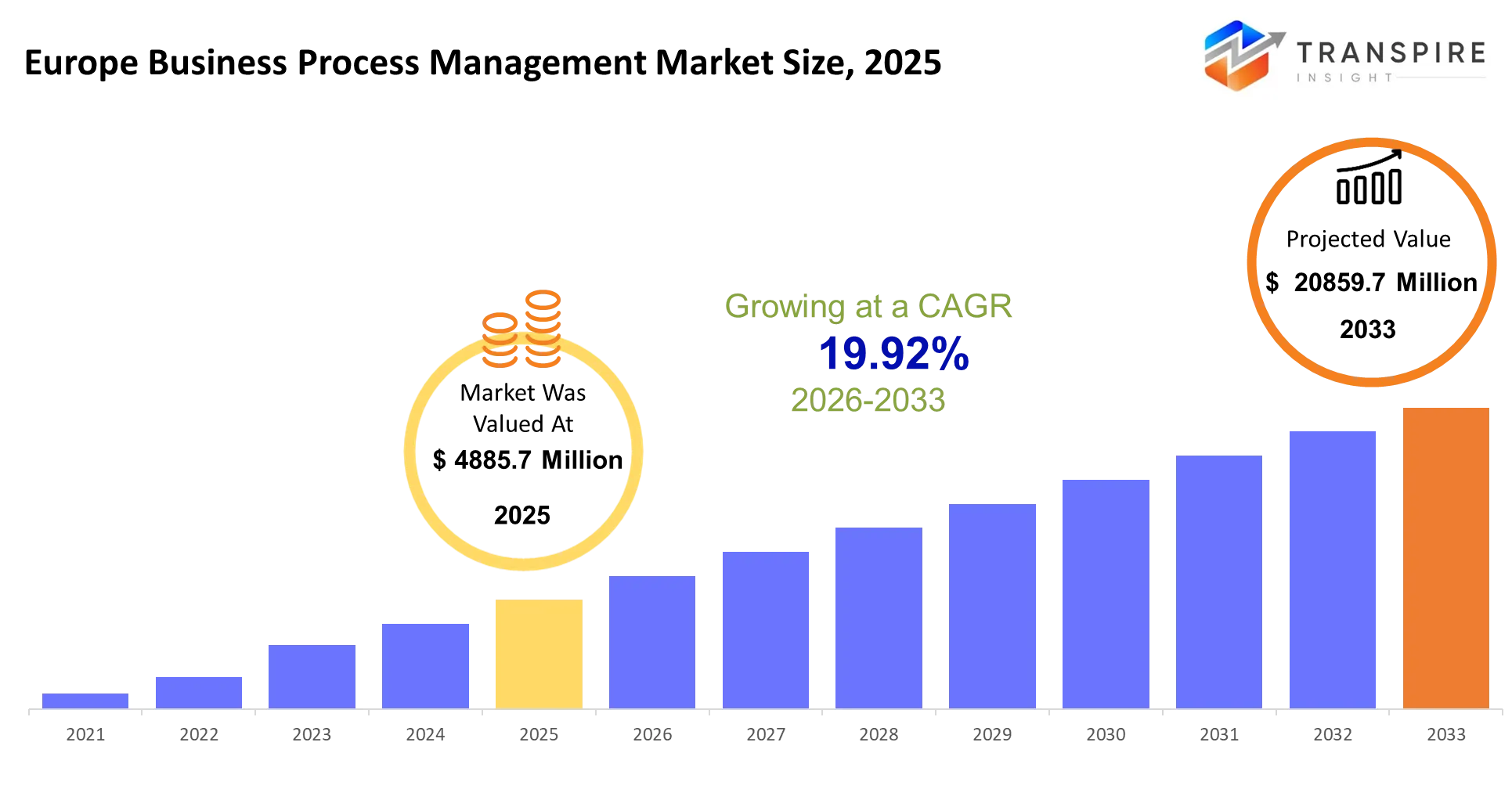
- Europe Business Process Management Market Size 2025: USD 4885.7 Million
- Europe Business Process Management Market Size 2033: USD 20859.7 Million
- Europe Business Process Management Market CAGR: 19.92%
- Europe Business Process Management Market Segments: By Type (Software, Services, Platforms, Automation Tools, AI-enabled BPM, Others), By Application (Finance, HR, Operations, Customer Service, Supply Chain, Compliance, Others), By End-User (Enterprises, SMEs, BFSI, Healthcare, IT & Telecom, Government, Others), By Deployment (Cloud, On-premise, Hybrid, Others).
To learn more about this report,  Download Free Sample Report
Europe Business Process Management Market Summary:
The Europe Business Process Management Market size is estimated at USD 4885.7 Million in 2025 and is anticipated to reach USD 20859.7 Million by 2033, growing at a CAGR of 19.92% from 2026 to 2033. The Europe Business Process Management (BPM) market enables organizations to create automated systems that improve their operational processes which connect various departments including finance and procurement and compliance and customer service. BPM platforms enable organizations to create digital processes which operate as complete systems that provide monitoring capabilities to businesses because they eliminate disjointed manual tasks which lead to mistakes while improving control measures and enabling quick responses to business operations
The market has shifted during the last three to five years because companies now use cloud-native AI-enabled orchestration platforms which provide unified data processing and automated decision making capabilities for their workflow needs. The COVID-19 pandemic served as the main catalyst which compelled businesses to implement quick digital solutions so their employees could work from home while they kept their operations running smoothly.
The change established a distinct relationship between cause and effect. Organizations needed centralized control and automatic processes after they started using multiple systems which created more data than they could handle. Organizations adopted BPM because it enhances their operational resilience while shortening their operational time and helping them meet regulatory requirements through digital processes which deliver measurable improvements and support business growth.
Key Market Insights
- The Business Process Management Market in Europe gives Western Europe a dominant position because the region will reach 45% market share by 2024 through its advanced IT systems and digital transformation of businesses.
- The Central and Eastern European market will experience its fastest growth until 2030 because organizations adopt cloud technology at a rapid pace and expand their shared service facilities.
- BPM software platforms hold a significant share of over 60% in 2024 because businesses prioritize automation together with analytics and workflow orchestration.
- Enterprise organizations use BPM services as their second largest business segment because they require consulting services and integration services and managed services to operate their complicated corporate systems.
- The cloud-based BPM solutions segment grows at the highest rate because it will continue to expand until 2030 while offering businesses scalable solutions and cost-efficient services and remote access capabilities.
- The BFSI sector uses applications at the highest rate because it holds 30% market share in 2024 which requires compliance and fraud management and process standardization.
- Healthcare and life sciences represent the applications with the fastest growth because they use BPM to optimize patient workflow and automate their regulatory compliance processes.
- The Europe Business Process Management Market gives large enterprises their leading position because they control more than 65% of the market through their need to manage complex workflows and their substantial automation expenditures.
- Small and medium enterprises use low-code BPM platforms to improve their business operations because they want to decrease the need for manual work.
What are the Key Drivers, Restraints, and Opportunities in the Europe Business Process Management Market?
The primary force accelerating the Europe Business Process Management market is the shift toward AI-enabled, cloud-native process orchestration. The transition happened because people discovered during the pandemic that manual and siloed workflows could not withstand operational challenges. The enterprises reacted by choosing platforms which create data connections and use automation to protect their business operations which their teams utilize throughout different locations. BPM adoption now connects to business outcomes which include faster processing times and reduced compliance risks and better customer response rates. Vendors generate more subscription income when organizations switch from outdated systems to advanced BPM systems which offer better scalability through their integrated features.
The main structural challenge organizations face involves establishing BPM systems which need to work together with existing enterprise systems that already exist in banking and manufacturing. The majority of European companies operate on outdated IT systems which have existed for multiple decades and these systems restrict their ability to conduct real-time data exchanges and API-based workflows. Organizations experience higher initial expenses because the process takes longer to finish while these restrictions create obstacles for complete implementation to happen. Organizations which need to adopt modern BPM systems within short periods will find themselves with limited ability to use multiple system features which results in decreased revenue for vendors operating under these conditions.
Low-code automation and process mining technologies present a significant market development opportunity for mid-sized companies throughout Central and Eastern Europe. Businesses in Poland and Romania are starting to implement tools which analyze event logs and create workflow optimization solutions because their cloud infrastructure has reached a mature stage. The process enables organizations to achieve faster system implementation while cutting down on operational expenses which helps them reach new customer segments.
What Has the Impact of Artificial Intelligence Been on the Europe Business Process Management Market?
The combination of artificial intelligence with advanced digital technologies enables European process management platforms to operate their systems through real-time automation and decision intelligence capabilities designed for complex operational environments. AI-driven engines now automate compliance workflows by monitoring emissions data streams, flagging deviations, and triggering corrective actions without manual intervention. The systems of industrial operations and maritime-linked operations maintain continuous performance monitoring through their connections with control architectures, which enable regulatory compliance and lower human mistakes during high-frequency operations.
The development of machine learning models enables scientists to create more accurate predictive systems. Companies use these systems to predict when equipment will break down, which results in better maintenance planning, and they use performance metrics from both past records and current data to make their predictions. The system enables operators to move from traditional maintenance methods toward maintenance based on equipment status, which results in better system reliability and fewer unexpected breakdowns. The emissions forecasting and resource optimization functions, which predictive analytics provide, lead to measurable benefits that organizations can achieve through reduced energy use and better operational performance.
The technologies enable organizations to achieve better business results through their capability to process data more quickly and decrease compliance costs while simultaneously lowering expenses. The process of adopting new technologies faces obstacles because organizations struggle to connect their systems, and their data quality varies between locations that have outdated systems which restrict their access to real-time information and their ability to create accurate models.
Key Market Trends
- The companies which existed before 2020 now use cloud-native platforms for business process management while current business operations implement SaaS-based process automation solutions for more than half of their new system implementations.
- The implementation of AI-driven business process management systems increased after 2021 when companies began using decision-making systems to handle exceptions automatically while decreasing the need for human workers to monitor operational procedures.
- European companies adopted process mining technology to analyze event-log data which enabled them to discover operational problems and create new business procedures that used actual work performance data.
- BPM platforms developed audit tracking systems and real-time monitoring features since 2019 because regulatory requirements particularly under GDPR and financial compliance standards demanded these functions.
- After 2022 SAP SE and IBM extended their low-code business process management solutions to capture business users without technical expertise and to improve their implementation speed.
- Mid-sized companies showed rising demand for subscription-based pricing after 2021 because this pricing model enabled them to begin process automation projects with lower initial expenses while they expanded their automated systems.
- BPM systems gained better integration with robotic process automation systems after 2020 because these systems permitted BPM to manage human operations together with software bots in shared working spaces.
- Centralized business process management systems became more popular in the European Union because cross-border business activities required organizations to use standardized procedures for managing their processes which enabled them to comply with multiple national regulations.
- The market competition changed because vendors spent money on developing artificial intelligence and analytics solutions and establishing partnerships with cloud providers which enabled them to grow their operations through mergers and partnerships.
Europe Business Process Management Market Segmentation
By Type
The software platforms which offer integrated workflow orchestration together with analytics and automation features have become the leading software platforms in the market. Since 2021 organizations have embraced AI-enabled business process management and low-code platforms because these tools enable them to achieve rapid deployment and obtain real-time decision-making assistance. The dual services of consulting together with system integration work as vital components especially in complex industries which depend on outdated technology systems.
Businesses use automation tools together with process mining solutions to identify inefficiencies while they strive to optimize their operations through data-driven insights. The software industry shows an upward trend because companies have started to use subscription models while service operations depend on custom requirements. The upcoming development will enable companies to combine AI with analytics and orchestration into complete platforms which will become a market advantage for them through their intelligent automation systems and scalable design frameworks.
By Application
The financial and compliance departments of European industries which apply their operations throughout multiple sectors. Businesses operating in banking and insurance and major companies use BPM systems to establish standard reporting procedures and conduct audits and safeguard their operations. The value of operations and supply chain management increased because the pandemic revealed operational weaknesses and organization-wide tracking problems. Organizations use business process management systems to enhance their customer service applications which enable faster response times and customized customer interactions.
The adoption of human resource management systems has increased because companies now use remote and hybrid work arrangements. Different applications experience different patterns of demand which stem from regulations and cost control needs and customer demands. The most probable area for future expansion will be supply chain operations and customer-facing functions which utilize real-time orchestration and predictive analytics to enhance efficiency and operational strength.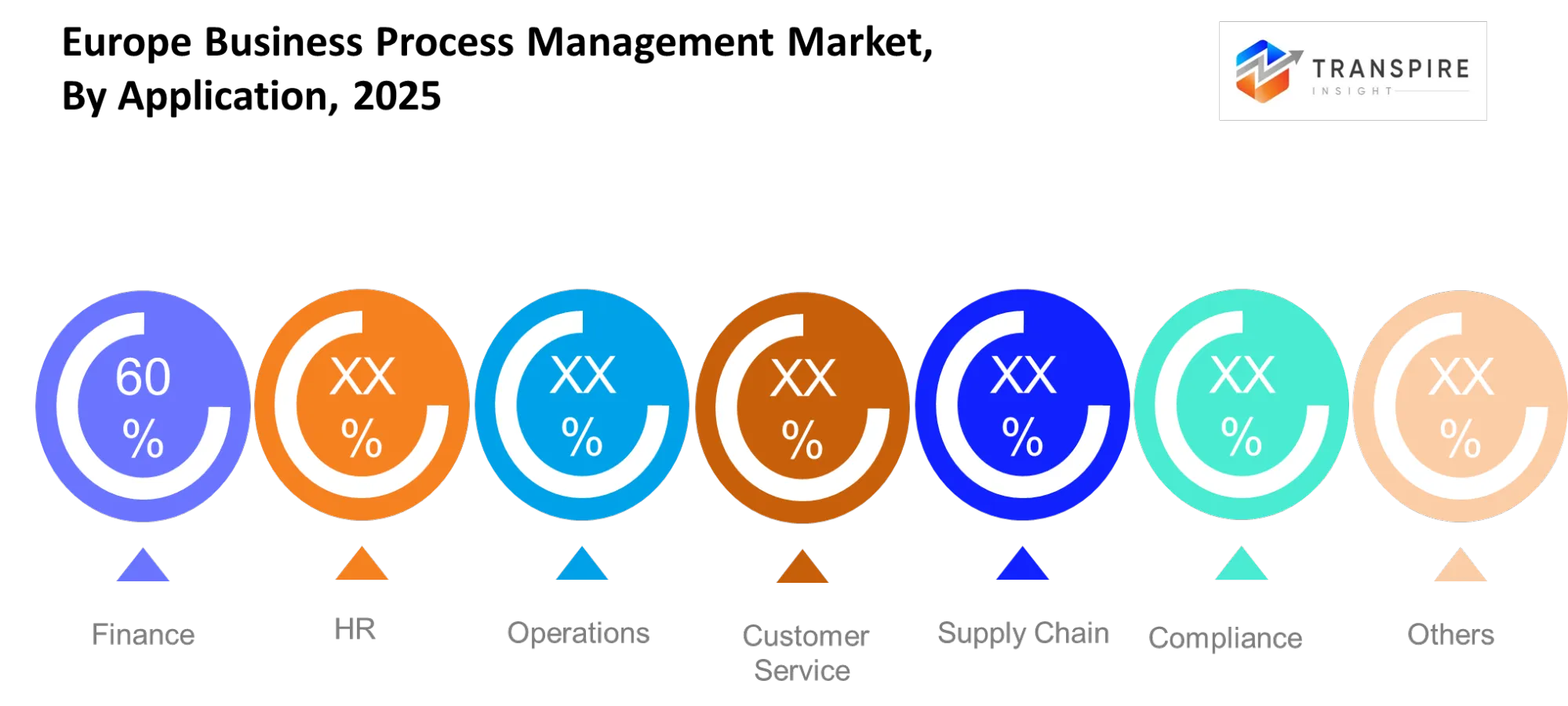
To learn more about this report, Download Free Sample Report
By End-User
The majority of market share belongs to large enterprises because they require complex operational systems and they spend more on automation and they must handle international compliance requirements. The BFSI sector together with IT and telecom and government institutions drive technology adoption because they handle high transaction volumes while needing to comply with stringent regulations. The healthcare sector has developed into a rapidly expanding market because organizations require systems to improve patient treatment processes and handle regulatory compliance demands.
Small and medium enterprises are increasingly adopting BPM solutions as cloud pricing models reduce entry barriers and simplify implementation. The demand patterns between large organizations and smaller firms show major differences because large organizations need scalable systems with governance controls while smaller firms focus on making products easy to use and cheap to operate. The expansion of SMEs together with specialized solutions for regulated industries will determine future growth.
By Deployment
Cloud-based solutions have become the preferred choice for new implementations because they provide scalability and cost savings and enable remote work capabilities at their initial launch. Organizations have moved their operations from on-premise systems to cloud environments since 2020 to achieve real-time collaboration and continuous system updates. On-premise deployments still maintain importance in highly regulated sectors because these sectors require organizations to maintain control over their data and protect their security measures.
Enterprises are increasingly adopting hybrid models to achieve both operational flexibility and compliance through the integration of their existing systems with contemporary cloud solutions. Organizations choose deployment options based on their need for operational control and their capacity to manage expenses and their desire for operational speed. The upcoming industry patterns show that cloud services will keep expanding while hybrid systems serve as intermediary solutions and vendors develop secure cloud services that meet specific industry requirements.
What are the Key Use Cases Driving the Europe Business Process Management Market?
The primary use case for BPM platforms requires financial services and regulated enterprises to handle compliance reporting and transaction workflows and audit trails which need to be maintained under General Data Protection Regulation requirements. The application creates its highest demand when organizations handle extensive transaction volumes because they must maintain dependable operations through automated systems that produce trackable results.
Healthcare providers and IT service firms are expanding BPM adoption to streamline patient workflows through claims processing and service delivery operations. Hospitals employ BPM to manage their admission and discharge processes, whereas telecom operators use it for quicker customer onboarding and service request handling.
The emerging use cases involve manufacturing and logistics operations which use AI-based process mining and predictive workflow optimization. Companies are starting to implement BPM systems which help them predict disruptions while they enhance supply chain efficiency and decision-making capabilities, but most companies still need to adopt this technology.
|
Report Metrics |
Details |
|
Market size value in 2025 |
USD 4885.7 Million |
|
Market size value in 2026 |
USD 5848.2 Million |
|
Revenue forecast in 2033 |
USD 20859.7 Million |
|
Growth rate |
CAGR of 19.92% from 2026 to 2033 |
|
Base year |
2025 |
|
Historical data |
2021 - 2024 |
|
Forecast period |
2026 - 2033 |
|
Report coverage |
Revenue forecast, competitive landscape, growth factors, and trends |
|
Regional scope |
Europe (Germany, United Kingdom, France, Italy, Spain and Rest of Europe) |
|
Key company profiled |
IBM, Oracle, SAP, Pegasystems, Appian, Microsoft, Nintex, Bizagi, Software AG, TIBCO, OpenText, Zoho, Kissflow, Bonitasoft, Creatio |
|
Customization scope |
Free report customization (country, regional & segment scope). Avail customized purchase options to meet your exact research needs. |
|
Report Segmentation |
By Type (Software, Services, Platforms, Automation Tools, AI-enabled BPM, Others), By Application (Finance, HR, Operations, Customer Service, Supply Chain, Compliance, Others), By End-User (Enterprises, SMEs, BFSI, Healthcare, IT & Telecom, Government, Others), By Deployment (Cloud, On-premise, Hybrid, Others) |
Which Regions are Driving the Europe Business Process Management Market Growth?
The market receives its leadership from Western Europe because of two factors. The first factor involves strict regulatory enforcement. The second factor relates to the region's early adoption of digital governance frameworks which includes the General Data Protection Regulation. The enterprise IT systems of Germany France and Netherlands provide established infrastructure which helps their industries to use automation technologies for their operations.
The multinational corporations that operate in these economies need BPM platforms because they must handle three different types of tasks. These tasks include managing cross-border compliance and complex workflows and high transaction volumes. The region maintains its leadership position because of its strong vendor presence together with its advanced cloud infrastructure and permanent development of AI-based enterprise software solutions.
Digital governance remains a primary focus for Northern Europe which countries such as Sweden and Denmark use to achieve operational transparency. This region differs from Western Europe by focusing more on public sector efficiency and sustainability-linked process optimization rather than large-scale enterprise complexity. The stable economic environment together with the ongoing creation of new regulations will drive organizations to invest in BPM solutions which they will implement throughout their operational activities in both governmental and commercial operations. The region maintains high digital maturity while people trust automation systems which helps it deliver stable market revenue throughout the entire year.
Central and Eastern Europe is the fastest-growing region, driven by rapid cloud adoption and increasing foreign direct investment in shared service centers. The countries of Poland and Romania have recently improved their digital infrastructure while developing their workforce skills which has created beneficial conditions for BPM implementation. Enterprises in these markets are modernizing their outdated systems by implementing low-code platforms which will help them achieve better operational results.
Who are the Key Players in the Europe Business Process Management Market and How Do They Compete?
The Europe Business Process Management market maintains moderate consolidation because established global enterprise software companies face competition from rapidly growing low-code firms. Companies now compete through AI-driven orchestration systems and connected cloud environments instead of traditional workflow automation methods. Businesses have shifted their competitive focus from product pricing to their ability to implement solutions quickly and connect with existing systems and deliver analytics features. The new market entrants challenge existing companies by providing solutions that require less time to set up and have simpler implementation procedures.
European enterprises use SAP SE leverages ERP solutions to implement BPM processes into their financial and supply chain operations. IBM uses AI-driven automation and hybrid cloud implementation as its competitive advantage which includes Watson-based analytics for optimizing complex workflows. Software AG strengthens its position with ARIS-based process intelligence and expands through system integrator partnerships and cloud migration programs.
Pegasystems provides enterprises with CRM solutions that enable them to manage flexible workflows through its decisioning and case management automation features. Appian uses its low-code platforms to compete in the finance and public sector modernization markets because its solutions enable faster system implementation. The two companies expand their European operations through cloud partnerships and ecosystem partnerships which lead to faster implementation times and better customer satisfaction.
Company List
- IBM
- Oracle
- SAP
- Pegasystems
- Appian
- Microsoft
- Nintex
- Bizagi
- Software AG
- TIBCO
- OpenText
- Zoho
- Kissflow
- Bonitasoft
- Creatio
Recent Development News
In February 2026, Synera raises €40M Series B for AI workflow automation: European engineering workflow automation platform Synera secured a €40 million Series B round led by VC investors focused on industrial process automation software. The company builds low-code AI orchestration tools that directly align with BPM use cases in engineering and enterprise operations across Europe.
Source: https://www.startup.eu
In January 2026, Agentic BPM systems emerging in enterprise platforms: A new wave of “Agentic Business Process Management Systems” is redefining enterprise workflow automation, heavily influencing US BPM software vendors. The model shifts BPM from rule-based automation to autonomous AI-driven process execution. This is expected to reshape enterprise BPM platforms used by US corporations.
Source: https://arxiv.org
What Strategic Insights Define the Future of the Europe Business Process Management Market?
The European Business Process Management Market is heading toward a future where businesses will use autonomous AI-based systems to handle all aspects of their operations through a shared digital platform. The requirement for companies to monitor their operations in real time together with their need to handle complex rules across different countries drives this change. Businesses will use BPM platforms as intelligent process orchestration systems which will connect to analytics and generative AI systems within the next five to seven years.
Enterprises face hidden dangers because they rely on a limited number of hyperscale cloud providers which creates concentration risk and results in pricing fluctuations and vendor platform dependency. The current situation will impede innovation because the different organizations do not have common standards for their systems to work together.
Public sector organizations and regulated industries in countries like Germany and France now have the chance to create sovereign cloud-based business process management systems. The new regulations force organizations to develop systems that handle data protection needs and regulatory requirements which leads to rising demand for local business process management systems. The market needs modular systems that work with both hybrid and sovereign cloud environments to support government and enterprise clients, according to market participants.
Europe Business Process Management Market Report Segmentation
By Type
- Software
- Services
- Platforms
- Automation Tools
- AI-enabled BPM
- Others
By Application
- Finance
- HR
- Operations
- Customer Service
- Supply Chain
- Compliance
- Others
By End-User
- Enterprises
- SMEs
- BFSI
- Healthcare
- IT & Telecom
- Government
- Others
By Deployment
- Cloud
- On-premise
- Hybrid
- Others
Frequently Asked Questions
Find quick answers to common questions.
The Approximate Europe Business Process Management Market size for the Market will be USD 20859.7 Million in 2033.
The key segments of the Europe Business Process Management Market are By Type (Software, Services, Platforms, Automation Tools, AI-enabled BPM, Others), By Application (Finance, HR, Operations, Customer Service, Supply Chain, Compliance, Others), By End-User (Enterprises, SMEs, BFSI, Healthcare, IT & Telecom, Government, Others), By Deployment (Cloud, On-premise, Hybrid, Others).
Major Players in the Europe Business Process Management Market are IBM, Oracle, SAP, Pegasystems, Appian, Microsoft, Nintex, Bizagi, Software AG, TIBCO, OpenText, Zoho, Kissflow, Bonitasoft, Creatio.
The Current Market size of the Europe Business Process Management Market is USD 4885.7 Million in 2025.
The Europe Business Process Management Market CAGR is 19.92%.
- IBM
- Oracle
- SAP
- Pegasystems
- Appian
- Microsoft
- Nintex
- Bizagi
- Software AG
- TIBCO
- OpenText
- Zoho
- Kissflow
- Bonitasoft
- Creatio
Recently Published Reports
-
Apr 2026
3D Optical Profiler Market
3D Optical Profiler Market Size, Share & Analysis Report By Type (Desktop 3D Optical Profiler, and Portable 3D Optical Profiler), By Technology (Confocal Technology, and White Light Interference), By End-Use Industry (Manufacturing, Research Institutions, Automotive, Aerospace and Defense, Medical Devices, and Other), and Geography (North America, Europe, Asia-Pacific, Middle East and Africa, South and Central America), 2021 - 2031
-
Apr 2026
Depth Sensor Market
Depth Sensor Market Size, Share & Analysis Report By Type (Infrared Depth Sensors, Time-of-Flight (ToF) Sensors, Stereo Vision Sensors, Structured Light Sensors, Ultrasonic Depth Sensors), By Application (Automotive, Robotics, Gaming, Consumer Electronics, Industrial Automation, Healthcare, Security & Surveillance, Others), By End Users (Automotive Manufacturers, Consumer Electronics Companies, Healthcare Providers, Industrial Companies, Security Agencies, Gaming Companies, Robotics Companies, Others), and Geography (North America, Europe, Asia-Pacific, Middle East and Africa, South and Central America), 2021 – 2031
-
Apr 2026
Digital Manufacturing Market
Digital Manufacturing Market Size, Share & Analysis Report By Component (Hardware, Software, and Services), By Technology (Robotics, 3D Printing, Internet of Things (IoT), and Others), By Application (Automotive and Transportation, Aerospace and Defense, Consumer Electronics, Industrial Machinery, and Others), By Process Type (Computer-Based Designing, Computer-Based Simulation, Computer 3D Visualization, Analytics, and Others), and Geography (North America, Europe, Asia-Pacific, Middle East and Africa, South and Central America), 2021 – 2031
-
Apr 2026
Digital Visa Services Market
Digital Visa Services Market Size, Share & Analysis Report By Type (Individual Travelers, Group Travelers), By Application (Tourism, Business Travel, Others), and Geography (North America, Europe, Asia-Pacific, Middle East and Africa, South and Central America), 2021 – 2031