
Europe Application Specific Integrated Circuit Market Size & Forecast:
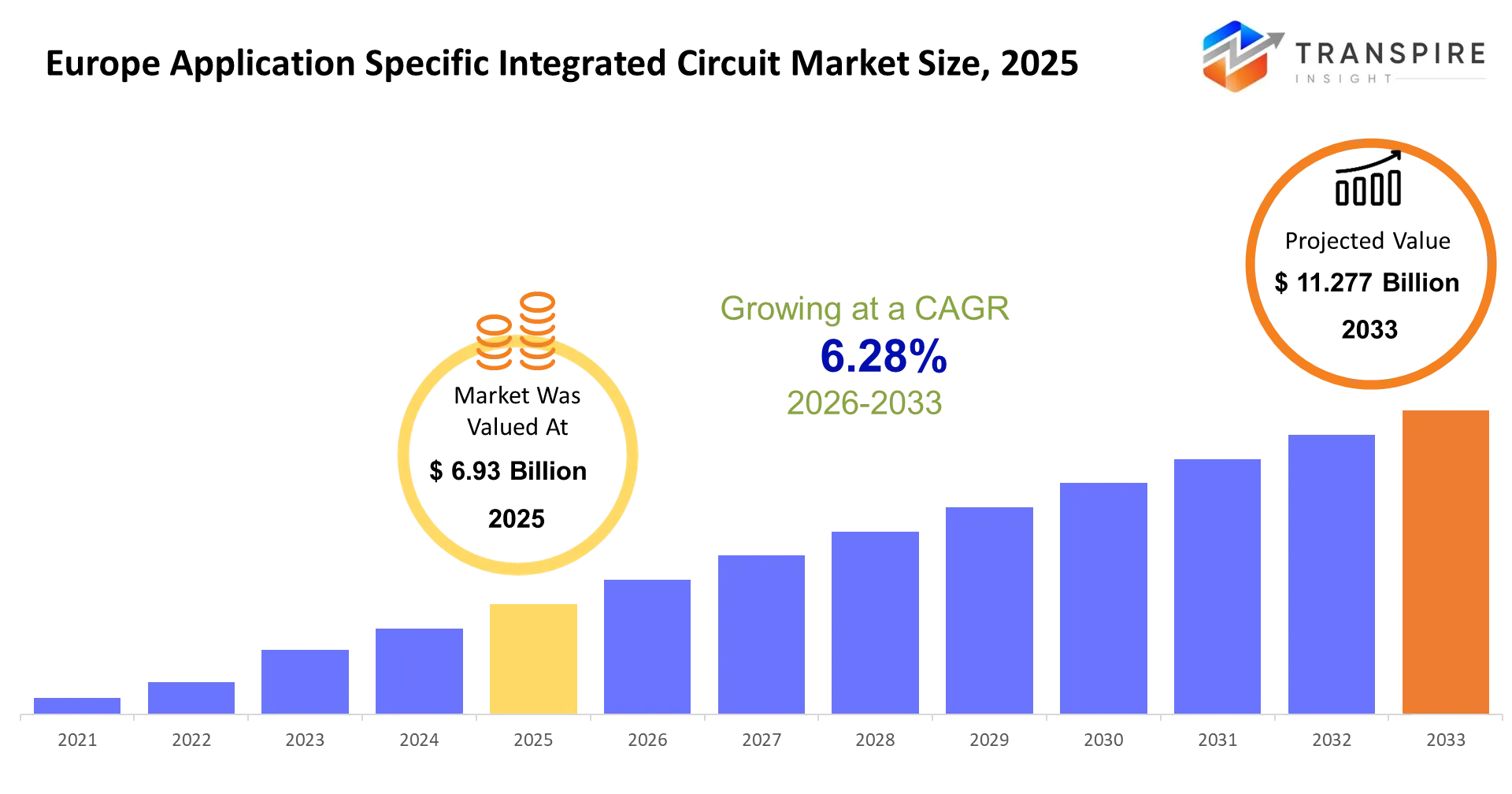
- Europe Application Specific Integrated Circuit Market Size 2025: USD 6.93 Billion
- Europe Application Specific Integrated Circuit Market Size 2033: USD 11.277 Billion
- Europe Application Specific Integrated Circuit Market CAGR: 6.28%
- Europe Application Specific Integrated Circuit Market Segments: By Type (Full Custom ASIC, Semi-Custom ASIC, Programmable ASIC, Analog ASIC, Digital ASIC, Mixed Signal ASIC, Others); By Application (Consumer Electronics, Automotive, Telecom, Healthcare, Industrial, AI Processing, Others); By End-User (Electronics Manufacturers, Automotive OEMs, Telecom Providers, Healthcare Providers, Others); By Technology (CMOS, BiCMOS, FinFET, Others)
To learn more about this report,  Download Free Sample Report
Europe Application Specific Integrated Circuit Market Summary
The Europe Application Specific Integrated Circuit Market was valued at USD 6.93 Billion in 2025. It is forecast to reach USD 11.277 Billion by 2033. That is a CAGR of 6.28% over the period.
Application specific integrated circuits play a critical role in Europe’s automotive, telecom, industrial automation, and AI computing ecosystems through their ability to enable devices and systems to process data at faster speeds while consuming less power and executing dedicated tasks with greater efficiency than general-purpose processors. Electric vehicles depend on ASICs for their battery management systems and advanced driver assistance systems, whereas telecom operators use custom chips to build their low-latency 5G infrastructure and edge computing systems.
Standardized semiconductor architectures lost market share over the past five years because the industry began to adopt highly specialized chip designs that consume less energy and process AI and autonomous mobility and industrial robotics tasks. The supply chain disruptions which occurred during 2021 and 2022 revealed that European industries relied on foreign foundries for semiconductor production, which then led to faster regional manufacturing initiatives from governments and semiconductor manufacturers through the European Chips Act. The structural transition between chipmakers and automotive OEMs and telecom providers resulted in increased long-term procurement agreements and strategic partnerships. The demand for ASICs has grown in industrial and mobility applications that require high-value use cases because industries now see localized semiconductor production and dedicated performance optimization as essential.
Key Market Insights
- Germany held the largest market share in the European application specific integrated circuit market which reached 28% in 2025 because of its strong automotive semiconductor manufacturing capabilities.
- France emerged as the fastest-growing regional market between 2026 and 2032 because the country received semiconductor investments while its AI research infrastructure continued to expand.
- Digital ASICs captured more than 40% market share in 2025 because automotive electronics and telecom processors required higher computational efficiency and lower latency.
- Mixed signal ASICs ranked as the second-largest segment because industrial automation systems and connected healthcare devices increasingly adopted this technology.
- AI developers will choose programmable ASICs because the technology provides them with design flexibility and reduced design time.
- Automotive applications generated approximately 32% of total revenue in 2025 because electric vehicles required advanced battery and power management chipsets.
- AI processing applications showed the fastest growth forecast because data centers and industrial edge systems required high-performance custom accelerators.
- Electronics manufacturers held the largest market share in the European application specific integrated circuit market because they produced smart consumer devices at high volumes.
- The end-user category for automotive original equipment manufacturers emerged as the fastest-growing sector because Germany and France experienced increasing investments in electric mobility and autonomous driving development.
- Infineon Technologies increased its production capacity for automotive ASICs to establish itself as the European electric vehicle semiconductor leader in all mobility markets.
What are the Key Drivers, Restraints, and Opportunities in the Europe Application Specific Integrated Circuit Market?
The primary driver accelerating the Europe Application Specific Integrated Circuit market is the rapid expansion of electric vehicles, industrial automation, and AI-enabled computing infrastructure. European Union carbon emission regulations and vehicle electrification targets pushed automotive OEMs to increase deployment of custom semiconductor architectures for battery management systems, advanced driver assistance platforms, and power control modules. Telecom operators expanded 5G infrastructure and developed edge computing networks which resulted in higher demand for ASICs that can process data with low latency. The combination of technological advancements led to increasing procurement contracts which required long-term semiconductor supply across both automotive and industrial sectors.
European advanced semiconductor fabrication capacity constitutes the most important obstacle because it falls short of Asian manufacturing centers. High-volume wafer fabrication facilities need multibillion-dollar funding because they require extended construction periods and specialized engineering expertise. The supply chain disturbances which occurred during 2021 and 2022 revealed fundamental reliance on international foundries which resulted in automotive production delays and restricted electronics manufacturing capacity. The absence of stable fabrication access keeps regional chip developers from generating potential revenue growth.
The European Chips Act enables European countries to develop their own semiconductor manufacturing capabilities which creates a major future opportunity. Germany and France attract new fabrication projects and research partnerships which focus on FinFET technology and AI accelerators and automotive-grade semiconductor production.These investments could strengthen local supply resilience while accelerating innovation in industrial AI systems and next-generation mobility platforms.
What Has the Impact of Artificial Intelligence Been on the Europe Application Specific Integrated Circuit Market?
The semiconductor design and deployment processes in Europe are undergoing transformation because of artificial intelligence and advanced digital technologies which currently operate through their application specific integrated circuit industry. Automotive manufacturers and telecom equipment providers increasingly use AI-enabled ASICs to automate real-time system monitoring, power management, and network traffic optimization. Smart manufacturing facilities use machine learning algorithms together with custom chips to automatically identify defects and manage temperature and adjust production lines which leads to shorter inspection periods and better manufacturing results.
Industrial and automotive applications now prioritize predictive analytics as their main research area. Machine learning models analyze sensor data from electric vehicle systems, robotics platforms, and telecom infrastructure to predict component failures before operational disruptions occur. Several European manufacturers reported reductions in unplanned equipment downtime after integrating AI-supported ASIC architectures into factory automation systems. AI-driven power optimization tools are also improving energy efficiency in edge computing and data center environments by dynamically adjusting processing loads during peak demand cycles.
European energy efficiency regulations require strict compliance which advanced ASIC integration has achieved through its effect on operational dependability and decreased maintenance expenses. The semiconductor industry faces challenges because high development expenses and lack of special training datasets for AI are stopping mid-sized semiconductor developers and industrial equipment manufacturers from adopting the technology.
Key Market Trends
- The European automobile original equipment manufacturers (OEMs) began to implement application-specific integrated circuit (ASIC) technology in their electric vehicle designs after the European Union established tighter emission regulations which prompted them to accelerate their electric vehicle development efforts.
- Telecom providers shifted their network architecture from using standard processors to implementing specialized ASIC hardware for their 5G networks because industrial connectivity applications required better performance through reduced network latency.
- STMicroelectronics and Infineon established semiconductor facility development plans which included regional semiconductor investments for the years 2022 through 2025 as they aimed to decrease their reliance on Asian semiconductor manufacturing facilities.
- Industrial automation companies turned to mixed signal ASIC technology because predictive maintenance systems and AI-powered robotics had become essential components of smart factory operations.
- European healthcare device manufacturers moved toward compact ASIC-enabled wearable monitors after remote patient monitoring demand increased following post-pandemic digital health expansion.
- The adoption of FinFET-based application-specific integrated circuits (ASICs) gained momentum because cloud service providers and artificial intelligence (AI) data center operators required their systems to consume less energy while processing large amounts of data in dense computing environments.
- Semiconductor buyers have shown a greater preference for long-term supplier agreements since 2023 because they want to prevent procurement disruptions which stem from geopolitical conflicts and wafer supply shortages.
- Consumer electronics manufacturers slowly adopted semi-custom application-specific integrated circuit (ASIC) designs because they wanted to decrease their product development time while achieving better product differentiation.
- European Union semiconductor funding initiatives encouraged local research collaborations, which universities together with chipmakers used to expedite their advanced node development projects.
- AI processing applications gained stronger investment attention after industrial enterprises increased deployment of edge computing systems for real-time operational analytics.
Europe Application Specific Integrated Circuit Market Segmentation
By Type:
The digital ASIC market presently holds the highest share of industry revenue because automotive electronics and consumer devices and telecom infrastructure create strong demand for these products. European countries continue to adopt this technology because it delivers high processing efficiency and low power consumption and works with advanced semiconductor nodes. Automotive manufacturers increasingly use digital ASICs in their development of advanced driver assistance systems and infotainment platforms and electric vehicle control units which leads to ongoing demand.
Mixed signal ASICs achieve widespread adoption because industrial automation systems and connected healthcare devices need to process both analog and digital signals at the same time. The telecom equipment industry requires mixed signal architectures to support their development of 5G base stations and high-speed networking equipment. The rising investments in AI-enabled edge devices will drive the development of programmable and semi-custom ASICs during the upcoming forecast period. Product developers will create flexible chip architectures which enable them to cut design expenses and speed up the introduction of specialized industrial solutions.
By Application:
Consumer electronics currently maintain a leading position within application demand due to sustained sales of smartphones, wearable devices, smart televisions, and connected home systems. Device manufacturers increasingly use application-specific chips to improve battery performance, graphics processing, and real-time connectivity. The electronics production hubs throughout Germany and France and the Nordic region maintain strong demand for customized semiconductor solutions.
The projected growth rate for automotive and AI processing applications will exceed all other sectors throughout the forecast period. European automotive original equipment manufacturers (OEMs) are increasing their funding for autonomous driving systems vehicle electrification solutions and intelligent cockpit technologies which need advanced application-specific integrated circuit (ASIC) components. The industrial automation and cloud infrastructure sectors require AI processing capabilities to handle low-latency data processing needs which drive current demand for AI systems. To fulfill growing computational demands from enterprise businesses and mobile solutions semiconductor firms will focus on developing advanced packaging methods and energy-efficient design frameworks.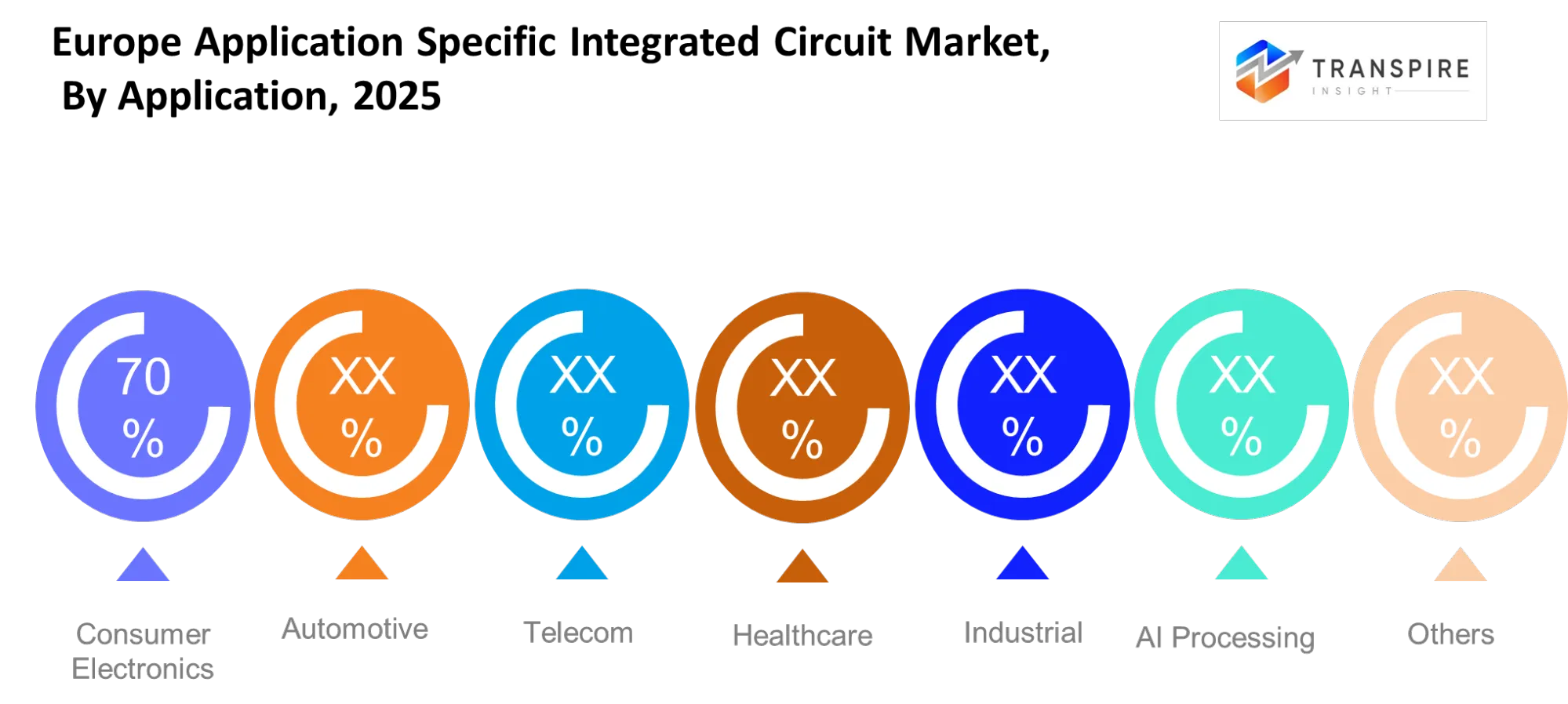
To learn more about this report, Download Free Sample Report
By End-User:
The electronics manufacturing sector serves as the primary customer group which drives chip procurement because it operates large-scale production facilities that produce consumer devices and communication equipment. High-volume manufacturing operations need ASIC solutions that provide cost-effective processing power for small electronic devices while maintaining high-performance capabilities. The development of new products in Europe continues to progress because semiconductor companies and electronics manufacturers maintain strong research collaborations.
The digital transformation programs which various companies in different sectors are implementing have created high-value customer groups which include automotive original equipment manufacturers (OEMs) and telecom organizations. Vehicle manufacturers increasingly require custom integrated circuits for electric drivetrains, battery monitoring systems, and autonomous navigation platforms. Telecom operators are making substantial investments in 5G networks, edge computing infrastructure, and data traffic management systems, which drives their demand for high-speed ASIC products. Healthcare providers will expand their use of specialized chips for imaging systems and wearable diagnostics devices throughout the entire forecast period.
By Technology:
CMOS technology currently maintains its strongest market position because semiconductor manufacturers prefer its low power consumption and high scalability and cost-effective manufacturing methods. The digital and mixed signal ASIC production compatibility of CMOS technology enables its increasing use in automotive electronics and industrial automation systems and consumer devices. European advanced semiconductor fabs are increasing their CMOS manufacturing capabilities to produce miniaturized electronic components that are currently in high demand.
FinFET technology has started to gain popularity because AI workloads and high-performance computing systems and advanced telecom infrastructure demand higher transistor density and better energy efficiency. Semiconductor developers increasingly adopt FinFET architectures for their next-generation processors which they use in edge computing and autonomous mobility applications. BiCMOS technology continues to serve specialized industrial and telecom use cases where analog precision and high-speed operation remain important. Future investment is likely to focus on smaller process nodes and energy-efficient chip designs that support increasingly complex electronic ecosystems across Europe.
What are the Key Use Cases Driving the Europe Application Specific Integrated Circuit Market?
European Application Specific Integrated Circuit markets experience their primary growth driver through automotive electronics adoption. Carmakers increasingly rely on ASICs for advanced driver assistance systems battery management systems infotainment systems and powertrain control systems in electric and hybrid vehicles. European Union vehicle safety standards and carbon emission regulations create growing demand from passenger car and commercial vehicle manufacturers.
The telecommunications sector shows rapid growth together with industrial automation applications. Manufacturing companies use ASICs in their robotics systems and factory automation equipment and predictive maintenance systems to enhance their operational efficiency. Telecom providers use custom chips for 5G infrastructure and edge computing hardware to achieve faster data processing and reduced network latency.
The emerging applications of aerospace electronics and healthcare diagnostics use the following technologies. European aerospace companies develop radiation-hardened ASICs for satellites and defense systems while medical device manufacturers test custom chips for portable imaging systems and wearable monitoring devices. The European digital infrastructure and advanced research programs will increase their investment which will lead to increased momentum for these niche applications.
|
Report Metrics |
Details |
|
Market size value in 2025 |
USD 6.93 Billion |
|
Market size value in 2026 |
USD 7.365 Billion |
|
Revenue forecast in 2033 |
USD 11.277 Billion |
|
Growth rate |
CAGR of 6.28% from 2026 to 2033 |
|
Base year |
2025 |
|
Historical data |
2021 - 2024 |
|
Forecast period |
2026 - 2033 |
|
Report coverage |
Revenue forecast, competitive landscape, growth factors, and trends |
|
Regional scope |
Europe (Germany, United Kingdom, France, Italy, Spain, Rest of Europe) |
|
Key company profiled |
Intel, Qualcomm, Broadcom, NVIDIA, AMD, Samsung Electronics, TSMC, Infineon, NXP, Texas Instruments, STMicroelectronics, Renesas, Marvell, MediaTek, ON Semiconductor |
|
Customization scope |
Free report customization (country, regional & segment scope). Avail customized purchase options to meet your exact research needs. |
|
Report Segmentation |
By Type (Full Custom ASIC, Semi-Custom ASIC, Programmable ASIC, Analog ASIC, Digital ASIC, Mixed Signal ASIC, Others); By Application (Consumer Electronics, Automotive, Telecom, Healthcare, Industrial, AI Processing, Others); By End-User (Electronics Manufacturers, Automotive OEMs, Telecom Providers, Healthcare Providers, Others); By Technology (CMOS, BiCMOS, FinFET, Others) |
Which Regions are Driving the Intel, Qualcomm, Broadcom, NVIDIA, AMD, Samsung Electronics, TSMC, Infineon, NXP, Texas Instruments, STMicroelectronics, Renesas, Marvell, MediaTek, ON Semiconductor Growth?
The Europe Application Specific Integrated Circuit market is dominated by Western Europe because the region contains numerous semiconductor design centers and automotive manufacturing hubs and receives public funding for chip sovereignty initiatives. Germany and France and the Netherlands drive regional demand through their electric vehicle manufacturing operations and their industrial automation activities and their research collaborations between semiconductor companies and academic institutions. The European Chips Act provides strong policy support which helps to speed up funding for wafer fabrication and advanced packaging and secure semiconductor supply chains throughout the region. The established automotive original equipment manufacturers together with dedicated equipment manufacturers and their complete research and development facilities enable ASIC developers to bring their high-performance products to market at a faster pace than competing regions.
Northern Europe contributes differently to the market because its growth is tied less to manufacturing scale and more to digital infrastructure and industrial reliability. The semiconductor market in Sweden and Finland remains strong because both countries require semiconductor components for their telecommunications equipment and data center expansion and industrial IoT deployment. The region benefits from predictable regulatory implementation, strong energy infrastructure, and consistent enterprise investment in secure connectivity technologies. These conditions create a dependable revenue base for ASIC suppliers focused on networking, edge computing, and low-power industrial applications rather than large-scale consumer electronics production.
The fastest-growing area in the world today belongs to Eastern Europe which experiences government agencies increasing their investment incentives for electronics manufacturing and supply chain diversification. Semiconductor companies and automotive component manufacturers are developing their business operations in Poland and the Czech Republic and Hungary to decrease their production activities that currently exist in Western Europe and Asia. Recent manufacturing modernization programs and nearshoring strategies have increased the demand for automotive application-specific integrated circuits and power management chips and embedded processing solutions. The transition from this point until 2026 to 2033 will present attractive market entry options for fabless chip designers and outsourced semiconductor assembly providers and investors who want to expand their businesses into low-cost markets in the European semiconductor ecosystem.
Who are the Key Players in the Europe Application Specific Integrated Circuit Market and How Do They Compete?
The Europe Application Specific Integrated Circuit market stays moderately consolidated because large semiconductor manufacturers compete with each other through their advanced design capabilities and their automotive partnerships and their long-term industrial supply contracts. The market experiences disruption because specialized chip developers create products for AI acceleration and edge computing and energy-efficient industrial needs. Companies compete against each other through technology innovation which includes development of low-power designs and automotive-grade dependable systems and secure edge processing systems. European governments require semiconductor sovereignty which drives strategic importance for geographic manufacturing facilities to develop local supply chains.
Infineon Technologies uses its power semiconductor technology and its complete connection to Europe’s automotive and industrial systems to compete in the market. The company controls a powerful market position in electric vehicle infrastructure and renewable energy systems through its silicon carbide and power management ASIC product line. The company has established partnerships in quantum technology and industrial power electronics which allow it to develop next-generation semiconductor products. STMicroelectronics uses its automotive-certified microcontrollers and radiation-hardened semiconductor solutions for aerospace and defense applications to create product differentiation. Its collaboration with European space technology firms expands its access to sovereign European semiconductor programs.
NXP Semiconductors operates in three specialized areas which include automotive connectivity and secure identification and industrial IoT ASICs.The company benefits from its established connections to European automotive manufacturers while using integrated security systems for connected mobility systems as its unique market advantage. TSMC is expanding its European footprint through strategic manufacturing investments and partnerships that will support automotive and industrial chip demand. TSMC operationalizes advanced ASIC production capabilities for high-performance and AI-driven applications by building a regional facility that enables European OEMs to access closer supply chain networks.
Company List
- Intel
- Qualcomm
- Broadcom
- NVIDIA
- AMD
- Samsung Electronics
- TSMC
- Infineon
- NXP
- Texas Instruments
- STMicroelectronics
- Renesas
- Marvell
- MediaTek
- ON Semiconductor
Recent Development News
In January 2026, STMicroelectronics entered a partnership with NanoXplore to qualify the NG-ULTRA radiation-hardened FPGA for European space applications. The certification under ESCC 9030 strengthens Europe’s sovereign semiconductor capabilities for aerospace and defense ASIC and FPGA deployments.https://nanoxplore.com
In March 2026, Infineon Technologies entered a partnership with DG Matrix to develop solid-state transformer technology for AI data centers and industrial power applications. The collaboration integrates Infineon’s silicon carbide semiconductor technology into next-generation power conversion platforms, reinforcing Europe’s position in high-efficiency ASIC-enabled industrial infrastructure.https://www.infineon.com
What Strategic Insights Define the Future of the Europe Application Specific Integrated Circuit Market?
The Europe Application Specific Integrated Circuit market is experiencing a fundamental transformation which centers on the development of specialized low-power semiconductor designs that meet the needs of three emerging technological trends. Over the next five to seven years, competitive advantage will increasingly depend on design specialization rather than manufacturing scale alone, particularly as European OEMs seek regionally secure supply chains and energy-efficient computing solutions. European wafer fabrication dependence together with its advanced packaging capabilities creates hidden dangers because it exposes ASIC manufacturers to supply chain interruptions that arise from geopolitical events despite the strong market demand. At the same time, edge AI ASICs tailored for industrial IoT and smart energy infrastructure represent an underpenetrated opportunity, especially as EU sustainability and digital sovereignty regulations accelerate localized deployment requirements. Market participants should establish strategic partnerships with automotive and industrial software ecosystems to develop vertically integrated design capabilities which will create application-specific products before standard AI chip platforms turn core functionalities into common market offerings.
Europe Application Specific Integrated Circuit Market Report Segmentation
By Type
- Full Custom ASIC
- Semi-Custom ASIC
- Programmable ASIC
- Analog ASIC
- Digital ASIC
- Mixed Signal ASIC
- Others
By Application
- Consumer Electronics
- Automotive
- Telecom
- Healthcare
- Industrial
- AI Processing
- Others
By End-User
- Electronics Manufacturers
- Automotive OEMs
- Telecom Providers
- Healthcare Providers
- Others
By Technology
- CMOS
- BiCMOS
- FinFET
- Others
Frequently Asked Questions
Find quick answers to common questions.
The Europe Application Specific Integrated Circuit Market size is USD 11.277 Billion in 2033.
Key Segments for the Europe Application Specific Integrated Circuit Market are By Type (Full Custom ASIC, Semi-Custom ASIC, Programmable ASIC, Analog ASIC, Digital ASIC, Mixed Signal ASIC, Others); By Application (Consumer Electronics, Automotive, Telecom, Healthcare, Industrial, AI Processing, Others); By End-User (Electronics Manufacturers, Automotive OEMs, Telecom Providers, Healthcare Providers, Others); By Technology (CMOS, BiCMOS, FinFET, Others)
Major Europe Application Specific Integrated Circuit Market Players are Intel, Qualcomm, Broadcom, NVIDIA, AMD, Samsung Electronics, TSMC, Infineon, NXP, Texas Instruments, STMicroelectronics, Renesas, Marvell, MediaTek, ON Semiconductor.
The Current Europe Application Specific Integrated Circuit Market size is USD 6.93 Billion in 2025.
The Europe Application Specific Integrated Circuit Market CAGR is 6.28% from 2026 to 2033.
- Intel
- Qualcomm
- Broadcom
- NVIDIA
- AMD
- Samsung Electronics
- TSMC
- Infineon
- NXP
- Texas Instruments
- STMicroelectronics
- Renesas
- Marvell
- MediaTek
- ON Semiconductor
About the Authors

Pankaj Ghogare Patil
I am Pankaj Ghogare Patil, a Senior Research Analyst at Transpire Insight, specializing in the Pharmaceutical, Chemicals & Materials, Healthcare IT, and Biotechnology industry. My expertise lies in conducting comprehensive market research, analyzing industry trends, evaluating competitive landscapes, and translating complex data into actionable insights. At Transpire Insight, I closely follow emerging technologies, regulatory developments, and market innovations to create accurate, well-researched, and informative content that helps businesses and professionals make informed decisions. I am committed to producing credible, evidence-based articles that reflect industry best practices while making technical topics accessible and valuable for a broad audience.

Chakradhar Khansole
Chakradhar serves as the Research Director at Transpire Insight, bringing over 8 years of experience in technology, innovation, and strategic market intelligence. He specializes in transforming complex market data into actionable business insights that enable organizations to make informed, growth-oriented decisions. Recognized for his strategic vision and analytical expertise, Chakradhar leads high-impact research initiatives, delivering comprehensive market assessments, competitive intelligence, and forward-looking industry analysis.
Recently Published Reports
-
May 2026
Healthcare Polymer Packaging Market
Healthcare Polymer Packaging Market Size, Share & Analysis Report By Packaging Type (Syringes, IV Bottles and Pouches, Clamshells, Blisters, Bottles & Jars, Containers, Tubes, IV Parental Packaging, Others), By Type (Regulated, Non-regulated), By Polymer Type (LDPE (Low-Density Polyethylene), HDPE (High-Density Polyethylene), Homo-polymer (Homo), Random Copolymer (Random), Block Copolymer (Block), PET, Polystyrene, Polyvinyl Chloride, Polyamide/EVOH, Others), and Geography (North America, Europe, Asia-Pacific, Middle East and Africa, South and Central America), 2021 - 2031
-
Apr 2026
Hydrophilic Tape (Waterstop) Market
Hydrophilic Tape (Waterstop) Market Size, Share & Analysis Report By Type (Bentonite-Based Hydrophilic Tape, Rubber-Based Hydrophilic Tape), By Application (Residential Buildings, Commercial Buildings, Infrastructure Projects), and Geography (North America, Europe, Asia-Pacific, Middle East and Africa, South and Central America), 2021 - 2031
-
Apr 2026
Metalens Market
Metalens Market Size, Share & Analysis Report By Type (Visible Light Metalens, and Infrared Metalens), By Application (Consumer Electronics, Automotive Electronics, Industrial, Medical, and Others), and Geography (North America, Europe, Asia-Pacific, Middle East and Africa, South and Central America), 2021 - 2031
-
Apr 2026
PBT Resin Market
PBT Resin Market Size, Share & Analysis Report By Type (Reinforced PBT Resin, Unreinforced PBT Resin), By Processing Method (Injection Molding, Extrusion, Blow Molding, Others), By End-User (Automotive, Electrical & Electronics, Consumer Appliances, Industrial Machinery, Medical Devices, Packaging, Others), and Geography (North America, Europe, Asia-Pacific, Middle East and Africa, South and Central America), 2021 - 2031