
Europe AI for Scientific Discovery Market Size & Forecast:
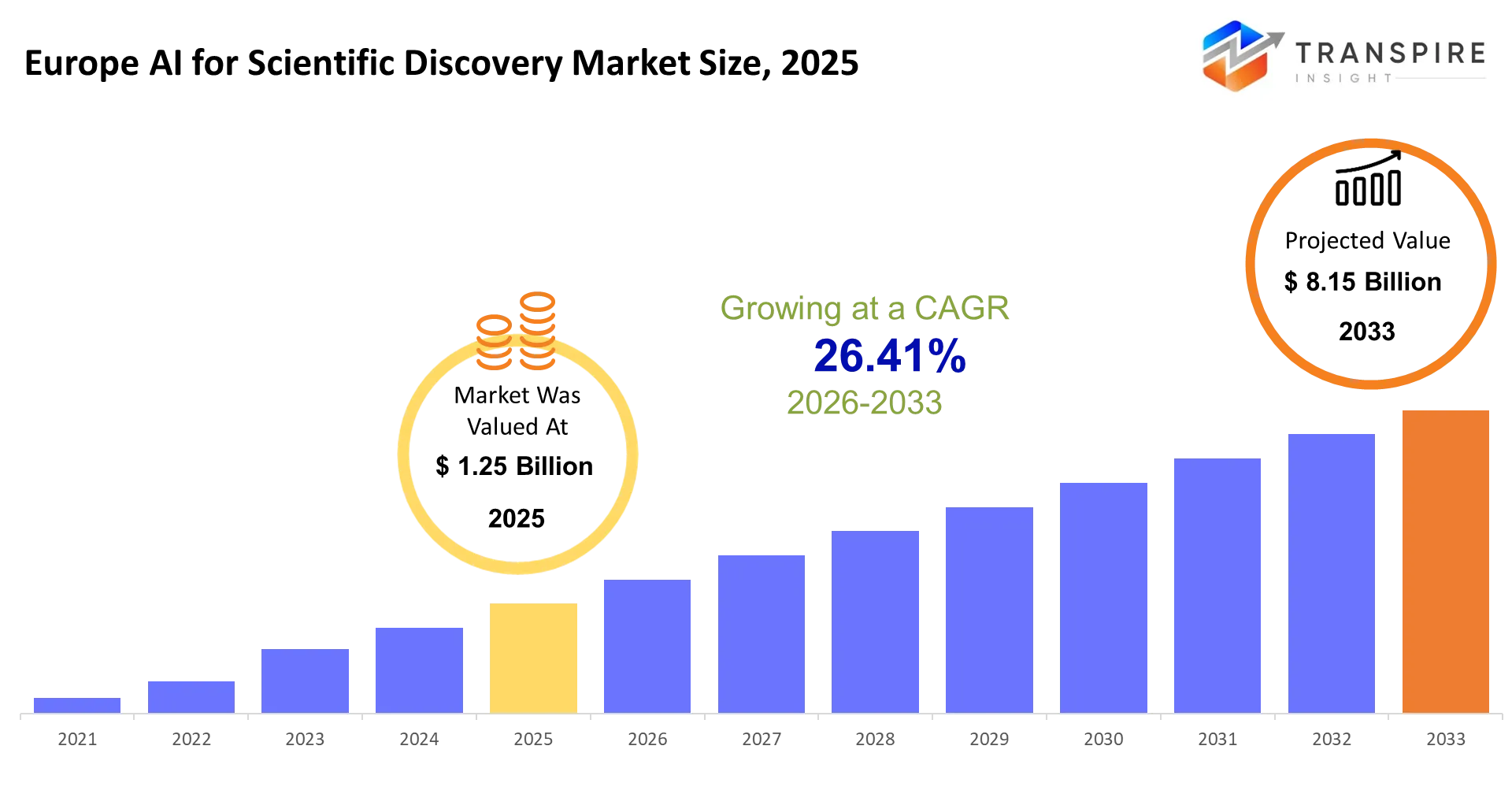
- Europe AI for Scientific Discovery Market Size 2025: USD 1.25 Billion
- Europe AI for Scientific Discovery Market Size 2033: USD 8.15 Billion
- Europe AI for Scientific Discovery Market CAGR: 26.41%
- Europe AI for Scientific Discovery Market Segments: By Type (Machine Learning Platforms, Deep Learning Models, AI Software, Data Analytics Tools, Others); By Application (Drug Discovery, Material Science, Climate Modeling, Physics Research, Genomics, Others); By End-User (Research Institutes, Pharma Companies, Universities, Tech Companies, Government Labs, Others); By Deployment (Cloud, On-premise, Hybrid, Others)
To learn more about this report,  Download Free Sample Report
Europe AI for Scientific Discovery Market Summary:
The Europe AI for Scientific Discovery Market size is estimated at USD 1.25 Billion in 2025 and is anticipated to reach USD 8.15 Billion by 2033, growing at a CAGR of 26.41% from 2026 to 2033.
The European AI system for scientific research discovery operates within the advanced research technology sector and will transform laboratory and institutional research methods for solving difficult problems. The system will evolve from its current capabilities as a data processing tool to develop new research hypotheses which will meet the growing demand for faster research results that can be reproduced. European researchers will seek transparent modeling solutions because regulators across Europe implement stricter data governance and ethical AI usage requirements. Open science initiatives will drive scientists to work together while competing proprietary platforms battle to provide the most accurate and understandable results. The academic research community will require AI systems to provide both research findings and actual scientific progress because funding organizations now prioritize climate change and health research and materials science investigation.
What Has the Impact of Artificial Intelligence Been on the Europe AI for Scientific Discovery Market?
The research ecosystem undergoes major changes because of artificial intelligence while its impact on the European artificial intelligence market for scientific research has become measurable and essential for business operations. AI-driven tools have developed new capabilities for market research and data analysis because they can analyze large experimental datasets faster and more accurately than traditional methods. The European artificial intelligence market for scientific research will enable researchers and organizations to make rapid evidence-based decisions by providing machine learning models that discover hidden relationships between different variables. Predictive analytics will enhance demand forecasting, which enables stakeholders to identify upcoming scientific needs while they distribute resources, thereby achieving better efficiency.
Artificial intelligence will create smart automation systems that will enhance production efficiency in European artificial intelligence systems that operate within scientific research markets. Organizations will use AI technology to streamline their laboratory and research facility operations by implementing automated systems that decrease the need for human work while decreasing operational mistakes. Intelligent systems will forecast material requirements, which will minimize waste production and decrease expenses, creating a direct effect on supply chain management. The European artificial intelligence market for scientific research will achieve enhanced operational capacity and greater ability to expand its operations.
The European artificial intelligence market for scientific research will use AI applications to create new research methods through customized research paths and flexible testing methods. Organizations that implement these technologies will achieve market dominance because they will shorten their research cycles while producing superior results. The European artificial intelligence market for scientific research will use AI integration to drive future scientific advancements, which will help the market maintain its leadership position throughout changing market trends.
Key Market Trends & Insights:
- The European AI market for scientific research is led by Western Europe, which controls 45% of the market share in 2025 through its robust research funding systems and AI development capabilities.
- The Northern Europe region shows the highest growth rate, which will exceed 30% annual growth between 2025 and 2030.
- The European market for AI-based scientific research discovery solutions is driven by increasing interest in advanced analytics tools, which enables software platforms to achieve market share above 50%.
- The services sector becomes the second largest market segment because it delivers three essential services that include integration work and consulting services and AI model customization.
- AI-as-a-service represents the most rapidly expanding market segment, which will experience fast growth until 2030 because of rising cloud service usage.
- AI technology drives drug discovery as it helps researchers identify new molecules while shortening clinical research periods.
- Materials science experienced its highest growth as new markets emerged that required development of sustainable materials which provide high-performance capabilities.
- Pharmaceutical and biotechnology companies lead with over 48% share, leveraging AI for faster R&D outcomes and cost efficiency.
- Public funding together with collaborative AI projects currently supports the fast expansion of academic and research organizations.
- The European AI market for scientific discovery research gains improved accessibility through dual forces of regional growth and cloud-based AI systems implementation.
Europe AI for Scientific Discovery Market Segmentation
By Type:
The Europe AI for Scientific Discovery Market will use machine learning platforms to create predictive models which will work with deep learning models that analyze complex datasets through pattern detection. AI software will assist automation, and data analytics tools will improve interpretation, with other tools supporting specialized research needs. Machine learning platforms will guide experiment planning through data-driven insights, while deep learning models will handle image and sequence analysis. AI software will streamline repetitive processes, and analytics tools will ensure clarity in outcomes, helping research systems maintain accuracy and speed.
By Application:
The Europe AI for Scientific Discovery Market will cover drug discovery through rapid molecule screening and material science through development of new material technologies. Climate modeling will improve environmental predictions, physics research will support simulations, and genomics will enhance genetic analysis, alongside other emerging scientific uses. The timeline for drug discovery will be shortened while material science will achieve better progress on developing eco-friendly materials. Climate modeling will provide better forecasting accuracy, physics research will allow deeper simulation studies, and genomics will support precision analysis in biological research fields.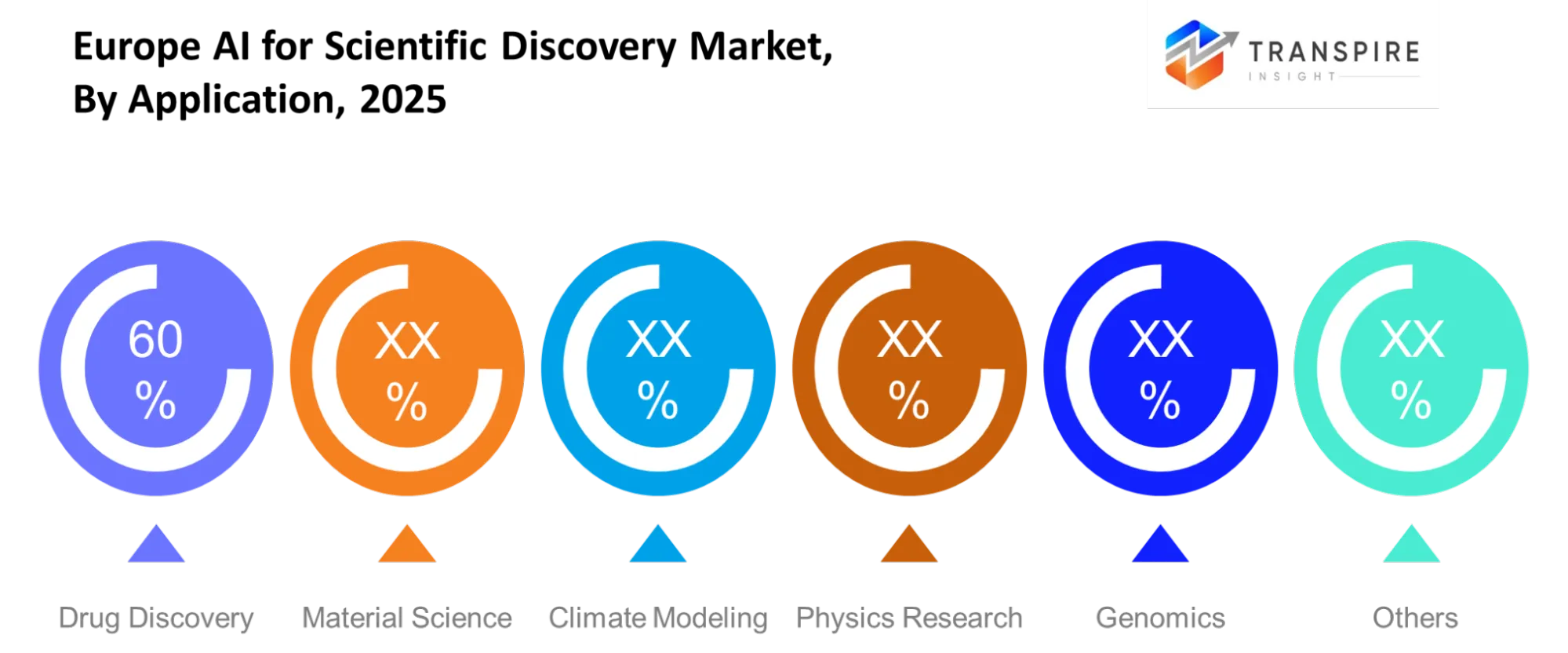
To learn more about this report, Download Free Sample Report
By End-User:
The European AI for Scientific Discovery Market will provide research institutes with AI solution which supports their innovative work while pharmaceutical companies use AI to enhance their drug development process.The discovery process will benefit from research institutes using advanced tools for their research activities while pharmaceutical companies work to enhance their drug development process. Universities will train skilled professionals and expand knowledge, tech companies will push system improvements, and government labs will focus on national research priorities and scientific advancement.
By Deployment:
The European AI for Scientific Discovery Market will use cloud deployment to achieve scalability, while organizations will use on-premise systems to maintain control over their data. Hybrid models will balance flexibility and security, and other deployment forms will address specific operational needs across different research environments. Organizations will gain research capabilities through cloud solutions, which provide remote access for users to collaborate. The hybrid deployment method will integrate both approaches because it enables organizations to operate flexibly, while the other models exist to fulfill distinct needs found in specific scientific and institutional environments.
What are the Main Challenges for the Europe AI for Scientific Discovery Market Growth?
The Europe AI market for scientific discovery research will experience multiple technical and operational obstacles which will prevent it from reaching its maximum potential. Researchers encounter difficulty in achieving accurate scientific results because complex algorithms fail to handle data quality problems. Scientists face challenges with large datasets because they need to achieve two goals simultaneously: they require advanced computing resources and dependable system operation.
The European Union AI market for scientific discovery research encounters difficulties because its various research systems exhibit performance restrictions and compatibility issues that impede system integration. Manufacturing and commercialization barriers will further impact growth. Developing AI-driven platforms involves high costs, extended validation cycles, and strict regulatory compliance related to data usage and research integrity. Standardization delays and approval delays will create bottlenecks which prevent solutions from transitioning into practical use within the European AI market for scientific discovery research. Small institutions will face challenges because cost restrictions will make it difficult to maintain their services.
Adoption challenges continue to affect expansion, particularly due to limited infrastructure and shortage of skilled professionals trained in both AI and scientific domains. Research organizations will need to wait until they secure funding because they have insufficient resources to implement advanced research tools. The European AI market for scientific discovery research will experience market limitations which will prevent its growth in less developed areas of the market.
Researchers will face future challenges because they need to compete against both new computational systems and changing regulatory requirements. The European AI market for scientific discovery research will experience difficulties in achieving ongoing development because two forces will drive companies to spend money on both new technologies and price reduction strategies.
Regional Insights
Western Europe will maintain its dominance as the main market for Europe AI for Scientific Discovery because Western European countries possess advanced infrastructure and secure research funding which drives their innovative development. The scientific ecosystems of Germany, France, and the United Kingdom together with their high-performance computing systems will enable these countries to become early adopters.
Northern Europe will experience steady expansion because of its digital readiness and government-backed AI strategies. The research capabilities of Sweden, Denmark, and Finland will experience growth through their collaboration efforts and public funding initiatives which will support scientific advancements and advanced technology development throughout various research fields.
Eastern and Southern Europe will experience slow development because of funding shortfalls and insufficient infrastructure yet their progress will advance through policy assistance and international partnerships. The establishment of increased investment together with improved knowledge sharing will enable research institutions to adopt new technologies while matching existing regional disparities.
Recent Development News
In April 2026, Google DeepMind announced Aletheia, an advanced AI system capable of solving complex mathematical proofs with high accuracy, marking a breakthrough in automated scientific reasoning and discovery processes. https://www.infoq.com/news/2026/04/deepmind-aletheia-agentic-math/ (InfoQ reports)
In April 2026, IBM launched “IBM Bob,” an AI development partner designed to accelerate enterprise AI-assisted coding into production-ready software, strengthening AI deployment capabilities for scientific and research workflows. https://newsroom.ibm.com/latest-news-artificial-intelligence (IBM Newsroom)
|
Report Metrics |
Details |
|
Market size value in 2025 |
USD 1.25 Billion |
|
Market size value in 2026 |
USD 1.58 Billion |
|
Revenue forecast in 2033 |
USD 8.15 Billion |
|
Growth rate |
CAGR of 26.41% from 2026 to 2033 |
|
Base year |
2025 |
|
Historical data |
2021 - 2024 |
|
Forecast period |
2026 - 2033 |
|
Report coverage |
Revenue forecast, competitive landscape, growth factors, and trends |
|
Regional scope |
Europe (Germany, United Kingdom, France, Italy, Spain, Rest of Europe) |
|
Key company profiled |
IBM, Google, Microsoft, NVIDIA, Amazon, OpenAI, DeepMind, Intel, Oracle, SAP, Dassault Systèmes, Schrödinger, Atomwise, Insilico Medicine, BenevolentAI |
|
Customization scope |
Free report customization (country, regional & segment scope). Avail customized purchase options to meet your exact research needs. |
|
Report Segmentation |
By Type (Machine Learning Platforms, Deep Learning Models, AI Software, Data Analytics Tools, Others); By Application (Drug Discovery, Material Science, Climate Modeling, Physics Research, Genomics, Others); By End-User (Research Institutes, Pharma Companies, Universities, Tech Companies, Government Labs, Others); By Deployment (Cloud, On-premise, Hybrid, Others) |
How Can New Companies Establish a Strong Foothold in the Europe AI for Scientific Discovery Market?
The European AI market for scientific discovery requires precise specialization from new market entrants who want to achieve success in their efforts. Startups can solve specific research needs through their specialized focus on genomics analytics, climate simulation and early-stage drug screening. The current industry trend demands specialized solutions which deliver high accuracy to address particular scientific challenges.
The European AI market for scientific discovery will use innovation as its primary factor for creating market distinctions. Research institutions will accept companies that create lightweight scalable models or enhance AI output interpretability faster. Startups like Insilico Medicine show how AI-based systems shorten drug discovery processes while BenevolentAI uses data to find new drug targets. The combination of technical skills and actual application examples will help these companies establish their presence in the market.
Partnerships that follow a strategic approach will become essential for success. Startups can use university partnerships and collaborations with pharmaceutical companies and public research laboratories to test their products and expand their market reach. European AI researchers need strategic alliances that provide access to valuable datasets and essential funding resources to advance their business operations.
The use of cloud platforms and automation technologies and predictive analytics will create technology differentiation which helps companies compete better. European AI for scientific discovery companies will gain permanent market presence through their solutions which create cost savings and data protection and simple system integration.
Key Europe AI for Scientific Discovery Market Company Insights
The European AI for Scientific Discovery Market will experience intense competition because worldwide technology companies and dedicated research organizations will both pursue innovation and performance development. The development of advanced algorithms and computing power will create advantages for competitors because research partnerships will enhance their ability to develop solutions which scientists can effectively use in their work.
Top organizations will use product development and rapid data analysis and consistent performance to achieve competitive success. The market presence of organizations will grow through their strategic partnerships and research expansion, while their pricing methods and scalable products will determine customer choices and business growth across various scientific fields.
Company List
- IBM
- Microsoft
- NVIDIA
- Amazon
- OpenAI
- DeepMind
- Intel
- Oracle
- SAP
- Dassault Systèmes
- Schrödinger
- Atomwise
- Insilico Medicine
- BenevolentAI
What are the Key Use-Cases Driving the Growth of the Europe AI for Scientific Discovery Market?
Artificial intelligence is driving innovation in various fields because European artificial intelligence applications create benefits for scientific research. The pharmaceutical industry uses artificial intelligence to create new drugs which use AI models that study molecular structures to forecast chemical reactions and decrease development time. The Europe AI for scientific discovery market enables pharmaceutical companies to decrease research expenses while their early-stage trial success rates increase through this capability.
AI systems in materials science use simulation to predict material properties and discover compounds that meet industrial requirements in automotive and energy applications. These tools enable researchers to run experiments at higher velocity while developing environmentally responsible solutions. In the Europe AI for scientific discovery market, industrial research teams use these applications to develop products that have better durability and improved operational efficiency.
The development of climate modeling and environmental research drives key growth for scientific research. AI-powered predictive analytics improves weather forecasting, carbon tracking, and resource management. The European AI for scientific discovery market is growing because organizations and governments emphasize building climate resilience which drives demand for this application.
AI uses complex biological data processing to create targeted treatments that enable scalable growth for genomics and precision medicine. The European AI for scientific discovery market will drive scientific innovation because it develops pathways for new scientific advancements through upcoming technological progress.
Europe AI for Scientific Discovery Market Report Segmentation
By Type
- Machine Learning Platforms
- Deep Learning Models
- AI Software
- Data Analytics Tools
- Others
By Application
- Drug Discovery
- Material Science
- Climate Modeling
- Physics Research
- Genomics
- Others
By End-User
- Research Institutes
- Pharma Companies
- Universities
- Tech Companies
- Government Labs
- Others
By Deployment
- Cloud
- On-premise
- Hybrid
- Others
Frequently Asked Questions
Find quick answers to common questions.
The Approximate Europe AI for Scientific Discovery Market size for the Market will be USD 8.15 Billion in 2033.
Key Segments for the Europe AI for Scientific Discovery Market are By Type (Machine Learning Platforms, Deep Learning Models, AI Software, Data Analytics Tools, Others); By Application (Drug Discovery, Material Science, Climate Modeling, Physics Research, Genomics, Others); By End-User (Research Institutes, Pharma Companies, Universities, Tech Companies, Government Labs, Others); By Deployment (Cloud, On-premise, Hybrid, Others).
Major Europe AI for Scientific Discovery Market Players are IBM, Google, Microsoft, NVIDIA, Amazon, OpenAI, DeepMind, Intel, Oracle, SAP, Dassault Systèmes, Schrödinger, Atomwise, Insilico Medicine, BenevolentAI.
The Current Europe AI for Scientific Discovery Market size is USD 1.25 Billion in 2025.
The Europe AI for Scientific Discovery Market CAGR is 26.41%.
- IBM
- Microsoft
- NVIDIA
- Amazon
- OpenAI
- DeepMind
- Intel
- Oracle
- SAP
- Dassault Systèmes
- Schrödinger
- Atomwise
- Insilico Medicine
- BenevolentAI
Recently Published Reports
-
Apr 2026
3D Optical Profiler Market
3D Optical Profiler Market Size, Share & Analysis Report By Type (Desktop 3D Optical Profiler, and Portable 3D Optical Profiler), By Technology (Confocal Technology, and White Light Interference), By End-Use Industry (Manufacturing, Research Institutions, Automotive, Aerospace and Defense, Medical Devices, and Other), and Geography (North America, Europe, Asia-Pacific, Middle East and Africa, South and Central America), 2021 - 2031
-
Apr 2026
Depth Sensor Market
Depth Sensor Market Size, Share & Analysis Report By Type (Infrared Depth Sensors, Time-of-Flight (ToF) Sensors, Stereo Vision Sensors, Structured Light Sensors, Ultrasonic Depth Sensors), By Application (Automotive, Robotics, Gaming, Consumer Electronics, Industrial Automation, Healthcare, Security & Surveillance, Others), By End Users (Automotive Manufacturers, Consumer Electronics Companies, Healthcare Providers, Industrial Companies, Security Agencies, Gaming Companies, Robotics Companies, Others), and Geography (North America, Europe, Asia-Pacific, Middle East and Africa, South and Central America), 2021 – 2031
-
Apr 2026
Digital Manufacturing Market
Digital Manufacturing Market Size, Share & Analysis Report By Component (Hardware, Software, and Services), By Technology (Robotics, 3D Printing, Internet of Things (IoT), and Others), By Application (Automotive and Transportation, Aerospace and Defense, Consumer Electronics, Industrial Machinery, and Others), By Process Type (Computer-Based Designing, Computer-Based Simulation, Computer 3D Visualization, Analytics, and Others), and Geography (North America, Europe, Asia-Pacific, Middle East and Africa, South and Central America), 2021 – 2031
-
Apr 2026
Digital Visa Services Market
Digital Visa Services Market Size, Share & Analysis Report By Type (Individual Travelers, Group Travelers), By Application (Tourism, Business Travel, Others), and Geography (North America, Europe, Asia-Pacific, Middle East and Africa, South and Central America), 2021 – 2031