

Europe Agile Development Software Market Size & Forecast:
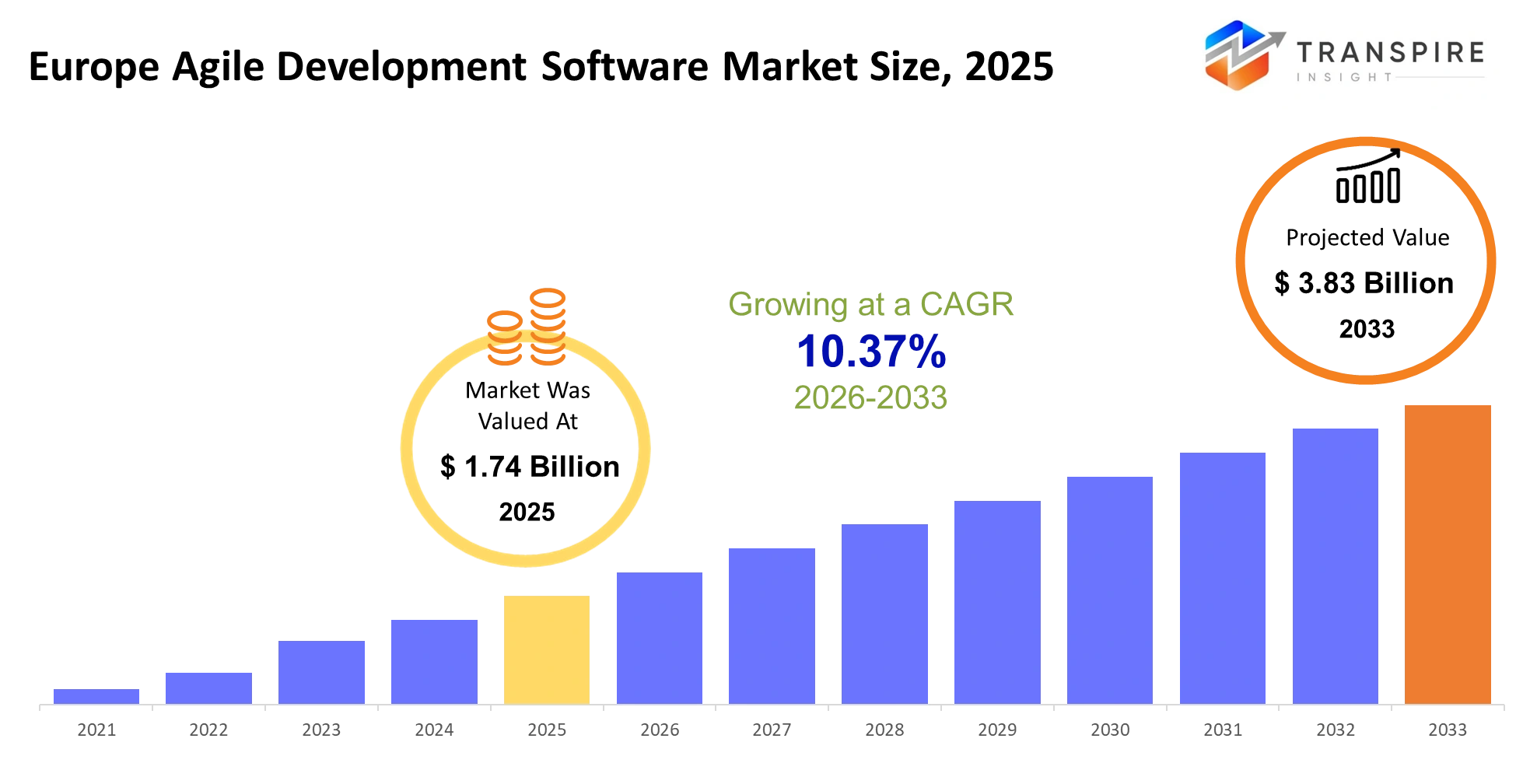
- Europe Agile Development Software Market Size 2025: USD 1.74 Billion
- Europe Agile Development Software Market Size 2033: USD 3.83 Billion
- Europe Agile Development Software Market CAGR: 10.37%
- Europe Agile Development Software Market Segments: By Type (Scrum Tools, Kanban Tools, DevOps Tools, Project Management Tools, Others); By Application (Software Development, Product Development, IT Operations, Testing, Collaboration, Others); By End-User (Enterprises, SMEs, IT Companies, Developers, Startups, Others); By Deployment (Cloud-based, On-premise, Hybrid, Others).
To learn more about this report,  Download Free Sample Report
Europe Agile Development Software Market Summary
The Europe Agile Development Software Market was valued at USD 1.74 Billion in 2025. It is forecast to reach USD 3.83 Billion by 2033. That is a CAGR of 10.37% over the period.
The Europe Agile Development Software Market enables enterprises to manage software creation as a continuous, collaborative process where planning, coding, testing, and deployment occur in tightly connected cycles. The system enables large organizations to synchronize their distributed engineering teams while they speed up product releases and fulfill necessary European data security and privacy standards. The system functions as the main operational foundation which supports digital product development across financial institutions, telecommunications companies manufacturing businesses and government organizations.
The market has evolved during the past three to five years from companies using different agile tools to adopt single DevOps platforms which manage all stages of software development. The structural change has happened because organizations have started using cloud-native architectures and require development teams to operate with continuous access to their development pipelines. The implementation of more stringent data management standards according to GDPR and new artificial intelligence rules has forced companies to switch to development systems which can be monitored and documented.
The process has accelerated for major corporations which need to replace outdated systems because vendors have developed new AI-based automation solutions which enhance operational productivity. The subscription-based revenue models have grown because of this development while European businesses now demand agile platforms which can scale and meet compliance requirements.
Key Market Insights
- Western Europe controls 45% of the Europe Agile Development Software Market which it will maintain until 2025 because its companies have adopted digital technology and built advanced digital systems.
- Eastern Europe will grow at the fastest rate because its software development nearshoring hubs will lead to talent development between 2023 and 2033 with an annual growth rate of 8 to 10 percent.
- The Europe Agile Development Software Market identifies DevOps tools as its leading solution because businesses choose to implement complete CI/CD systems instead of using separate agile software.
- The combined platform market share exceeds 60% while Kanban and Scrum tools maintain their position as the second largest market segment.
- Software development applications control the market with almost 50% share because enterprises heavily invest in continuous delivery systems and automated workflow processes.
- The application segment of IT operations shows the fastest growth because organizations move their operations to cloud systems and upgrade their existing infrastructure.
- The enterprise sector holds the biggest user base because organizations need to meet special regulatory requirements while they implement large-scale digital transformation projects.
- The user base for SMEs has expanded the fastest because cloud-based agile tools provide lower deployment costs and better access to their services.
- Monday.com and Asana develop their small business market through their user-friendly project management software and low-code agile workflow solutions.
- IBM improves its market strength by providing hybrid cloud systems and enterprise security solutions which comply with industry standards.
What are the Key Drivers, Restraints, and Opportunities in the Europe Agile Development Software Market?
The Europe Agile Development Software market experiences its main growth through the rapid adoption of cloud-native enterprise software delivery which results from both large-scale digital transformation initiatives and the modernization requirements that emerged after the pandemic. Financial services companies and telecom operators and public administration agencies have adopted integrated DevOps ecosystems to replace their previous use of separate development tools which enable them to achieve continuous integration and deployment. The platform providers experience increased subscription revenue because enterprises adopt unified agile suites to replace their existing toolchain systems which streamline their operations through faster release times and reduced downtime and better interdepartmental collaboration.
European Union member states follow separate regulations which create major operational challenges for businesses because they must comply with both GDPR data sovereignty requirements and the AI governance regulations which are currently being implemented. The structural barrier forces vendors to operate local data storage systems which include compliance settings that hinder their ability to expand platforms into new international markets while driving up their operational expenses. The adoption of AI-enabled agile systems forces enterprises to wait longer through their adoption process because these systems need centralized data processing which creates challenges for global vendors who operate in multiple regulatory environments.
The growth of sovereign cloud infrastructure initiatives presents a major opportunity for businesses that develop compliant agile platforms because of upcoming government investments in Germany and France. European public sector organizations and cloud providers have formed partnerships which enable them to create DevOps environments that meet local needs for defense and healthcare and essential infrastructure protection.This trend indeed represents an opportunity for those providing agile solutions based on the concept of compliance and modularity to take up high-value driven regulated works in the upcoming expansion trend.
What Has the Impact of Artificial Intelligence Been on the Europe Agile Development Software Market?
Artificial intelligence is transforming agile development platforms across European countries through its implementation of automated software delivery processes. AI technology now handles enterprise environments through its ability to automate backlog prioritization tasks and code review operations and testing cycles which decreases the need for teams to communicate across different locations. Microsoft Azure DevOps and GitLab platforms have started to implement machine learning technology for their sprint planning processes while their deployment risk detection system has improved production system reliability through reduced operational downtimes.
The ability to predict future events has grown because machine learning models can now forecast system failures which include infrastructure load and performance bottlenecks before they disrupt operational activities. The regulated European industries use these tools to enhance their compliance tracking capabilities by detecting development pipeline deviations and identifying security vulnerabilities in real time. Organizations achieve operational improvements through deployment frequency gains and incident resolution time reductions when they implement predictive analytics into their CI/CD workflows.
The integration process with existing enterprise systems and the need to maintain consistent development environment data throughout the organization create obstacles that prevent organizations from achieving better results through these advancements. Many organizations experience difficulties with model accuracy when they need to assess customized workflows that use limited or inconsistent training data. The implementation of centralized AI processing faces obstacles because strict data sovereignty regulations in Germany and France prevent intelligent agile systems from being fully deployed across various countries.
Key Market Trends
- Enterprise organizations in Europe have moved away from using separate agile tools to adopt complete DevOps platforms which combine all aspects of software development from coding to testing and deployment.
- AI-assisted development features have replaced manual sprint planning processes at an increasing rate since 2025 because they help distributed software teams work more efficiently.
- Regulatory pressure from GDPR and emerging AI governance rules has pushed vendors toward compliance-native software architectures.
- Cloud adoption has turned into the most common deployment method because enterprises between 2024 and 2026 adopted cloud solutions to replace their existing on-premise systems.
-
Microsoft and Atlassian now face stronger competition because both companies are expanding their ecosystems through acquisitions while developing new AI-based products.
-
Mid-sized firms now choose modular agile tools because those tools help them achieve both lower integration expenses and protection against vendor lock-in.
- Eastern European outsourcing centers now require scalable agile platforms which enable their distributed engineering teams to work effectively.
- German and French companies are now spending more money on audit-ready DevOps pipelines because data sovereignty regulations in their countries have become more stringent.
- Regulated industries have adopted hybrid deployment models to achieve their cloud efficiency goals while maintaining their security and compliance obligations.
Europe Agile Development Software Market Segmentation
By Type:
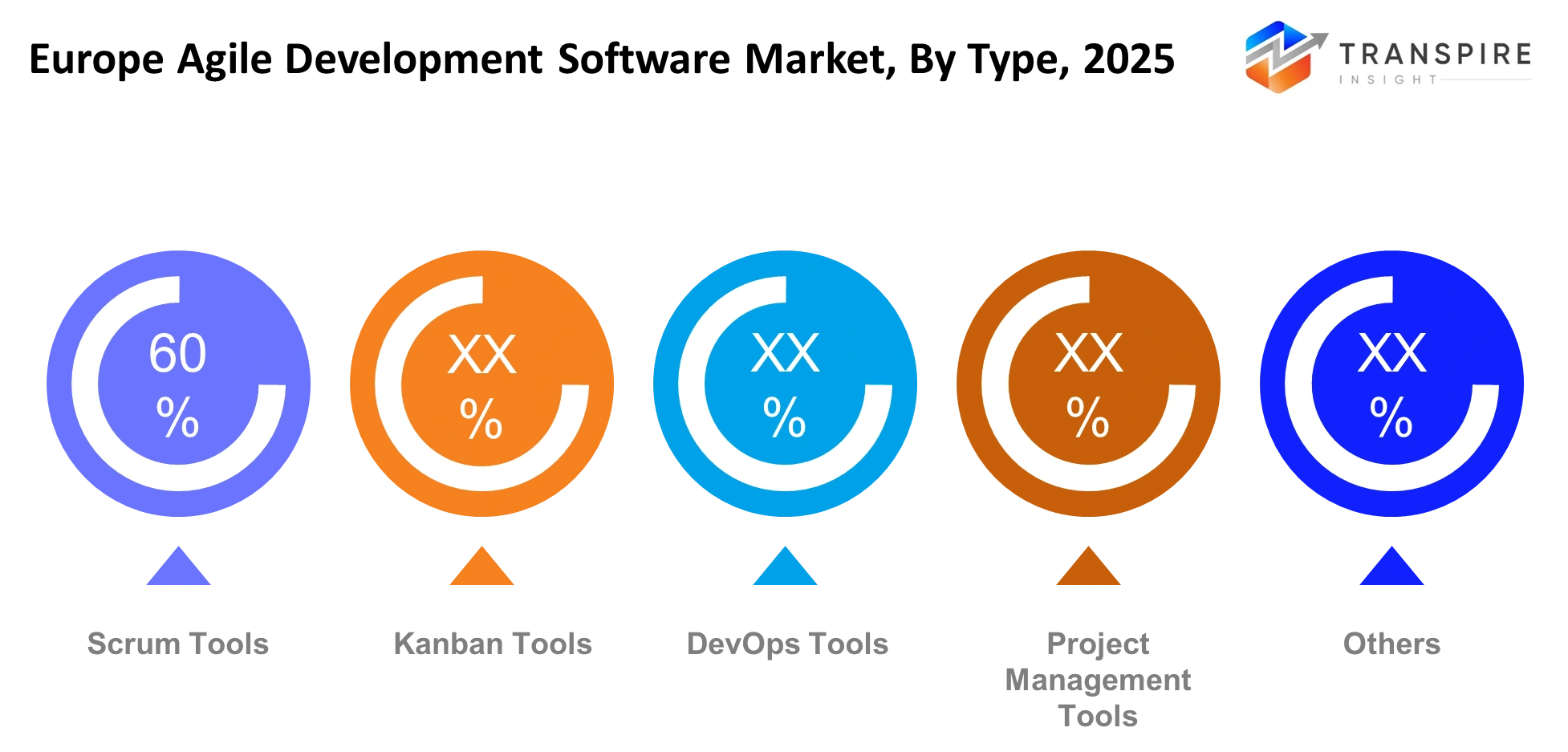
The strong enterprise demand for integrated development and operations workflows has established DevOps Tools as the primary solution for organizations. The continuous delivery pipelines which large organizations use create higher adoption rates than standalone Scrum or Kanban tools. Scrum Tools remain widely used in team-level project planning, but their scope is narrower and often embedded within larger platforms. The combined growth of Kanban Tools and Project Management Tools experiences challenges from unified DevOps ecosystems, which create fewer operational tools for organizations to use.
European enterprises which prioritize automation and security and compliance create higher demand for DevOps Tools than any other software delivery instrument. The regulatory requirements which govern both Germany and France create an increased need for traceable and auditable pipelines which DevOps platforms deliver more effectively than single-purpose tools. The development of AI-based DevOps suites will drive software vendors to create integrated systems which eliminate operational barriers between their products. Investors will favor platforms offering end-to-end integration over single-function solutions.
To learn more about this report, Download Free Sample Report
By Application:
Software Development leads all applications in usage because it supports enterprise digital transformation initiatives which drive digital changes across Europe. The IT Operations sector needs to maintain system reliability while supporting organizations that require continuous deployment capabilities. Testing and Collaboration applications grow as supporting functions, driven by distributed teams and faster release cycles.
The agile platforms of Software Development enable teams to develop code, manage software versions, and control product releases throughout their entire enterprise systems. The IT Operations team needs to expand its operations because cloud-based systems and hybrid systems demand better collaboration between development teams and infrastructure teams. Future application demand will move toward unified application stacks which combine development, testing and operations functions because vendors have to create all-in-one solutions. Tools that simplify integration processes while providing complete visibility of product development and operational tracks will be preferred by buyers.
By End-User:
The digital transformation programs of enterprises have enabled them to gain the largest market share because their budgets exceed those of other companies. IT Companies and Developers represent strong secondary demand, driven by continuous product iteration cycles and outsourcing models. The tool selection process for SMEs and Startups is more stringent than for other businesses because they expand rapidly while facing budget constraints.
Enterprises dominate because regulatory compliance, security requirements, and multi-team coordination demand advanced agile systems. IT Companies use agile platforms to speed up product delivery to clients while keeping their project schedules competitive. SMEs and Startups drive growth through cloud-based lightweight tools that reduce upfront investment and scale easily. The market will develop towards pricing models which offer flexible options and modular systems that serve both large enterprises and smaller development teams effectively.
By Deployment:
The strongest solution for businesses exists in Cloud-based systems which provide better scalability and lower maintenance requirements while supporting distributed work environments.Organizations that need to balance their regulatory obligations with the advantages of cloud computing benefit from hybrid deployment systems.
European enterprises increasingly adopt remote and cross-border development structures which enable Cloud-based systems to dominate the market. The defense banking and government sectors continue to use on-premise solutions because they must follow strict data residency rules. Organizations adopt hybrid deployment models to gradually move toward complete cloud adoption while they keep their existing systems operational. Cloud-first architectural designs will become the preferred choice for future adoption because vendors will need to strengthen their security certifications and local data hosting capabilities.
What are the Key Use Cases Driving the Europe Agile Development Software Market?
The primary application of enterprise software development exists within organizations from financial services and telecomand public sector sectors. Agile platforms help these industries to control their intricate release processes while they maintain compliance with European data protection laws and manage their geographically distributed teams. Agile tools serve as essential components that organizations need for their dual requirements of operational efficiency and regulatory compliance.
Manufacturing and automotive industries are adopting agile methods to develop embedded software and digital products through their expanding application base. Retail and e-commerce firms are also adopting these tools to accelerate customer-facing feature releases and improve cross-functional collaboration between marketing and engineering teams.
Organizations in the healthcare and energy sectors are using agile platforms to create emerging applications which they develop for regulated environments. Organizations are showing increasing interest in using agile workflows for AI model development because they need to implement iterative testing and governance processes.
|
Report Metrics |
Details |
|
Market size value in 2025 |
USD 1.74 Billion |
|
Market size value in 2026 |
USD 1.92 Billion |
|
Revenue forecast in 2033 |
USD 3.83 Billion |
|
Growth rate |
CAGR of 10.37% from 2026 to 2033 |
|
Base year |
2025 |
|
Historical data |
2021 - 2024 |
|
Forecast period |
2026 - 2033 |
|
Report coverage |
Revenue forecast, competitive landscape, growth factors, and trends |
|
Regional scope |
Europe (Germany, United Kingdom, France, Italy, Spain, Rest of Europe) |
|
Key company profiled |
Atlassian, Microsoft, IBM, Google, GitLab, Broadcom, VersionOne, Targetprocess, Zoho, Monday.com, Asana, ClickUp, Smartsheet, Wrike, Rally Software. |
|
Customization scope |
Free report customization (country, regional & segment scope). Avail customized purchase options to meet your exact research needs. |
|
Report Segmentation |
By Type (Scrum Tools, Kanban Tools, DevOps Tools, Project Management Tools, Others); By Application (Software Development, Product Development, IT Operations, Testing, Collaboration, Others); By End-User (Enterprises, SMEs, IT Companies, Developers, Startups, Others); By Deployment (Cloud-based, On-premise, Hybrid, Others). |
Which Regions are Driving the Europe Agile Development Software Market Growth?
The Agile Development Software market in Western Europe maintains its lead because digital policies match existing enterprise IT systems which have reached mature status. The data protection regulations which Germany, United Kingdom, and France implement lead enterprises to establish structured agile systems that comply with legal requirements. The region maintains ongoing access to modern DevOps techniques because it has a widespread network of cloud providers and consulting companies and skilled developers. The public sector and large enterprises create a continuous demand for digital transformation programs which they use to achieve their productivity and transparency objectives.
Northern Europe functions as a reliable second tier which develops through digital maturity and governance systems that establish consistent operational standards. Swedish and Dutch markets develop their own competitive environment because they focus on open-source adoption and interoperability standards instead of Western European markets which primarily serve enterprises. The combination of economic resilience with active participation from small and medium enterprises creates consistent market requirements for various flexible cloud-based agile solutions which compete against comprehensive software packages. The region establishes consistent market patterns through its controlled system of regulations which receive highly trustworthy digital system implementation.
The software outsourcing industry in Eastern Europe is growing rapidly because of its development as a major outsourcing destination and its establishment of nearshoring centers. Poland and Romania have developed their digital infrastructure and startup ecosystems while expanding their developer workforce. The EU has increased its funding support and cross-border collaboration initiatives which help mid-sized businesses adopt agile tools.The current expansion creates a chance for businesses and investors to enter the market because they should offer affordable and expandable solutions which meet the needs of expanding development teams between 2026 and 2033.
Who are the Key Players in the Europe Agile Development Software Market and How Do They Compete?
The European Agile Development Software market exhibits moderate competition through multiple vendors yet the industry trend leads to consolidation across platform ecosystems which provide combined development tools and collaboration features and AI-powered workflow solutions. Existing companies maintain their market shares by developing cloud-native solutions which include automation, whereas new competitors present market entry through user-friendly software at competitive rates. The primary basis of competition has shifted from cost to technology depth and integration, particularly the ability to unify DevOps pipelines with real-time analytics and AI-driven insights. The European region data governance framework together with regional compliance requirements creates an extra competitive element which requires companies to prove their data management and storage capabilities.
Atlassian competes through deep ecosystem integration, combining tools like Jira and Confluence into a tightly connected workflow platform. The company establishes its unique position through its extensible system which includes a broad marketplace and its current focus on AI-based tools for developer efficiency which it built through multiple strategic acquisitions that boost engineering knowledge. Microsoft uses its Azure cloud platform together with GitHub connectivity to create a complete DevOps solution which helps businesses achieve efficient cloud implementation and security compliance throughout their European operations.
GitLab focuses on a single-application DevOps platform, positioning itself around simplicity and end-to-end visibility rather than toolchain fragmentation. The method decreases integration costs for companies that must follow regulations. Monday.com and Asana create differentiation through their user-friendly design which enables users to tailor workflows according to their requirements, making them suitable for teams that need to work together across different functions outside of engineering.The company uses partnerships and new features to expand its business because these features will help non-technical departments implement agile practices and extend its market reach beyond existing software development customers.
Company List
- Atlassian
- Microsoft
- IBM
- GitLab
- Broadcom
- VersionOne
- Targetprocess
- Zoho
- Monday.com
- Asana
- ClickUp
- Smartsheet
- Wrike
- Rally Software
Recent Development News
“In March 2026, Atlassian announced layoffs of approximately 1,600 employees as part of a strategic pivot toward AI-driven software development. The restructuring signals accelerated investment in AI-native agile tooling and a shift in product innovation priorities across global markets, including Europe. https://www.reuters.com/technology/atlassian-lay-off-about-1600-people-pivot-ai-2026-03-11/ (Reuters).”
“In January 2026, Atlassian completed its acquisition of developer productivity platform DX, originally announced in 2025. The deal strengthens Atlassian’s engineering intelligence capabilities and reinforces consolidation trends in agile development platforms. https://en.wikipedia.org/wiki/Atlassian (Wikipedia).”
What Strategic Insights Define the Future of the Europe Agile Development Software Market?
The Europe Agile Development Software market is currently moving toward AI-based platform ecosystems which provide integrated development systems, as organizations need full development process monitoring and operational process automation. The next 5 to 7 years will see value creation through vendors who combine planning activities with coding processes testing operations and deployment tasks into unified intelligent workflows. The European market faces a hidden danger because different countries have established their own regulations which control AI technology and data protection rights, making it more difficult for platform providers to expand internationally and increasing their legal compliance expenses. The public sector and defense sector will benefit from agile tools that adapt to sovereign cloud requirements; these tools will use compliance-native architectures as their main advantage. Market participants should develop platforms that support compliance through AI functions and modular design, while establishing regional partnerships to manage legal requirements and develop presence in industries that prioritize trust.
Europe Agile Development Software Market Report Segmentation
By Type
- Scrum Tools
- Kanban Tools
- DevOps Tools
- Project Management Tools
- Others
By Application
- Software Development
- Product Development
- IT Operations
- Testing
- Collaboration
- Others
By End-User
- Enterprises
- SMEs
- IT Companies
- Developers
- Startups
- Others
By Deployment
- Cloud-based
- On-premise
- Hybrid
- Others
Frequently Asked Questions
Find quick answers to common questions.
The Europe Agile Development Software Market size is USD 3.83 Billion in 2033.
Key segments for the Europe Agile Development Software Market are By Type (Scrum Tools, Kanban Tools, DevOps Tools, Project Management Tools, Others); By Application (Software Development, Product Development, IT Operations, Testing, Collaboration, Others); By End-User (Enterprises, SMEs, IT Companies, Developers, Startups, Others); By Deployment (Cloud-based, On-premise, Hybrid, Others).
Major Europe Agile Development Software Market players are Atlassian, Microsoft, IBM, Google, GitLab, Broadcom, VersionOne, Targetprocess, Zoho, Monday.com, Asana, ClickUp, Smartsheet, Wrike, Rally Software.
The Europe Agile Development Software Market size is USD 1.74 Billion in 2025.
The Europe Agile Development Software Market CAGR is 10.37% from 2026 to 2033.
- Atlassian
- Microsoft
- IBM
- GitLab
- Broadcom
- VersionOne
- Targetprocess
- Zoho
- Monday.com
- Asana
- ClickUp
- Smartsheet
- Wrike
- Rally Software
Recently Published Reports
-
Apr 2026
3D Optical Profiler Market
3D Optical Profiler Market Size, Share & Analysis Report By Type (Desktop 3D Optical Profiler, and Portable 3D Optical Profiler), By Technology (Confocal Technology, and White Light Interference), By End-Use Industry (Manufacturing, Research Institutions, Automotive, Aerospace and Defense, Medical Devices, and Other), and Geography (North America, Europe, Asia-Pacific, Middle East and Africa, South and Central America), 2021 - 2031
-
Apr 2026
Depth Sensor Market
Depth Sensor Market Size, Share & Analysis Report By Type (Infrared Depth Sensors, Time-of-Flight (ToF) Sensors, Stereo Vision Sensors, Structured Light Sensors, Ultrasonic Depth Sensors), By Application (Automotive, Robotics, Gaming, Consumer Electronics, Industrial Automation, Healthcare, Security & Surveillance, Others), By End Users (Automotive Manufacturers, Consumer Electronics Companies, Healthcare Providers, Industrial Companies, Security Agencies, Gaming Companies, Robotics Companies, Others), and Geography (North America, Europe, Asia-Pacific, Middle East and Africa, South and Central America), 2021 – 2031
-
Apr 2026
Digital Manufacturing Market
Digital Manufacturing Market Size, Share & Analysis Report By Component (Hardware, Software, and Services), By Technology (Robotics, 3D Printing, Internet of Things (IoT), and Others), By Application (Automotive and Transportation, Aerospace and Defense, Consumer Electronics, Industrial Machinery, and Others), By Process Type (Computer-Based Designing, Computer-Based Simulation, Computer 3D Visualization, Analytics, and Others), and Geography (North America, Europe, Asia-Pacific, Middle East and Africa, South and Central America), 2021 – 2031
-
Apr 2026
Digital Visa Services Market
Digital Visa Services Market Size, Share & Analysis Report By Type (Individual Travelers, Group Travelers), By Application (Tourism, Business Travel, Others), and Geography (North America, Europe, Asia-Pacific, Middle East and Africa, South and Central America), 2021 – 2031