

Europe Nanomechanical Testing Market Size & Forecast:
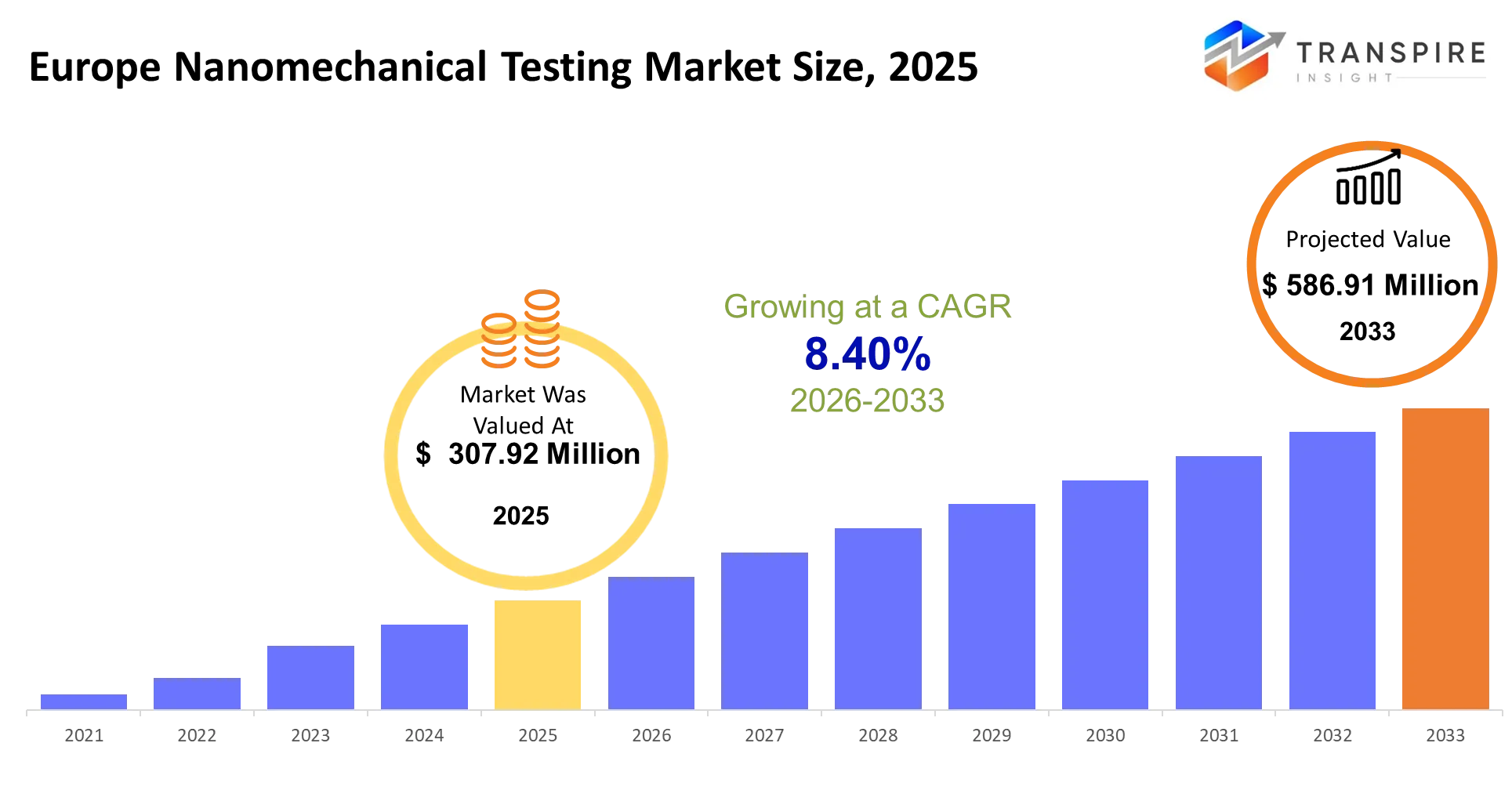
- Europe Nanomechanical Testing Market Size 2025: USD 307.92 Million
- Europe Nanomechanical Testing Market Size 2033: USD 586.91 Million
- Europe Nanomechanical Testing Market CAGR: 8.40%
-
Europe Nanomechanical Testing Market Segments: By Type (Nanoindentation, Microindentation, Scratch Testing, Others); By Application (Material Science, Semiconductors, Coatings, Biomedical Research, Nanotechnology Research, Others); By End-User (Research Institutes, Semiconductor Companies, Healthcare Sector, Universities, Industrial Firms, Others); By Technology (AFM-based Testing, Depth Sensing, Others)
To learn more about this report,  Download Free Sample Report
Europe Nanomechanical Testing Market Summary
The Europe Nanomechanical Testing Market was valued at USD 307.92 Million 2025. It is forecast to reach USD 586.91 Million by 2033. That is a CAGR of 8.40% over the period.
The Europe nanomechanical testing market supports industries that need to measure how materials behave at micro and nanoscale levels, especially in sectors like semiconductors, coatings, and advanced manufacturing which requires testing of small mechanical performance to achieve reliable product results. The tools work as practical instruments which engineers use to validate durability testing and thin film optimization and high-precision component failure prevention.
The market has moved toward automated high-throughput testing systems which use digital analysis platforms for testing. This reflects a broader move toward Industry 4.0 environments where materials data feeds directly into design and production systems. European manufacturers used local production networks and tighter quality control standards after supply chain disruptions which occurred during the COVID-19 pandemic to implement their manufacturing operations.
The companies invest in advanced testing systems which provide accurate measurements and testing capacity because they want to decrease material waste while increasing product validation speed and keeping their edge in manufacturing high-value products.
Key Market Insights
-
The market for Nanomechanical Testing in Europe is primarily led by Germany which controls approximately 28 percent of the market share during 2024 because of its advanced engineering capabilities and semiconductor industry strengths.
-
The Netherlands and France experience the highest growth rates which exceed 7 percent until 2030 because of their ongoing nanotechnology research activities and public funding initiatives.
-
The market for nanoindentation systems reaches 45 percent during 2024 when these systems get deployed to assess thin film and coating performance.
-
Atomic force microscopy (AFM) systems hold the second-largest share, driven by precision imaging and mechanical characterization capabilities.
-
The demand for real-time material analysis drives the rapid growth of in-situ testing solutions, which will continue to expand until 2030.
-
The semiconductor industry shows a 35 percent market share in 2024 because of the rising demand for complex chips and nanoscale reliability testing.
-
The energy storage and biomedical coatings fields experience the highest growth rates because of recent advancements in battery technology and materials used in implants.
-
The industrial manufacturing sector, which uses nanomechanical testing to ensure product quality and durability testing, accounts for more than 40 percent of industry demand.
-
EU-sponsored nanotechnology and materials science programs create growth opportunities for research institutes and universities, which represent the fastest-expanding sector.
-
The combination of software analytics with our system creates a business advantage because it delivers real-time information, which helps customers make better decisions.
What are the Key Drivers, Restraints, and Opportunities in the Europe Nanomechanical Testing Market?
Driver:
The Europe Nanomechanical Testing Market grows through a single force which stems from semiconductor manufacturers who push forward their efforts to make smaller chips and create better protective coatings. The semiconductor industry discarded traditional material testing methods because chipmakers now operate at manufacturing speeds below 10 nanometers since the last five years. The industry required manufacturers to adopt nanoindentation and in-situ testing systems which exceeded conventional material testing capabilities because they needed to measure mechanical properties at atomic scales. The industry experienced a critical failure point because high-density chips and thin films started to fail at increasing rates this led to higher production costs and reduced manufacturing output. The companies began spending more money to buy precision testing equipment because this technology helped them build product trustworthiness and decrease testing time while safeguarding their profit margins which led to increased sales from their testing equipment and maintenance services.
Restraint:
The nanomechanical testing systems create two major obstacles through their expensive requirements and their complicated technical needs. The instruments need both substantial initial costs and the establishment of special testing facilities and the presence of skilled operators. The implementation of these systems requires businesses to transform their current operations because these systems need to be combined with digital analysis systems which use advanced metrology techniques. The complicated system requires mid-sized manufacturers to take additional time to adopt it while it restricts itself to use in high-end sectors. The market absorbs this constraint through longer sales cycles and uneven adoption across regions which suppresses near-term revenue expansion despite clear technical benefits.
Opportunity:
The main business opportunity exists when companies bring together nanomechanical testing systems and artificial intelligence-based materials informatics platforms. The European research community and private sector funding sources have combined their efforts to develop digital materials engineering through which testing data serves as input for predictive modeling systems.The research project from Germany and the Netherlands establishes a connection between nano-testing results and machine learning tools to speed up material discovery processes. The combination of development resources through this process will create essential testing systems which serve as fundamental components for digital research and development environments, thus creating new business opportunities beyond traditional equipment sales.
What Has the Impact of Artificial Intelligence Been on the Europe Nanomechanical Testing Market?
Artificial intelligence together with advanced digital technologies bring fundamental changes to nanomechanical testing systems which now operate differently in European research laboratories and industrial manufacturing spaces. The AI-driven software system controls indentation testing through automatic load depth and sampling rate adjustments which occur during real-time material testing while decreasing the requirement for operator involvement and enhancing testing consistency. The automated control systems in high-throughput environments enable continuous testing of hundreds of assessments which leads to improved operational efficiency and better equipment usage.
Machine learning models use historical testing data to predict material failure points while assessing deformation behavior and wear pattern development. This technology enables manufacturers to identify potential performance problems with coatings and semiconductor materials before actual material failure takes place. The companies experience better validation efficiency together with less material waste because advanced facilities have shortened their testing cycles by 20 percent.
The operational process benefits from digital twin and data platform integration because it improves traceability while decreasing the time needed for design-to-production transitions. The absence of standardized high-quality datasets essential for robust AI model training remains an important limitation. The different testing conditions together with various material types lead to decreased model accuracy which makes it necessary to use more resources for model deployment than originally planned.
Key Market Trends
-
Since 2020 manufacturers have stopped using standalone nanoindentation instruments and now use unified systems which include imaging capabilities and testing functions and analytical tools to shorten their material validation process.
-
Semiconductor companies established a new standard which requires all equipment to operate with nanomechanical systems that maintain accuracy at 10 nanometer resolution to prevent production defects and equipment breakdowns.
-
Between 2021 and 2024 Bruker Corporation and KLA Corporation developed new testing software products which use AI technology to perform complicated measurement tasks without human intervention.
-
European research funding under Horizon programs increased investment in nanotechnology infrastructure by over 15% since 2021 which made it easier for academic institutions and industrial companies to work together.
-
Manufacturers required in-situ testing because they wanted to observe real-time deformation data which occurred during production instead of using post-production validation.
-
European companies moved their advanced material testing to local facilities because COVID-19 supply chain disruptions which resulted in stronger domestic equipment procurement and service networks.
-
Software integration has become the main purchasing requirement for buyers because over 40% of new systems which companies sold after 2023 now include cloud-based data analysis and remote monitoring features.
-
Energy storage and battery developers adopted nanomechanical testing after 2022 to assess electrode durability during multiple charge cycles and extreme stress testing.
-
The high system costs create an obstacle which prevents mid-sized manufacturers from adopting technology whereas large industrial companies and small production facilities maintain their operational capabilities.
Europe Nanomechanical Testing Market Segmentation
By Type:
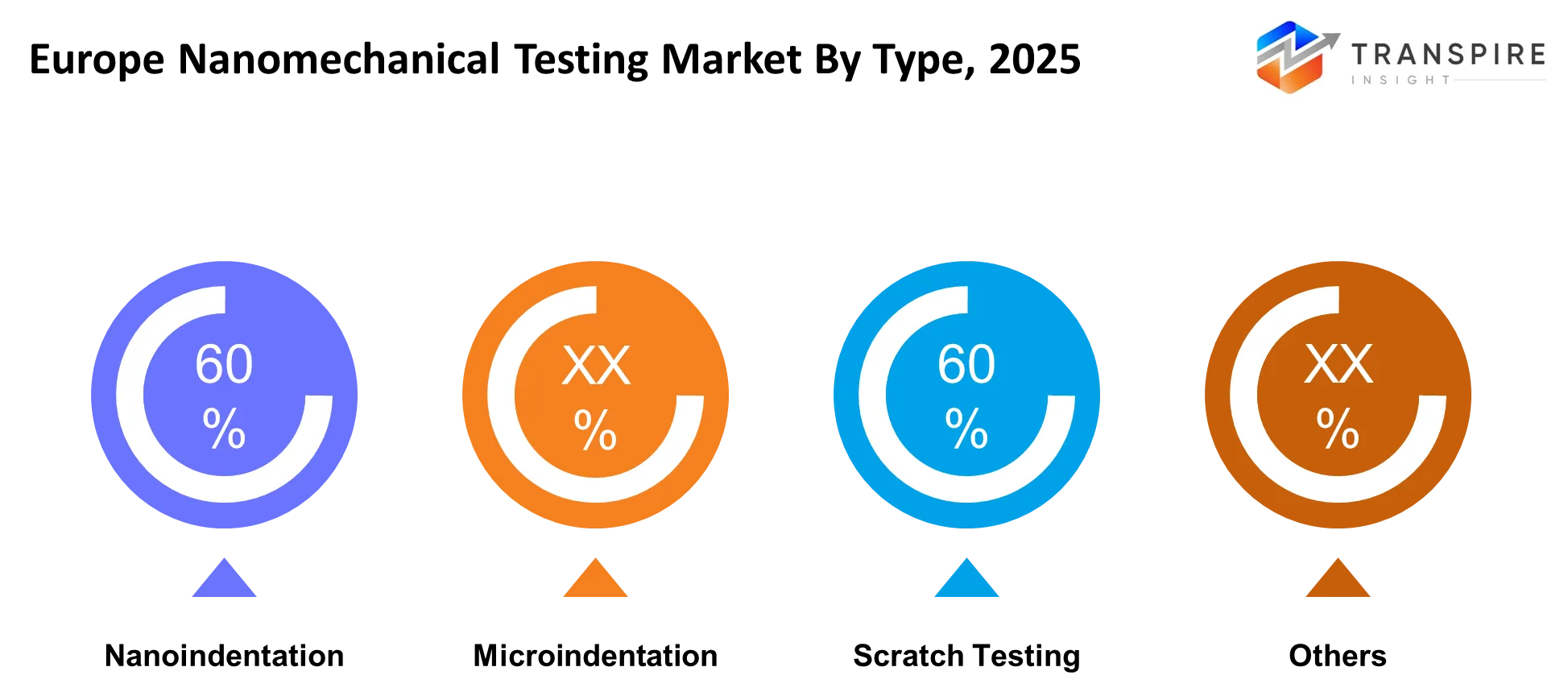
The proper way to categorize your data begins with the first option which divides data into distinct groups. Nanoindentation holds the leading position with more than 45% share because industries require accurate measurements of hardness and modulus at nanoscale dimensions. The semiconductor fabrication and thin film validation processes require complete process control because even the smallest mechanical defects can lead to equipment malfunction.
Microindentation and scratch testing follow as secondary segments which focus on evaluating coatings and bulk materials through less demanding testing processes. The demand for nanoindentation has increased because it is now used for producing less than 10 nanometer chips and developing advanced coatings. The automotive and aerospace industries now use scratch testing to evaluate their coatings because the wear resistance of these coatings affects their lifecycle costs. The application of microindentation testing in advanced materials development projects faces substantial obstacles which result in decreased market demand.
The future market demand will select hybrid systems which combine nanoindentation with both imaging and in-situ technology. Equipment manufacturers are expected to allocate their resources toward developing automated systems and multi-modal platforms which will enable them to address various industrial applications. Buyers will choose products which offer multiple functions and easy system integration instead of using tools which perform only one function.
To learn more about this report, Download Free Sample Report
By Application:
The semiconductor industry controls approximately 35% of application share because they need to meet strict reliability requirements while developing smaller devices. The field of material science ranks second in research activity which includes academic and industrial studies about polymers and metals and composites. The research areas of coatings and biomedical science maintain consistent market demand because surface engineering and implant durability research work require their capabilities.
The development of semiconductor technology depends on two factors which are node scaling and failure analysis requirements. The demand for biocompatible materials and implant testing under mechanical stress drives the expansion of biomedical applications. Western Europe benefits from public funding which supports nanotechnology research through international research partnerships.
The future of expansion will depend on two sectors which include energy storage and flexible electronics because these fields require precise control of mechanical properties at miniature dimensions. The diverse application needs of customers will compel vendors to develop systems that can effectively manage various material types. Testing will become the main focus for investors who want to understand how it impacts product commercialization schedules.
By End-User:
Industrial firms lead with over 40% share as manufacturers integrate nanomechanical testing into quality control and product validation processes. Semiconductor companies represent a significant portion given the direct link between material performance and chip yield. Research institutes and universities form a strong secondary base because they maintain continuous funding in nanoscience research
The industrial sector grows because companies need to decrease defects while they strive to boost their production efficiency. Companies in the semiconductor industry spend large amounts of money on advanced testing because they want to protect their manufacturing process from expensive production mistakes. Academic institutions use these systems for their research programs but need to reduce their expenses before they can implement them at full capacity.
Future demand will shift toward collaborative ecosystems where testing infrastructure will be shared by industry and academia. The healthcare sector will adopt new technologies because of the rising importance of implant reliability and biomaterials. Vendors will need to provide pricing and service options which can expand their services to smaller institutions and new customer bases.
By Technology:
AFM-based testing holds a dominant position because it can show atomic-level details through its combination of imaging and mechanical testing. The most common method for measuring hardness and elastic properties in thin films uses depth sensing technology. The other technologies serve specific industrial or research needs which result in their limited market presence.
AFM-based systems grow because of demand for simultaneous visualization and testing in semiconductor and nanotechnology research. Depth sensing remains relevant for standardized testing environments where repeatability and speed are critical. The high costs of equipment combined with operational complexities make it difficult for organizations to implement advanced technological solutions.
Future development will center on integrating multiple technologies into unified platforms. Vendors are expected to enhance software capabilities to simplify operation and improve data interpretation. Buyers will increasingly favor systems that balance precision with usability, especially in high-throughput industrial settings.
What are the Key Use Cases Driving the Europe Nanomechanical Testing Market?
The main driver of market adoption for semiconductor manufacturing lies in its requirement for nanomechanical tests which validate the strength of thin films and the bond between layers at nodes below 10 nanometers. The testing systems play a crucial role in production efficiency because even the slightest mechanical errors lead to decreased chip output.
The battery industry together with biomedical device manufacturing represents a growing field of application. Energy storage firms use these systems to assess electrode degradation under repeated charge cycles, while healthcare companies evaluate implant coatings for wear resistance and long-term biocompatibility under mechanical stress.
Flexible electronics and hydrogen storage materials present emerging use cases which face difficulties in maintaining mechanical stability during dynamic conditions. The integration of nanoscale testing into material design workflows exists as an early-stage project that multiple organizations across Germany and the Netherlands use to reduce their time needed for commercialization.
|
Report Metrics |
Details |
|
Market size value in 2025 |
USD 307.92 Million |
|
Market size value in 2026 |
USD 333.78 Million |
|
Revenue forecast in 2033 |
USD 586.91 Million |
|
Growth rate |
CAGR of 8.40% from 2026 to 2033 |
|
Base year |
2025 |
|
Historical data |
2021 - 2024 |
|
Forecast period |
2026 - 2033 |
|
Report coverage |
Revenue forecast, competitive landscape, growth factors, and trends |
|
Regional scope |
Europe (Germany, United Kingdom, France, Italy, Spain, Rest of Europe) |
|
Key company profiled |
Bruker, Agilent, Anton Paar, KLA Corporation, Thermo Fisher, Keysight, Fischer Technology, Nanovea, ZwickRoell, Micro Materials, Hitachi High-Tech, JEOL, Oxford Instruments, Shimadzu, MTS Systems |
|
Customization scope |
Free report customization (country, regional & segment scope). Avail customized purchase options to meet your exact research needs. |
|
Report Segmentation |
By Type (Nanoindentation, Microindentation, Scratch Testing, Others); By Application (Material Science, Semiconductors, Coatings, Biomedical Research, Nanotechnology Research, Others); By End-User (Research Institutes, Semiconductor Companies, Healthcare Sector, Universities, Industrial Firms, Others); By Technology (AFM-based Testing, Depth Sensing, Others) |
Which Regions are Driving the Europe Nanomechanical Testing Market Growth?
The market in Western Europe operates under German and French and Dutch industrial and research system which establishes Germany and France and the Netherlands as its main industrial power. The European Union establishes strict regulations on product reliability together with advanced manufacturing standards which compel companies to use precise testing equipment. The semiconductor industry maintains its demand through a network of semiconductor fabrication facilities and material testing laboratories and government-funded research centers. The partnership between business executives and research institutions creates a system which brings fresh ideas to the development of new testing methods.
Northern Europe serves as a dependable region which Sweden and Denmark use to create high-quality products through their research programs. The region maintains its focus on consistent operations through its established engineering practices which receive continuous governmental support. Companies test nanomechanical systems to uphold product quality standards required by medical device manufacturers and advanced coating producers. The business environment provides stable procurement patterns which lead to enduring relationships between buyers and their vendors.
Eastern Europe has become the most rapidly expanding area because industrial development progresses together with EU-financed infrastructure development. Since 2022 multiple nations expanded their semiconductor packaging capabilities and materials research facilities which created new requirements for testing equipment. Manufacturers who wish to create new production sites will find operational costs to be lower while workers acquire more technical knowledge. The current momentum enables equipment vendors and investors to create their businesses early while securing future growth until 2033.
Who are the Key Players in the Europe Nanomechanical Testing Market and How Do They Compete?
The Europe nanomechanical testing market exhibits moderate consolidation because a few global instrumentation companies maintain substantial market power while specialized firms focus on specific market segments. Buyers consider price as the least important factor because they value technology depth and software integration capabilities which enable precise and repeatable data analysis. Existing companies maintain their market position through ongoing product development and maintenance of their service networks, while new companies introduce cost-efficient modular systems. The market values companies that succeed in merging precise hardware performance with sophisticated data analysis capabilities and seamless operational system links.
Bruker Corporation provides a unique product through its integrated nanoindentation and atomic force microscopy systems which enable users to gather mechanical and structural data in one workflow. KLA Corporation develops semiconductor solutions by integrating nanomechanical testing into its yield management system, which helps customers in chip manufacturing environments. Anton Paar GmbH develops user-friendly systems with standardized testing methods, which industrial customers use to establish reliable quality assessment processes.
Oxford Instruments leverages its research partnerships with European academic institutions to create advanced characterization equipment, which accelerates its acceptance in academic and hybrid research environments. Keysight Technologies develops its business by connecting mechanical testing results with electronic measurement systems, which enables cross-disciplinary research. The companies use their strategies to attract different customer groups while building partnerships and developing regional distribution systems and enhancing their technological capabilities.
Company List
- Bruker
- Agilent
- Anton Paar
- KLA Corporation
- Thermo Fisher
- Keysight
- Fischer Technology
- Nanovea
- ZwickRoell
- Micro Materials
- Hitachi High-Tech
- JEOL
- Oxford Instruments
- Shimadzu
- MTS Systems
Recent Development News
“In April 2026, Bruker Corporation hosted the Nanobrücken 2026 conference in Austria, showcasing advanced nanoindentation, in-situ SEM/TEM testing, and high-precision instruments. This event reinforced technology leadership and accelerated industry adoption of next-generation nanomechanical testing techniques. https://www.bruker.com
“In May 2025, KLA Corporation opened a new semiconductor equipment and R&D facility in South Wales. The site strengthens its advanced materials and process control capabilities, supporting nanomechanical and thin-film analysis innovation in Europe. https://compoundsemiconductor.net
What Strategic Insights Define the Future of the Europe Nanomechanical Testing Market?
The Europe Nanomechanical Testing Market is moving toward fully integrated, data-centric platforms that connect material characterization directly with digital design and manufacturing systems. The semiconductor and energy storage and advanced coatings industries need to reduce their product development time because their products now depend on nanoscale performance for commercial success. Testing systems will progress from their present state as isolated devices during the next five to seven years to become essential components of digital engineering workflows.
The equipment market faces hidden dangers because users increasingly rely on a limited number of top-tier equipment suppliers which will restrict their ability to set prices while causing product development to progress more slowly because of decreased competition. AI-based materials discovery research presents a new opportunity that exists in Germany and the Netherlands because both countries are developing their battery and hydrogen technologies through public and private funding.
Organizations should invest in open-platform system development while establishing formal partnerships with software providers and research institutions to maintain their market position through upcoming interconnected system developments.
Europe Nanomechanical Testing Market Report Segmentation
By Type
- Nanoindentation
- Microindentation
- Scratch Testing
- Others
By Application
- Material Science
- Semiconductors
- Coatings
- Biomedical Research
- Nanotechnology Research
- Others
By End-User
- Research Institutes
- Semiconductor Companies
- Healthcare Sector
- Universities
- Industrial Firms
- Others
By Technology
- AFM-based Testing
- Depth Sensing
- Others
Frequently Asked Questions
Find quick answers to common questions.
The Europe Nanomechanical Testing Market size is USD 586.91 Million in 2033.
Key segments for the Europe Nanomechanical Testing Market are By Type (Nanoindentation, Microindentation, Scratch Testing, Others); By Application (Material Science, Semiconductors, Coatings, Biomedical Research, Nanotechnology Research, Others); By End-User (Research Institutes, Semiconductor Companies, Healthcare Sector, Universities, Industrial Firms, Others); By Technology (AFM-based Testing, Depth Sensing, Others).
Major Europe Nanomechanical Testing Market players are Bruker, Agilent, Anton Paar, KLA Corporation, Thermo Fisher, Keysight, Fischer Technology, Nanovea, ZwickRoell, Micro Materials, Hitachi High-Tech, JEOL, Oxford Instruments, Shimadzu, MTS Systems.
The Europe Nanomechanical Testing Market size is USD 307.92 Million in 2025.
The Europe Nanomechanical Testing Market CAGR is 8.40% from 2026 to 2033.
- Bruker
- Agilent
- Anton Paar
- KLA Corporation
- Thermo Fisher
- Keysight
- Fischer Technology
- Nanovea
- ZwickRoell
- Micro Materials
- Hitachi High-Tech
- JEOL
- Oxford Instruments
- Shimadzu
- MTS Systems
Recently Published Reports
-
Apr 2026
Fiber Optic Faceplates Market
Fiber Optic Faceplates Market Size, Share & Analysis Report By Type (< 300 mm2, 300-350 mm2, and > 350 mm2, By Application (Night Vision, Holographic Imaging, Medical, and Others), and Geography (North America, Europe, Asia-Pacific, Middle East and Africa, South and Central America), 2021 - 2031
-
Apr 2026
High Temperature Superconductors Market
High Temperature Superconductors Market Size, Share & Analysis Report By Type (1G HTS, and 2G HTS), By Application (Power Cable, Fault Current Limiter, and Transformer), and Geography (North America, Europe, Asia-Pacific, Middle East and Africa, South and Central America), 2021 - 2031
-
Apr 2026
Industrial Plugs and Socket Market
Industrial Plugs and Socket Market Size, Share & Analysis Report By Type (Industrial Plugs, Industrial Sockets), By Current (Up to 32 A, 32 to 125 A, Above 125 A), By Protection (Dustproof and Splash Proof, Waterproof, Explosion Proof), By End User (Heavy Industries, Oil and Gas, Chemicals and Pharmaceuticals, Power Generation, Others), and Geography (North America, Europe, Asia-Pacific, Middle East and Africa, South and Central America), 2021 - 2031
-
Apr 2026
InGaAs Avalanche Photodiodes Market
InGaAs Avalanche Photodiodes Market Size, Share & Analysis Report By Type (1100 - 1700 nm, and 1000 - 1600 nm), By Application (Missile Warning System, Muzzle Flash Detection, Wafer Defect Inspection, Laser Rangefinders, and Others), and Geography (North America, Europe, Asia-Pacific, Middle East and Africa, South and Central America), 2021 - 2031