
Electrical Enclosures Market Summary:
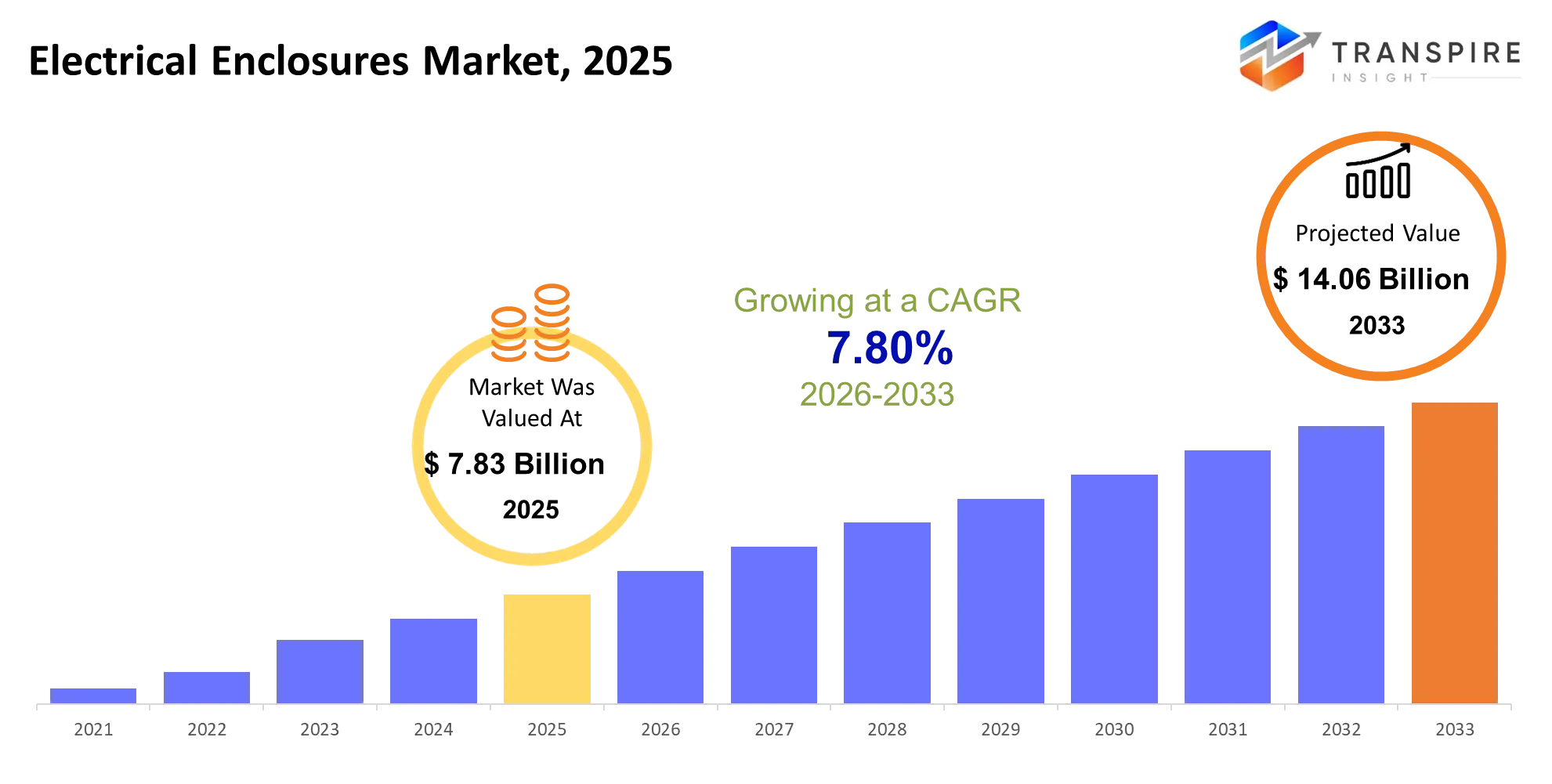
As per the Transpire Insight, The Electrical Enclosures Market size is estimated at USD 7.83 billion in 2025 and is anticipated to reach USD 14.06 billion by 2033, growing at a CAGR of 7.80% from 2026 to 2033.
The electrical enclosures market is maturing as industrial and utility customers and infrastructure operators look for safer and more flexible ways to protect their critical electrical assets. Power enclosures are used to protect switchgear, circuit breakers, control stations, and power distribution devices from potential dust, moisture, corrosion, heat, and human contact. Over the past three to five years, the market has shifted away from traditional fabricated metal cabinets to modular, thermally-managed and sensor-compatible enclosures. That trend has gained momentum thanks to the exponential growth in hyperscale data centres, renewable power generation and robotics-supported manufacturing. One structural change is the use of non-metallic and digitally monitored enclosures in addition to steel enclosures. The accelerated build-out of battery power storage systems and solar farms has increased demands for weatherproof and application-specific protection. As a result, manufacturers are stressing application-specific customisation, improved protection level and lifecycle reliability.
Electrical Enclosures Market Size & Forecast:
- Market Size 2025: USD 7.83 Billion
- Expected Market Value (2033): USD 14.06 Billion
- Forecast CAGR (2026–2033): 7.80%
- Leading Region in 2025: North America
- Fastest Growing Region: Asia Pacific
- Key Company Profiles: Rittal, Schneider Electric, ABB, Eaton, nVent, Legrand, Hubbell, Hammond Manufacturing, Pentair, Siemens, Eldon, Fibox, Adalet, Allied Moulded, Saginaw Control & Engineering.
Key Electrical Enclosures Market Insights:
As costs of electrical downtime rise with the growing deployment of electropower, the market is evolving from commodity protection to connected infrastructure that is tailored to each application. The advantages of now are in thermal engineering, customisation speed, depth of certifications, and digital-service capability.
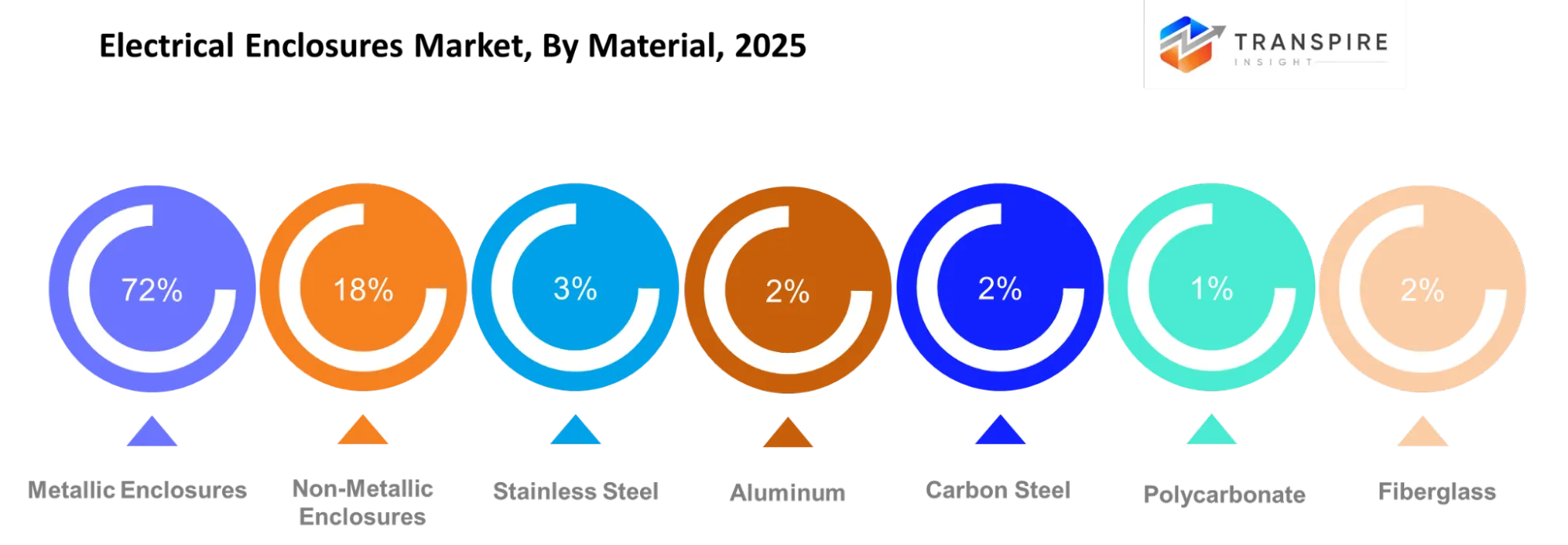
- The share of metallic enclosures is 72.0%, with Rittal's modular systems taking a step forward with integrated cooling, IoT monitoring, and rack designs that can be expanded.
- The non-metallic enclosures are expanding at a 6.1% CAGR, while Fibox distinguishes itself with corrosion-preventing polymer products for process and outdoor applications.
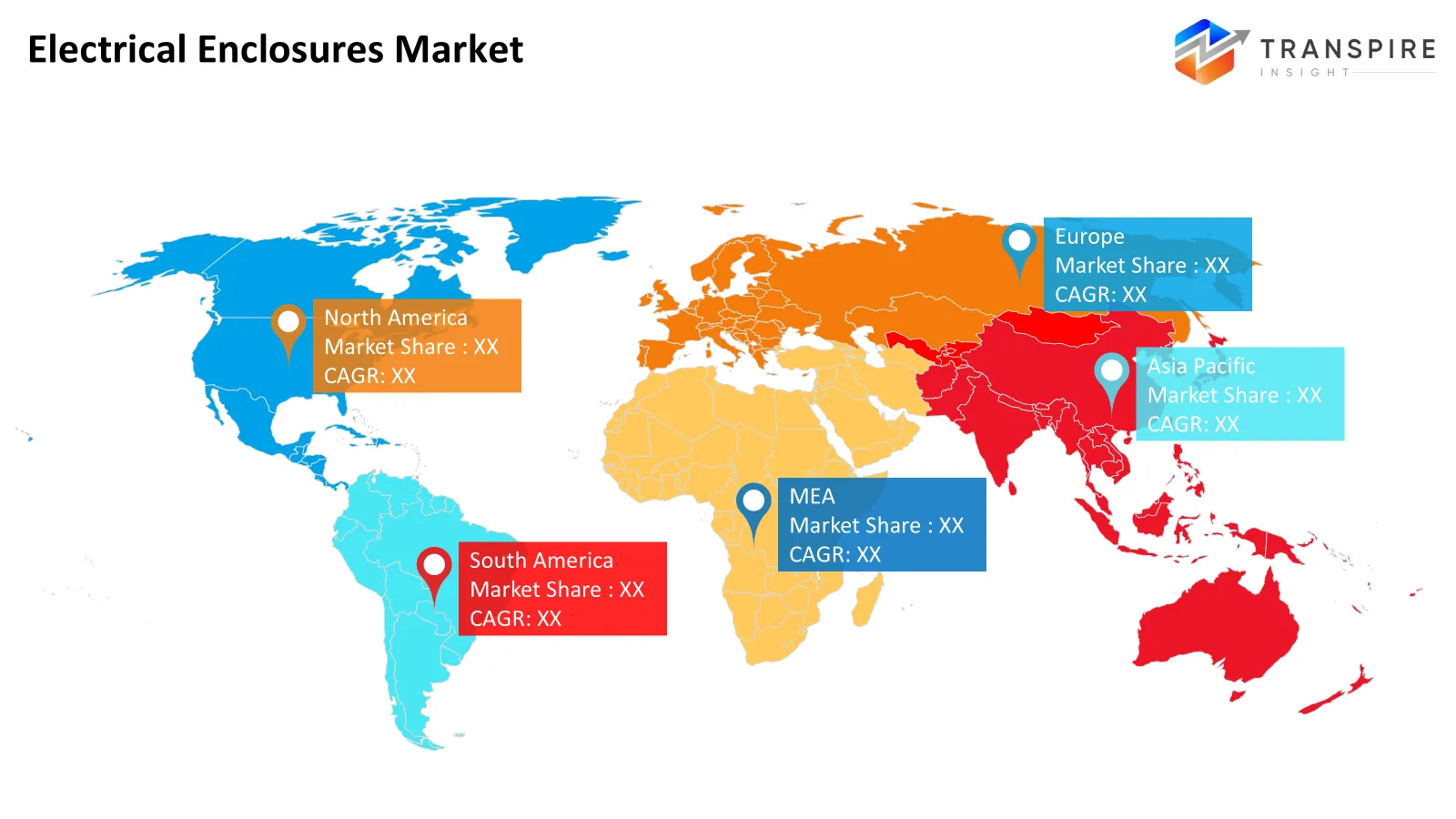
- North America represents 35.2% of the market. ABB merged with Bel Products in June 2025 to expand its North American business and manufacturing footprint.
- Schneider Electric continues to connect enclosures to Schneider Electric's EcoStruxure platform for predictive maintenance and energy optimisation, accounting for 29.9% of the European market.
- Asia Pacific accounts for 27.0% of the market and is expected to experience a CAGR of 7.0%, due to the growth of manufacturing, renewables and smart city infrastructure.
- They account for 4.9% of the total, and grid-upgrade, mining, and solar energy projects are increasingly driving localised enclosure supply in Latin America.
- Other areas include the Middle East and Africa, which make up 3.0%, and oil and gas operators, who still require explosion-proof and high-temperature-rated systems.
- Eaton's approach is integrated power management; nVent and Eldon's focus is on application-specific, engineered enclosure platforms.
- A shift toward pre-integrated cabinets, which offer protection, cooling, power distribution, and remote diagnostics, is underway with buyers.
What are the Key Drivers, Restraints, and Opportunities in the Electrical Enclosures Market?
Driver:
Enclosures specific to an application are also growing due to improvements to the electrical grid, more renewable energy solutions, and industrial automation. Solar inverters, battery storage solutions, and automated manufacturing systems all require enclosures with electrical assemblies that are protected against ambient conditions and operating 24/7. The expansion of hyperscale data centres is also driving higher purchases of high-density power distribution cabinets, resulting in more equipment and customers that are now building out their infrastructure using enclosures with higher levels of thermal management and protection.
Restraint:
Raw-material volatility, especially steel and aluminium, continues to pressure margins and lengthen lead times. The issue persists because enclosure manufacturing is metal-intensive, globally sourced, and exposed to energy prices, tariffs, and logistics disruption. Smaller fabricators also struggle to fund certifications, tooling, and rapid customisation, limiting their ability to compete for complex industrial and utility projects.
Opportunity:
Battery energy storage, EV charging infrastructure, and distributed renewable generation are creating demand for outdoor-rated, thermally managed, and corrosion-resistant enclosures that protect inverters, converters, switchgear, and monitoring equipment. Asia-Pacific and the Middle East offer particularly strong scope for modular and non-metallic systems, where harsh climates, coastal exposure, and rapid infrastructure build-out favour polycarbonate and fibreglass designs. Manufacturers that combine integrated cooling, IoT-based monitoring, and flexible mounting can move beyond commodity supply into higher-value, specification-led projects, building durable relationships with utilities, storage operators, and charging-network developers.
Driver Impact Analysis – Electrical Enclosures Market
|
Driver |
Relative Impact on Growth (%) |
Geographic Relevance |
Impact Timeline |
Demand Strength |
Growth Mechanism |
Key Beneficiaries |
Major Constraint |
|
Expansion of Power Infrastructure and Grid Modernization |
26% |
North America, Asia-Pacific, Europe, Middle East |
Medium-term (2–4 years) |
High |
Expanding substations and distribution networks increases enclosure installations. |
Switchgear manufacturers, utilities, enclosure suppliers, EPC contractors. |
High infrastructure investment and project approval costs. |
|
Increasing Industrial Automation and Smart Manufacturing Adoption |
22% |
Asia-Pacific, North America, Europe |
Long-term (≥4 years) |
High |
Automated production lines require durable control-panel protection systems. |
Industrial manufacturers, automation vendors, control-panel manufacturers. |
High initial automation investment and integration complexity. |
|
Growing Renewable Energy and Energy Storage Installations |
20% |
Asia-Pacific, Europe, North America, Middle East |
Medium-term (2–4 years) |
High |
Solar, wind, and battery projects require weather-resistant electrical enclosures. |
Renewable developers, BESS manufacturers, enclosure suppliers, utilities. |
Renewable project delays and fluctuating raw-material prices. |
|
Expansion of Data Centres and Telecommunications Infrastructure |
18% |
North America, Asia-Pacific, Europe |
Short-term (≤2 years) |
High |
AI infrastructure expansion increases demand for power-protection enclosures. |
Data-centre operators, electrical OEMs, cooling-system providers. |
Power availability constraints and infrastructure construction costs. |
|
Stringent Electrical Safety Standards and Demand for Advanced Enclosures |
14% |
Europe, North America, Asia-Pacific, Global |
Long-term (≥4 years) |
Medium |
Safety requirements encourage certified, corrosion-resistant, specialised enclosure adoption. |
Certified enclosure manufacturers, industrial operators, electrical component suppliers. |
Certification expenses and higher manufacturing costs. |
|
Total |
100% |
Global |
— |
— |
— |
— |
— |
What Has the Impact of Artificial Intelligence Been on the Electrical Enclosures Market?
AI changes the game for enhancing enclosures and opening the door to enclosures as part of an optimised, monitorable power ecosystem. One example is manufacturing, where machine-vision technologies enable inspections for seals, coatings, cutouts, and panel positioning to ensure protection performance remains intact and rework is avoided. Innovation also enables optimised designs with digital-twin simulations to optimise heat dissipation, cable management, structural strength, and component density before prototype creation, saving time and reducing material waste.
Smart enclosures, equipped with sensors monitoring temperature, humidity, vibration, access doors, and power quality, for example, can detect outlier patterns that can lead to the risk of condensation, overheating, or improper access, and trigger alerts for predictive maintenance to avert failures and disruptions, with benefits for increased uptime, safety, and lifecycle costs for users in renewable energy, oil and gas, telecommunications, and data-centre sectors, for example. The biggest stumbling block to intelligent enclosures is integration; it's costly and time-consuming to add sensors and analytic capabilities to existing, legacy installations, and the quality of resulting data depends on sensor positioning, connectivity, and model tuning. Without a common, open data architecture, many operators still think of enclosures as passive assets.
In January 2026, Electrix AI launched an automated layout generation and digital twin planning software platform. The integration of proprietary AI models and an interactive "AI Copilot" interface allows engineers to systematically automate enclosure layout construction from circuit diagrams in a fraction of the usual time.
Key Electrical Enclosures Market Trends:
The market is shifting from one standard protective housing to application-specific, connected, and thermally optimised infrastructure. Enclosures are now evaluated more as a way to add to uptime, compliance, and TCO than as a physical barrier.
- Growth in outdoor renewable projects is creating a demand for enclosures that are UV-stable, corrosion-resistant, and thermally managed, for inverters, storage, and grid equipment.
- Modular power-distribution cabinets for liquid cooling and cable density and higher loads are the result of AI-driven data-centre building.
- Manufacturers are incorporating IoT sensors to measure temperature, humidity, vibration and door access, so that they can offer condition-based maintenance.
- The modular, expandable, configurable enclosure is becoming more appealing to buyers as they require more power and automation.
- There are stricter ingress protection, EMC, and safety requirements, which are driving suppliers to provide certified, traceable, higher-quality designs.
- Environmental considerations are promoting recycled metals, reduced waste in manufacturing, and design for long life.
- The range of edge computing and small cells for 5G is driving the need for compact, weather-proof, tamper-resistant outdoor cabinets.
- Localisation in the supply chain is growing as project developers look for shorter lead times and tariff-resistant sourcing.
- Enclosure suppliers are going toward pre-integrated solutions that integrate protection, cooling, power distribution, and monitoring.
Electrical Enclosures Market Segmentation
Material:
Metallic enclosures represent the major chunk in the market, which occupies a market share of 72.0% because of their high durability, electrical grounding, and temperature tolerance, which make them compatible in industrial control as well as power distribution applications. Stainless steel market share is 3.0%, that of aluminium is 2.0%, while carbon steel is 1.5% because of their use in application areas like chemical industries and marine applications, where they can protect from corrosion. Non-metallic enclosure is growing at a rate of 6.1% CAGR with 18.0% of market share, as non-metallic ones give better insulation than those of metal. Polycarbonate is 1.2% while fibre glass is 1.0%; others constitute 1.3%. Moving forward, the hybrid model will see further expansion.
Product Type:
Junction boxes facilitate secure cable connections and circuit protection, while disconnect enclosures provide safe electrical isolation during maintenance. Operator interface enclosures house monitoring and control equipment, whereas control enclosures protect automation components. Floor-mounted designs accommodate larger electrical assemblies, while wall-mounted units suit space-constrained installations. Modular enclosures offer configurable layouts, allowing manufacturers and infrastructure operators to expand electrical capacity, simplify equipment replacement, and reduce installation complexity as operational requirements evolve.
Protection Level:
IP54 and IP55 enclosures protect against dust and water exposure in indoor and moderately demanding environments. IP65 and IP66 designs support applications requiring stronger resistance to dust ingress and water jets, particularly in outdoor industrial facilities. IP67 enclosures address temporary immersion conditions. NEMA-rated products serve applications with specific environmental protection requirements, while explosion-proof enclosures protect electrical installations in hazardous locations, including chemical processing, oil and gas, and combustible industrial environments.
Application:
Power distribution represents a major application, with enclosures protecting switchgear, circuit breakers and electrical assemblies across substations and distribution networks. Industrial automation and control systems require reliable housing for programmable logic controllers, drives and monitoring equipment. Renewable energy installations create opportunities for weather-resistant solar inverter and battery storage enclosures. Data centres require specialized cabinets with thermal management, while oil and gas and telecommunications depend on ruggedised designs for continuous operation under demanding environmental conditions.
End User:
Energy and power companies require durable enclosures for substations, transmission infrastructure and renewable energy installations. Manufacturing facilities purchase customized cabinets to protect machinery controls, automation systems, and electrical distribution equipment. Process industries prioritize corrosion resistance and operational safety in chemical and industrial environments. Construction projects require adaptable electrical protection for commercial buildings and infrastructure. Oil and gas operators, food and beverage manufacturers, and telecom companies need application-specific solutions addressing moisture, contamination, hazardous conditions, and equipment reliability.
Installation:
Indoor enclosures serve factories, commercial buildings, and electrical rooms where controlled environmental conditions support equipment protection. Outdoor installations require weather-resistant materials, suitable sealing, and corrosion protection. Wall-mounted configurations support compact control systems, whereas floor-mounted designs accommodate larger electrical assemblies. Pole-mounted enclosures serve utility distribution and telecommunications equipment, while underground installations require specialized protection against moisture and soil exposure. Modular configurations provide installation flexibility, enabling infrastructure operators to expand capacity and accommodate changing electrical requirements without extensive system redesign.
What are the Key Use Cases Driving the Electrical Enclosures Market?
The core use case is protecting control and power-distribution equipment in factories, utilities, and industrial automation systems. Metallic enclosures, which account for 72.0% of the market, are widely used to house PLCs, drives, switchgear, and operator interfaces where mechanical strength, grounding, and heat tolerance are essential.
Expanding applications include solar farms, wind installations, battery storage, EV charging, and telecom networks. These sites require outdoor-rated, corrosion-resistant enclosures for inverters, converters, distribution boards, and monitoring equipment exposed to weather, dust, and temperature swings.
Emerging use cases centre on AI-ready data centres and edge infrastructure. High-density computing requires modular power cabinets, improved airflow, intelligent monitoring, and liquid-cooling-compatible designs.
|
Report Metrics |
Details |
|
Market size value in 2025 |
USD 7.83 Billion |
|
Market size value in 2026 |
USD 8.32 Billion |
|
Revenue forecast in 2033 |
USD 14.06 Billion |
|
Growth rate |
CAGR of 7.80% from 2026 to 2033 |
|
Base year |
2025 |
|
Historical data |
2021 - 2024 |
|
Forecast period |
2026 - 2033 |
|
Report coverage |
Revenue forecast, competitive landscape, growth factors, and trends |
|
Regional scope |
United States; Canada; Mexico; United Kingdom; Germany; France; Italy; Spain; Denmark; Sweden; Norway; China; Japan; India; Australia; South Korea; Thailand; Brazil; Argentina; South Africa; Saudi Arabia; United Arab Emirates |
|
Key companies profiled |
Rittal, Schneider Electric, ABB, Eaton, nVent, Legrand, Hubbell, Hammond Manufacturing, Pentair, Siemens, Eldon, Fibox, Adalet, Allied Moulded, Saginaw Control & Engineering. |
|
Customization scope |
Free report customization (country, regional & segment scope). Available customized purchase options to meet your exact research needs. |
|
Report Segmentation |
Material (Metallic, Non-Metallic, Stainless Steel, Aluminum, Carbon Steel, Polycarbonate, Fiberglass, Others)Product Type (Junction Boxes, Disconnect Enclosures, Operator Interface Enclosures, Control Enclosures, Floor-Mounted Enclosures, Wall-Mounted Enclosures, Modular Enclosures, Others)Protection Level (IP54, IP55, IP65, IP66, IP67, NEMA Rated, Explosion-Proof, Others)Application (Power Distribution, Industrial Automation, Control Systems, Renewable Energy, Data Centers, Oil & Gas, Telecommunications, Others)End User (Energy & Power, Manufacturing, Process Industries, Construction, Oil & Gas, Food & Beverage, Telecom, Others)Installation (Indoor, Outdoor, Wall-Mounted, Floor-Mounted, Pole-Mounted, Underground, Modular, Others). |
Which Regions are Driving the Electrical Enclosures Market Growth?
North America accounts for 35.2 of demand, in part, because of efforts to modernize the grid and build new data centres, bring manufacturing back to North America, and the region's strict electrical codes and standards. North America's ecosystem of increasingly reliable utility infrastructure, industrial automation adoption and significant investment in digital infrastructures supporting AI amplify the demand for high-density control cabinets and outdoor-rated enclosures, while policy support for domestic manufacturing and clean energy deployment drives demand for certified, local products.
In October 2026, Rockwell Automation unveiled its new EtherNet/IP In-cabinet Solution along with the AI-ready LogixEdge Controller at Automation Fair 2026. This development allows high-density control cabinets to seamlessly integrate IT and OT workloads while bolstering cybersecurity and hardware resilience right on the plant floor.
Europe accounts for 29.9%, while North America's data centre market accounts for more data centres, with new regulation and energy switchers driving its growth. Replacement of ageing grids, the even greater decarbonization of industry, expansion of EV charging infrastructure and strict safety and environmental standards that benefit higher-specification and standard enclosures have resulted in many well-known homegrown players such as Rittal, Schneider Electric, ABB, Siemens, and Legrand, ensuring a stable supply base and consistent flow of innovations.
In June 2026, Schneider Electric showcased its next-generation DC-Coupled Megawatt Charging Station at the Power2Drive Europe exhibition. This system combines megawatt charging capabilities, battery energy storage, and distributed energy resources within an integrated DC microgrid to overcome severe capacity constraints on local grids.
Asia Pacific is the fastest-growing market at 7.0% CAGR and is the largest market at 27.0% share. Recent wins have centred around the rapid growth of new renewable capacity, deployments in semiconductors & electronics manufacturing, and electrification in China, India, and Southeast Asia. Emerging is the on-shoring of modular, corrosion-resistant, and smart enclosures for solar, storage, telecom, and industrial projects in which price and short project timelines benefit the region's vendors.
In October 2026, Sigenergy launched its SigenCube, a smart, cabinet-style commercial and industrial battery energy storage enclosure, at the Renewable Energy India Expo. The intelligent, integrated solution combines modular solar conversion and battery storage with an AI-driven energy management system to maximise solar self-consumption and lower electricity costs for regional businesses.
Who are the Key Players in the Electrical Enclosures Market, and how do they compete?
Industry competition depends on product breadth and industry overlap, engineering competency, levels of customisation, distribution depth, and application-specific standards of protection. Rittal, Schneider Electric, ABB, Eaton, nVent and Legrand compete on electrical infrastructure portfolios, while niche integrators have differentiated products and application-specific fabrication capabilities.
Rittal focuses on modular enclosures, thermal management and digital engineering through the EPLAN ecosystem. Schneider Electric on PanelSeT, PrismaSeT, and sustainable material innovations. ABB combines distribution enclosures with installation flexibility. Eaton on scale manufacturing with a range of customer-specific modular solutions. NVent on engineered protection and thermal management. And Legrand on electrical and digital infrastructure applications. Hubbell competes through utility and industrial automation and power solutions; Hammond Manufacturing through modular configurable standard products; and Pentair through industrial protection expertise. Siemens through integration of electrical distribution and automation control. Eldon through modular and non-metallic solutions and Fibox non-metallic enclosures. Adalet through hazardous locations protection; Allied Moulded through composite enclosures; and Saginaw Control & Engineering through custom fabrication. All compete based on differentiated application solutions, distribution channels, product innovation, and manufacturing agility.
Key Players are:
- Rittal
- Schneider Electric
- ABB
- Eaton
- nVent
- Legrand
- Hubbell
- Hammond Manufacturing
- Pentair
- Siemens
- Eldon
- Fibox
- Adalet
- Allied Moulded
- Saginaw Control & Engineering
Electrical Enclosures Market — Enhanced Competitive Benchmarking
|
Company |
Est. Revenue Share Range |
Key Offerings |
Strategic Positioning |
Geographic Strength |
Technology Focus |
|
Rittal GmbH & Co. KG |
5–8% |
VX25, AX/KX enclosures, TS 8 systems, climate-control enclosures |
enclosure specialist with modular systems leadership |
Europe, North America, Asia Pacific |
Modular enclosure architecture and automated panel manufacturing |
|
Schneider Electric SE |
4–7% |
PanelSeT SFN, S3D, PLM, Thalassa industrial enclosures |
Premium integrated solutions with extensive customization capabilities |
Europe, North America, Asia Pacific |
Sustainable materials, thermal optimization and digital configuration |
|
nVent Electric plc |
3–6% |
HOFFMAN enclosures, SCHROFF cabinets, wall-mount and floor-standing enclosures |
Broad enclosure portfolio targeting industrial and infrastructure applications |
North America, Europe, Asia Pacific |
Modular cabinet systems, thermal management and protection engineering |
|
ABB Ltd. |
3–5% |
SR2 enclosures, automation cabinets, distribution enclosures, industrial panel systems |
Electrical distribution integration and industrial automation specialization |
Europe, Asia Pacific, North America |
High-IP protection, modular panel design and electrical integration |
|
Eaton Corporation plc |
3–5% |
Crouse-Hinds enclosures, industrial control enclosures, electrical distribution cabinets, hazardous-area enclosures |
Safety-focused solutions for critical electrical infrastructure |
North America, Europe, Asia Pacific |
Hazardous-area protection, corrosion resistance and enclosure safety |
|
Hubbell Incorporated |
2–4% |
Quazite enclosures, electrical junction boxes, utility enclosures, meter enclosures |
Utility-focused specialization and durable infrastructure solutions |
North America, Latin America |
Weather-resistant materials and underground utility protection |
|
Legrand SA |
2–4% |
XL³ distribution enclosures, electrical cabinets, distribution boards, modular enclosures |
Building infrastructure specialization and distribution-system integration |
Europe, North America, Asia Pacific |
Modular electrical distribution and compact enclosure architecture |
|
Hammond Manufacturing Ltd. |
1–3% |
Type 4X enclosures, 1418 freestanding cabinets, disconnect enclosures, operator-interface enclosures |
Broad standard-product selection and custom enclosure manufacturing |
North America, Europe |
Metal and non-metallic fabrication with NEMA-rated protection |
|
Fibox Oy Ab |
1–2% |
ARCA IEC enclosures, CAB cabinets, polycarbonate boxes, polyester enclosures |
Specialty non-metallic enclosure and harsh-environment positioning |
Europe, North America, Asia Pacific |
Injection-moulded plastics and advanced environmental sealing |
|
Siemens AG |
1–3% |
SIVACON cabinets, ALPHA distribution boards, industrial control cabinets, power distribution enclosures |
Integrated switchgear and industrial infrastructure solutions |
Europe, Asia Pacific, North America |
Modular switchgear integration and digital engineering |
Recent Development News
- In April 2026, Mouser Electronics signed a distribution agreement with Transtector, expanding the availability of Transtector's NEMA equipment enclosures, surge protection devices, and power distribution solutions through its international distribution network. The agreement strengthens product accessibility for industrial, utility, telecommunications, and critical infrastructure applications. https://www.mouser.in/en/newsroom/publicrelations-transtector-new-manufacturer-2026final/
- In September 2026, Eaton announced an investment of more than USD 242 million to establish a new manufacturing facility in North Little Rock, Arkansas, expanding its customized modular electrical enclosure production capacity by nearly two times. The investment strengthens manufacturing capabilities to address growing requirements from data centres, utilities, industrial facilities and digital communications infrastructure. https://www.eaton.com/us/en-us/company/news-insights/news-releases/2026/eaton-expands-manufacturing-for-modular-electrical-enclosures.html
- In October 2026, nVent Electric plc secured a lease for a new 400,000-square-foot production facility in Goodyear, Arizona. This footprint expansion scales up the industrial manufacturing capacity of its engineered buildings division, directly boosting output for prefabricated electrical houses (e-houses) to meet growing grid modernisation demands. https://investors.nvent.com/press-releases/press-release-details/2026/nVent-Expands-Engineered-Buildings-Manufacturing-Capacity-with-New-U-S--Production-Facility/default.aspx
What Strategic Insights Define the Future of the Electrical Enclosures Market?
The smart energy consumer is driving the market toward pre-engineered connected cabinets equipped with plug-and-play functions to address equipment cooling and protection, power distribution, and diagnostics to fuel larger renewable energy projects, artificial intelligence (AI) data centres, and electrified industries. However, one hidden watch-out is the trend to "over-standardise" solutions as customer requirements for speed to customize increase, and suppliers reliant on lock-step product families lose market share to regional manufacturers with more flexible architectures. An attractive white space is the emerging growth of AI-ready modular infrastructure where manufacturers can profit from thermal management, sensor packages, and lifecycle analytics. From a strategic perspective, electrical equipment manufacturers should consider configurable product architectures, localisation of manufacturing close to high growth corridors for power and data centre markets, and expansion of channel partner infrastructure developer relationships. They should also attempt to leverage digital monitoring, predictive maintenance, and performance analytics to offer recurring maintenance and services instead of a one-and-done hardware sale.
Key Segmentations are:
Material
- Metallic
- Non-Metallic
- Stainless Steel
- Aluminium
- Carbon Steel
- Polycarbonate
- Fibreglass
- Others
Product Type
- Junction Boxes
- Disconnect Enclosures
- Operator Interface Enclosures
- Control Enclosures
- Floor-Mounted Enclosures
- Wall-Mounted Enclosures
- Modular Enclosures
- Others
Protection Level
- IP54
- IP55
- IP65
- IP66
- IP67
- NEMA Rated
- Explosion-Proof
- Others
Application
- Power Distribution
- Industrial Automation
- Control Systems
- Renewable Energy
- Data Centres
- Oil & Gas
- Telecommunications
- Others
End User
- Energy & Power
- Manufacturing
- Process Industries
- Construction
- Oil & Gas
- Food & Beverage
- Telecom
- Others
Installation
- Indoor
- Outdoor
- Wall-Mounted
- Floor-Mounted
- Pole-Mounted
- Underground
- Modular
- Others
By Regional Analysis
North America
- US
- Canada
- Mexico
Europe
- Germany
- UK
- France
- Italy
- Spain
- Russia
- Rest of Europe
Asia Pacific
- China
- Japan
- India
- South Korea
- Australia
- Rest of Asia Pacific
South America
- Brazil
- Argentina
- Rest of South America
Middle East & Africa
- UAE
- Saudi Arabia
- Qatar
- South Africa
- Rest of the Middle East & Africa
Frequently Asked Questions
Find quick answers to common questions.
The electrical enclosures market size was valued at USD 7.83 billion in 2025 and is poised to reach USD 14.06 billion by 2033, expanding at a 7.80% CAGR.
Key segments for the electrical enclosures market are Material (Metallic, Non-Metallic, Stainless Steel, Aluminum, Carbon Steel, Polycarbonate, Fiberglass, Others)Product Type (Junction Boxes, Disconnect Enclosures, Operator Interface Enclosures, Control Enclosures, Floor-Mounted Enclosures, Wall-Mounted Enclosures, Modular Enclosures, Others)Protection Level (IP54, IP55, IP65, IP66, IP67, NEMA Rated, Explosion-Proof, Others)Application (Power Distribution, Industrial Automation, Control Systems, Renewable Energy, Data Centers, Oil & Gas, Telecommunications, Others)End User (Energy & Power, Manufacturing, Process Industries, Construction, Oil & Gas, Food & Beverage, Telecom, Others)Installation (Indoor, Outdoor, Wall-Mounted, Floor-Mounted, Pole-Mounted, Underground, Modular, Others).
Growth is primarily driven by grid modernization, renewable energy installations, industrial automation, expansion of AI data centres, rising electricity infrastructure investments, and demand for durable, weather-resistant electrical protection systems.
The electrical enclosures market is led by major manufacturers including Rittal, Schneider Electric, ABB, Eaton, nVent, Legrand, Hubbell, Hammond Manufacturing, Pentair, Siemens, Eldon, Fibox, Adalet, Allied Moulded, and Saginaw Control & Engineering.
North America dominates the electrical enclosures market with a 35.2% share, supported by grid modernization, established manufacturing capabilities, data-centre investments, industrial automation, and renewable energy infrastructure development.
Key opportunities include AI data-centre infrastructure, battery energy storage, EV charging networks, smart monitoring systems, modular enclosures and corrosion-resistant non-metallic materials.
- Rittal
- Schneider Electric
- ABB
- Eaton
- nVent
- Legrand
- Hubbell
- Hammond Manufacturing
- Pentair
- Siemens
- Eldon
- Fibox
- Adalet
- Allied Moulded
- Saginaw Control & Engineering
About the Authors

Avinash Kumar
I’m Avinash Kumar, a Senior Research Analyst at Transpire Insight, with expertise in the Electronics and Semiconductor and Energy & Power industry. My work focuses on analyzing emerging technologies, market trends, industry developments, and innovation across these sectors. I specialize in transforming complex technical and market insights into clear, research-backed content that helps professionals, businesses, and decision-makers stay informed. Through continuous industry research and data-driven analysis, I strive to deliver accurate, reliable, and practical perspectives on the latest advancements shaping the semiconductor and energy landscape.

Chakradhar Khansole
Chakradhar serves as the Research Director at Transpire Insight, bringing over 8 years of experience in technology, innovation, and strategic market intelligence. He specializes in transforming complex market data into actionable business insights that enable organizations to make informed, growth-oriented decisions. Recognized for his strategic vision and analytical expertise, Chakradhar leads high-impact research initiatives, delivering comprehensive market assessments, competitive intelligence, and forward-looking industry analysis.
Recently Published Reports
-
Apr 2026
Fiber Optic Faceplates Market
Fiber Optic Faceplates Market Size, Share & Analysis Report By Type (< 300 mm2, 300-350 mm2, and > 350 mm2, By Application (Night Vision, Holographic Imaging, Medical, and Others), and Geography (North America, Europe, Asia-Pacific, Middle East and Africa, South and Central America), 2021 - 2031
-
Apr 2026
High Temperature Superconductors Market
High Temperature Superconductors Market Size, Share & Analysis Report By Type (1G HTS, and 2G HTS), By Application (Power Cable, Fault Current Limiter, and Transformer), and Geography (North America, Europe, Asia-Pacific, Middle East and Africa, South and Central America), 2021 - 2031
-
Apr 2026
Industrial Plugs and Socket Market
Industrial Plugs and Socket Market Size, Share & Analysis Report By Type (Industrial Plugs, Industrial Sockets), By Current (Up to 32 A, 32 to 125 A, Above 125 A), By Protection (Dustproof and Splash Proof, Waterproof, Explosion Proof), By End User (Heavy Industries, Oil and Gas, Chemicals and Pharmaceuticals, Power Generation, Others), and Geography (North America, Europe, Asia-Pacific, Middle East and Africa, South and Central America), 2021 - 2031
-
Apr 2026
InGaAs Avalanche Photodiodes Market
InGaAs Avalanche Photodiodes Market Size, Share & Analysis Report By Type (1100 - 1700 nm, and 1000 - 1600 nm), By Application (Missile Warning System, Muzzle Flash Detection, Wafer Defect Inspection, Laser Rangefinders, and Others), and Geography (North America, Europe, Asia-Pacific, Middle East and Africa, South and Central America), 2021 - 2031