
Downhole Drilling Tools Market Summary:
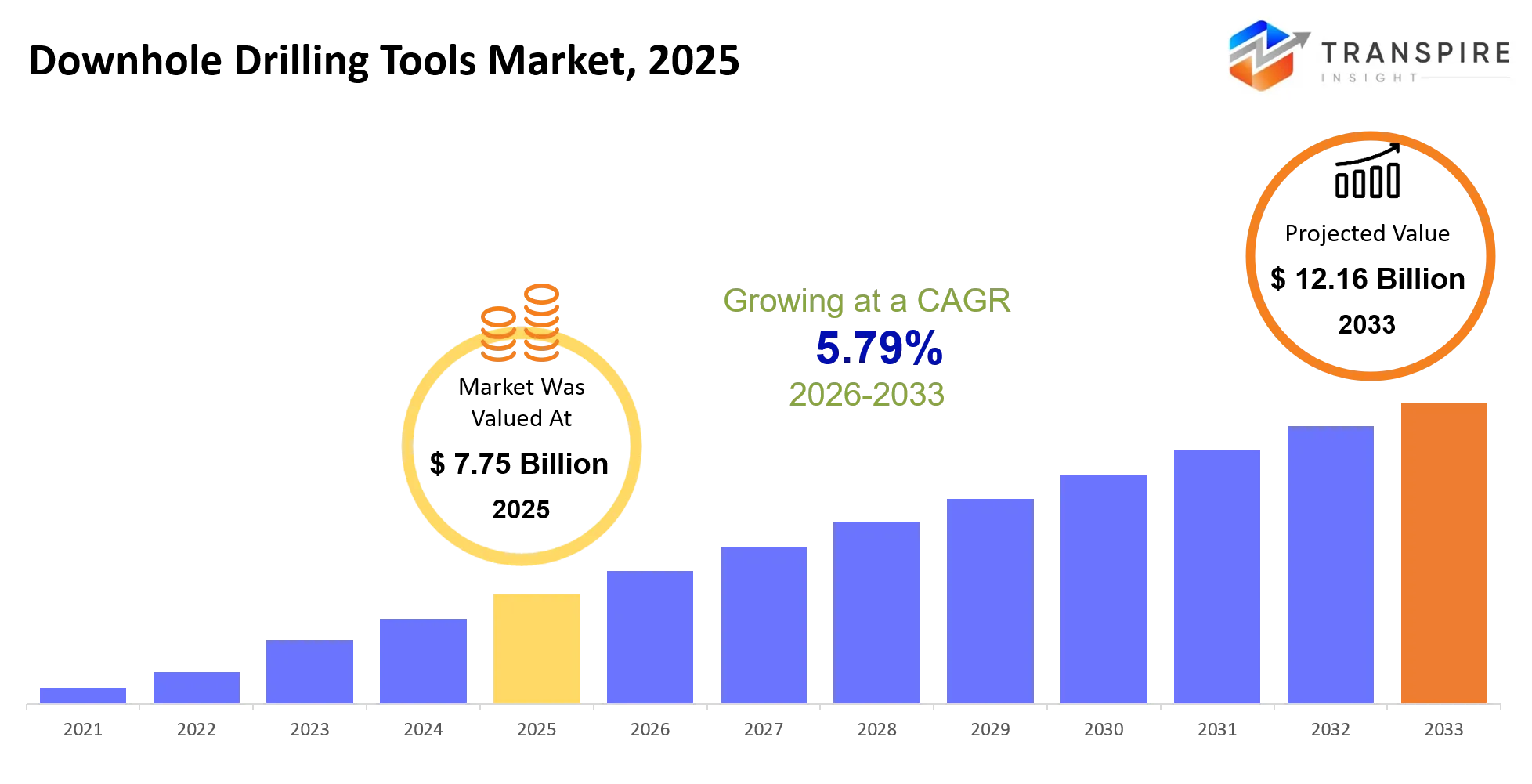
As per the Transpire Insight Analysis, The Downhole Drilling Tools Market size is estimated at USD 7.75 billion in 2025 and is anticipated to reach USD 12.16 billion by 2033, growing at a CAGR of 5.79% from 2026 to 2033.
The downhole drilling tools market supplies operators with downhole tools to support drilling, steering, measurement, pressure control, and borehole maintenance in complex and challenging subsurface conditions. Over the last three to five years, the market has transitioned from being comprised mainly of stand-alone mechanical tools to digitally connected systems combining MWD/LWD data, rotary steerable control, and real-time analytics. This structural change has been driven by the needs of longer horizontal shale wells, deeper offshore developments, and more-restrictive well- integrity standards, where inaccurate placement and unplanned tool failure become more expensive. One real-world catalyst for this transition has been the requirement to reduce non-productive time in complex drilling campaigns while satisfying increasingly rigorous methane-monitoring and leak-repair requirements. As wells grow hotter, deeper, and more geometrically complex, operators are replacing legacy steerable technologies with higher-performance sensors, motors, and steering systems. This increases the value of each well, as reliable and data-enabled tools prevent sidetracks, avoid the expense of stuck pipe, and improve reservoir contact.
Downhole Drilling Tools Market Size & Forecast:
- Market Size 2025: USD 7.75 Billion
- Expected Market Value (2033): USD 12.16 Billion
- Forecast CAGR (2026–2033): 5.79%
- Leading Region in 2025: North America
- Fastest Growing Region: Asia Pacific
- Key Company Profiles: Baker Hughes, Halliburton, SLB, NOV, Weatherford, Nabors Industries, Helmerich & Payne, Hunting, National Oilwell Varco, Vallourec, Schoeller-Bleckmann, Dril-Quip, Gyrodata, Scientific Drilling, Archer.
Key Downhole Drilling Tools Market Insights:
Rig-time variability is the new currency in the market, as operators are willing to pay for tools that lessen the variability in rig time, rather than just mechanical components. The digital integration is driving competition in connected steering, measurement, automation, and lifecycle-service packages.
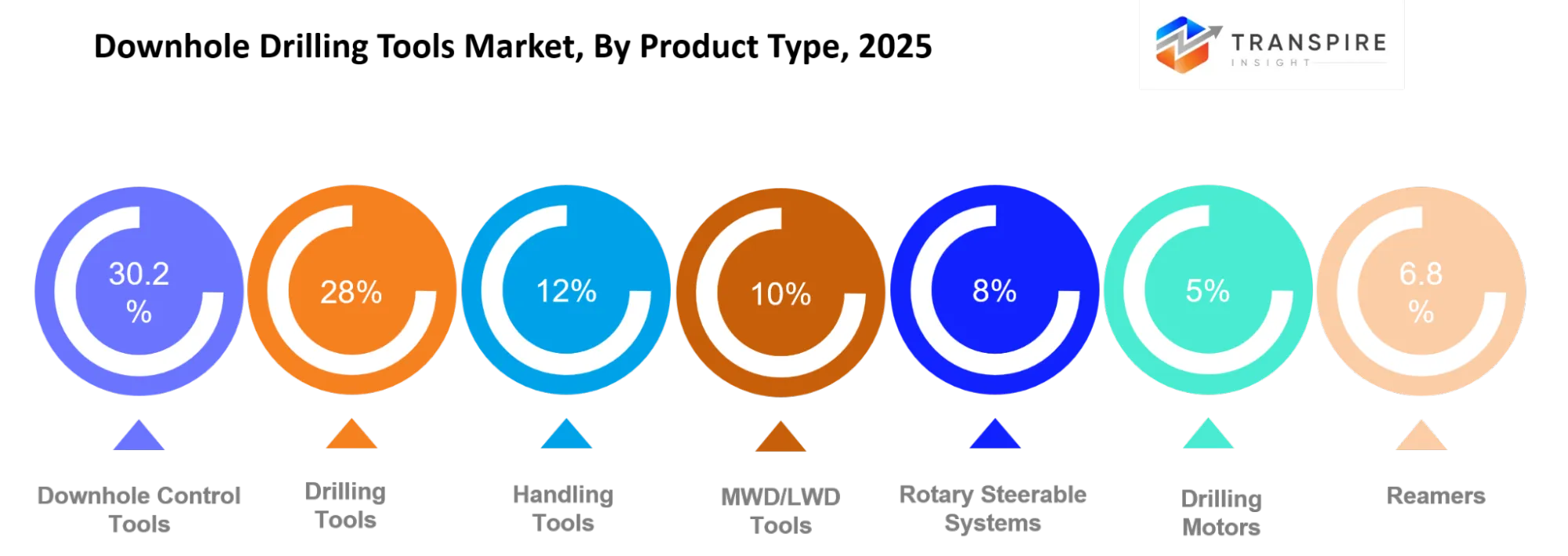
- Downhole Control Tools have 30.2%, and Halliburton is adding LOGIX automation to Nabors SmartROS to standardise drilling execution.
- Drilling Tools make up 28%, and Baker Hughes is beefing up its automated optimisation for complex directional wells, based on its AutoTrak software.
- Handling Tools make up 12%, and rig contractors are using mechanised handling to create a safer working environment for their crew and to minimise the variation in connection time.
- MWD/LWD Tools have 10% ownership, and SLB is integrating real-time data with closed-loop steering through its digital drilling workflows.
- Rotary Steerable Systems account for 8% of the market: H&P's RSS downlinking schema enhances interoperability among rig-control and third-party tool systems.
- Drilling Motors make up 5%; hybrid motor-RSS designs are tackling torque and friction in longer horizontal laterals.
- Reamers account for 4%, and vibration-aware hole-conditioning tools are becoming commonplace for operators to safeguard their casing-running schedules.
- Other tools account for 2.8%, and specialised HPHT components are finding their way in where conventional elastomers and electronics are failing early.
What are the Key Drivers, Restraints, and Opportunities in the Downhole Drilling Tools Market?
Driver:
Growth is being propelled by the offshore drilling rising technical intensity of drilling rather than simply by a higher well count. Extended-reach horizontal wells in shale and tight-oil formations require precise trajectory control, continuous formation evaluation, and reliable pressure management. The trigger is the higher cost of drilling errors: a poorly placed lateral, excessive vibration, or premature tool failure can consume rig days and reduce reservoir recovery. Consequently, drilling contractors and operators are adopting MWD/LWD packages, drilling motors, reamers, and rotary steerable systems that improve rate of penetration, wellbore quality, and placement accuracy. This expands revenue per drilling campaign because tool providers increasingly supply integrated hardware, telemetry, software, and field-service support.
Restraint:
High acquisition and operating costs limit adoption, especially among independent operators and in lower-margin mature fields. Advanced tools must withstand vibration, corrosive fluids, high pressure, and high temperature, requiring specialised materials, calibration, maintenance, and trained crews. This structural cost burden persists because downhole failure risk cannot be eliminated through low-cost substitutes.
Opportunity:
Electrified, automated, and digitally enabled drilling systems are creating new demand in complex offshore, HPHT, geothermal, and extended-reach unconventional wells. Wired drill pipe and high-speed telemetry transform the drillstring into a real-time data network, allowing faster formation imaging, continuous tool-health monitoring, and closed-loop optimisation of drilling parameters. This reduces data latency, limits non-productive time, and improves well placement in difficult reservoirs. Service companies that combine intelligent downhole tools with remote operations centres can shift from one-time equipment rentals to recurring, performance-linked digital-service revenue.
What Impact Has Artificial Intelligence Had on the Downhole Drilling Tools Market?
Artificial intelligence is advancing downhole drilling tools from measurement devices to adaptive control systems. Machine-learning models can seamlessly connect data from MWD and LWD tools, torque, vibration, pressure, rate of penetration, formation indicators, and past well results to recognise anomalies, predict bit or tool wear, and suggest drilling parameters prior to when it causes degradation. This and other predictive applications can further improve wellbore stability, hydraulics, trajectory control and diagnostics. In automated RSS workflows, models can interpret deviations in the planned downhole trajectory and make near real-time correction suggestions for the rig to make, reducing the need for human intervention.
AI is also used to integrate formation measurements and the surface well plan for enhanced geosteering, helping optimise reservoir position and reduce correction hours. In 2026, Level 3 automation of RSS downhole trajectory control was identified by the Society of Petroleum Engineers, and AI-autonomous drilling was proved out in deepwater operations and integrated with rig and downhole equipment. The main challenge is integration; a model needs high-frequency, reliable data and needs to operate across legacy systems, geographies, and formations, with multiple safety constraints, validations, and broad generalizations.
In January 2026, Baker Hughes launched its TRU-Steer rotary steerable system (RSS) alongside the PermaFORCE-TRU PDC drill bit. This coordinated equipment design protects the system from premature failure, mitigates downhole dysfunctions, and reduces overall maintenance costs during autonomous drilling operations.
Key Downhole Drilling Tools Market Trends:
The market will shift from a single downhole tool to connected, automated tool strings that will convert measurements to drilling actions. The main transition is the closer coupling between sensing, steering, pressure control, rig automation, and real-time decision-making.
- More slide-intensive directional drilling techniques are being phased out in favour of rotary steerable systems where smoother wellbores and better trajectory control are warranted by the increased cost of the tools.
- MWD/LWD is moving from a post-drill confirmation process to real-time formation evaluation and proactive geosteering.
- Drilling teams can make adjustments to parameters while conditions are still actionable with the help of wired drill pipe and faster telemetry.
- AI-powered drilling is moving from advisory dashboards to autonomous directional drilling in specific repeatable sections of a well.
- The increasing use of tool-health sensors to monitor shock, vibration, and temperature allows for predictive maintenance and prevents a downhole failure from driving a trip.
- High-reliability, pressure-resistant systems are being favoured for offshore and deep water campaigns, because intervention becomes more costly with water depth.
- The need for extended hole quality is growing as long shale laterals increase the demand for friction management tools, reamers and motors.
- Methane-control and well-integrity regulations are making a strong case for reliable pressure-control, monitoring, and completion-related downhole equipment.
Downhole Drilling Tools Market Segmentation
By Tool Type:
Downhole Control Tools hold the largest share at 30.2% and are advancing at a 5.1% CAGR, supported by greater use of automated actuation and precise downhole control. Drilling Tools account for 28%, reflecting their importance in cutting performance, durability, and borehole formation. Handling Tools represent 12%, supporting efficient deployment and retrieval of downhole assemblies. MWD/LWD Tools contribute 10%, enabling real-time measurement and formation evaluation. Rotary Steerable Systems hold 8%, followed by Drilling Motors at 5%, Reamers at 4%, and Others at 2.8%, increasingly integrated into digital drilling workflows.
By Application:
Drilling remains the core use case because downhole tools directly influence penetration, trajectory control, borehole quality, and drilling efficiency. Completion applications increasingly use precision tools for placement and well preparation, while Well Intervention and Workover depend on reliable downhole access for maintenance and remediation. Production applications use tools to monitor and manage well performance. Directional Drilling benefits from RSS and MWD/LWD integration, while Well Logging supports formation evaluation and reservoir decisions through real-time subsurface measurements.
By Well Type:
Onshore wells continue to represent an important deployment base because operators require cost-efficient, repeatable drilling performance across large field programs. Offshore and Deepwater operations place greater emphasis on tool reliability, telemetry, and resistance to pressure and vibration. Ultra-deepwater projects require highly qualified assemblies because intervention costs are substantial. Shale and Tight Oil wells favour directional tools capable of maintaining long horizontal sections, while Mature Fields increasingly use specialised tools to extend productive life.
By Technology:
Conventional systems continue supporting established drilling programs, but Automated and Digital technologies are reshaping tool deployment. MWD and LWD systems increasingly transmit actionable formation and trajectory information during drilling, reducing dependence on delayed measurements. Rotary Steerable systems improve directional control while minimising sliding requirements. Measurement Systems are also becoming more connected with surface platforms and automation software. This progression is creating closed-loop workflows in which sensing, computation, interpretation, and tool control increasingly operate as one integrated drilling process.
By Pressure:
Low-pressure and Medium-pressure tools remain suitable for conventional drilling environments, whereas High-pressure and HPHT applications require specialized electronics, seals, materials, and qualification procedures. Ultra-HPHT, Deepwater Pressure, and Extreme Pressure environments further increase engineering requirements because equipment must maintain measurement accuracy and mechanical integrity under severe conditions. These applications encourage investment in high-temperature components, pressure-resistant housings, and advanced telemetry. API standards and qualification frameworks remain important for improving equipment reliability and establishing consistent requirements across demanding oilfield environments.
By End User:
Oil Companies and Gas Companies increasingly select downhole tools based on drilling performance, reliability, and measurable operational outcomes. Drilling Contractors prioritise equipment availability, utilization, and compatibility with rig systems, while Oilfield Service Companies emphasize technology integration and service efficiency. National Oil Companies often support larger-scale deployment through field development programs and technology partnerships. Independent Operators remain focused on cost-effective performance, whereas Offshore Operators place greater emphasis on uptime, remote monitoring, tool reliability, and data quality because intervention costs are considerably higher.
By Tool Material:
Steel remains foundational because of its mechanical strength, manufacturability, and established use across drilling assemblies. Tungsten Carbide and Diamond provide high wear resistance for cutting and abrasive downhole environments, extending tool service life. Nickel Alloys offer corrosion and temperature resistance for demanding applications, while Titanium can reduce weight without sacrificing performance. Ceramic and Composite materials are gaining relevance where thermal stability, lower weight, or specialised mechanical properties are required. Material selection increasingly depends on pressure, temperature, vibration, formation hardness, and expected tool life.
What are the Key Use Cases Driving the Downhole Drilling Tools Market?
The core use case is drilling and directional control, where Downhole Control Tools, holding a 30.2% share, help maintain pressure, manage flow, and stabilise the wellbore during difficult intervals. Their value rises in extended-reach wells because better control reduces sidetracks, stuck-pipe incidents, and avoidable rig time.
Expanding applications include MWD/LWD-enabled formation evaluation, rotary steerable drilling, hole enlargement, completion support, and mature-field workovers. These applications help operators place laterals within productive zones, evaluate formations while drilling, and extend recovery from existing assets without relying solely on new exploration.
Emerging use cases involve digitally monitored HPHT, deepwater, geothermal, and methane-sensitive wells. In these settings, predictive tool-health monitoring, high-speed telemetry, and automated drilling responses can improve safety, reduce intervention exposure, and support more reliable well-integrity management.
|
Report Metrics |
Details |
|
Market size value in 2025 |
USD 7.75 Billion |
|
Market size value in 2026 |
USD 8.20 Billion |
|
Revenue forecast in 2033 |
USD 12.16 Billion |
|
Growth rate |
CAGR of 5.79% from 2026 to 2033 |
|
Base year |
2025 |
|
Historical data |
2021 - 2024 |
|
Forecast period |
2026 - 2033 |
|
Report coverage |
Revenue forecast, competitive landscape, growth factors, and trends |
|
Regional scope |
United States; Canada; Mexico; United Kingdom; Germany; France; Italy; Spain; Denmark; Sweden; Norway; China; Japan; India; Australia; South Korea; Thailand; Brazil; Argentina; South Africa; Saudi Arabia; United Arab Emirates |
|
Key companies profiled |
Baker Hughes, Halliburton, SLB, NOV, Weatherford, Nabors Industries, Helmerich & Payne, Hunting, National Oilwell Varco, Vallourec, Schoeller-Bleckmann, Dril-Quip, Gyrodata, Scientific Drilling, Archer. |
|
Customization scope |
Free report customisation (country, regional & segment scope). Available customised purchase options to meet your exact research needs. |
|
Report Segmentation |
By Tool Type (Downhole Control Tools, Drilling Tools, Handling Tools, MWD/LWD Tools, Rotary Steerable Systems, Drilling Motors, Reamers, Others); By Application (Drilling, Completion, Well Intervention, Workover, Production, Directional Drilling, Well Logging, Others); By Well Type (Onshore, Offshore, Deepwater, Ultra-deepwater, Shale, Tight Oil, Mature Fields, Others); By Technology (Conventional, Automated, Digital, MWD, LWD, Rotary Steerable, Measurement Systems, Others); By Pressure (Low-pressure, Medium-pressure, High-pressure, HPHT, Ultra-HPHT, Deepwater Pressure, Extreme Pressure, Others); By End User (Oil Companies, Gas Companies, Drilling Contractors, Oilfield Service Companies, National Oil Companies, Independent Operators, Offshore Operators, Others); By Tool Material (Steel, Tungsten Carbide, Diamond, Nickel Alloys, Titanium, Ceramic, Composite, Others). |
Which Regions are Driving the Downhole Drilling Tools Market Growth?
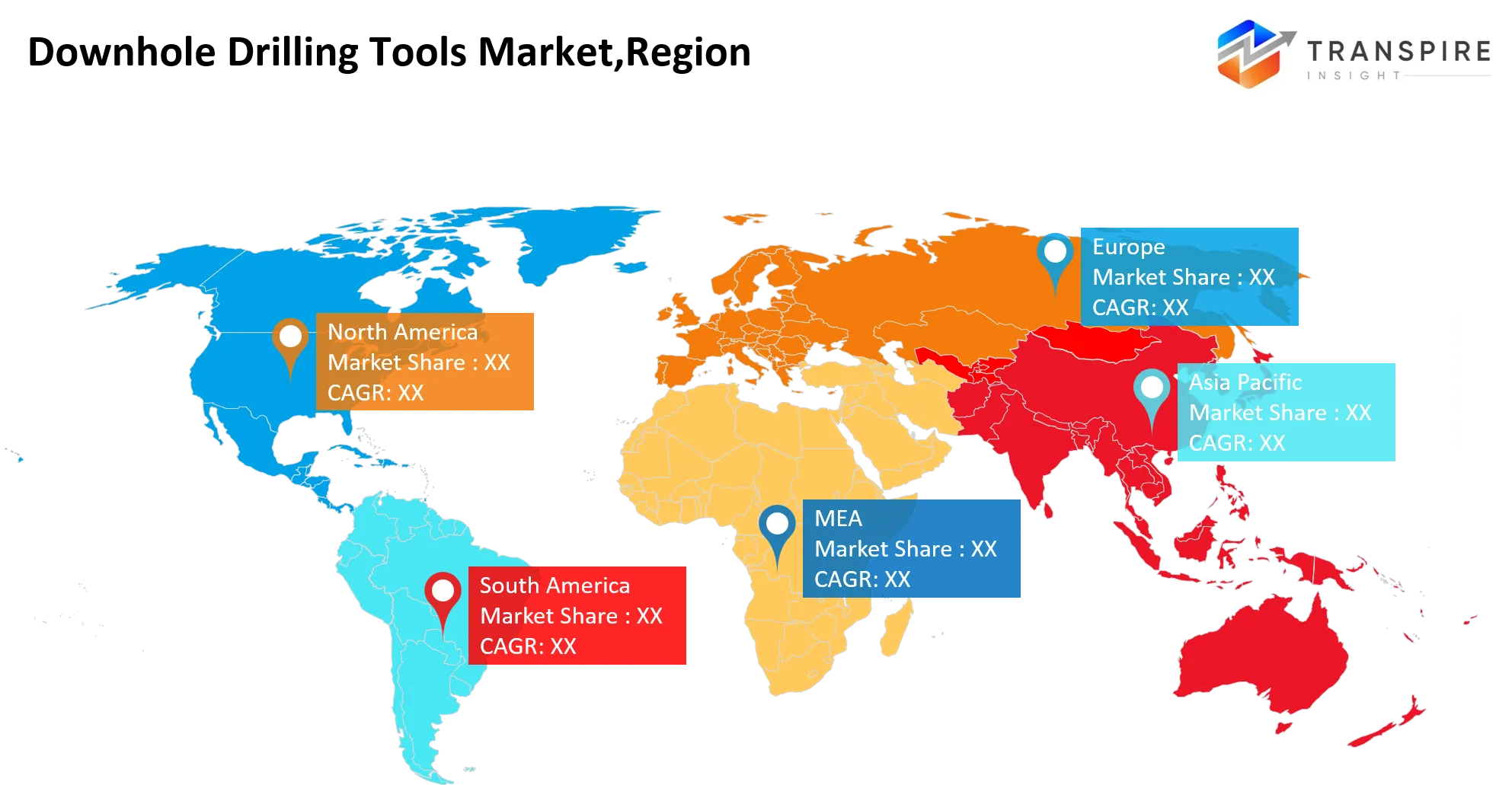
North America accounts for the largest market share of 34.9%, driven by its significant installed base of shale, tight-oil, and Gulf of Mexico drilling activity. Long horizontal wells deliver a steady appetite for motors, MWD/LWD, reamers and rotary steerable tools, as operators navigate the challenge of balancing the placement of laterals for friction and vibration. Its service infrastructure of high-specification land rigs, oilfield-service network, digital operations centres and depth of experience with unconventional drilling expedites the adoption cycle for new tools, while methane-monitoring and leak-repairing regulations support expenditure on reliable pressure-control, sensing and well-integrity equipment.
In September 2026, Superior Energy Services accepted a takeover offer to acquire Danish robotic technology developer Welltec. This transaction directly expands the North American service ecosystem by giving Superior Energy Services immediate access to Welltec’s specialised robotic well-intervention tools used to maintain downhole integrity.
https://energywatch.com/EnergyNews/Oil___Gas/article19669506.ece
Middle East & Africa accounts for 17%, with expansion expected from long-term national oil company (NOC) projects rather than short-term shale-style switchover drilling. Demand drivers include capacity maintenance, brownfield enhancement and reservoir-recovery schemes by NOCs such as Saudi Arabia, Abu Dhabi, Qatar and regional independent offshore operators. These are complemented by Abu Dhabi National Oil Company (ADNOC)'s expansion plans and integrated drilling services models, providing a perennial market for premium downhole systems such as push-button automated rigs and high-reliability directional tools, less vulnerable to short-term commodity-price variations but dominated by large NOC operators.
In September 2026, SLB secured four advanced well construction contracts from Aramco to manage end-to-end well services and deliver more than 450 wells across Saudi Arabia.
Asia Pacific 28% Asia Pacific is the fastest-growing region, driven by accelerated offshore investment, gas security agendas and domestic exploration programmes in China, India, Southeast Asia and Australia. Momentum has now shifted to deepwater gas, high-angle wells, and more technically complex offshore projects after the first couple of years saw just one or two isolated shallow-water projects. India is seeking applications for a handful of specialist jack-ups while proposed offshore contract awards in Southeast Asia signal more demand for measurement, steering and downhole pressure-resistant equipment. The growth opportunity is in local service capability, regional repair centres and digital support models suited to different basin conditions.
In August 2026, Fugro secured a three-year contract extension from Vantage International Management Company to provide deepwater remotely operated vehicle (ROV) and drill support services for the Oil and Natural Gas Corporation (ONGC) offshore drilling operations in India.
Who are the Key Players in the Downhole Drilling Tools Market, and how do they compete?
Industry competition is focused on technology depth, downhole hardware reliability, and the ability of downhole hardware to work with drilling automation. SLB, Halliburton, and Baker Hughes compete via integrated rotary-steerable, MWD/LWD, and digital-drilling platforms. Equipment manufacturers and niche players compete based on materials, tool robustness, responsiveness, and application-specific engineering. The three largest service companies are collectively estimated to represent 72% to 78% of the revenue for rotary-steerable systems, reflecting scale and data advantages.
SLB differentiates through Power Drive rotary-steerable systems, real-time reservoir navigation, and AI-assisted directional workflow. Halliburton competes with iCruise, Geo Pilot, Sperry Drilling, and its LOGIX workflow alliance with Nabors based on consistent well-construction results. Baker Hughes expands through Auto Trak systems and drilling-optimisation AI solutions. NOV, Vallourec, Hunting, Schoeller-Bleckmann, Dril-Quip, and National Oilwell Varco compete through engineered equipment, premium tubulars, speciality materials, and offshore-specific hardware. Weatherford competes in resilient and high-temperature directional-drilling markets, while Nabors and Helmerich & Payne compete via high-spec rig automation and interoperable control systems. Niche providers include Gyrodata, Scientific Drilling, and Archer through survey accuracy, independent directional services, and regional field support.
Key Players are:
- Baker Hughes
- Halliburton
- SLB
- NOV
- Weatherford
- Nabors Industries
- Helmerich & Payne
- Hunting
- National Oilwell Varco
- Vallourec
- Schoeller-Bleckmann
- Dril-Quip
- Gyrodata
- Scientific Drilling
- Archer
Recent Development News
In August 2026, SLB launched the ExaCT electrical downhole coiled tubing control system. The platform provides real-time electrical communication, power, telemetry, and downhole tool actuation, supporting multiple intervention services in a single run and improving control in extended-reach and multilateral wells.
In August 2026, Helmerich & Payne advanced an industry collaboration on a standardized API schema for rotary steerable system downlinking. The schema enables surface rig-control systems to communicate steering commands with downhole RSS tools through a common protocol, supporting interoperability among drilling-tool and automation providers and reducing command-transmission issues.
In September 2026, Expro progressed its agreement to acquire Enhanced Well Technologies Group (Enhanced Drilling). This transaction integrates specialized managed pressure drilling systems and deepwater downhole operational capabilities directly into Expro’s well intervention and flow management offering.
What Strategic Insights Define the Future of the Downhole Drilling Tools Market?
The industry is heading towards closed-loop, interoperable drilling architectures whereby downhole tools need to be increasingly capable of detecting downhole environments, analyzing information, and providing autonomous action with little surface intervention. Consequently, the focus of strategy will shift from the effectiveness of downhole tools to how well RSD, MWD/LWD, motors, sensors, rig controls and AI systems can operate as a workflow. An open secret risk to avoid is interoperability and cybersecurity: separate data communication protocols can prevent capable tools from realising their full automation potential; more connected equipment creates a bigger attack surface. An attractive opportunity is in standards-based interfaces, edge computing, and autonomous downhole control, particularly in ultra-deep water or extended-reach wells. Industry participants should concentrate on open communications standards, backward compatibility, high-temperature electronics, and proven AI algorithms rather than on automation being a feature for its own sake. The strongest commercial driver will be cost savings, i.e., a quantified reduction in drilling hours, re-spots, and unplanned operations.
Key Segmentations are:
By Tool Type
- Downhole Control Tools
- Drilling Tools
- Handling Tools
- MWD/LWD Tools
- Rotary Steerable Systems
- Drilling Motors
- Reamers
- Others
By Application
- Drilling
- Completion
- Well Intervention
- Workover
- Production
- Directional Drilling
- Well Logging
- Others
By Well Type
- Onshore
- Offshore
- Deepwater
- Ultra-deepwater
- Shale
- Tight Oil
- Mature Fields
- Others
By Technology
- Conventional
- Automated
- Digital
- MWD
- LWD
- Rotary Steerable
- Measurement Systems
- Others
By Pressure
- Low-pressure
- Medium-pressure
- High-pressure
- HPHT
- Ultra-HPHT
- Deepwater Pressure
- Extreme Pressure
- Others
By End User
- Oil Companies
- Gas Companies
- Drilling Contractors
- Oilfield Service Companies
- National Oil Companies
- Independent Operators
- Offshore Operators
- Others
By Tool Material
- Steel
- Tungsten Carbide
- Diamond
- Nickel Alloys
- Titanium
- Ceramic
- Composite
- Others
Frequently Asked Questions
Find quick answers to common questions.
The downhole drilling tools market size was valued at USD 7.75 billion in 2025 and is poised to reach USD 12.16 billion by 2033, expanding at a 5.79% CAGR
Key segments for the downhole drilling tools market are By Tool Type (Downhole Control Tools, Drilling Tools, Handling Tools, MWD/LWD Tools, Rotary Steerable Systems, Drilling Motors, Reamers, Others); By Application (Drilling, Completion, Well Intervention, Workover, Production, Directional Drilling, Well Logging, Others); By Well Type (Onshore, Offshore, Deepwater, Ultra-deepwater, Shale, Tight Oil, Mature Fields, Others); By Technology (Conventional, Automated, Digital, MWD, LWD, Rotary Steerable, Measurement Systems, Others); By Pressure (Low-pressure, Medium-pressure, High-pressure, HPHT, Ultra-HPHT, Deepwater Pressure, Extreme Pressure, Others); By End User (Oil Companies, Gas Companies, Drilling Contractors, Oilfield Service Companies, National Oil Companies, Independent Operators, Offshore Operators, Others); By Tool Material (Steel, Tungsten Carbide, Diamond, Nickel Alloys, Titanium, Ceramic, Composite, Others).
Growth is primarily driven by extended-reach and directional drilling, automation and closed-loop well control, demand for real-time MWD/LWD data, deepwater and HPHT exploration, and increasing focus on reducing drilling time and nonproductive operations.
The downhole drilling tools market is led by major manufacturers, including Baker Hughes, Halliburton, SLB, NOV, Weatherford, Nabors Industries, Helmerich & Payne, Hunting, National Oilwell Varco, Vallourec, Schoeller-Bleckmann, Dril-Quip, Gyrodata, Scientific Drilling, Archer
North America holds 34.9% of the market, supported by mature shale drilling infrastructure, extensive horizontal well programs, advanced directional technologies, and strong adoption of automated drilling and real-time downhole monitoring.
Key opportunities include autonomous drilling, standardized tool interoperability, AI-driven optimization, high-temperature/HPHT tools, and advanced downhole systems for deepwater and extended-reach wells.
- Baker Hughes
- Halliburton
- SLB
- NOV
- Weatherford
- Nabors Industries
- Helmerich & Payne
- Hunting
- National Oilwell Varco
- Vallourec
- Schoeller-Bleckmann
- Dril-Quip
- Gyrodata
- Scientific Drilling
- Archer
About the Authors

Avinash Kumar
I’m Avinash Kumar, a Senior Research Analyst at Transpire Insight, with expertise in the Electronics and Semiconductor and Energy & Power industry. My work focuses on analyzing emerging technologies, market trends, industry developments, and innovation across these sectors. I specialize in transforming complex technical and market insights into clear, research-backed content that helps professionals, businesses, and decision-makers stay informed. Through continuous industry research and data-driven analysis, I strive to deliver accurate, reliable, and practical perspectives on the latest advancements shaping the semiconductor and energy landscape.

Chakradhar Khansole
Chakradhar serves as the Research Director at Transpire Insight, bringing over 8 years of experience in technology, innovation, and strategic market intelligence. He specializes in transforming complex market data into actionable business insights that enable organizations to make informed, growth-oriented decisions. Recognized for his strategic vision and analytical expertise, Chakradhar leads high-impact research initiatives, delivering comprehensive market assessments, competitive intelligence, and forward-looking industry analysis.
Recently Published Reports
-
Apr 2026
Active Power Filter Market
Active Power Filter Market Size, Share & Analysis Report By Type (Shunt Active Power Filters, Series Active Power Filter, Hybrid Active Power Filter), By Application (Harmonics Mitigation, Reactive Power Compensation, Voltage Regulation, Power Factor Correction), By Phase (Single Phase, Three Phase), By End-User Industry (Manufacturing, Healthcare, Commercial, Automotive, Oil and Gas, Others), and Geography (North America, Europe, Asia-Pacific, Middle East and Africa, South and Central America), 2021 - 2031
-
Apr 2026
Electrical Transformer Market
Electrical Transformer Market Size, Share & Analysis Report By Core (Closed, Shell, and Berry), By Insulation (Gas, Oil, Solid, Air, and Other), By Phase (Single, and Three), By Rating (100 MVA to 500 MVA, 501 MVA to 800 MVA, and 801 MVA to 1200 MVA), and Geography (North America, Europe, Asia-Pacific, Middle East and Africa, South and Central America), 2021 – 2031
-
Apr 2026
Hydraulic Piston Pumps Market
Hydraulic Piston Pumps Market Size, Share & Analysis Report By Type (Axial Piston Pumps, Radial Piston Pumps), By Operating Pressure (Low Pressure, Medium Pressure, High Pressure), By Application (Construction, Mining, Agriculture, Automotive, Oil & Gas, Industrial Machinery, Others), By End-User (OEMs, Aftermarket), and Geography (North America, Europe, Asia-Pacific, Middle East and Africa, South and Central America), 2021 – 2031
-
Apr 2026
Laboratory Gas Generators Market
Laboratory Gas Generators Market Size, Share & Analysis Report By Product (Nitrogen Gas Generator, Hydrogen Gas Generator, Zero Air Gas Generator, Purge Gas Generator, TOC Gas Generators, Others), By Application (Gas Chromatography, Liquid Chromatography-mass Spectrometry (LC-MS), Gas Analyzers, Others), By End-user (Life Science, Chemical & Petrochemical, Food & Beverage, Others), and Geography (North America, Europe, Asia-Pacific, Middle East and Africa, South and Central America), 2021 – 2031