

Domestic Courier, Express and Parcel Market Summary:
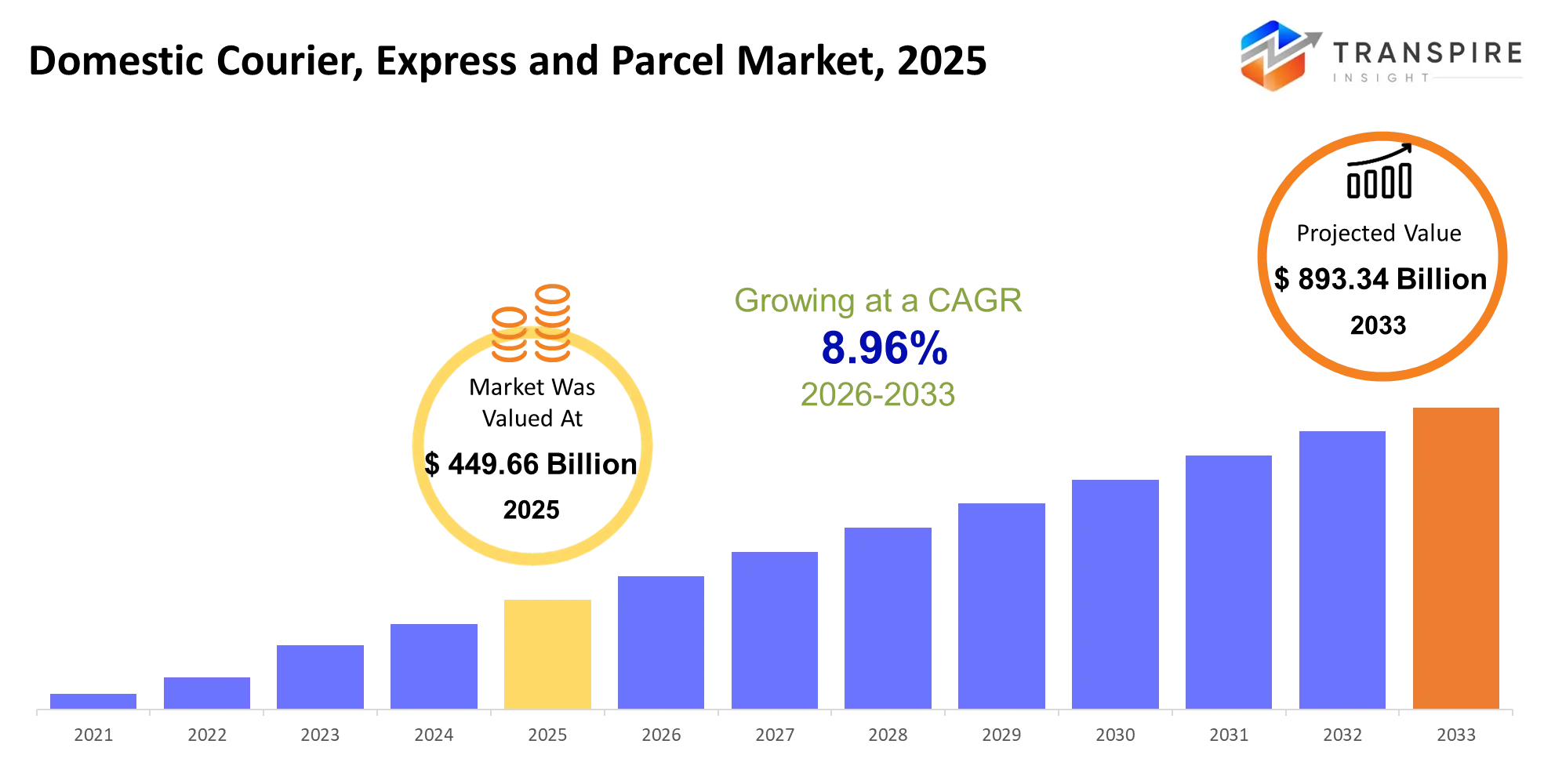
As per Transpire Insight Analysis, the Domestic Courier, Express and Parcel Market size is estimated at USD 449.66 billion in 2025 and is anticipated to reach USD 893.34 billion by 2033, growing at a CAGR of 8.96% from 2026 to 2033.
The domestic courier and parcel market is changing. It is moving from a delivery service to a technology-driven fulfilment network. Standard delivery still holds a share of the market. Faster options are becoming more popular. Shoppers and businesses now want delivery times, accurate tracking and reliable return processes. During the e-commerce development period lasting for three to five years, digital ordering and the improvement of last-mile logistics networks have transformed the way parcels are delivered through domestic markets. One significant development is the application of automated sorting technologies, GPS tracking systems, route optimisation technology, mobile applications, and electronic proof of delivery. The outbreak of the coronavirus was one of the factors contributing to the acceleration of online purchasing activities. Besides, it encouraged retailers to develop their delivery capacity. With the growing number of orders, operators invest in the improvement of automation and the optimisation of routes. This will enable them to organize deliveries while ensuring their visibility.
Domestic Courier, Express and Parcel Market Size & Forecast:
- Market Size 2025: USD 449.66 Billion
- Expected Market Value (2033): USD 893.34 Billion
- Forecast CAGR (2026–2033): 8.96%
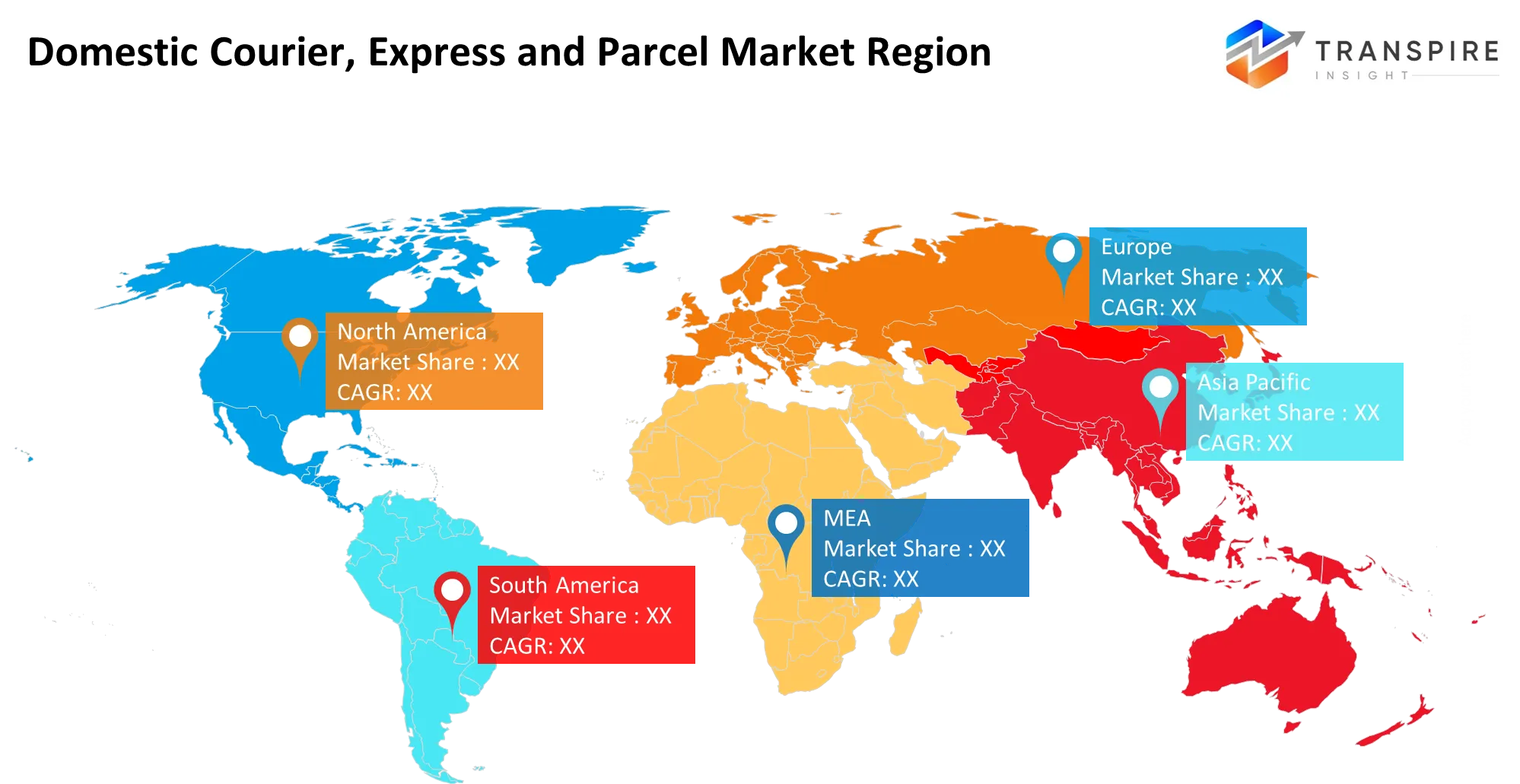
- Leading Region in 2025: Asia Pacific
- Fastest Growing Region: North America
- Key Company Profiles: DHL, FedEx, UPS, SF Express, JD Logistics, Cainiao, Yamato, Japan Post, Delhivery, Blue Dart, DTDC, Ecom Express, XpressBees, Royal Mail, Aramex
Key Market Insights:
The industry is shifting towards the use of technology-enabled home delivery, with reliability, visibility, and speed becoming critical competitive criteria. Standard Delivery continues to be the biggest category of services, but Express Delivery is bringing in more opportunities for growth because of the need for fast deliveries.
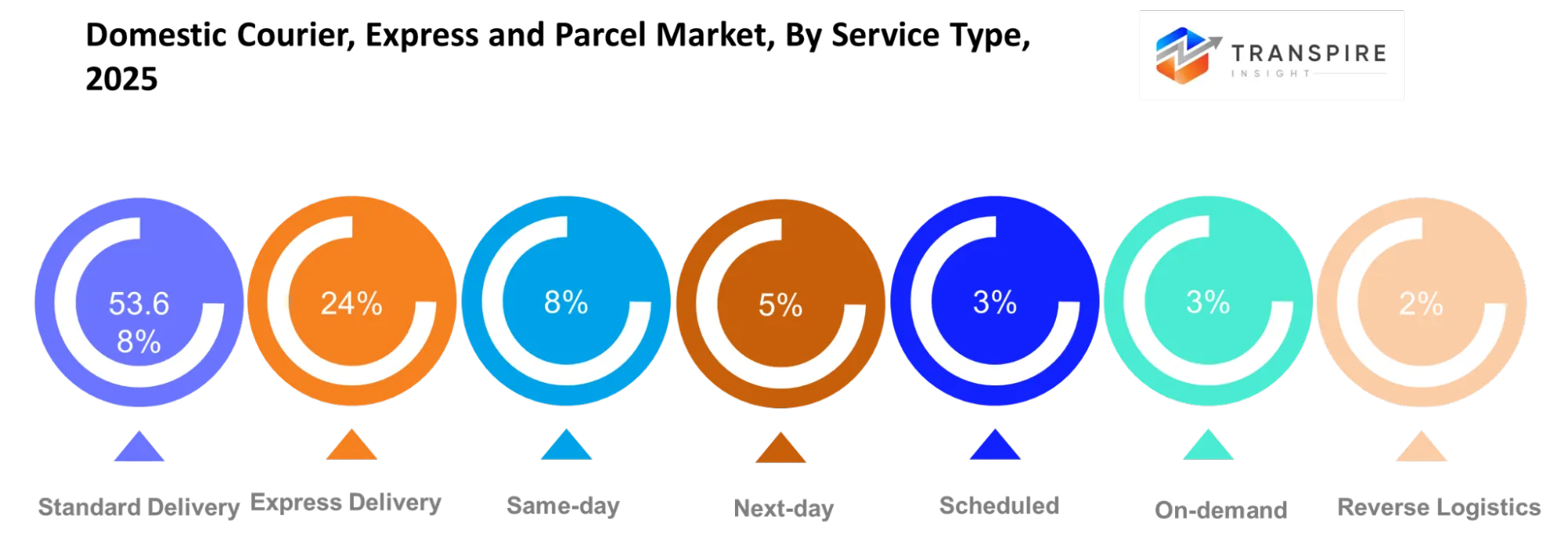
- Standard Delivery is 53.68%, holding the highest percentage due to the continued appreciation of cost-effective and reliable package delivery.
- Express Delivery makes up 24% of the total services and is the fastest-growing service type at a rate of 6.98% CAGR, due to the increased preference for quick shipment.
- Same-day Delivery constitutes 8% due to the rise in e-commerce, food delivery, medicine delivery, and many other services where quick delivery is appreciated more.
- Next-day Delivery makes up 5%, demonstrating how retailers and logistics firms are utilizing localized inventory and fulfilment services.
- Scheduled Delivery accounts for 3%, with the digital booking and choice of delivery slots allowing for increased control of delivery schedules by the customer.
- Reverse Logistics accounts for 2%, owing to the increase in demand for returns, exchanges, and product pickups, brought about by e-commerce.
What are the Key Drivers, Restraints, and Opportunities in the Domestic Courier, Express and Parcel Market?
Drivers
Growth is driven by the rise of e-commerce, specifically in those areas where orders placed through the internet ensure a consistent stream of parcels. The change from physical purchases to online purchases has meant that there is now more demand for reliable services in terms of picking up, sorting, tracking, and delivering the parcels. The retailers are taking the performance of deliveries into consideration as part of the experience of the consumer and are thus pressuring the courier operators to be faster, more visible, and handle returns better.
Restraints
The high cost associated with last-mile logistics infrastructure. The urban environment might be subjected to high traffic, limited parking space, labour availability, and repeated deliveries, while the rural environment might have long distances to cover with limited shipments per unit area. It will thus become challenging to attain equal efficiency in deliveries across geographies.
Opportunities
opportunity is that of building a data-driven delivery network. AI-enabled forecasting, automation of warehouses, smart lockers, e-vehicles, and route optimisation are some of the ways through which the companies can keep their empty miles low and increase the accuracy of delivery. Investments in regional fulfilment centres and local networks could speed up deliveries without being limited to premium ones.
What Has the Impact of artificial intelligence on the Domestic Courier, Express and Parcel Market?
Artificial Intelligence is transforming domestic courier and package delivery processes by allowing businesses to make decisions in terms of picking up, sorting, routing, and delivering shipments more quickly. AI technologies allow analysing order numbers, traffic, previous delivery performance, weather forecasts, and available transport to suggest effective routes and optimise resource utilisation. Forecasting software can spot potential problems with delivery, predict demand in certain locations, and enable operators to position vehicles or employees prior to high order volumes. During the sorting process, computer vision and automation technologies can scan parcels, read barcodes, sort packages, and avoid manual intervention. In terms of delivery, AI-driven route optimisation allows reorganising the route depending on changes in traffic or number of orders. Such technologies allow increasing consistency in deliveries, avoiding unnecessary mileage, and optimising utilisation of fleet capacity. FedEx, for instance, has purchased RouteSmart Technologies to optimise routes in terms of picking up and delivering parcels. Additionally, FedEx has launched a product called FedEx Surround in India, which uses near real-time visibility and AI-based predictive analytics to track shipments. Still, AI adoption may be hampered by implementation costs, quality of data, legacy systems, and the need to integrate new solutions with logistics platforms.
Instance
In February 2026, FedEx launched AI-based innovations in its Tracking+ and Returns+ services that would automatically answer questions regarding deliveries and returns, while also analysing patterns in shipments through the use of AI.https://newsroom.fedex.com/newsroom/-english/fedex-to-offer-access-to-ai-powered-post-purchase-solutions-for-enterprises
Key Market Trends:
The trend in the market is one that considers the factors of speed, visibility and flexibility in addition to cost. The greatest advances have been seen in last-mile technology, fulfilment location and consumer choice.
- Digital tracking has evolved from being an additional function to a mandatory service, as consumers track their shipments using their mobile phones and internet portals.
- Automation has found its way into the sorting operations at parcel hubs, making the process more efficient by decreasing the number of human interactions and enabling operators to deal with bigger volumes of shipments during busy times.
- Delivery operations are getting closer to consumers due to the development of local fulfilment centres and urban distribution centres.
- The provision of same-day and next-day deliveries is becoming increasingly feasible, in particular in categories like e-commerce, groceries, healthcare and others.
- Route planning is becoming increasingly data-driven, allowing operators to vary the sequence of deliveries based on traffic, parcel density and shipment volume.
- Customers have increasing control over deliveries, using options of schedule, instructions, pickup points and locker boxes.
Domestic Courier, Express and Parcel MarketSegmentation
By Service Type
Standard Delivery is leading with 53.68%, considering the relevance of affordable and reliable transportation of parcels. The second service in terms of revenue generation is Express Delivery with a 24% share, and it has the fastest growth rate of 6.98% CAGR owing to the increase in expectations for deliveries and e-commerce time-sensitive orders. Same-day Delivery constitutes an 8% share, whereas Next-day Delivery makes up 5%. Scheduled Delivery, On-demand Delivery and Reverse Logistics make up 3% each, whereas the Other category consists of 1.32% of the market share.
By Business Model
The business-to-consumer model continues to have a strong connection with the movement of parcels via e-commerce, while business-to-business helps in moving commercial shipments, documents, and business supplies. The consumer-to-consumer model works for individual senders, while business-to-business-to-consumer involves intermediaries between business organisations and customers. The direct-to-consumer model is gaining significance as many companies continue to move products from direct producers to consumers. The marketplace and subscription models help to develop repeat business and also to integrate fulfilment services for logistics companies. The others belong to other business structures.
By Parcel Weight
Parcels weighing light or small parcels are an important category in domestic e-commerce parcels since online shopping includes consumer products. Parcels weighing medium or heavy need to have better handling and transport equipment, while large parcels pose extra needs for vehicles, storage, and delivery. The documents are important for professional and institutional activities, while the bulk parcels help in business and industry movement. Others involve parcels requiring specialised handling. The future possibilities are based on combining the parcel nature with the right transport and sorting processes.
By End Users
E-commerce is an important category of end-users as it results in regular deliveries and returns at residences. Retail firms make use of courier networks for delivery of customer orders, restocking of products and movement of products. Healthcare institutions need transportation of medicines, samples, and related supplies. The BFSI sector needs secure transportation of documents and packages, while manufacturers need transportation of components, spare parts and finished products. Government agencies and individual consumers also contribute towards domestic parcel traffic. Growing digitisation in these industries is motivating logistics firms to provide advanced services.
By Transportation
Road transportation continues to be an important mode of transportation for domestic parcels owing to its extensive reach and first- and last-mile movement. Air transportation becomes an important mode when time is a critical factor. Railways become an important mode of transportation in case of high-volume traffic over long domestic distances. Multimodal networks consist of various modes of transportation. Electric vehicles and two-wheelers are becoming an increasingly important mode of transportation for urban deliveries.
By Delivery Area
Urban locations see significant parcel delivery due to high population density, online retailing and businesses. Semi-urban and rural markets present future growth potential as logistics networks continue to grow outside of urban centres. In-city parcel deliveries involve movement over relatively short distances, whereas inter-city and regional deliveries link distribution centres with customers. National-level networks have a wide coverage area and need good infrastructure, sorting capability and transport organisation. Further growth will be based on route profitability, infrastructure quality and schedule reliability.
By Technology
GPS Tracking assists in tracking shipments, while Automated Sorting speeds up and streamlines their handling. Route Optimisation aids courier organisations in optimising their deliveries, and Smart Lockers offer alternative pick-up and return locations. Mobile Apps help customers and delivery workers handle shipping information more effectively. AI Analytics could help in forecasting demand and making route plans. The general technological shift lies in the interconnectedness of all systems, which allows for managing parcels, transport, employees and customer data through digital means.
What are the Key Use Cases Driving the Domestic Courier, Express and Parcel Market?
The use case for the industry is still dependable parcel transport for e-commerce and retail deliveries. Standard delivery constitutes the service offerings. Express services are increasingly being utilised for time-critical deliveries, which is more relevant to this segment. Same-day and next-day service offerings are increasingly being applied in cases of grocery delivery, medicine delivery, electronics and other items where timely delivery influences the purchase decision. There is also an increasing trend of businesses using couriers for delivery of returned goods, replacement consignments, documents, spare parts and even direct consumer deliveries. This is contributing to the increased importance of reverse logistics services, business-to-business and direct consumer fulfilment services in the domestic delivery networks. Emerging use cases include smart lockers, digital scheduling, two-wheeled electric vehicle fleets and AI-enabled route planning.
|
Report Metrics |
Details |
|
Market size value in 2025 |
USD 449.66 Billion |
|
Market size value in 2026 |
USD 489.95 Billion |
|
Revenue forecast in 2033 |
USD 893.34 Billion |
|
Growth rate |
CAGR of 8.96% from 2026 to 2033 |
|
Base year |
2025 |
|
Historical data |
2021 - 2024 |
|
Forecast period |
2026 - 2033 |
|
Report coverage |
Revenue forecast, competitive landscape, growth factors, and trends |
|
Regional scope |
United States; Canada; Mexico; United Kingdom; Germany; France; Italy; Spain; Denmark; Sweden; Norway; China; Japan; India; Australia; South Korea; Thailand; Brazil; Argentina; South Africa; Saudi Arabia; United Arab Emirates |
|
Key company profiled |
DHL, FedEx, UPS, SF Express, JD Logistics, Cainiao, Yamato, Japan Post, Delhivery, Blue Dart, DTDC, Ecom Express, XpressBees, Royal Mail, Aramex |
|
Customization scope |
Free report customization (country, regional & segment scope). Avail customized purchase options to meet your exact research needs. |
|
Report Segmentation |
By Service Type (Standard Delivery, Express Delivery, Same-day Delivery, Next-day Delivery, Scheduled Delivery, On-demand Delivery, Reverse Logistics, Others); By Business Model (B2C, B2B, C2C, B2B2C, D2C, Marketplace, Subscription, Others); By Parcel Weight (Lightweight, Medium, Heavy, Oversized, Documents, Small Parcels, Bulk Parcels, Others); By End User (E-commerce, Retail, Healthcare, BFSI, Manufacturing, Government, Individuals, Others); By Transport Mode (Road, Air, Rail, Multimodal, Electric Vehicles, Two-wheelers, Drones, Others); By Delivery Area (Urban, Semi-urban, Rural, Intra-city, Inter-city, Regional, National, Others); By Technology (GPS Tracking, Automated Sorting, Route Optimization, Smart Lockers, Mobile Apps, AI Analytics, Electronic Proof of Delivery, Others) |
Which Regions are Driving the Domestic Courier, Express and Parcel MarketGrowth?
North America
North America is the fastest-growing regional market with a CAGR of 7.4% due to its growing fulfilment centres, faster delivery initiatives, and investments in coverage of rural areas and smaller cities. Organisations are now providing delivery services in areas outside big city markets, thus making it necessary for organisations to have a local logistics infrastructure. North America’s technological environment also helps in optimising routes and shipment tracking. All these factors provide couriers with an opportunity to improve their efficiency during the last mile.
In March 2026, FedEx introduced FedEx SameDay Local services with two-hour and end-of-day delivery capabilities via a nationwide network of over 1,000 delivery partners, using real-time tracking and artificial intelligence (AI) for delivery orchestration, enhancing last-mile parcel delivery services in the U.S.https://newsroom.fedex.com/newsroom/-english/fedex-to-offer-faster-delivery-with-launch-of-fedex-sameday-local
Europe
Europe constitutes 22% of the market and has well-established infrastructure for parcels, e-commerce operations, and delivery focus. It is further supported by parcel lockers, organised roadways and ongoing technology use by the logistics companies. Latin America constitutes 7% of the market and is growing in terms of online commerce, thereby increasing its need for efficient delivery in the country. Middle East & Africa constitutes 5.7% of the market and is growing due to the development of infrastructure and increased logistics connections.
In May 2025, InPost revealed the installation of almost 3,000 parcel locker systems in the first quarter of 2025, increasing its total number of automated parcel machine systems to 49,808. This development helped strengthen the company’s out-of-home parcel delivery service in Europe.https://inpost.eu/news-profitability-uplift-and-market-share-gains-across-key-geographies-q1-2025
Asia Pacific
Asia Pacific has the largest market share of 40.3% due to a high density of urban population, increasing e-commerce operations, and ongoing development of logistics infrastructure. Large markets and adoption of digital payments are aiding courier firms to develop large domestic networks. North America makes up 25% of the market, and its carrier networks and technology adoption provide a steady base for parcel volumes. It is the fastest-growing market at a 7.4% CAGR.
In February 2026, Delhivery unveiled a strategic plan to employ electric vehicles for its last-mile delivery services in India, contributing to the growth and development of its domestic delivery services.https://www.delhivery.com/company/press-release
Who are the Key Players in the Domestic Courier, Express and Parcel Market,and how do they compete?
Competition in the domestic courier, express, and parcel market is increasingly becoming driven by speed of delivery, network efficiency, technological prowess, and last-mile cost management. DHL is competing by relying on its logistics integration services, advanced automated sorting system, and partners who extend its delivery services. DHL’s 2026 agreement with USPS will reinforce the last-mile solution in the US by combining DHL’s pickup, sorting and line-haul network with the USPS delivery service.Amazon is competing by way of a technology-driven fulfilment and delivery service utilising its local facilities, forecasted demand, artificial intelligence (AI) supported routing and delivery partner network. Amazon has committed investment in its Indian operations network and capacity expansion in fulfilment. UPS competes through its existing parcel network, digital shipment solutions and investments in automation and visibility, including wide-scale deployment of RFID on its small package network in the US
Domestic Courier, Express and Parcel Market companies
- DHL
- FedEx
- UPS
- SF Express
- JD Logistics
- Cainiao
- Yamato
- Japan Post
- Delhivery
- Blue Dart
- DTDC
- Ecom Express
- XpressBees
- Royal Mail
- Aramex
Recent Development News
In January 2025, UPS acquired Frigo-Trans and BPL, thus enhancing its temperature-controlled and time-critical healthcare logistics capabilities in Europe. The acquisition helped UPS Healthcare build its expertise in specialised logistics for pharmaceutical and healthcare shipments.https://about.ups.com/us/en/newsroom/press-releases/our-strategy/ups-completes-acquisitions-of-healthcare-cold-chain-logistics-pr.html
In March 2026, FedEx introduced FedEx SameDay Local, which provides services of two-hour and end-of-day deliveries using more than 1,000 delivery partners. It utilises intelligent orchestration, live tracking, predictive ETAs, and AI-based routing.https://newsroom.fedex.com/newsroom/-english/fedex-to-offer-faster-delivery-with-launch-of-fedex-sameday-local
What Strategic Insights Define the Future of the Domestic Courier, Express and Parcel Market?
The market is evolving towards integrated domestic delivery networks where location fulfilment, route intelligence, automation, and customer visibility come together rather than operate independently. Traditional delivery will probably remain relevant due to its cost-effectiveness, which indicates ongoing demand for cost-effective and reliable deliveries, while express deliveries can benefit from. The lurking danger is that rising delivery requirements can result in costs increasing faster than revenues if a company invests in additional transportation, facilities, and personnel without sufficient route density. A new business opportunity may come from the integration of intelligent forecasting, automated sorting, smart lockers, and eco-friendly delivery fleets for increased efficiency and faster deliveries. It may be possible to grow through regional fulfilment centres and partnerships that enhance last-mile delivery capability. From an operator's point of view, it would be sensible to focus on technologies providing measurable improvements in parcel volume, routes, and deliveries rather than implementing automation for no reason.
By Service Type
- Standard Delivery
- Express Delivery
- Same-day Delivery
- Next-day Delivery
- Scheduled Delivery
- On-demand Delivery
- Reverse Logistic
By Business Mode
- B2C
- B2B
- C2C
- B2B2C
- D2C
- Marketplace
- Subscription
By Parcel Weight
- Lightweight
- Medium
- Heavy
- Oversized
- Documents
- Small Parcels
- Bulk Parcels
By End User
- E-commerce
- Retail
- Healthcare
- BFSI
- Manufacturing
- Government
- Individuals
By Transport Mode
- Road
- Air
- Rail
- Multimodal
- Electric Vehicles
- Two-wheelers
- Drones
By Delivery Area
- Urban
- Semi-urban
- Rural
- Intra-city
- Inter-city
- Regional
- National
By Technology
- GPS Tracking
- Automated Sorting
- Route Optimization
- Smart Lockers
- Mobile Apps
- AI Analytics
- Electronic Proof of Delivery
By Regional Analysis
North America
- US
- Canada
- Mexico
Europe
- Germany
- UK
- France
- Italy
- Spain
- Russia
- Rest of Europe
Asia Pacific
- China
- Japan
- India
- South Korea
- Australia
- Rest of Asia Pacific
South America
- Brazil
- Argentina
- Rest of South America
Middle East & Africa
- UAE
- Saudi Arabia
- Qatar
- South Africa
- Rest of the Middle East & Africa
Frequently Asked Questions
Find quick answers to common questions.
The domestic courier, express and parcel market size was valued at USD 449.66 Billion in 2025 and is poised to reach USD 893.34 Billion by 2033, expanding at an 8.96% CAGR.
Key segments for the domestic courier, express and parcel market are By Service Type (Standard Delivery, Express Delivery, Same-day Delivery, Next-day Delivery, Scheduled Delivery, On-demand Delivery, Reverse Logistics, Others); By Business Model (B2C, B2B, C2C, B2B2C, D2C, Marketplace, Subscription, Others); By Parcel Weight (Lightweight, Medium, Heavy, Oversized, Documents, Small Parcels, Bulk Parcels, Others); By End User (E-commerce, Retail, Healthcare, BFSI, Manufacturing, Government, Individuals, Others); By Transport Mode (Road, Air, Rail, Multimodal, Electric Vehicles, Two-wheelers, Drones, Others); By Delivery Area (Urban, Semi-urban, Rural, Intra-city, Inter-city, Regional, National, Others); By Technology (GPS Tracking, Automated Sorting, Route Optimization, Smart Lockers, Mobile Apps, AI Analytics, Electronic Proof of Delivery, Others)
Growth is primarily driven by increased online shopping, demand for quick delivery services, urbanisation, and adoption of digital technology in logistics and tracking.
The market is led by major manufacturers including DHL, FedEx, UPS, SF Express, JD Logistics, Cainiao, Yamato, Japan Post, Delhivery, Blue Dart, DTDC, Ecom Express, XpressBees, Royal Mail, Aramex
The Asia Pacific region accounts for 40.3% of the worldwide domestic courier, express, and parcels industry. This domination is facilitated by the fast-growing number of e-commerce websites, an increase in online shopping, a well-developed logistics chain, and an increase in demand for fast last-mile delivery.
Opportunities in the domestic courier, express, and parcel industry include same-day or next-day deliveries, development of e-commerce logistics, automation of sorting and tracking, and delivery solutions that are environmentally sustainable. Another opportunity is provided by the increasing demand for deliveries from online stores and small businesses.
- DHL
- FedEx
- UPS
- SF Express
- JD Logistics
- Cainiao
- Yamato
- Japan Post
- Delhivery
- Blue Dart
- DTDC
- Ecom Express
- XpressBees
- Royal Mail
- Aramex
About the Authors

Mayur Shinde
I am Mayur Shinde, a Senior Research Analyst at Transpire Insight, specializing in the Automotive & Transportation and Information & Communication Technology (ICT) Industry. My work focuses on analyzing emerging market trends, technological advancements, competitive landscapes, and industry developments to deliver accurate, data-driven insights. I am passionate about transforming complex market information into clear, actionable content that helps businesses, professionals, and decision-makers stay informed and make confident strategic decisions.

Chakradhar Khansole
Chakradhar serves as the Research Director at Transpire Insight, bringing over 8 years of experience in technology, innovation, and strategic market intelligence. He specializes in transforming complex market data into actionable business insights that enable organizations to make informed, growth-oriented decisions. Recognized for his strategic vision and analytical expertise, Chakradhar leads high-impact research initiatives, delivering comprehensive market assessments, competitive intelligence, and forward-looking industry analysis.
Recently Published Reports
-
Apr 2026
ATV & UTV Market
ATV & UTV Market Size, Share & Analysis Report By Type (ATV, and UTV), By Variants (Less Than 400 CC, 400 CC To 800 CC, and More Than 800 CC), and Geography (North America, Europe, Asia-Pacific, Middle East and Africa, South and Central America), 2021 - 2031
-
Apr 2026
Automotive Central Gateway Module Market
Automotive Central Gateway Module Market Size, Share & Analysis Report By Type (Ethernet Central Gateway Module, CAN Central Gateway Module, LIN Central Gateway Module, and FlexRay), By Application (Powertrain Control, Body Control, Infotainment System, Advanced Driver Assistance Systems (ADAS), and Others), By End User (Passenger Vehicles, and Commercial Vehicles), and Geography (North America, Europe, Asia-Pacific, Middle East and Africa, South and Central America), 2021 - 2031
-
Apr 2026
Automotive Engine Oil Filter Market
Automotive Engine Oil Filter Market Size, Share & Analysis Report By Filter Type (Fuel Filter, Engine Oil Filter, Hydraulic Oil Filter, and Others), By Filter Media (Cellulose, Synthetic, and Micro), By Sales Channel (OEMs, and Aftermarket), By Vehicle Type (Passenger Cars, Light Commercial Vehicles, Heavy Duty Trucks, Buses and Coaches, and Off-road Vehicles), and Geography (North America, Europe, Asia-Pacific, Middle East and Africa, South and Central America), 2021 - 2031
-
Apr 2026
Automotive Parts Aluminium Die Casting Market
Automotive Parts Aluminium Die Casting Market Size, Share & Analysis Report By Production Process (Pressure Die Casting, Vacuum Die Casting, Squeeze Die Casting, Gravity Die Casting), By Application (Body Parts, Engine Parts, Transmission Parts, Battery And Related Components, Other Application Types), and Geography (North America, Europe, Asia-Pacific, Middle East and Africa, South and Central America), 2021 - 2031
Our Clients



