

DIY Home Improvement Market Summary:
According to Transpire Insight, a detailed research report on the market reflects that the Building Materials segment dominates the DIY Home Improvement Market, accounting for approximately 48.33% of the total share worldwide. The Home Depot leads the market with approximately USD 164.7 billion in annual revenue and an estimated 7–10% market share, making it the leading contributor to market development, innovation, advanced DIY home improvement solutions, expanding retail and manufacturing capabilities, and growth dynamics.
Market Snapshot
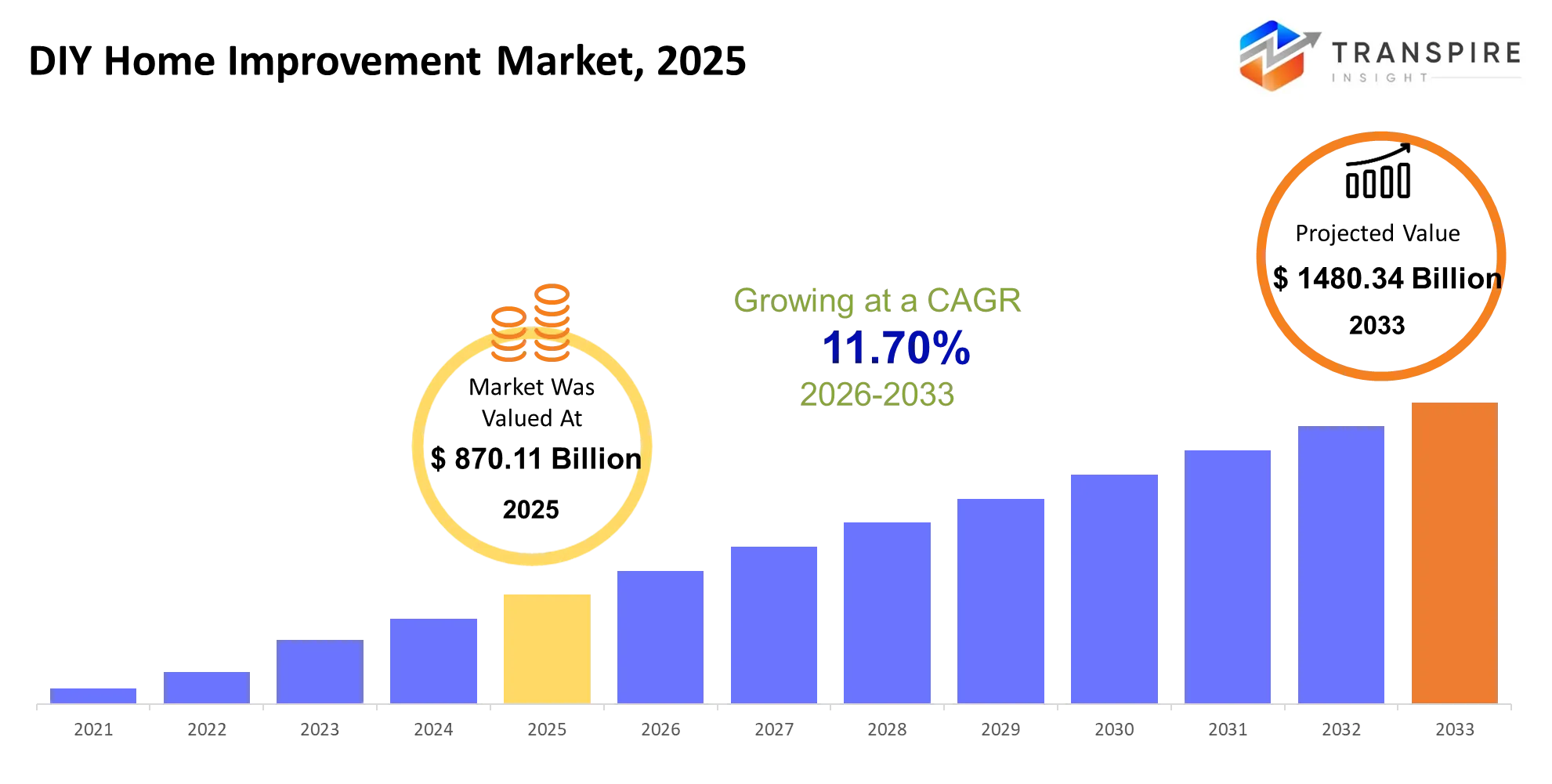
- Market Value (2025): USD 870.11 Billion.
- Expected Market Value (2026): USD 930.01 Billion.
- Estimated Market Value (2033): USD 1480.34 Billion.
- Forecast CAGR (2026–2033): 11.70%
- Leading Region in 2025: North America
- Second-largest Region: Europe
- Fastest Growing Region: Asia Pacific
Introduction
DIY home improvement industry is made up of sales of tools, hardware, building materials, décor, and related supplies to consumers who use them for home repair, maintenance, renovations, and improvement activities. This industry helps people get more involved in how the projects can be done, designs chosen, and household improvement. Some of the tasks associated with DIY home improvement include painting, flooring, landscaping, carpentry, decorating, repairs, and many other household improvement tasks. Digital technology has helped in enhancing the DIY experience through helping in planning, visualizing, discovering products and designs. Some examples of digital technologies that have been used for DIY home improvement planning are Houzz, Planner 5D, and Magicplan. Planner 5D has floor planning and interior design using artificial intelligence, 2D and 3D visualization.
For instance:-
- North America: Aging homes generate consistent demand for DIY projects related to roof repair, painting, flooring, and fixture installation, while the omnichannel retailing trend and digital solutions for home project planning foster customer engagement.
- Europe: The omnichannel retailing trend, energy efficiency projects, sustainable DIY materials, and mandatory green building codes present many investment options within the home improvement and DIY segments.
Key Market Highlights: -
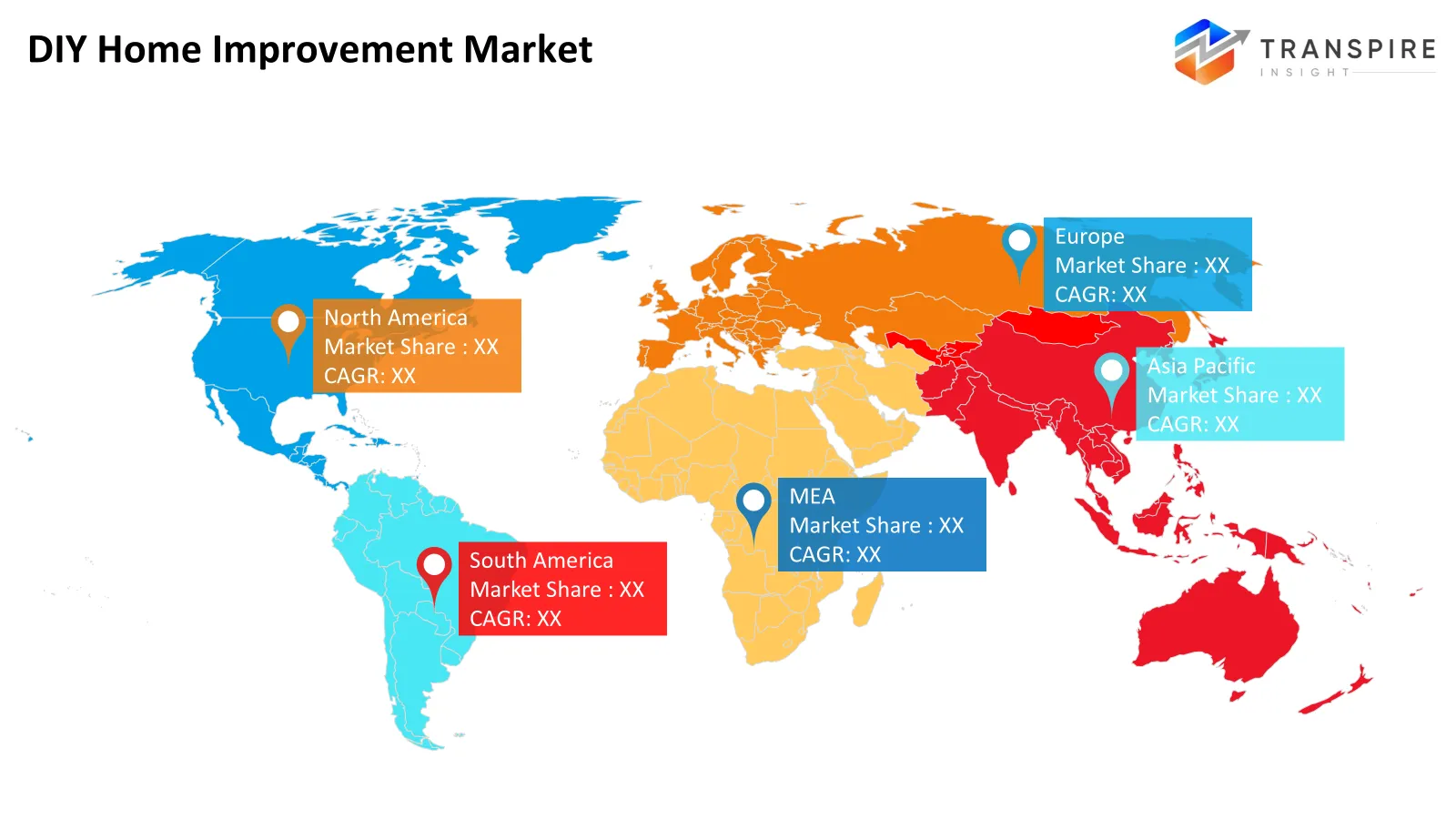
- North America is expected to grow at a rapid CAGR in the DIY Home Improvement Market by holding around 39% of the share during the forecast period.
- Europe is anticipated to hold roughly 29% share of the DIY Home Improvement Market over the predicted timeframe.
- Asia Pacific is anticipated to hold nearly 23% share of the DIY Home Improvement Market over the predicted timeframe.
- By Product, the Tools and Equipment dominated the market and holds nearly 25% share in 2025 and is projected to grow at a substantial CAGR during the forecast period.
- By Project Type, the Remodeling dominated the market and holds close to 37.38% share in 2025 and is projected to grow at a substantial CAGR during the forecast period.
- By Room, the Bedroom dominated the market and holds about 34% share in 2025 and is projected to grow at a substantial CAGR during the forecast period.
- Green Do-It-Yourself Incentives: With the introduction of green retrofitting incentives, such as the European Green Deal, consumers have been prompted to purchase solar panels, smart insulation, and water-efficient devices, resulting in the increased demand for sustainable DIY home improvement products worldwide.
How is Technology Driving Growth in the DIY Home Improvement Market?
Advances in technology have been contributing to growth in the DIY home improvement sector by easing project completion and shopping. The availability of tutorials and project guides online boosts the confidence of consumers on challenging renovation projects, while e-commerce and omnichannel systems streamline the process of finding products, comparing prices, and purchasing them. Power tools which are cordless, ergonomically designed, and energy efficient ensure that renovation projects are both safe and productive, while the increased usage of smart ready fixtures and energy management systems powered by AI contribute to connected renovation projects.
|
Report Metrics |
Details |
|
Market size value in 2025 |
USD 870.11 Billion |
|
Market size value in 2026 |
USD 930.01 Billion |
|
Revenue forecast in 2033 |
USD 1480.34 Billion |
|
Growth rate |
CAGR of 11.70% from 2026 to 2033 |
|
Base year |
2025 |
|
Historical data |
2021 - 2024 |
|
Forecast period |
2026 - 2033 |
|
Report coverage |
Revenue forecast, competitive landscape, growth factors, and trends |
|
Regional scope |
United States; Canada; Mexico; United Kingdom; Germany; France; Italy; Spain; Denmark; Sweden; Norway; China; Japan; India; Australia; South Korea; Thailand; Brazil; Argentina; South Africa; Saudi Arabia; United Arab Emirates |
|
Key company profiled |
Home Depot, Lowe's, Kingfisher, Adeo, Menards, Ace Hardware, Travis Perkins, Bunnings, Walmart, Amazon, OBI, Hornbach, Bauhaus, Canadian Tire, Mr. Bricolage |
|
Customization scope |
Free report customization (country, regional & segment scope). Avail customized purchase options to meet your exact research needs. |
|
Report Segmentation |
By Product (Tools, Hardware, Paints & Coatings, Flooring, Lighting, Plumbing Products, Garden Equipment, Others); By Project Type (Renovation, Remodeling, Repair, Decoration, Maintenance, Landscaping, Installation, Others); By Room (Kitchen, Bathroom, Bedroom, Living Room, Garage, Outdoor, Basement, Others); By Product Category (Power Tools, Hand Tools, Building Materials, Décor, Furniture, Electrical, Plumbing, Others); By Consumer Type (Homeowners, Renters, First-time Buyers, DIY Enthusiasts, Hobbyists, Professionals, Families, Others); By Distribution (Home Improvement Stores, Hardware Stores, Online, Specialty Stores, Department Stores, Direct Sales, Marketplaces, Others); By Price Range (Economy, Mid-range, Premium, Luxury, Professional, Value, Custom, Others) |
Market Drivers
The rising cost of labour and professional services is prompting budget-savvy homeowners to carry out their own painting, floorwork and simple repairs, which makes saving money the key driver of growth within the DIY home improvement market. The activities of millennials and first-time homeowners increase the level of renovation work, whereas high mortgage interest rates and shortage of available property encourage homeowners to improve their homes rather than move to other locations. Moreover, technology such as digital retail channels, AR-based visualization solutions, and video tutorials decreases the skill barrier. Lastly, the age of houses and need for increased energy efficiency keeps creating demand for maintenance and renovation.
For instance:-
- Asia Pacific: Urbanization, increasing disposable income levels, smart home systems, and e-commerce provide significant impetus to DIY product demand, especially within the connected home and renovation categories.
- Latin America: Increased urban housing activity along with enhanced digital retailing infrastructure fosters customer access to DIY products and construction materials.
Restrain
Higher prices of wood, metal, paint, and specialized tools increase the disadvantage that is associated with DIY works, while low expertise levels and aging demographics prompt consumers to turn to professionals for complex tasks. Moreover, strict regulations regarding construction, permits, and high time demands due to busy schedules prevent homeowners from completing major construction projects on their own. Besides, increasing awareness about the waste created by construction sites, unrecyclable materials, and VOC-containing substances discourages environmentally friendly consumers.
|
Driver |
Relative Impact on Growth (%) |
Geographic Relevance |
Impact Timeline |
Demand Strength |
Growth Mechanism |
Key Beneficiaries |
Major Constraint |
|
Aging Housing Stock and Rising Repair & Renovation Needs |
28% |
North America, Europe |
Long-term (≥4 years) |
High |
Aging homes increase recurring repair and upgrade requirements |
DIY retailers, building-material manufacturers, homeowners |
High material and renovation costs |
|
Preference for Renovating Existing Homes Over Relocation |
23% |
North America, Europe |
Medium-term (2–4 years) |
High |
Mortgage costs encourage homeowners to upgrade existing properties |
Home-improvement retailers, tool brands, homeowners |
Elevated interest rates constrain budgets |
|
E-commerce, Omnichannel Fulfillment and Digital DIY Education |
20% |
North America, Europe, Asia-Pacific |
Short-term (≤2 years) |
High |
Online tutorials and rapid delivery simplify DIY project execution |
E-commerce platforms, retailers, tool manufacturers |
Product selection and technical complexity |
|
AI, AR and Smart-Tool Adoption for DIY Planning |
16% |
North America, Asia-Pacific, Europe |
Medium-term (2–4 years) |
Medium |
AI planning and AR visualization reduce project uncertainty |
Technology vendors, retailers, DIY consumers |
Limited digital skills and interoperability |
|
Sustainability and Energy-Efficiency Home Upgrades |
13% |
Europe, North America, Asia-Pacific |
Long-term (≥4 years) |
Medium |
Efficient fixtures and sustainable materials stimulate replacement demand |
Eco-material suppliers, smart-home vendors, homeowners |
Higher upfront product costs |
Analysis of Prices and Consumer Behaviour
The market of DIY home improvement products consists predominantly of high-quality products (68% of the total market; mainly because of the demand by homeowners, hobbyists of home renovations, and people carrying out repair, maintenance, and remodeling projects). The price of high-quality and durable DIY home improvement products will be 35% higher than the price of other products because these products will be made using state-of-the-art materials and technologies, quality tested, and capable of delivering constant performance and durability. About 45% of all unit sales of DIY home improvement products occur in powdered, compact, or easy-to-store form depending on the category of products. The sales are influenced by the flexibility of usage in various home repair, maintenance, renovations, and improvements projects as well as the convenient storage and longer life of the products. Home renovation and functional improvement markets constitute about 70% of the demand from such applications. The consumer purchase behavior indicates that 55% of consumers give priority to the quality, durability, performance, and standardization of specifications of the products. The remaining 33% of customers are those who like buying products on bulk or long-term contracts so that they can save money on the procurement of do-it-yourself home improvement products and be assured of a steady supply of goods whenever there is a need for renovations or remodeling of their homes.
|
Company |
Est. Revenue Share Range |
Key Offerings |
Strategic Positioning |
Geographic Strength |
Technology Focus |
|
The Home Depot |
12–16% |
Building materials, tools, hardware, paint, flooring, garden, appliances |
Scale-led omnichannel home-improvement leadership |
North America |
AI-enabled personalization and interconnected commerce |
|
Lowe’s Companies |
6–9% |
Hardware, tools, lumber, paint, flooring, kitchens, outdoor products |
Broad DIY portfolio with omnichannel expansion |
North America |
Digital commerce, visualization and customer analytics |
|
Groupe ADEO (Leroy Merlin) |
5–8% |
Building materials, tools, kitchens, bathrooms, garden, décor |
Multi-banner European DIY ecosystem strategy |
Europe, Latin America, Asia |
Digital marketplaces and connected-home solutions |
|
Kingfisher plc |
4–6% |
B&Q, Screwfix, Castorama, Brico Dépôt, TradePoint |
Multi-format specialization and private-label scale |
Europe |
AI-driven retail optimization and personalization |
|
Menards |
3–5% |
Building materials, lumber, hardware, appliances, garden |
Value-led integrated DIY retail model |
North America |
Integrated retail systems and digital merchandising |
|
OBI Group |
2–4% |
Tools, construction materials, garden, décor, kitchens |
Digitalized European DIY ecosystem and store network |
Central Europe |
heyOBI digital ecosystem and personalization |
|
Bunnings Group |
2–4% |
Hardware, building supplies, tools, garden, outdoor living |
Everyday-value leadership with large-format stores |
Australia, New Zealand |
Omnichannel platforms, data and supply-chain technology |
|
Ace Hardware |
2–3% |
Hardware, power tools, paint, lawn and garden, repair products |
Community-based franchising and service differentiation |
North America |
Retail analytics, e-commerce and connected franchise systems |
|
HORNBACH Holding |
1.5–2.5% |
Building materials, tools, garden, flooring, construction products |
Project-focused specialist with large-format expertise |
Europe |
Digital project planning and omnichannel retail |
|
MR D.I.Y. Group |
1–2% |
Hardware, household products, tools, electrical, home accessories |
Low-cost mass-market DIY expansion strategy |
Southeast Asia |
High-volume retail systems and digital engagement |
Who are the Key Players in the DIY Home Improvement Market and how do they compete?
Competitiveness in the international market for DIY Home Improvement Market implies that the companies should be engaged in technology innovations, application-oriented solutions, and creation of distribution networks at the level. Competing not on prices, but through products that are durable, technologically advanced, intelligent and connected, and integrated into digital and retail systems, such a competitive strategy implies continuous development of the products and also provides opportunities for organizations to become more productive, efficient, resourceful and visible in their operations.
Through intelligent DIY home improvement products, smart home solutions, digital platforms, and connected technologies, Home Depot creates its competitive advantage in the market. Developing high-performance home improvement products for renovation, repair, maintenance, remodeling, and other residential purposes, Lowe's distinguishes itself from its competitors. Through integrated solutions in DIY home improvement products, home renovation, automation and smart homes technologies, Kingfisher creates its competitive advantage and helps consumers increase their productivity and efficiency.
Top Companies in the DIY Home Improvement Market
- Home Depot
- Lowe's
- Kingfisher
- Adeo
- Menards
- Ace Hardware
- Travis Perkins
- Bunnings
- Walmart
- Amazon
- OBI
- Hornbach
- Bauhaus
- Canadian Tire
- Mr. Bricolage
|
Investment Factor |
Why It Matters to Investors |
Opportunity |
Investment Implication |
|
Aging Housing Stock & Recurring Repair Demand |
Older homes require continual maintenance, replacement, accessibility, and modernization spending. |
Repair materials, flooring, plumbing, electrical, insulation, accessibility products |
Long-term: Supports recurring demand and reduces reliance on discretionary remodeling cycles. |
|
Omnichannel DIY Commerce & Fulfillment |
Consumers increasingly research digitally while still relying heavily on physical stores for purchases. |
Click-and-collect, marketplace platforms, local fulfillment, digital inventory tools |
Short-to-medium-term: Attractive for scalable retail technology and fulfillment models. |
|
AI-Powered DIY Assistance |
AI can simplify complex projects through product recommendations, project guidance, compatibility checks, and planning. |
AI advisors, project planners, personalized recommendations, visualization platforms |
Medium-term: Creates technology-led differentiation and improves digital conversion potential. |
|
Energy-Efficient & Sustainable Upgrades |
Energy costs and efficiency priorities encourage insulation, efficient fixtures, smart controls, and sustainable materials. |
Energy-saving kits, smart-home products, low-impact materials, weatherization solutions |
Medium-to-long-term: Supports premium products and policy-linked renovation demand. |
|
Targeted Renovation & High-Value DIY Categories |
Cost-conscious homeowners increasingly prioritize smaller projects with defined outcomes rather than large renovations. |
Flooring, painting, outdoor living, kitchens, bathrooms, repair kits |
Short-to-medium-term: Favors suppliers with accessible pricing and modular project solutions. |
|
Asia-Pacific & Emerging-Market Expansion |
Rising urbanization, homeownership and expanding retail infrastructure create additional DIY adoption potential. |
Localized assortments, digital marketplaces, value products, compact-format retail |
Medium-to-long-term: Provides geographic diversification and scalable distribution opportunities. |
DIY Home Improvement Market Segmentation
The DIY Home Improvement Market share is divided into seven categories: By Product Type, By Project Type, By Room, By Product Category, By Consumer Type, By Distribution, By Price Range.
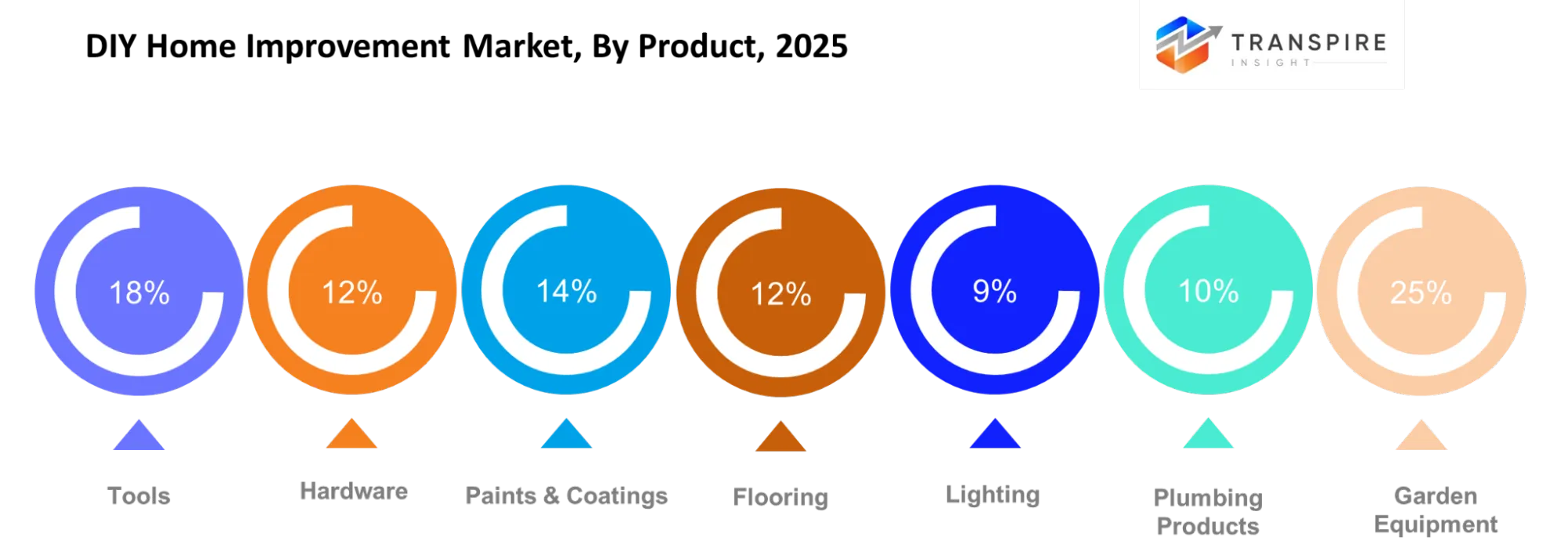
The Tools and Equipment dominated the market, accounting for nearly 25% in 2025 and is expected to rise at a significant CAGR during the forecast period.
The DIY Home Improvement Market is by product into tools, hardware, paints & coatings, flooring, lighting, plumbing products, garden equipment, others. Among these, the Tools and Equipment dominated the market, accounting for nearly 25% in 2025 and expected to increase at a significant CAGR during the forecast period. Tools & Equipment come first because all Do-It-Yourself projects require them, and innovations and ergonomics will ensure regular repurchases.
The Remodeling dominated the market, accounting for close to 37.38% in 2025, and is expected to rise at a significant CAGR during the forecast period
The DIY Home Improvement Market is segmented by project type into renovation, remodeling, repair, decoration, maintenance, landscaping, installation, others. Among these, the Remodeling dominated the market, accounting for close to 37.38% in 2025 and expected to increase at a significant CAGR during the forecast period. Remodeling is at the top because of the homeowner’s preference for upgrading the house rather than moving, due to aging housing units and need for updating.
The Bedroom dominated the market, accounting for about 34% in 2025 and is expected to rise at a significant CAGR during the forecast period.
The DIY Home Improvement Market by room into kitchen, bathroom, bedroom, living room, garage, outdoor, basement, others. Among these, the Bedroom dominated the market, accounting for about 34% in 2025 and expected to increase at a significant CAGR during the forecast period. Bedrooms come first as homeowners focus on comfort and customization, looking for cost-effective and regular Do-It-Yourself solutions like painting and furnishing.
Regional Segment Analysis of the DIY Home Improvement Market
- Europe (Germany, France, U.K., Italy, Spain, Rest of Europe)
- North America (U.S., Canada, Mexico)
- Asia-Pacific (China, Japan, India, Rest of APAC)
- South America (Brazil and the Rest of South America)
- The Middle East and Africa (UAE, South Africa, Rest of MEA)
North America is expected to grow at a rapid CAGR in the DIY Home Improvement Market, holding around 39% of the share during the forecast period.
DIY home improvement dominates North America due to high levels of homeownership, aging residential stock, and high spending on home renovation. Efficient retail channels, such as home centers and e-commerce sites, allow quick access to tools and materials. Professional labor costs push consumers towards conducting DIY renovations, whereas numerous tutorial videos increase consumer confidence. Furthermore, mortgage rates favor renovation over moving, which further stimulates demand and growth in the region.
Europe is the high-growth region in the DIY Home Improvement Market during the period, holding roughly 29% share.
Europe is also a major player in the DIY home improvement market due to established home improvement culture, aging residential buildings, and strict energy efficiency regulations. Such initiatives as the European Green Deal push consumers to engage in sustainable home improvement projects, whereas high labor costs encourage consumers to conduct the work themselves. In addition, efficient home improvement retail channels and increased e-commerce adoption further stimulate demand.
Asia Pacific is the fastest-growing region in the DIY Home Improvement Market during the period, holding nearly 23% share.
The DIY home improvement industry in the Asia Pacific is growing at an unprecedented pace due to high urbanization rates, disposable incomes, and homeownership among the middle class. The government initiatives on homebuilding and renovation programs, especially in India and China, boost the consumption of building products and tools. The increased adoption of e-commerce, social media tutorials, and a young demographic that desires personalized spaces favor its growth.
Strategies for Market Growth in Non-Leading Regions:
DIY home improvement product manufacturing and distribution technologies that will enable the development of non-leading regions will have advantages for small and medium-sized retailers, suppliers, and manufacturers. DIY home improvement product manufacturing and distribution locally will help decrease dependency on imports and cut down the total cost of procurement and operations. Collaboration and cooperation with regional manufacturers, home improvement retailers, contractors, suppliers, and distributors will help boost market penetration of DIY home improvement products and solutions. Training and technical skills improvement are needed to raise the knowledge level of DIY home improvement, product selection, installation, maintenance, quality control, and renovation. Also, the affordability of DIY home improvement products can be achieved via flexible financing options, long-term contracts of supply, and contract manufacturing. In addition, collaborative projects with government, construction, housing, and home improvement projects, as well as digital sales, will help increase accessibility of DIY home improvement products and ensure sustainable worldwide market development in developing countries.
Future Market Trends for the DIY Home Improvement Market: -
- Integration of AI into Omnichannel Selling: More retailers are turning to AI-based merchandising, AI-driven recommendations, planning applications, and in-store fulfillment of online purchases to enhance ease, customization, and efficiency in the purchasing process.
- Environmentally-Friendly and “Smart” Home Improvement: Growing demand for environmentally-friendly building products, paints with low-VOC content, energy-efficient home improvement products, and “smart” home technologies that help customers improve their homes in an eco-efficient way.
- Portable Multifunctional Tools & Outdoor Improvement: Consumers are seeking products for cordless multifunctional tools and home improvement items for outdoor use.
Recent Development
- Kingfisher plc introduced its environmentally friendly series of power tools with an interchangeable battery in April 2026, owing to growing consumer interest in portable and battery-efficient power tools.
- The DIY home improvement report of Zion Market Research was published on July 13, 2026. The market size stood at USD 857.05 billion in 2024 and is expected to reach USD 1,192.01 billion by 2034.
Market Segment
This study forecasts revenue at global, regional and country levels from 2020 to 2033. Transpire Insight has segmented the DIY Home Improvement Market based on the below-mentioned segments:
DIY Home Improvement Market, By Product
- Tools
- Hardware
- Paints & Coatings
- Flooring
- Lighting
- Plumbing Products
- Garden Equipment
- Others
DIY Home Improvement Market, By Project Type
- Renovation
- Remodeling
- Repair
- Decoration
- Maintenance
- Landscaping
- Installation
- Others
DIY Home Improvement Market, By Room
- Kitchen
- Bathroom
- Bedroom
- Living Room
- Garage
- Outdoor
- Basement
- Others
DIY Home Improvement Market, By Product Category
- Power Tools
- Hand Tools
- Building Materials
- Décor
- Furniture
- Electrical
- Plumbing
- Others
DIY Home Improvement Market, By Consumer Type
- Homeowners
- Renters
- First-time Buyers
- DIY Enthusiasts
- Hobbyists
- Professionals
- Families
- Others
DIY Home Improvement Market, By Distribution
- Home Improvement Stores
- Hardware Stores
- Online
- Specialty Stores
- Department Stores
- Direct Sales
- Marketplaces
- Others
DIY Home Improvement Market, By Price Range
- Economy
- Mid-range
- Premium
- Luxury
- Professional
- Value
- Custom
- Others
By Regional Analysis
North America
- US
- Canada
- Mexico
Europe
- Germany
- UK
- France
- Italy
- Spain
- Russia
- Rest of Europe
Asia Pacific
- China
- Japan
- India
- South Korea
- Australia
- Rest of Asia Pacific
South America
- Brazil
- Argentina
- Rest of South America
Middle East & Africa
- UAE
- Saudi Arabia
- Qatar
- South Africa
- Rest of the Middle East & Africa
Frequently Asked Questions
Find quick answers to common questions.
Rising renovation costs, aging homes, e-commerce adoption, digital tutorials, and consumer interest in personalized living spaces are driving market growth.
North America dominates the market, supported by high homeownership, aging housing stock, established retailers, renovation spending, and strong e-commerce adoption.
Remodeling dominates the project type segment, accounting for approximately 37.38% share in 2025, driven by homeowners upgrading existing properties.
AI, augmented reality, digital tutorials, smart tools, and omnichannel platforms simplify project planning, product selection, purchasing, installation, and home improvement execution.
Key trends include AI-powered shopping, sustainable materials, energy-efficient upgrades, multifunctional cordless tools, smart-home integration, and expanding omnichannel retail.
- Home Depot
- Lowe's
- Kingfisher
- Adeo
- Menards
- Ace Hardware
- Travis Perkins
- Bunnings
- Walmart
- Amazon
- OBI
- Hornbach
- Bauhaus
- Canadian Tire
- Mr. Bricolage
About the Authors

Kartik bhong
I am Kartik Bhong, a Senior Research Analyst at Transpire Insight, specializing in the Packaging, Manufacturing, and Construction industry. My work focuses on analyzing market trends, emerging technologies, industry regulations, and competitive landscapes to deliver accurate, data-driven insights. I am passionate about transforming complex industry information into clear, practical content that helps businesses, professionals, and decision-makers stay informed and make confident strategic decisions. Through continuous research and a strong commitment to accuracy, I strive to create reliable, well-researched content that reflects the latest developments across these dynamic industries and supports the vision of Transpire Insight in delivering valuable market intelligence.

Chakradhar Khansole
Chakradhar serves as the Research Director at Transpire Insight, bringing over 8 years of experience in technology, innovation, and strategic market intelligence. He specializes in transforming complex market data into actionable business insights that enable organizations to make informed, growth-oriented decisions. Recognized for his strategic vision and analytical expertise, Chakradhar leads high-impact research initiatives, delivering comprehensive market assessments, competitive intelligence, and forward-looking industry analysis.
Recently Published Reports
-
Apr 2026
Handling and Lifting Equipment Market
Handling and Lifting Equipment Market Size, Share & Analysis Report By Product (Cranes and Hoists, Forklifts, Conveyor Systems, Aerial Work Platforms, Others), By Application (E-Commerce, Automotive and Railway, Food and Beverages, Aviation, Others), and Geography (North America, Europe, Asia-Pacific, Middle East and Africa, South and Central America), 2021 - 2031
-
Apr 2026
HVAC Equipment Market
HVAC Equipment Market Size, Share & Analysis Report By Heating Equipment Type (Boilers and Furnaces, Heat Pumps, and Unitary Heaters), By Ventilation Equipment (Air Handling Units, Humidifiers and Dehumidifiers, Air Filters, and Fan Coiling Units), By Air Conditioning Equipment (Unitary Air Conditioners, Room Air Conditioners, Packaged Terminal Air Conditioners, and Chillers), By End User (Commercial, Residential, Industrial, and others), and Geography (North America, Europe, Asia-Pacific, Middle East and Africa, South and Central America), 2021 – 2031
-
Apr 2026
Refrigeration Valves Market
Refrigeration Valves Market Size, Share & Analysis Report By Type (Solenoid Valves, Expansion Valves, Check Valves, Service Valves, Others), By Application (Commercial Refrigeration, Industrial Refrigeration, Transport Refrigeration, Residential Refrigeration, Air Conditioning Systems), By End User (Food and Beverage Industry, Pharmaceutical Industry, HVAC Industry, Chemical Industry, Others), and Geography (North America, Europe, Asia-Pacific, Middle East and Africa, South and Central America), 2021 – 2031
-
Apr 2026
E-Commerce Packaging Materials Market
E-Commerce Packaging Materials Market By Material Type (Corrugated Boxes, Paper & Paperboard, Foam & Cushioning Materials, Plastic Packaging, Flexible Packaging, Protective Packaging, Others), By Product(Primary Packaging, Secondary Packaging, Tertiary Packaging), By Packaging Function (Protective Packaging, Branding & Presentation Packaging, Transit & Logistic Packaging, Sustainable Packaging, Tamper Evidence Packaging), By End-User (Retail & Consumer Goods, Electronic Appliances, Food & Beverages, Healthcare & Pharmaceutical, Fashion & Apparel, Home & Furnishing, Others); By Industry Analysis, Size, Share, Growth, Trends, and Forecasts 2021-2033