

Disposable Tableware Market Summary:
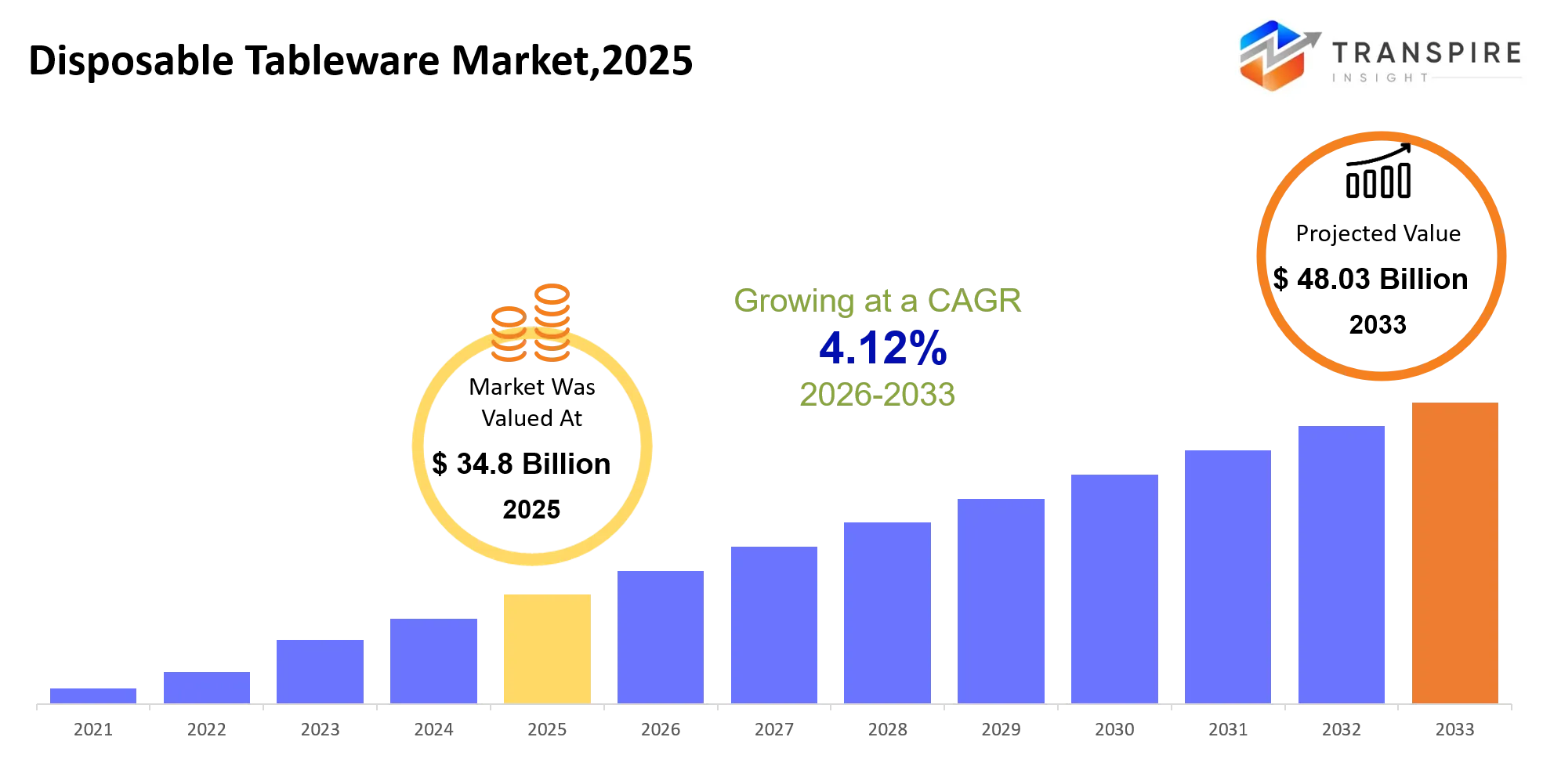
As per the Transpire Insight Analysis, The Disposable Tableware Market size is estimated at USD 34.8 billion in 2025 and is anticipated to reach USD 48.03 billion by 2033, growing at a CAGR of 4.12% from 2026 to 2033.
The market for disposable tableware has shifted from serving products to engineered formats that deliver convenience, reduce waste, and ensure compliance. During the past three to five years, paper, bagasse, bamboo, and PLA options have become more common as operators focus on plastic restrictions and retailer sustainability directives. We are witnessing a fundamental shift from traditional plastics to fibre-based and compostable formats driven by more severe packaging regulations and developing forming technologies. The European Union's Packaging and Packaging Waste Regulation was adopted in August 2026, introducing measures for reducing PFAS in food-contact packaging and further increasing supplier pressure to create grease- and moisture-resistant formats. This regulatory catalyst is driving material substitution and qualification efforts. Growth comes from foodservice operators mandating compliant formats for takeaway, delivery, catering, and meals, and manufacturers adding value through higher-specification cups, containers, lids, and fibre products rather than through volume sales, thus improving the product mix.
Key Disposable Tableware Market Insights:
- The market is moving from buying individual items to systems delivered, which require cups, containers, lids, and fibre formats to work together to provide leak resistance, food-contact safety, and disposal requirements. The performance of the material, verified PFAS-free, and the conversion of moulded-fibre on a scalable level are becoming a competitive advantage, not just the production of low-cost plastics.
- Cafés are transitioning to fibre formats that work well in dairy and cold-food applications, as Huhtamaki's single-coated ProDairy cup is 31.80% recyclable.
- As caterers switch from foam to serving solutions that can withstand higher temperatures, Dart's SOLO Bold Hold paper plate continues to lead the way in the advancement of plates that are free of PFAS and higher-weight paper.
- Bowls, 13.00%: A 6.85% CAGR has been correlated with grain-bowl, ramen, and layered-meal delivery, which has led to deeper moulded-fibre designs that feature greater rigidity.
- As restaurant chains cut down on packaging vendors, Food containers, 12.00% as Novolex's purchase of Pactiv Evergreen bolsters integrated food-container supply.
- Sabert's PulpUltra launch points to a new trend in the hot-food sector: recyclable, plant-fibre based formats in addition to plastic-replacement cutlery programs, Cutlery reports.
- As Dart moves away from foam trays and towards certified renewable-resource meal carriers, trays are also switching from traditional foam to Dart's PFAS-free fibre trays, which are now 7.00%.
- As a solution to the challenge of portion control and plastic-reduction compatibility, the fibre cup-and-lidding-film format from Eco-Products is the answer schools are looking for.
- Meanwhile, as meal kits and delivery services are becoming more uniform, others, such as Tamper-evident inserts and portion accessories, are becoming more relevant, accounting for 4.20% of the market.
- Paper-led conversion is a PFAS-free barrier innovation that allows fibre tableware to manage oily foods without the use of fluorinated grease-proofing chemistry.
What are the Key Drivers, Restraints, and Opportunities in the Disposable Tableware Market?
Driver:
The largest growth driver is the operating model of quick-service restaurants, cloud kitchens, cafés and delivery platforms, where every order requires a hygienic, transport-safe serving format. The trigger has been the sustained normalisation of off-premise eating: food operators now need containers that retain heat, resist oil leakage, stack efficiently and support brand presentation. This increases revenue not simply through more meals served, but through higher-value sales of coated paper, moulded-fibre bowls, compartment trays and tamper-evident lids. Regulatory action intensifies the shift. India’s ban on several low-utility single-use plastic items forced buyers to replace plastic cups, plates, cutlery and trays with alternative materials.
Restraint:
Cost and end-of-life infrastructure remain structural barriers. Bagasse, bamboo, PLA and speciality barrier-coated paper can cost more than conventional plastic, while compostability claims provide limited value where separate collection and industrial composting are unavailable. Foodservice buyers consequently face a trade-off between regulatory compliance, performance and unit economics. Material availability, inconsistent local rules, and food-contact testing also slow conversion.
Opportunity:
The strongest opportunity lies in scalable PFAS-free fibre tableware using recyclable or compostable barrier coatings. U.S. withdrawal of PFAS grease-proofing agents and stricter EU packaging requirements are accelerating demand for water-based, bio-based and mineral-based barriers. These technologies can provide grease and moisture resistance without fluorinated chemicals. Investment in moulded-fibre capacity across Asia-Pacific is particularly attractive because agricultural residues, local converting capabilities and fast-growing food-delivery networks can lower material costs, reduce imported petroleum-resin dependence and support regionally compliant tableware production.
What Has the Impact of Artificial Intelligence Been on the Disposable Tableware Market?
AI for quality, supply and production Converters are already applying AI to improve quality control, production planning and material utilisation. Computer-vision systems can detect cracks, waviness, misshapen rims, under-embossing, contamination, dimensional variation or defective barrier coating on cups, plates, lids and moulded-fibre products before they are shipped, helping reduce customer complaints and scrap – especially for converters with high-speed thermoforming, paper converting or pulp-moulding lines running millions of units. Demand-forecasting software can help converters co-ordinate the delivery of paperboard, bagasse pulp, PLA, coatings and packaging film with projected restaurant, retail and seasonal event orders. Better forecasting can help avoid stock-outs at peak delivery times and excess inventory of moisture-sensitive fibre products, and predictive maintenance tools may monitor temperature, pressure, vibration and cycle-time data to predict wear on moulding presses and forming equipment, avoiding costly downtime. But adoption varies, with smaller producers potentially lacking connected equipment, clean data and trained personnel, and the cost of integration, as well as variations in the quality of raw-material colours, textures and lighting across batches affecting the accuracy of AI inspections, meaning human checks are still important for food-contact compliance. The technology is more valuable when used with standardised production metrics and line automation, and not as a "bolt-on" system.
In September 2026, [WM Thermoforming Machines] announced a partnership with to deploy an AI-assisted digital platform and smart factory concept. This integration connects in-line vision quality control, real-time analytics, and automated material handling.
https://www.smartlogistix.com/industry
Key Disposable Tableware Market Trends:
Disposable tableware is shifting from commodity plastic supply to compliance-driven, performance-engineered food contact products. It is not just unit price that's the key competitive issue, but material credibility, including heat resistance, grease control, recyclability, and verified chemical safety.
- In response to the ban on low-utility single-use plastic items, plastic-heavy portfolios are being redesigned to paper, bagasse, bamboo, and wood.
- Conventional fluorinated treatments in paper food contact products are being phased out in the U.S. market in favour of PFAS-free grease resistance.
- As more people are eating at home, the moulded-fibre bowls and clamshells are taking up more retail space, as food delivery meals demand a more robust and leak-proof alternative to the foam versions.
- Quick-service restaurants are moving from simple cups to logo-printed, tamper-resistant cups, lids and delivery containers.
- To compensate for rising input costs, producers are cutting weight by thinning walls and nesting designs and by better fibre moulding.
- Reusable foodservice targets are causing a divide between disposables, which are still needed for convenience, and reusables, which are increasing in controlled environments.
- As food contact chemistry regulations become more stringent in key markets, digital traceability and supplier documentation are gaining significance.
- Independent restaurants, caterers and event operators are accelerating their procurement cycles with online channels.
- It is now possible to make fibre-based products that are designed to cook in the microwave, or to withstand hot liquids or oily foods, in addition to being dry snacks.
- The growth of regional manufacturing around agricultural residues is driving increased interest in bagasse-based products and in sourcing materials as a circular feedstock.
Disposable Tableware Market Segmentation
Product Type:
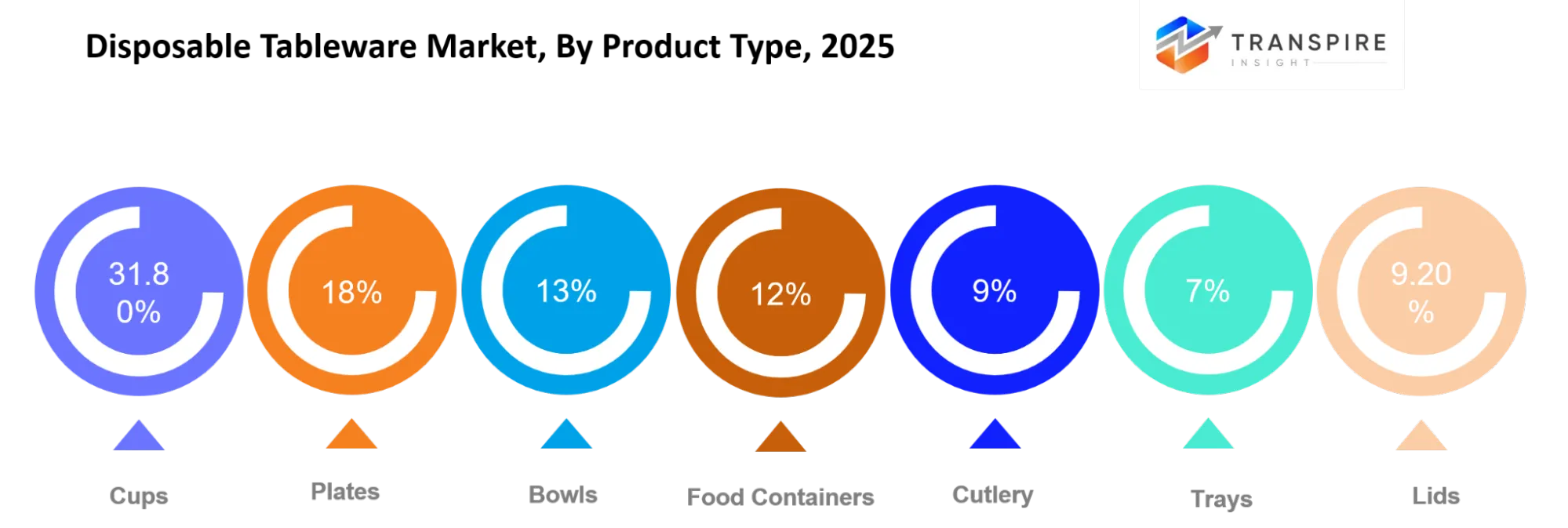
Cups lead at 31.80%, supported by frequent beverage consumption across cafés, quick-service restaurants and takeaway channels. Plates account for 18.00%, serving prepared meals, catering and institutional foodservice requirements. Bowls represent 13.00% and register a 6.85% CAGR, supported by expanding soup, salad, noodle and portioned-meal applications. Food Containers hold 12.00%, benefiting from delivery, takeaway and portion-control needs. Cutlery contributes 9.00%, followed by Trays at 7.00%, Lids at 5.00% and Others at 4.20%, with coordinated formats improving compatibility, convenience, handling efficiency and overall foodservice packaging performance.
Material:
Paper is gaining strategic importance as PFAS restrictions and recyclable-design requirements encourage alternative barrier technologies for food-contact products. Plastic remains important where strength, affordability, flexibility, and heat resistance influence purchasing decisions. Aluminium supports premium takeaway and catering applications requiring rigidity and thermal performance. Bagasse, bamboo, and Wood benefit from renewable-material positioning, particularly in foodservice. PLA/Bioplastic provides another substitution pathway where compostability infrastructure and certification are established. Material selection increasingly depends on performance, regulation, sourcing stability, and end-of-life compatibility.
Application:
Foodservice remains central because restaurants, cafés and takeaway operators require standardised, high-volume serving formats with consistent performance. Household applications benefit from convenience-oriented occasions, including gatherings and outdoor consumption. Catering and Events favour lightweight tableware that reduces washing requirements, labour, and turnaround time during peak operations. Institutional users increasingly evaluate hygiene, food-contact documentation, and disposal processes. Hospitality applications emphasise presentation alongside operational efficiency, while Retail provides consumer access to packaged disposable products and supports wider adoption through convenient product availability.
Distribution Channel:
Hypermarkets and Supermarkets provide broad consumer access and support high-volume purchases through established retail networks. Online channels enable smaller-batch purchasing, product comparison, and access to specialised sustainable formats. Convenience Stores favour immediately available cups, plates and cutlery for everyday consumption. Specialty Stores serve buyers seeking particular materials or premium designs, while Wholesale supports price-sensitive bulk procurement. Direct Sales enable customisation and contract supply, whereas Foodservice Distributors provide recurring deliveries, inventory coordination and product portfolios for restaurants and institutional customers.
End User:
Restaurants and Quick-Service Restaurants anchor consumption because they require reliable, high-volume tableware for dine-in, takeaway and delivery operations. Hotels and Cafeterias add recurring institutional demand, balancing presentation, hygiene and operating efficiency. Airlines prioritise lightweight products that reduce onboard weight and handling complexity, while Hospitals emphasize hygiene, controlled usage and convenient disposal. Households remain important for gatherings, celebrations and convenience occasions. Future adoption will increasingly depend on suppliers combining material performance, regulatory compliance, functional design and dependable channel-specific fulfilment capabilities.
What are the Key Use Cases Driving the Disposable Tableware Market?
The core use case is takeaway and delivery foodservice, led by disposable cups, which hold 31.80% of product demand. Restaurants and quick-service outlets use cups, lids, bowls and containers to protect beverages and meals during transport, reduce washing requirements and support rapid order fulfilment. Bowls are particularly relevant for soups, curries, salads and meal-bowl concepts, with the segment projected to grow at a 6.85% CAGR.
Expanding applications include catered corporate meals, food courts, hospitality buffets, airline service, hospital cafeterias and large public events. These settings value hygienic, stackable products that simplify post-service cleanup while handling high guest volumes.
Emerging use cases include premium home-delivery kits, ghost kitchens, eco-focused festivals and refill-compatible takeaway programs. As rules restrict certain plastic products, operators are adopting moulded bagasse trays, paper-based cups and PFAS-free grease-resistant formats to retain convenience while improving regulatory readiness.
|
Report Metrics |
Details |
|
Market size value in 2025 |
USD 34.8 Billion |
|
Market size value in 2026 |
USD 36.2 Billion |
|
Revenue forecast in 2033 |
USD 48.03 Billion |
|
Growth rate |
CAGR of 4.12% from 2026 to 2033 |
|
Base year |
2025 |
|
Historical data |
2021 - 2024 |
|
Forecast period |
2026 - 2033 |
|
Report coverage |
Revenue forecast, competitive landscape, growth factors, and trends |
|
Regional scope |
United States; Canada; Mexico; United Kingdom; Germany; France; Italy; Spain; Denmark; Sweden; Norway; China; Japan; India; Australia; South Korea; Thailand; Brazil; Argentina; South Africa; Saudi Arabia; United Arab Emirates |
|
Key companies profiled |
Dart Container, Huhtamaki, Pactiv Evergreen, Georgia-Pacific, Reynolds Consumer Products, Novolex, Graphic Packaging, WestRock, International Paper, Berry Global, Amcor, Genpak, Sabert, Solo Cup, Duni. |
|
Customization scope |
Free report customisation (country, regional & segment scope). Available customised purchase options to meet your exact research needs. |
|
Report Segmentation |
Product Type (Cups, Plates, Bowls, Trays, Cutlery, Food Containers, Lids, Others); Material (Paper, Plastic, Aluminium, Wood, Bagasse, Bamboo, PLA/Bioplastic, Others); Application (Foodservice, Household, Catering, Institutional, Events, Hospitality, Retail, Others); Distribution Channel (Hypermarkets & Supermarkets, Online, Convenience Stores, Speciality Stores, Wholesale, Direct Sales, Foodservice Distributors, Others); End User (Restaurants, Quick-Service Restaurants, Hotels, Cafeterias, Airlines, Hospitals, Households, Others). |
Which Regions are Driving the Disposable Tableware Market Growth?
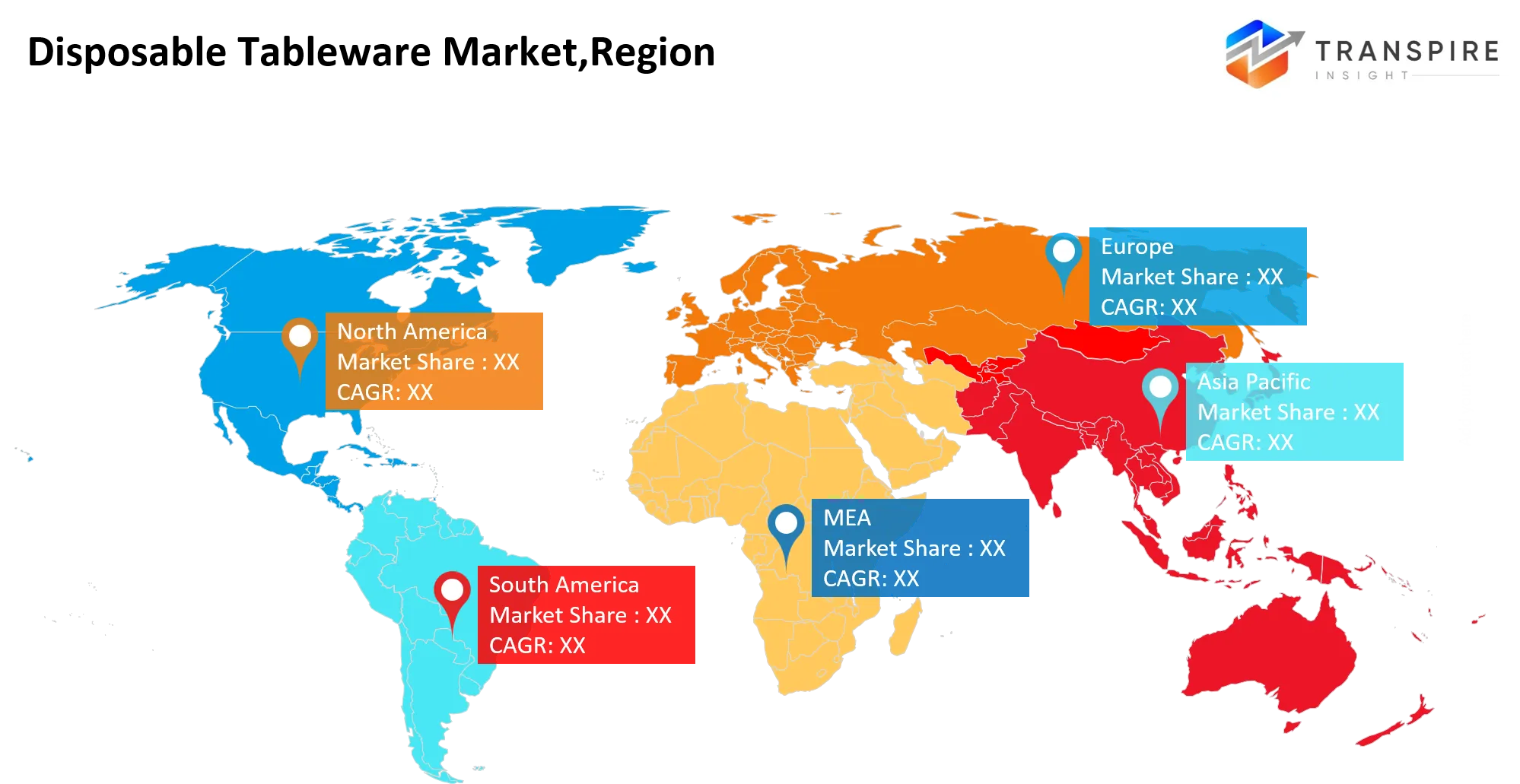
Asia-Pacific held the largest share of 34.40% in the disposable tableware market. The presence of well-developed urban foodservice channels, the increasing number of QSRs, and the higher shipment frequency of delivery orders drive the demand for on-the-go packaging. A large manufacturing base comprising paper, plastic, bagasse, and bamboo disposable tableware improves supply responsiveness and provides cost competitiveness. The Indian ban on specific single-use plastic plates, cups, cutlery, and trays promoted substitution of existing formats with other materials to avoid consequences of the new regulation. The ecosystem has then in place policy compliance, local agricultural-fibre feedstocks, and a significant customer base of price-conscious foodservice operators.
In April 2026, Amcor completed its all-stock of Berry Global. This integration accelerated synergy capture 10% ahead of initial projections and expanded manufacturing and reusable tableware distribution capabilities globally.
https://www.packagingdive.com/news/amcor-closes-berry-global-acquisition/746755/
Europe accounts for 23.00% of the market and can be described as less of a volume driver, with its demand mostly coming from compliance & technology. There are bans on some plastic cutlery, plates & expanded-polystyrene food & beverage containers by the European Union that raise the barrier for plastic types and favour paper, fibre & reusable systems. There is a procurement premise of recyclability, minimisation & reuse criteria in purchasing decisions via Regulation and thus, Europe will have an ongoing demand for certified, traceable & high-quality fibre-based formats rather than volume.
In May 2026, UPM, Michelman, and BOBST launched two new fibre-based packaging concepts designed to directly comply with the European Union's tightening single-use plastics and recycling regulations.
https://environment.ec.europa.eu/news/new-eu-rules-packaging-enter-application-2026-08-11_en
North America is the fastest-growing regional market, projected to expand at a 4.00% CAGR, as food delivery, convenience retail and restaurant chains continue to modernise packaging portfolios. The recent PFAS phase-out in U.S. grease-proof food-contact packaging has increased demand for alternative barrier technologies in paper and moulded-fibre tableware. Consolidation, including Novolex’s $6.7 billion acquisition of Pactiv Evergreen in April 2025, is improving national distribution reach and innovation capacity. Latin America, with 7.00%, and the Middle East and Africa, with 5.60%, offer future upside through urban foodservice growth, tourism and modern retail expansion.
In January 2024, Genpak launched its new moulded fibre packaging line under the "Harvest Fibre" brand to provide grease-resistant food containers without intentionally added PFAS. This product introduction helps foodservice operators comply with tightening chemical regulations while maintaining oil and moisture barriers for takeout and delivery foods.
Who are the Key Players in the Disposable Tableware Market, and how do they compete?
Competition is shifting away from standalone products, towards portfolio scope and depth, material advances, and superior national coverage. Novolex, with the acquisition of Pactiv Evergreen, is establishing integrated capacities in food, beverage, and speciality packaging under a Novolex platform. Dart Container leverages a high-volume foodservice base with an augmented moulded-fibre line that contains no PFAS, is home-compostable, and uses a minimum of 96% renewable content.
Huhtamaki advances paperboard conversion and moulded-fibre conversion innovations; the 2025 corporate-structure separation of Fibre Packaging from Foodservice Packaging sharpens product-market focus for each. Its Pro Dairy coated-paper-cup platform emphasises high performance in the tough dairy environment, and not just fibre substitution. Along with printing, finishing, and foil-lamination leaders Georgia-Pacific, Reynolds Consumer Products, Graphic Packaging, West Rock, and International Paper provide their scale, expertise, and commercial relationships to extend paper-and-converting, while Berry Global, Amcor, and Genpak sustain US distinction in engineered plastics, barrier, and rigid container systems. Sabert, Duni, and Solo Cup pursue presentation and niche meal-occasion capabilities for foodservice, while the former Pactiv Evergreen portfolio adds PWP-systems-based versatility to the Novolex offering.
Key Players are:
- Dart Container
- Huhtamaki
- Pactiv Evergreen
- Georgia-Pacific
- Reynolds Consumer Products
- Novolex
- Graphic Packaging
- WestRock
- International Paper
- Berry Global
- Amcor
- Genpak
- Sabert
- Solo Cup
- Duni
Recent Development News
- In February 2026, Eco-Products launched its comprehensive portfolio of reusable, recyclable, and compostable foodservice packaging in the United Kingdom. This international expansion leverages its UK-based sister company, Vegware, to deliver scalable waste-diversion solutions to European stadiums, universities, and caterers.
- In September 2026, Aaroyaa expanded its compostable tableware portfolio to more than 100 SKUs covering biodegradable plates, bowls, cups and cutlery for households and foodservice customers. The company is also developing additional products using materials such as areca, bamboo and agricultural waste, supporting broader substitution of conventional single-use plastics.
- In July 2026, Footprint acquired Transcend Packaging’s PE-free hot and cold cup platform along with next-generation paper lid and straw solutions. The transaction adds recyclable and home-compostable disposable beverage ware to Footprint’s portfolio, with production planned to scale through its Poland facility and later North America.
What Strategic Insights Define the Future of the Disposable Tableware Market?
The industry is moving in the direction of a compliance-based food contact material substitution, where recyclability, PFAS-avoidance, recycled content, and transparent end-of-life management are no longer sustainability advantages, but capital expenditure requirements. A concern with this is that new materials may add to total cost of ownership (coating, certifying, tooling, and waste handling infrastructure), which will be a barrier to adoption if performance and disposal aren't as expected. An opportunity here is the move towards integrated product systems, including cups with certain domes and lidding systems, fibre containers with matching trays, digitally taggable materials that can streamline procurement and compliance, which could bring innovators from transaction-based unit sales to specification-based contracts, and stronger long-term customer partnerships. Manufacturers should look to exploit materials platform capabilities by offering multiple formats, build barriers to minimize costly coatings, prove recyclability/compostability, take advantage of regionally produced materials and capability, and stay abreast of regional regulations, all commercial levers for quick reformulation and scope of qualification for all customers.
Key Segmentations are:
Product Type
- Cups
- Plates
- Bowls
- Trays
- Cutlery
- Food Containers
- Lids
- Others
Material
- Paper
- Plastic
- Aluminium
- Wood
- Bagasse
- Bamboo
- PLA/Bioplastic
- Others
Application
- Foodservice
- Household
- Catering
- Institutional
- Events
- Hospitality
- Retail
- Others
Distribution Channel
- Hypermarkets & Supermarkets
- Online
- Convenience Stores
- Speciality Stores
- Wholesale
- Direct Sales
- Foodservice Distributors
- Others
End User
- Restaurants
- Quick-Service Restaurants
- Hotels
- Cafeterias
- Airlines
- Hospitals
- Households
- Others
Frequently Asked Questions
Find quick answers to common questions.
The disposable tableware market size was valued at USD 34.8 billion in 2025 and is poised to reach USD 48.03 billion by 2033, expanding at a 4.12% CAGR.
Key segments for the disposable tableware market are Product Type (Cups, Plates, Bowls, Trays, Cutlery, Food Containers, Lids, Others); Material (Paper, Plastic, Aluminum, Wood, Bagasse, Bamboo, PLA/Bioplastic, Others); Application (Foodservice, Household, Catering, Institutional, Events, Hospitality, Retail, Others); Distribution Channel (Hypermarkets & Supermarkets, Online, Convenience Stores, Specialty Stores, Wholesale, Direct Sales, Foodservice Distributors, Others); End User (Restaurants, Quick-Service Restaurants, Hotels, Cafeterias, Airlines, Hospitals, Households, Others).
Growth is primarily driven by plastic-use restrictions, expansion of food delivery and takeaway services, adoption of fibre-based and compostable materials, demand for lightweight foodservice formats, and investment in recyclable and PFAS-free packaging technologies.
The disposable tableware market is led by major manufacturers, including Dart Container, Huhtamaki, Pactiv Evergreen, Georgia-Pacific, Reynolds Consumer Products, Novolex, Graphic Packaging, WestRock, International Paper, Berry Global, Amcor, Genpak, Sabert, Solo Cup, and Duni.
Asia-Pacific holds 34.40% of the market, supported by large foodservice populations, expanding takeaway and delivery activity, established manufacturing capacity, abundant raw-material supply, and cost-efficient production networks.
Opportunities include PFAS-free barriers, molded-fiber products, recycled-content formats, mono-material packaging, and integrated cup-container-lid systems for foodservice and takeaway applications.
- Dart Container
- Huhtamaki
- Pactiv Evergreen
- Georgia-Pacific
- Reynolds Consumer Products
- Novolex
- Graphic Packaging
- WestRock
- International Paper
- Berry Global
- Amcor
- Genpak
- Sabert
- Solo Cup
- Duni
About the Authors

Chetan Dhatrak
I’m Chetan Dhatrak, a Senior Research Analyst at Transpire Insight, specializing in the Consumer Goods, Foods and Beverages industry. I focus on analyzing market trends, consumer behavior, competitive landscapes, and industry developments to deliver accurate, data-driven insights. My research at Transpire Insight is built on credible sources and in-depth analysis, helping businesses and readers better understand market dynamics, emerging opportunities, and evolving consumer preferences. I’m committed to creating reliable, well-researched content that supports informed decision-making and reflects the latest developments in the consumer goods and food & beverage sectors.

Chakradhar Khansole
Chakradhar serves as the Research Director at Transpire Insight, bringing over 8 years of experience in technology, innovation, and strategic market intelligence. He specializes in transforming complex market data into actionable business insights that enable organizations to make informed, growth-oriented decisions. Recognized for his strategic vision and analytical expertise, Chakradhar leads high-impact research initiatives, delivering comprehensive market assessments, competitive intelligence, and forward-looking industry analysis.
Recently Published Reports
-
Apr 2026
Bottled Water Market
Bottled Water Market Size, Share & Analysis Report By Product Type (Still Bottled Water, Carbonated Bottled Water, Functional Bottled Water, and Others), By Packaging (PET, Cans, and Others), By Sales Channel (Supermarkets/Hypermarkets, Convenience Stores/Drug Stores, Grocery Stores/Club Stores, Foodservice, and Others) and Geography (North America, Europe, Asia-Pacific, Middle East and Africa, South and Central America), 2021 - 2032
-
Apr 2026
Color Cosmetic Packaging Market
Color Cosmetic Packaging Market Size, Share & Analysis Report By Application (Mascara Packaging, Liquid Packaging, and Liquid Face), By Type (Tubes & Bottles, Pens & Markers, Compacts & Containers, and Droppers & Pumps), and Geography (North America, Europe, Asia-Pacific, Middle East and Africa, South and Central America), 2021 - 2031
-
Apr 2026
External Microphone For Camera Market
External Microphone For Camera Market Size, Share & Analysis Report By Type (Shotgun Microphone, Lavalier Microphone, and Others), By Application (Digital Camera, Professional Video Camera, and Others), and Geography (North America, Europe, Asia-Pacific, Middle East and Africa, South and Central America), 2021 - 2031
-
Apr 2026
Foot Orthotic Insoles Market
Foot Orthotic Insoles Market Size, Share & Analysis Report By Type (Pre-fabricated, and Custom-made), By Material (Thermoplastic, Composite Carbon Fiber, and Others), By Distribution Channel (Drug Stores, Hospitals & Clinics, and Others), and Geography (North America, Europe, Asia-Pacific, Middle East and Africa, South and Central America), 2021 - 2031