
Dirt Bike Market Summary:
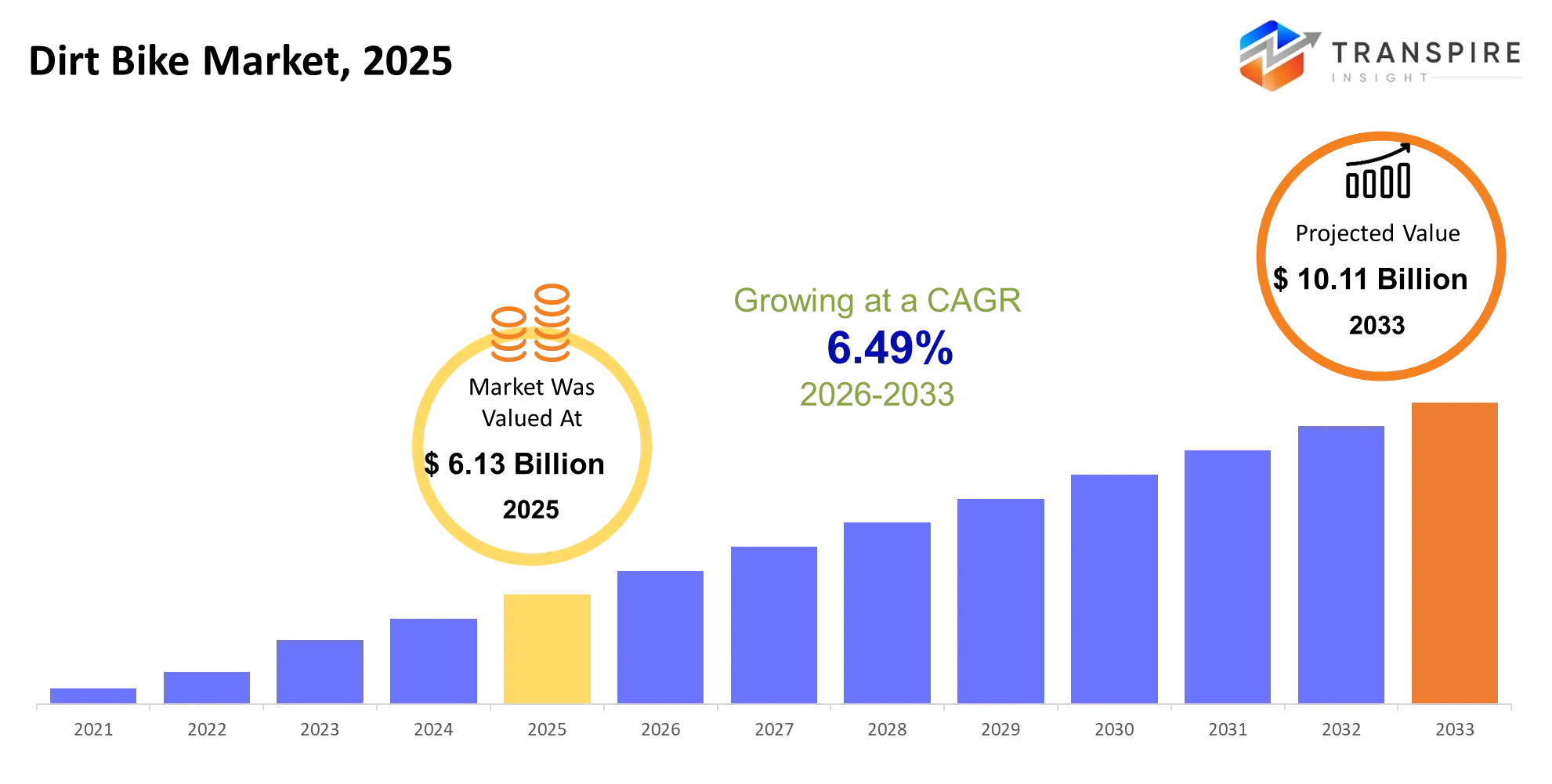
As per the Transpire Insight, The Dirt Bike Market size is estimated at USD 6.13 billion in 2025 and is anticipated to reach USD 10.11 billion by 2033, growing at a CAGR of 6.49% from 2026 to 2033.
The off-road dirt bike market provides off-road transportation for motocross competition, enduro racing, trail riding, rider training, and recreation. Bike manufacturers compete in the pursuit of lighter weight, suspension tuning, engine response, durability, and rider safety, while bike dealers provide maintenance and replacement parts. Recent trends include an increase in models powered by alternative electric powertrains as well as continued advances in fuel injection, electronic controls, and emissions performance. Of significance is the increased adoption of battery-powered dirt bikes for youth and training models, where lower noise and easier maintenance open the market to broader adoption. Motocross race competition and organized riding events drive product design, with competitors responding by incorporating some race technology into consumer models. Growth patterns follow a natural cycle: Ride quality, more accessible introductory models, and off-road riding, with electric options also promising new markets where noise levels are limited.
Dirt Bike Market Size & Forecast:
- Market Size 2025: USD 6.13 Billion
- Expected Market Value (2033): USD 10.11 Billion
- Forecast CAGR (2026–2033): 6.49%
- Leading Region in 2025: North America
- Fastest Growing Region: Asia Pacific
- Key Company Profiles: KTM, Honda, Yamaha, Kawasaki, Suzuki, Husqvarna, Beta Motor, GasGas, Sherco, Rieju, Fantic Motor, TM Racing, Triumph Motorcycles, Stark Future, Zero Motorcycles
Key Dirt Bike Market Insights:
The market is changing due to competition-driven engineering, specialised riding requirements, and electrification, rather than engine performance. Companies that design products to match the rider's ability, the terrain, service and operating constraints are more likely to capture value for the long term.
- The application demand for Motocross remains steady at 31.0%, while the MY26 TF 250-X from Triumph is designed to be a serious competitor in the high-dollar 250 cc class, thanks to a fuel map tweak and some chassis improvements from the race.
- Enduro comprises 24.0% of demand, with KTM's EXC-F 350 Six Days edition going straight for the top-billed riders with all-factory suspension and competition-grade reinforced parts.
- Trail riding is 20.0%, and Stark's VARG EX has an electric range of up to 7.2 kWh and up to 6 hours of trail riding, with 1–2 hours of charging.
- Recreational riding accounts for 9.0%, and lightweight electric models like Sur-Ron and Talaria are bringing in first-time riders and younger riders.
- Racing accounts for 6.0%, and Honda's new 2026 CRF450R is based on new engine mapping, frame geometry, and corner-exit traction.
- Adventure is a 4.5% segment of demand and is driving dual-sport and road-homologated electric product sales, including VARG EX from Stark.
- Training takes up 3.5%, and the electric power curves can be adjusted so they do not need to be re-tuned at the dealership to make them progressively more difficult to use.
- The remainder is in other applications, such as trials and speciality competition formats, which represent 2.0% of sales and convey Honda's RTL Electric signals into the world of non-motocross applications.
- Electric dirt bikes are growing at a 12.4% CAGR, and Stark's Dynamic Traction Control is helping to make rider-assistance software more of a recurring revenue stream.
What are the Key Drivers, Restraints, and Opportunities in the Dirt Bike Market?
Driver:
Motocross competition, off-road tourism, and structured rider development support purchases of specialized motorcycles and performance upgrades. Manufacturers use race-derived suspension, improved fuel injection, and selectable power delivery to help riders manage demanding terrain. This creates revenue beyond initial bike sales through replacement components, protective accessories, servicing, and aftermarket tuning. The continued professionalization of off-road events reinforces demand for competition-ready models.
Restraint:
High upfront cost and limited range continue to restrict mass adoption. Electric models require expensive battery packs, specialized service capability, and charging infrastructure, while long-distance trail users still favour fuel-based range flexibility. This persists because off-road riding is geographically dispersed, making dense public charging economically difficult.
Opportunity:
Electric dirt bikes offer manufacturers a route into youth training, noise-sensitive recreation, and lower-maintenance riding. In May 2026, Radian unveiled its EXR electric competition enduro motorcycle with a rapidly swappable battery system, targeting range and charging limitations that have restricted electric off-road use. Manufacturers can build on this approach through battery innovation, modular components, and regional dealer-service partnerships. Wider adoption will depend on battery affordability, charging access, durability, and credible real-world range.
Driver Impact Analysis – Dirt Bike Market
|
Driver |
Relative Impact on Growth (%) |
Geographic Relevance |
Impact Timeline |
Demand Strength |
Growth Mechanism |
Key Beneficiaries |
Major Constraint |
|
Rising popularity of motocross and off-road recreation |
28% |
North America, Europe, Australia |
Short-term (≤2 years) |
High |
Racing participation stimulates bike purchases and upgrades |
OEMs, racing teams, dealerships, aftermarket suppliers |
Limited tracks and restricted trail access |
|
Expansion of adventure tourism and recreational riding |
22% |
North America, Europe, Asia-Pacific |
Medium-term (2–4 years) |
High |
Guided tours and rentals introduce new recreational riders |
Tour operators, rental fleets, dealers, manufacturers |
Seasonal tourism and terrain-access restrictions |
|
Advancements in electric dirt bikes and battery technology |
20% |
North America, Europe, Asia-Pacific |
Medium-term (2–4 years) |
High |
Improved torque and quieter operation broaden riding opportunities |
Electric OEMs, battery suppliers, charging providers, riders |
High battery costs and limited riding range |
|
Demand for lightweight, high-performance motorcycles |
17% |
North America, Europe, Japan |
Medium-term (2–4 years) |
High |
Better suspension and power delivery encourage premium upgrades |
Premium OEMs, component makers, performance workshops |
High purchase prices and maintenance costs |
|
Growing entry-level demand and expanding distribution |
13% |
Asia-Pacific, Latin America, North America |
Long-term (≥4 years) |
Medium |
Affordable models and online access attract first-time buyers |
Mass-market OEMs, dealers, e-commerce platforms, service networks |
Affordability gaps and limited after-sales coverage |
|
Total |
100% |
— |
— |
— |
— |
— |
— |
What Has the Impact of Artificial Intelligence Been on the Dirt Bike Market?
AI enhances dirt bike racing and training by harnessing the power of the mechanical systems built into modern dirt bikes and motocross tracks. Electric dirt bikes connected to phone apps can be set to optimize performance and safety for the track and weather conditions, and the rider's level. They can use power, braking, traction control, suspension behaviour, and other variable settings without mechanical adjustments. For example, Stark's VARG track-optimised dirt bike uses app-based profiles to optimize performance rather than re-tuning it mechanically. AI-enabled telemetry will help race teams and training schools optimise throttle application, braking, lap-to-lap consistency, cornering techniques and suspension tuning. It can also be used to alert teams to battery decline, overheating, high vibration, extreme tyre or mechanical stress in advance of failures, reducing downtime or crashes. Terrain mapping and automated track-levelling pilots help facilities create the same terrain conditions for all heats, which improves safety and fairness. However, the barriers to technology adoption are still high, with integration costs, the need for sensor, cloud, and cybersecurity infrastructure and qualified service networks, and the relative noisiness of data from less defined off-road courses diminishing the value of predictions.
In February 2026, the SuperMotocross (SMX) League entered into a strategic partnership with Owl AI, naming the sports technology pioneer its Official AI Trailblazer. This collaboration integrates advanced artificial intelligence into the Monster Energy SMX World Championship platform, optimizing live telemetry data to revolutionise action sports broadcasting and stream real-time performance analytics.
Key Dirt Bike Market Trends:
The market is not just about engine performance anymore; manufacturers are choosing to strike a balance between user control, lower operating complexity, and access to new user cohorts. The increased regulation of events, digital tuning, and electrification are beginning to change the way dirt bikes are being manufactured, sold, and maintained.
- The electric models are coming up from basic beginner models to competition-oriented electrics that can be used with swappable batteries and adjustable power delivery.
- Youth bikes are becoming more flexible in terms of adjustability and control, so that the beginner can develop his or her abilities gradually.
- In many performance applications, fuel injection has been replacing carburetion, with better fuel metering in varying riding conditions.
- Power modes and ride customisation are becoming more accessible and are becoming linked to the smartphone, beyond the professional racing arena.
- The handling enhancements on technical tracks and rough trails continue to be key features with improved chassis and suspension geometry.
- The specialist dealers are still needed for set-up, repairs and warranties, but direct online sales are increasing product discovery.
- Racing requirements are continuing to be standardised in terms of safety controls, sound level and electric-bike specifications, with the latter impacting product engineering.
- Battery diagnostics and connected service tools are opening the door to greater proactivity for maintenance, while some models and price points are seeing greater adoption.
Dirt Bike Market Segmentation
Engine Type:
Due to their balance of durability, available torque, efficiency, and compliance with standards, four-stroke engines are still the backbone of commercial motocross, enduro, and trail engines. Competition motocross riders continue to favour two-stroke engines for their emphasis on lower weight and rapid acceleration. Electric engines are an emerging segment growing at a rate of 12.4% CAGR, which is primarily attributed to regulation changes, lower maintenance, immediate torque, and quiet operation. Hybrid, fuel-injected, carbureted, performance engine variants for transitional applications, economical engines, as well as niche applications for custom builds are also in the mix.
Engine Capacity:
The 125-250 cc and 250-450 cc engine capacity categories currently dominate our market. They are well suited to race, more advanced play riding and trail use, and offer a sensible mix of power, usability, maintenance cost and spare parts supply. Less than 125 cc motors are gaining significance via youth riding and racing training, novice rider formats and electric equivalents. 450-650 cc plus-650 cc categories are quite specialist, with competition and other capacity versions used in racing and other tough applications, and electric equivalents begin to open these to less experienced users.
Application:
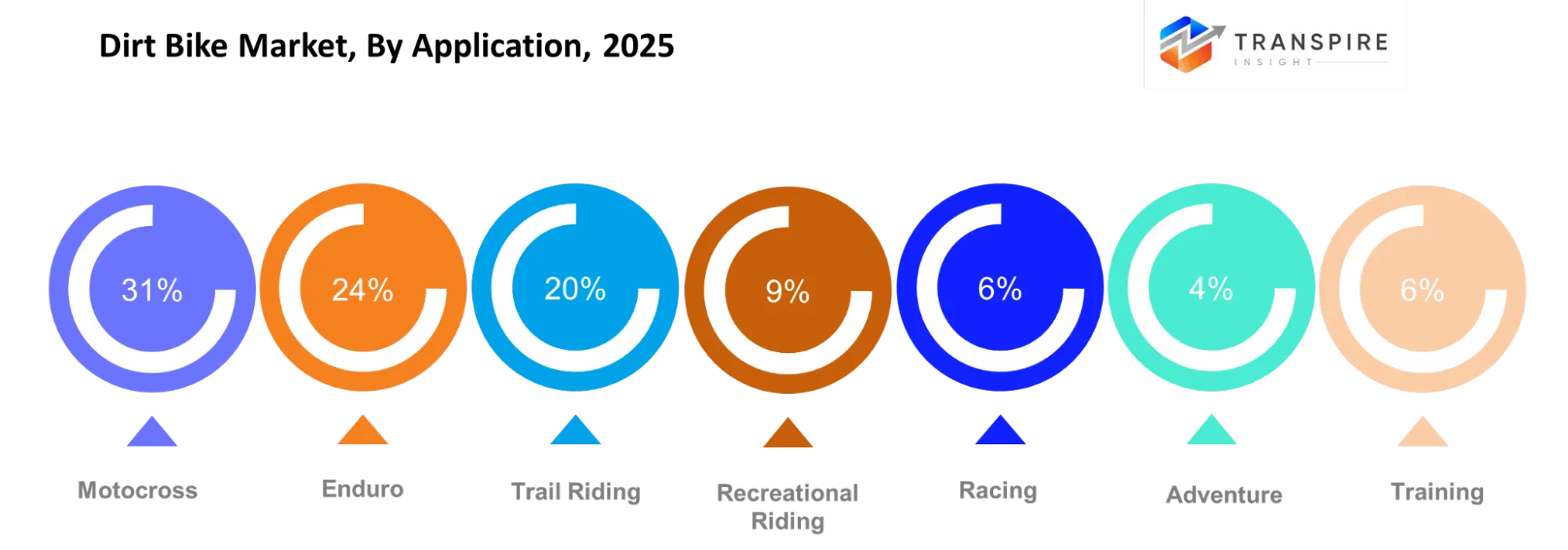
Motocross leads the market with 31.0%, based on racing disciplines, corporate sponsorship, track use, and component usage cycles. Enduro contributes 24.0%, driven by endurance riding and technical terrain, plus long-distance off-road enduros. Trail riding accounts for 20.0%, based on outdoor recreational riding and higher levels of participation in nature-based riding activities. Recreational riding provides 9.0%, while racing comprises 6.0%, reflecting the strength of organised competition at pro and amateur levels. Adventure riding provides 4.5%, training 3.5%, and other activities 2.0%. Total mainstream racing and trail applications provide the balance of demand.
Bike Type:
Motocross bikes command the largest position because they are closely linked to organised racing, performance upgrades, and repeat purchases of tyres, suspension parts, and engine components. Electric dirt bikes are the fastest-growing category at 12.4% CAGR, driven by low noise, reduced maintenance, and beginner-friendly power delivery. Enduro, trail, and dual-sport bikes serve riders seeking durability, range, and road-legal flexibility. Trials bikes address precision-based competition, while youth dirt bikes support early skill development. Other bike types serve specialised recreational and competitive requirements across markets.
Distribution Channel:
The primary access to dirt bikes as power sports dealerships provide financing, servicing, spares, safety and technical support for specific models. Growing e-commerce makes accessories, apparel, entry-level bikes, and price comparison more accessible for new and young riders. Speciality stores fill a niche for enthusiasts wanting high-end parts, plus expertise. Direct sales are on the rise for electric bike builders, while distributors make dealerships accessible to remote regions. Racing dealers cater to experienced racing teams, while rental companies offer riding experience to attract new riders, lowering the hurdle for inexperienced, occasional, and beginner riders.
End User:
Demand is driven by professional riders and racing teams, who require high-performance suspension and engine tuning, lightweight parts, and replacement parts in high volumes. Sport and recreational riders drive overall volume by looking for a machine that's inexpensive, durable, and capable. Youth riders are an important target segment due to the relatively compact size of these two-stroke and four-stroke models of small-displacement and electric bikes designed for slow-speed training. Adventure riders want long range and rugged durability, while riding schools are turning more to electric bikes, which are quieter, easier to maintain, and have more tunability for safety and cost-effective off-road training.
What are the Key Use Cases Driving the Dirt Bike Market?
Motocross remains the core use case, accounting for 31.0% of application demand. Racing teams, professional riders, and serious amateurs purchase high-performance 250–450 cc machines, creating recurring revenue through parts, tyres, suspension servicing, and engine upgrades.
Enduro and trail riding are expanding applications, together representing 44.0% of demand. These users prioritise durability, fuel or battery range, and terrain adaptability, supporting demand for enduro bikes, dual-sport models, and adventure-oriented equipment.
Emerging use cases include youth training, rental fleets, and electric-first riding schools. Adjustable electric youth bikes and low-noise powertrains make off-road riding more accessible in urban-fringe and regulated areas, linking training schools, rental operators, and family buyers to the fastest-growing electric segment.
|
Report Metrics |
Details |
|
Market size value in 2025 |
USD 6.13 Billion |
|
Market size value in 2026 |
USD 6.51 Billion |
|
Revenue forecast in 2033 |
USD 10.11 Billion |
|
Growth rate |
CAGR of 6.49% from 2026 to 2033 |
|
Base year |
2025 |
|
Historical data |
2021 - 2024 |
|
Forecast period |
2026 - 2033 |
|
Report coverage |
Revenue forecast, competitive landscape, growth factors, and trends |
|
Regional scope |
United States; Canada; Mexico; United Kingdom; Germany; France; Italy; Spain; Denmark; Sweden; Norway; China; Japan; India; Australia; South Korea; Thailand; Brazil; Argentina; South Africa; Saudi Arabia; United Arab Emirates |
|
Key companies profiled |
KTM, Honda, Yamaha, Kawasaki, Suzuki, Husqvarna, Beta Motor, GasGas, Sherco, Rieju, Fantic Motor, TM Racing, Triumph Motorcycles, Stark Future, Zero Motorcycles. |
|
Customization scope |
Free report customization (country, regional & segment scope). Available customized purchase options to meet your exact research needs. |
|
Report Segmentation |
Engine Type (Two-Stroke, Four-Stroke, Electric, Hybrid, Fuel-Injection, Carbureted, Performance Engines, Others)Engine Capacity (Below 125 cc, 125–250 cc, 250–450 cc, 450–650 cc, Above 650 cc, Electric Equivalent, Racing Class, Others)Application (Motocross, Enduro, Trail Riding, Recreational Riding, Racing, Adventure, Training, Others)Bike Type (Motocross Bikes, Enduro Bikes, Trail Bikes, Dual-Sport Bikes, Trials Bikes, Electric Dirt Bikes, Youth Dirt Bikes, Others)Distribution Channel (Dealers, Online Retail, Specialty Stores, Direct Sales, Distributors, Racing Dealers, Rental Companies, Others)End User (Professional Riders, Amateur Riders, Recreational Users, Youth Riders, Racing Teams, Adventure Riders, Training Schools, Others). |
Which Regions are Driving the Dirt Bike Market Growth?
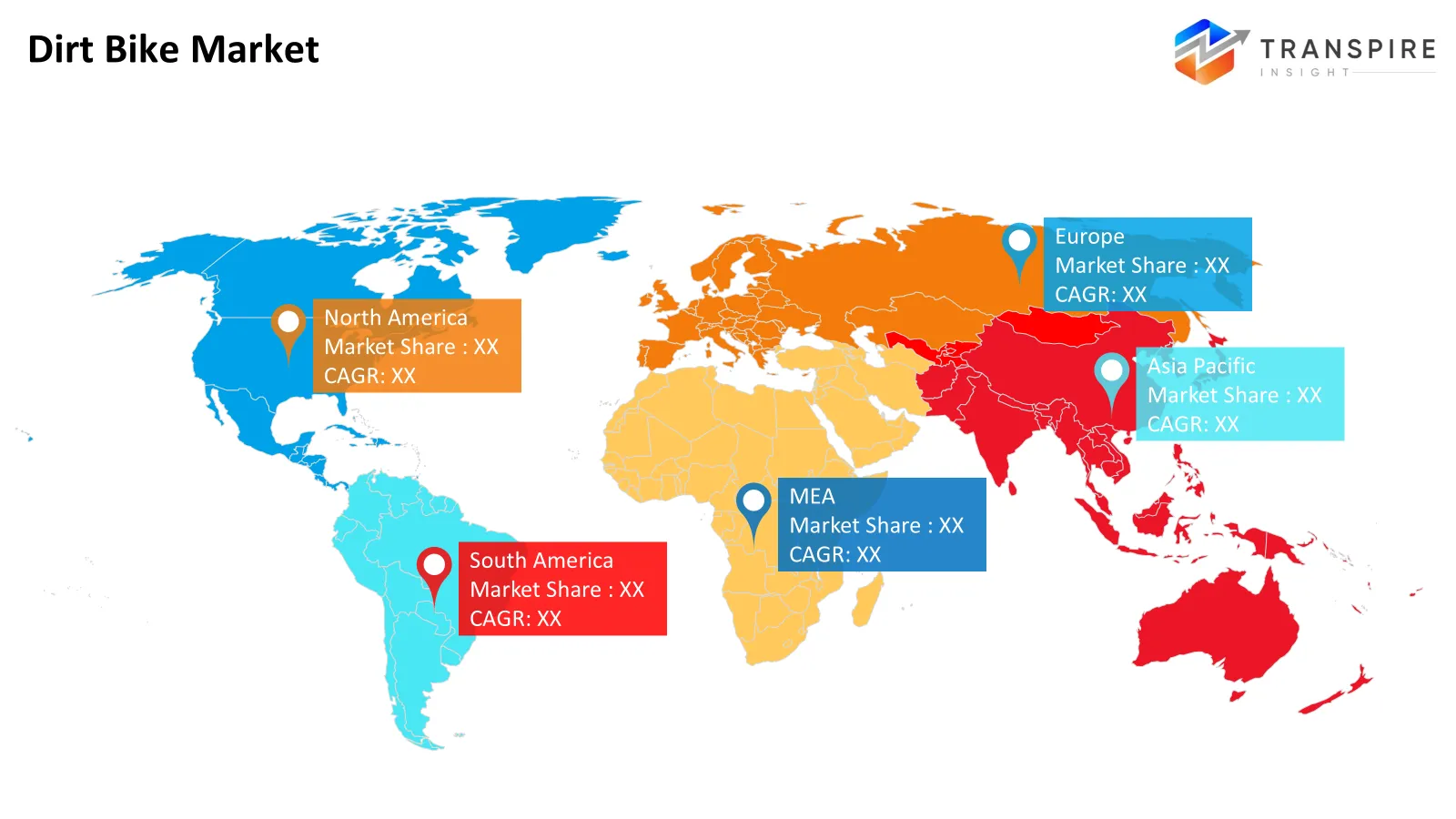
North America accounted for the largest market share of 35.12% in the dirt bike market. This is primarily due to the presence of various motocross competitions and their popularity, the availability of the expansive off-road riding and indulgence segment, and high spending on recreational motorsports. An available broad network of dealerships, mechanics, service centres, specialist retailers, and aftermarket suppliers drives ownership and maintenance accessibility. Moreover, established riding parks and racing events provide products and supplementary offerings such as repair parts, accessories, and performance enhancement opportunities.
In October 2026, LiveWire debuted the production-intent DUST Hightail electric off-roader at the EICMA trade show. This strategic product launch, powered by LiveWire’s acquisition of Dust Moto, opens up new growth opportunities within the competitive and recreational off-road dirt bike market.
https://www.visordown.com/news/livewire-set-debut-arguably-its-most-important-bike-yet-eicma-2026
Europe accounts for 31.0% of the market, leveraging established enduro legacy, challenging terrain, and OEMs with robust competition histories. The growing market in Europe, apart from North America's significant recreational ecosystem, is supported by engineering capabilities, premium motorcycle offerings, and diverse national riding communities. Support from OEMs such as KTM, Beta, and Sherco drives niche product development and rider-focused innovation. Regulations on noise and environmental restrictions foster engineers and drive exploration of electric options.
In March 2026, the FIM EnduroGP World Championship officially updated its framework to allow Electric Power Vehicles (EPVs) to compete directly alongside traditional internal combustion engine machines across major categories like Enduro1, Enduro2, and Enduro3.
Asia Pacific comprises 24.0% of the market share and is expected to grow at a CAGR of 6.81%, making it the fastest-growing region based on the data provided. Rising disposable incomes, growing interest in motorsports, and even the growth of regional manufacturing and distribution networks are opening up the off-road motorcycle segment. The region also provides potential for small, budget-friendly models and electric bikes for young riders, with growth depending on local buying power, accessibility of service networks, the cost of batteries and the availability of dedicated riding areas.
In October 2026, Ni Hsin EV Tech Sdn Bhd completed the handover of its first batch of 43 upgraded SURRON electric off-road motorcycles to Chongqing Qiulong Technology Co Ltd. This partnership leverages local assembly capabilities to support Malaysia’s electric vehicle ecosystem and expand lightweight, high-performance electric dirt bikes across ASEAN markets.https://www.thestar.com.my/business/business-news/2026/10/23/ni-hsin-delivers-first-batch-of-43-surron-electric-motorcycles-to-chinese-partner
Who are the Key Players in the Dirt Bike Market, and how do they compete?
The competition is tightening on three key fronts – combustion performance, regulatory-compliant electrification, and software-led rider experience. Japanese OEMs protect their scale and reliability advantages; European OEMs use their racing heritage; electric specialist brands take the premium enduro and motocross space.
KTM, Honda, Yamaha, Kawasaki and Suzuki operate with broad portfolios, proven dealer footprints and enduro/motocross segment strength. Husqvarna and GASGAS, with their niche portfolio within the KTM stable, target premium engineering/price and a broader range of off-road experiences; Beta Motor, Sherco, Rieju, Fantic Motor and TM Racing have production and dealer reach supporting specialist enduro, trials, lightweight and competition-off-road models, which bring product development specificity but dealer and economics constraints. Triumph Motorcycles is building off-road credibility through competition-based product and mature brand recognition. Stark Future has a premium electric motocross and enduro portfolio. Zero Motorcycles, with established electric motor technology expertise, could be a platform partner for adjacent off-road mobility markets. Their opportunities lie in riding/handling, battery accessibility, and service networks, but upfront cost and charging access will be hurdles. As with all brands, long-term advantage requires consistent investment in clean-sheet technology development that matches distribution coverage and rider value.
Key Players are:
- KTM
- Honda
- Yamaha
- Kawasaki
- Suzuki
- Husqvarna
- Beta Motor
- GasGas
- Sherco
- Rieju
- Fantic Motor
- TM Racing
- Triumph Motorcycles
- Stark Future
- Zero Motorcycles
Dirt Bike Market — Enhanced Competitive Benchmarking
|
Company |
Est. Revenue Share Range |
Key Offerings |
Strategic Positioning |
Geographic Strength |
Technology Focus |
|
Honda Motor Co., Ltd. |
12–18% (Estimated) |
CRF250R, CRF450R, CRF250RX, CRF450RX |
Broad product portfolio backed by scale |
North America, Asia Pacific, Europe |
Unicam engines, fuel injection, chassis optimisation |
|
Yamaha Motor Co., Ltd. |
10–15% (Estimated) |
YZ125, YZ250, YZ250F, YZ450F |
Race-proven performance with strong motocross heritage |
North America, Europe, Asia Pacific |
Crossplane engines, traction control, launch control |
|
KTM AG |
10–15% (Estimated) |
250 SX-F, 450 SX-F, 300 EXC, 350 EXC-F |
Premium racing performance with extensive off-road specialization |
Europe, North America, Australia |
Lightweight frames, advanced engine mapping, ride modes |
|
Kawasaki Motors, Ltd. |
7–11% (Estimated) |
KX250, KX450, KLX230R, KLX300R |
Competition-focused engineering across motocross and trail |
North America, Asia Pacific, Europe |
KX race chassis, engine calibration, suspension tuning |
|
Suzuki Motor Corporation |
4–8% (Estimated) |
RM-Z250, RM-Z450, DR-Z4S |
Established motocross engineering with focused model coverage |
North America, Europe, Asia Pacific |
Fuel injection, Suzuki Holeshot Assist, traction management |
|
Husqvarna Mobility |
4–7% (Estimated) |
FC 250, FC 450, TE 300, FE 350 |
Premium off-road differentiation through lightweight design |
Europe, North America, Australia |
Chromoly frames, advanced suspension, selectable engine maps |
|
GASGAS Motorcycles |
2–5% (Estimated) |
MC 250F, MC 450F, EC 300, EC 350F |
Accessible European performance with racing-oriented product design |
Europe, North America, Australia |
Lightweight chassis, engine mapping, hydraulic clutch systems |
|
Betamotor S.p.A. |
2–4% (Estimated) |
250 RR, 300 RR, 350 RX, 450 RX |
Specialist off-road engineering with racing-led differentiation |
Europe, North America, Australia |
Two-stroke engines, four-stroke tuning, adjustable suspension |
|
Stark Future S.L. |
1–3% (Estimated) |
Stark VARG, Stark VARG EX |
Electric performance differentiation and software-enabled customization |
Europe, North America, Australia |
High-output electric motors, battery management, software tuning |
|
Triumph Motorcycles Ltd. |
1–3% (Estimated) |
TF 250-X, TF 450-RC, TF 250-E, TF 450-E |
Newer motocross entrant leveraging premium brand engineering |
Europe, North America, Australia |
Lightweight chassis, competition-focused engine calibration, electronic controls |
Recent Development News
- In June 2026, Ducati launched the Desmo450 EDS, its first modern enduro motorcycle, designed for demanding off-road riding. The model features a redesigned single-cylinder engine, enduro-specific suspension and protective components, and an optional traction control system with the racing kit, strengthening Ducati’s presence in the performance-oriented off-road motorcycle segment. https://www.ducati.com/gb/en/news/ducati-desmo450-eds-the-first-enduro-motorcycle-from-the-borgo-panigale-based-manufacturer
- In October 2026, GASGAS introduced the MC-E 2.12, an electric dirt bike designed specifically for young riders, as part of its 2027 model lineup. The launch expands the brand’s electric mini-motorcycle portfolio, supporting youth participation in off-road riding and broadening access to entry-level dirt biking. https://press.gasgas.com/News.aspx
- In May 2026, LiveWire Group acquired the assets of Dust Moto to expand into the electric off-road motorcycle segment. The acquisition is expected to accelerate the development and commercialization of Dust Moto’s electric dirt bike platform by combining off-road expertise with LiveWire’s engineering capabilities, manufacturing scale, and distribution network. https://investor.livewire.com/news-events-1/news/news-details/2026/LiveWire-Group-Inc--Acquires-Dust-Moto/default.aspx
What Strategic Insights Define the Future of the Dirt Bike Market?
The dirt bike industry is shifting to a more nuanced market, where bike builders compete more on rider experience, application-specific builds, and total cost of ownership than pure power. Electrification can carve out a niche for youth training, noiseless recreation, and select competitive disciplines, with ultimate commercial viability in batteries' longevity, replacement cost, and service delivery. There is an unquantified risk of dealers or OEMs making a large EV bet before access to charging, resale value, and consumer payment mindset is fully understood. Simultaneously, emissions restrictions and lack of access to legal riding terrain will limit use of products even if sales to run on two wheels remain high. OEMs can maintain a competitive lineup of internal-combustion bikes and selectively develop electric bike platforms, modular batteries, and digital diagnostics; work with riding schools, rental firms, race groups, and niche dealers to validate products prior to scaling up with rollouts improving noise, handling, and low-maintenance qualities.
Key Segmentations are:
Engine Type
- Two-Stroke
- Four-Stroke
- Electric
- Hybrid
- Fuel-Injection
- Carbureted
- Performance Engines
- Others
Engine Capacity
- Below 125 cc
- 125–250 cc
- 250–450 cc
- 450–650 cc
- Above 650 cc
- Electric Equivalent
- Racing Class
- Others
Application
- Motocross
- Enduro
- Trail Riding
- Recreational Riding
- Racing
- Adventure
- Training
- Others
Bike Type
- Motocross Bikes
- Enduro Bikes
- Trail Bikes
- Dual-Sport Bikes
- Trials Bikes
- Electric Dirt Bikes
- Youth Dirt Bikes
- Others
Distribution Channel
- Dealers
- Online Retail
- Specialty Stores
- Direct Sales
- Distributors
- Racing Dealers
- Rental Companies
- Others
End User
- Professional Riders
- Amateur Riders
- Recreational Users
- Youth Riders
- Racing Teams
- Adventure Riders
- Training Schools
- Others
By Regional Analysis
North America
- US
- Canada
- Mexico
Europe
- Germany
- UK
- France
- Italy
- Spain
- Russia
- Rest of Europe
Asia Pacific
- China
- Japan
- India
- South Korea
- Australia
- Rest of Asia Pacific
South America
- Brazil
- Argentina
- Rest of South America
Middle East & Africa
- UAE
- Saudi Arabia
- Qatar
- South Africa
- Rest of the Middle East & Africa
Frequently Asked Questions
Find quick answers to common questions.
The dirt bike market size was valued at USD 6.13 billion in 2025 and is poised to reach USD 10.11 billion by 2033, expanding at a 6.49% CAGR.
Key segments for the dirt bike market are Engine Type (Two-Stroke, Four-Stroke, Electric, Hybrid, Fuel-Injection, Carbureted, Performance Engines, Others)Engine Capacity (Below 125 cc, 125–250 cc, 250–450 cc, 450–650 cc, Above 650 cc, Electric Equivalent, Racing Class, Others)Application (Motocross, Enduro, Trail Riding, Recreational Riding, Racing, Adventure, Training, Others)Bike Type (Motocross Bikes, Enduro Bikes, Trail Bikes, Dual-Sport Bikes, Trials Bikes, Electric Dirt Bikes, Youth Dirt Bikes, Others)Distribution Channel (Dealers, Online Retail, Specialty Stores, Direct Sales, Distributors, Racing Dealers, Rental Companies, Others)End User (Professional Riders, Amateur Riders, Recreational Users, Youth Riders, Racing Teams, Adventure Riders, Training Schools, Others).
Growth is primarily driven by expanding motocross and enduro participation, rising interest in off-road recreation, advancements in lightweight chassis and suspension systems, improved fuel injection, and the development of electric dirt bikes for youth training and noise-sensitive riding environments.
The dirt bike market is led by major manufacturers, including KTM, Honda, Yamaha, Kawasaki, Suzuki, Husqvarna, Beta Motor, GasGas, Sherco, Rieju, Fantic Motor, TM Racing, Triumph Motorcycles, Stark Future, and Zero Motorcycles.
North America holds a 35.12% market share, supported by established motocross competitions, extensive off-road riding facilities, strong recreational spending, and a well-developed dealership, servicing, and aftermarket ecosystem.
Key opportunities include electric dirt bikes, swappable battery technology, affordable youth models, AI-enabled predictive maintenance, and expansion of dealer and rental networks in emerging markets.
- KTM
- Honda
- Yamaha
- Kawasaki
- Suzuki
- Husqvarna
- Beta Motor
- GasGas
- Sherco
- Rieju
- Fantic Motor
- TM Racing
- Triumph Motorcycles
- Stark Future
- Zero Motorcycles
About the Authors

Mayur Shinde
I am Mayur Shinde, a Senior Research Analyst at Transpire Insight, specializing in the Automotive & Transportation and Information & Communication Technology (ICT) Industry. My work focuses on analyzing emerging market trends, technological advancements, competitive landscapes, and industry developments to deliver accurate, data-driven insights. I am passionate about transforming complex market information into clear, actionable content that helps businesses, professionals, and decision-makers stay informed and make confident strategic decisions.

Chakradhar Khansole
Chakradhar serves as the Research Director at Transpire Insight, bringing over 8 years of experience in technology, innovation, and strategic market intelligence. He specializes in transforming complex market data into actionable business insights that enable organizations to make informed, growth-oriented decisions. Recognized for his strategic vision and analytical expertise, Chakradhar leads high-impact research initiatives, delivering comprehensive market assessments, competitive intelligence, and forward-looking industry analysis.
Recently Published Reports
-
Apr 2026
ATV & UTV Market
ATV & UTV Market Size, Share & Analysis Report By Type (ATV, and UTV), By Variants (Less Than 400 CC, 400 CC To 800 CC, and More Than 800 CC), and Geography (North America, Europe, Asia-Pacific, Middle East and Africa, South and Central America), 2021 - 2031
-
Apr 2026
Automotive Central Gateway Module Market
Automotive Central Gateway Module Market Size, Share & Analysis Report By Type (Ethernet Central Gateway Module, CAN Central Gateway Module, LIN Central Gateway Module, and FlexRay), By Application (Powertrain Control, Body Control, Infotainment System, Advanced Driver Assistance Systems (ADAS), and Others), By End User (Passenger Vehicles, and Commercial Vehicles), and Geography (North America, Europe, Asia-Pacific, Middle East and Africa, South and Central America), 2021 - 2031
-
Apr 2026
Automotive Engine Oil Filter Market
Automotive Engine Oil Filter Market Size, Share & Analysis Report By Filter Type (Fuel Filter, Engine Oil Filter, Hydraulic Oil Filter, and Others), By Filter Media (Cellulose, Synthetic, and Micro), By Sales Channel (OEMs, and Aftermarket), By Vehicle Type (Passenger Cars, Light Commercial Vehicles, Heavy Duty Trucks, Buses and Coaches, and Off-road Vehicles), and Geography (North America, Europe, Asia-Pacific, Middle East and Africa, South and Central America), 2021 - 2031
-
Apr 2026
Automotive Parts Aluminium Die Casting Market
Automotive Parts Aluminium Die Casting Market Size, Share & Analysis Report By Production Process (Pressure Die Casting, Vacuum Die Casting, Squeeze Die Casting, Gravity Die Casting), By Application (Body Parts, Engine Parts, Transmission Parts, Battery And Related Components, Other Application Types), and Geography (North America, Europe, Asia-Pacific, Middle East and Africa, South and Central America), 2021 - 2031
Our Clients