

Credit Card Market Summary:
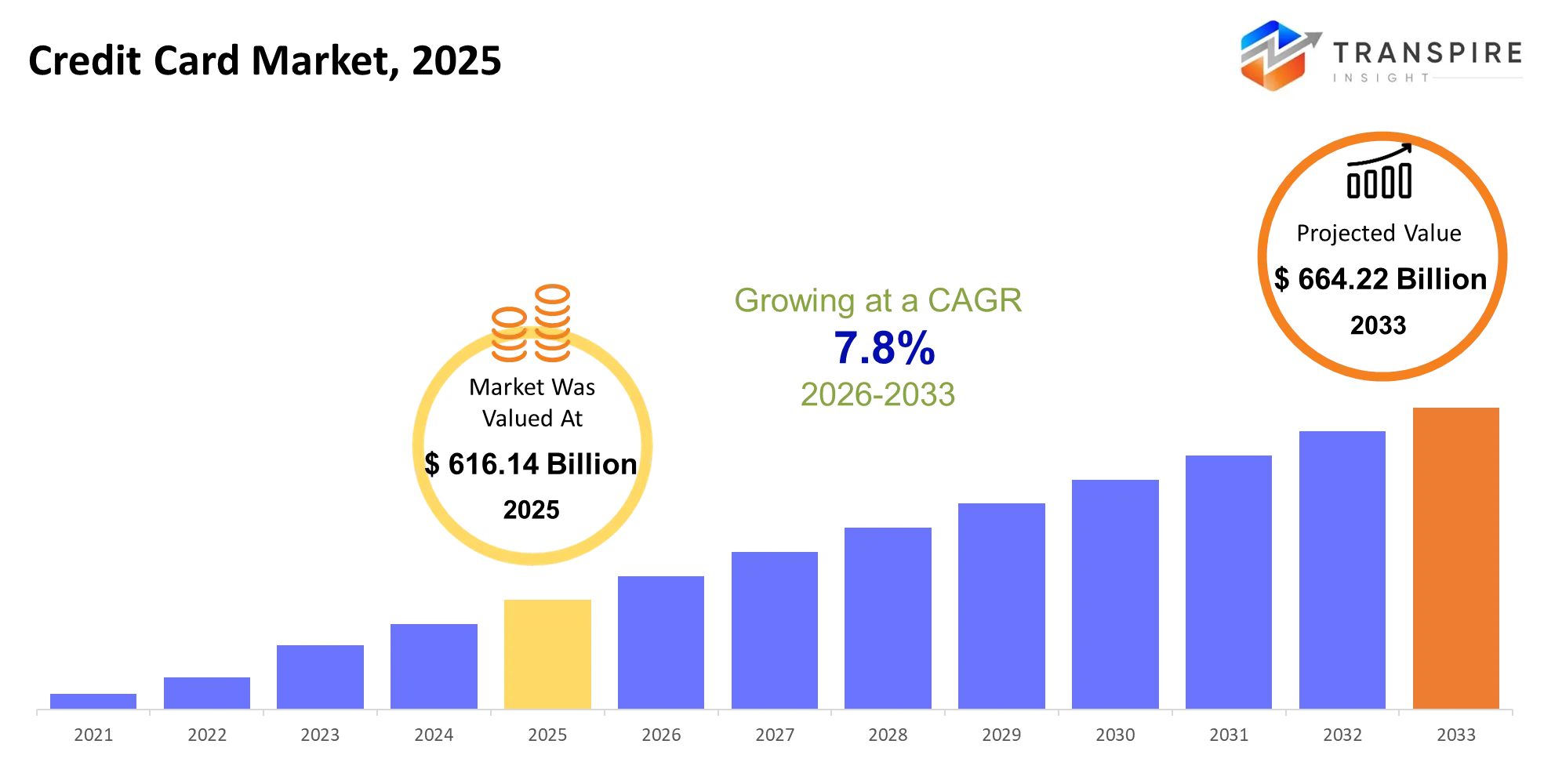
As per Transpire Insight Analysis, the Credit Card Market size is estimated at USD 616.14 billion in 2025 and is anticipated to reach USD 1123.65 billion by 2033, growing at a CAGR of 7.8% from 2026 to 2033.
The credit card industry is changing as banks, fintech companies, and payment networks are increasing the use of credit cards in retail, travel, online shopping, subscriptions and daily expenses. In the past three to five years, the market has moved from the conventional way of doing things that included the use of physical cards to the use of new techniques, which include the use of contactless payment, digital wallets, tokenisation of data and applications to manage credit cards. Contactless payment is a very important feature of in-person purchases. Currently, the process of tokenisation is used to make transactions through the online payment processor secure. The trend that is emerging right now includes credit cards and mobile wallets. The new regulation of the merchant fees charged by businesses using credit cards is influencing the handling of money in the bank and the network. In the United States, Visa and Mastercard have reached an agreement on certain regulations that can reduce the fee charged by the merchants using the two cards. Such trends have promoted the development of the credit card market by facilitating payments, expanding the payments' scope and increasing the means of spending on credit cards.
Credit Card Market Size & Forecast:
- Market Size 2025: USD 616.14 Billion
- Expected Market Value (2033): USD 1123.65 Billion
- Forecast CAGR (2026–2033): 7.8%
- Leading Region in 2025: North America
- Fastest Growing Region: Asia Pacific
- Key Company Profiles: JPMorgan Chase, Bank of America, Citigroup, American Express, Capital One, Discover Financial, Wells Fargo, HSBC, Barclays, Synchrony Financial, Mastercard, Visa, HDFC Bank, ICICI Bank, SBI Cards
Key Market Insights:
The credit card industry is evolving on the back of the ongoing transition to digital payments, customised card products, and mobile payments. Traditional cards account for the biggest segment, while the trend towards contactless payments is growing as more people want convenience and speed during checkouts.
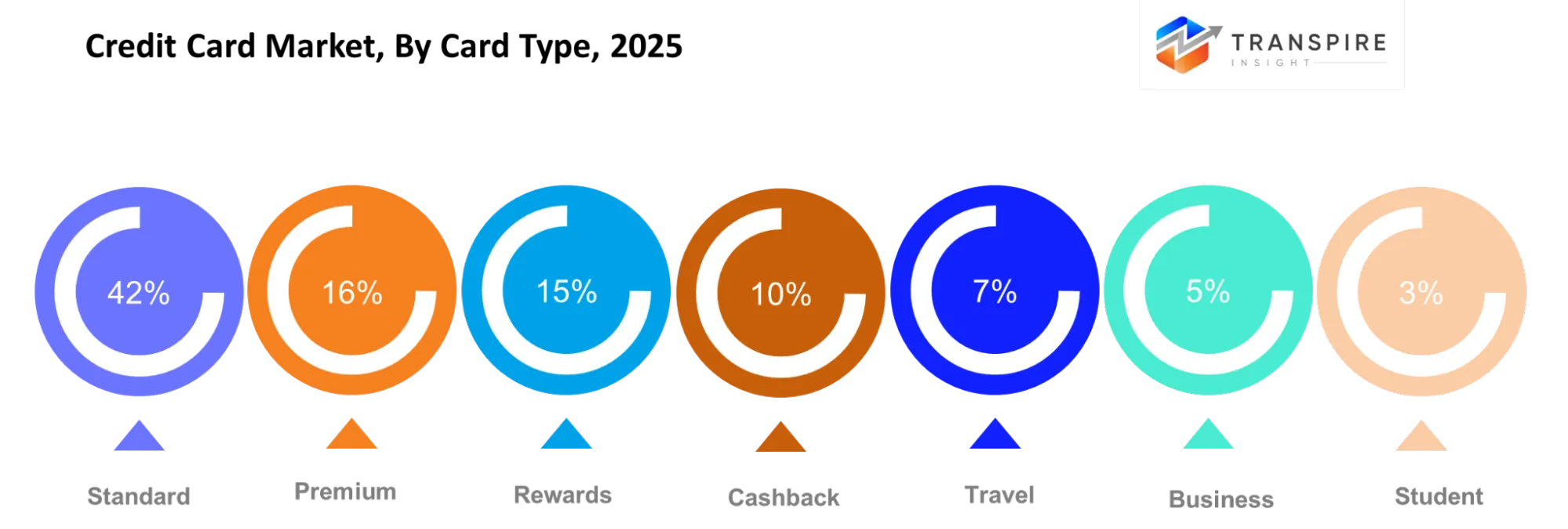
- Standard Credit Cards account for 42% of the market and remain the most popular types of cards as banks keep launching broad access products for everyday use.
- Premium Credit Cards constitute 16% of the market, as issuers reinforce their premium product range through travel, lifestyle, and individual benefits.
- Rewards Credit Cards constitute 15% of the market, as loyalty program benefits keep affecting the choice of cards via points, discounts, and purchase-related benefits.
- Cashback Credit Cards account for 10% of the market as people look to save money when making their regular purchases.
- Travel Credit Cards make up 7% of the market, as issuers keep adding travel, hotel, airport, and foreign spending benefits.
- Student Credit Cards account for 3% of the market, as the process of digital onboarding makes entry-level credit products more available to the younger generation
What are the Key Drivers, Restraints, and Opportunities in the Credit Card Market?
Drivers
The international credit card industry is fueled by the fast pace at which digital payments are taking precedence over traditional ways of payment. With the growing use of smartphones and mobile wallets, card transactions have become quick and more convenient, leading to increased usage of credit cards in offline retail as well as online shopping platforms. Financial institutions have also upgraded their digital customer service.
Restraints
Issues such as credit risk, fraud, data security, and regulatory changes may be a constraint to the growth of the market. Issuers require better authentication, fraud monitoring, and compliance systems, which increases their operating expenses. The structural constraints may hinder small providers from competing with the existing financial institutions.
Opportunities
The growth of the personalisation and digital payment ecosystem allows card providers to create more personalised products. Transaction data can be used to personalise rewards and credit cards that suit the customer better. Providers also have opportunities to grow digitally due to the rise in Asia Pacific, especially mobile-first banking and fintech in the region.
What Has the Impact of artificial intelligence on the Credit Card Market?
The use of artificial intelligence technology is revolutionising the methods that credit card companies use in their transactions, customer service, credit risk evaluation, and fraud detection. Financial institutions deploy artificial intelligence in machine learning models to evaluate transactional trends for the purpose of identifying any abnormal trends and detecting fraud. The artificial intelligence technology is also capable of evaluating the behaviour of customers in order to provide them with customised services. Customer service can benefit from chatbots and automation systems powered by artificial intelligence, which could automate answering common questions on credit accounts. The challenge lies in the integration of the technology into existing frameworks as well as the issues related to the quality, privacy, and accuracy of data. There are also high implementation costs to consider.
Instance
In March 2026, MasterCard launched a new foundation model of generative artificial intelligence based on billions of anonymised payment transactions to help detect fraud, analyse unique payment patterns, and minimise the number of false declines.https://www.mastercard.com/us/en/news-and-trends/stories/2026/mastercard-new-generative-ai-model.html
Key Market Trends:
The trend of the world’s credit card market involves more digitalisation, personalisation, and speed of the transaction process. This trend is driven by such factors as contactless payments, mobile wallets, enhanced security systems, and consumers’ changing preferences.
- Contactless payments are gaining momentum with the increasing preference of tap-and-go payments due to time savings in the checkout process.
- Mobile wallet payments are transforming into mainstream channels used for credit card payments.
- The issuance of digital cards is eliminating the use of plastic cards and enabling users to activate and manage accounts via mobile apps.
- Personalised incentives are being offered by credit card providers owing to the evolving consumer spending trends.
- Tokenisation has become increasingly important in the realm of online payments since card numbers are being substituted by digital tokens.
- The rise of e-commerce is driving the requirement for convenient credit payment methods in the world of online commerce.
Credit Card Market Segmentation
By Card Type
Standard Credit Cards have the greatest dominance in the international credit card market with a share of 42% in the total market. Because of their universal acceptance and versatility in making purchases, they are very popular among all sorts of consumers. Premium Credit Cards have a share of 16% because of the customer demand for greater benefits and more exclusive offers. Reward cards constitute 15% of the total market because of the growing popularity of loyalty programs among card owners. Cash Back Credit Cards have 10%, followed by 7% of Travel Cards, 5% of Business Credit Cards, 3% of Student Cards, and 2% of Secured Cards.
By Providers
the banks are still important providers of cards due to the existing customer base and banking infrastructure. The Credit Unions, Fintechs, Payment Networks, Retailers, NBFCs, and Digital Banks are also participating in the market with specialised products, digital technologies, and alternative means of getting access to credit.
By Payment Types
the Contactless Credit Card is seen as the most rapidly growing segment at a CAGR of 12.6%. The chip and PIN technology is still important for making card payments safe, while online payments and mobile wallets are developing with the growth of e-commerce and the use of smartphones. QR Payments and Recurring Payments also contribute to new ways of making payments.
By Consumer Type
Individual consumers constitute a key consumer group for the use of credit cards for regular purchases and expenditures. Credit cards are used by SMEs & Large Enterprises for business expenditures, and Students & Affluent Consumers are more niche markets. Other consumer types include Mass Market Consumers & Government.
By Application
the use of credit cards takes place in the domains of Retail, Travel & Hospitality, e-commerce, Healthcare, Education, and Utilities. The applications in Retail & e-commerce pertain to normal transactions, while travel and hospitality applications are associated with bookings, services, etc. The applications for healthcare, education, and utilities constitute further areas for credit card usage.
By Distribution
Banks are still using Bank Branches and Online Banking for their operations, but mobile apps are an important tool for applications, account management, and payments as well. Other channels such as agents, direct marketing, retail partnerships, fintech platforms, and others increase customer reach.
By Under Credit Limit
The worldwide credit card market comprises cards in the category of below $1,000 to above $100,000, depending on the credit requirements of the customers. Cards with limits of $1,000-$5,000 and $5,000-$10,000 will be helpful in case of limited spending requirements. Whereas, higher credit limit cards like $10,000-$25,000 and $25,000-$50,000 would offer greater spending opportunities. In addition, cards with limits of $50,000-$100,000 and above $100,000 would suit customers or businesses
What are the Key Use Cases Driving the Credit Card Market?
Standard Credit Cards are used in retail purchases, which involves Standard Credit Cards in the market and facilitates regular purchases of consumers. Due to their wide acceptability in brick-and-mortar establishments and even online merchants, it serves as an effective means of payment for everyday purchases. Market expansion of credit cards also includes e-commerce, travel, hospitality, health care, education, and utilities. Such uses will enable consumers and businesses to pay with their credit cards while shopping online, making payments or booking tickets.Some of the emerging uses include contactless payments, mobile wallet transactions, and recurring digital payments. Contactless Credit Cards have gained popularity because of the increasing preference of both consumers and merchants for faster payment processes
|
Report Metrics |
Details |
|
Market size value in 2025 |
USD 616.14 Billion |
|
Market size value in 2026 |
USD 664.22 Billion |
|
Revenue forecast in 2033 |
USD 1123.65 Billion |
|
Growth rate |
CAGR of 7.8% from 2026 to 2033 |
|
Base year |
2025 |
|
Historical data |
2021 - 2024 |
|
Forecast period |
2026 - 2033 |
|
Report coverage |
Revenue forecast, competitive landscape, growth factors, and trends |
|
Regional scope |
United States; Canada; Mexico; United Kingdom; Germany; France; Italy; Spain; Denmark; Sweden; Norway; China; Japan; India; Australia; South Korea; Thailand; Brazil; Argentina; South Africa; Saudi Arabia; United Arab Emirates |
|
Key company profiled |
JPMorgan Chase, Bank of America, Citigroup, American Express, Capital One, Discover Financial, Wells Fargo, HSBC, Barclays, Synchrony Financial, Mastercard, Visa, HDFC Bank, ICICI Bank, SBI Cards |
|
Customization scope |
Free report customization (country, regional & segment scope). Avail customized purchase options to meet your exact research needs. |
|
Report Segmentation |
By Card Type (Standard Credit Cards, Premium Credit Cards, Rewards Cards, Cashback Cards, Travel Cards, Business Cards, Student Cards, Secured Cards); By Provider (Banks, Credit Unions, Fintechs, Payment Networks, Retailers, NBFCs, Digital Banks, Others); By Payment Type (Contactless, Chip & PIN, Magnetic Stripe, Online Payments, Mobile Wallet, QR Payments, Recurring Payments, Others); By Consumer Type (Individuals, SMEs, Large Enterprises, Students, Affluent Consumers, Mass-market Consumers, Government, Others); By Application (Retail, Travel, Hospitality, E-commerce, Healthcare, Education, Utilities, Others); By Distribution (Bank Branches, Online Banking, Mobile Apps, Agents, Direct Marketing, Retail Partnerships, Fintech Platforms, Others); By Credit Limit (Below $1,000, $1,000–$5,000, $5,000–$10,000, $10,000–$25,000, $25,000–$50,000, $50,000–$100,000, Above $100,000, Others) |
Which Regions are Driving the Credit Card Market Growth?
North America
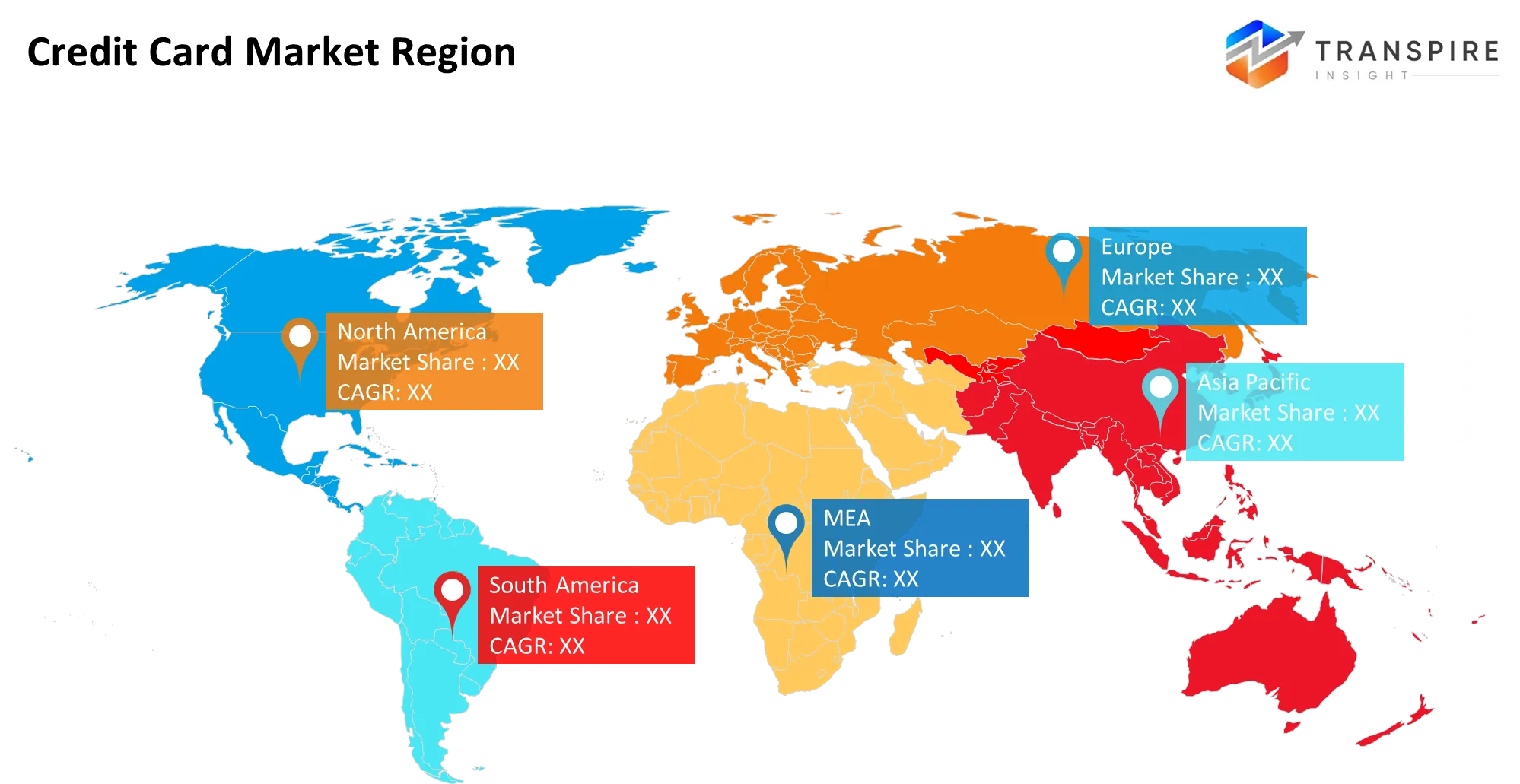
The North American region leads with a 38% share in the market. This is supported by a well-established banking infrastructure, a vast number of card acceptance locations, and digital payment facilities. High use among consumers in various sectors, including retail, online shopping, tourism, and subscription-based services, ensures the continuing use of cards.
In September 2025, American Express introduced significant upgrades to its Consumer & Business Platinum cards in the U.S., bringing new travel, dining, shopping and business perks to its premium credit card product in the US.
Europe
The European region represents 21% of the market share and has continued demand owing to its well-developed financial systems and wide use of electronic payments. The financial systems present within the region ensure the consistent use of credit cards in both personal and business environments. Regulatory policies and the use of digital payment methods have influenced the provision of card services.
In February 2026, European Travel Commission, Mastercard and ICBC: The European Travel Commission, Mastercard and ICBC rolled out a new European Travel Co-branded Credit Card for Chinese travellers, merging the cross-border banking strengths of ICBC with the Mastercard payment processing capabilities in Europe.https://newsroom.mastercard.com/news/europe/en/newsroom/press-releases/en/2026/enabling-seamless-journeys-the-european-travel-commission-and-mastercard-launch-new-european-travel-co-branded-card-for-chinese-visitors/
Asia Pacific
The Asia Pacific region accounts for 31% of the worldwide market and is the most rapidly growing region, with a CAGR of 10.8%. Growing adoption of smartphones, mobile-first finance services, growth in the Fintech industry, and increased adoption of digital payments are factors contributing to market growth. The growing ecosystem of digital banking in the region presents new avenues for credit card issuers.
In May 2026, HSBC Hong Kong launched Asia Pacific’s first World Legend Mastercard through its HSBC Privé program, featuring premium travel, dining and lifestyle benefits for high-net-worth individuals.https://newsroom.mastercard.com/news/ap/en/newsroom/press-releases/en/2026/hsbc-hong-kong-introduces-asia-pacific-s-first-world-legend-mastercard/
Who are the Key Players in the Credit Card Market and how do they compete?
The credit card market in the world has competition in terms of payment networks, banks, and dedicated card issuers, where companies compete on the basis of transaction size, digital capabilities, security, rewards, and customer-related services. Visa and Mastercard are growing their businesses not only in the area of payment processing but also through investments in value-added services, cybersecurity, data, and innovative payment flows. Visa implements an innovation- and scale-based business model by combining a network of acceptance with tokenisation, artificial intelligence-based fraud protection, and value-added services. Mastercard is differentiated by cybersecurity, data services, digital identity, and commercial and innovative payment flows, in addition to geographic and payment channel expansion. American Express implements a premium and niche-based business model, which focuses on rewards, travel, lifestyle, and customer experience. The expansion strategy includes digital payments and new partner program initiatives.
Credit Card Market companies
- JPMorgan Chase
- Bank of America
- Citigroup
- American Express
- Capital One
- Discover Financial
- Wells Fargo
- HSBC
- Barclays
- Synchrony Financia
- Mastercard
- Visa
- HDFC Bank,
- ICICI Bank
- SBI Cards
Recent Development News
- In July 2025, JPMorganChase entered into a partnership with Coinbase, which allows Chase credit cardholders to fund their Coinbase accounts and convert their Ultimate Rewards points to Coinbase.https://www.jpmorganchase.com/newsroom/press-releases/2025/jpmc-coinbase-partnership
- In May 2026, Mastercard allied with JD.com to develop payment capabilities for international businesses and investigate AI-based transactions and anti-fraud solutions for cross-border digital payments.https://www.mastercard.com/us/en/news-and-trends/press/2026/may/mastercard-jd-dot-com-partnership.html
What Strategic Insights Define the Future of the Credit Card Market?
The future of the credit card industry will feature increased digitisation, personalisation, and intelligence in terms of contactless transactions, mobile payment wallets, AI-driven decision-making, and fraud controls. The downside of this trend will be greater potential vulnerability to fraud, data breaches, and operational risks in the context of rapid digital transformation, which is why security investment is no longer optional but critical. The promising area is AI-powered payment experience, where service providers could leverage transaction data and insights for customising credit limits, rewards, and offers and for conducting risk assessment. The most important strategic focus will thus have to be the combination of digital capabilities with enhanced security and sound credit practices. Card providers can differentiate themselves in this industry by investing in AI systems, tokenisation, fraud prevention, mobile services, and personalised products, as well as partnerships with fintech and digital commerce players.
By Card Type
- Standard Credit Cards
- Premium Credit Cards
- Rewards Cards
- Cashback Cards
- Travel Cards
- Business Cards
- Student Cards
- Secured Cards
By Provider
- Banks
- Credit Unions
- Fintechs
- Payment Networks
- Retailers
- NBFCs
- Digital Banks
By Payment Type
- Contactless
- Chip & PIN
- Magnetic Stripe
- Online Payments
- Mobile Wallet
- QR Payments
- Recurring Payments
By Consumer Type
- Individuals
- SMEs
- Large Enterprises
- Students
- Affluent Consumers
- Mass-market Consumers
- Government
By Application
- Retail
- Travel
- Hospitality
- E-commerce
- Healthcare
- Education
- Utilities
By Distribution
- Bank Branches
- Online Banking
- Mobile Apps
- Agents
- Direct Marketing
- Retail Partnerships
- Fintech Platforms
By Credit Limit
- Below $1,000
- $1,000–$5,000
- $5,000–$10,000
- $10,000–$25,000
- $25,000–$50,000
- $50,000–$100,000,
- Above $100,000
By Regional Analysis
North America
- US
- Canada
- Mexico
Europe
- Germany
- UK
- France
- Italy
- Spain
- Russia
- Rest of Europe
Asia Pacific
- China
- Japan
- India
- South Korea
- Australia
- Rest of Asia Pacific
South America
- Brazil
- Argentina
- Rest of South America
Middle East & Africa
- UAE
- Saudi Arabia
- Qatar
- South Africa
- Rest of the Middle East & Africa
Frequently Asked Questions
Find quick answers to common questions.
The credit card market size was valued at USD 616.14 billion in 2025 and is poised to reach USD 1123.65 billion by 2033, expanding at a 7.8% CAGR.
Key segments for the credit card market are By Card Type (Standard Credit Cards, Premium Credit Cards, Rewards Cards, Cashback Cards, Travel Cards, Business Cards, Student Cards, Secured Cards); By Provider (Banks, Credit Unions, Fintechs, Payment Networks, Retailers, NBFCs, Digital Banks, Others); By Payment Type (Contactless, Chip & PIN, Magnetic Stripe, Online Payments, Mobile Wallet, QR Payments, Recurring Payments, Others); By Consumer Type (Individuals, SMEs, Large Enterprises, Students, Affluent Consumers, Mass-market Consumers, Government, Others); By Application (Retail, Travel, Hospitality, E-commerce, Healthcare, Education, Utilities, Others); By Distribution (Bank Branches, Online Banking, Mobile Apps, Agents, Direct Marketing, Retail Partnerships, Fintech Platforms, Others); By Credit Limit (Below $1,000, $1,000–$5,000, $5,000–$10,000, $10,000–$25,000, $25,000–$50,000, $50,000–$100,000, Above $100,000, Others)
Growth is primarily driven by an increase in consumer expenditure, increased e-commerce transactions, use of contactless payment methods, and development of online banking and financial technology services. Growth in the demand for loyalty programs, cashbacks, and credit facilities is driving the growth of the market
The market is led by major manufacturers including JPMorgan Chase, Bank of America, Citigroup, American Express, Capital One, Discover Financial, Wells Fargo, HSBC, Barclays, Synchrony Financial, Mastercard, Visa, HDFC Bank, ICICI Bank, SBI Cards
North America represents 38% of the world's credit card market share owing to high levels of credit card penetration, a good banking system, use of digital payments, and financial institutions. The advanced fintech environment, use of contactless payments, and trend towards cashless payments are some of the features that have enhanced the market's impact on the dynamics.
Opportunities within the credit card industry in the economy can be increased via the introduction of digitised and contactless payments, mobile/virtual credit cards, and loyalty/rewards programs. Underbanked populations in developing nations can also be targeted by financial organisations through the use of digital credit products. Additionally, the implementation of AI for personalisation, fraud protection, and customised card programs presents opportunities in this market.
- JPMorgan Chase
- Bank of America
- Citigroup
- American Express
- Capital One
- Discover Financial
- Wells Fargo
- HSBC
- Barclays
- Synchrony Financia
- Mastercard
- Visa
- HDFC Bank,
- ICICI Bank
- SBI Cards
About the Authors

Mayur Shinde
I am Mayur Shinde, a Senior Research Analyst at Transpire Insight, specializing in the Automotive & Transportation and Information & Communication Technology (ICT) Industry. My work focuses on analyzing emerging market trends, technological advancements, competitive landscapes, and industry developments to deliver accurate, data-driven insights. I am passionate about transforming complex market information into clear, actionable content that helps businesses, professionals, and decision-makers stay informed and make confident strategic decisions.

Chakradhar Khansole
Chakradhar serves as the Research Director at Transpire Insight, bringing over 8 years of experience in technology, innovation, and strategic market intelligence. He specializes in transforming complex market data into actionable business insights that enable organizations to make informed, growth-oriented decisions. Recognized for his strategic vision and analytical expertise, Chakradhar leads high-impact research initiatives, delivering comprehensive market assessments, competitive intelligence, and forward-looking industry analysis.
Recently Published Reports
-
Apr 2026
3D Optical Profiler Market
3D Optical Profiler Market Size, Share & Analysis Report By Type (Desktop 3D Optical Profiler, and Portable 3D Optical Profiler), By Technology (Confocal Technology, and White Light Interference), By End-Use Industry (Manufacturing, Research Institutions, Automotive, Aerospace and Defense, Medical Devices, and Other), and Geography (North America, Europe, Asia-Pacific, Middle East and Africa, South and Central America), 2021 - 2031
-
Apr 2026
Depth Sensor Market
Depth Sensor Market Size, Share & Analysis Report By Type (Infrared Depth Sensors, Time-of-Flight (ToF) Sensors, Stereo Vision Sensors, Structured Light Sensors, Ultrasonic Depth Sensors), By Application (Automotive, Robotics, Gaming, Consumer Electronics, Industrial Automation, Healthcare, Security & Surveillance, Others), By End Users (Automotive Manufacturers, Consumer Electronics Companies, Healthcare Providers, Industrial Companies, Security Agencies, Gaming Companies, Robotics Companies, Others), and Geography (North America, Europe, Asia-Pacific, Middle East and Africa, South and Central America), 2021 – 2031
-
Apr 2026
Digital Manufacturing Market
Digital Manufacturing Market Size, Share & Analysis Report By Component (Hardware, Software, and Services), By Technology (Robotics, 3D Printing, Internet of Things (IoT), and Others), By Application (Automotive and Transportation, Aerospace and Defense, Consumer Electronics, Industrial Machinery, and Others), By Process Type (Computer-Based Designing, Computer-Based Simulation, Computer 3D Visualization, Analytics, and Others), and Geography (North America, Europe, Asia-Pacific, Middle East and Africa, South and Central America), 2021 – 2031
-
Apr 2026
Digital Visa Services Market
Digital Visa Services Market Size, Share & Analysis Report By Type (Individual Travelers, Group Travelers), By Application (Tourism, Business Travel, Others), and Geography (North America, Europe, Asia-Pacific, Middle East and Africa, South and Central America), 2021 – 2031