
Container Terminal Operations Market Summary:
According to Transpire Insights, a detailed research report on the market reflects that the container handling application segment dominates the Container Terminal Operations Market, accounting for approximately 58% of the total market share worldwide. APM Terminals leads the market with approximately 5–8% estimated global market share, making it a leading contributor to global container terminal development, innovation, advanced container handling operations, expanding terminal capabilities, and growth dynamics.
Market Snapshot
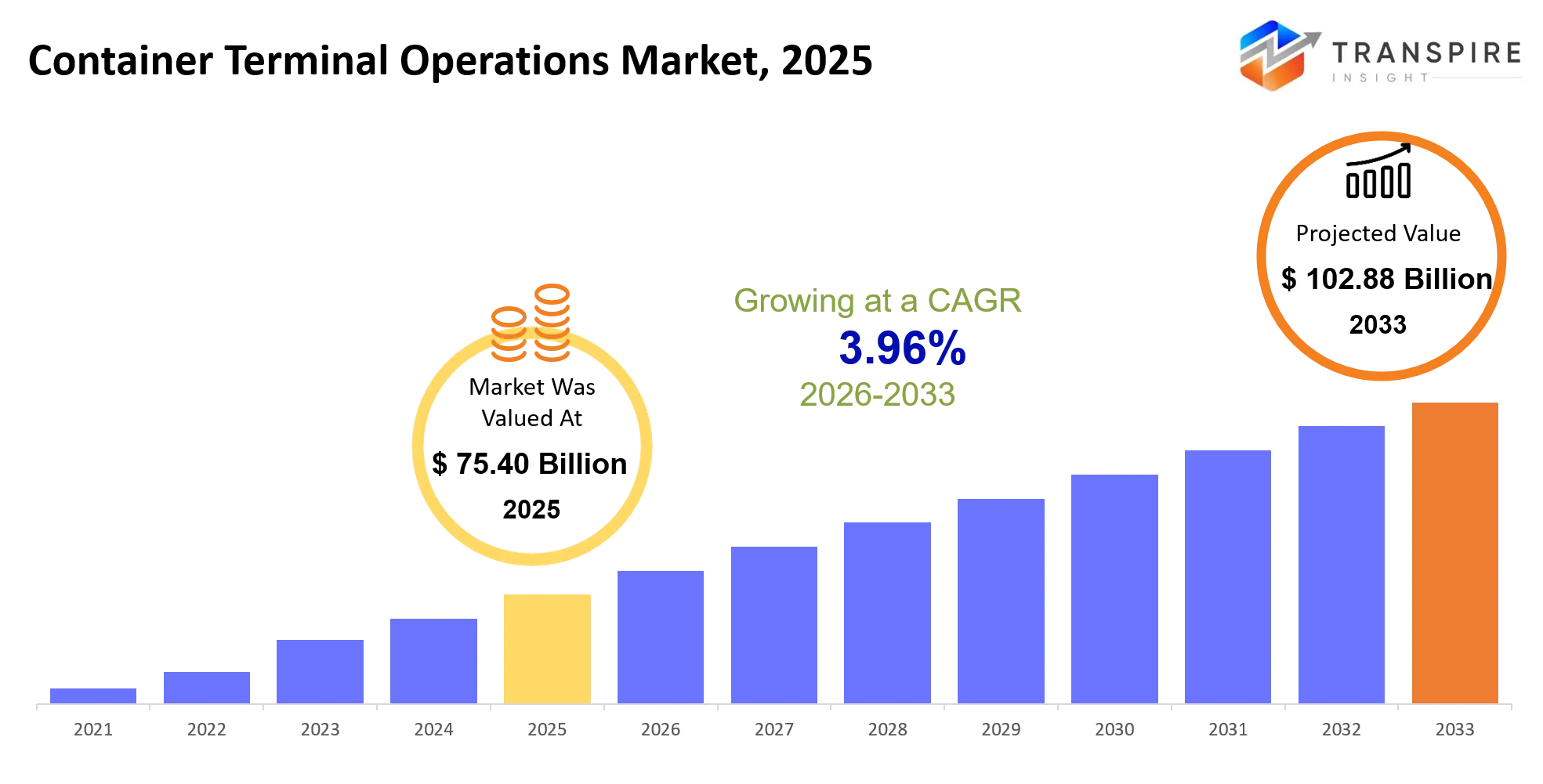
- Global Market Value (2025): USD 75.40 Billion.
- Expected Market Value (2026): USD 78.39 Billion.
- Estimated Market Value (2033): USD 102.88 Billion.
- Forecast CAGR (2026–2033): 3.96%
- Leading Region in 2025: Asia Pacific
- Second-largest Region: Europe
- Fastest Growing Region: North America
Introduction
The global container terminal operations industry is focused on all activities occurring in marine terminals handling standard shipping containers. A container terminal refers to a specialized area of a port or inland where standardized containers are handled, stored, and transferred from one mode of transport to another including ships, trucks, and trains. Automation, digitization, and smart terminal technologies are progressively changing the Container Terminal Operations Market. Remote-controlled environments, as well as automatic yard management, can lead to reduced labor costs, improving the operational efficiency of the terminals. Higher crane productivity does enhance the process of container handling while decreasing unnecessary movements, due to the use of AI planning and automation-based solutions. It is important to mention that the implementation of efficient Terminal Operating Systems (TOS) leads to improved scheduling, enhanced management of the gateways, as well as vessel coordination and, correspondingly, decreased time and congestion at the terminals. At the same time, Storage automation ensures safety on the job by reducing the exposure of personnel to the high-risk area.
For instance:-The container terminal operations sector in Russia is booming as a result of a switch to trade in Asia and a recovery in the Baltic Sea. Major investments like the construction of the Altai terminal by the Chinese company Swift Group mark a new phase of advancement in port operations and transportation links between Russia and neighboring territories.
Market Highlights: -
- Asia Pacific is anticipated to hold around 40% share of the Container Terminal Operations Market over the predicted timeframe.
- Europe is expected to grow at a rapid CAGR in the Container Terminal Operations Market by holding around25% of the share during the forecast period.
- North America is anticipated to hold around15% share of the Container Terminal Operations Market over the predicted timeframe.
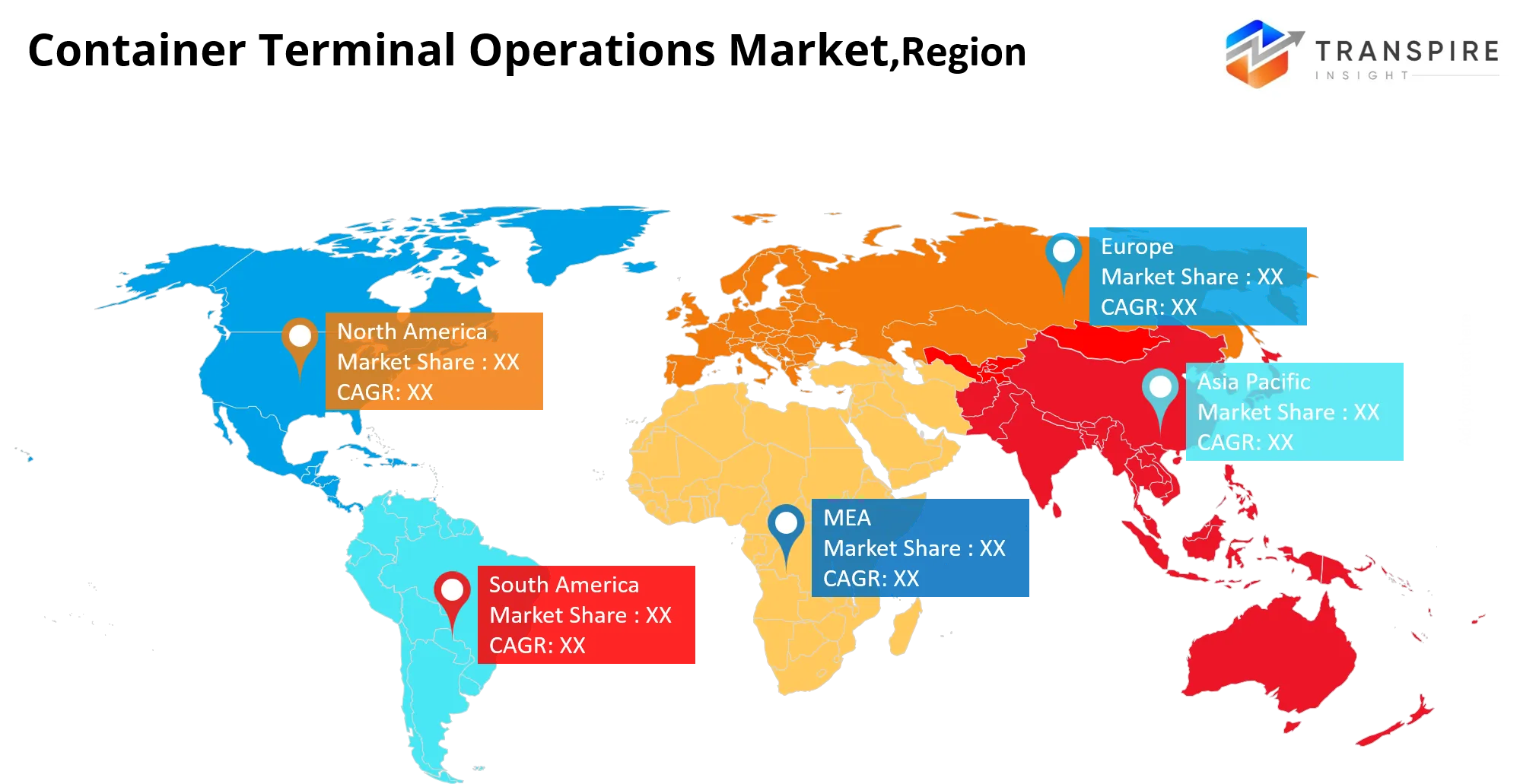
- By terminal type, the Conventional Terminals segment dominated the market and holds nearly 68% share in 2025 and is projected to grow at a substantial CAGR during the forecast period.
- By automation, the Semi-automated segment dominated the market and holds nearly 48% share in 2025 and is projected to grow at a substantial CAGR during the forecast period.
- By end user, the Shipping Lines segment dominated the market and holds nearly 32% share in 2025 and is projected to grow at a substantial CAGR during the forecast period.
- Container Manufacturing Assistance Scheme (CMAS) is a five-year project with a budget of ₹10,000 crore that is meant to improve India's capacity for container manufacturing by up to 7.5 lakh TEUs every year. The program contributes to enhancing containerized trade, supply-chain resilience, and terminal throughput, while contributing indirectly to the Container Terminal Operations Market, with the availability of containers as well as reducing the country's reliance on imports.
How is Technology Driving Growth in the Container Terminal Operations Market?
The Container Terminal Operations sector is evolving with the help of automation, artificial intelligence, the latest Terminal Operating Systems (TOS), and sustainability technologies. With the help of artificial intelligence and machine learning, it is possible to take advantage of predictive maintenance techniques, smart optimization of the yard, coordination in real-time, and lowering the frequency of container inspection handling activities. The introduction of terminal automation technologies and robots like Automated Guided Vehicles (AGVs), auto-stacking cranes, and remote-operated ship-to-shore cranes has improved safety, efficiency, and continuous delivery of goods. Modern TOS systems synchronize vessel, yard, truck, and rail operations, which allows faster execution of operations and less congestion. As for the electrification and “green” technologies, they help decrease emissions, improve compliance with regulations, enhance energy efficiency, and make terminal operations “greener.” In this way, all these technologies help improve operational resilience and throughput in achieving cost efficiency and increasing supply chain visibility in container terminals worldwide.
|
Report Metrics |
Details |
|
Market size value in 2025 |
USD 75.40 Billion |
|
Market size value in 2026 |
USD 78.39 Billion |
|
Revenue forecast in 2033 |
USD 102.88 Billion |
|
Growth rate |
CAGR of 3.96% from 2026 to 2033 |
|
Base year |
2025 |
|
Historical data |
2021 - 2024 |
|
Forecast period |
2026 - 2033 |
|
Report coverage |
Revenue forecast, competitive landscape, growth factors, and trends |
|
Regional scope |
United States; Canada; Mexico; United Kingdom; Germany; France; Italy; Spain; Denmark; Sweden; Norway; China; Japan; India; Australia; South Korea; Thailand; Brazil; Argentina; South Africa; Saudi Arabia; United Arab Emirates |
|
Key company profiled |
DP World, PSA International, Hutchison Ports, APM Terminals, COSCO Shipping Ports, ICTSI, China Merchants Port, Eurogate, SSA Marine, Yilport Holding, PSA Antwerp, Terminal Investment Limited, AD Ports Group, Ports America, ICTSI |
|
Customization scope |
Free report customization (country, regional & segment scope). Avail customized purchase options to meet your exact research needs. |
|
Report Segmentation |
By Terminal Type (Automated Terminals, Semi-automated Terminals, Conventional Terminals, Transshipment Terminals, Gateway Terminals, Inland Terminals, Feeder Terminals, Others); By Equipment (Ship-to-Shore Cranes, Rubber-tired Gantry Cranes, Rail-mounted Gantry Cranes, Reach Stackers, Straddle Carriers, Automated Guided Vehicles, Empty Container Handlers, Others); By Operation (Loading, Unloading, Transshipment, Storage, Gate Operations, Yard Management, Inspection, Others); By Automation (Manual, Semi-automated, Fully Automated, Remote-controlled, AI-enabled, IoT-enabled, Autonomous, Others); By Container Type (Dry Containers, Reefer Containers, Tank Containers, Open-top, Flat-rack, High-cube, Special Containers, Others); By Service (Stevedoring, Storage, Handling, Gate Services, Customs Support, Documentation, Equipment Services, Others); By End User (Shipping Lines, Port Authorities, Freight Forwarders, Importers, Exporters, Logistics Providers, Government, Others) |
Market Drivers
The Container Terminal Operations Market is propelled by the growth of international trade and increasing container cargo volumes as ports need to enhance their capacities and optimize cargo movement. Automation and digitalization, such as Terminal Operating Systems, Automated Guided Vehicles, and remotely operated cranes enable greater efficiency, reduced expenses, as well as quicker vessel turnaround. Modernization of port infrastructure ensures that terminals are able to serve ultra-large container ships and process the ever-increasing traffic levels in a quick and cost-effective way. Steps towards decarbonization stimulate investments in electric equipment, green energy, and operational innovations. Furthermore, integration of supply chains through the use of intermodal solutions, customs services, and logistics help operators to widen their revenue sources and increase customer satisfaction levels. The market for container terminal operations is able to provide tangible benefits due to the use of automation, digitalization, and increased operations scale. The reduced labor costs will assist the terminals in necessary reduction of the dependency on human labor and increasing the level of efficiency from the standpoint of costs. The increase in efficiency due to the use of automated equipment and implemented Terminal Operating Systems (TOS) allows for cranes to operate more efficiently and facilitates the process of vessels' turnaround. The need for scale and sourcing of the equipment enables the foremost players in the market using the synergies of many networks with the use of the processes standardization and mass procurement of the equipment. In addition, green finance enables investments in means of handling that rely on electricity, renewable energy, and less polluting facilities. Moreover, using automatic guided vehicles (AGV) as well as remote-operated cranes allows making the operations safer and more accurate thereby reducing the human interference, making fewer mistakes, lessening the congestion, and minimizing the risks associated with the safety of the terminal operations.
For Instance: -
- The operations of container terminals in the United Kingdom are growing rapidly because of the increase in standard twenty-foot equivalent units (TEUs) of containers. Large investments such as DP World's investment in expanding its terming facilities at London Gateway, and a surge in investments in port infrastructure are propelling the adoption of automation processes, all-electric green berthing facilities, and smart technologies related to supply chains.
- The American container terminal activity sector is developing consistently, with trade moving to the East Coast and Gulf Coast ports and significant investments in infrastructure development being the drivers of this growth. Investors are focusing on terminal automation technologies, green technologies, and nearshoring logistics of nearshoring.
Restrain
The Container Terminal Operations Market faces different limitations. The most common include a lot of money necessary for automation and terminal updates, the lack of infrastructure, congestion and insufficient connectivity with hinterland. Situations such as instability in the political situation in various countries lead to problems with transportation. The integration of legacy systems makes operational processes more complicated, and the rising operational costs also impede the profitability of terminals and the implementation of new technologies.
|
Driver |
Relative Impact on Growth (%) |
Geographic Relevance |
Impact Timeline |
Demand Strength |
Growth Mechanism |
Key Beneficiaries |
Major Constraint |
|
Global Container Trade and Terminal Capacity Expansion |
28% |
Asia Pacific, Europe, North America |
Long-term |
High |
Rising container volumes require expanded terminal capacity and throughput. |
Terminal operators, crane manufacturers, shipping lines |
Port congestion and limited hinterland connectivity |
|
Automation, AI, and Digital Terminal Technologies |
24% |
Asia Pacific, Europe, North America |
Medium-term |
High |
AI, TOS, automation optimize yards, vessels, gates, and equipment. |
Automation vendors, TOS providers, terminal operators |
High upfront investment and legacy-system integration |
|
Port Infrastructure Modernization and Intermodal Connectivity |
20% |
Asia Pacific, Middle East, Europe |
Long-term |
High |
New berths, yards, rail links expand handling capacity and connectivity. |
Port authorities, construction firms, logistics providers |
Long project cycles and infrastructure constraints |
|
Decarbonization and Electrification of Terminal Equipment |
15% |
Europe, Asia Pacific, North America |
Long-term |
High |
Emission targets accelerate electric cranes, hybrid carriers, and shore-power infrastructure. |
Equipment manufacturers, green-technology vendors, terminal operators |
High capital costs and charging infrastructure gaps |
|
Supply-Chain Resilience and Integrated Logistics Demand |
13% |
Asia Pacific, North America, Europe |
Medium-term |
High |
Integrated port-to-hinterland services improve cargo visibility and reliability. |
3PLs, shipping lines, terminal operators, cargo owners |
Geopolitical disruptions and fragmented logistics networks |
Analysis of Prices and Consumer Behaviour
Container terminals are the dominant players in the market for container terminal operations, accounting for 41.62% of the market in 2025 as a result of the increasing demand by ports, shipping lines, logistics companies, and global trade. Technologically advanced automated terminals are usually more expensive than traditional terminal operations since they involve the use of automated systems, computerized terminal management systems, and integrated control technology. Around68.41% of container terminals will be manual in 2025, showing that there is ample opportunity for automation and technology in the industry. During the same year, the global container ports registered a throughput of 994 million TEUs. Major operators’ purchasing decisions show much need for their operations to perform efficiently, possess automated features, show high equipment productivity, and offer effective cargo-handling capabilities.
|
Investment Factor |
Why It Matters to Investors |
Opportunity |
Investment Implication |
|
Global Trade & Capacity Expansion |
Containerized trade sustains long-term terminal throughput requirements. |
Invest in capacity expansion and high-volume gateway terminals. |
Supports long-duration infrastructure investment strategies. |
|
Terminal Automation & AI |
Automation improves productivity, safety, equipment utilization, and operating efficiency. |
Automated cranes, AGVs, AI yard optimization, and smart TOS. |
Creates technology-led growth and recurring software opportunities. |
|
Port Infrastructure Modernization |
Aging facilities require modernization to handle larger vessels efficiently. |
Berth expansion, automated yards, intermodal connections, and smart gates. |
Favors infrastructure developers and specialized equipment suppliers. |
|
Electrification & Decarbonization |
Emission targets accelerate replacement of conventional terminal equipment. |
Electric cranes, hybrid equipment, charging infrastructure, and energy systems. |
Creates long-term demand for green terminal technologies. |
|
Integrated Logistics & Hinterland Connectivity |
Cargo owners increasingly value seamless port-to-hinterland transportation. |
Rail, trucking, warehousing, freight platforms, and logistics integration. |
Enables diversified revenue streams beyond terminal handling. |
|
Emerging-Market Port Development |
Expanding trade corridors require new terminal capacity and services. |
Asia Pacific, Middle East, Africa, and Latin American terminals. |
Provides geographic diversification and infrastructure-growth exposure. |
Who are the Key Players in the Container Terminal Operations Market and how do they compete?
Competitiveness in the container terminal operations market is facilitated by companies engaged in automation technologies implementation, terminal-specific solutions, and development of global port networks. Rather than relying solely on operational efficiency, the competition is based on automated cargo handling, digital terminal management, smart port technologies, and systems wide integration with logistics and supply chain systems to ensure continuous operational growth and improvement of productivity, efficiency and visibility of container terminals’ activities.
With the rise of automated terminal technologies, digital port platforms, and automated container handling systems, PSA International improves its positioning in the market. By creating high-performance terminal technologies applicable at the largest ports, logistics hubs, and trade corridors, firms gain competitive advantages over their rivals. APM Terminals is strengthening its position in the industry by using integrated container terminal operations combined with advanced digital technologies for effective operations in logistics networks.
Top Companies i the Container Terminal Operations Market
- DP World
- PSA International
- Hutchison Ports
- APM Terminals
- COSCO Shipping Ports
- ICTSI
- China Merchants Port
- Eurogate
- SSA Marine
- Yilport Holding
- PSA Antwerp
- Terminal Investment Limited
- AD Ports Group
- Ports America
- ICTSI
|
Company |
Est. Revenue Share Range |
Key Offerings |
Strategic Positioning |
Geographic Strength |
Technology Focus |
|
PSA International |
6–8% |
Container terminals, transshipment, port services, supply-chain solutions |
Global scale through automated terminal network |
Asia Pacific, Europe, Americas |
Automated terminals, AI, digital twins, data analytics |
|
China Merchants Port Holdings |
5–7% |
Container terminals, port operations, logistics, terminal investments |
Portfolio diversification and network expansion |
Asia Pacific, Europe, Africa |
CTOS, smart ports, automation, digital operations |
|
APM Terminals |
5–7% |
Container handling, terminal management, inland logistics |
Integrated terminal operations and efficiency |
Europe, North America, Latin America |
Automation, electrification, remote operations, TOS |
|
COSCO SHIPPING Ports |
5–7% |
Terminal operations, port investment, logistics connectivity |
Shipping-linked network and global port integration |
Asia Pacific, Europe, Middle East |
Digital intelligence, automation, smart terminal systems |
|
MSC / Terminal Investment Limited |
4–6% |
Container terminals, port infrastructure, terminal concessions |
Carrier-linked global terminal network expansion |
Europe, Mediterranean, Americas |
Terminal automation, operational analytics, digitalization |
|
DP World |
4–6% |
Container terminals, marine services, logistics, inland connectivity |
End-to-end integrated trade and logistics platform |
Middle East, Asia, Europe, Americas |
AI, CARGOES, automation, digital supply-chain platforms |
|
Hutchison Ports |
4–6% |
Container terminals, cargo handling, port logistics |
Established global network with operational modernization |
Asia Pacific, Europe, Americas |
Remote-control cranes, autonomous trucks, IoT |
|
CMA CGM / CMA Terminals |
1–3% |
Terminal operations, port investments, logistics services |
Carrier-led vertical integration and network expansion |
Europe, Mediterranean, Asia, Americas |
Digital platforms, automation, smart logistics |
|
ICTSI |
1–2% |
Container terminals, cargo handling, port management |
Independent multi-region terminal specialization |
Asia Pacific, Americas, Middle East, Africa |
Automation, remote operations, terminal systems |
|
Yilport Holding |
1–2% |
Container terminals, cargo handling, port investments |
International expansion through diversified terminals |
Europe, Türkiye, Americas |
Automation, TOS, digital port management |
Market Segmentation
The Container Terminal Operations Market share is divided into seven categories: By terminal type, equipment, operation, automation, container, service and end user.
The Conventional Terminals dominated the market, accounting for nearly 68% in 2025 and is expected to rise at a significant CAGR during the forecast period.
The Container Terminal Operations Market is segmented by terminal type into Automated Terminals, Semi-automated Terminals, Conventional Terminals, Transshipment Terminals, Gateway Terminals, Inland Terminals, Feeder Terminals, Others. Among these, the Conventional Terminals segment dominated the market, accounting for nearly 68% in 2025 and expected to increase at a significant CAGR during the forecast period. The Conventional Terminals segment has been the biggest part of the Container Terminal Operations Market, making up almost 68% share in 2025, due to factors like their infrastructure already developed, large global presence, lower technological investments needed and compatibility with existing systems. Continuous demand from developing nations and established ports also helps in making this segment suitable for implementation. Further growth of the segment is expected throughout the forecast period, since global container volumes continue to increase and more terminals are getting their capacities raised.
The Semi-automated dominated the market, accounting for nearly 48% in 2025, and is expected to rise at a significant CAGR during the forecast period.
The Container Terminal Operations Market is segmented by automation into Manual, Semi-automated, Fully Automated, Remote-controlled, AI-enabled, IoT-enabled, Autonomous, Others. Among these, the Semi-automated segment dominated the market, accounting for nearly 48% in 2025 and expected to increase at a significant CAGR during the forecast period. The section of the Container Terminal Operations Market that includes Semi-Automated Terminals is predicted to retain a strong position in the segment throughout 2025, holding 48% of the market share. As the terminals have achieved favorable balance between automation, flexibility, and lower investments in comparison to the fully automated terminals, they manage to achieve higher productivity levels and safety standards while still utilizing human supervision. The rise of modernization trends will contribute to the segment development.
The Shipping Lines dominated the market, accounting for nearly 32% in 2025 and is expected to rise at a significant CAGR during the forecast period.
The Container Terminal Operations Market is segmented by end user into Shipping Lines, Port Authorities, Freight Forwarders, Importers, Exporters, Logistics Providers, Government, Others. Among these, the Shipping Lines segment dominated the market, accounting for nearly 32% in 2025 and expected to increase at a significant CAGR during the forecast period. The leading role in terms of market size in Container Terminal Operations Market was played by the Shipping Lines segment, which is forecasted to reach a 32% market share, propelled by their vast fleet of ships and cargo movement capabilities, legal contracts, and incorporated logistics. The positive market dynamics of the segment will be driven by the increasing amount of containers, smart terminal investments, and the growing need for reliable terminals.
Regional Segment Analysis of the Container Terminal Operations Market:
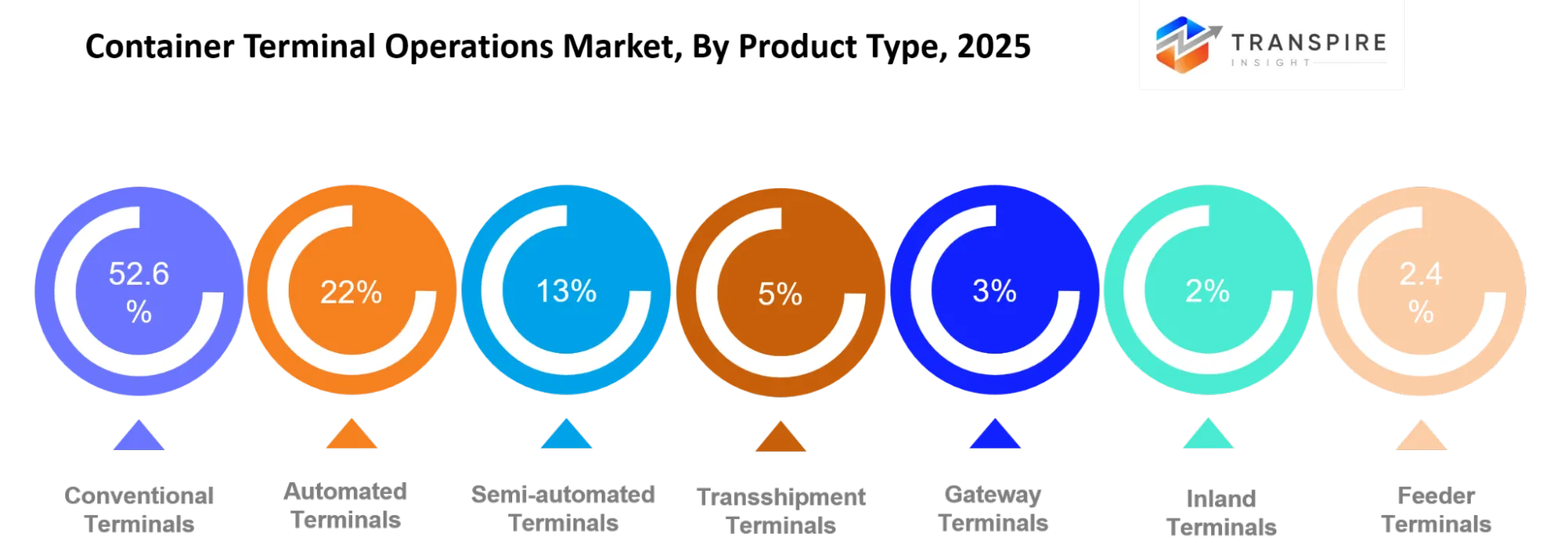
- North America (U.S., Canada, Mexico)
- Europe (Germany, France, U.K., Italy, Spain, Rest of Europe)
- Asia-Pacific (China, Japan, India, Rest of APAC)
- South America (Brazil and the Rest of South America)
- The Middle East and Africa (UAE, South Africa, Rest of MEA)
Asia Pacific is the fastest-growing region in the Container Terminal Operations Market during the period, holding around 40% share.
Asia Pacific is the fastest-growing region in the Container Terminal Operations Market during the forecast period, holding around 40% share during the forecast period. Asia Pacific is considered the fastest-growing region in the Container Terminal Operations Market as it has approximately 40% market share. Increasing trade in containers, manufacturing goods intended to be exported, infrastructure development at ports, and investments in terminal automation are the main forces behind this market growth. Moreover, the growth in transshipment activities, the e-commerce industry, the integration of regional supply chains, and cooperation in terms of investments in smart ports support this market expansion as well.
Europe is expected to grow at a rapid CAGR in theContainer Terminal Operations Market, holding around 25% of the share during the forecast period.
Europe is expected to grow at a rapid CAGR in the Container Terminal Operations Market holding around 25% share during the forecast period. The Container Terminal Operations Market in Europe is expected to experience a fast growth rate, accounting for nearly 25% of total market size due to excellent port infrastructure, strong trade relations, existing logistics systems, and developing terminals in the region. The continuously developing industry provides automated systems and new digital technologies used in ports, sustainability, and intermodal connection improvements.
North America is the fastest-growing region in the Container Terminal Operations Market during the period, holding around 15% share.
North America is expected to grow at a rapid CAGR in the Container Terminal Operations Market holding around 15% share during the forecast period. Growth in the North American Container Terminal Operations Market is expected to continue as it holds a market share of almost 15% due to increase in both containerized trade and port modernization, along with supply-chain opportunities and terminal automation investments. Continuous development of transpacific trade, e-commerce only volumes, intermodal connections, and digital ports contribute to advancing the cargo handling, developing the regional container terminal, and increasing efficiency in overall operations.
Strategies for Market Growth in Non-Leading Regions:
The use of effective and scalable container terminal automation technologies can assist small to medium-sized terminal operators in the development of non-core regions. The introduction and utilization of automated cargo handling devices as well as the creation of local smart terminal centers can help diminish the dependence on foreign technologies and save on operational expenses. The formation of strategic cooperation with regional terminal authorities, shipping lines, logistics companies, and freight forwarders will boost the penetration of the market for container terminal operators. In order to improve the knowledge concerning terminal automation and digitalization, qualifications enhancement, and maintenance, a number of training courses need to be performed. Furthermore, flexible financing options, long-term service contracts, and technology partnership schemes will help make state-of-the-art container terminal systems less expensive and motivate their implementation by terminal operators.
Future Market Trends for the Container Terminal Operations Market: -
- Automation and Robotics in Ports: Rapid use of automated stacking cranes, AI-based Internet of Things (IoT) solutions, and self-driving vehicles to avoid mistakes made by people.
- High-tech TOS Implementation: Increasing use of advanced terminal operating systems (TOS) for better planning of cargoes in ports and ships.
- Green Port Development: Huge investments in environmentally-friendly technologies, shore power, and electrification following the requirements of the international standards for reductions in emission levels.
- Road Transportation in Logistics: Change of focus from traditional loading and unloading to logistics value chain services including customs services and digital scheduling.
- Ultra-Large Container Ships and Ports: Adaptation of ports to the needs of mega container ships and change of technologies necessary for the servicing of large ships with the capacity exceeding 30,000 TEUs.
Recent Development
- In February 2026: The Damietta Alliance Container Terminals initiated commercial activities at Damietta Port in Egypt after the official opening ceremony. This container terminal has a quay that stretches for 1,670 meters and a designed handling capacity of 3.3 million TEUs per year. This new terminal is expected to significantly boost transshipment capacity and facilitate the improvement of supply chain operations in this region.
- In March 2026: ICTSI launched its South Luzon Container Terminal (SLCT) in Batangas, Philippines, with an investment of US$800 million. The terminal, which is expected to handle about 1.6 million TEUs per year, is equipped with an 800-meter quay and sophisticated systems, which improve connectivity, efficiency, sustainability, and resilience of cargo handling and supply chain processes, helping to boost the terminal operations market.
- In April 2026: DP World initiated the Brazil–Africa Link, which associates the export activities of Santos with its operations in Angola and Mozambique via the structure of its logistics network in South Africa. This integrated corridor bolsters containerized trade activities, multimodal logistics functions, terminal connections, supply-chain visibility, and processing capacities, thereby contributing to the development of the Container Terminal Operations Market worldwide.
This study forecasts revenue at global, regional and country levels from 2020 to 2033. Transpire Insights has segmented the Container Terminal Operations Market based on the below-mentioned segments:
Container Terminal Operations Market, By Terminal Type
- Automated Terminals
- Semi-automated Terminals
- Conventional Terminals
- Transshipment Terminals
- Gateway Terminals
- Inland Terminals
- Feeder Terminals
- Others
Container Terminal Operations Market, By Equipment
- Ship-to-Shore Cranes
- Rubber-tired Gantry Cranes
- Rail-mounted Gantry Cranes
- Reach Stackers
- Straddle Carriers
- Automated Guided Vehicles
- Empty Container Handlers
- Others
Container Terminal Operations Market, By Operation
- Loading
- Unloading
- Transshipment
- Storage
- Gate Operations
- Yard Management
- Inspection
- Others
Container Terminal Operations Market, By Automation
- Manual
- Semi-automated
- Fully Automated
- Remote-controlled
- AI-enabled
- IoT-enabled
- Autonomous
- Others
Container Terminal Operations Market, By Container Type
- Dry Containers
- Reefer Containers
- Tank Containers
- Open-top
- Flat-rack
- High-cube
- Special Containers
- Others
Container Terminal Operations Market, By Service
- Stevedoring
- Storage
- Handling
- Gate Services
- Customs Support
- Documentation
- Equipment Services
- Others
Container Terminal Operations Market, By End User
- Shipping Lines
- Port Authorities
- Freight Forwarders
- Importers
- Exporters
- Logistics Providers
- Government
- Others
Container Terminal Operations Market, By Regional Analysis
North America
- US
- Canada
- Mexico
Europe
- Germany
- UK
- France
- Italy
- Spain
- Russia
- Rest of Europe
Asia Pacific
- China
- Japan
- India
- South Korea
- Australia
- Rest of Asia Pacific
South America
- Brazil
- Argentina
- Rest of South America
Middle East & Africa
- UAE
- Saudi Arabia
- Qatar
- South Africa
- Rest of the Middle East & Africa
Frequently Asked Questions
Find quick answers to common questions.
The market is projected to reach USD 102.88 billion by 2033, expanding at a 3.96% CAGR during 2026–2033.
Asia Pacific is expected to dominate, accounting for approximately 40% share, driven by container trade, infrastructure development, automation, and smart-port investments.
Conventional Terminals held the largest share at nearly 68% in 2025, supported by established infrastructure and widespread adoption across global container ports.
Semi-automated terminals dominated with nearly 48% share in 2025, supported by balanced automation, flexibility, productivity, safety, and investment requirements.
A. Key players include DP World, PSA International, Hutchison Ports, APM Terminals, COSCO Shipping Ports, ICTSI, and China Merchants Port.
- DP World
- PSA International
- Hutchison Ports
- APM Terminals
- COSCO Shipping Ports
- ICTSI
- China Merchants Port
- Eurogate
- SSA Marine
- Yilport Holding
- PSA Antwerp
- Terminal Investment Limited
- AD Ports Group
- Ports America
- ICTSI
About the Authors

Kartik bhong
I am Kartik Bhong, a Senior Research Analyst at Transpire Insight, specializing in the Packaging, Manufacturing, and Construction industry. My work focuses on analyzing market trends, emerging technologies, industry regulations, and competitive landscapes to deliver accurate, data-driven insights. I am passionate about transforming complex industry information into clear, practical content that helps businesses, professionals, and decision-makers stay informed and make confident strategic decisions. Through continuous research and a strong commitment to accuracy, I strive to create reliable, well-researched content that reflects the latest developments across these dynamic industries and supports the vision of Transpire Insight in delivering valuable market intelligence.

Chakradhar Khansole
Chakradhar serves as the Research Director at Transpire Insight, bringing over 8 years of experience in technology, innovation, and strategic market intelligence. He specializes in transforming complex market data into actionable business insights that enable organizations to make informed, growth-oriented decisions. Recognized for his strategic vision and analytical expertise, Chakradhar leads high-impact research initiatives, delivering comprehensive market assessments, competitive intelligence, and forward-looking industry analysis.
Recently Published Reports
-
Apr 2026
Handling and Lifting Equipment Market
Handling and Lifting Equipment Market Size, Share & Analysis Report By Product (Cranes and Hoists, Forklifts, Conveyor Systems, Aerial Work Platforms, Others), By Application (E-Commerce, Automotive and Railway, Food and Beverages, Aviation, Others), and Geography (North America, Europe, Asia-Pacific, Middle East and Africa, South and Central America), 2021 - 2031
-
Apr 2026
HVAC Equipment Market
HVAC Equipment Market Size, Share & Analysis Report By Heating Equipment Type (Boilers and Furnaces, Heat Pumps, and Unitary Heaters), By Ventilation Equipment (Air Handling Units, Humidifiers and Dehumidifiers, Air Filters, and Fan Coiling Units), By Air Conditioning Equipment (Unitary Air Conditioners, Room Air Conditioners, Packaged Terminal Air Conditioners, and Chillers), By End User (Commercial, Residential, Industrial, and others), and Geography (North America, Europe, Asia-Pacific, Middle East and Africa, South and Central America), 2021 – 2031
-
Apr 2026
Refrigeration Valves Market
Refrigeration Valves Market Size, Share & Analysis Report By Type (Solenoid Valves, Expansion Valves, Check Valves, Service Valves, Others), By Application (Commercial Refrigeration, Industrial Refrigeration, Transport Refrigeration, Residential Refrigeration, Air Conditioning Systems), By End User (Food and Beverage Industry, Pharmaceutical Industry, HVAC Industry, Chemical Industry, Others), and Geography (North America, Europe, Asia-Pacific, Middle East and Africa, South and Central America), 2021 – 2031
-
Apr 2026
E-Commerce Packaging Materials Market
E-Commerce Packaging Materials Market By Material Type (Corrugated Boxes, Paper & Paperboard, Foam & Cushioning Materials, Plastic Packaging, Flexible Packaging, Protective Packaging, Others), By Product(Primary Packaging, Secondary Packaging, Tertiary Packaging), By Packaging Function (Protective Packaging, Branding & Presentation Packaging, Transit & Logistic Packaging, Sustainable Packaging, Tamper Evidence Packaging), By End-User (Retail & Consumer Goods, Electronic Appliances, Food & Beverages, Healthcare & Pharmaceutical, Fashion & Apparel, Home & Furnishing, Others); By Industry Analysis, Size, Share, Growth, Trends, and Forecasts 2021-2033