
Clinical Data Analytics In Healthcare Market Summary:
According to Transpire Insights, a detailed research report on the market reflects that the clinical data analytics application segment dominates the Global Clinical Data Analytics in Healthcare Market, accounting for approximately 36% of the total share worldwide. Health Catalyst leads the market with approximately USD 311.1 million in annual revenue and an estimated leading global market position, making it a key contributor to global market development, innovation, advanced clinical data analytics solutions, expanding healthcare data capabilities, and growth dynamics.
Market Snapshot
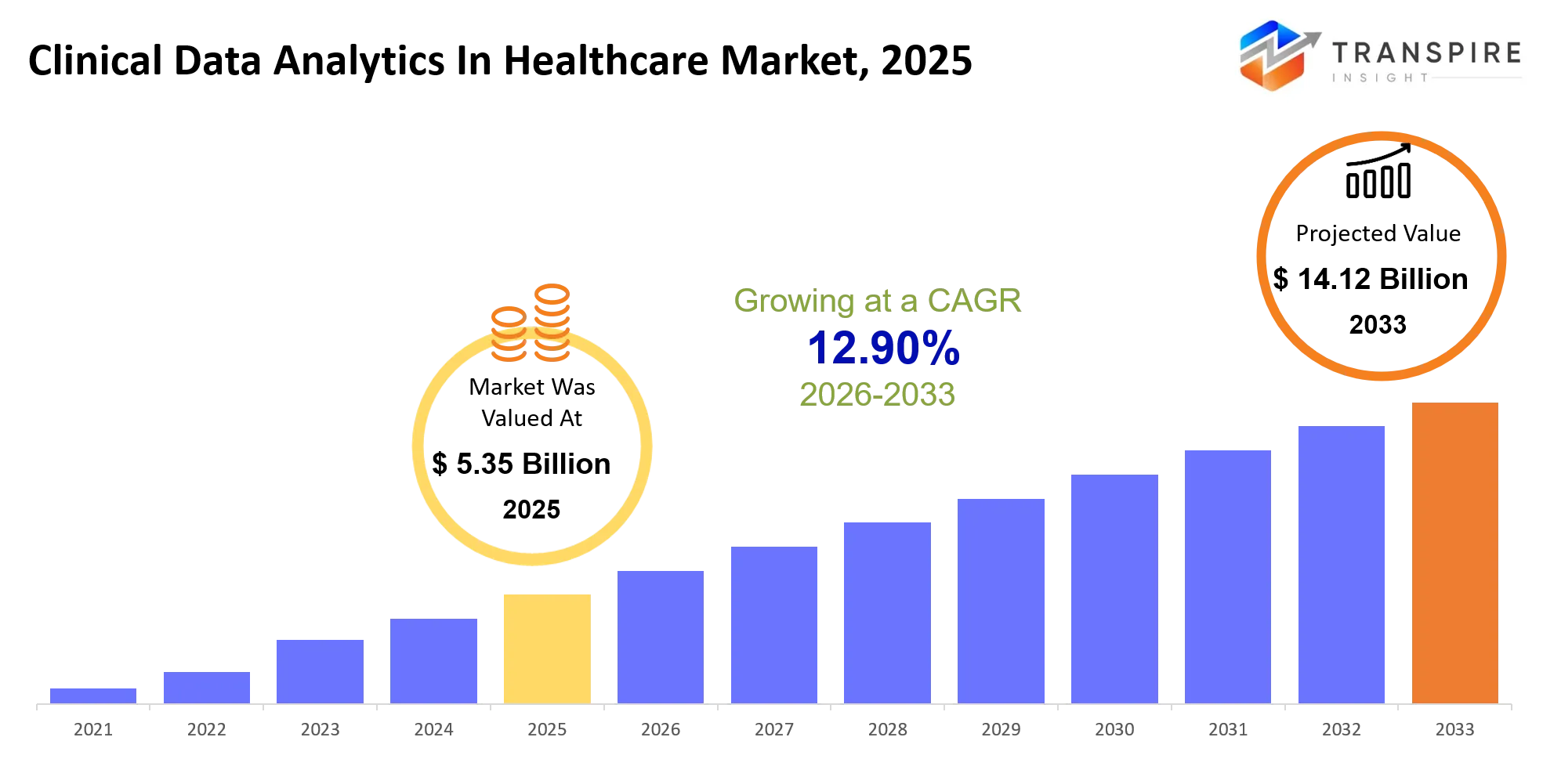
- Market Value (2025): USD 5.35 Billion.
- Expected Market Value (2026): USD 6.04 Billion.
- Estimated Market Value (2033): USD 14.12 Billion.
- Forecast CAGR (2026–2033): 12.90%
- Leading Region in 2025: North America
- Second-largest Region: Europe
- Fastest Growing Region: Asia Pacific
Introduction
Clinical Data Analytics in Healthcare Market refers to software, platforms, and services that capture, consolidate, manage, and analyze the highly complex data available through EHRs, medical devices, clinical trials, diagnostics systems, and other digital health technology sources. Clinical Data Analytics help healthcare providers, payers, and life science companies to derive meaningful insights from fragmented data that enable them to make informed clinical decisions, offer customized treatments, perform risk stratification, manage population health, and optimize quality of care. Some of the major trends influencing the market include the increased prevalence of value-based care, digitization of healthcare, interoperable data platforms, AI, and predictive analytics. Clinical Data Analytics also play a significant role in clinical research, pharmaceutical development, operations optimization, regulatory compliance, and resource management. Demand for evidence-based healthcare and better patient outcomes makes the solutions all the more strategic.
For instance:-
- Germany: The adoption of clinical data analytics is driven by digitization of healthcare, interoperable health data infrastructure, use of electronic patient records, and growth in AI-based clinical decision-making investments.
- United Kingdom: In the UK market, there are opportunities in digital transformation of the NHS, development of healthcare data infrastructure, use of cloud technology, and analytics tools to improve population health and clinical efficiency.
Key Market Highlights: -
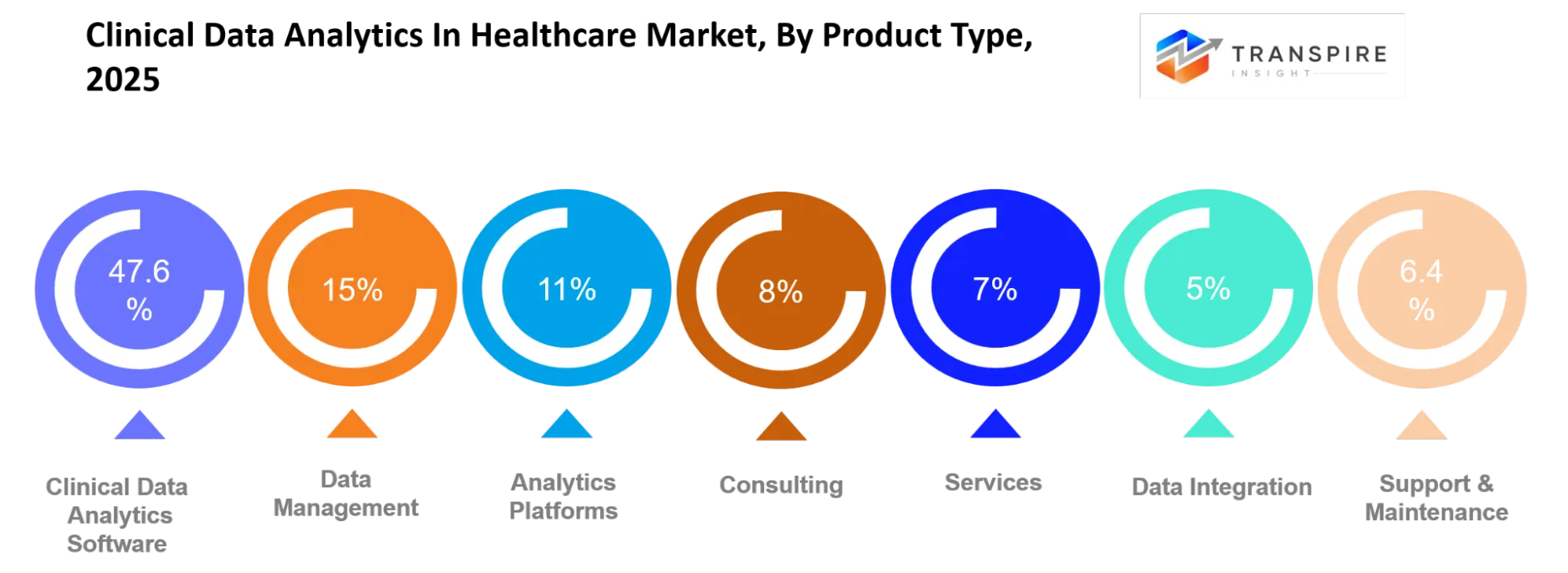
- North America is expected to grow at a rapid CAGR in the Clinical Data Analytics In Healthcare Market by holding around56% of the share during the forecast period.
- Europe is anticipated to hold roughly24.9% share of the Clinical Data Analytics In Healthcare Market over the predicted timeframe.
- Asia Pacific is anticipated to hold nearly 45%share of the Clinical Data Analytics In Healthcare Market over the predicted timeframe.
- By Component, the Software dominated the market and holds nearly 54% share in 2025 and is projected to grow at a substantial CAGR during the forecast period.
- By Analytics Type, the Descriptive Analytics dominated the market and holds close to 45% share in 2025 and is projected to grow at a substantial CAGR during the forecast period.
- By Application, the Patient Care dominated the market and holds about 42% share in 2025 and is projected to grow at a substantial CAGR during the forecast period.
- The growth of demand for advanced analytics solutions is driven by government-led digital health transformation, AI adoption, value-based care, interoperable healthcare infrastructure, and clinical data ecosystems.
How is Technology Driving Growth in the Clinical Data Analytics In Healthcare Market?
The use of technology has increased the growth of the Clinical Data Analytics in Healthcare Market through the process of turning complicated clinical data into useful information for faster evidence-based decision making. EHRs are the initial datasets, AI and machine learning technologies help in doing predictive analysis, risk stratification and clinical decision support. IoMT devices and wearables are helping in continuous monitoring of patients through real-time clinical data generation. Cloud-based analytics platforms increase scalability, interoperability, and access to data, while advanced analytics help in delivering value-based care.
|
Report Metrics |
Details |
|
Market size value in 2025 |
USD 5.35 Billion |
|
Market size value in 2026 |
USD 6.04 Billion |
|
Revenue forecast in 2033 |
USD 14.12 Billion |
|
Growth rate |
CAGR of 13.43%from 2026 to 2033 |
|
Base year |
2025 |
|
Historical data |
2021 - 2024 |
|
Forecast period |
2026 - 2033 |
|
Report coverage |
Revenue forecast, competitive landscape, growth factors, and trends |
|
Regional scope |
United States; Canada; Mexico; United Kingdom; Germany; France; Italy; Spain; Denmark; Sweden; Norway; China; Japan; India; Australia; South Korea; Thailand; Brazil; Argentina; South Africa; Saudi Arabia; United Arab Emirates |
|
Key company profiled |
IBM, Oracle, SAS Institute, Microsoft, Google, IQVIA, Cerner, Epic Systems, Optum, Health Catalyst, Veradigm, Merative, Inovalon, Truveta, Komodo Health |
|
Customization scope |
Free report customization (country, regional & segment scope). Avail customized purchase options to meet your exact research needs. |
|
Report Segmentation |
By Component (Software, Services, Platforms, Analytics Tools, Data Management, Consulting, Support & Maintenance, Others); By Analytics Type (Descriptive, Diagnostic, Predictive, Prescriptive, Real-time, Cognitive, Clinical Intelligence, Others); By Application (Clinical Trials, Patient Care, Population Health, Drug Discovery, Disease Management, Quality Management, Risk Management, Others); By Deployment (Cloud, On-premise, Hybrid, SaaS, Private Cloud, Public Cloud, Hosted, Others); By End User (Hospitals, Pharmaceutical Companies, Biotechnology Companies, CROs, Research Institutes, Government Organizations, Academic Institutions, Others); By Data Type (EHR Data, Claims Data, Clinical Trial Data, Medical Imaging Data, Genomic Data, Patient-generated Data, Wearable Data, Others); By Enterprise Size (Large Enterprises, SMEs, Hospitals, Research Organizations, Government, Academic, Startups, Others) |
Market Drivers
The Clinical Data Analytics in Healthcare market is powered by the accelerated digital transformation of the healthcare industry and the increasing adoption of EHRs and connectivity of clinical data. The shift towards value-based care is leading to an increased demand for predictive analytics, risk stratification, and outcomes measurement. AI and machine learning assist in improving clinical decision-making capabilities through recognizing patterns from complex data sets. In addition to this, analytics are being used by the healthcare organizations for optimizing operations, cost containment, better resource utilization, and minimizing errors. Moreover, various government efforts to modernize the healthcare system are aiding in the growth of clinical data analytics.
For instance:-
- France: Clinical data analytics is being enhanced in France through healthcare modernization, digital health investments, interoperability programs, and rising use of AI-based clinical decision-making solutions.
- Spain: Spain offers growing opportunities for clinical data analytics through healthcare digitization, regional health system modernization, cloud infrastructure development, and increased use of data-based clinical management solutions.
Restrain
Restrictions that are placed on the Clinical Data Analytics in Healthcare Market include fragmented healthcare data, interoperability issues, and strict regulations related to privacy of patients' data. Costs associated with implementation and maintenance of the solution may be an impediment for adoption by small healthcare organizations. Poor quality of data, bias in algorithms, cybersecurity risks, and lack of clinicians who have analytical skills may affect the efficiency of adoption.
|
Driver |
Relative Impact on Growth (%) |
Geographic Relevance |
Impact Timeline |
Demand Strength |
Growth Mechanism |
Key Beneficiaries |
Major Constraint |
|
Driver 1: AI and Machine Learning Integration in Clinical Analytics |
28% |
North America, Europe, Asia-Pacific |
Short-term |
High |
Enables predictive insights from complex clinical datasets |
AI vendors, analytics providers, hospitals, clinicians |
Data quality limits reliable predictive model performance |
|
Driver 2: Growing Adoption of Electronic Health Records and Interoperability |
23% |
North America, Europe, Asia-Pacific |
Medium-term |
High |
Expands accessible standardized data for clinical analytics |
EHR vendors, healthcare providers, analytics platforms |
Fragmented systems hinder seamless healthcare data exchange |
|
Driver 3: Rising Demand for Value-Based and Data-Driven Healthcare |
20% |
North America, Europe |
Medium-term |
High |
Analytics improves outcomes while reducing avoidable healthcare costs |
Hospitals, payers, clinicians, analytics service providers |
Implementation costs constrain adoption among smaller providers |
|
Driver 4: Expansion of Real-World Evidence and Precision Medicine |
16% |
North America, Europe, Asia-Pacific |
Long-term |
High |
Integrates real-world data for personalized clinical decisions |
Pharmaceutical firms, researchers, hospitals, patients |
Privacy requirements restrict access to patient-level datasets |
|
Driver 5: Increasing Healthcare Digitization and Cloud Analytics Investment |
13% |
Asia-Pacific, North America, Europe |
Short-term |
Medium |
Cloud platforms scale analytics across distributed healthcare environments |
Cloud providers, technology vendors, healthcare organizations |
Cybersecurity risks increase complexity of cloud deployments |
Analysis of Prices and Consumer Behaviour
The Clinical Data Analytics in Healthcare market is led by cloud deployments (64.10% of total market size; mainly on account of increasing demand for scalable healthcare analytics platforms, software-as-a-service (SaaS) solutions and clinical intelligence solutions enabled by artificial intelligence). Population health management applications form 41.85% of the market, on account of increasing adoption of value-based care, predictive risk management and patient outcomes through data. 70.65% of historical spend in clinical data analytics belongs to healthcare providers while payer spends are witnessing a CAGR of 15.85% fueled by increasing demand for fraud detection, risk scores and preventive care management solutions. Descriptive analytics forms 45% of the market, while predictive and prescriptive analytics are seeing increasing adoption owing to clinical decision support and risk stratification powered by artificial intelligence. The buying behavior of healthcare organizations shows that approximately 55% attach high priority to data accuracy, data interoperability, reliability of analytics and security of patient data. Additionally, another 33% of healthcare organizations opt for long-term contracts for their technology purchases owing to cost savings and scalability issues.
|
Company |
Est. Revenue Share Range |
Key Offerings |
Strategic Positioning |
Geographic Strength |
Technology Focus |
|
Oracle Health |
6–9% (Estimated) |
Oracle Health Data Intelligence, Healthcare Foundation, clinical analytics, population-health analytics |
Integrated platform leadership across healthcare data ecosystems |
North America, Europe, Asia-Pacific |
Cloud AI, EHR interoperability, data warehousing, ML |
|
IQVIA |
5–8% (Estimated) |
Real-world data, clinical analytics, RWE, clinical-trial analytics |
Data-driven leadership across clinical and life-science analytics |
North America, Europe, Asia-Pacific |
AI, RWD, advanced analytics, clinical intelligence |
|
SAS Institute |
4–6% (Estimated) |
SAS Health, SAS Viya, clinical data discovery, predictive analytics |
Analytics and AI leadership with healthcare specialization |
North America, Europe, Asia-Pacific |
AI/ML, explainable AI, NLP, predictive modeling |
|
Microsoft |
3–5% (Estimated) |
Microsoft Fabric healthcare data solutions, Azure Health Data Services, healthcare analytics |
Cloud ecosystem strategy integrating healthcare data analytics |
North America, Europe, Asia-Pacific |
Cloud, Fabric, AI, FHIR, OMOP, data lakehouse |
|
Health Catalyst |
3–5% (Estimated) |
Healthcare analytics platform, population health analytics, quality analytics, data management |
Healthcare-specialized analytics with outcome-focused differentiation |
North America, Europe |
AI/ML, cloud analytics, data warehouse, clinical intelligence |
|
Innovaccer |
2–4% (Estimated) |
Healthcare AI platform, population health, data activation, clinical analytics |
AI-led platform strategy focused on healthcare transformation |
North America, Asia-Pacific |
Generative AI, ML, interoperability, data activation |
|
Arcadia |
2–4% (Estimated) |
Healthcare data platform, analytics, population health, value-based-care analytics |
Healthcare data-platform specialization for value-based care |
North America |
Data lakehouse, AI/ML, interoperability, analytics |
|
Truveta |
1–3% (Estimated) |
Truveta Data, clinical research analytics, real-world evidence, clinical-trial intelligence |
Real-time clinical data specialization for evidence generation |
North America |
EHR data, AI, RWD, longitudinal analytics |
|
Komodo Health |
1–3% (Estimated) |
Healthcare Map, healthcare analytics, real-world evidence, Marmot AI |
Healthcare intelligence differentiation through large-scale data |
North America, Europe |
AI, RWD, NLP, longitudinal patient analytics |
|
Merative |
1–3% (Estimated) |
Clinical decision support, healthcare analytics, Micromedex, data solutions |
Clinical intelligence specialization with enterprise healthcare solutions |
North America, Europe, Asia-Pacific |
AI, clinical decision support, data analytics, NLP |
Who are the Key Players in the Clinical Data Analytics In Healthcare Market and how do they compete?
The competitiveness of Clinical Data Analytics in Healthcare in the international market is based on companies specializing in technology innovations, solutions designed specifically for the healthcare industry, and building global data analytics networks. Competitive not only on price but based on analytics, artificial intelligence, secure data platforms, interoperability, and integration with digital health and operations systems, such a competitive strategy results in continuous innovation as well as allows achieving increased clinical productivity, efficiency, resource optimization, and visibility for healthcare organizations.
IBM builds up its competitive position in the market through developing AI-based clinical analytics, predictive healthcare solutions, data intelligence platforms, and connected healthcare solutions. By designing advanced healthcare analytics and data management solutions designed to assist in making clinical decisions, managing patients, operations of healthcare organizations, and other healthcare applications, Oracle differentiates itself from its competitors. The competitive position of SAS Institute is built through integrated solutions in clinical analytics, artificial intelligence, predictive analytics, healthcare data management, and advanced analytics.
Top Companies in the Clinical Data Analytics In Healthcare Market
- IBM
- Oracle
- SAS Institute
- Microsoft
- IQVIA
- Cerner
- Epic Systems
- Optum
- Health Catalyst
- Veradigm
- Merative
- Inovalon
- Truveta
- Komodo Health
|
Investment Factor |
Why It Matters to Investors |
Opportunity |
Investment Implication |
|
AI-Enabled Clinical Decision Support |
Improves clinical intelligence and workflow efficiency |
Predictive analytics, generative AI, clinical decision support |
Prioritize scalable AI-enabled analytics platforms |
|
Healthcare Data Interoperability |
Expands usable data across fragmented healthcare systems |
FHIR integration, EHR connectivity, data normalization |
Invest in interoperable healthcare data infrastructure |
|
Real-World Evidence Expansion |
Strengthens evidence generation for clinical and commercial decisions |
RWE platforms, longitudinal datasets, research analytics |
Target high-value evidence generation capabilities |
|
Value-Based Healthcare Adoption |
Links analytics directly with outcomes and cost management |
Population health, quality analytics, risk stratification |
Favor outcome-focused recurring analytics models |
|
Cloud-Based Analytics Adoption |
Enables scalable deployment across healthcare organizations |
Cloud platforms, healthcare data warehouses, SaaS analytics |
Support scalable subscription-based analytics businesses |
|
Emerging-Market Digitalization |
Creates new demand as healthcare infrastructure digitizes |
Asia-Pacific, Middle East, Latin America healthcare systems |
Pursue partnerships and localized regional expansion |
Airport Quick Service Restaurant (QSR) Market Segmentation
The Clinical Data Analytics In Healthcare Market share is divided into seven categories: By Component, By Analytics Type, By Application, By Deployment, By End User, By Data Type, By Enterprise Size
The Software dominated the market, accounting for nearly 54% in 2025 and is expected to rise at a significant CAGR during the forecast period.
The Clinical Data Analytics In Healthcare Market isby component into software, services, platforms, analytics tools, data management, consulting, support & maintenance, others. Among these, the Software dominated the market, accounting for nearly 54% in 2025 and expected to increase at a significant CAGR during the forecast period. The software segment is most prominent because of the rising use of scalable analytics platforms, artificial intelligence applications, integration, and clinical decision support systems.
The Descriptive Analytics dominated the market, accounting for close to 45% in 2025, and is expected to rise at a significant CAGR during the forecast period
The Clinical Data Analytics In Healthcare Market is segmented by analytics type into descriptive, diagnostic, predictive, prescriptive, real-time, cognitive, clinical intelligence, others. Among these, the Descriptive Analytics dominated the market, accounting for close to 45% in 2025 and expected to increase at a significant CAGR during the forecast period. The descriptive analytics segment is most prominent because of rising healthcare data analysis, performance evaluations based on past performance, clinical reports, and decision-making.
The Patient Care dominated the market, accounting for about 42% in 2025 and is expected to rise at a significant CAGR during the forecast period.
The Clinical Data Analytics In Healthcare Market by application into clinical trials, patient care, population health, drug discovery, disease management, quality management, risk management, others. Among these, the Patient Care dominated the market, accounting for about 42% in 2025 and expected to increase at a significant CAGR during the forecast period. The patient care segment is most prominent because of rising need for customized treatment, clinical decision support, patient monitoring, and improved healthcare outcomes.
Regional Segment Analysis of the Clinical Data Analytics In Healthcare Market
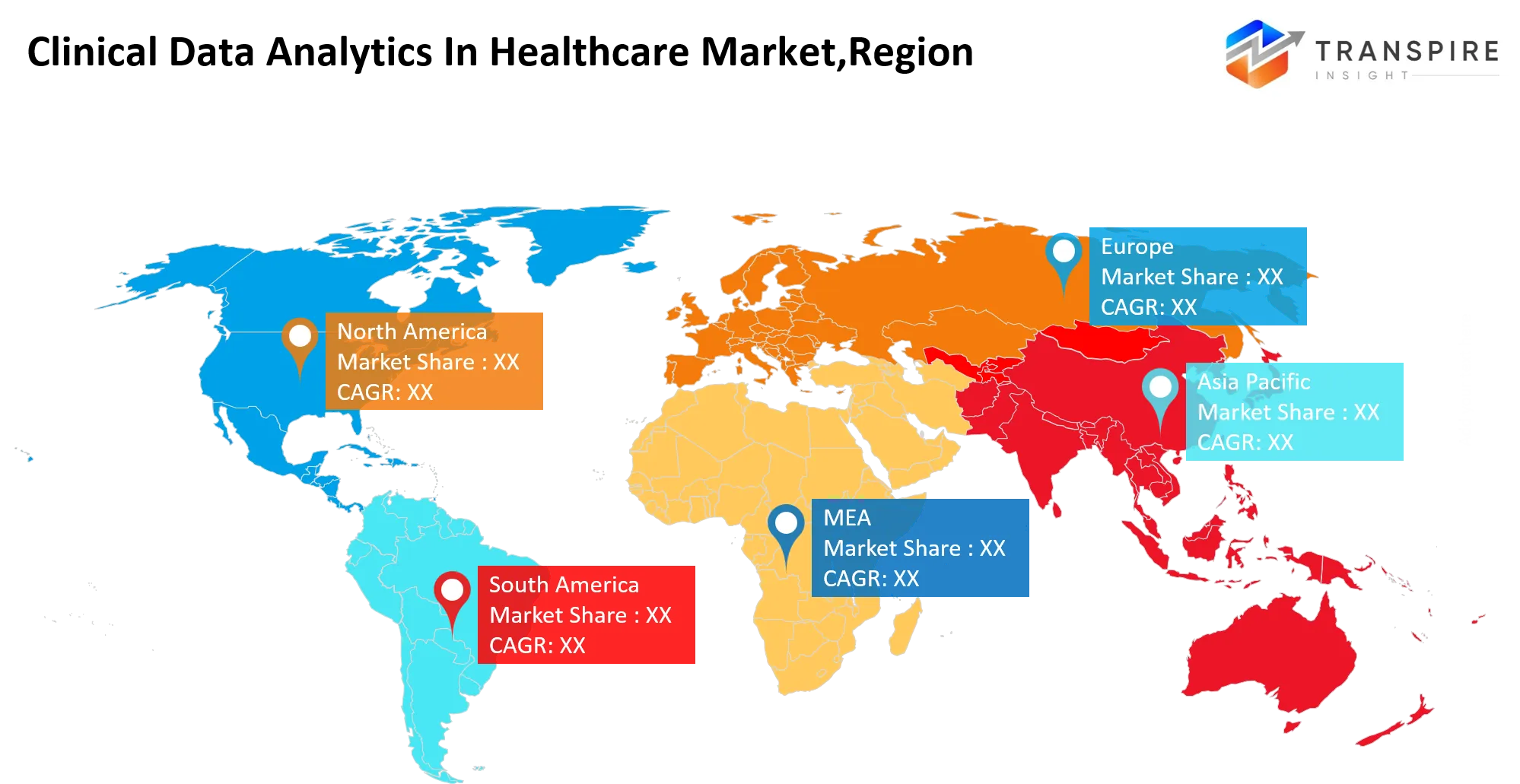
- Europe (Germany, France, U.K., Italy, Spain, Rest of Europe)
- North America (U.S., Canada, Mexico)
- Asia-Pacific (China, Japan, India, Rest of APAC)
- South America (Brazil and the Rest of South America)
- The Middle East and Africa (UAE, South Africa, Rest of MEA)
North America is expected to grow at a rapid CAGR in the Clinical Data Analytics In Healthcare Market, holding around 56% of the share during the forecast period.
North America occupies the dominant position in the Clinical Data Analytics in Healthcare Market owing to the presence of sophisticated healthcare infrastructure, high adoption rate of electronic health records, significant investment in artificial intelligence technologies, and increasing need for data-driven clinical decision-making. Factors favoring the development of the regional market include the presence of established healthcare analytics vendors, rich clinical data resources, positive digital health policies, and increasing cloud-based analytics adoption.
Europe is the high-growth region in the Clinical Data Analytics In Healthcare Market during the period, holding roughly 24.9% share.
Europe emerges as a high growth region in the Clinical Data Analytics in Healthcare Market on account of expanding healthcare digitization, rising adoption of electronic health records, as well as increasing investment in artificial intelligence and cloud-based analytics solutions. The development of the region's market is being accelerated by government-led modernization of the healthcare sector, growing importance of clinical data analytics for achieving interoperability, and increasing need for value-based care.
Asia Pacific is the fastest-growing region in the Clinical Data Analytics In Healthcare Market during the period, holding nearly 45% share.
The Asia Pacific region is the fastest growing region in the Clinical Data Analytics in Healthcare Market on account of rapid digitization in the healthcare sector, high adoption rate of EHRs (Electronic Health Records), and substantial investment in artificial intelligence and cloud analytics. Digitization drives in healthcare spearheaded by governments, development of healthcare infrastructure, and demand for cost-efficient clinical decision support systems are some of the factors driving market adoption.
Strategies for Market Growth in Non-Leading Regions:
The development of non-leadership regions through an effective and scalable platform and technology of clinical data analytics would benefit small to medium-sized healthcare organizations. The local installation of data infrastructure of healthcare, cloud analytics platform, and interoperable clinical data system can decrease technology dependency and increase the overall efficiency of implementation. The formation of strategic alliances with regional healthcare providers, technology firms, research institutes, insurers, and distributors of healthcare would increase the market penetration of clinical data analytics solutions. Technical training and skills development would be needed to enhance the level of knowledge on clinical analytics, data management, interoperability, cybersecurity, and applications of artificial intelligence. Also, flexible financing schemes, technology agreements, and managed analytics services would be helpful to make clinical data analytics solutions more affordable and promote the adoption of these solutions in the healthcare organizations. The development of partnership programs with government, healthcare modernization, and digital health initiatives as well as digital delivery approaches would increase the accessibility of clinical data analytics solutions and drive the sustainable worldwide market growth in developing countries.
Future Market Trends for the Clinical Data Analytics In Healthcare Market: -
Artificial Intelligence and Machine Learning: AI and machine learning have transformed clinical data analytics through prediction and decision making, identification of risk, and improved patient outcome in healthcare institutions.
Predictive and Prescriptive Analytics: Healthcare institutions are embracing predictive and prescriptive analytics for patient risk assessment, treatment plan optimization, resource management, and decision making in healthcare.
Population Health and Precision Medicine: Clinical data analytics has grown from being applied in population health and genomics to precision medicine in healthcare institutions.
Recent Development
In March 2026: MDClone introduced the ADAMS Copilot, allowing for a secure generative AI system which would allow spoken medical language to be turned into valid and compliant healthcare analytics.
In June 2026: Veeva Systems introduced enhanced capabilities in clinical data management, focusing on automation, risk-based data management, and efficient clinical trial data management.
In May 2026: Healthcare analytics platform providers introduced expanded capabilities in population health, real-time analytics, and interoperability to provide better integrated clinical data management.
Market Segment
This study forecasts revenue at global, regional and country levels from 2020 to 2033. Transpire Insights has segmented the Clinical Data Analytics In Healthcare Market based on the below-mentioned segments:
Clinical Data Analytics In Healthcare Market, By Component
- Software
- Services
- Platforms
- Analytics Tools
- Data Management
- Consulting
- Support & Maintenance
- Others
Clinical Data Analytics In Healthcare Market, By Analytics Type
- Descriptive
- Diagnostic
- Predictive
- Prescriptive
- Real-time
- Cognitive
- Clinical Intelligence
- Others
Clinical Data Analytics In Healthcare Market, By Application
- Clinical Trials
- Patient Care
- Population Health
- Drug Discovery
- Disease Management
- Quality Management
- Risk Management
- Others
Clinical Data Analytics In Healthcare Market, By Deployment
- Cloud
- On-premise
- Hybrid
- SaaS
- Private Cloud
- Public Cloud
- Hosted
- Others
Clinical Data Analytics In Healthcare Market, By End User
- Hospitals
- Pharmaceutical Companies
- Biotechnology Companies
- CROs
- Research Institutes
- Government Organizations
- Academic Institutions
- Others
Clinical Data Analytics In Healthcare Market, By Data Type
- EHR Data
- Claims Data
- Clinical Trial Data
- Medical Imaging Data
- Genomic Data
- Patient-generated Data
- Wearable Data
- Others
Clinical Data Analytics In Healthcare Market, By Enterprise Size
- Large Enterprises
- SMEs
- Hospitals
- Research Organizations
- Government
- Academic
- Startups
- Others
Clinical Data Analytics In Healthcare Market, By Regional Analysis
North America
- US
- Canada
- Mexico
Europe
- Germany
- UK
- France
- Italy
- Spain
- Russia
- Rest of Europe
Asia Pacific
- China
- Japan
- India
- South Korea
- Australia
- Rest of Asia Pacific
South America
- Brazil
- Argentina
- Rest of South America
Middle East & Africa
- UAE
- Saudi Arabia
- Qatar
- South Africa
- Rest of the Middle East & Africa
Frequently Asked Questions
Find quick answers to common questions.
Growing healthcare digitization, AI adoption, electronic health records, interoperability, and demand for data-driven clinical decision-making are accelerating market growth.
Software dominates due to scalable analytics platforms, artificial intelligence integration, interoperability capabilities, and increasing demand for clinical decision-support solutions.
Descriptive analytics leads due to widespread healthcare reporting, historical data analysis, performance evaluation, clinical insights, and informed decision-making requirements.
North America leads due to advanced healthcare infrastructure, extensive EHR adoption, strong AI investments, established analytics providers, and digital health initiatives.
AI, machine learning, predictive analytics, prescriptive analytics, population health management, precision medicine, cloud platforms, and interoperable healthcare data will shape growth
- IBM
- Oracle
- SAS Institute
- Microsoft
- IQVIA
- Cerner
- Epic Systems
- Optum
- Health Catalyst
- Veradigm
- Merative
- Inovalon
- Truveta
- Komodo Health
About the Authors

Pankaj Ghogare Patil
I am Pankaj Ghogare Patil, a Senior Research Analyst at Transpire Insight, specializing in the Pharmaceutical, Chemicals & Materials, Healthcare IT, and Biotechnology industry. My expertise lies in conducting comprehensive market research, analyzing industry trends, evaluating competitive landscapes, and translating complex data into actionable insights. At Transpire Insight, I closely follow emerging technologies, regulatory developments, and market innovations to create accurate, well-researched, and informative content that helps businesses and professionals make informed decisions. I am committed to producing credible, evidence-based articles that reflect industry best practices while making technical topics accessible and valuable for a broad audience.

Chakradhar Khansole
Chakradhar serves as the Research Director at Transpire Insight, bringing over 8 years of experience in technology, innovation, and strategic market intelligence. He specializes in transforming complex market data into actionable business insights that enable organizations to make informed, growth-oriented decisions. Recognized for his strategic vision and analytical expertise, Chakradhar leads high-impact research initiatives, delivering comprehensive market assessments, competitive intelligence, and forward-looking industry analysis.
Recently Published Reports
-
Apr 2026
AI in Diabetic Retinopathy Market
AI in Diabetic Retinopathy Market Size, Share & Analysis Report By Type (Screening AI Systems, Diagnostic AI Systems, and Predictive AI Models), By Application Segment (Hospitals, Ophthalmology Clinics, Diagnostic Centers, and Research and Development), and Geography (North America, Europe, Asia-Pacific, Middle East and Africa, South and Central America), 2021 - 2031
-
Apr 2026
Psychometric Tests Market
Psychometric Tests Market Size, Share & Analysis Report By Type (Personality Tests, Ability/Aptitude Tests, Skill/Knowledge Tests, and Others), By Application (Talent Acquisition and Talent Management), and Geography (North America, Europe, Asia-Pacific, Middle East and Africa, South and Central America), 2021 – 2031
-
Apr 2026
Rare Biological Sample Collection Market
Rare Biological Sample Collection Market Size, Share & Analysis Report By Type (Isolation Kits & Reagent, Blood Collection Tubes, and Others), By Application (Oncology, Transcriptomics, Pharmacogenomics, and Others), and Geography (North America, Europe, Asia-Pacific, Middle East and Africa, South and Central America), 2021 – 2031
-
Jul 2026
Diabetic Retinopathy Market
Diabetic Retinopathy Market Size, Share & Analysis Report By Type (Proliferative Diabetic Retinopathy, and Diabetic Macular Edema (DME)), By Treatment Type (Anti VEGF Drug, Steroid Implants, Laser Surgeries, and Vitrectomy), and Geography (North America, Europe, Asia-Pacific, Middle East and Africa, South and Central America), 2021 – 2031
Our Clients







