
Clearing Houses And Settlements Market Summary:
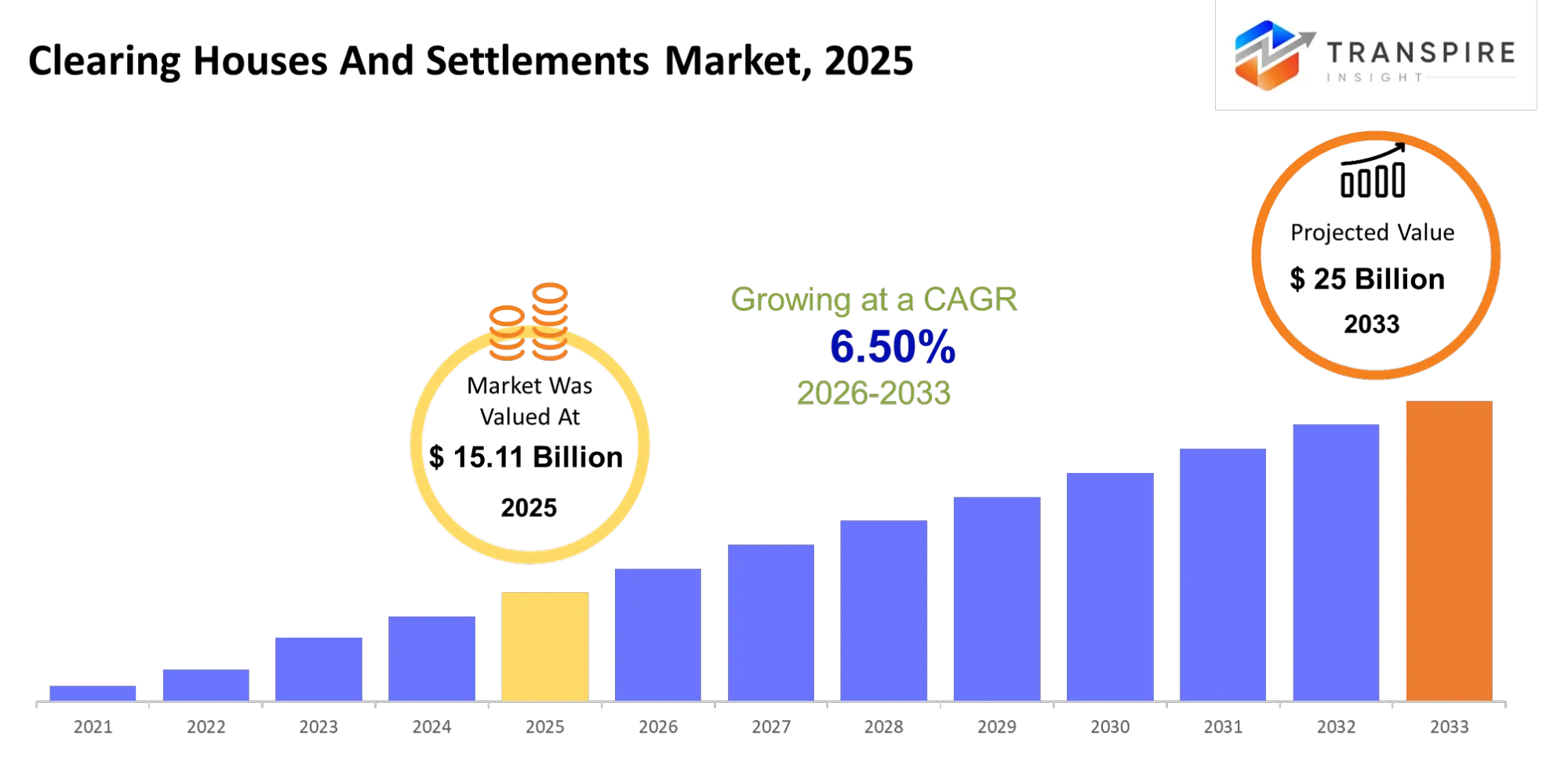
As per the Transpire Insight, The Clearing Houses and Settlements Market size is estimated at USD 15.11 billion in 2025 and is anticipated to reach USD 25 billion by 2033, growing at a CAGR of 6.50% from 2026 to 2033.
The marketplace for clearing houses and settlement provides the backbone for the process whereby a completed trade results in a real transfer of cash, security, collateral, or other asset; confirms instructions; net obligations; controls counterparty exposure; governs margin; and picks up exceptions before any actual breaches result in losses. This marketplace has been moving from an end-of-day model to a far more automated intraday risk and liquidity management solution over the last 3-5 years, and this evolution was practically launched by North America's move to T+1 settlement, reducing the timeframe to affirm trades, fund positions, and fix data errors. This has led to increased activity in straight-through processing, standards-based messaging, cloud connectivity, and exception-management technology. Growth follows a clear trend: shrinking settlement cycle times and increased resilience expectations raise operational risk, which encourages organisations to offload more clearance, settlement, collateral, and reconciliation functions onto specialist networks, and the European T+1 rollout continues that pattern.
Clearing Houses And Settlements Market Size & Forecast:
- Market Size 2025: USD 15.11 Billion
- Expected Market Value (2033): USD 25 Billion
- Forecast CAGR (2026–2033): 6.50%
- Leading Region in 2025: North America
- Fastest Growing Region: Asia-Pacific
- Key Company Profiles: DTCC, Euroclear, Clearstream, CME Group, LCH, ICE Clear, Nasdaq, London Stock Exchange Group, SIX Group, Deutsche Börse, Euronext, OCC, Japan Securities Clearing Corporation, ASX, Hong Kong Exchanges and Clearing.
Key Clearing Houses And Settlements Market Insights:
With clearing and settlement moving towards being a technology-driven risk control market, it is no longer just about processing completed trades; it is about who can do it faster and identify the exceptions, fund them, collateralise them and settle them earlier. The best investment opportunity is to connect regulated infrastructure with cloud, AI, APIs and tokenised-asset workflows while maintaining legal finality and cyber resilience.
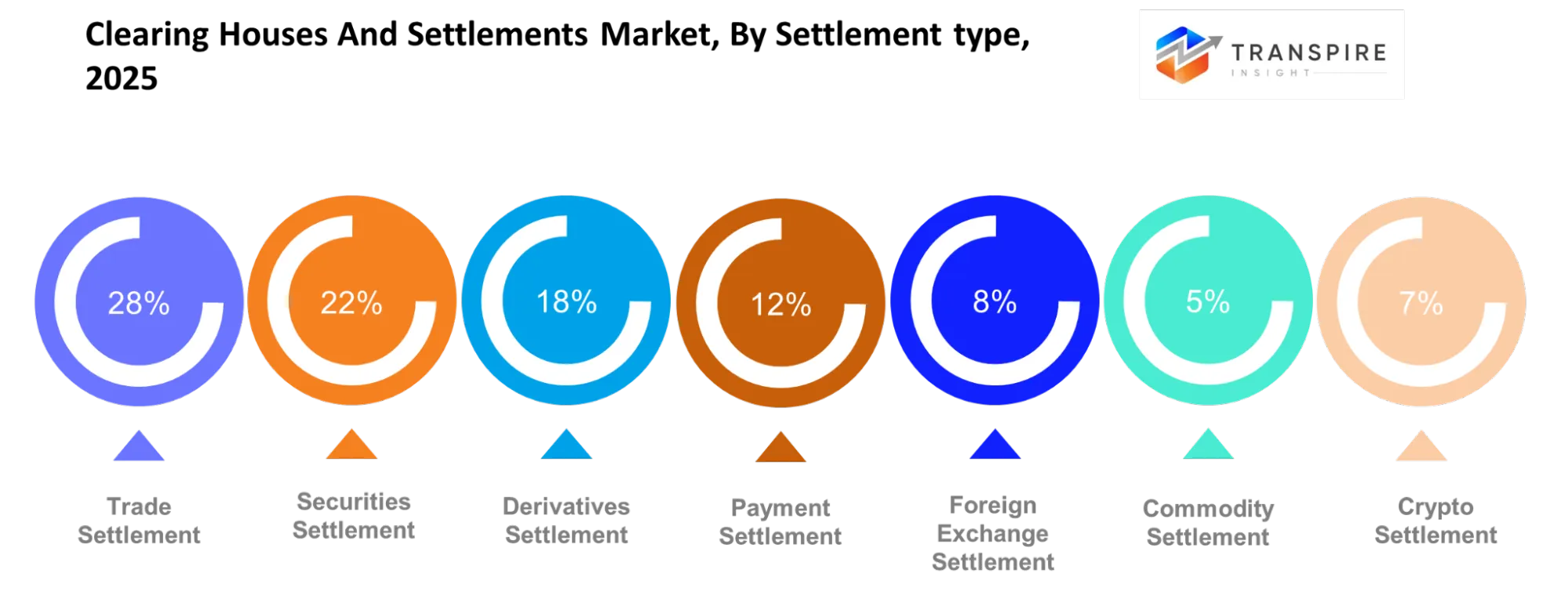
- DTCC is addressing trade settlement with a partial-settlement automation that is moving trade operations toward earlier exception repairs, 28.00%.
- Securities settlement, 22.00%, is a gain from Euroclear's D-FMI that brings DLT native issuance onto conventional liquidity rails.
- LCH DigitalAssetClear, which adds regulated CCP workflows to Bitcoin-index derivatives, has provided support for derivatives settlement at 18.00%.
- Payment settlement, 12.00%, is heading towards tokenised cash, with LSEG running the pilot for Digital Settlement House features.
- FX settlement, 8.00%, is evolving with LCH ForexClear's forward-clearing growth, which is helping to facilitate increasingly standardised risk transfers.
- Commodity settlement, 5.00%, is increasingly using API-based collateral and margin monitoring instead of batch workflows.
- Crypto settlement, 3.00%, is heading towards being institutionalised with regulated venues focusing on segregated clearing and clear benchmarks.
- Other settlements, 4.00%, gain relevance as Euroclear and Clearstream digitise Eurobond issuance from 2026.
- Central counterparty clearing and real-time and blockchain-based settlement advances, at 14.20% CAGR with programmable delivery-versus-payment models, continue to play a key role.
What are the Key Drivers, Restraints, and Opportunities in the Clearing Houses And Settlements Market?
Driver:
The major growth driver is the compression of the settlement cycle, coupled with stricter operational-resilience and collateral requirements. The U.S., Canada, and Mexico shifted key securities transactions to T+1, while the EU is preparing. Less time between trade execution and settlement raises the cost of manual affirmations, incomplete trade data, late FX funding, and unmatched instructions. Banks, broker-dealers, custodians, and asset managers consequently spend more on automated matching, workflow controls, real-time exception handling, collateral optimisation, and managed post-trade services. This lifts recurring transaction, connectivity, risk-management, and value-added data-service revenue.
Restraint:
Legacy architecture remains the main constraint. Many institutions still operate fragmented back-office systems, country-specific settlement procedures, inconsistent reference data, and manual handoffs between trading, custody, treasury, and compliance teams. Replacing these systems is expensive and risky because migration can disrupt live settlement flows. The problem persists because post-trade operations involve multiple counterparties and infrastructures; one participant’s modernisation does not eliminate the need to support another participant’s older format or timetable.
Opportunity:
Interoperable digital settlement is creating new opportunities for automation across clearing and post-trade operations. In 2026, The Clearing House advanced its on-chain money initiative to connect tokenized deposits with established payment rails and enable faster, programmable settlement. This model can reduce manual intervention, improve transaction traceability, and support automated reconciliation. It also creates opportunities for API-based connectivity, tokenized collateral management, and continuous processing, helping financial institutions build more flexible settlement infrastructure while maintaining links with established regulated payment systems.
What Has the Impact of Artificial Intelligence Been on the Clearing Houses And Settlements Market?
AI can support clearing and settlement by helping humans concentrate on transactions more likely to fail. Machine-learning models analyse historical settlement breaks, counterparty behaviour, missing trade fields, custody cut-off times, funding flows, and collateral readiness to flag the trades that require action ahead of the scheduled settlement date and the earlier rectification of mismatched instructions to avoid costly settlement failures. Other examples include document extraction, trade-data reconciliation and validation, regulatory-report preparation, message metadata tagging, and case prioritisation.
Generative AI copilots enable operations teams to search procedures, summarise exceptions, and locate missing evidence from a high volume of messages. In collateral management, optimisation models recommend more effective collateral allocation while preserving margin coverage and liquidity buffers. The Depository Trust & Clearing Corporation (DTCC) has listed settlement-fail prediction, data reconciliation, and collateral optimisation as high-priority AI use cases for post-trade processing. The only real limitation is not the algorithms but their deployment quality. Predictive insights depend on firms collecting complete, standardised, and timely data. Legacy platforms, inconsistent identifier usage, data-siloed ownership, model-management requirements, and the need for explainability can make deploying models difficult in some circumstances, especially if they may trigger a settlement or regulatory breach if wrongly automated.
In September 2026, Nasdaq launched the Nasdaq Calypso Agentic AI Environment, a new framework integrated into its capital markets platform to scale AI automation across the trade lifecycle. This deployment aims to drastically reduce manual interventions and eliminate post-trade operational inefficiencies that cause settlement delays.
Key Clearing Houses And Settlements Market Trends:
The market is shifting away from post-trade processing to financial infrastructure that is connected with the market throughout the institutional workflow. Shorter settlement windows, central clearing and programmable settlement are altering the way participants are managing risk, liquidity and exceptions.
- T+1 is moving the settlement process from overnight to compressed allocation, confirmation and exception management.
- Manual instructions are being replaced with standardised electronic messaging for improved straight-through processing.
- Traditional derivatives are no longer the only customers of central clearing, as integrated margin, collateral and liquidity workflows increase.
- Cross-margining is becoming more critical as regulators and clearing venues strive to reduce resources utilised in similar positions.
- Cloud-based platforms are shifting from edge workloads to scalable post-trade processing and connectivity.
- Point-to-point interfaces are being superseded by APIs, which are faster connections between market participants.
- Distributed-ledger experiments are in the process of transitioning from pilots to taking networks of tokenised money and settlement with interoperability requirements.
- AI is moving beyond break resolution to prioritising exceptions, forecasting liquidity, and anomaly detection.
- Intraday margining and liquidity visibility are becoming increasingly important, which is driving collateral workflows to be more real-time.
- In a push for resilient requirements, infrastructures are being modernised to increase redundancy and cyber controls and recovery testing.
Clearing Houses And Settlements Market Segmentation
Settlement Type:
Trade Settlement holds the largest share at 28.00%, supported by high transaction volumes and the need for coordinated delivery-versus-payment processing. Securities Settlement accounts for 22.00%, reflecting the scale of equity and bond transactions requiring secure asset transfer and finality. Derivatives Settlement represents 18.00%, driven by margin, collateral, and exposure-management requirements. Payment Settlement contributes 12.00%, while Foreign Exchange Settlement represents 8.00%, supported by cross-border transaction flows. Commodity Settlement accounts for 5.00%, Crypto Settlement 3.00%, and Other Settlements 4.00%, covering specialized transaction structures and emerging digital-market workflows.
Clearing Type:
Central Counterparty Clearing leads at 48.20%, reflecting regulatory preference for standardized risk mutualization and centralized margin management. Bilateral and multilateral clearing remain important for transactions requiring tailored counterparty arrangements. Netting continues to improve capital and liquidity efficiency, while gross settlement supports transactions where individual obligations require direct completion. Automated and hybrid clearing models are gaining relevance as institutions combine centralized risk controls with flexible processing. Meanwhile, real-time and blockchain-based settlement, growing at a 14.20% CAGR, signals a stronger shift toward digital infrastructure.
Asset Class:
Equities, bonds and derivatives remain the principal asset groups supported by established clearing and settlement infrastructure. Equities benefit from standardized exchange-based processing, while bonds require efficient custody, matching and delivery-versus-payment capabilities across fragmented markets. Derivatives create additional requirements for margin calculation, collateral optimization, and exposure monitoring. Foreign exchange and commodities broaden the need for cross-market interoperability, particularly where settlement cycles and liquidity conditions differ. ETFs combine characteristics of securities and fund structures, while digital assets introduce programmable settlement, tokenization and continuously operating infrastructure.
Service:
Clearing, settlement and custody form the core operational layer, ensuring transactions are completed, assets are safeguarded and obligations are managed efficiently. Risk management is becoming more data-driven as institutions monitor exposures and margin requirements across interconnected positions. Collateral management is gaining importance as shorter settlement cycles increase liquidity pressure and reduce response time. Reconciliation is shifting toward automated matching, reducing manual investigation of transaction breaks. Reporting is also becoming more integrated, with standardized data and API connectivity enabling faster regulatory submissions, operational monitoring and cross-platform information sharing.
Participant:
Banks and broker-dealers remain central because they connect trading activity with clearing, custody, and settlement networks. Asset managers increasingly require automated post-trade processing to handle larger transaction volumes without expanding operational workloads. Exchanges continue integrating trading and post-trade capabilities to improve transaction continuity and risk visibility. Institutional investors are seeking greater transparency across settlement and collateral positions, while corporates increasingly access sophisticated payment and treasury infrastructure. Government entities also participate through public-market issuance and settlement activity. These relationships are encouraging direct connectivity, standardized messaging, and automated workflows across participant groups.
Technology:
Traditional systems continue handling critical transaction workloads, but cloud platforms are improving scalability and infrastructure flexibility. Distributed Ledger Technology is enabling experiments with tokenised securities, shared records and programmable settlement, while AI and analytics support reconciliation, anomaly detection and risk monitoring. API-based systems are improving interoperability between participants, platforms and service providers. Real-time settlement is also gaining attention as institutions seek faster completion and liquidity visibility. Increasingly, these capabilities converge around shared data layers, allowing transaction, collateral and risk information to move across processing, reporting and control functions.
What are the Key Use Cases Driving the Clearing Houses And Settlements Market?
The core use is trade and securities settlement, where the 28.00% Trade Settlement segment and 22.00% Securities Settlement segment depend on matching, delivery-versus-payment, reconciliation and exception resolution. T+1 is accelerating automation because less time is available for post-trade completion.
Expanding applications include derivatives clearing, collateral optimisation, margin processing and Treasury-market clearing. Central Counterparty Clearing, at 48.20%, links these applications to standardised risk management, while cross-margining can reduce duplicated collateral needs.
Emerging use cases centre on tokenised deposits, digital assets and programmable settlement. The Clearing House’s 2026 on-chain money initiative demonstrates how payment rails can connect with tokenised transactions, creating opportunities for 24/7 settlement and conditional payments.
|
Report Metrics |
Details |
|
Market size value in 2025 |
USD 15.11 Billion |
|
Market size value in 2026 |
USD 16.09 Billion |
|
Revenue forecast in 2033 |
USD 25 Billion |
|
Growth rate |
CAGR of 6.50% from 2026 to 2033 |
|
Base year |
2025 |
|
Historical data |
2021 - 2024 |
|
Forecast period |
2026 - 2033 |
|
Report coverage |
Revenue forecast, competitive landscape, growth factors, and trends |
|
Regional scope |
United States; Canada; Mexico; United Kingdom; Germany; France; Italy; Spain; Denmark; Sweden; Norway; China; Japan; India; Australia; South Korea; Thailand; Brazil; Argentina; South Africa; Saudi Arabia; United Arab Emirates |
|
Key companies profiled |
DTCC, Euroclear, Clearstream, CME Group, LCH, ICE Clear, Nasdaq, London Stock Exchange Group, SIX Group, Deutsche Börse, Euronext, OCC, Japan Securities Clearing Corporation, ASX, Hong Kong Exchanges and Clearing. |
|
Customization scope |
Free report customisation (country, regional & segment scope). Avail customised purchase options to meet your exact research needs. |
|
Report Segmentation |
Settlement Type (Trade Settlement, Securities Settlement, Derivatives Settlement, Payment Settlement, Foreign Exchange Settlement, Commodity Settlement, Crypto Settlement); Clearing Type (Central Counterparty Clearing, Bilateral Clearing, Multilateral Clearing, Netting, Gross Settlement, Automated Clearing, Hybrid Clearing); Asset Class (Equities, Bonds, Derivatives, FX, Commodities, ETFs, Digital Assets); Service (Clearing Services, Settlement Services, Custody, Risk Management, Collateral Management, Reconciliation, Reporting); Participant (Banks, Broker-Dealers, Asset Managers, Exchanges, Institutional Investors, Corporates, Government Entities); Technology (Traditional Systems, Cloud Platforms, Blockchain, Distributed Ledger Technology, AI & Analytics, API-Based Systems, Real-Time Settlement). |
Which Regions are Driving the Clearing Houses And Settlements Market Growth?
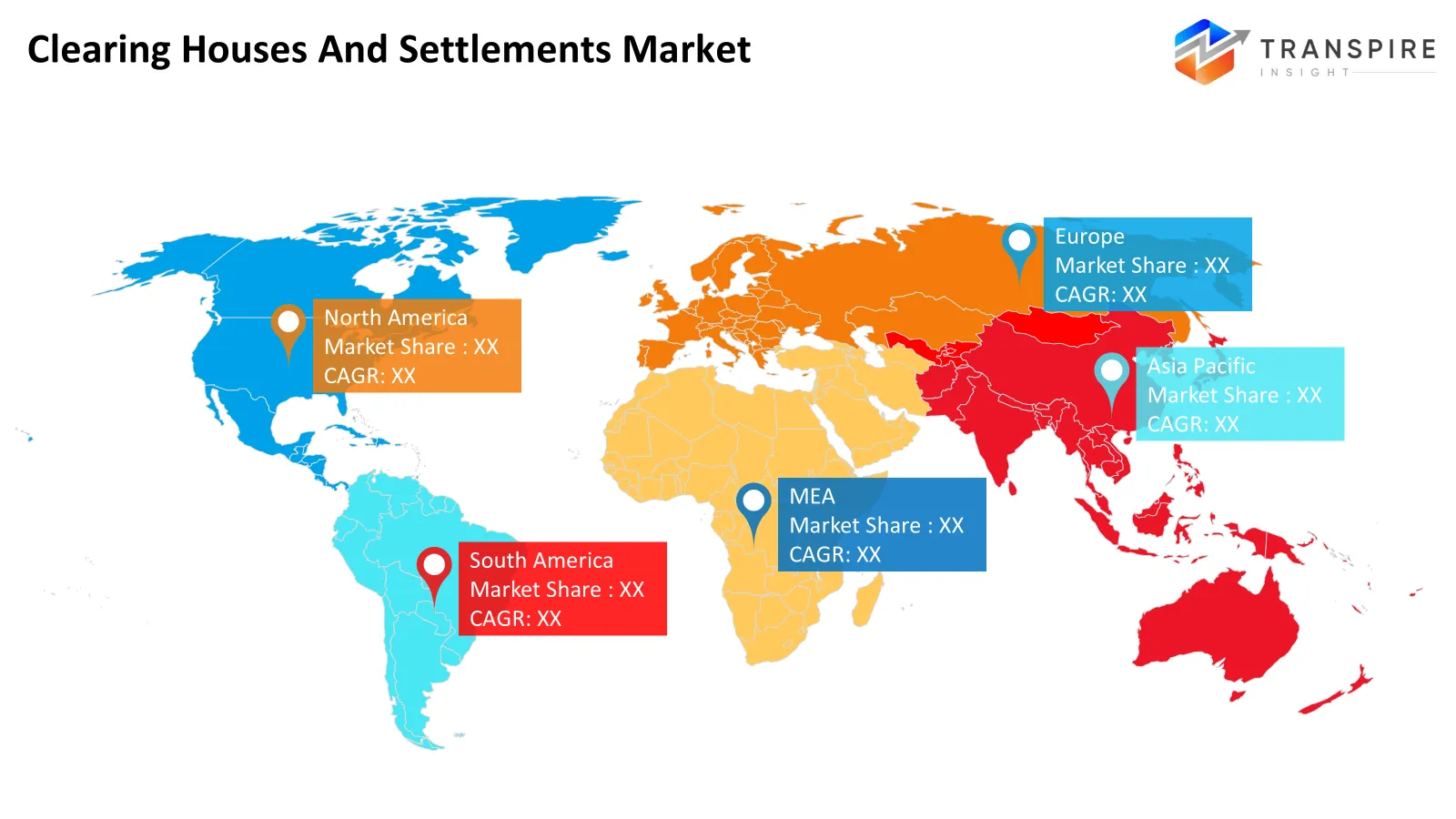
North America leads with 37.80% of the market given its large securities, derivatives, and Treasury-market activity, coupled with its long-established chains of broker-dealers, custodians, and clearing members. T+1 implementation for the United States has driven firms to upgrade procedures for same-day affirmation, allocation, funding, and reconciliation. Depository Trust & Clearing Corporation's roadmap for post-trade modernisation, including cloud migration for core clearance, settlement, and risk applications, supports the region's IT edge. Regulatory pressure, a well-developed CCP structure, and high institutional trading volumes sustain the need for resilient, scalable post-trade technologies.
In April 2026, the Depository Trust & Clearing Corporation (DTCC) expanded its Cloud First strategy by partnering with Amazon Web Services (AWS) to incrementally migrate a defined set of core clearing, settlement, and risk applications.
Europe has a 32.00% market share and, while thus far trailing North America, derives benefits from tightly linked cross-border custody and collateral pools. It is based on mature infrastructures such as Euroclear, Clearstream, LCH, Euronext and Target-connected settlement systems. The EU has adopted T+1, effective 11 October 2027, which drives the industry towards cross-border harmonisation of allocation, matching and settlement-discipline rules. Euroclear's plan is for a single post-trade entry point in all 27 EU-27 markets in order to benefit from increased cross-border efficiency, as well as deeper asset-servicing integration.
In September 2026, Euroclear partnered with HSBC to launch AutoFX, a new automated FX service. This service embeds foreign exchange conversion directly into the securities settlement process to help cross-border clients navigate the compressed timelines driving region-wide transformation.
https://www.euroclear.com/newsandinsights/en/press/2026/mr-21-launch-automated-fx-service.html
Asia Pacific has a 22.00% share of the market and is the fastest-growing region, with a CAGR of 10.90%, driven by growing capital markets, digital asset pilots, and an expanding number of institutional investors. The recent market developments have shifted towards digital finance on a regulated basis rather than simply reducing settlement cycles. Clearing and exchange infrastructure in Japan, Hong Kong, Singapore, Australia and India is investing heavily in interoperable solutions, tighter margin controls and automated operational processes; the key to the opportunity is regional connectivity between fast digitising domestic markets and custody, collateral and FX markets.
In September 2026, Citi expanded Citi Token Services into Japan. By utilising bank-grade capabilities that connect traditional financial infrastructure with emerging digital networks, this expansion enables corporate and financial institutional clients to utilize tokenized deposits for real-world transaction management and cross-border settlement.
https://investingnews.com/citi-r-token-services-expands-global-footprint-into-japan-and-uae/
Who are the Key Players in the Clearing Houses And Settlements Market, and how do they compete?
Competition arises from scale, regulatory credibility, collateral networks, and the ability to more easily introduce digital services without displacing high-volume legacy activities. The members, DTCC, Euroclear, Clearstream, CME Group, LCH, ICE Clear, Nasdaq, LSEG, SIX Group, Deutsche Börse, Euronext, OCC, Japan Securities Clearing Corporation, ASX and HKEX compete by asset class specialisation, regional connectivity, risk models and automation.
The DTCC plays to its U.S. market infrastructure scale and, through a tier 1 modernisation initiative, hosts new Tier 1 core applications in the public cloud, alongside preparations for offering digitisation services to promote collateral mobility and to support 24/7 transfers. Euroclear relies on cross-border custody and settlement by combining traditional settlement and collateral management with its DLT-based Digital Financial Market Infrastructure for digital-native securities. LSEG and LCH leverage multi-asset clearing, digital-asset derivatives, and partner-led growth; eleven banks took a 20% stake in LSEG Post Trade Solutions, and LCH launched Digital Asset Clear. Deutsche Börse, Clearstream, SIX, Euronext, and Nasdaq focus on regional market integration, custody, Central Securities Depositories, and technology standards; CME, ICE Clear, OCC, JSCC, ASX, and HKEX seek to maintain advantages in listed derivatives, options, domestic securities, and Asia-Pacific risk management.
Key Players are:
- DTCC
- Euroclear
- Clearstream
- CME Group
- LCH
- ICE Clear
- Nasdaq
- London Stock Exchange Group
- SIX Group
- Deutsche Börse
- Euronext
- OCC
- Japan Securities Clearing Corporation
- ASX
- Hong Kong Exchanges and Clearing
Recent Development News
- In September 2026, The Clearing House partnered with Quant to advance its On-Chain Money Initiative, using Quant’s technology for interoperability, orchestration, and transaction management across tokenised deposit clearing and settlement. The initiative is designed to support immediate settlement and connect tokenised transactions with established payment networks such as RTP and CHIPS. https://www.theclearinghouse.org/payment-systems/Articles/2026/09/The-Clearing-House-Partners-with-Quant-to-Advance-the--On-Chain-Money-Initiative
- In September 2026, Shanghai Clearing House launched BUMP, a full-process platform for bilateral margin management to support China’s new OTC derivatives margin requirements. The platform enabled 36 institutions to participate initially, with Bank of China and Shanghai Pudong Development Bank completing the first automated bilateral margin settlement through the system. https://www.ceicdata.com/en/china/shanghai-stock-exchange-turnover-value
What Strategic Insights Define the Future of the Clearing Houses And Settlements Market?
The market is evolving toward integrated post-trade networks where clearing, settlement, collateral and asset servicing are managed via data, APIs and programmable infrastructure. T+1 is accelerating this trend because the faster timelines mean manual exception management is less sustainable. Fragmentation and a proliferation of tokenised networks, data models and diverging regulation risk the duplication of silos that modernisation seeks to eradicate. As settlement functions become more digitally integrated, cyber resilience is an increasingly important consideration. The emerging opportunity is in aggregating tokenised assets, real-time collateral and AI-powered exception management within a regulated infrastructure. Depository Trust & Clearing Corporation's 2026 production tokenisation initiative shows how existing infrastructure can underpin connected settlement solutions. On a strategic level, providers should invest in interoperable architecture, standards-based data, automated controls and regulatory portability, rather than disparate or non-interoperable technologies. Firms that combine existing and new digital solutions will succeed without compromising trust, resilience, or settlement finality.
Key Segmentations are:
Settlement Type
- Trade Settlement
- Securities Settlement
- Derivatives Settlement
- Payment Settlement
- Foreign Exchange Settlement
- Commodity Settlement
- Crypto Settlement
Clearing Type
- Central Counterparty Clearing
- Bilateral Clearing
- Multilateral Clearing
- Netting
- Gross Settlement
- Automated Clearing
- Hybrid Clearing
Asset Class
- Equities
- Bonds
- Derivatives
- FX
- Commodities
- ETFs
- Digital Assets
Service
- Clearing Services
- Settlement Services
- Custody
- Risk Management
- Collateral Management
- Reconciliation
- Reporting
Participant
- Banks
- Broker-Dealers
- Asset Managers
- Exchanges
- Institutional Investors
- Corporates
- Government Entities
Technology
- Traditional Systems
- Cloud Platforms
- Blockchain
- Distributed Ledger Technology
- AI & Analytics
- API-Based Systems
- Real-Time Settlement
By Regional Analysis
North America
- US
- Canada
- Mexico
Europe
- Germany
- UK
- France
- Italy
- Spain
- Russia
- Rest of Europe
Asia Pacific
- China
- Japan
- India
- South Korea
- Australia
- Rest of Asia Pacific
South America
- Brazil
- Argentina
- Rest of South America
Middle East & Africa
- UAE
- Saudi Arabia
- Qatar
- South Africa
- Rest of the Middle East & Africa
Frequently Asked Questions
Find quick answers to common questions.
The clearing houses and settlements market size was valued at USD 15.11 billion in 2025 and is poised to reach USD 25 billion by 2033, expanding at a 6.50% CAGR.
Key segments for the clearing houses and settlements market are Settlement Type (Trade Settlement, Securities Settlement, Derivatives Settlement, Payment Settlement, Foreign Exchange Settlement, Commodity Settlement, Crypto Settlement); Clearing Type (Central Counterparty Clearing, Bilateral Clearing, Multilateral Clearing, Netting, Gross Settlement, Automated Clearing, Hybrid Clearing); Asset Class (Equities, Bonds, Derivatives, FX, Commodities, ETFs, Digital Assets); Service (Clearing Services, Settlement Services, Custody, Risk Management, Collateral Management, Reconciliation, Reporting); Participant (Banks, Broker-Dealers, Asset Managers, Exchanges, Institutional Investors, Corporates, Government Entities); Technology (Traditional Systems, Cloud Platforms, Blockchain, Distributed Ledger Technology, AI & Analytics, API-Based Systems, Real-Time Settlement).
Growth is primarily driven by shorter settlement cycles, expansion of central clearing, regulatory modernisation, automation of post-trade workflows, rising collateral-management needs, and adoption of cloud, API, AI and digital-ledger technologies.
The clearing houses and settlements market is led by major manufacturers, including DTCC, Euroclear, Clearstream, CME Group, LCH, ICE Clear, Nasdaq, London Stock Exchange Group, SIX Group, Deutsche Börse, Euronext, OCC, Japan Securities Clearing Corporation, ASX, Hong Kong Exchanges and Clearing.
North America holds 37.80% of the market, supported by mature clearing infrastructure, deep capital markets, regulatory modernisation, institutional participation, T+1 settlement adoption, and strong investment in digital post-trade technologies.
Opportunities include tokenized settlement, real-time collateral management, AI-driven reconciliation, API-based interoperability, automated exception handling, and cloud-enabled post-trade infrastructure.
- DTCC
- Euroclear
- Clearstream
- CME Group
- LCH
- ICE Clear
- Nasdaq
- London Stock Exchange Group
- SIX Group
- Deutsche Börse
- Euronext
- OCC
- Japan Securities Clearing Corporation
- ASX
- Hong Kong Exchanges and Clearing
About the Authors

Mayur Shinde
I am Mayur Shinde, a Senior Research Analyst at Transpire Insight, specializing in the Automotive & Transportation and Information & Communication Technology (ICT) Industry. My work focuses on analyzing emerging market trends, technological advancements, competitive landscapes, and industry developments to deliver accurate, data-driven insights. I am passionate about transforming complex market information into clear, actionable content that helps businesses, professionals, and decision-makers stay informed and make confident strategic decisions.

Chakradhar Khansole
Chakradhar serves as the Research Director at Transpire Insight, bringing over 8 years of experience in technology, innovation, and strategic market intelligence. He specializes in transforming complex market data into actionable business insights that enable organizations to make informed, growth-oriented decisions. Recognized for his strategic vision and analytical expertise, Chakradhar leads high-impact research initiatives, delivering comprehensive market assessments, competitive intelligence, and forward-looking industry analysis.
Recently Published Reports
-
Apr 2026
3D Optical Profiler Market
3D Optical Profiler Market Size, Share & Analysis Report By Type (Desktop 3D Optical Profiler, and Portable 3D Optical Profiler), By Technology (Confocal Technology, and White Light Interference), By End-Use Industry (Manufacturing, Research Institutions, Automotive, Aerospace and Defense, Medical Devices, and Other), and Geography (North America, Europe, Asia-Pacific, Middle East and Africa, South and Central America), 2021 - 2031
-
Apr 2026
Depth Sensor Market
Depth Sensor Market Size, Share & Analysis Report By Type (Infrared Depth Sensors, Time-of-Flight (ToF) Sensors, Stereo Vision Sensors, Structured Light Sensors, Ultrasonic Depth Sensors), By Application (Automotive, Robotics, Gaming, Consumer Electronics, Industrial Automation, Healthcare, Security & Surveillance, Others), By End Users (Automotive Manufacturers, Consumer Electronics Companies, Healthcare Providers, Industrial Companies, Security Agencies, Gaming Companies, Robotics Companies, Others), and Geography (North America, Europe, Asia-Pacific, Middle East and Africa, South and Central America), 2021 – 2031
-
Apr 2026
Digital Manufacturing Market
Digital Manufacturing Market Size, Share & Analysis Report By Component (Hardware, Software, and Services), By Technology (Robotics, 3D Printing, Internet of Things (IoT), and Others), By Application (Automotive and Transportation, Aerospace and Defense, Consumer Electronics, Industrial Machinery, and Others), By Process Type (Computer-Based Designing, Computer-Based Simulation, Computer 3D Visualization, Analytics, and Others), and Geography (North America, Europe, Asia-Pacific, Middle East and Africa, South and Central America), 2021 – 2031
-
Apr 2026
Digital Visa Services Market
Digital Visa Services Market Size, Share & Analysis Report By Type (Individual Travelers, Group Travelers), By Application (Tourism, Business Travel, Others), and Geography (North America, Europe, Asia-Pacific, Middle East and Africa, South and Central America), 2021 – 2031