
Built-in Refrigerator Market Summary:
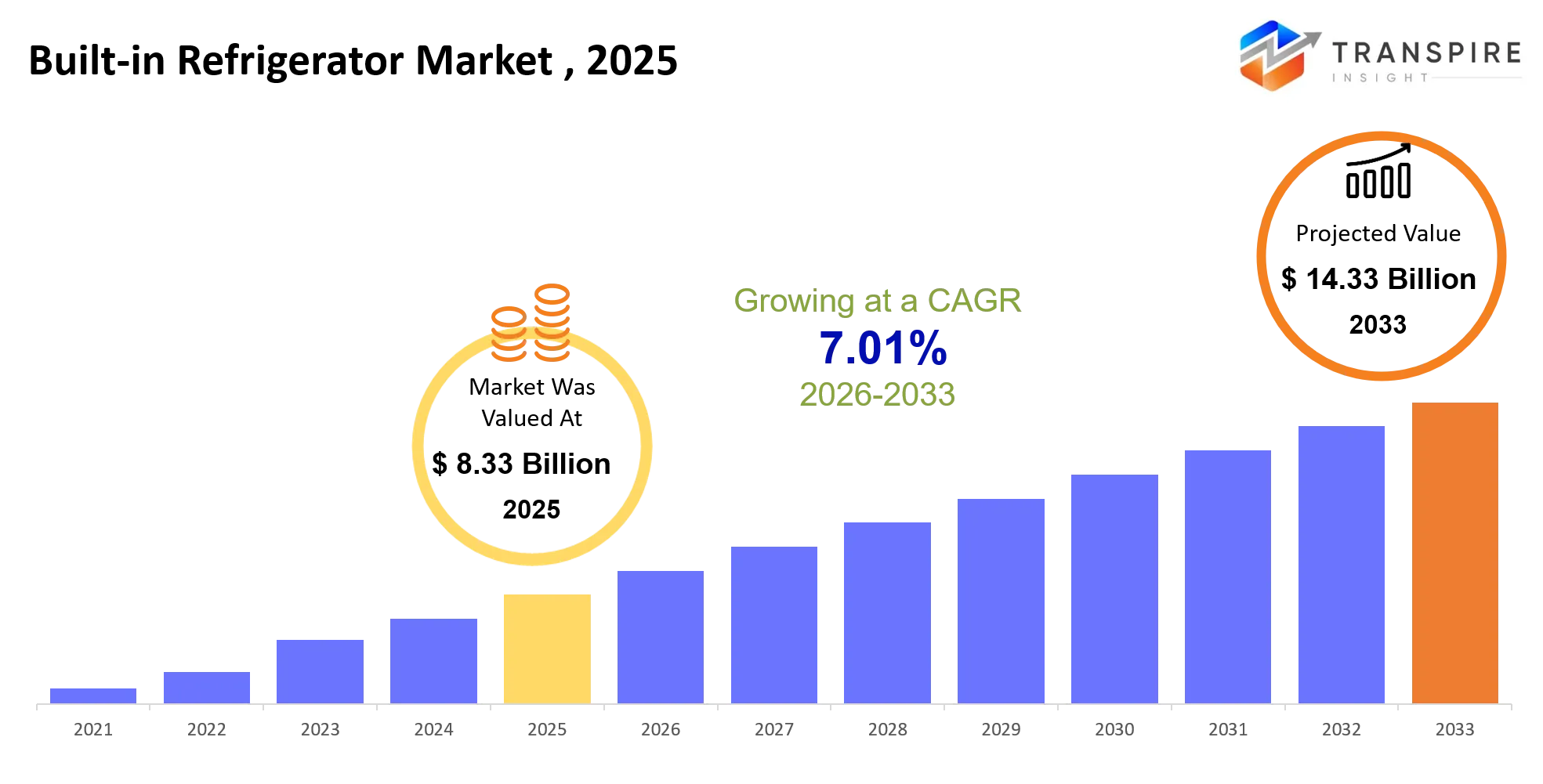
As per Transpire Insight Analysis, the Built-in Refrigerator Market size is estimated at USD 8.33 billion in 2025 and is anticipated to reach USD 14.33 billion by 2033, growing at a CAGR of 7.01% from 2026 to 2033.
The Built-in Refrigerator market around the world is changing as people who live in houses, those who build homes and businesses in the hotel industry are searching for cooling systems that fit well into today's kitchens without losing storage space or performance. In the past three to five years, companies that make refrigerators have focused more on designs that blend in, compressors that use inverter technology, controls that connect to the internet and better energy efficiency. A big change is happening where traditional cooling machines are being replaced with smaller models that match kitchen cabinets. Higher electricity bills and more people paying attention to how efficient appliances are have made companies work harder to improve cooling and cut down on wasted energy. The growth of high-end home kitchen makeovers and custom kitchen setups has also helped this change. New products that can tell what food is inside manage temperature smartly. Offering flexible storage shows how features are becoming something that sets brands apart. Because of this, companies are trying to sell to people who care about saving money over time, having nice looks and keeping food fresh for longer.
Built-in Refrigerator Market Size & Forecast
- Market Size 2025: USD 8.33 Billion
- Expected Market Value (2033): USD 14.33 Billion
- Forecast CAGR (2026–2033): 7.01%
- Leading Region in 2025: North America
- Fastest Growing Region: Asia Pacific
- Key Company Profiles: Whirlpool, Samsung Electronics, LG Electronics, Electrolux, Haier, Bosch, Siemens, Miele, Sub-Zero, Viking Range, Liebherr, Fisher & Paykel, GE Appliances, KitchenAid, Beko
Key Market Insights:
industry is moving towards this due to the increasing demand for modern kitchen designs and efficient cooling solutions.
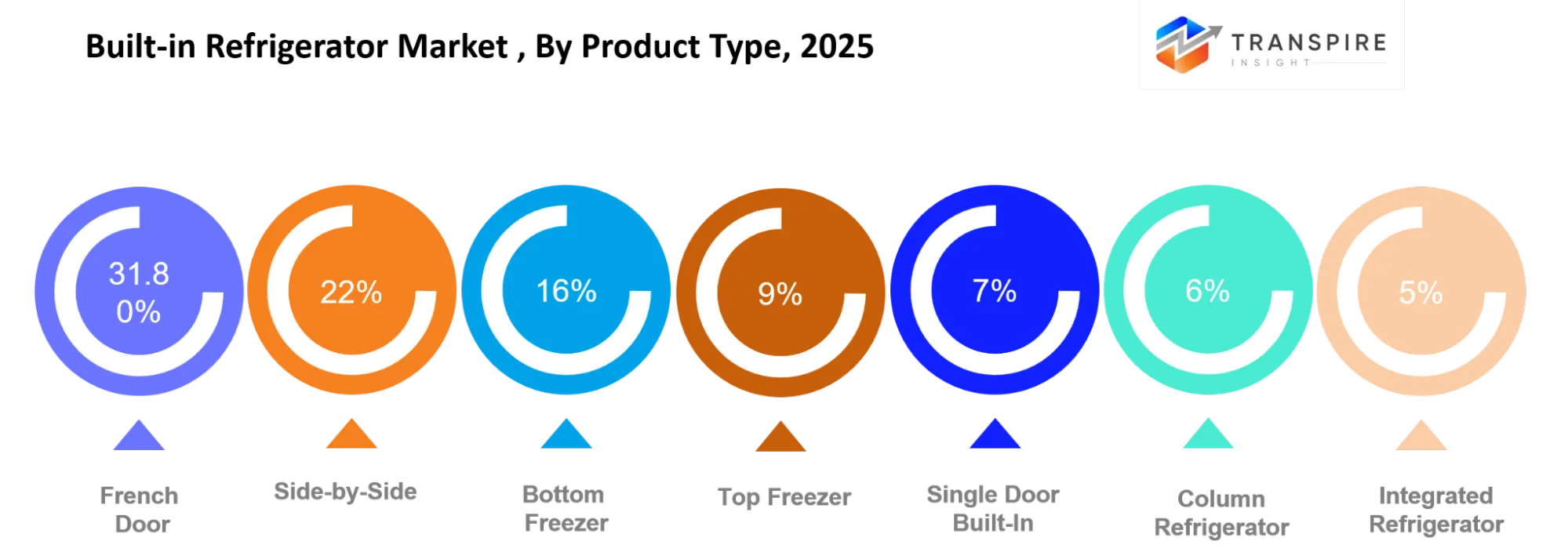
- The French door refrigerators make up 31.80% of the market share, owing to the need for larger storage capacity and easy access.
- Side-by-side refrigerators constitute 22.00% due to their design of different refrigerator and freezer compartments along with organised storage.
- Bottom freezer refrigerators represent 16.00%, and they meet the requirements of those who need fresh foods at their eye level.
- Single door built-in refrigerators account for 7.00%, and they suit places with lower storage space requirements.
- Column refrigerators represent 6.00%, and they offer flexible combinations for luxury kitchens.
- Integrated refrigerators account for 5.00% of market share, and these appliances serve for blending with cabinets.
- Under-counter refrigerators represent 3.20%, and they suit small kitchens as well as hotels and other supplementary applications.
What are the Key Drivers, Restraints, and Opportunities in the Built-in Refrigerator Market
Drivers
Modular kitchen demand, high-end housing and renovation activities are propelling demand for built-in refrigerators. Consumers like appliances that are designed to match the rest of the cabinetry and facilitate efficient storage and cooling. The proliferation of inverter compressors, flexible compartments and connected controls also enhances the attractiveness of high-end models. New construction and remodelling are advantageous occasions to purchase, as appliances can be matched to cabinets.
Restraints
High purchase and installation costs continue to be a barrier. Some built-in models require custom cabinetry, exact measurements, opening space, and professional installation. While these costs may put off a budget-conscious household considering replacing a non-built-in model that doesn't match the in-place cut-out, difficulties in sourcing servicing support for specialised styles may be another downside in markets where premium model servicing networks are less developed.
Opportunities
To reach more buyers, manufacturers could offer an increasing number of energy-efficient compressors, flexible installation options and connected cooling systems. Introducing models that have a high-end look with lower operating costs could also appeal to mid-range as well as luxury buyers. In Asia Pacific, the opportunity for growth is significant, as the development of urban housing, kitchen modernisation programmes and uptake of premium appliances take hold in selected markets. Collaborations with kitchen design specialists, home developers and appliance retailers may offer another opportunity for companies to increase product exposure and streamline the installation process.
|
Driver |
Relative Impact on Growth (%) |
Geographic Relevance |
Impact Timeline |
Demand Strength |
Growth Mechanism |
Key Beneficiaries |
Major Constraint |
|
Premium kitchen renovation and integrated interior design |
28% |
North America, Europe |
Short-term (≤2 years) |
High |
Renovations increase demand for seamless cabinetry-integrated refrigeration |
Appliance manufacturers, kitchen designers, premium retailers |
High purchase and installation costs limit adoption |
|
Rising disposable incomes and premium appliance adoption |
24% |
North America, Asia Pacific, Europe |
Medium-term (2–4 years) |
High |
Higher purchasing power supports premium refrigerator upgrades |
Premium brands, distributors, residential developers |
Economic uncertainty delays discretionary appliance purchases |
|
Energy efficiency and sustainability requirements |
20% |
Europe, North America, Asia Pacific |
Medium-term (2–4 years) |
High |
Efficient compressors reduce electricity consumption and operating costs |
Manufacturers, component suppliers, environmentally conscious consumers |
Advanced efficiency technologies increase manufacturing costs |
|
Smart refrigeration and connected appliance technologies |
16% |
North America, Asia Pacific, Europe |
Long-term (≥4 years) |
Medium |
Sensors and connectivity enable intelligent temperature and inventory management |
Smart appliance manufacturers, software vendors, connected-home providers |
Connectivity costs and privacy concerns restrict adoption |
|
Growth in luxury housing and premium residential construction |
12% |
North America, Asia Pacific, Middle East |
Long-term (≥4 years) |
Medium |
Luxury housing projects specify integrated premium refrigeration systems |
Appliance suppliers, property developers, kitchen contractors |
Construction slowdowns reduce premium housing demand |
|
Total |
100% |
— |
— |
— |
— |
— |
— |
What Has the Impact of Artificial Intelligence Been on the Built-in Refrigerator Market?
The artificial intelligence system is enabling the refrigerator makers in adopting adaptive cooling, energy management and food storage capabilities of the products. In certain models, sensors and the AI software could use data such as internal temperature, number of door openings and the amount of stored food to make adjustments during the cooling process, hence maintaining good storage environments without unnecessary use of the compressor. The connected control system enables consumers to monitor settings, alarms and manage chosen functions using mobile applications. Predictive features could enable anomaly detection in terms of temperature, maintenance alerts and detection of usage patterns that could pose any problems. Food recognition capabilities could help with keeping inventory as well as meal planning, and automated modes could adjust performance according to different usage patterns. The use of AI systems does not mean that each case could achieve reduced energy usage or efficient food storage. These would vary depending on the quality of sensors, software, product design and consumer behaviour patterns. Besides, the advanced components used could result in increased manufacturing cost as well as price at retailing stages, while the integration issue could arise because of connectivity.
Instance
In January 2026, the AI-powered Smart Refrigerator by GE Appliances. GE Profile launched its Smart 4-Door French-Door Refrigerator with Kitchen Assistant, which has an in-built scanner for creating shopping lists and making meal planning easy.
Key Market Trends:
The trend has started evolving from traditional refrigerators to those that integrate with the kitchen and have versatile functionality. More importance is being given to the practicality of digital features, energy efficiency, and designs that accommodate different home spaces.
- Energy management is becoming increasingly significant. Inverter compressors and adaptive cooling functions are receiving increasing attention as consumers consider running costs in addition to purchase costs.
- Kitchen styling is having an impact on product design. Seamless integration into cabinetry, matching finishes, and reduction in external detailing are becoming increasingly significant in high-end residential applications.
- Flexibility in storage solutions is being enhanced. Adjustable shelving, specialised storage compartments, and dedicated cooling zones enable manufacturers to cope with varying food storage requirements.
- Food management functions are developing. Some smart refrigerators even have food recognition, inventory management, and shopping list functions, but they vary by model.
- Higher-end product formats are becoming more varied. French door and column models offer alternatives for customers who require increased storage flexibility or a customised kitchen design.
- Retail and installation support are becoming increasingly significant. Manufacturers and retailers have an opportunity to streamline measurements, product selection, delivery, and installation.
Built-in Refrigerator Market Segmentation
By Product Type
French door refrigerators lead the supplied segmentation with a share of 31.80% as they have large interior capacity, easy access, and are suitable for upscale kitchens. Side-by-side refrigerators constitute 22.00%, bottom-freezer refrigerators make up 16.00%, top-freezer refrigerators consist of 9.00%, single-door built-ins amount to 7.00%, column refrigerators consist of 6.00%, integrated refrigerators account for 5.00%, and under-counter refrigerators make up 3.20%. The above products cater to varied requirements of storage, installation, and design needs. French door refrigerators have an advantage due to broader appeal among consumers, but column and under-counter refrigerators cater to niche requirements. Future competition will be based on usable volume, flexibility of installation, efficiency, and price.
By Capacity
Units sold in market Less than 200 L 200-300 L 301-400 L 401-500 L 501-600 L 601-700 L Above 700 L The supplied document does not provide the individual capacity shares therefore, it cannot be confirmed as to whether there is a dominant capacity. Whilst smaller-sized units can be suitable for small dwellings, offices and extra storage capacity, it is medium capacity ranges that meet everyday household needs. Larger sizes are of concern for family homes, as well as the high end of the market, where consumers require more capacity for fresh foods, frozen items and managed storage. Overall demand will be affected by household size, the size of the kitchen, energy ratings and available purchase budgets.
By Technology
In the market, appliances can operate in various ways. Conventional cooling, frost-free, inverter, multi-airflow, smart cooling, dual cooling, AI-enabled cooling. We see smart and inverter already as the fastest-growing trends in the market, with an 8.20% CAGR projected. Conventional cooling offers the simplicity of straightforward functionality, and smart and AI-enabled devices provide monitoring and automation in the kitchen. Ultimately, the real opportunity is to provide affordable, reliable and practical energy management.
By Application
Markets include residential, hospitality and dining, commercial kitchens, offices, institutional facilities, luxury housing developments. Residential applications are related to kitchen upgrading, new residence construction and integrated interior system demand. Hospitality and dining outlets may focus on storage management, reliability and product size to align with targeted kitchen designs. Institutions and offices may need small or specialised units to complement specific restrooms and/or facilities. Luxury residential may involve custom finishing and concept packaging; growth across markets will depend on installation needs, extent of use, purchase budget and service provision; application-specific shares were not provided.
By Distribution Channel
Products are sold via Specialty stores and Supermarkets and hypermarkets, Online Retail, Appliance retailers, Brand stores, Home Improvement stores, and direct sales. Speciality stores and brand stores can advise on product dimensions, finishes and technical features and can demonstrate products. Online retail can help consumers to compare products and is a convenient channel for the selection of built-in refrigerators, although they may need to be carefully measured and planned for fitting in advance. Online, combined with assured installation and after-sales services, has the potential to improve conversion rates. No separate indication of market shares per channel are available.
By Price Range
Included are economy, mid-range, premium, luxury, ultra-premium, custom built-in and professional-grade products. Lower-tier economy and mid-range will target consumers seeking integrated refrigeration with relatively few ultra-premium features. Ultra-premium and bespoke products serve unique interior specifications, custom projects and colour schemes. Professional models may suit demanding kitchen environments where volume capacity and operational reliability are paramount. Manufacturers offering multiple configurations, use of standard parts, flexible service agreements and range-wide pricing will be able to appeal to a greater customer base. Price tier shares were not detailed in the data presented.
What are the Key Use Cases Driving the Built-in Refrigerator Market?
French door refrigerators, use case are suitable for family kitchens where there would be need for storage of fresh food, large shelves, and compartments. Businesses involved in the hospitality industry, restaurants, or commercial kitchens would prefer built-in refrigeration where there would be planning of cabinetry, effective space usage, and coordination in the interior design of the place. Based on the environment, column and under-counter types could be used to ensure that storage is achieved without the unnecessary consumption of the available floor space. Potential use case scenarios include food management systems, use in entertainment zones at home, and built-in appliances in urban homes. The addition of smart features and inverter systems would make use even more convenient, while the construction of luxury homes would lead to coordinated appliance systems.
|
Report Metrics |
Details |
|
Market size value in 2025 |
USD 8.33 Billion |
|
Market size value in 2026 |
USD 8.92 Billion |
|
Revenue forecast in 2033 |
USD 14.33 Billion |
|
Growth rate |
CAGR of 7.01% from 2026 to 2033 |
|
Base year |
2025 |
|
Historical data |
2021 - 2024 |
|
Forecast period |
2026 - 2033 |
|
Report coverage |
Revenue forecast, competitive landscape, growth factors, and trends |
|
Regional scope |
United States; Canada; Mexico; United Kingdom; Germany; France; Italy; Spain; Denmark; Sweden; Norway; China; Japan; India; Australia; South Korea; Thailand; Brazil; Argentina; South Africa; Saudi Arabia; United Arab Emirates |
|
Key company profiled |
Whirlpool, Samsung Electronics, LG Electronics, Electrolux, Haier, Bosch, Siemens, Miele, Sub-Zero, Viking Range, Liebherr, Fisher & Paykel, GE Appliances, KitchenAid, Beko |
|
Customization scope |
Free report customization (country, regional & segment scope). Avail customized purchase options to meet your exact research needs. |
|
Report Segmentation |
Product Type (French Door, Side-by-Side, Bottom Freezer, Top Freezer, Single Door Built-In, Column Refrigerator, Integrated Refrigerator, Under-Counter Refrigerator); Capacity (<200 L, 200–300 L, 301–400 L, 401–500 L, 501–600 L, 601–700 L, >700 L); Technology (Conventional Cooling, Frost-Free, Inverter, Multi-Airflow, Smart Cooling, Dual Cooling, AI-Enabled Cooling); Application (Residential, Hospitality, Restaurants, Commercial Kitchens, Offices, Institutional, Luxury Housing); Distribution Channel (Specialty Stores, Supermarkets & Hypermarkets, Online Retail, Appliance Dealers, Brand Stores, Home Improvement Stores, Direct Sales); Price Range (Economy, Mid-Range, Premium, Luxury, Ultra-Premium, Custom Built-In, Professional Grade) |
Which Regions are Driving the Built-in Refrigerator MarketGrowth?
North America
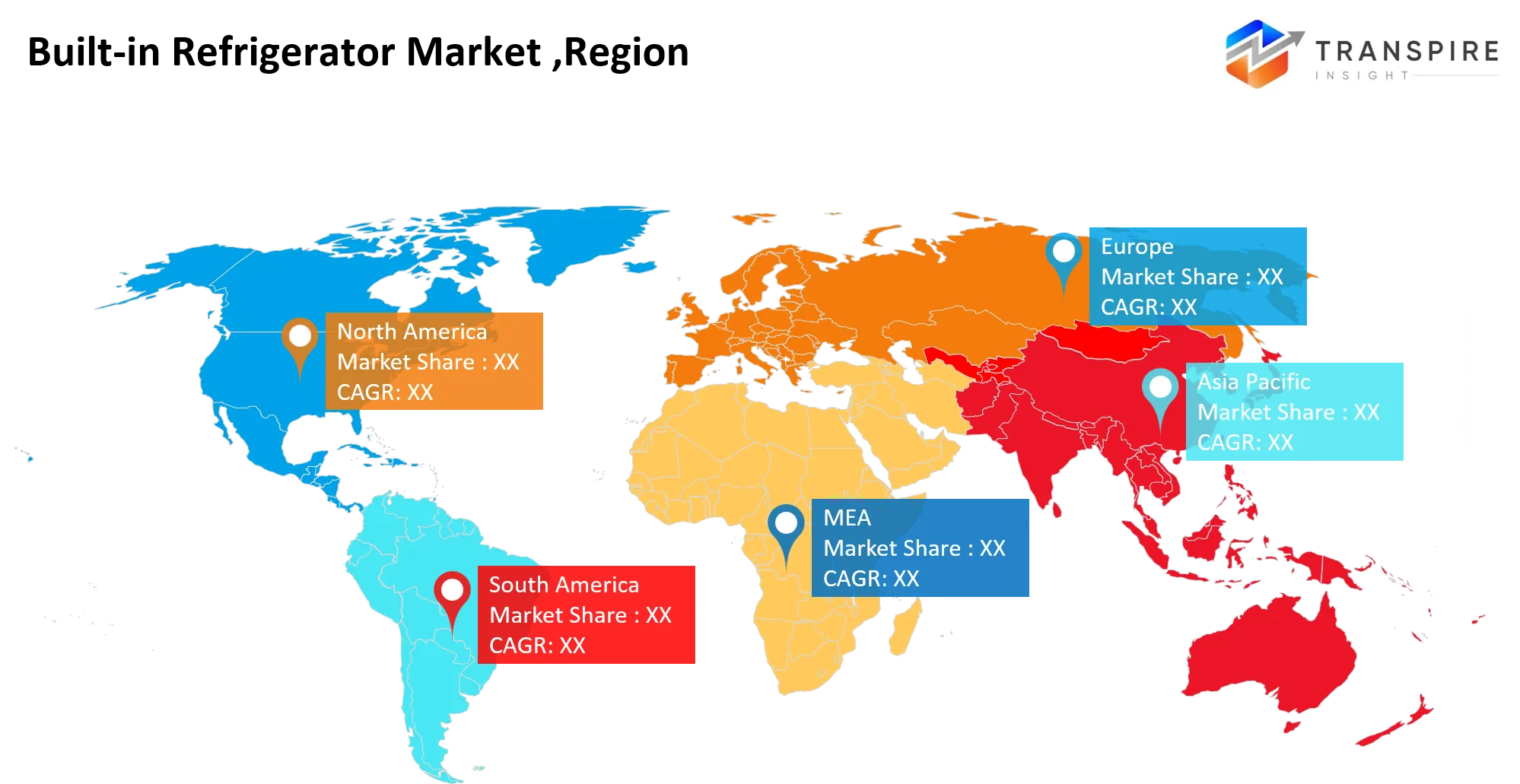
North America accounts for the largest share, constituting 34.60% due to the presence of well-established premium appliance sales channels and existing residential renovation trends and consumer experience with larger refrigerator sizes. The demand for built-in models that combine in-storage convenience with matching interiors is driven by kitchen remodelling projects. Retailer networks, professional installation services, and a well-established appliance servicing infrastructure are also contributing to product adoption. The demand will ultimately depend on housing activity, replacement rates, and consumer willingness to pay for higher-end features.
In February 2026, Whirlpool launches a refrigerator with an integrated nugget ice maker. Whirlpool has launched a refrigerator with an integrated nugget ice maker before the Kitchen and Bath Industry Show (KBIS) 2026. Such a development indicates manufacturers' attempts to incorporate additional useful features in home refrigerators, thus satisfying the demand for premium and feature-filled refrigerators in North America.
Europe
Europe represents 31.00% of the market, which is underpinned by the traditional kitchen, the emergence of built-in cabinets, as well as a preference for efficient appliances. The selection of products in Europe resembles that in North America, with a specific focus on kitchen sizes, built-in cabinets, as well as energy efficiency. Existing supply channels, as well as brand relations, ensure stability.
In April 2026,LG Electronics expands its built-in kitchen appliance range at EuroCucina 2026. LG has launched its LG Built-in package that consists of refrigerators, ovens, induction cooktops and dishwashers. The range of refrigerators includes energy-saving technology, large capacity and integration with the kitchen interior. Such a development demonstrates manufacturers' concerns about energy performance, space efficiency and integrated kitchen interiors in Europe.
https://lgcorp.com/media/release/30075
Asia Pacific
Asia Pacific accounts for 25.00% of the supplied market and has the highest growth rate of 7.10% CAGR. Urban housing development, rising luxury property markets and improvements in kitchen design trends are driving interest in integrated refrigeration, while suppliers are developing connected features and higher-capacity formats to meet consumer demand; how far this translates into sales will depend on how prevalent these products will be in different countries and consumer segments. Partnering with property developers, kitchen designers and appliance retailers could facilitate further growth.
In June 2025,Liebherr Appliances India launches its first Made-in-India fully integrated refrigerators. Liebherr Appliances India has launched fully integrated refrigerators, freezers and combination units produced in India. The development is associated with the extension of locally produced premium refrigeration products and may be helpful for the adoption of integrated appliances by consumers.
Who are the Key Players in the Built-in Refrigerator Marketand how do they compete?
The Competition in the Built-in Refrigerator Market involves firms that distinguish themselves through their portfolios of design, cooling technology, energy management, connectivity, and distribution. Some of the firms worth consideration include BSH Home Appliances, LG Electronics, Samsung Electronics, Electrolux Group, Whirlpool Corporation, and GE Appliances. The portfolios of these firms have a wide range of products in terms of prices and type of refrigerators as well as varying presence across the globe and built-in refrigerators. BSH competes with its portfolio of appliances, which is made up of Bosch and Siemens appliances that focus on integrated installation and cooling technologies. GE Appliances compete with differentiated design and functionalities of its refrigerators, while Whirlpool competes with its established refrigeration products and innovations. Electrolux Group competes with its portfolio of kitchen appliances and designs. Collaboration with retailers, demonstrations of the products, relations with kitchen designers, and quality installation services are some of the means by which firms could increase market access.
Built-in Refrigerator Marketcompanies
- Whirlpool
- Samsung Electronics
- LG Electronics
- Electrolux
- Haier
- Bosch
- Siemens
- Miele
- Sub-Zero
- Viking Range
- Liebherr
- Fisher & Paykel
- GE Appliances
- KitchenAid
- Beko
|
Company |
Est. Revenue Share Range |
Key Offerings |
Strategic Positioning |
Geographic Strength |
Technology Focus |
|
Bosch Home Appliances |
Estimated 5–8% |
Integrated refrigerators, built-in fridge-freezers, VitaFresh models, NoFrost appliances |
Engineering-led differentiation across premium and mid-premium segments |
Europe, North America, Asia Pacific |
VitaFresh preservation, NoFrost cooling, energy-efficient compressors |
|
Whirlpool Corporation |
Estimated 4–7% |
Built-in refrigerators, integrated fridge-freezers, under-counter refrigeration, KitchenAid built-in models |
Broad appliance portfolio supported by established retail distribution |
North America, Europe, Latin America |
Adaptive cooling, temperature management, energy-efficient refrigeration |
|
Electrolux Group |
Estimated 3–6% |
Integrated refrigerators, built-in fridge-freezers, under-counter units, premium European models |
Design-led differentiation with strong European appliance integration |
Europe, North America, Asia Pacific |
MultiFlow cooling, humidity management, precision temperature control |
|
Samsung Electronics |
Estimated 3–6% |
Built-in refrigerators, integrated fridge-freezers, Bespoke refrigeration, connected premium models |
Smart-home differentiation combined with contemporary kitchen design |
Asia Pacific, North America, Europe |
SmartThings connectivity, AI-enabled features, intelligent cooling |
|
LG Electronics |
Estimated 2–5% |
Built-in refrigerators, integrated fridge-freezers, premium built-in refrigeration, connected models |
Technology-led differentiation emphasizing convenience and reliability |
Asia Pacific, North America, Europe |
Inverter compressors, ThinQ connectivity, advanced cooling systems |
|
Haier Group |
Estimated 2–5% |
Integrated refrigerators, built-in fridge-freezers, premium built-in appliances, compact refrigeration |
Multi-brand portfolio targeting different price and premium segments |
Asia Pacific, Europe, North America |
Variable-speed compressors, freshness management, connected controls |
|
Siemens Home Appliances |
Estimated 2–5% |
Integrated refrigerators, built-in fridge-freezers, pr |
|||
|
Bosch Home Appliances |
Estimated 5–8% |
Integrated refrigerators, built-in fridge-freezers, VitaFresh models, NoFrost appliances |
Engineering-led differentiation across premium and mid-premium segments |
Europe, North America, Asia Pacific |
VitaFresh preservation, NoFrost cooling, energy-efficient compressors |
|
Whirlpool Corporation |
Estimated 4–7% |
Built-in refrigerators, integrated fridge-freezers, under-counter refrigeration, KitchenAid built-in models |
Broad appliance portfolio supported by established retail distribution |
North America, Europe, Latin America |
Adaptive cooling, temperature management, energy-efficient refrigeration |
|
Electrolux Group |
Estimated 3–6% |
Integrated refrigerators, built-in fridge-freezers, under-counter units, premium European models |
Design-led differentiation with strong European appliance integration |
Europe, North America, Asia Pacific |
MultiFlow cooling, humidity management, precision temperature control |
Recent Development News
In April 2026, LG launched a suite of built-in kitchen appliances. LG unveiled its built-in kitchen range, including refrigerators, ovens, induction stoves, and dishwashers at EuroCucina 2026. This is an indication of its efforts to strengthen its proposition around the integrated kitchen and focus on efficiency, space-saving, and connectivity.
https://lgcorp.com/media/release/30034
In December 2025, Samsung launches improved AI Vision. Samsung made an announcement of its plans to launch the latest version of its Bespoke AI fridge at CES 2026, which will be powered by AI Vision developed in collaboration with Google Gemini. This is indicative of the trend of increased automation in kitchen management.
https://news.samsung.com/in/samsung-to-unveil-ai-vision-built-with-google-gemini-at-ces-2026
What Strategic Insights Define the Future of the Built-in Refrigerator Market?
The built-in refrigerator market is moving toward providing built-in fridge units that incorporate kitchen integration, flexibility in storage options and efficient cooling. French door refrigerators have the best product positioning; however, the trend toward technologically advanced and inverter refrigerators shows increasing significance of technological differentiators. Product development should concentrate on functionality and not on the introduction of new expensive features without any customer value addition. The hidden risk lies in the disparity between the pricing of premium products and total cost of their installation. Customised cabinets, installation and servicing may turn out to be a hindrance in buying, especially in developing countries. Firms that ignore these costs will face problems converting consumer interest into sales. The opportunity that arises is Asia Pacific region, where supplied r. Companies can improve their positions by collaborating with property developers, kitchen designers and appliance retailers. The right way to do this is through efficient cooling, flexibility in sizes, and transparent costs of installation and servicing.
Product Type
- French Door
- Side-by-Side
- Bottom Freezer
- Top Freezer
- Single Door Built-In
- Column Refrigerator
- Integrated Refrigerator
- Under-Counter Refrigerator
Capacity
- Less than 200 L
- 200–300 L
- 301–400 L
- 401–500 L
- 501–600 L
- 601–700 L
- More than 700 L
Technology
- Conventional Cooling
- Frost-Free
- Inverter
- Multi-Airflow
- Smart Cooling
- Dual Cooling
- AI-Enabled Cooling
Application
- Residential
- Hospitality
- Restaurants
- Commercial Kitchens
- Offices
- Institutional
- Luxury Housing
Distribution Channel
- Specialty Stores
- Supermarkets & Hypermarkets
- Online Retail
- Appliance Dealers
- Brand Stores
- Home Improvement Stores
- Direct Sales
Price Range
- Economy
- Mid-Range
- Premium
- Luxury
- Ultra-Premium
- Custom Built-In
- Professional Grade
Frequently Asked Questions
Find quick answers to common questions.
The built-in refrigerator market size was valued at USD 8.33 billion in 2025 and is poised to reach USD 14.33 billion by 2033, expanding at a7.01% CAGR.
Key segments for the built-in refrigerator market are Product Type (French Door, Side-by-Side, Bottom Freezer, Top Freezer, Single Door Built-In, Column Refrigerator, Integrated Refrigerator, Under-Counter Refrigerator); Capacity (<200 L, 200–300 L, 301–400 L, 401–500 L, 501–600 L, 601–700 L, >700 L); Technology (Conventional Cooling, Frost-Free, Inverter, Multi-Airflow, Smart Cooling, Dual Cooling, AI-Enabled Cooling); Application (Residential, Hospitality, Restaurants, Commercial Kitchens, Offices, Institutional, Luxury Housing); Distribution Channel (Specialty Stores, Supermarkets & Hypermarkets, Online Retail, Appliance Dealers, Brand Stores, Home Improvement Stores, Direct Sales); Price Range (Economy, Mid-Range, Premium, Luxury, Ultra-Premium, Custom Built-In, Professional Grade)
Growth is primarily driven by increasing home renovation activities, growing disposable incomes, preference for premium and space-saving appliances, and the adoption of smart and energy-efficient refrigerators
The market is led by major manufacturers including Whirlpool, Samsung Electronics, LG Electronics, Electrolux, Haier, Bosch, Siemens, Miele, Sub-Zero, Viking Range, Liebherr, Fisher & Paykel, GE Appliances, KitchenAid, Beko
North America accounts for 34.60% of the built-in refrigerator market, driven by factors like consumer buying power, the popularity of premium kitchen appliances, smart homes, and preference for energy-efficient and space-saving refrigerators.
- Whirlpool
- Samsung Electronics
- LG Electronics
- Electrolux
- Haier
- Bosch
- Siemens
- Miele
- Sub-Zero
- Viking Range
- Liebherr
- Fisher & Paykel
- GE Appliances
- KitchenAid
- Beko
About the Authors

Chetan Dhatrak
I’m Chetan Dhatrak, a Senior Research Analyst at Transpire Insight, specializing in the Consumer Goods, Foods and Beverages industry. I focus on analyzing market trends, consumer behavior, competitive landscapes, and industry developments to deliver accurate, data-driven insights. My research at Transpire Insight is built on credible sources and in-depth analysis, helping businesses and readers better understand market dynamics, emerging opportunities, and evolving consumer preferences. I’m committed to creating reliable, well-researched content that supports informed decision-making and reflects the latest developments in the consumer goods and food & beverage sectors.

Chakradhar Khansole
Chakradhar serves as the Research Director at Transpire Insight, bringing over 8 years of experience in technology, innovation, and strategic market intelligence. He specializes in transforming complex market data into actionable business insights that enable organizations to make informed, growth-oriented decisions. Recognized for his strategic vision and analytical expertise, Chakradhar leads high-impact research initiatives, delivering comprehensive market assessments, competitive intelligence, and forward-looking industry analysis.
Recently Published Reports
-
Apr 2026
Bottled Water Market
Bottled Water Market Size, Share & Analysis Report By Product Type (Still Bottled Water, Carbonated Bottled Water, Functional Bottled Water, and Others), By Packaging (PET, Cans, and Others), By Sales Channel (Supermarkets/Hypermarkets, Convenience Stores/Drug Stores, Grocery Stores/Club Stores, Foodservice, and Others) and Geography (North America, Europe, Asia-Pacific, Middle East and Africa, South and Central America), 2021 - 2032
-
Apr 2026
Color Cosmetic Packaging Market
Color Cosmetic Packaging Market Size, Share & Analysis Report By Application (Mascara Packaging, Liquid Packaging, and Liquid Face), By Type (Tubes & Bottles, Pens & Markers, Compacts & Containers, and Droppers & Pumps), and Geography (North America, Europe, Asia-Pacific, Middle East and Africa, South and Central America), 2021 - 2031
-
Apr 2026
External Microphone For Camera Market
External Microphone For Camera Market Size, Share & Analysis Report By Type (Shotgun Microphone, Lavalier Microphone, and Others), By Application (Digital Camera, Professional Video Camera, and Others), and Geography (North America, Europe, Asia-Pacific, Middle East and Africa, South and Central America), 2021 - 2031
-
Apr 2026
Foot Orthotic Insoles Market
Foot Orthotic Insoles Market Size, Share & Analysis Report By Type (Pre-fabricated, and Custom-made), By Material (Thermoplastic, Composite Carbon Fiber, and Others), By Distribution Channel (Drug Stores, Hospitals & Clinics, and Others), and Geography (North America, Europe, Asia-Pacific, Middle East and Africa, South and Central America), 2021 - 2031