

Behavioral Health EHR Market Summary:
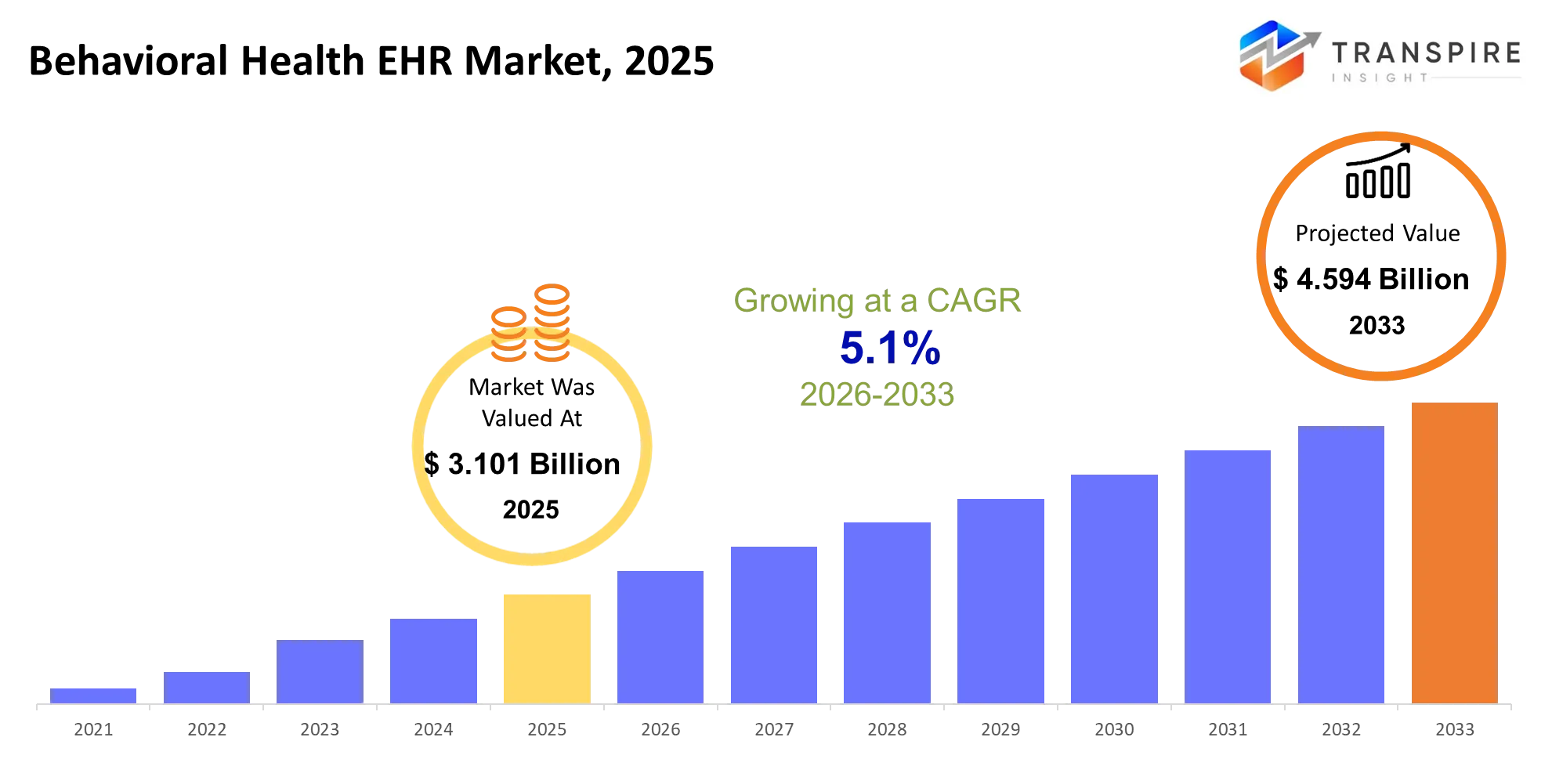
As per Transpire Insight, the Behavioural Health EHR Market size is estimated at USD 3.101 billion in 2025 and is anticipated to reach USD 4.594 billion by 2033, growing at a CAGR of 5.1% from 2026 to 2033.
The behavioural health electronic health records market is changing. Mental health clinics, psychiatric hospitals, addiction treatment centres, and individual doctors are replacing separate records and tools with digital systems that work together. These systems help health care workers keep track of histories, make treatment plans, schedule visits, handle prescriptions and manage billing all in one place. In the three to five years using the cloud adding telehealth features and having automatic writing of notes have become more important when buying these systems. A big change is the move to care, where mental health services work with regular doctors and other medical services. Not enough workers and more tasks to do have made this change stronger. Alaska Behavioural Health chose Netsmart’s CareFabric platform and myAvatar EHR in 11 places to help with care. As the number of health care providers grows, the need for software that can grow with them, help with setup and connect the ways doctors work is creating chances for companies in the market.
Behavioral Health EHR Market Size & Forecast:
- Market Size 2025: USD 3.101 Billion
- Expected Market Value (2033): USD 4.594 Billion
- Forecast CAGR (2026–2033): 5.1%
- Leading Region in 2025: North America
- Fastest Growing Region: Asia Pacific
- Key Company Profiles: Oracle Health, Epic Systems, Netsmart, Qualifacts, Core Solutions, Valant, AdvancedMD, Credible, Qualifacts CareLogic, NextGen Healthcare, athenahealth, Tebra, Raintree Systems, Kipu Health, Foothold Technology
Key Market Insights:
Adoption of behavioural health EHR has become more defined by the need for integration of clinical record-keeping, patient management, and finances under one platform. Software is the most prevalent part of the provided market analysis statistics, with deployment in cloud and AI-assisted processes also presenting an opportunity.
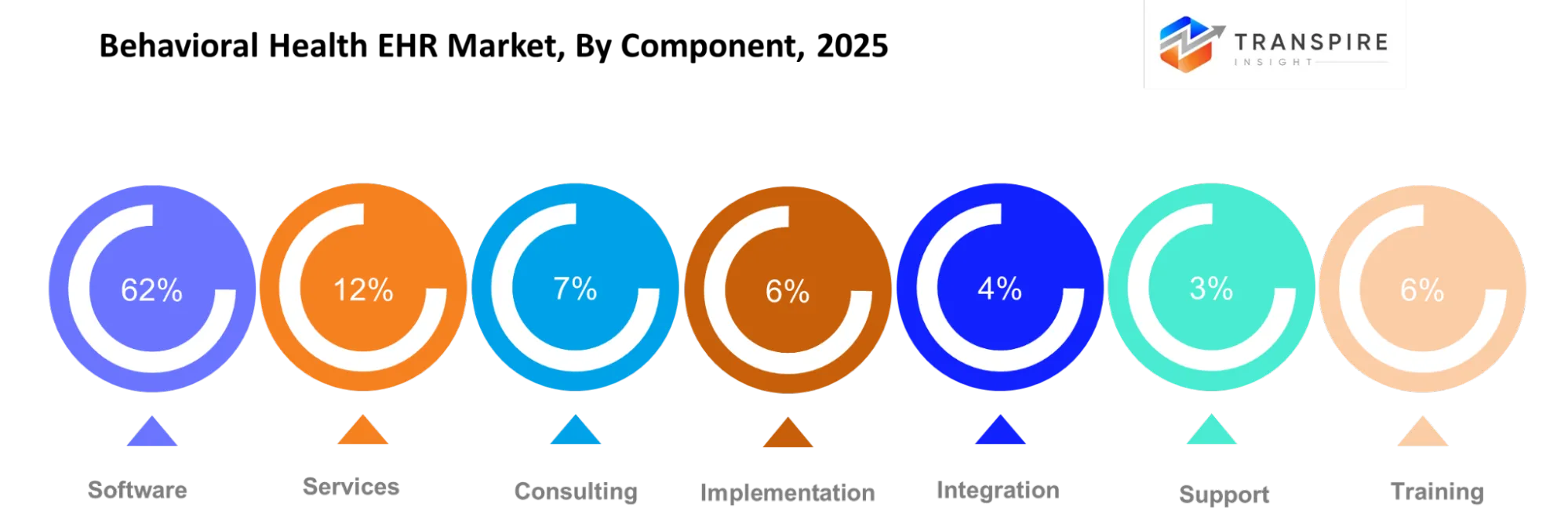
- Software comprises 62.4% of the supplied component segmentation due to the vital role played by software in documentation, treatment plan development, scheduling, and record keeping.
- Consulting is made up of 7.0% of the component, where there are opportunities available for companies which help the providers to choose a platform, change workflows, and go digital.
- Implementation covers 6.0% of the component segmentation, and it entails how much effort is required in order to configure the EHR platforms in different care setting.
- Integration makes up 4.5% of the components and it is where connections between clinical applications, billing, scheduling, and telemedicine are able to reduce workflow fragmentation.
- Support makes up 3.5% while maintenance makes up 2.1%, and this is still important even after implementation since the providers require the reliability of the system.
- Training holds 2.0% of the component segmentation.
What are the Key Drivers, Restraints, and Opportunities in the Behavioral Health EHR Market?
Drivers:
The market is the drive for behavioral health integration in outpatient facilities, psychiatric institutions, and addiction treatment centres. Behavioural health clinicians keep intricate records of evaluations, progress notes, medication management, and reimbursement forms. These are costly to manage within disjoined systems. The increase in integrated care delivery programs has also resulted in money going into linking clinical workflow with administrative workflow.
Restraints:
The cost of implementation, along with the transition from older systems, training of employees and incompatibility between different electronic health systems, can be barriers that can delay decisions to purchase. It can be difficult for smaller practices to raise the required capital, and the private details of patients have to be kept safe from any other party and from any cyber attacks. This is an ongoing issue because providers will have to keep up with the quality of services while implementing changes.
Opportunities:
Cloud-based solutions, AI-powered documentation and billing solutions have the potential to reduce the burden on back office work. There could be opportunities for vendors in unserved Asia Pacific regions as the digital health infrastructure of the region continues to develop. Solutions with flexible pricing models, regional compliance, multi-language support and secure data migration could be favoured by smaller practices and new networks.
|
Driver |
Relative Impact on Growth (%) |
Geographic Relevance |
Impact Timeline |
Demand Strength |
Growth Mechanism |
Key Beneficiaries |
Major Constraint |
|
Rising Mental Health and Substance Use Disorders |
28% |
North America, Europe, Asia-Pacific |
Long-term (≥4 years) |
High |
Expanding patient volumes increase demand for specialized digital clinical records. |
Behavioral health clinics, EHR vendors, psychiatric hospitals, addiction treatment centers |
Budget limitations and shortages of qualified mental health professionals. |
|
Cloud-Based EHR Adoption and Digital Transformation |
23% |
North America, Europe, Asia-Pacific |
Medium-term (2–4 years) |
High |
Subscription platforms reduce infrastructure costs and simplify system deployment. |
Cloud providers, software developers, private practices, community mental health centers |
Cybersecurity risks and limited digital infrastructure in underserved regions. |
|
Integration of Behavioral and Physical Healthcare Records |
20% |
North America, Europe |
Medium-term (2–4 years) |
High |
Interoperable records improve coordination across multidisciplinary healthcare teams. |
EHR vendors, hospitals, integrated care networks, healthcare technology providers |
Legacy system incompatibility and complex cross-platform data integration. |
|
Government Regulations and Healthcare IT Investment |
17% |
North America, Europe |
Short-term (≤2 years) |
High |
Interoperability requirements and funding encourage compliant EHR implementation. |
Certified EHR vendors, healthcare providers, public health systems, IT consultants |
Compliance costs and uncertainty surrounding funding availability. |
|
AI-Enabled Clinical Documentation and Workflow Automation |
12% |
North America, Europe, Asia-Pacific |
Medium-term (2–4 years) |
Medium |
AI-assisted documentation reduces administrative workload and supports clinical workflows. |
AI software vendors, EHR developers, clinicians, behavioral health organizations |
Data privacy concerns and unreliable AI-generated clinical documentation. |
What Has the Impact of Artificial Intelligence Been on the Behavioural Health EHR Market?
Artificial intelligence is transforming the behavioural health EHR market through its role in assisting with documentation management, patient data retrieval, and the organisation of routine clinical and administrative processes. Note-taking through AI assistance can automate the process of converting clinicians' sessions' approved information into structured note drafts, which takes time away from record preparation. Another aspect of development through this innovation may be represented through its predictive capabilities. With the help of analysed symptoms, treatment, appointments, and other necessary information, appropriate AI technology could provide outputs to notify the team of changes that need attention. The above can serve a supportive purpose for clinical evaluation, but at no moment should it take over the work of professionals, thus affecting patients' treatment plans; there are restrictions associated with implementation. For one, AI innovations can increase the cost of software and demand integration. Moreover, incorrect transcriptions, lack of adequate clinical context, bias, and privacy concerns might affect reliability.
Instance:
In July 2026, Qualifacts rolled out new generative and agentic AI features into its Qualifacts iQ EHR suite. These improvements enable the automation of clinical documentation based on patient data, diagnoses, prescriptions, and treatment goals. At the same time, AI-driven billing and analytics tools make administrative tasks easier and help identify clinical trends. It shows how AI is helping to improve the efficiency of behavioural health EHR platforms by minimising documentation burden and providing clinicians with access to patient data.
Key Market Trends:
The development of behavioral health EHRs is moving from simple electronic documentation to systems that are interconnected and can assist in clinical decision-making and operations.
- The shift is from a completely manual note-taking process to an AI-driven and structured note-taking process reviewed by clinicians.
- Intake, assessment, treatment planning, follow-up and discharge processes are being integrated to minimise duplicate data entry.
- Providers are increasingly seeing the benefits of secure information exchange within behavioural health and the larger healthcare system.
- Vendors are improving their browser-based platforms to facilitate ease of updates and support distributed teams.
- Behavioural, primary care, and substance abuse treatment programs are all being integrated into one system.
- Rather than creating separate solutions to solve these challenges, vendors are now building intelligence into documentation, reporting, and workflow processes.
- The dashboards and reporting functionalities allow administrators to view caseloads, services delivered, bottlenecks in operations, and organisational performance.
Behavioral Health EHR Market Segmentation
By component:
The leading position among all other components of the delivered component belongs to software, which takes 62.4% of the market. Services have 12.5%, consulting 7.0%, implementation 6.0%, integration 4.5%, support 3.5%, maintenance 2.1%, and training 2.0%. These components will be used for system installation, customisation, preparing the staff, and improving system performance. Software will continue to play an important role in purchase decision-making, whereas services will get the opportunity to capitalize on companies’ needs in deployment and workflow optimisation.
By deployment:
Cloud-Based EHR is the fastest-growing segment of deployment, with a supplied CAGR of 13.8%. Cloud systems provide access across sites for authorised users and ease of upgrades to the software and the infrastructure and may continue to be attractive for some organisations in need of local infrastructure control, but hybrid, SaaS, hosted, private-cloud, and public-cloud configurations will be required for organisations with particular operational and security needs. Future market adoption will be driven by cost, integration, data safety, and access.
By function:
The functionalities are clinical documentation and patient management, scheduling and billing, electronic prescribing, telehealth, care coordination, and analytics. Clinical documentation and patient management are basically the very essence of what providers do every day, and the scheduling and billing functionality assists a provider practice to function well. Telehealth and care coordination are necessary in cases where the patients are undergoing treatment across different locations. The analytics bucket gives administrators insights into workloads, utilisation, and efficiency of the processes. One that can combine all these functions in a single interface would be best positioned to develop a care network
By end user:
Functionality requirements will also differ between these settings. Long-term psychiatric hospitals, large community health centres, and residential treatment centres will probably require advanced access controls, multi-disciplinary tracking, and reporting. Community clinics will be more interested in the ability to enable light case management and compliance documentation. Private practices will need the basics of scheduling, note capturing, and billing. And residential and addiction treatment centres will value workflows that are customizable to your treatment program and medication management workflows. Flexibility in a product becomes more important as the size of provider staff, volume, and program complexity.
By patient type:
The market in this area is large, including mental health, drug and alcohol abuse, eating disorders, autism, behaviour disorders, paediatric behavioural care, elder behavioural care. Each of these has varying needs for record keeping and communication. The substance use clinician may have comprehensive assessment and treatment plans, whereas paediatrics will need contact with other clinicians, parents and carers, and elder care might be part of a broader range of medical services. An EHR that can cater for specialised workflows but still meet general needs is useful in a broader range of clinical settings.
By organization size:
Buying Factors for Large Networks and Small Vendors. Large networks require more scalability in terms of load, role-based security, multiple location reporting, and integration with other applications. The mid-range vendors have their own factors for purchase like cost of operation being low and installation fees being consistent. Small firms prefer easy-to-use interfaces and monthly subscription costs being low. Governments and academic institutions may have additional reporting or research requirements or procurement systems. Modular products and flexible pricing and migration can be provided by vendors to meet these requirements.
What are the Key Use Cases Driving the Behavioral Health EHR Market?
A use case would be digital documentation in the form of software illustrated in the data. Extended use cases can include telemedicine documentation, e-prescription, coordination of care and full records for treatment of addiction and public health. This would involve integrating of the clinical workflow processes with the administrative process in multiple locations such as behavioural clinics, psychiatric hospitals, and individual practices where EHRs are used to document history and assessment, plan treatment, schedule appointments, and billings. Other use cases which could prove useful would be automated creation of notes, clinical workflow automation, and analytics which would provide information for clinical reviews. However, these would need human intervention and proper safeguards.
|
Report Metrics |
Details |
|
Market size value in 2025 |
USD 3.101 Billion |
|
Market size value in 2026 |
USD 3.259 Billion |
|
Revenue forecast in 2033 |
USD 4.594 Billion |
|
Growth rate |
CAGR of 5.1% from 2026 to 2033 |
|
Base year |
2025 |
|
Historical data |
2021 - 2024 |
|
Forecast period |
2026 - 2033 |
|
Report coverage |
Revenue forecast, competitive landscape, growth factors, and trends |
|
Regional scope |
United States; Canada; Mexico; United Kingdom; Germany; France; Italy; Spain; Denmark; Sweden; Norway; China; Japan; India; Australia; South Korea; Thailand; Brazil; Argentina; South Africa; Saudi Arabia; United Arab Emirates |
|
Key company profiled |
Oracle Health, Epic Systems, Netsmart, Qualifacts, Core Solutions, Valant, AdvancedMD, Credible, Qualifacts CareLogic, NextGen Healthcare, athenahealth, Tebra, Raintree Systems, Kipu Health, Foothold Technology |
|
Customization scope |
Free report customization (country, regional & segment scope). Avail customized purchase options to meet your exact research needs. |
|
Report Segmentation |
Component (Software, Services, Consulting, Implementation, Integration, Support, Training, Maintenance)Deployment (Cloud-Based, On-Premise, Hybrid, SaaS, Hosted, Private Cloud, Public Cloud, Others)Function (Clinical Documentation, Patient Management, Scheduling, Billing, e-Prescribing, Telehealth, Care Coordination, Analytics)End User (Psychiatric Hospitals, Behavioral Health Clinics, Community Health Centers, Private Practices, Addiction Treatment Centers, Residential Facilities, Government Facilities, Others)Patient Type (Mental Health, Substance Abuse, Eating Disorders, Autism Spectrum, Behavioral Disorders, Geriatric Behavioral Care, Pediatric Behavioral Care, Others)Organization Size (Large Organizations, Mid-Sized Organizations, Small Practices, Hospital Networks, Government Systems, Academic Centers, Integrated Health Systems, Others) |
Which Regions are Driving the Behavioral Health EHR Market Growth?
North America:
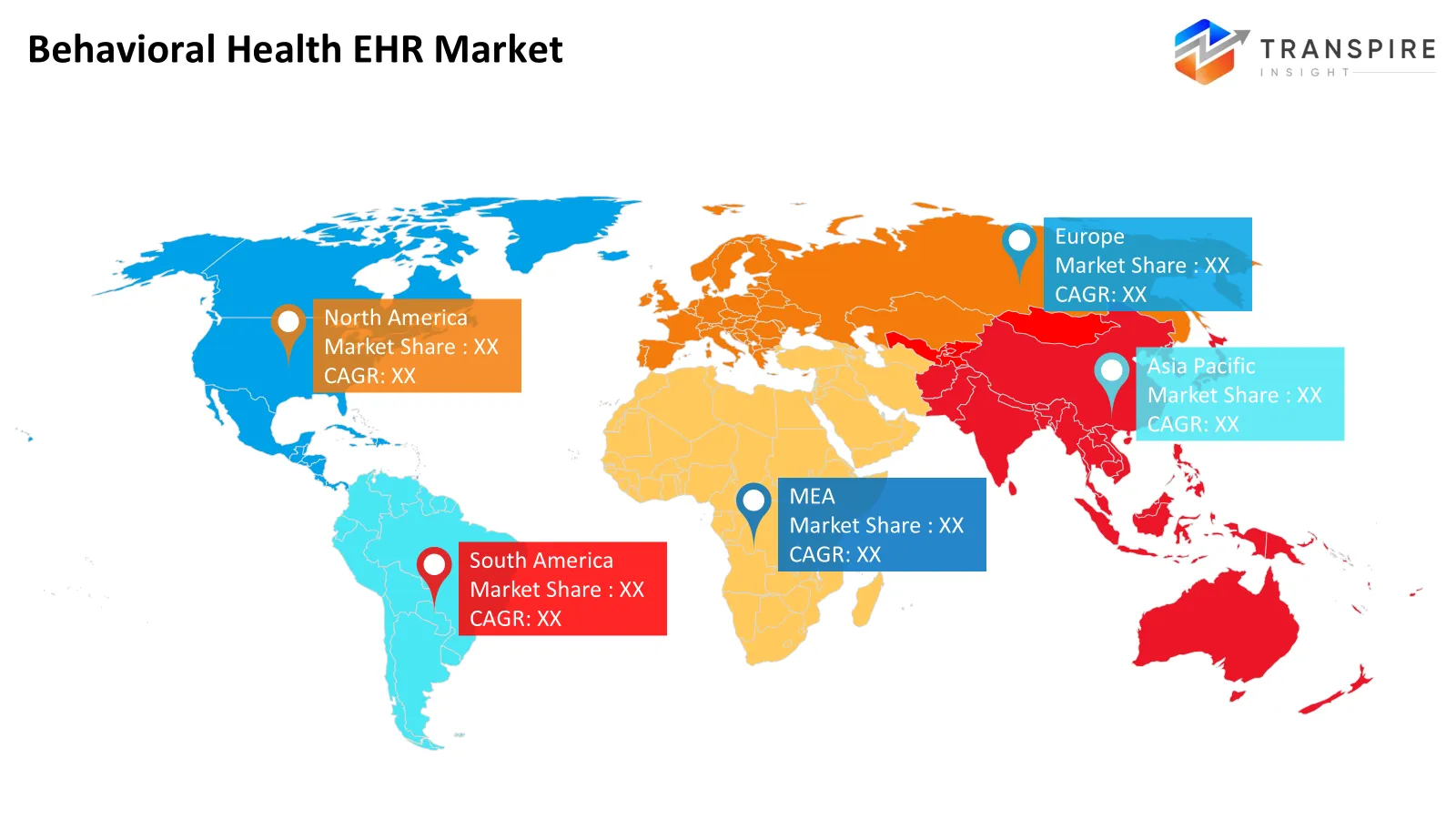
North America leads the regional segmentation offered with a share of 67.5%, owing to the presence of a mature healthcare IT ecosystem and familiarity with electronic records. Behavioural health clinics, psychiatric centres, and drug abuse centres require a platform that can integrate clinical documentation, billing, reporting, and patient management. Integrated care programs and investments in specific software solutions will drive adoption of the platform by providers in the region. The mature vendor environment and the need for advanced workflows in the region are expected to continue driving growth in the market.
In April 2025, Qualifacts launched AI-powered EHR solutions: Qualifacts unveiled new AI functionalities aimed at reducing administrative burden and improving clinical workflow for behavioural health providers. Such moves are aligned with the rising demand for EHR solutions that ease the process of documentation, scheduling, and other tasks.
Europe:
Europe holds 17.8% of the regional segmentation supplied and is the second largest region among the estimates provided. The growth in Europe depends on the healthcare digitization process, data protection requirements, and efforts to coordinate mental health care with overall healthcare services. The conditions of adoption vary among countries because the procurement practices, health infrastructure, language requirements, and data-sharing practices vary among the nations. Vendors who can provide a flexible platform and robust privacy controls will find opportunities with public health care entities and private providers.
In April 2025, Mindler formed a partnership with Tandem Health: Tandem Health partnered with Mindler to launch AI-driven documentation solutions for psychologists in their European operations. It is another of increasing interest in digital clinical documentation and solutions for lowering administrative burden in mental health care.
Asia Pacific:
Asia Pacific constitutes 9.8% of the supplied regional share and is classified as the most rapidly growing region, with a CAGR of 16.2%. The growth in the digital health care infrastructure, remote consulting facilities, and investments in clinical technology is generating new avenues for the use of electronic records systems. Healthcare providers may prefer cloud-based solutions to lessen their dependency on the local IT infrastructure. Affordable vendors with localised and safe data storage features will benefit from these opportunities.
In August 2025, Alpha and LIO launched mental healthcare technology in Australia: Alpha signed an exclusive distribution deal for the LIO mental health hospital solution in Australia. The solution provides for digital observation, patient monitoring, operations management, and electronic patient record integration.
Who are the Key Players in the Behavioral Health EHR Market and how do they compete?
The competition in the behavioural health EHR market is between specialist software vendors and healthcare technology firms. The competition takes the form of clinical workflows, implementation, interoperability, billing, and organisation size. The advantage that established vendors have is their experience in complex healthcare operations, while new vendors are differentiating through cloud-based delivery and AI functionalities. Netsmart offers technology for behavioural health and human services organisations in the form of its CareFabric platform and myAvatar EHR to enable connected care delivery. The differentiation is due to its ability to address the complexities and multi-service provider environment and coordinate operations at the facility level. Qualifacts offers competitive advantages with its behavioural health-focused platforms such as Credible, CareLogic, and InSync. These platforms offer functionality for documentation, scheduling, billing, and analytics and can be used by organisations from small to large organisations with multiple locations. Core Solutions is following an innovation-driven strategy through Cx360 Intelligence, which offers AI-assisted documentation, reporting and workflow automation. TherapyNotes and Valant are competing in the specialist practice segment through platforms that are developed for behavioural health documentation and practice administration.
Behavioral Health EHR Market Companies
- Oracle Health
- Epic Systems
- Netsmart
- Qualifacts
- Core Solutions
- Valant
- AdvancedMD
- Credible
- Qualifacts CareLogic
- NextGen Healthcare
- athenahealth
- Tebra
- Raintree Systems
- Kipu Health
- Foothold Technology
|
Company |
Est. Revenue Share Range |
Key Offerings |
Strategic Positioning |
Geographic Strength |
Technology Focus |
|
Netsmart Technologies |
Estimated: 6–10% |
myAvatar, CareFabric, clinical EHR, care coordination |
Community behavioral healthcare and human services specialization |
North America |
Integrated clinical records and population health analytics |
|
Qualifacts |
Estimated: 5–9% |
CareLogic, Credible, InSync, Qualifacts iQ |
Comprehensive behavioral health software portfolio |
North America |
AI-assisted documentation and interoperable cloud platforms |
|
Epic Systems |
Estimated: 4–8% |
Epic EHR, behavioral health workflows, patient portal, care coordination |
Enterprise healthcare integration and premium positioning |
North America, Europe |
Unified patient records and integrated psychiatric workflows |
|
Oracle Health |
Estimated: 3–7% |
Oracle Health EHR, clinical documentation, patient management, interoperability |
Enterprise hospital integration and large-scale healthcare IT |
North America, Europe |
Enterprise data platforms and AI-enabled clinical automation |
|
Core Solutions |
Estimated: 2–5% |
Cx360, behavioral health EHR, clinical documentation, reporting |
Community mental health and human services specialization |
North America |
AI-assisted documentation and behavioral health analytics |
|
NextGen Healthcare |
Estimated: 2–5% |
NextGen Enterprise, ambulatory EHR, practice management, patient engagement |
Integrated ambulatory care with behavioral health capabilities |
North America |
Cloud-based workflows and interoperability |
|
Valant |
Estimated: 2–4% |
Valant EHR, practice management, clinical documentation, billing |
Specialized software for psychiatric practices |
North America |
Psychiatric workflows and practice automation |
|
TherapyNotes |
Estimated: 2–4% |
TherapyNotes EHR, scheduling, billing, clinical notes |
Focused platform for therapists and behavioral health practices |
North America |
Cloud-based therapy documentation and automated workflows |
|
SimplePractice |
Estimated: 2–4% |
EHR, telehealth, scheduling, billing, client portal |
Subscription platform for independent practitioners |
North America |
Cloud-native practice management and AI-assisted documentation |
|
Kipu Health |
Estimated: 1–3% |
Kipu EMR, admissions management, utilization review, revenue cycle tools |
Addiction treatment and behavioral health facility specialization |
North America |
Treatment workflow automation and integrated clinical data |
Recent Development News
- In May 2026, NextGen Healthcare announced that Chestnut Health Systems chose its Enterprise EHR and Enterprise Practice Management platforms. The implementation is set to help integrate primary, dental, and behavioural healthcare within Chestnut's Illinois and Missouri facilities. This case shows the need for linked records, improved reporting, and care coordination among different services. https://www.nextgen.com/company/newsroom/press-release/nextgen-healthcare-chosen-by-chestnut-health-systems-to-supercharge-whole-person-care-delivery
- In August 2025, Core Solutions made an announcement about Zoom telehealth integration into their Cx360 Intelligence clinical support platform. This was aimed at integrating telehealth and behavioural health workflows in order to create one unified digital experience for clinicians. The example demonstrates ways to expand the functionality of EHR solutions through partnerships and telehealth integrations. https://www.coresolutionsinc.com/news
What Strategic Insights Define the Future of the Behavioural Health EHR Market?
Future developments in this area of the behavioural health EHR market will not only involve basic digitisation but also the ability of software to link all clinical, administrative, and financial processes together. The key to success for the vendors will be an ability to offer platforms that eliminate redundant paperwork, promote coordinated care, and provide necessary information without increasing complexity. Cloud-based software and machine learning capabilities offer a chance for companies to attract both large provider networks and small practices. The main disadvantage that can arise in this situation is that quick automation can lead to documentation errors and data leakage if not done properly. That is why vendors need to pay attention to secure data sharing, transparency of the machine learning process, reliable migration, and clinician supervision along with new functionalities. Another promising trend is connected with modular and cost-effective platforms designed especially for behavioural health providers who have limited resources and work in countries with developing digital healthcare markets. This is where vendors can focus their efforts on interoperability, better workflow management, affordable pricing, and implementation.
Key Segmentations are:
Component
- Software
- Services
- Consulting
- Implementation
- Integration
- Support
- Training
- Maintenance
Deployment
- Cloud-Based
- On-Premise
- Hybrid
- SaaS
- Hosted
- Private Cloud
- Public Cloud
- Others
Function
- Clinical Documentation
- Patient Management
- Scheduling
- Billing
- e-Prescribing
- Telehealth
- Care Coordination
- Analytics
End User
- Psychiatric Hospitals
- Behavioral Health Clinics
- Community Health Centers
- Private Practices
- Addiction Treatment Centers
- Residential Facilities
- Government Facilities
- Others
Patient Type
- Mental Health
- Substance Abuse
- Eating Disorders
- Autism Spectrum
- Behavioral Disorders
- Geriatric Behavioral Care
- Pediatric Behavioral Care
- Others
Organization Size
- Large Organizations
- Mid-Sized Organizations
- Small Practices
- Hospital Networks
- Government Systems
- Academic Centers
- Integrated Health Systems
- Others
By Regional Analysis
North America
- US
- Canada
- Mexico
Europe
- Germany
- UK
- France
- Italy
- Spain
- Russia
- Rest of Europe
Asia Pacific
- China
- Japan
- India
- South Korea
- Australia
- Rest of Asia Pacific
South America
- Brazil
- Argentina
- Rest of South America
Middle East & Africa
- UAE
- Saudi Arabia
- Qatar
- South Africa
- Rest of the Middle East & Africa
Frequently Asked Questions
Find quick answers to common questions.
The behavioural health EHR market size was valued at USD 3.101 Billion in 2025 and is poised to reach USD 4.594 Billion by 2033, expanding at a 5.1% CAGR.
Key segments for the behavioural health EHR market are Component (Software, Services, Consulting, Implementation, Integration, Support, Training, Maintenance)Deployment (Cloud-Based, On-Premise, Hybrid, SaaS, Hosted, Private Cloud, Public Cloud, Others)Function (Clinical Documentation, Patient Management, Scheduling, Billing, e-Prescribing, Telehealth, Care Coordination, Analytics)End User (Psychiatric Hospitals, Behavioral Health Clinics, Community Health Centers, Private Practices, Addiction Treatment Centers, Residential Facilities, Government Facilities, Others)Patient Type (Mental Health, Substance Abuse, Eating Disorders, Autism Spectrum, Behavioral Disorders, Geriatric Behavioral Care, Pediatric Behavioral Care, Others)Organization Size (Large Organizations, Mid-Sized Organizations, Small Practices, Hospital Networks, Government Systems, Academic Centers, Integrated Health Systems, Others).
Growth is primarily driven by increasing adoption of digital healthcare solutions, growing demand for efficient patient record management, expanding telehealth services, and supportive government initiatives promoting healthcare IT adoption.
The market is led by major manufacturers including Oracle Health, Epic Systems, Netsmart, Qualifacts, Core Solutions, Valant, AdvancedMD, Credible, Qualifacts CareLogic, NextGen Healthcare, athenahealth, Tebra, Raintree Systems, Kipu Health, Foothold Technology.
The North American region constitutes 67.5% of the total behavioral health EHR market, which is driven by advanced healthcare IT infrastructure, increasing usage of electronic health records, growing need for mental health services, favorable government policies, and the presence of key EHR vendors.
Opportunities in the behavioral health electronic health record (EHR) industry across the world include increased usage of cloud-based EHR solutions, usage of artificial intelligence (AI) based solutions, expansion of telehealth services, demand for interoperable healthcare solutions, and increasing usage of digital health solutions in developing nations.
- Oracle Health
- Epic Systems
- Netsmart
- Qualifacts
- Core Solutions
- Valant
- AdvancedMD
- Credible
- Qualifacts CareLogic
- NextGen Healthcare
- athenahealth
- Tebra
- Raintree Systems
- Kipu Health
- Foothold Technology
About the Authors

Pankaj Ghogare Patil
I am Pankaj Ghogare Patil, a Senior Research Analyst at Transpire Insight, specializing in the Pharmaceutical, Chemicals & Materials, Healthcare IT, and Biotechnology industry. My expertise lies in conducting comprehensive market research, analyzing industry trends, evaluating competitive landscapes, and translating complex data into actionable insights. At Transpire Insight, I closely follow emerging technologies, regulatory developments, and market innovations to create accurate, well-researched, and informative content that helps businesses and professionals make informed decisions. I am committed to producing credible, evidence-based articles that reflect industry best practices while making technical topics accessible and valuable for a broad audience.

Chakradhar Khansole
Chakradhar serves as the Research Director at Transpire Insight, bringing over 8 years of experience in technology, innovation, and strategic market intelligence. He specializes in transforming complex market data into actionable business insights that enable organizations to make informed, growth-oriented decisions. Recognized for his strategic vision and analytical expertise, Chakradhar leads high-impact research initiatives, delivering comprehensive market assessments, competitive intelligence, and forward-looking industry analysis.
Recently Published Reports
-
Apr 2026
AI in Diabetic Retinopathy Market
AI in Diabetic Retinopathy Market Size, Share & Analysis Report By Type (Screening AI Systems, Diagnostic AI Systems, and Predictive AI Models), By Application Segment (Hospitals, Ophthalmology Clinics, Diagnostic Centers, and Research and Development), and Geography (North America, Europe, Asia-Pacific, Middle East and Africa, South and Central America), 2021 - 2031
-
Apr 2026
Psychometric Tests Market
Psychometric Tests Market Size, Share & Analysis Report By Type (Personality Tests, Ability/Aptitude Tests, Skill/Knowledge Tests, and Others), By Application (Talent Acquisition and Talent Management), and Geography (North America, Europe, Asia-Pacific, Middle East and Africa, South and Central America), 2021 – 2031
-
Apr 2026
Rare Biological Sample Collection Market
Rare Biological Sample Collection Market Size, Share & Analysis Report By Type (Isolation Kits & Reagent, Blood Collection Tubes, and Others), By Application (Oncology, Transcriptomics, Pharmacogenomics, and Others), and Geography (North America, Europe, Asia-Pacific, Middle East and Africa, South and Central America), 2021 – 2031
-
Jul 2026
Diabetic Retinopathy Market
Diabetic Retinopathy Market Size, Share & Analysis Report By Type (Proliferative Diabetic Retinopathy, and Diabetic Macular Edema (DME)), By Treatment Type (Anti VEGF Drug, Steroid Implants, Laser Surgeries, and Vitrectomy), and Geography (North America, Europe, Asia-Pacific, Middle East and Africa, South and Central America), 2021 – 2031
Our Clients







