

Bay Leaves Market Summary:
According to Transpire Insights, a detailed research report on the market reflects that the food and beverages application segment dominates the Bay LeavesMarket, accounting for approximately 64% of the total market share worldwide. McCormick &Company,Inc. leads the market with approximately USD 6.9 billion in annual revenue and an estimated 18–22% market share, making it the leading contributor to market development, product innovation, advanced bay leaf processing technologies, expanding manufacturing and distribution capabilities, sustainable sourcing initiatives, and overall market growth dynamics.
Market Snapshot
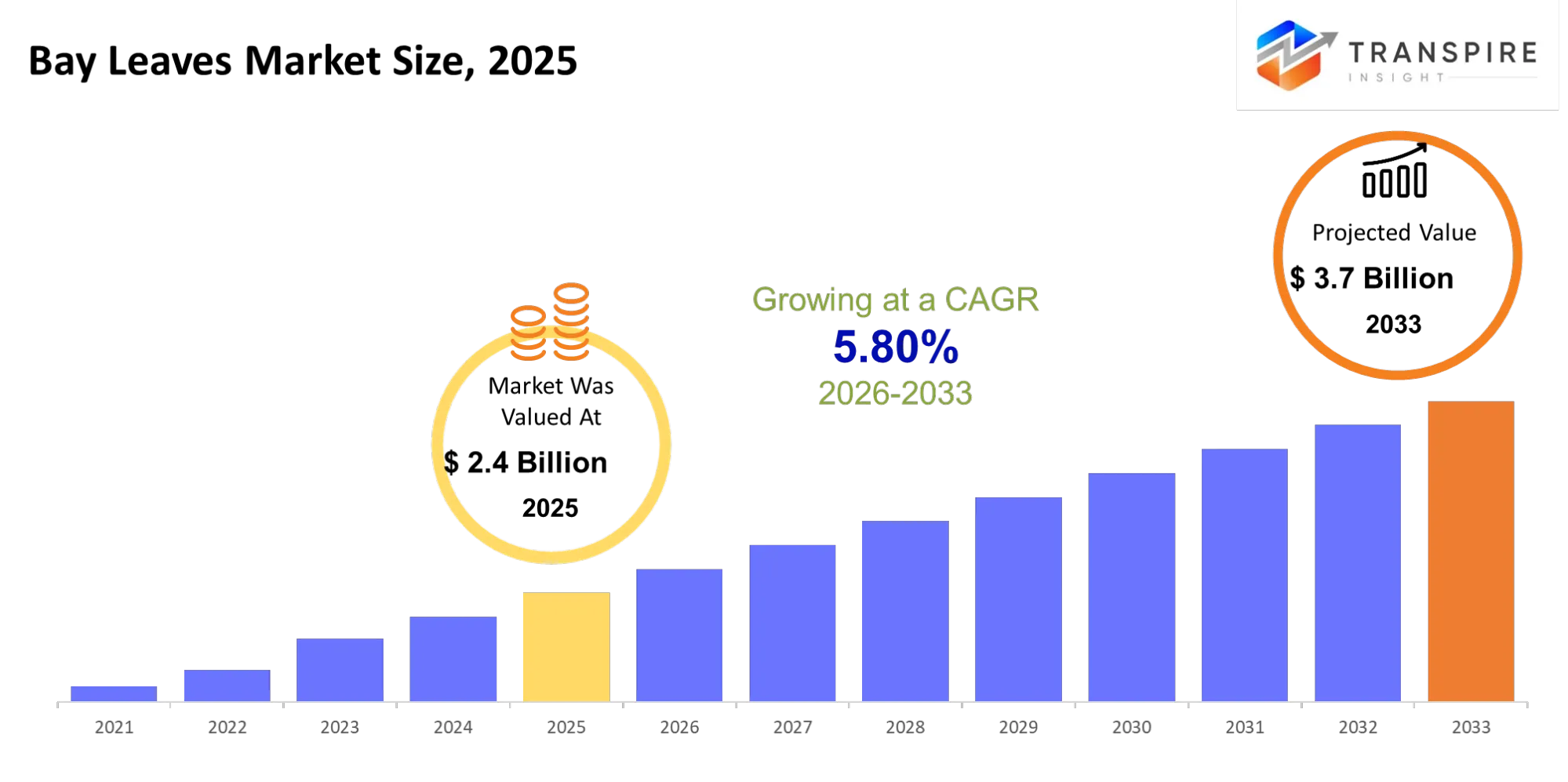
- Market Value (2025): USD 2.4 Billion.
- Expected Market Value (2026): USD 2.5 Billion.
- Estimated Market Value (2033): USD 3.7 Billion.
- Forecast CAGR (2026–2033): 5.80%.
- Leading Region in 2025: Asia Pacific
- Second-largest Region: Europe
- Fastest Growing Region: North America
Introduction
The Bay Leaves Market includes the cultivation, processing, distribution and commercialization of bay leaves and their value added products for various industrial applications. Bay leaves are an essential ingredient in the food and beverage, pharmaceutical, cosmetics and personal care industries due to their characteristic aroma, natural flavor-enhancing properties and bioactive compounds. The market is witnessing consistent growth owing to the rising consumer preference for natural ingredients, clean-label food products, herbal formulations, and organic spices. The increasing awareness of plant-based wellness solutions, increasing international trade of culinary herbs, and continuous product innovation further strengthen the market demand. Advances in sustainable growing practices, effective processing methods and high-end packaging options are all helping to raise product quality, extend its reach around the world and improve long-term sustainability in the market.
For instance:- North America: Rising demand for premium spices, clean-label ingredients and organic food products is driving investment in sustainable sourcing, advanced packaging and expansion of e-commerce distribution networks.
Asia-Pacific: Asia-Pacific remains the market leader propelled by high production of bay leaf, rising export demand, and increased investments in organic cultivation, traceability systems, and sustainable farming practices.
Key Market Highlights: -
- Asia Pacific is expected to grow at a rapid CAGR in the Bay Leaves Market by holding around 43% of the share during the forecast period.
- Europe is anticipated to hold roughly 33% share of the Bay Leaves Market over the predicted timeframe.
- North America is anticipated to hold nearly 18%share of the Bay Leaves Market over the predicted timeframe.
- By Product Type, the Whole Bay Leaves dominated the market and holds nearly 55.10% share in 2025 and is projected to grow at a substantial CAGR during the forecast period.
- By Source, the California bay leaf segment dominated the market and holds close to 38% share in 2025 and is projected to grow at a substantial CAGR during the forecast period.
- By Application, the food processing dominated the market and holds about 65% share in 2025 and is projected to grow at a substantial CAGR during the forecast period.
- Government initiatives such as horticulture development programmes, export promotion measures and quality certification frameworks are underpinning the cultivation of bay leaf, improving supply chain efficiency, increasing export competitiveness and supporting sustainable market growth.
How is Technology Driving Growth in the Bay Leaves Market?
The Bay Leaves Market is growing with the help of technology through advanced processing, precision agriculture, and innovations in digital supply chains. Modern drying and steam distillation technologies enable preservation of natural aroma, essential oils and product quality and enhancement of extraction efficiency in food, pharmaceutical and cosmetic applications. Precision farming techniques increase the productivity of crops, improve resource use efficiency, and promote sustainable cultivation practices. Automated systems for cleaning, grading and quality inspection ensure uniform product standards and reduce post-harvest losses. Blockchain-based traceability, digital quality monitoring, and the proliferation of e-commerce platforms further enhance supply chain transparency and build consumer confidence, while also expanding access to the marketplace to drive long-term industry growth.
Market Drivers
The Bay Leaves Market is growing in North America, Europe, and Asia-Pacific, driven by the rising demand for natural spices, clean-label food ingredients, and premium culinary herbs. The demand for ethnic cuisines, processed foods and organic products is increasing and driving the growth of the market. The Asia-Pacific region benefits from the availability of ample raw materials, expanding cultivation and growing exports, while in Europe the demand for herbs is supported by strict quality standards and a growing preference for certified organic herbs. Growth in North America continues to be driven by e-commerce growth, sustainable sourcing efforts and premium food applications. Moreover, technological advancements in processing, better supply chain transparency and rising consumer awareness on natural ingredients are also contributing to the long-term growth of the market.
For Instance: Europe: The region is witnessing investments in premium-quality bay leaf imports and sustainable supply chains due to strict food safety regulations, growing demand for certified organic herbs, and rising consumption of gourmet and Mediterranean cuisine.
Restrain
Seasonal harvesting cycles are a challenge to the Bay Leaves Market, which can limit the year-round availability and lead to variations in product availability. The price volatility of raw materials is driven by climate variability, unpredictable weather conditions and changing agricultural yields, which affect the stability of the market as a whole. Moreover, strict quality standards, export compliance requirements, and increasing competition from alternative herbs, spices and synthetic flavoring ingredients may limit the market growth and affect the profitability across the supply chain.
Analysis of Prices and Consumer Behaviour
Whole bay leaves account for the majority of the market for bay leaves (approximately 58% of the total market), driven by strong demand from the food and beverage, hospitality, spice processing and retail sectors. Certified organic and premium-grade bay leaves cost around 25% more than conventional products. The higher cost is attributed to better quality, sustainable cultivation practices and adherence to international food safety standards. Whole leaves comprise about 62% of the total bay leaf sales due to their longer shelf life, natural aroma retention, and widespread use in cooking. The food and beverage industry is the largest end-use segment, accounting for nearly 64% of the total demand.Consumer purchase behavior indicates that approximately 57% of buyers favor product quality, natural aroma, traceability of origin and organic certification, while about 35% of commercial buyers prefer long-term supply agreements and bulk procurement to ensure stable pricing, consistent quality and continuous availability of the product in domestic and international markets. Consumer purchase behavior indicates that approximately 57% of buyers favor product quality, natural aroma, traceability of origin and organic certification, while about 35% of commercial buyers prefer long-term supply agreements and bulk procurement to ensure stable pricing, consistent quality and continuous availability of the product in domestic and international markets.
Top Companies in the Bay Leaves Market
- McCormick & Company
- Olam Food Ingredients
- Bart Ingredients
- Badia Spices
- Frontier Co-op
- MDH Spices
- Everest Spices
- Catch Foods
- Kerry Group
- Ajinomoto
- Eastmade Spices
- Organic India
- Simply Organic
- Schwartz
- DS Group
Bay Leaves Market Segmentation
The Bay Leaves Market share is divided into five categories: By Product Type, By Source, By Application, By Distribution Channel, By End User
The Whole Bay Leaves dominated the market, accounting for nearly 55.10% in 2025 and is expected to rise at a significant CAGR during the forecast period.
The Bay Leaves Market is segmented by product type into whole bay leaves, ground bay leaves, organic bay leaves, conventional bay leaves, fresh bay leaves, dried bay leaves, bay leaf extracts, others. Among these, the Whole Bay Leaves dominated the market, accounting for nearly 55.10% in 2025 and expected to increase at a significant CAGR during the forecast period. Whole bay leaves were more dominant in the market, as they had better aroma retention, longer shelf life, wider use in cooking, lower cost and growing demand around the world.
The California bay leaf segment dominated the market, accounting for close to 38% in 2025, and is expected to rise at a significant CAGR during the forecast period
The Bay Leaves Market is segmented by source into mediterranean bay leaf, indian bay leaf, california bay leaf, turkish bay leaf, indonesian bay leaf, wild harvested, cultivated, others. Among these, the California bay leaf segment dominated the market, accounting for close to 38% in 2025 and expected to increase at a significant CAGR during the forecast period. California bay leaves were the leading product in the market due to their distinct aroma, high quality, growing culinary uses, sustainable production and increasing consumer preference worldwide.
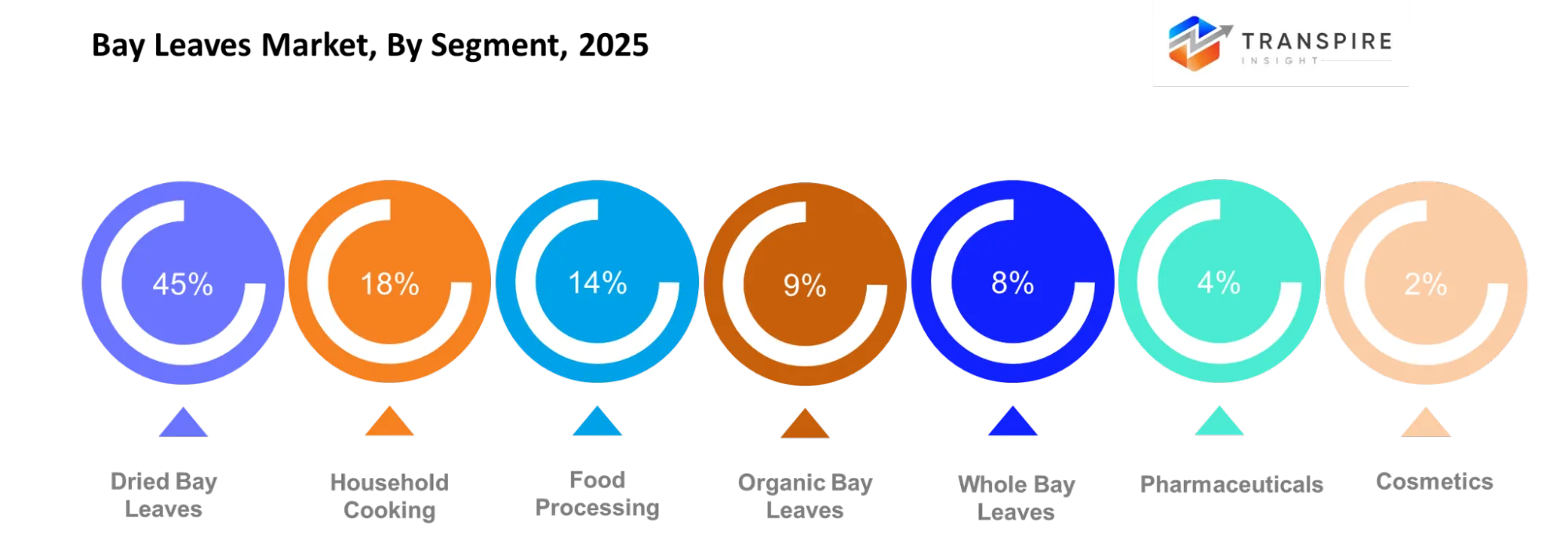
Food processing dominated the market, accounting for about 65% in 2025 and is expected to rise at a significant CAGR during the forecast period.
The Bay Leaves Market is by application into food processing, household cooking, seasoning blends, pharmaceuticals, cosmetics, essential oils, herbal products, others. Among these, the food processing dominated the market, accounting for about 65% in 2025 and expected to increase at a significant CAGR during the forecast period. Food processing held the biggest market share, due to the rising demand for natural flavoring ingredients, processed foods, shelf life, and culinary applications.
Regional Segment Analysis of the Bay Leaves Market
- Europe (Germany, France, U.K., Italy, Spain, Rest of Europe)
- North America (U.S., Canada, Mexico)
- Asia-Pacific (China, Japan, India, Rest of APAC)
- South America (Brazil and the Rest of South America)
- The Middle East and Africa (UAE, South Africa, Rest of MEA)
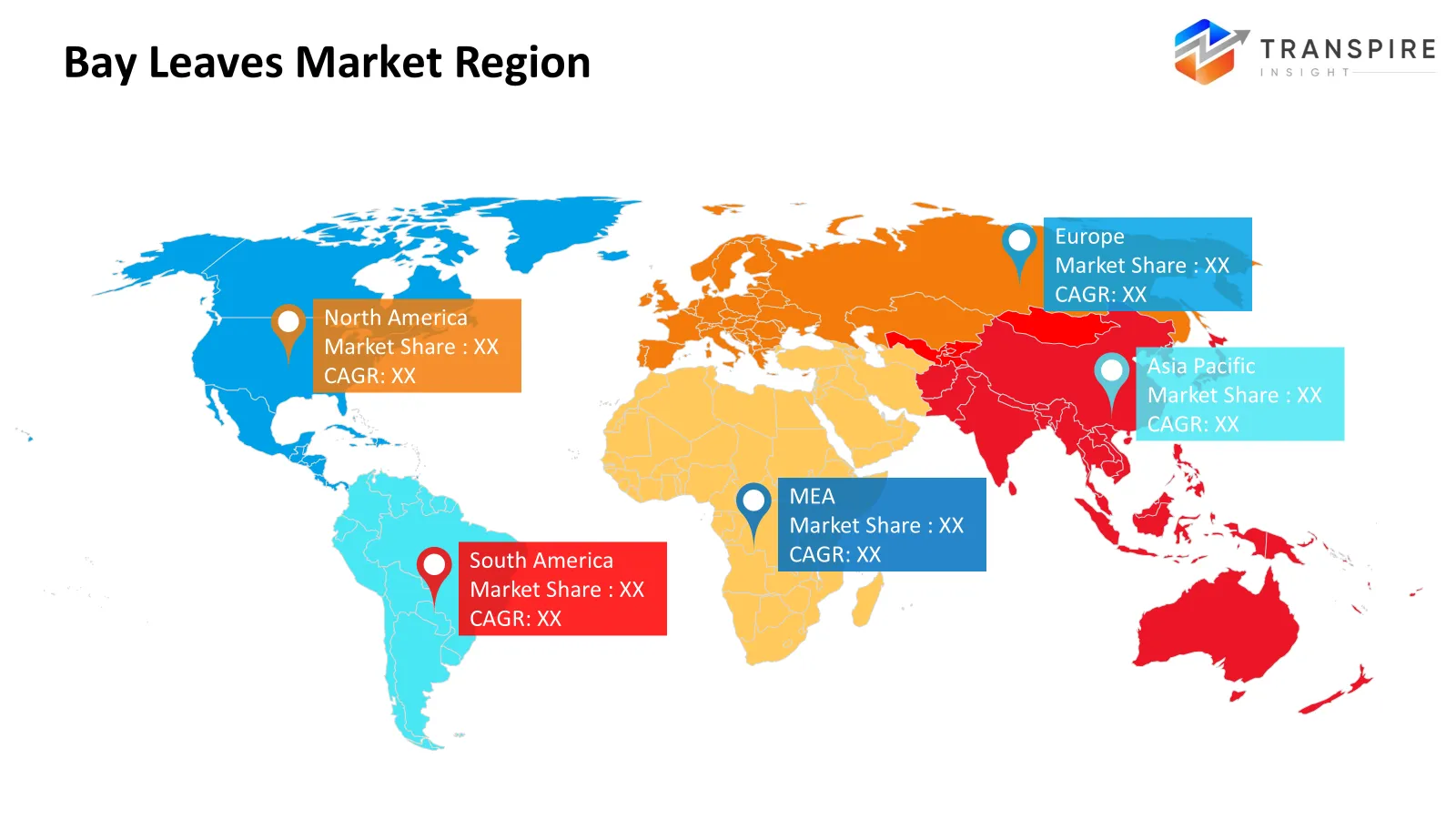
Asia Pacific is expected to grow at a rapid CAGR in the Bay Leaves Market, holding around 43% of the share during the forecast period.
The Asia Pacific region is anticipated to lead the Bay Leaves Market owing to the availability of abundant raw materials, favourable climatic conditions and substantial cultivation in India, Indonesia and nearby nations. Further, the growth of food processing industries, rising exports, increasing demand for natural spices, government support for sustainable agriculture and ongoing investments in organic farming, advanced processing technologies and efficient supply chain infrastructure are further driving regional market growth and enhancing its competitiveness.
Europe is the fastest-growing region in the Bay Leaves Market during the period, holding roughly 33% share.
Europe is the fastest growing region in the Bay Leaves Market as demand for premium culinary herbs, certified organic spices, and clean-label food ingredients is rising. Growing regional demand is driven by strong consumer preference for Mediterranean cuisine, strict food quality standards, increasing imports and rising applications in food processing, herbal products and natural seasonings. Ongoing investments in sustainable sourcing, advanced packaging and efficient distribution networks support the growing market position of Europe.
North America is the fastest-growing region in the Bay Leaves Market during the period, holding nearly 18% share.
North America is the fastest growing region in the Bay Leaves Market due to rising demand for premium spices, clean label food ingredients, and ethnic cuisines. Market expansion is being driven by the expansion of food processing industries, increased consumer preference for organic and natural seasonings, and robust growth in retail and e-commerce distribution channels. Additional investments in sustainable sourcing, innovative packaging technologies and efficient supply chain networks contribute to product availability and help long-term growth of regional markets.
Strategies for Market Growth in Non-Leading Regions:
The development of non-leading regions through efficient and scalable technologies for bay leaf cultivation, processing, drying, grading and packaging would benefit small and medium-sized producers. The growth of local bay leaf production and the creation of local processing and value-addition facilities will reduce the dependence on imports, strengthen the domestic supply chain and lower the cost of production. Strategic alliances with regional farmers, food processing companies, spice manufacturers, retailers, exporters and distribution channels will increase market penetration and improve product accessibility. Conduct training programs on sustainable cultivation, post-harvest handling, quality assurance, grading standards and compliance to international food safety standards to improve industry capabilities. Flexible financing, long-term procurement agreements and contract processing arrangements can also improve affordability, ensure a stable supply and encourage wider commercial uptake.Collaborative efforts of governments, agricultural development agencies, horticulture boards, spice promotion organisations, and food processing programmes and growth of digital sales channels and e-commerce platforms will enhance the market access, export opportunities, and sustainable long-term growth of the Bay Leaves Market in emerging economie
Future Market Trends for the Bay Leaves Market: -
- Natural Ingredients Are Booming: The rising consumer preference for natural spices, clean label food ingredients and organic culinary herbs will boost the ongoing demand for premium-quality bay leaves in food industries.
- Broader Industrial Applications: Increasing use of bay leaves in food processing, herbal formulations, essential oils and personal care products industries is offering new growth opportunities and fueling the market growth.
- Robust regional production and trade: Asia-Pacific remains at the forefront of the production hub, while demand for premium food products, sustainable sourcing practices, and growing international spice trade continues to be driven by North America and Europe.
Recent Development
- In February 2026 FAO said that there is growing demand for natural flavor ingredients and urged Asia-Pacific countries to grow more export-oriented bay leaves and expand sustainable production.
- In April 2026: Alpina Organic Bay Leaf Company increased its bay leaf extract production to enhance its value-added processing capabilities and to meet the growing demand of the food, cosmetic and herbal product industries.
Market Segment
This study forecasts revenue at global, regional and country levels from 2020 to 2033. Transpire Insights has segmented the Bay Leaves Market based on the below-mentioned segments:
Bay Leaves Market, By Product Type
- Whole Bay Leaves
- Ground Bay Leaves
- Organic Bay Leaves
- Conventional Bay Leaves
- Fresh Bay Leaves
- Dried Bay Leaves
- Bay Leaf Extracts
- Others
Bay Leaves Market, By Source
- Mediterranean Bay Leaf
- Indian Bay Leaf
- California Bay Leaf
- Turkish Bay Leaf
- Indonesian Bay Leaf
- Wild Harvested
- Cultivated
- Others
Bay Leaves Market, By Application
- Food Processing
- Household Cooking
- Seasoning Blends
- Pharmaceuticals
- Cosmetics
- Essential Oils
- Herbal Products
- Others
Bay Leaves Market, By Distribution Channel
- Supermarkets
- Hypermarkets
- Specialty Stores
- Online Retail
- Wholesale Suppliers
- Convenience Stores
- Direct Sales
- Others
Bay Leaves Market, By End User
- Households
- Restaurants
- Food Manufacturers
- Pharmaceutical Companies
- Cosmetic Manufacturers
- Herbal Industry
- Hotels
- Others
Bay Leaves Market, By Regional Analysis
North America
- United States
- Canada
- Mexico
Europe
- Germany
- United Kingdom
- France
- Spain
- Italy
- Rest of Europe
Asia Pacific
- Japan
- China
- Australia & New Zealand
- South Korea
- India
- Rest of Asia Pacific
South America
- Brazil
- Argentina
- Rest of South America
Middle East & Africa
- Saudi Arabia
- United Arab Emirates
- South Africa
- Rest of the Middle East & Africa
Frequently Asked Questions
Find quick answers to common questions.
Rising demand for natural spices, clean-label ingredients, organic products, expanding food processing applications, and increasing culinary consumption drive market growth.
Asia-Pacific dominates the market due to abundant cultivation, favorable climate, expanding exports, strong production capabilities, and growing investments in sustainable farming.
Whole bay leaves lead the market because of superior aroma retention, longer shelf life, extensive culinary applications, and strong consumer demand.
Advanced drying, precision farming, automated quality inspection, blockchain traceability, and digital distribution platforms improve product quality, efficiency, and market accessibility worldwide.
Seasonal harvesting, climate variability, raw material price fluctuations, stringent quality regulations, and competition from alternative spices continue challenging market expansion.
- McCormick & Company
- Olam Food Ingredients
- Bart Ingredients
- Badia Spices
- Frontier Co-op
- MDH Spices
- Everest Spices
- Catch Foods
- Kerry Group
- Ajinomoto
- Eastmade Spices
- Organic India
- Simply Organic
- Schwartz
- DS Group
About the Authors

Chetan Dhatrak
I’m Chetan Dhatrak, a Senior Research Analyst at Transpire Insight, specializing in the Consumer Goods, Foods and Beverages industry. I focus on analyzing market trends, consumer behavior, competitive landscapes, and industry developments to deliver accurate, data-driven insights. My research at Transpire Insight is built on credible sources and in-depth analysis, helping businesses and readers better understand market dynamics, emerging opportunities, and evolving consumer preferences. I’m committed to creating reliable, well-researched content that supports informed decision-making and reflects the latest developments in the consumer goods and food & beverage sectors.

Chakradhar Khansole
Chakradhar serves as the Research Director at Transpire Insight, bringing over 8 years of experience in technology, innovation, and strategic market intelligence. He specializes in transforming complex market data into actionable business insights that enable organizations to make informed, growth-oriented decisions. Recognized for his strategic vision and analytical expertise, Chakradhar leads high-impact research initiatives, delivering comprehensive market assessments, competitive intelligence, and forward-looking industry analysis.
Recently Published Reports
-
Apr 2026
Baby Infant Formula Market
Baby Infant Formula Market Size, Share & Analysis Report By ype (Infant Milk, Follow On Milk, Specialty Baby Milk, Growing-Up Milk), By Ingredient (Carbohydrate, Fat, Protein, Minerals, Vitamins, and Others), By Product Form (Powder, Liquid, and Ready-to-feed), By Distribution Channels (Supermarket/Hypermarket, Specialty Store, Pharmacies, Online Retail, and Others), and Geography (North America, Europe, Asia-Pacific, Middle East and Africa, South and Central America), 2021 - 2031
-
Apr 2026
Edible Insects for Animal Feed Market
Edible Insects for Animal Feed Market Size, Share & Analysis Report By Type (Insect Powder, Insect Meal, Insect Bar, Insect Paste, Insect Oil, and Others), By Insect Type (Beetles, Cricket, Caterpillar, Hymenoptera, Orthoptera, Tree Bugs, and Others), By Application (Livestock, Pet Food, and Aquaculture), By Livestock Type (Poultry, Swine, and Others), and Geography (North America, Europe, Asia-Pacific, Middle East and Africa, South and Central America), 2021 - 2031
-
Apr 2026
Food Industry Disinfection and Bacterial Control Market
Food Industry Disinfection and Bacterial Control Market Size, Share & Analysis Report By Type (Chemical Disinfectants, Physical Disinfectants, and Biocides and Antimicrobials), By Application (Food Processing Equipment Surface Disinfection, Food Preparation Areas Surface Disinfection, Storage Areas Surface Disinfection, Anti-microbial Coatings Food Preservation, and Preservative Solutions Food Preservation), By End User (Meat and Poultry Processing, Dairy Processing, Seafood Processing, Bakery and Confectionery, Restaurants and Commercial Kitchens, and Food Service Providers), By Sales Channel (Online, Offline), and Geography (North America, Europe, Asia-Pacific, Middle East and Africa, South and Central America), 2021 - 2031
-
May 2026
Freeze Dried Food Market
Freeze Dried Food Market Size, Share & Analysis Report By Product Type (Fruits, Vegetables, Freeze-Dried Dairy Products, Freeze-Dried Meat and Seafood, Freeze-Dried Pet Food, and Prepared Meal), By Nature (Organic, and Conventional), By Form (Powdered, Granules, and Diced), By End Use (Breakfast Cereals, Dairy Products, Bakery & Confectionery, Nutritional Bars & Supplements, Powdered Beverages, Snacks, and Retail (Household)), and Geography (North America, Europe, Asia-Pacific, Middle East and Africa, South and Central America), 2021 - 2031