
Backup Power Systems Market Summary:
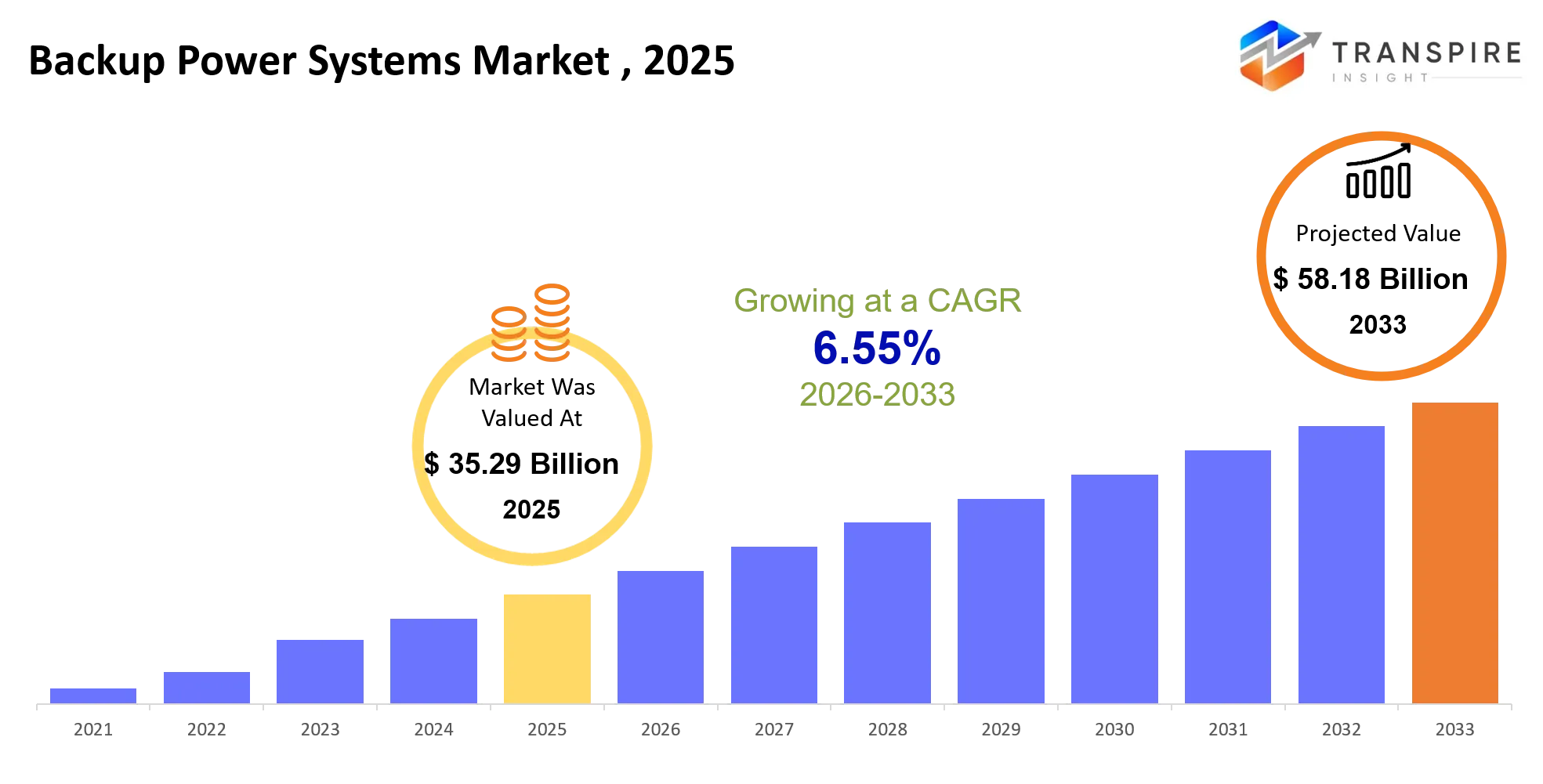
As per the Transpire Insight Analysis, The Backup Power Systems Market size is estimated at USD 35.29 billion in 2025 and is anticipated to reach USD 58.18 billion by 2033, growing at a CAGR of 6.55% from 2026 to 2033.
The market for backup power systems enables operations at data centers, hospitals, telecommunications, manufacturing facilities, and commercial buildings to continue during disruptions in the electricity grid. In the past five years, the industry has shifted from traditional diesel generators toward integrated power systems that include energy storage, intelligent controls and alternative fuels. This evolution has been accelerated by higher demands to maintain operational resilience, rising electricity consumption for artificial intelligence hardware, and the need to decarbonize. Extreme weather, transmission network constraints, and longer utility outages have created significant financial losses due to power failures, prompting companies to increase onsite power capacity and reduce risk exposure. Data center operators demand faster transfer times, modular systems, and coordinated energy management to mitigate risk to sensitive equipment. This has led to a growing list of hybrid power offerings, and customers are valuing lifecycle reliability, remote energy monitoring, and fuel flexibility to minimize capital expenditure.
Backup Power Systems Market Size & Forecast:
- Market Size 2025: USD 35.29 Billion
- Expected Market Value (2033): USD 58.18 Billion
- Forecast CAGR (2026–2033): 6.55%
- Leading Region in 2025: North America
- Fastest Growing Region: Asia Pacific
- Key Company Profiles: Caterpillar, Cummins, Generac, Eaton, Schneider Electric, Vertiv, Kohler, Rolls-Royce Power Systems, ABB, Huawei, Mitsubishi Heavy Industries, Briggs & Stratton, Atlas Copco, Aggreko, Delta Electronics.
Key Backup Power Systems Market Insights:
The market is maturing from outage protection to integrated resilience platforms that integrate generation, storage, and intelligent controls. The competitive edge is now going to vendors who can offer low-carbon, AI-ready power architectures instead of just equipment.
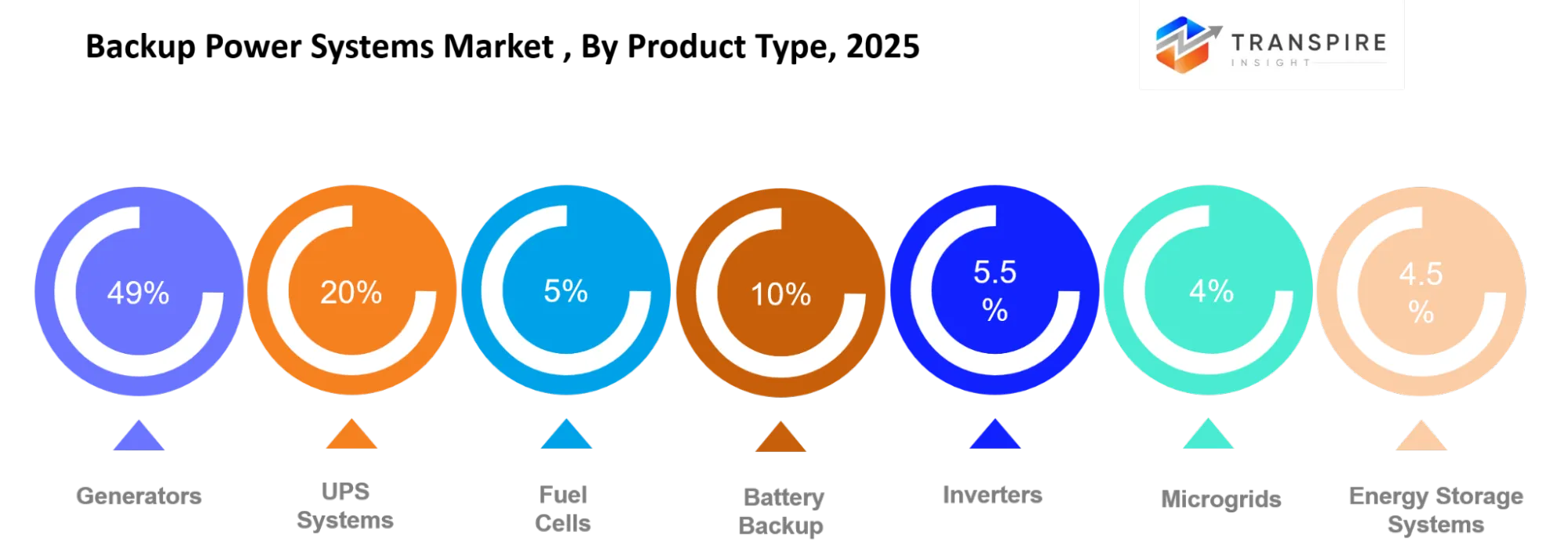
- Caterpillar keeps 49.0% of product-type revenue, but is experimenting with large-format hydrogen fuel cells for data centres' backup power.
- UPS systems accounted for 20.0% of the market, and Vertiv and Caterpillar are collaborating on pre-engineered energy-optimisation architectures to speed data-centre deployment.
- Battery backup is 10.0%, and lithium-ion is gaining traction because of its higher density, remote diagnostics, and longer service life.
- Battery energy storage makes up 4.5% and is transitioning in use from emergency reserve to peak shaving and grid support infrastructure.
- Fuel cells make up 5.0%, and AWS finished a 3 MW hydrogen fuel-cell backup pilot in Northern Virginia, indicating hyperscaler interest in reducing diesel use.
- Microgrids are growing on campus, in utilities, and in industrial facilities looking to integrate local renewables and isolate outages, representing 4.0%.
- Solar-plus-storage installations and the need for bidirectional power conversion in hybrid systems drive inverter sales, which account for 5.5% of the market.
- Rolls-Royce Power Systems is expanding its mtu EnergyPack portfolio with the inclusion of solar and wind solutions for applications in grid stability and backup power.
- Data-centre expansion, industrial automation, and investment in renewable energy-based microgrids are driving revenue growth in Asia Pacific at 10.8% CAGR for 30.5% revenue.
What are the Key Drivers, Restraints, and Opportunities in the Backup Power Systems Market?
Driver:
Grid instability, extreme weather, and electricity-intensive AI data centers are accelerating investment in backup infrastructure. Unexpected outages interrupt digital transactions, hospital services, and industrial production, creating measurable financial losses. Operators consequently invest in generators, UPS systems, and battery storage to maintain service continuity. Expanding hyperscale facilities and telecommunications networks also support recurring revenue through equipment upgrades, maintenance contracts, and monitoring services.
Restraint:
Backup power deployment remains constrained by equipment expenditure, fuel storage requirements, permitting, and maintenance obligations. Large installations require electrical integration, ventilation, emissions compliance, and skilled technicians. These structural requirements persist because critical facilities cannot compromise reliability or safety. Battery systems introduce additional challenges involving thermal management, replacement economics, and recycling infrastructure, particularly in cost-sensitive markets.
Opportunity:
Hybrid and low-carbon backup architectures can unlock the next growth phase. Natural-gas, dual-fuel, hydrogen-ready fuel cells, and battery-generator hybrids allow operators to meet emissions targets without sacrificing runtime. For example, data-centre operators are evaluating HVO-compatible generators, lithium-ion UPS batteries, and microgrids as part of low-carbon resilience strategies; regions with strong decarbonization policy, such as California, are likely to accelerate this transition.
Driver Impact Analysis – Backup Power Systems Market
|
Driver |
Relative Impact on Growth (%) |
Geographic Relevance |
Impact Timeline |
Demand Strength |
Growth Mechanism |
Key Beneficiaries |
Major Constraint |
|
AI-driven data centre expansion and rising power density |
28% |
North America, China, Europe, Asia-Pacific |
Short-term (≤2 years) |
High |
Expanding AI workloads require redundant UPS and generator capacity. |
UPS manufacturers, generator OEMs, hyperscale data centre operators |
Grid connection delays and high infrastructure capital expenditure. |
|
Increasing grid instability, outages, and power reliability requirements |
24% |
Asia-Pacific, North America, Africa, Latin America |
Short-term (≤2 years) |
High |
Frequent outages accelerate deployment of dependable emergency power systems. |
Generator manufacturers, battery suppliers, critical-facility operators |
High equipment costs and variable fuel availability. |
|
Industrial automation and uninterrupted business continuity requirements |
19% |
Asia-Pacific, North America, Europe |
Medium-term (2–4 years) |
High |
Automated facilities require continuous power for critical production processes. |
Industrial generator OEMs, UPS vendors, manufacturing enterprises |
Installation costs and complex maintenance requirements. |
|
Battery storage, hybrid backup, and smart power management advancements |
16% |
North America, Europe, China, India |
Medium-term (2–4 years) |
High |
Battery integration improves response speed and reduces generator runtime. |
Battery manufacturers, inverter suppliers, microgrid integrators |
Battery costs, degradation, and integration complexity. |
|
Healthcare, telecom, and critical infrastructure resilience investments |
13% |
North America, Europe, Asia-Pacific, Middle East |
Long-term (≥4 years) |
High |
Critical services require reliable emergency power and redundancy. |
Healthcare facilities, telecom operators, backup power suppliers |
Regulatory compliance costs and limited infrastructure budgets. |
|
Total |
100% |
— |
— |
— |
— |
— |
— |
What Has the Impact of Artificial Intelligence Been on the Backup Power Systems Market?
AI is enabling backup power to evolve from a simple passive failover system to an advanced layer of energy management. Data centres with AI-based solutions actively monitor uninterruptible power supplies, analyse battery conditions, generator readiness, fuel levels, and load patterns. By automating failover and intelligently optimizing distribution, these management systems help operators automate away many tasks that would otherwise require intervention and keep data centres online during power grid disturbances.
One of the most valuable features is predictive management. Machine-learning models can identify anomalous temperature, voltage, charging, or vibration patterns in batteries and generators in the days or weeks before issues occur, enabling condition-based maintenance and reducing unplanned outages, unnecessary service visits, and premature battery replacements. AI also improves load management by forecasting and optimising loads. Some facilities in the study with high AI loads hosted a storage system that could accommodate power fluctuations on the millisecond timescale from GPU clusters. The energy-management system simultaneously coordinated batteries, renewable resources, generators, and loads, shifting loads and shedding peaks, so backup infrastructure was functioning during non-emergency periods.
In October 2026, Vertiv expanded its capabilities by completing the acquisition of Utility Innovation Group (UIG) for $2.6 billion. This strategic move enhances Vertiv’s ability to deploy highly intelligent behind-the-meter power systems and microgrids tailored specifically for data centres managing volatile AI workloads.
Key Backup Power Systems Market Trends:
AI workloads, variability in renewable energy sources, and increasingly stringent emissions targets are driving the transition of backup power from emergency use to resilience and energy optimization.
- Dual-fuel, hybrid, and HVO-compatible configurations are becoming increasingly prevalent as operators weigh each option against diesel generators, considering emissions, fuel availability, and lifecycle costs.
- New data-centre and commercial installations are replacing lead-acid UPS batteries with lithium-ion batteries because of their higher energy density, longer cycle life, and ability to monitor the batteries.
- Battery energy storage is moving from backup to peak shaving, demand charge reduction, frequency regulation, and renewable balancing.
- AI data centres are driving the need for battery backup units (BATS) at the rack level in addition to centralised UPS systems, providing an additional layer to the traditional power architecture.
- As hospitals, campuses, utilities and industrial facilities increasingly look to local resilience and renewable integration, microgrids are becoming more relevant.
- Fuel cells are still a niche but important technology, and hydrogen and solid-oxide fuel cells are progressing in areas where there is a high level of policy support and net-zero commitments.
- Operators are seeking to adopt modular and scalable systems to accommodate higher densities of AI racks, edge infrastructure, and evolving load patterns.
- Urban and regulated locations are being forced to shift toward quieter battery-driven or gas-fuelled backup systems as a result of noise, air-quality, and diesel-generator restrictions.
- Large backup-power fleets are expected to have digital twins, remote monitoring capabilities, and AI-based maintenance platforms.
Backup Power Systems Market Segmentation
Product Type:
Generators remain the market’s largest segment at 49.0%, reflecting their established role in extended-duration backup for hospitals, industrial plants, telecom sites, and large data centres. UPS systems account for 20.0% and continue to lead where instantaneous switchover is essential for IT, healthcare, and financial infrastructure. Battery backup holds 10.0%, while battery energy storage systems represent 4.5% but carry the strongest growth logic because they combine emergency power with peak shaving and grid services; data-centre BESS demand is forecast to grow at a 14.2% CAGR. Fuel cells account for 5.0%, inverters 5.5%, microgrids 4.0%, and others 2.0%, with these segments benefiting from decarbonization, renewable integration, and distributed-energy strategies.
Power Rating:
Systems below 100 kW serve residential properties, retail outlets, and small commercial facilities, where affordability and compact installation are priorities. The 100–500 kW category supports telecommunications sites and mid-sized businesses, while 500 kW–1 MW and 1–5 MW systems serve hospitals, factories, and data centres requiring redundancy. Demand for 5–10 MW and above-10 MW installations is supported by large industrial campuses and hyperscale computing facilities. Modular systems enable phased capacity expansion without extensive redesign.
Fuel Type:
Diesel remains widely used because of established reliability, rapid deployment, and accessible fuel infrastructure. Natural gas is gaining attention where pipeline availability and emissions requirements favour cleaner combustion. LPG serves locations with limited gas access, while biofuels offer opportunities to reduce lifecycle emissions in compatible equipment. Hydrogen-powered systems remain constrained by fuel availability and infrastructure costs. Battery-based and hybrid configurations are evolving rapidly, enabling faster response, reduced generator runtime, and better integration with renewable electricity.
Application:
Data centres, healthcare, telecommunications, and industrial facilities anchor demand because outages can cause financial losses, safety risks, or service interruptions. AI computing expansion increases requirements for reliable power protection and coordinated backup capacity. Hospitals require dependable electricity for life-support equipment, while telecommunications operators protect network availability across distributed sites. Manufacturing facilities use backup systems to prevent production stoppages and equipment damage. Utilities and commercial buildings are also adopting storage-integrated solutions for resilience, peak-load management, and improved electricity utilization.
Technology:
Standby systems remain essential for emergency outages, while prime-power and continuous-power configurations support sites requiring extended or regular independent electricity generation. Online UPS systems protect sensitive digital equipment through continuous power conditioning, whereas offline and line-interactive UPS solutions serve applications with different protection and cost requirements. Hybrid systems are gaining strategic importance by coordinating generators, batteries, and renewable sources. Intelligent controllers improve switching and energy allocation, helping operators reduce fuel consumption, manage emissions, and maintain stable power during fluctuating loads.
End User:
IT and telecommunications operators prioritize uninterrupted service, power quality, and rapid recovery, particularly as computing workloads expand. Manufacturing businesses focus on preventing production losses, while healthcare facilities require reliable electricity for critical equipment and emergency services. BFSI organisations protect transaction processing, data integrity, and branch operations. Government facilities prioritize essential public services and emergency preparedness, whereas retailers seek to preserve transactions, refrigeration, and security systems. Residential adoption is supported by solar integration, home battery storage, and greater awareness of weather-related outages.
What are the Key Use Cases Driving the Backup Power Systems Market?
Generators, representing 49.0% of product demand, provide emergency electricity for hospitals, industrial facilities, and data centres. They maintain essential operations during utility failures, preventing equipment damage, production interruptions, and service disruptions.
Expanding applications include telecommunications towers, banking networks, commercial complexes, and residential properties. UPS systems protect sensitive electronics, while battery storage supports immediate power transfer and improved continuity across distributed infrastructure.
Emerging applications center on AI data centers, renewable-powered microgrids, and grid-constrained industrial campuses. Battery Energy Storage, growing at a 14.2% CAGR, supports hybrid architectures that combine rapid response, intelligent energy dispatch, and reduced generator operating hours while strengthening operational flexibility and resilience.
|
Report Metrics |
Details |
|
Market size value in 2025 |
USD 35.29 Billion |
|
Market size value in 2026 |
USD 37.32 Billion |
|
Revenue forecast in 2033 |
USD 58.18 Billion |
|
Growth rate |
CAGR of 6.55% from 2026 to 2033 |
|
Base year |
2025 |
|
Historical data |
2021 - 2024 |
|
Forecast period |
2026 - 2033 |
|
Report coverage |
Revenue forecast, competitive landscape, growth factors, and trends |
|
Regional scope |
United States; Canada; Mexico; United Kingdom; Germany; France; Italy; Spain; Denmark; Sweden; Norway; China; Japan; India; Australia; South Korea; Thailand; Brazil; Argentina; South Africa; Saudi Arabia; United Arab Emirates |
|
Key companies profiled |
Caterpillar, Cummins, Generac, Eaton, Schneider Electric, Vertiv, Kohler, Rolls-Royce Power Systems, ABB, Huawei, Mitsubishi Heavy Industries, Briggs & Stratton, Atlas Copco, Aggreko, Delta Electronics. |
|
Customization scope |
Free report customization (country, regional & segment scope). Available customized purchase options to meet your exact research needs. |
|
Report Segmentation |
Product Type (Generators, UPS Systems, Battery Backup, Fuel Cells, Inverters, Microgrids, Energy Storage Systems, Others)Power Rating (Below 100 kW, 100–500 kW, 500 kW–1 MW, 1–5 MW, 5–10 MW, Above 10 MW, Modular Systems, Others)Fuel Type (Diesel, Natural Gas, LPG, Hydrogen, Biofuel, Battery, Hybrid, Others)Application (Data Centers, Healthcare, Telecommunications, Industrial, Commercial, Residential, Utilities, Others)Technology (Standby, Prime Power, Continuous Power, Online UPS, Offline UPS, Line-Interactive UPS, Hybrid Systems, Others)End User (IT & Telecom, Manufacturing, Healthcare, BFSI, Retail, Government, Residential, Others). |
Which Regions are Driving the Backup Power Systems Market Growth?
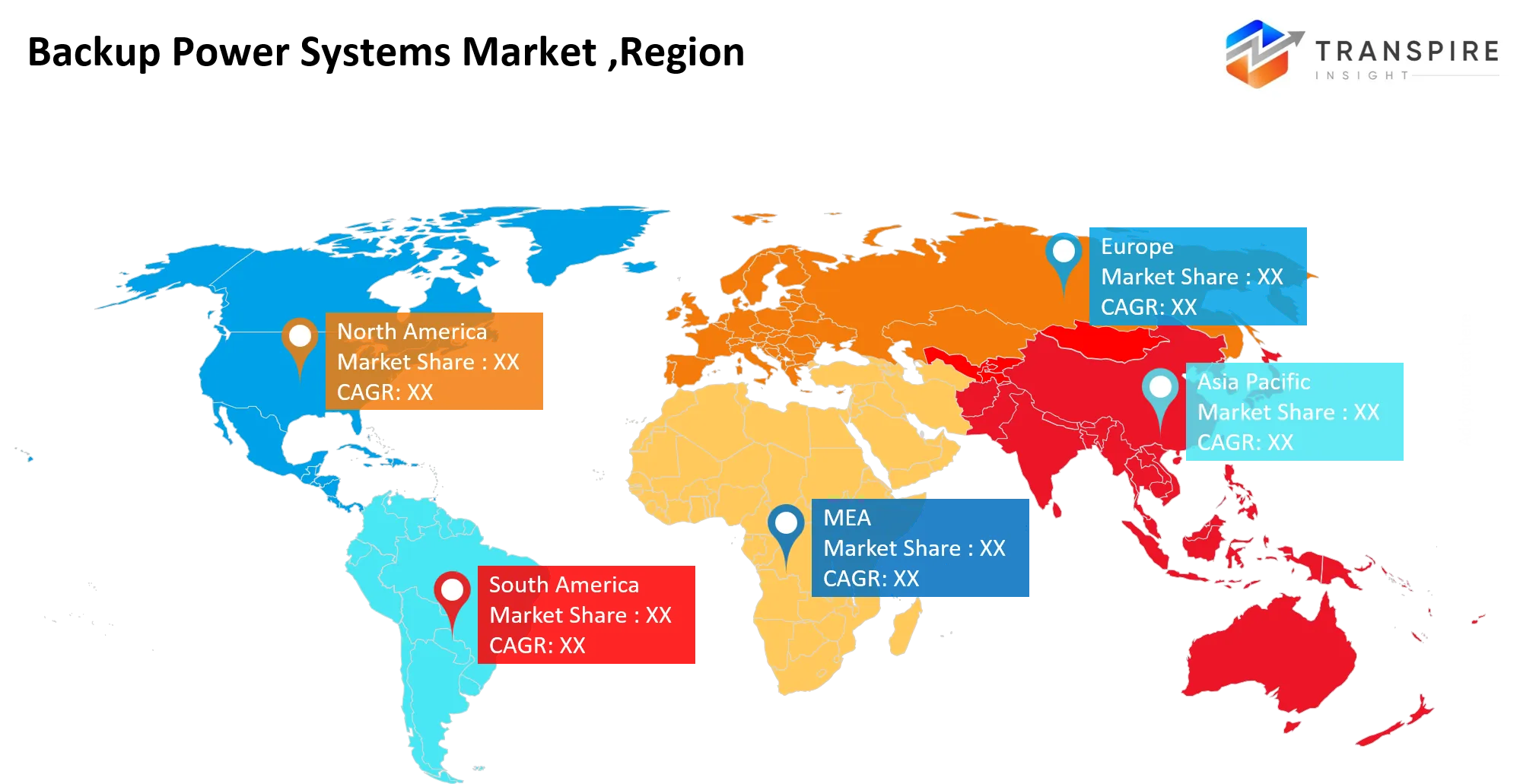
North America contributes 32.5% of revenue driven by the proliferation of hyperscale data centres, cloud providers, health networks and financial institutions. North America remains the largest market region for HPW solutions, thanks to high uptime standards, advanced grid-modernisation programs, and an appetite for redundant power infrastructure. The strong tailwinds from increased policy focus on grid resilience, adoption of AI-ready data centre developments and buildout, also support increased demand for high-capacity UPS, gensets and batteries.
In October 2026, Vantage and Heron Power announced a gigawatt-scale manufacturing capacity agreement for solid-state transformers. This partnership secures over 1GW of solid-state transformer capacity to be deployed across Vantage's hyperscale data centre campuses.
Europe accounts for 23.0% of the market, with the Middle East and Africa and Latin America accounting for 8.0% and 6.0%, respectively. Europe is markedly different from North America in the context of its aggressive decarbonization policies, aggressive renewable penetration targets, and high-energy efficiency criteria that are part of the buying criteria. As a result, there will be a higher need for a more standardised natural gas-based, hybrid, battery-led, and lower-emission backup solution in data centres, utilities, and regulated industries.
In March 2026, Pure Data Centres Group partnered with power supply provider AVK-SEG to launch a €1 billion microgrid data centre project in Dublin, Ireland. The 110 MW campus relies primarily on low-emission natural gas engines, which can seamlessly switch to Hydrotreated Vegetable Oil (HVO) backup and are designed to integrate a 20 MW battery energy storage system.
https://puredc.com/2026/03/11/pure-dc-and-avk-deploy-europes-first-data-centre-microgrid
Asia Pacific is the fastest-growing region at 10.8% CAGR and contributes 30.5% of the overall market. Recent growth was driven by rising cloud and AI infrastructure investments in China, India, Japan, and Southeast Asia, coupled with growing industrial automation and regionalised data-storage requirements. Weakness in grid reliability in a number of markets will require backup solutions, while growth in the emerging renewable energy sector and microgrid projects will present future growth opportunities for modular-storage-led architectures.
In May 2026, Microsoft celebrated the one-year milestone of its Indonesia Central cloud region while scaling local AI infrastructure and operational capacity to support financial institutions and digital platforms. This deployment enhanced in-country data residency and lowered latency for enterprise workloads, directly reinforcing regional cloud expansion and microgrid-backed resilience.
https://uk.finance.yahoo.com/news/asia-pacific-artificial-intelligence-ai-083800886.html
Who are the Key Players in the Backup Power Systems Market, and how do they compete?
The competitive landscape is shifting from equipment to integrated resilience solutions. The players are competing on metrics such as time-to-power, emissions compliance, software-centric monitoring, and the ability to integrate generator sets, batteries, UPS, and grid-interconnection points within an architecture.
Players such as Caterpillar and Cummins are pursuing innovative strategies, bringing combined expertise in large generator sets with clean-fuel and hybrid solutions. Caterpillar's hydrogen fuel-cell demonstration with Microsoft and Ballard distinguishes it on the data-centre decarbonization front. Generac focuses on residential and light-commercial resilience and has been distinguished by its home standby systems and distributed energy platform. Eaton, Schneider Electric, ABB, and Vertiv are competing on integrated electrical infrastructure, bringing together UPS, switchgear, distribution, and digital management for system-level uptime. Kohler and Briggs & Stratton are focusing on reliable, low-cost, service-supported standby power for commercial and residential applications. Rolls-Royce Power Systems and Mitsubishi Heavy Industries serve the industrial and mission-critical markets with high-power output, energy storage, and fuel-flexible platforms. Huawei and Delta Electronics compete on power electronics and battery systems and AI-enabled monitoring. Aggreko and Atlas Copco are growing their rental, temporary power, and hybrid deployment offerings for exhibitions, events, construction sites, utilities, and emergency response.
Key Players are:
- Caterpillar
- Cummins
- Generac
- Eaton
- Schneider Electric
- Vertiv
- Kohler
- Rolls-Royce Power Systems
- ABB
- Huawei
- Mitsubishi Heavy Industries
- Briggs & Stratton
- Atlas Copco
- Aggreko
- Delta Electronics
Backup Power Systems Market — Enhanced Competitive Benchmarking
|
Company |
Est. Revenue Share Range |
Key Offerings |
Strategic Positioning |
Geographic Strength |
Technology Focus |
|
Caterpillar Inc. |
Estimated 6–10% |
Diesel and gas generator sets; Cat switchgear; paralleling controls; microgrid solutions |
Large-scale generator leadership for critical infrastructure |
North America, Asia Pacific, Middle East & Africa |
High-capacity gensets, microgrids, digital power controls |
|
Cummins Inc. |
Estimated 5–9% |
Diesel and gas gensets; transfer switches; power-command controls; integrated generator systems |
Broad generator portfolio with extensive service networks |
North America, Asia Pacific, Europe |
Fuel-efficient engines, hybrid power, remote monitoring |
|
Generac Holdings Inc. |
Estimated 4–8% |
Residential standby generators; commercial generators; automatic transfer switches; energy management systems |
Residential standby leadership with distributed-energy expansion |
North America, Europe, Latin America |
Smart generators, home energy management, storage integration |
|
Schneider Electric |
Estimated 3–6% |
Galaxy UPS; APC Smart-UPS; power distribution; EcoStruxure monitoring |
Integrated power protection for data centers and enterprises |
Europe, North America, Asia Pacific |
Modular UPS, lithium-ion storage, intelligent power management |
|
Eaton Corporation |
Estimated 3–6% |
9PX UPS; 93PM UPS; backup power distribution; power monitoring software |
Mission-critical power protection with lifecycle service differentiation |
North America, Europe, Asia Pacific |
Energy-efficient UPS, modular architectures, digital monitoring |
|
Vertiv Holdings |
Estimated 2–5% |
Liebert UPS; battery systems; power distribution; critical-power monitoring |
Data-center-focused backup and integrated infrastructure specialist |
North America, Europe, Asia Pacific |
High-density UPS, modular power, predictive maintenance |
|
Rehlko (formerly Kohler Energy) |
Estimated 2–4% |
Industrial generator sets; commercial standby generators; transfer switches; power controls |
Engineered generator solutions across commercial and industrial loads |
North America, Europe, Asia Pacific |
Diesel and gas generation, automatic transfer, load management |
|
Rolls-Royce Power Systems (MTU) |
Estimated 2–4% |
mtu diesel gensets; gas generator systems; emergency power modules; digital controls |
Premium high-power generation for demanding critical loads |
Europe, North America, Asia Pacific |
High-output engines, rapid load response, hybrid integration |
|
Mitsubishi Heavy Industries |
Estimated 2–4% |
Diesel generator systems; gas engine generators; cogeneration systems; integrated power solutions |
Industrial-scale generation with engineering-led differentiation |
Asia Pacific, Europe, North America |
High-efficiency engines, gas generation, cogeneration |
|
Atlas Copco AB |
Estimated 1–3% |
Portable generators; containerized generators; energy storage systems; hybrid power packages |
Portable and temporary power specialist serving varied site requirements |
Europe, Asia Pacific, North America |
Hybrid battery-generator systems, remote fleet monitoring |
Recent Development News
In October 2026, Jackery partnered with Qmerit to provide certified electrician installation services for residential backup power systems across the United States. The partnership simplifies transfer switch installation, permitting, and system integration, supporting wider adoption of reliable home backup power solutions.
In September 2026, Vertiv announced an agreement to acquire UtilityInnovation Group for approximately USD 1.45 billion, with additional performance-based consideration. The acquisition is expected to strengthen microgrid controls, on-site generation integration, and energy storage capabilities, improving power resilience for AI data centres and critical infrastructure.
In September 2026, ZincFive launched its next-generation battery management system (BMS) for nickel-zinc battery technology. The development supports more advanced battery monitoring and management, strengthening the technology's potential for reliable backup power applications in mission-critical infrastructure.
https://zincfive.com/announcements/
What Strategic Insights Define the Future of the Backup Power Systems Market?
The backup power systems market is heading towards all-in-one resilience platforms with integrated generation, storage, power electronics and intelligent controls. Future systems will compete on their response times, fuel flexibility and life cycle performance rather than their equipment capacity. Data centres driven by AI will accelerate the trend as cloud computing demands rapidly varying load profiles requiring quick power stabilization and short-term backup infrastructure coordination. One latent risk is the degradation of batteries operating in shallow cycling mode with unpredictable load swings, which will increase replacement costs and degrade system reliability. Meanwhile, grid-constrained industrial campuses represent potential hubs for hybrid microgrids combining onsite generation with energy storage. OEMs should focus on modular design, condition monitoring and cybersecurity, as well as interoperability between equipment platforms. Partnering with utilities, data centre owners and energy service providers can reduce market entry barriers while enabling subscription fees for monitoring, maintenance and performance-based services.
Key Segmentations are:
Product Type
- Generators
- UPS Systems
- Battery Backup
- Fuel Cells
- Inverters
- Microgrids
- Energy Storage Systems
- Others
Power Rating
- Below 100 kW
- 100–500 kW
- 500 kW–1 MW
- 1–5 MW
- 5–10 MW
- Above 10 MW
- Modular Systems
- Others
Fuel Type
- Diesel
- Natural Gas
- LPG
- Hydrogen
- Biofuel
- Battery
- Hybrid
- Others
Application
- Data Centers
- Healthcare
- Telecommunications
- Industrial
- Commercial
- Residential
- Utilities
- Others
Technology
- Standby
- Prime Power
- Continuous Power
- Online UPS
- Offline UPS
- Line-Interactive UPS
- Hybrid Systems
- Others
End User
- IT & Telecom
- Manufacturing
- Healthcare
- BFSI
- Retail
- Government
- Residential
- Others
Frequently Asked Questions
Find quick answers to common questions.
The backup power systems market size was valued at USD 35.29 billion in 2025 and is poised to reach USD 58.18 billion by 2033, expanding at a 6.55% CAGR.
Key segments for the backup power systems market are Product Type (Generators, UPS Systems, Battery Backup, Fuel Cells, Inverters, Microgrids, Energy Storage Systems, Others)Power Rating (Below 100 kW, 100–500 kW, 500 kW–1 MW, 1–5 MW, 5–10 MW, Above 10 MW, Modular Systems, Others)Fuel Type (Diesel, Natural Gas, LPG, Hydrogen, Biofuel, Battery, Hybrid, Others)Application (Data Centers, Healthcare, Telecommunications, Industrial, Commercial, Residential, Utilities, Others)Technology (Standby, Prime Power, Continuous Power, Online UPS, Offline UPS, Line-Interactive UPS, Hybrid Systems, Others)End User (IT & Telecom, Manufacturing, Healthcare, BFSI, Retail, Government, Residential, Others).
Growth is primarily driven by data center expansion, grid instability, extreme weather events, industrial electrification, telecommunications infrastructure development, and increasing adoption of battery storage and hybrid power systems.
The backup power systems market is led by major manufacturers, including Caterpillar, Cummins, Generac, Eaton, Schneider Electric, Vertiv, Kohler, Rolls-Royce Power Systems, ABB, Huawei, Mitsubishi Heavy Industries, Briggs & Stratton, Atlas Copco, Aggreko, Delta Electronics.
North America holds 32.5% of the market, supported by hyperscale data centre investments, advanced power infrastructure, stringent reliability requirements, and growing demand for on-site generation and energy storage.
- Caterpillar
- Cummins
- Generac
- Eaton
- Schneider Electric
- Vertiv
- Kohler
- Rolls-Royce Power Systems
- ABB
- Huawei
- Mitsubishi Heavy Industries
- Briggs & Stratton
- Atlas Copco
- Aggreko
- Delta Electronics
About the Authors

Avinash Kumar
I’m Avinash Kumar, a Senior Research Analyst at Transpire Insight, with expertise in the Electronics and Semiconductor and Energy & Power industry. My work focuses on analyzing emerging technologies, market trends, industry developments, and innovation across these sectors. I specialize in transforming complex technical and market insights into clear, research-backed content that helps professionals, businesses, and decision-makers stay informed. Through continuous industry research and data-driven analysis, I strive to deliver accurate, reliable, and practical perspectives on the latest advancements shaping the semiconductor and energy landscape.

Chakradhar Khansole
Chakradhar serves as the Research Director at Transpire Insight, bringing over 8 years of experience in technology, innovation, and strategic market intelligence. He specializes in transforming complex market data into actionable business insights that enable organizations to make informed, growth-oriented decisions. Recognized for his strategic vision and analytical expertise, Chakradhar leads high-impact research initiatives, delivering comprehensive market assessments, competitive intelligence, and forward-looking industry analysis.
Recently Published Reports
-
Apr 2026
Active Power Filter Market
Active Power Filter Market Size, Share & Analysis Report By Type (Shunt Active Power Filters, Series Active Power Filter, Hybrid Active Power Filter), By Application (Harmonics Mitigation, Reactive Power Compensation, Voltage Regulation, Power Factor Correction), By Phase (Single Phase, Three Phase), By End-User Industry (Manufacturing, Healthcare, Commercial, Automotive, Oil and Gas, Others), and Geography (North America, Europe, Asia-Pacific, Middle East and Africa, South and Central America), 2021 - 2031
-
Apr 2026
Electrical Transformer Market
Electrical Transformer Market Size, Share & Analysis Report By Core (Closed, Shell, and Berry), By Insulation (Gas, Oil, Solid, Air, and Other), By Phase (Single, and Three), By Rating (100 MVA to 500 MVA, 501 MVA to 800 MVA, and 801 MVA to 1200 MVA), and Geography (North America, Europe, Asia-Pacific, Middle East and Africa, South and Central America), 2021 – 2031
-
Apr 2026
Hydraulic Piston Pumps Market
Hydraulic Piston Pumps Market Size, Share & Analysis Report By Type (Axial Piston Pumps, Radial Piston Pumps), By Operating Pressure (Low Pressure, Medium Pressure, High Pressure), By Application (Construction, Mining, Agriculture, Automotive, Oil & Gas, Industrial Machinery, Others), By End-User (OEMs, Aftermarket), and Geography (North America, Europe, Asia-Pacific, Middle East and Africa, South and Central America), 2021 – 2031
-
Apr 2026
Laboratory Gas Generators Market
Laboratory Gas Generators Market Size, Share & Analysis Report By Product (Nitrogen Gas Generator, Hydrogen Gas Generator, Zero Air Gas Generator, Purge Gas Generator, TOC Gas Generators, Others), By Application (Gas Chromatography, Liquid Chromatography-mass Spectrometry (LC-MS), Gas Analyzers, Others), By End-user (Life Science, Chemical & Petrochemical, Food & Beverage, Others), and Geography (North America, Europe, Asia-Pacific, Middle East and Africa, South and Central America), 2021 – 2031