

Baby Diapers Market Summary:
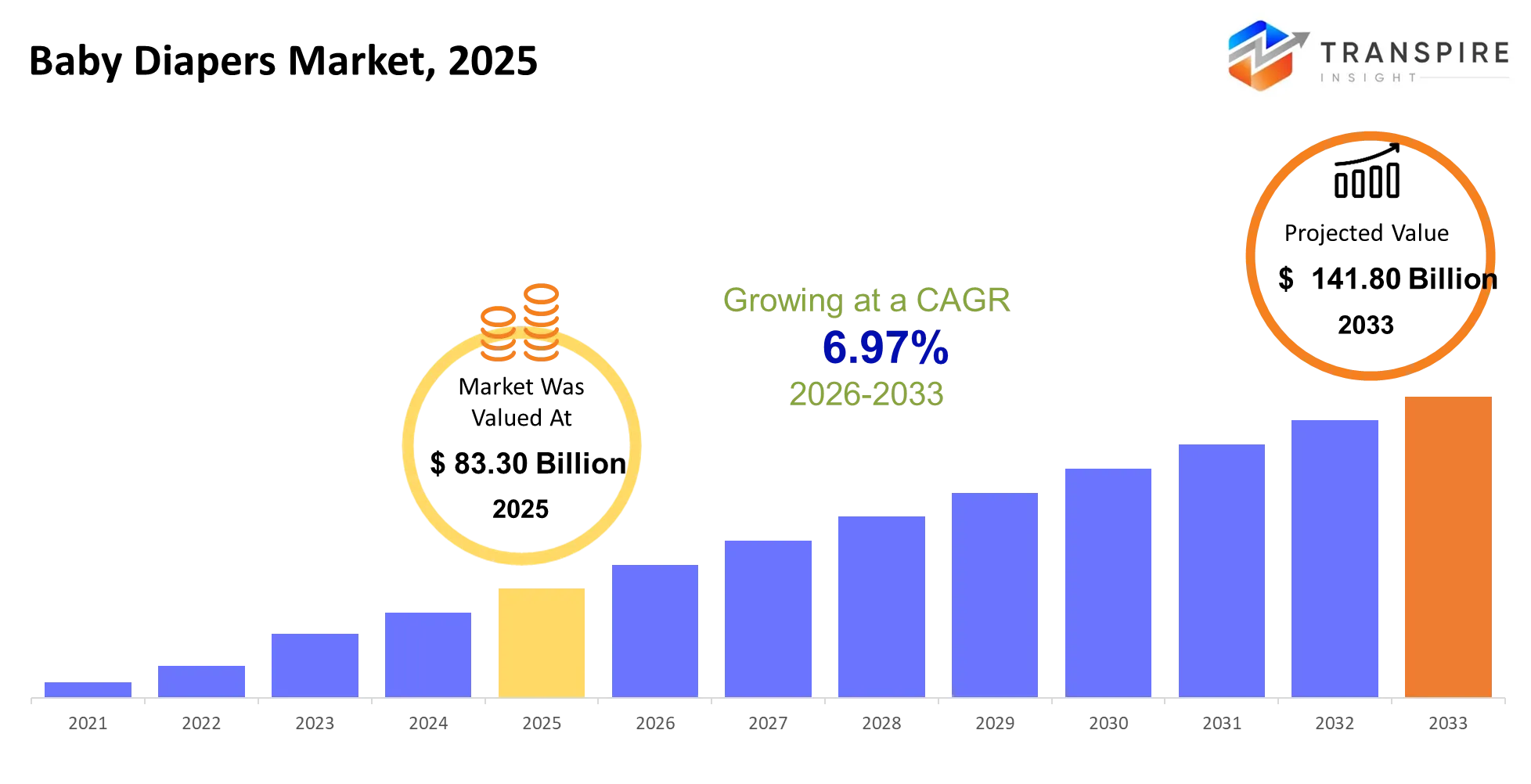
As per Transpire Insight Analysis, the Baby Diapers Market size is estimated at USD 83.30 billion in 2025 and is anticipated to reach USD 141.80 billion by 2033, growing at a CAGR of 6.97% from 2026 to 2033.
The baby diapers market is changing. It is moving away from being a basic hygiene product. Now it is becoming more focused on performance and specific needs. Parents are looking for fit, skin comfort, convenience and choices in materials when they buy diapers. Disposable diapers still make up a part of sales. Eco-friendly options are getting more attention. More parents and retailers care about reducing waste and using materials. In the past three to five years, diaper makers have improved their products. They have made absorbent cores thinner. Leak barriers have gotten better. The layers that touch the baby’s skin are softer. There are also styles made for newborns, active toddlers and overnight use. These changes help meet needs. A big shift is happening with materials. More companies are using recycled content or biodegradable options. Recycling programs are also becoming more common. Parents are driving this change. They care more about comfort, cleanliness and value for money. This progress follows a pattern. When diapers work better, parents keep buying them. When there are sizes and types, more families use them. When premium or eco-friendly versions come out, companies can earn more. Each improvement leads to sales and wider adoption.
Baby Diapers Market Size & Forecast:
- Market Size 2025: USD 83.30 Billion
- Expected Market Value (2033): USD 141.80 Billion
- Forecast CAGR (2026-2033): 6.97%
- Leading Region in 2025: Asia Pacific
- Fastest Growing Region: Latin America
- Key Company Profiles: Procter & Gamble, Kimberly-Clark, Unicharm, Essity, Kao Corporation, Hengan International, Ontex, Domtar, Nobel Hygiene, First Quality Enterprises, Hayat Kimya, Drylock Technologies, Kao, Pigeon Corporation, The Honest Company
Key Market Insights:
The baby diaper market has moved towards absorbency in its evolution, where performance, innovation, sustainability, and localisation form the core of differentiation. The disposable category holds the largest share, while there are new categories that could act as differentiation factors.
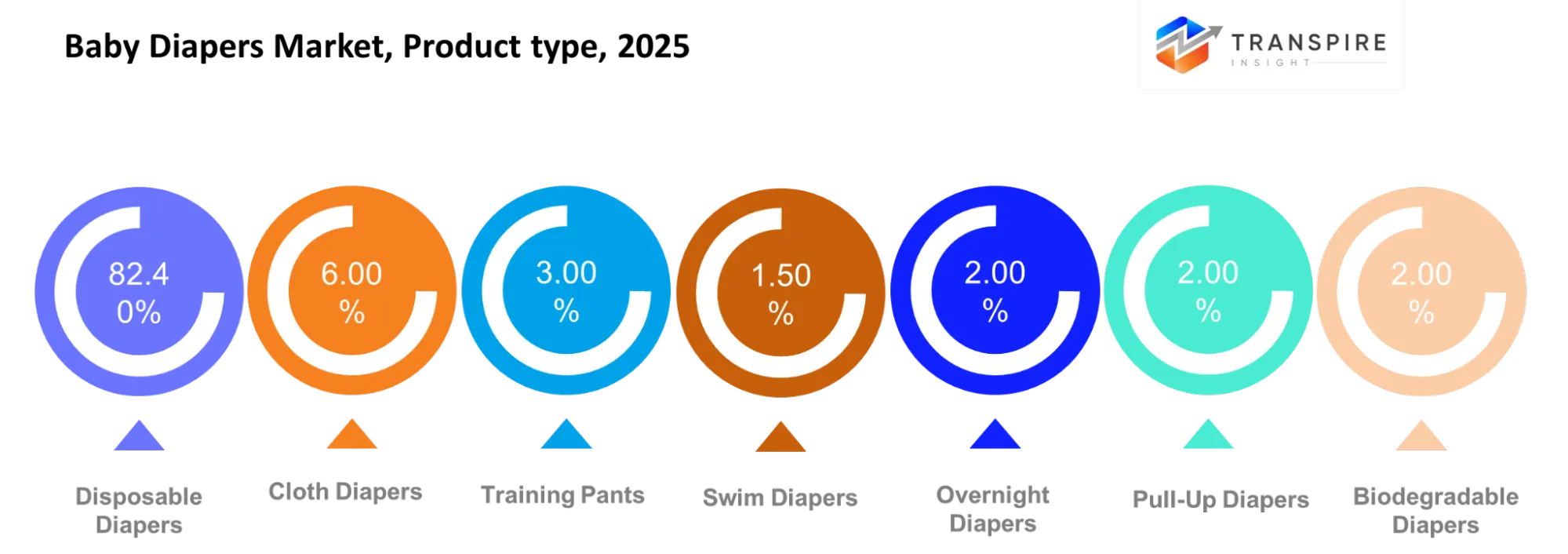
- The prominent product types include disposable diapers, which account for 82.40%. The manufacturers are striving to enhance the qualities of absorbency, softness, and leak protection.
- Biodegradable diapers are holding a CAGR of 8.90%, due to which manufacturers have started thinking about utilising recycled and plant-based materials.
- Cloth diapers constitute 6.00% and cater to the needs of customers who prefer reusability.
- Training pants have a market share of 3.00% because of the increase in mobility in toddlers, requiring convenient product design.
- Swim diapers make up 1.50% of the market, representing a specific application that requires special-purpose product design.
- The category of overnight diapers constitutes 2.00%, driven by the need for better leakage protection during the night.
- Pull-up diapers make up 2.00%, with manufacturers reacting to rising toddler independence by providing pants-like designs.
What are the Key Drivers, Restraints, and Opportunities in the Baby Diapers Market?
Drivers
The drivers of growth involve improved products in regard to leakage, fit, absorption, and skin. As parents begin to compare more products for their features, companies are going beyond conventional disposable diapers to focus on nighttime use, pull-ups, premium, and skin-focused diapers. Such developments ensure growth due to better product performance, which will reduce switching costs, leakage, and discomfort, thereby encouraging customers to come back for repeat purchases. The driver here is convenience.
Restraints
The restraint on this market is the environmental cost of disposable diapers. It will persist because diapers include a number of non-separable materials like plastics, absorbent polymers, and others. Moreover, the systems of collecting and recycling such products are still underdeveloped. This may create additional pressure on the market stakeholders.
Opportunities
The business opportunities lie in developing convenient products which are environmentally sustainable. These include the use of recycled materials for the production of diapers, plant-based feedstock as an input, slim packaging, and even diaper recycling programs. Unicharm's RefF scheme offers a model for how this could be done. The scheme sees to the collection and processing of used disposable diapers into recycled pulps and superabsorbent materials for further production purposes. It also enables manufacturers of premium products to capitalise on their strengths in material science and recycling partnerships.
What Has the Impact of Artificial Intelligence Been on the Baby Diapers Market?
The use of Artificial intelligence to drive the diapers business through aspects such as manufacturing, quality checking, demand prediction and product design and not through the diaper. On the production line, machine vision systems can perform continuous quality checks on diapers to detect faults such as wrong positioning of parts, bonding faults, contaminants or wrong shape and dispose of any that would cause quality concerns. The AI-powered analytics could even make use of historic data from machines and production to detect anomalies and predict breakdown of machines so that there is no downtime and material losses. AI could help the scientists to find connections between material composition, diaper performance, and reactions of users to create new products faster. Smart diapers are one more way to integrate AI, where sensors and machine learning algorithms will monitor parameters such as moisture and inform the users about them. There are some difficulties in this process, such as lack of funding, incompatibility with existing equipment, etc.
Instance
In May 2026, Unicharm Corporation extended the AI-driven service for caring for diapers by analysing user data to offer personalised recommendations for size and care, showcasing how AI has been used increasingly to enhance diaper selection and personalisation.https://publish-www.unicharm.co.jp/en/company/news/2026/0101-01.html
Key Market Trends:
The baby diapers market is shifting towards performance, sustainability, and convenience rather than depending solely on absorption.
- Diaper innovation is evolving from its absorptive core into a multifunctional product, which includes enhanced leak prevention, more advanced fit systems, as well as gentler skin contact surfaces.
- There has been a slight change in the product portfolio by introducing more pants-like diapers that cater to a growing baby demographic.
- Overnight safety has become a more defined product necessity, leading to manufacturers' efforts to introduce greater absorbent zones as well as designs intended to minimise night-time leaking.
- Green aspects of consumer goods have evolved from a niche interest to an essential development feature. This entails the usage of recycled inputs, environmentally friendly fabrics, light packaging, as well as diaper recycling programs.
- Producers are increasing automation of production by implementing machine vision technology to monitor fast production lines.
Baby Diapers Market Segmentation
By product type
the market share of disposable diapers accounts for 82.40%, since they are very convenient, reliable in terms of absorbency, and easily available on the market. Cloth diapers constitute 6.00%, training pants 3.00%, swim diapers 1.50%, while overnight and pull-up diapers each make up 2.00%. Biodegradable diapers constitute 2.00% and reusable diapers 1.10%. The biodegradable and eco-friendly segment is considered to be the fastest-growing one 8.90% CAGR, which means that an ecological approach becomes commercially significant along with the traditional one.
By size
The range in the market includes baby, small, medium, large, extra-large, double-X-large, and custom sizes. The baby and small sizes serve the needs of early age care, whereas the medium to double-X-large sizes provide increased body measurements along with increased mobility. Custom sizing addresses specific needs when the provision of a proper fit is not available through the standard sizes. The potential for the future in this product category will be based on improved fit, adjustable waist technology, proper leakage barriers, and sizing for delaying size changes.
By age group
The various age groups include infants of 0-6 months old, 6-12 months old, 12-18 months old, 18-24 months old, children of 2-3 years, 3-4 years, and those more than 4 years of age. While young babies need comfortable fabrics, secure fitting, and protection against rash, the older babies would need movement freedom, easy disposal, and potty training. Hence, there is room for development of age-specific elements as well, instead of looking at the whole group of children as a single user category.
By distribution channel
Supermarkets and hypermarkets remain highly important for bulk purchase by households, while pharmacies, convenience stores, speciality stores, baby stores, and wholesalers provide additional physical accessibility. Online shopping will continue to become more and more important since parents will be able to compare the specifications, reviews, pricing, pack sizes, and subscriptions before making the actual purchases. Channel mixing will evolve in such a way that physical stores would be used for immediate shopping and digital channels would be used to make shopping convenient and recurrent. Those brands that have online presence and that are sold through retail will reach parents at different stages of consideration.
By material
Cotton, non-woven cloth, super absorbent polymer, bamboo fibre, organic materials, recycled materials, and synthetic fibres have been used in the search for the best blend of softness, absorption, durability, competitive pricing, and sustainability. The use of super-absorbent polymers is vital when taking into account the moisture retention element, but the use of non-woven fabric takes care of the comfort part. But natural and recycled raw materials become increasingly important as manufacturers design sustainable diapers. An example of this is Unicharm’s RefF, which applies recycled pulp and super-absorbent raw materials in diapers.
By Price Category
The market includes economy packs, mid-range, premium, super-premium, organic, and eco-friendly products. Economy products will target the family that looks at the value per unit, while premium products will be competing on the basis of a better fit, absorbency, skin-friendliness, special use, and brand recognition. Organic and eco-friendly products present another way to differentiate for those consumers who take into consideration the materials used and the environment. The future outlook indicates a wider price ladder where the manufacturer can sell economy products and earn more from premium products.
What are the Key Use Cases Driving the Baby Diapers Market?
The use case is daily infant hygiene, spearheaded by disposable diapers, of the provided mix of product types. Their powerful presence is because of their convenience, good absorbency, easy disposal, and wide availability. New uses for this product type would be nighttime protection, pull-ups, training pants, and swim diapers. They cater to the practices of sleeping, mobility, toilet training, and water activities, which help companies expand their uses beyond regular diapering. Possible new uses would be in skin care, sustainability, and special needs for infants. The biodegradable and reusable versions would help address the need for eco-friendly products, while the advanced newborn and skin products can address sensitive care needs.
|
Report Metrics |
Details |
|
Market size value in 2025 |
USD 83.30 Billion |
|
Market size value in 2026 |
USD 88.50 Billion |
|
Revenue forecast in 2033 |
USD 141.80 Billion |
|
Growth rate |
CAGR of 6.97% from 2026 to 2033 |
|
Base year |
2025 |
|
Historical data |
2021 - 2024 |
|
Forecast period |
2026 - 2033 |
|
Report coverage |
Revenue forecast, competitive landscape, growth factors, and trends |
|
Regional scope |
United States; Canada; Mexico; United Kingdom; Germany; France; Italy; Spain; Denmark; Sweden; Norway; China; Japan; India; Australia; South Korea; Thailand; Brazil; Argentina; South Africa; Saudi Arabia; United Arab Emirates |
|
Key company profiled |
Procter & Gamble, Kimberly-Clark, Unicharm, Essity, Kao Corporation, Hengan International, Ontex, Domtar, Nobel Hygiene, First Quality Enterprises, Hayat Kimya, Drylock Technologies, Kao, Pigeon Corporation, The Honest Company |
|
Customization scope |
Free report customization (country, regional & segment scope). Avail customized purchase options to meet your exact research needs. |
|
Report Segmentation |
Product Type (Disposable Diapers, Cloth Diapers, Training Pants, Swim Diapers, Overnight Diapers, Pull-Up Diapers, Biodegradable Diapers, Reusable Diapers); Size (Newborn, Small, Medium, Large, Extra Large, XXL, Custom Sizes); Age Group (0-6 Months, 6-12 Months, 12-18 Months, 18-24 Months, 2-3 Years, 3-4 Years, Above 4 Years); Distribution Channel (Supermarkets & Hypermarkets, Pharmacies, Convenience Stores, Specialty Stores, Online Retail, Baby Stores, Wholesale); Material (Cotton, Nonwoven Fabric, Superabsorbent Polymer, Bamboo Fiber, Plant-Based Materials, Recycled Materials, Synthetic Fibers); Price Category (Economy, Mid-Range, Premium, Super-Premium, Organic, Eco-Friendly, Value Packs) |
Which Regions are Driving the Baby Diapers Market Growth?
North America
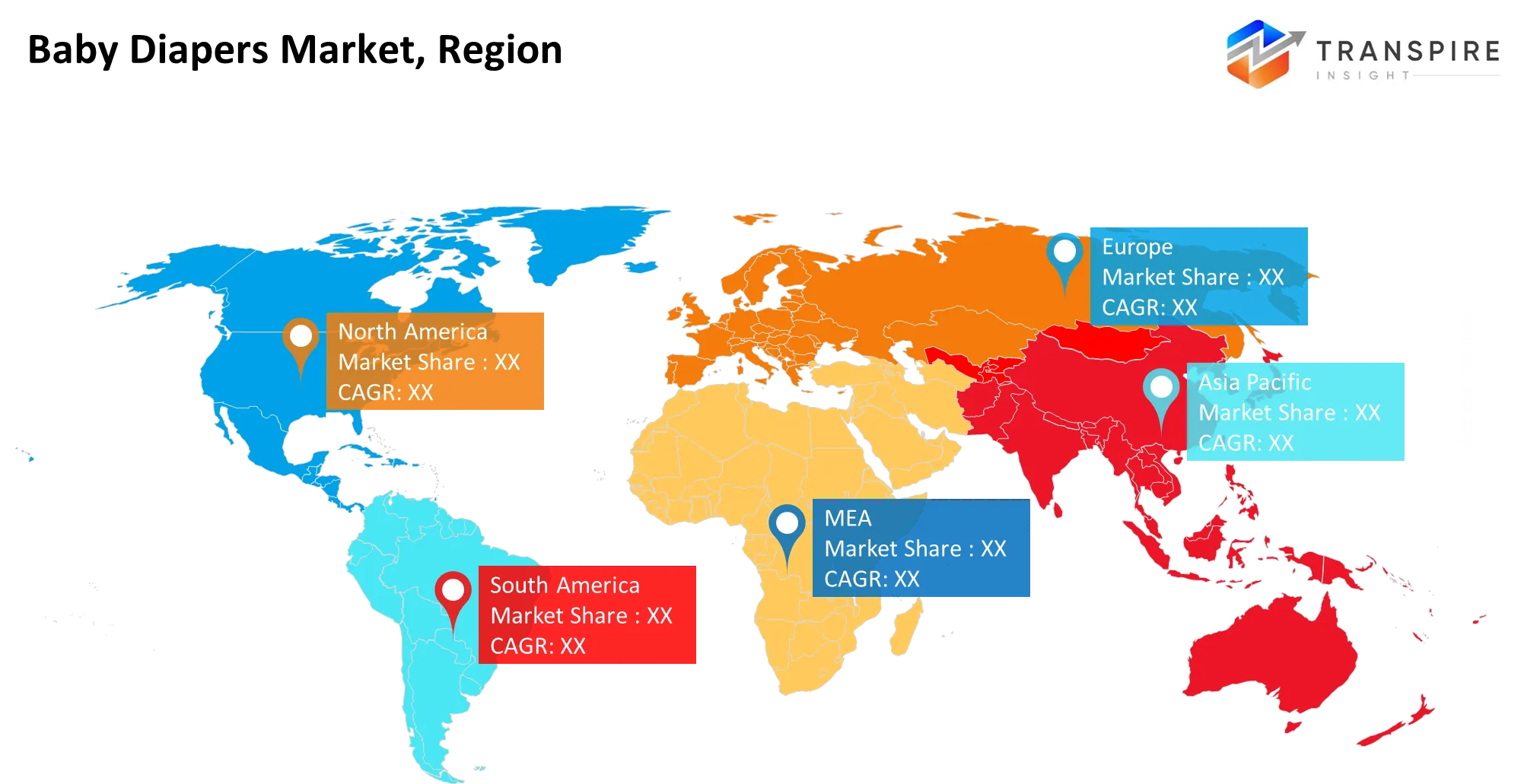
North America constitute 24.00% of the total baby diapers market share due to a sound distribution network and abundance of branded baby diapers available in modern distribution channels. In North America, there are well-developed distribution channels to sell such products through supermarkets, pharmacies, speciality stores, and even online. Differentiation through skin-friendliness, anti-leakage, and convenience is instrumental in boosting repurchase and premiumization in the market. Therefore, the prospects do not lie in access, but in innovation.
In June 2026, Procter & Gamble announced that it would strip Pampers Swaddlers diapers of their smell in all sizes in the United States. The change was attributed to the changing tastes of parents while the product still retains its absorbency, softness, and leak protection attributes. This is an example of product differentiation through skin-friendliness and changing consumer preferences in the North American baby diapers market. Procter & Gamblehttps://us.pg.com/newsroom/news-releases/Pampers-Swaddlers--from-Americas-1-Diaper-Brand1--Are-Now-Fragrance-Free/
Europe
Europe hold 21.00% of the baby diapers market and operates within the framework of consumer preference for sustainable and responsible products that are safe. There is a growing trend of retailers and consumers analysing such features as materials used, sustainability of packaging, the ability to recycle products and so on. Such a market favours the development of biodegradable, reusable, recycled-material diapers and low-plastic-content products in general, while keeping interest in reliable disposables.
In July 2025, Ontex Group incorporated bio-based superabsorbent polymer (bioSAP) in some Moltex Pure & Nature baby diaper products. The company noted that the bio-based raw material was 15%-25% more environmentally friendly in terms of its carbon footprint than conventional SAP.https://ontex.com/news/ontex-introduces-lower-carbon-bio-based-absorbent-material-in-diapers/
Asia Pacific
The Asia Pacific region is the leading regional market, accounting for 43.80% of the total market share on account of its strong consumer base, urbanisation, production capabilities, and availability of branded hygiene products. Product customisation according to local budgets, climatic conditions, baby care needs, and retail conditions allows disposable formats to reach more consumers. Premium product categories are also finding space alongside value-based products to create a wide range of pricing strategies rather than one type of market. The Latin America region, as per the provided data, is the fastest-growing region at 7.20% CAGR.
In September 2025, Kao Malaysia launched its Merries baby diapers with improved 360-degree breathability, increased absorbency and a stretchable waistband. The new improved versions of the baby diapers were meant to offer better comfort, breathability and leak protection to the babies.https://www.kao.com/my/news/2025/20251023-001/
Who are the Key Players in the Baby Diapers Market and how do they compete?
competition in the baby diapers market is focused on scalability, performance, branding, pricing models, and regional adaptability. Big players rely on design specialisation, sustainable solutions, online engagement, and regional product innovations to protect their positions instead of relying merely on product absorption. Procter & Gamble differentiates Pampers through research and development, performance, skin comfort, and specialisation of its solutions, as well as by offering products for premature babies. Expansion strategy relies on leveraging a combination of brand scale at the level and local innovations and consumer understanding. Competition from Kimberly-Clark is done by means of Huggies through fit, protection, skin comfort of the product, and portfolio relaunching, together with technology adaptations for regional markets such as Brazil. Unicharm pursues an innovation-based pricing model via MamyPoko and Moony brands, which cover value-based and specialised products along with recycling programs like RefF. Competition of Essity includes Libero and other baby-care solutions via brand scale and consumer understanding.
Baby Diapers Market companies
- Procter & Gamble
- Kimberly-Clark
- Unicharm
- Essity
- Kao Corporation
- Hengan International
- Ontex
- Domtar
- Nobel Hygiene
- First Quality Enterprises
- Hayat Kimya
- Drylock Technologies
- Kao
- Pigeon Corporation
- The Honest Company
Recent Development News
In March 2026, Unicharm has made an announcement regarding its MamyPoko Pants with the new “stretchable fit” design, making the present one size last longer due to greater flexibility. This demonstrates a direct answer to family budget issues and makes fit engineering a value along with absorbency.https://www.unicharm.co.jp/ja/company/news/2026/0331-01.html
In November 2025, Procter & Gamble’s Pampers came out with the introduction of Swaddlers Preemie XXS, a nappy created especially for the smallest premature babies, with the involvement of the help of the medical community. It broadens the special segment in newborn care and emphasises the trend in the development of size-specific diapers.https://origprod-cus-us.pg.com/blogs/pampers-introduces-worlds-tiniest-diaper/
What Strategic Insights Define the Future of the Baby Diapers Market?
The future for baby diaper value propositions is moving towards a bifurcated one where high-volume disposables will continue to be the core focus, but high-end, skin-friendly, specialised, and low-impact variants will take up an increasing share of the portfolio mix. The key trade-off that will have to be made will be between convenience and sustainability without making prices unaffordable for households. The underlying risk is that sustainability promises might outstrip recycling capabilities, leading to increased compliance costs or even consumer distrust due to a lack of adequate solutions for disposing of the product. One opportunity in this regard could be circular materials, localised product design and data-driven manufacturing, which could help improve consistency of product and reduce waste. There could also be the possibility of smart diapers, which would help create a new connection between hygiene and infant monitoring, although commercial viability is not clear yet.
Product Type
- Disposable Diapers
- Cloth Diapers
- Training Pants
- Swim Diapers
- Overnight Diapers
- Pull-Up Diapers
- Biodegradable Diapers
- Reusable Diapers
Size
- Newborn
- Small
- Medium
- Large
- Extra Large
- XXL
- Custom Sizes
Age Group
- 0-6 Months
- 6-12 Months
- 12-18 Months
- 18-24 Months
- 2-3 Years
- 3-4 Years
- Above 4 Years
Distribution Channel
- Supermarkets & Hypermarkets
- Pharmacies
- Convenience Stores
- Specialty Stores
- Online Retail
- Baby Stores
- Wholesale
Material
- Cotton
- Nonwoven Fabric
- Superabsorbent Polymer
- Bamboo Fiber
- Plant-Based Materials
- Recycled Materials
- Synthetic Fibers
Price Category
- Economy
- Mid-Range
- Premium
- Super-Premium
- Organic
- Eco-Friendly
- Value Packs
By Regional Analysis
North America
- US
- Canada
- Mexico
Europe
- Germany
- UK
- France
- Italy
- Spain
- Russia
- Rest of Europe
Asia Pacific
- China
- Japan
- India
- South Korea
- Australia
- Rest of Asia Pacific
South America
- Brazil
- Argentina
- Rest of South America
Middle East & Africa
- UAE
- Saudi Arabia
- Qatar
- South Africa
- Rest of the Middle East & Africa
Frequently Asked Questions
Find quick answers to common questions.
The baby diapers market size was valued at USD 83.30 Billion in 2025 and is poised to reach USD 141.80 Billion by 2033, expanding at a 6.97% CAGR.
Key segments for the baby diapers market are Product Type (Disposable Diapers, Cloth Diapers, Training Pants, Swim Diapers, Overnight Diapers, Pull-Up Diapers, Biodegradable Diapers, Reusable Diapers); Size (Newborn, Small, Medium, Large, Extra Large, XXL, Custom Sizes); Age Group (0-6 Months, 6-12 Months, 12-18 Months, 18-24 Months, 2-3 Years, 3-4 Years, Above 4 Years); Distribution Channel (Supermarkets & Hypermarkets, Pharmacies, Convenience Stores, Specialty Stores, Online Retail, Baby Stores, Wholesale); Material (Cotton, Nonwoven Fabric, Superabsorbent Polymer, Bamboo Fiber, Plant-Based Materials, Recycled Materials, Synthetic Fibers); Price Category (Economy, Mid-Range, Premium, Super-Premium, Organic, Eco-Friendly, Value Packs)
Growth is primarily driven by Increasing birth rates in developing countries, greater knowledge about hygiene of infants, rising incomes, urbanization, greater need for convenience in child care products, and rise of e-commerce.
The market is led by major manufacturers including Procter & Gamble, Kimberly-Clark, Unicharm, Essity, Kao Corporation, Hengan International, Ontex, Domtar, Nobel Hygiene, First Quality Enterprises, Hayat Kimya, Drylock Technologies, Kao, Pigeon Corporation, The Honest Company
The Asia Pacific region accounts for 43.80% of the baby diapers market owing to its rising number of infants, rising disposable incomes, growing urbanization, and growing awareness about baby hygiene. The growing retail network and increasing demand for premium baby diapers contribute to the growing influence of the region on the market dynamics
Opportunities for businesses in the international baby diapers industry include high-end and eco-friendly diapers, biodegradable products, intelligent diaper technology, customization, and development of e-commerce platforms. Businesses can also explore opportunities in developing countries through provision of low-cost but relevant products.
- Procter & Gamble
- Kimberly-Clark
- Unicharm
- Essity
- Kao Corporation
- Hengan International
- Ontex
- Domtar
- Nobel Hygiene
- First Quality Enterprises
- Hayat Kimya
- Drylock Technologies
- Kao
- Pigeon Corporation
- The Honest Company
About the Authors

Chetan Dhatrak
I’m Chetan Dhatrak, a Senior Research Analyst at Transpire Insight, specializing in the Consumer Goods, Foods and Beverages industry. I focus on analyzing market trends, consumer behavior, competitive landscapes, and industry developments to deliver accurate, data-driven insights. My research at Transpire Insight is built on credible sources and in-depth analysis, helping businesses and readers better understand market dynamics, emerging opportunities, and evolving consumer preferences. I’m committed to creating reliable, well-researched content that supports informed decision-making and reflects the latest developments in the consumer goods and food & beverage sectors.

Chakradhar Khansole
Chakradhar serves as the Research Director at Transpire Insight, bringing over 8 years of experience in technology, innovation, and strategic market intelligence. He specializes in transforming complex market data into actionable business insights that enable organizations to make informed, growth-oriented decisions. Recognized for his strategic vision and analytical expertise, Chakradhar leads high-impact research initiatives, delivering comprehensive market assessments, competitive intelligence, and forward-looking industry analysis.
Recently Published Reports
-
Apr 2026
Bottled Water Market
Bottled Water Market Size, Share & Analysis Report By Product Type (Still Bottled Water, Carbonated Bottled Water, Functional Bottled Water, and Others), By Packaging (PET, Cans, and Others), By Sales Channel (Supermarkets/Hypermarkets, Convenience Stores/Drug Stores, Grocery Stores/Club Stores, Foodservice, and Others) and Geography (North America, Europe, Asia-Pacific, Middle East and Africa, South and Central America), 2021 - 2032
-
Apr 2026
Color Cosmetic Packaging Market
Color Cosmetic Packaging Market Size, Share & Analysis Report By Application (Mascara Packaging, Liquid Packaging, and Liquid Face), By Type (Tubes & Bottles, Pens & Markers, Compacts & Containers, and Droppers & Pumps), and Geography (North America, Europe, Asia-Pacific, Middle East and Africa, South and Central America), 2021 - 2031
-
Apr 2026
External Microphone For Camera Market
External Microphone For Camera Market Size, Share & Analysis Report By Type (Shotgun Microphone, Lavalier Microphone, and Others), By Application (Digital Camera, Professional Video Camera, and Others), and Geography (North America, Europe, Asia-Pacific, Middle East and Africa, South and Central America), 2021 - 2031
-
Apr 2026
Foot Orthotic Insoles Market
Foot Orthotic Insoles Market Size, Share & Analysis Report By Type (Pre-fabricated, and Custom-made), By Material (Thermoplastic, Composite Carbon Fiber, and Others), By Distribution Channel (Drug Stores, Hospitals & Clinics, and Others), and Geography (North America, Europe, Asia-Pacific, Middle East and Africa, South and Central America), 2021 - 2031