
Market Summary
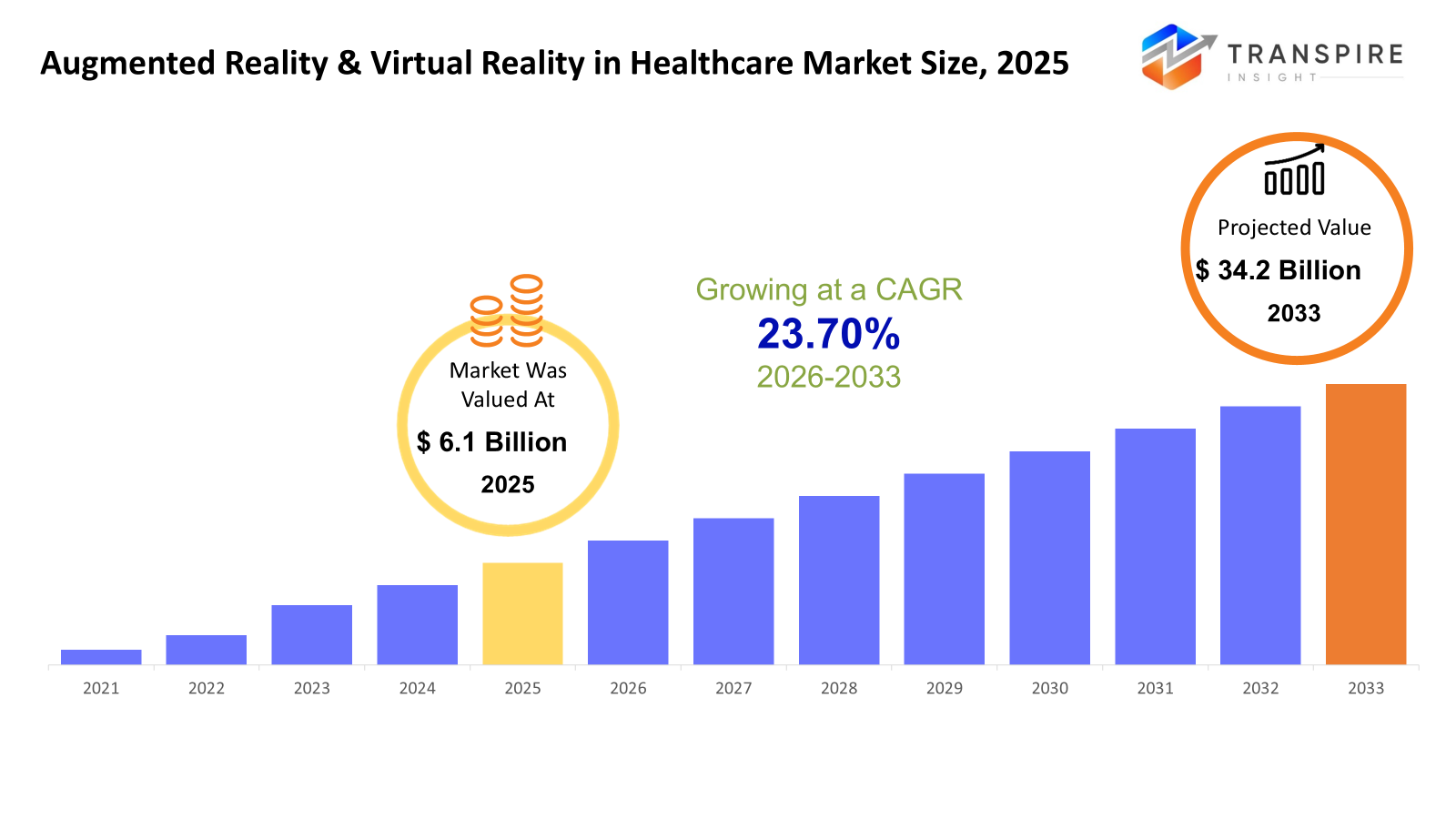
The global Augmented Reality & Virtual Reality in Healthcare Market size was valued at USD 6.1 billion in 2025 and is projected to reach USD 34.2 billion by 2033, growing at a CAGR of 23.70% from 2026 to 2033.
The market for Augmented Reality & Virtual Reality in the Healthcare Industry is gaining significant momentum globally, with these technologies changing the manner in which medical professionals train, diagnose, treat, and heal patients. AR superimposes computer-generated images on the real-time environment, whereas VR constructs completely virtual environments, both of which help in better visualization, learning, and simulation in the healthcare industry. Rise in investments in digital health, growing need for advanced surgical training solutions, and better patient engagement solutions are some factors propelling the market forward. These technologies have gained significant popularity in the past few years due to rapid technological developments, including the integration of AI & telemedicine platforms, coupled with the development of advanced healthcare infrastructure in developed & emerging markets, making them significant drivers of innovative healthcare globally.
Market Size & Forecast
- 2025 Market Size: USD 6.1 Billion
- 2033 Projected Market Size: USD 34.2 Billion
- CAGR (2026-2033): 23.70%
- North America: Largest Market in 2026
- Asia Pacific: Fastest Growing Market
To learn more about this report,  Download Free Sample Report
Key Market Trends Analysis
- The expansion of its clinical applications encompasses support for surgical planning, diagnosis, pain management, and even rehabilitation training, hence making these technologies increasingly indispensable across a range of healthcare functions.
- Immersive Medical Simulation and Training: Healthcare providers and academic institutions are increasingly adopting AR/VR to create a risk-free, immersive training environment that improves procedural skills, reduces errors, and prepares clinicians for real-world challenges.
- AR/VR will be integrated with telehealth and remote care, comprising virtual consultations, remote diagnostics, and improved patient engagement outside the bounds of the traditional clinical setting.
- Introduction of New Technologies and AI: Continuous hardware (head-mounted displays), software, and artificial intelligence improvements are further enriching user experience, accuracy, and clinical utility of AR/VR solutions in healthcare.
- Increasingly, the focus is laid on Patient Engagement and Education: AR/VR tools are increasingly used to let patients understand conditions and treatments better with visual and interactive experiences that improve adherence and enhance satisfaction.
Augmented Reality & Virtual Reality in Healthcare Market Segmentation
By Technology
- Augmented Reality (AR)
Augmented Reality is being increasingly used in the medical industry for overlaying data on the real-world operating environment. The usage of AR globally includes its applications in surgical navigation, visualization of medical images, detecting veins, and providing real-time medical guidance.
- Virtual Reality (VR)
A critical application of Virtual Reality is found in the medical field with computer-simulated environments used for medical education and surgery simulation, pain relief, psychology therapy, and physical rehabilitation. At a worldwide level, it is primarily driven as it offers risk-free learning and patient engagement support for digital healthcare services.
- Mixed Reality (MR)
Mixed Reality integrates both AR and VR components to enable digital entities to interact with real-world surroundings in real-time. Presently, MR has shown promise in medical implementations for advanced surgery planning, shared diagnostics, and advanced training in various medical settings around the world.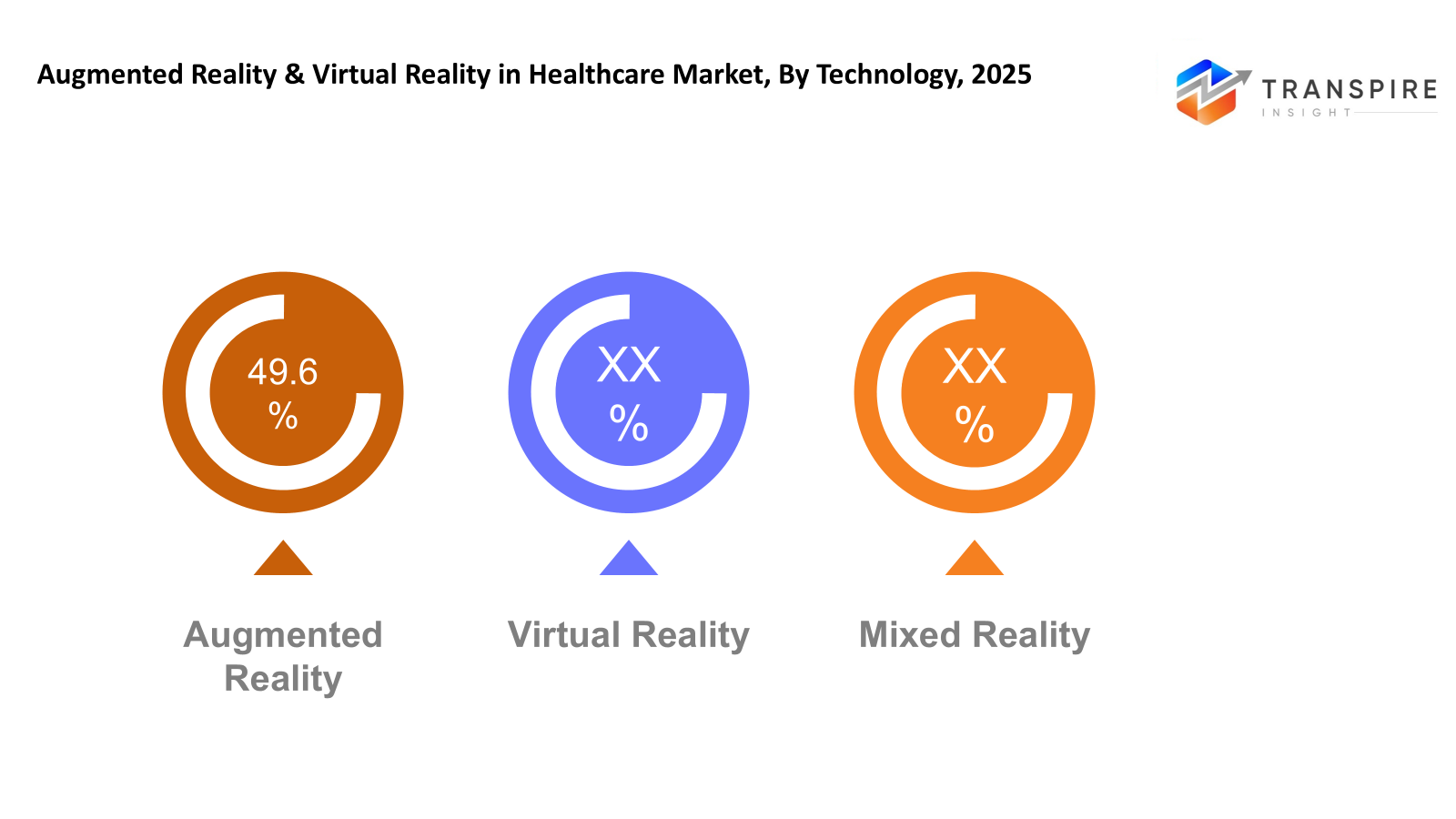
To learn more about this report, Download Free Sample Report
By Application
- Surgical Training
AR and VR are extensively employed in surgical training to create immersive risk-free settings for practicing complex procedures. AR and VR have been shown to enhance surgical precision and minimize training costs in order to develop skills around the world without hampering patient safety.
- Patient Education
AR and VR technologies improve patient education, allowing patients to understand different medical conditions, medical procedures, and care plans using visual explanations. On a global scale, patient engagement, compliance, and decision-making improve with increased patient understanding.
- Pain Management
VR technology is being widely used in managing pain conditions through the creation of virtual environments that provide distraction to the patients during the execution of painful procedures and in the treatment of chronic conditions of pain. Worldwide, the non-pharmacological technique reduces the dependence on the utilization of pain medications and ensures enhanced patient comfort.
- Physical Rehabilitation
Physical Rehabilitation In the area of physical rehabilitation, AR and VR enable interactive therapy sessions that aid in regaining motor functions. Such technologies are employed worldwide for providing customized and engaging experiences for physical recovery.
- Mental Health Therapy
AR and VR have been widely accepted in the world of mental health treatments for people dealing with conditions like anxiety, PTSD, and phobias. Virtual reality environments have the capability to provide controlled exposure therapy and virtual mental health interventions.
By End-user
- Hospitals
Hospitals are one of the major adopters of AR and VR technologies for surgical planning, managing pain, rehabilitation, and patient education. Therefore, hospitals around the world use these solutions to enhance procedural accuracy and reduce medical errors for better outcomes in patient care.
- Clinics
Clinics use AR and VR for outpatient therapies, mental treatments, and physical rehabilitations. The portability and flexibility of these systems have made it possible to provide innovative care with more engaged patients in clinics globally.
- Medical Schools
Medical schools use AR and VR in training and simulations to have students practice complex procedures without risk. Ultimately, these technologies raise learning efficiency and practical competencies for future healthcare specialists worldwide.
- Research Institutions
These are used in research institutions for developing new treatment protocols, simulating clinical scenarios, and studying disease progression. Thus, globally, these platforms are helping innovation in medical research and advancement in the development of next-generation healthcare solutions.
Regional Insights
North America dominates the overall AR & VR in healthcare market with the highest market share, attributed to its well-advanced medical infrastructure and significant research and development investments, and early adoption rates with immersive technologies. The U.S. takes the lead on the implementation front with applications across surgeries, medical staff training, and rehabilitative applications.
The second largest market for augmented reality (AR) and virtual reality (VR) in healthcare is in Europe. This can be attributed to the increasing investments made in digital healthcare in this region, as well as active R&D work in this sector. Countries such as Germany, the UK, and France are at the forefront in adopting AR/VR technology in their healthcare systems.
The Asia-Pac market is the fastest-growing, thanks to the speedy evolution of the healthcare industry, investments in better healthcare infrastructure, awareness about the benefits of AR/VR, and the medical tourism segment. The big markets, such as China, India, Japan, and South Korea, are investing in the adoption of immersive technologies.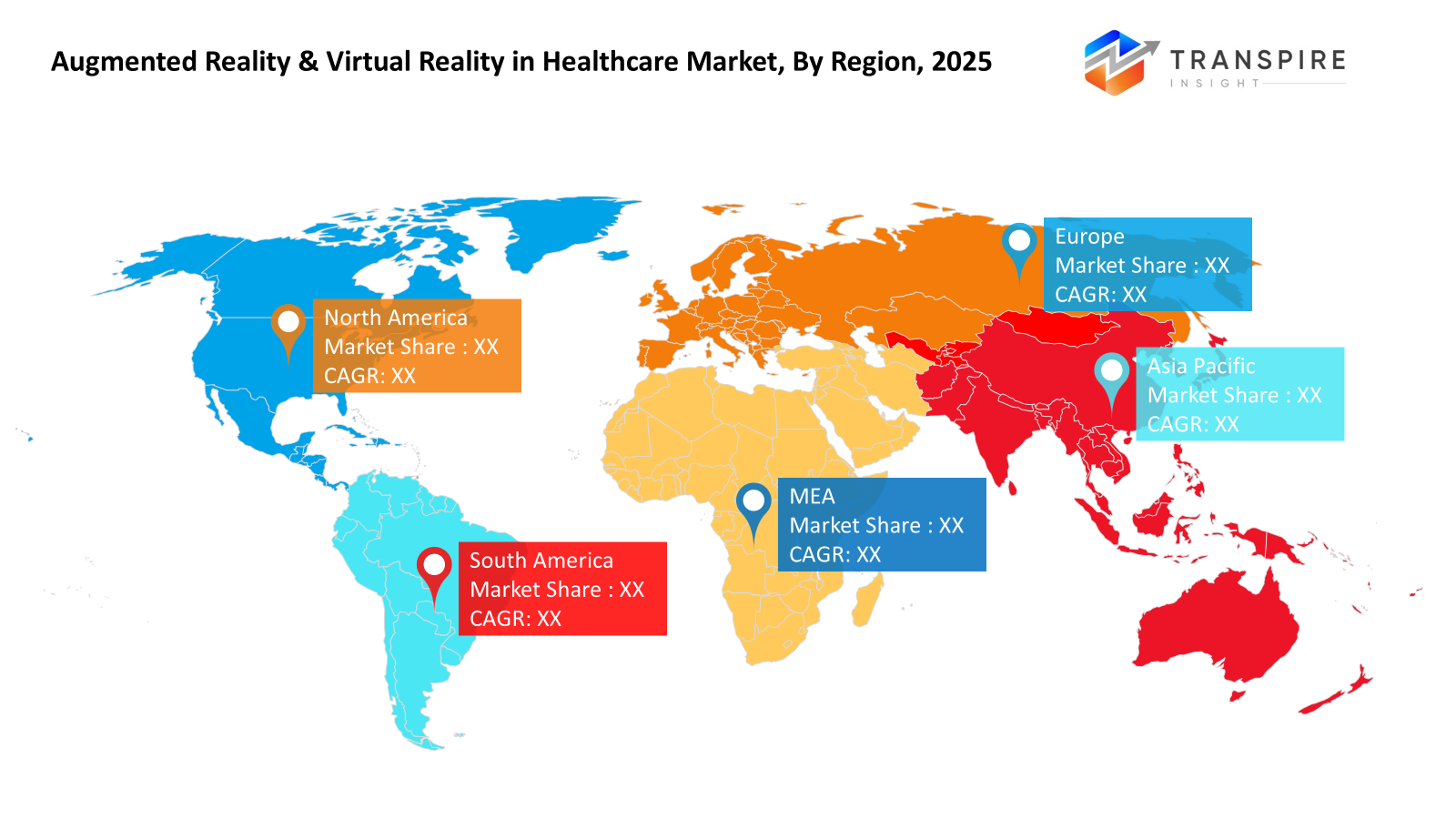
To learn more about this report, Download Free Sample Report
Recent Development News
- In March 2024, Siemens Healthineers launched an app developed for Apple Vision Pro to enable medical students, surgeons, and patients to view interactive, immersive holograms of the human body in medical scans in real-world settings. It can assist in medical education, surgical planning, or visualizing procedures.
Source:https://www.siemens-healthineers.com/press/releases/cinematic-reality-applevisionpro
- In July 2024, Medisim VR developed Chennai’s first immersive and interactive VR training lab at Sri Ramachandra Institute of Higher Education and Research (SRIHER). The lab utilizes VR technologies to provide unparalleled access to hands-on medical training to students to boost their skills and competency.
Source:https://sriramachandra.edu/news/sriher-sets-up-vr-simulation-lab-in-tie-up-with-medisim/
|
Report Metrics |
Details |
|
Market size value in 2025 |
USD 6.1 Billion |
|
Market size value in 2026 |
USD 7.8 Billion |
|
Revenue forecast in 2033 |
USD 34.2 Billion |
|
Growth rate |
CAGR of 23.70% from 2026 to 2033 |
|
Base year |
2025 |
|
Historical data |
2021 – 2024 |
|
Forecast period |
2026 – 2033 |
|
Report coverage |
Revenue forecast, competitive landscape, growth factors, and trends |
|
Regional scope |
North America; Europe; Asia Pacific; Latin America; Middle East & Africa |
|
Country scope |
United States; Canada; Mexico; United Kingdom; Germany; France; Italy; Spain; Denmark; Sweden; Norway; China; Japan; India; Australia; South Korea; Thailand; Brazil; Argentina; South Africa; Saudi Arabia; United Arab Emirates |
|
Key company profiled |
CAE Healthcare, GE Healthcare, Philips Healthcare, Microsoft, Siemens Healthineers, Intuitive Surgical, Psious, MindMaze, Virtualis, Oxford VR, Augmedics, Surgical Theater, EchoPixel, Medivis, Health Scholars, Vicarious Surgical, Touch Surgery, Propio Vision, Immersive Touch, OSSO VR, SentiAR, Medical |
|
Customization scope |
Free report customization (country, regional & segment scope). Avail customized purchase options to meet your exact research needs. |
|
Report Segmentation |
By Technology (Augmented Reality, Virtual Reality, Mixed Reality), By Application (Surgical Training, Patient Education, Pain Management, Physical Rehabilitation, Mental Health Therapy), By End-Use (Hospitals, Clinics, Medical Schools, Research Institutions) |
Key Augmented Reality & Virtual Reality in Healthcare Company Insights
With its broad portfolio-including IoT-enabled precision equipment, autonomous machinery, and data analytics platforms-Deere & Company is a clear market leader. Its global presence and significant investment in research and development allow the company to continue to innovate, providing scalable solutions for farmers that help improve operational efficiency and sustainability. Deere's ability to integrate hardware and software ecosystems provides a competitive advantage, which fosters wide diffusion across large commercial farms worldwide.
Key Augmented Reality & Virtual Reality in Healthcare Companies:
- CAE Healthcare
- GE Healthcare
- Philips Healthcare
- Microsoft
- Siemens Healthineers
- Intuitive Surgical
- Psious
- MindMaze
- Virtualis
- Oxford VR
- Augmedics
- Surgical Theater
- EchoPixel
- Medivis
- Health Scholars
- Vicarious Surgical
- Touch Surgery
- Propio Vision
- Immersive Touch
- OSSO VR
- SentiAR
- Medical
Global Augmented Reality & Virtual Reality in Healthcare Market Report Segmentation
By Technology
- Augmented Reality
- Virtual Reality
- Mixed Reality
By Application
- Surgical Training
- Patient Education
- Pain Management
- Physical Rehabilitation
- Mental Health Therapy
By End-user
- Hospitals
- Clinics
- Medical Schools
- Research Institutions
Regional Outlook
- North America
- United States
- Canada
- Mexico
- Europe
- Germany
- United Kingdom
- France
- Spain
- Italy
- Rest of Europe
- Asia Pacific
- Japan
- China
- Australia & New Zealand
- South Korea
- India
- Rest of Asia Pacific
- South America
- Brazil
- Argentina
- Rest of South America
- Middle East & Africa
- Saudi Arabia
- United Arab Emirates
- South Africa
- Rest of the Middle East & Africa
Frequently Asked Questions
Find quick answers to common questions.
The approximate Augmented Reality & Virtual Reality in Healthcare Market size for the market will be USD 34.2 billion in 2033.
Key segments for the Augmented Reality & Virtual Reality in Healthcare Market are By Technology (Augmented Reality, Virtual Reality, Mixed Reality), By Application (Surgical Training, Patient Education, Pain Management, Physical Rehabilitation, Mental Health Therapy), By End-Use (Hospitals, Clinics, Medical Schools, Research Institutions).
Major Augmented Reality & Virtual Reality in Healthcare Market players are CAE Healthcare, GE Healthcare, Philips Healthcare, Microsoft, Siemens Healthineers, Intuitive Surgical, Psious, MindMaze, Virtualis, Oxford VR, Augmedics, Surgical Theater, EchoPixel, Medivis, Health Scholars, Vicarious Surgical, Touch Surgery, Propio Vision, Immersive Touch, OSSO VR, SentiAR, Medical.
The North America region is leading the Augmented Reality & Virtual Reality in Healthcare Market.
The CAGR of the Augmented Reality & Virtual Reality in Healthcare Market is 23.70%.
- CAE Healthcare
- GE Healthcare
- Philips Healthcare
- Microsoft
- Siemens Healthineers
- Intuitive Surgical
- Psious
- MindMaze
- Virtualis
- Oxford VR
- Augmedics
- Surgical Theater
- EchoPixel
- Medivis
- Health Scholars
- Vicarious Surgical
- Touch Surgery
- Propio Vision
- Immersive Touch
- OSSO VR
- SentiAR
- Medical
Recently Published Reports
-
Dec 2024
AI in Diabetic Retinopathy Market
AI in Diabetic Retinopathy Market Size, Share & Analysis Report By Type (Screening AI Systems, Diagnostic AI Systems, and Predictive AI Models), By Application Segment (Hospitals, Ophthalmology Clinics, Diagnostic Centers, and Research and Development), and Geography (North America, Europe, Asia-Pacific, Middle East and Africa, South and Central America), 2021 - 2031
-
Feb 2025
Psychometric Tests Market
Psychometric Tests Market Size, Share & Analysis Report By Type (Personality Tests, Ability/Aptitude Tests, Skill/Knowledge Tests, and Others), By Application (Talent Acquisition and Talent Management), and Geography (North America, Europe, Asia-Pacific, Middle East and Africa, South and Central America), 2021 – 2031
-
Feb 2025
Rare Biological Sample Collection Market
Rare Biological Sample Collection Market Size, Share & Analysis Report By Type (Isolation Kits & Reagent, Blood Collection Tubes, and Others), By Application (Oncology, Transcriptomics, Pharmacogenomics, and Others), and Geography (North America, Europe, Asia-Pacific, Middle East and Africa, South and Central America), 2021 – 2031
-
Dec 2025
Patient Lift Pendant Market
Patient Lift Pendant Market By Product Type (Wired Pendants, Wireless, Programmable), By Operation Type(Manual, Electric), By End-Users (Healthcare Professionals, Patients), By Application (Hospitals, Homecare, Rehabilitation Centers, Others), By Industry Analysis, Size, Share, Growth, Trends, and Forecasts 2021-2033
Our Clients
.jpg)