
Asia Pacific Wheat Bran Market Size & Forecast:
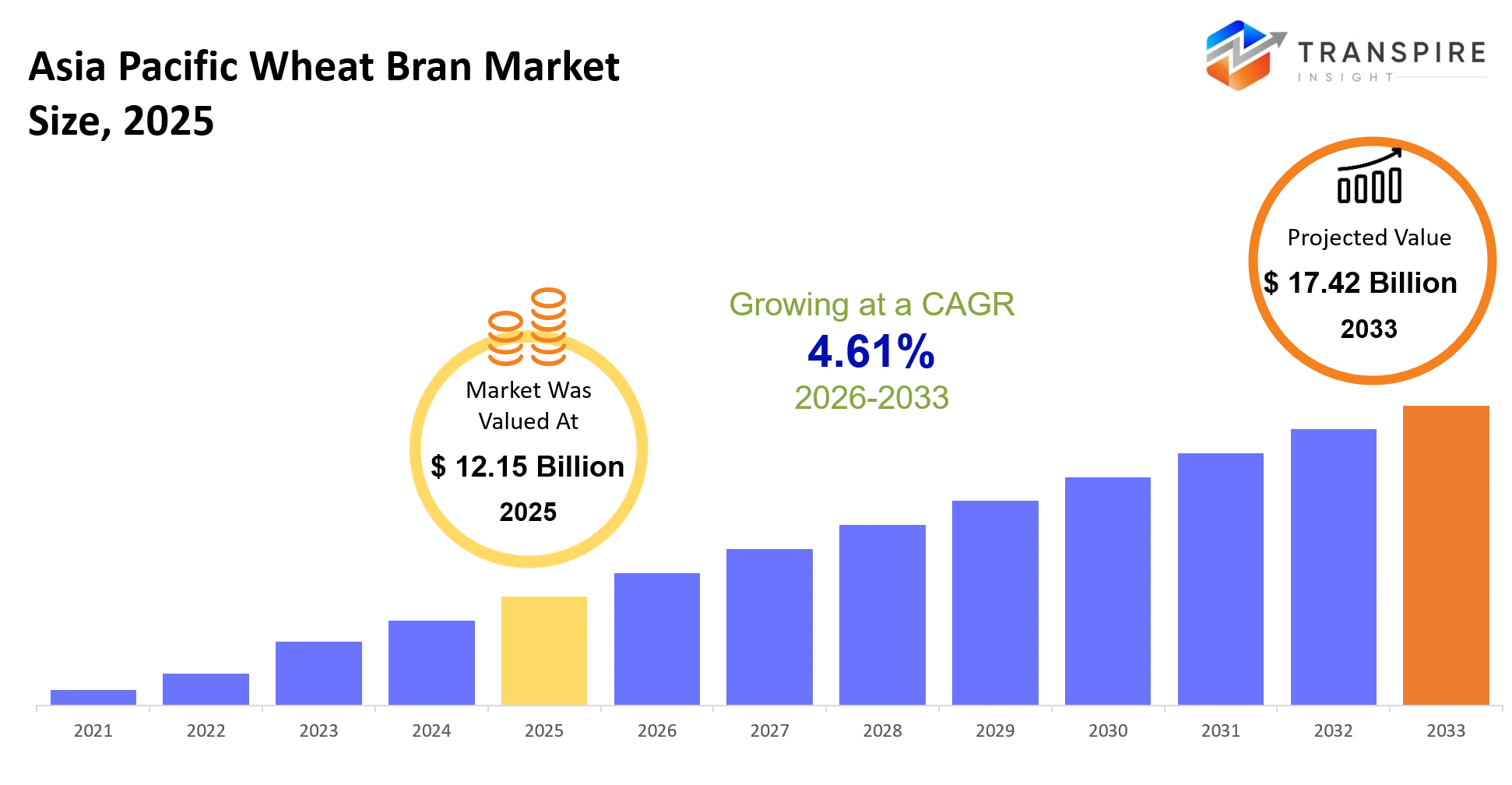
- Asia Pacific Wheat Bran Market Size 2025: USD 12.15 Billion
- Asia Pacific Wheat Bran Market Size 2033: USD 17.42 Billion
- Asia Pacific Wheat Bran Market CAGR: 4.61%
- Asia Pacific Wheat Bran Market Segments: By Product Type (Coarse Wheat Bran, Fine Wheat Bran, Organic Wheat Bran, Others); By Application (Animal Feed, Bakery Products, Cereals & Snacks, Dietary Supplements, Others); By End User (Feed Manufacturers, Food Industry, Consumers, Others)
To learn more about this report,  Download Free Sample Report
Asia Pacific Wheat Bran Market Summary
The Asia Pacific Wheat Bran Market was valued at USD 12.15 Billion in 2025. It is forecast to reach USD 17.42 Billion by 2033. That is a CAGR of 4.61% over the period.
The Asia Pacific wheat bran market kind of plays a key part in the regions food, feed, and nutrition value chain, by taking a milling byproduct and turning it into a higher value ingredient, that then shows up in animal feed, bakery goods, cereals, dietary supplements, and functional foods. Wheat bran helps feed manufacturers get better livestock nutrition and at the same time lets food processors raise the fiber content in their products without really pushing up production costs too much.
In the past five years or so, the market has shifted in a more structural way. A lot of food makers moved from more refined grain formulations toward fiber enriched products, and this matches what people are now aiming for with their diets. Meanwhile, supply chain issues after global grain trade volatility , plus changes in wheat exports, messed with raw material availability and pricing across several major Asia Pacific economies. Because of that, millers and processors started leaning harder on local sourcing networks, and they also invested in bran products with more added value. Growth is being supported by the expansion of commercial livestock farming, the wider use of fiber ingredients in packaged foods, and the increasing incorporation of wheat bran into nutraceutical formulas, which opens up new revenue paths beyond the usual feed use.
Key Market Insights
- Asia Pacific Wheat Bran Market, kind of sits on top with the largest global industry portion, helped by solid wheat processing capability, especially in China and India.
- In the East Asia slice, consumption takes the lead and it’s projected at around 38–42% market share in 2025 because flour milling keeps running at a big scale.
- South Asia is seen as the quickest moving regional arena through 2033, with momentum coming from livestock feed upgrade projects and additional investments in food processing, more or less.
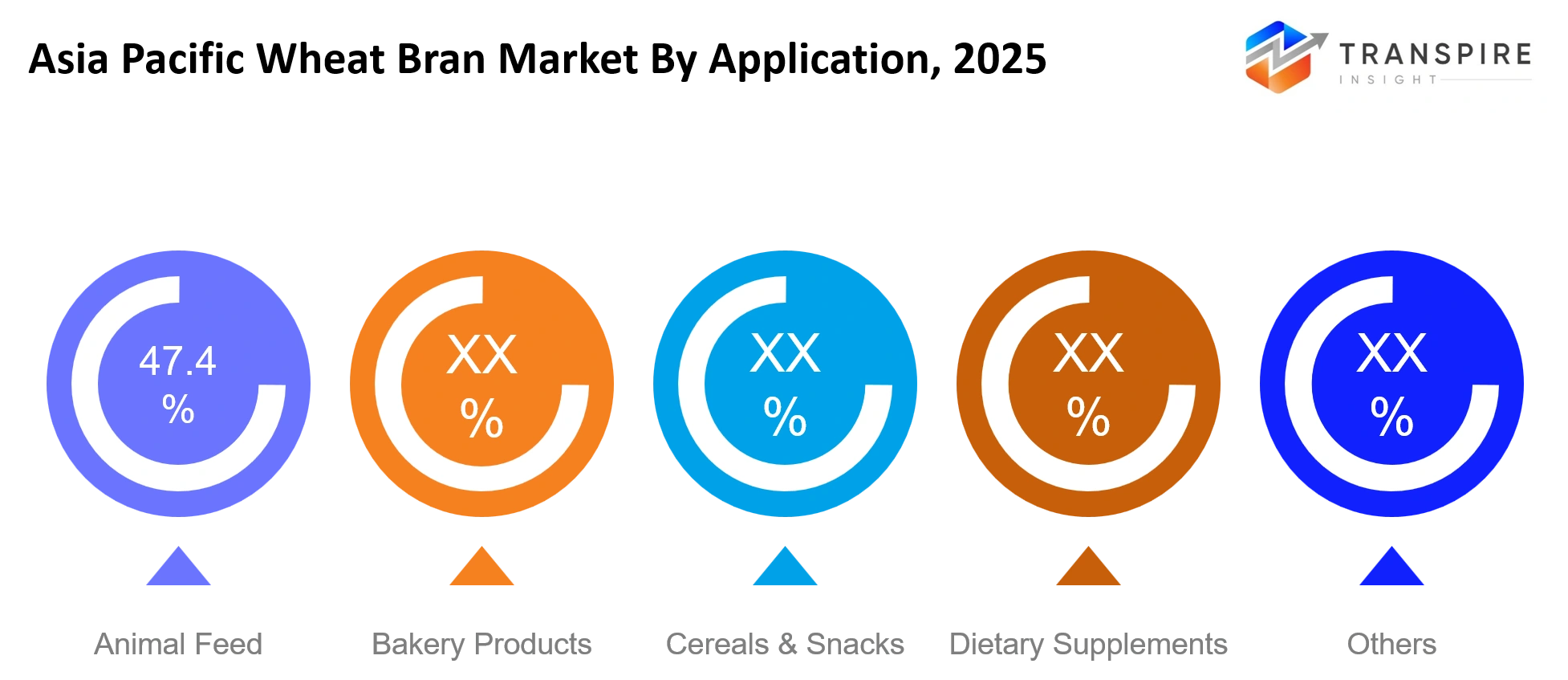
- When it comes to the product side, animal feed continues as the main segment, bringing in well over 55% of market revenue in 2025, used across poultry, dairy, and aquaculture tasks.
- Food-grade wheat bran stays in second place , gaining from fiber-boosted bakery items and breakfast cereal production.
- Functional, plus nutraceutical-grade bran is projected to post the swifter growth during 2026–2033.
- For applications, livestock feed covers about 60% of total demand so it becomes the most dominant revenue-maker by far.
- Functional foods and dietary supplements are starting to look like the fastest-growing use-cases, backed by launches of higher-end nutrition products.
- On the end-user front, commercial feed makers remain the biggest customer group with more than 50% market share across the Asia Pacific Wheat Bran Market.
- Key players such as Cargill, ADM, Wilmar International, Bunge, ITC, and Louis Dreyfus are pushing for product novelty, regional rollout, and supply chain streamlining efforts , to keep their competitive position strong.
What are the Key Drivers, Restraints, and Opportunities in the Asia Pacific Wheat Bran Market?
The primary growth driver is the rapid expansion of commercial livestock and poultry production across China, India, Vietnam, Indonesia and Thailand. Over the last several years rising feed costs, and this pushed feed formulators to try and include economical fiber-rich materials that help feed efficiency, while also keeping production expenses under control. Wheat bran gives a decent balance between nutritional value and cost, so it becomes attractive for large-scale feed manufacturers. And as the integrated livestock systems expand procurement volumes of wheat bran keep climbing, which directly adds to market revenue growth.
The biggest restraint is basically the market’s dependence on wheat production cycles plus grain price volatility. Wheat bran availability is naturally tied to flour milling output, so supply cannot really be expanded on its own just because demand rises. There are also climate-related disruptions, export restrictions, and swings in global wheat trade which together create structural supply risks that hit pricing and procurement plans. Because of these issues processors and feed producers hesitate on long-term purchasing commitments and their investment visibility also gets dimmer.
There’s a big opportunity in value-added fiber components for functional foods and nutraceuticals, not just the usual stuff. Food manufacturers in Japan, South Korea, Australia, China and India are increasingly put money into digestive wellbeing and fiber-heavy recipe styles. At the same time, new bran stabilization approaches are improving, which helps them last longer on the shelf and keeps nutritional integrity intact, so wheat bran starts to fit better into premium food applications. In other words, companies that can create branded, food-grade wheat bran ingredients might tap into higher margin pathways and lessen their dependence on straightforward commodity feed demand.
What Has the Impact of Artificial Intelligence Been on the Asia Pacific Wheat Bran Market?
Artificial intelligence is, a bit slowly really, reshaping how wheat is processed and how bran comes out across the Asia Pacific region. In many places, modern flour mills are rolling out AI enabled monitoring setups, to make grain sorting better, keep moisture under control, push milling efficiency higher, and keep product quality steady. With these systems you get huge amounts of production data looked at in real time, then the software nudges the processing settings automatically, so waste drops and overall output quality tends to rise.
At the same time, machine learning models are being used more often to anticipate wheat supply situations, track raw material costs, and estimate inventory needs. Predictive analytics in practice lets processors see procurement risks earlier and fine tune their storage methods, so they don’t get stuck with awkward stock. On top of that, some bigger milling companies rely on AI driven maintenance routines that spot equipment wear before a failure happens, which cuts down the surprise downtime and lifts how well the plant can actually run.
From an operations view, these tools back up lower processing losses, better yield recovery, and tighter energy consumption. There are also AI assisted quality management systems that help keep fiber level and particle size within the required ranges, the ones food and feed buyers typically demand.
Still, the uptake is not equal everywhere. A lot of medium sized mills struggle with high integration costs and patchy digital infrastructure. Also, AI models need extensive operational datasets, and those simply aren’t always available in older, traditional milling setups. So even if the efficiency gains look clear, these limitations keep broader deployment from moving as fast as it could.
Key Market Trends
- Producers of feed bumped up wheat bran inclusion rates from 2021 to 2025 , mostly to smooth out the volatile corn and soybean meal pricing.
- Meanwhile food manufacturers started expanding their fiber-enriched bakery ranges by well over 20% across big urban hubs, starting around 2022 .
- China and India also put more focus on domestic milling capacity , which helped make wheat bran more available locally , and made supply feel steadier.
- At the same time, premium food-grade bran offerings picked up share , as digestive-health formulations got more traction in Japan and South Korea.
- After 2023 , digital grain procurement platforms became pretty common, giving buyers better sourcing visibility and cleaner inventory planning.
- Bigger processors then began moving away from pure bulk commodity sales, and toward more bespoke brand specs for both food and feed users .
- Bran stabilization technologies got wider adoption too, which generally extended shelf life and supported ingredient sales aimed at export channels.
- Also, strategic acquisitions among milling and grain-processing firms picked up speed between 2024 and 2026 , mainly to beef up their ingredient portfolio .
- Livestock integrators increasingly signed longer term supply agreements , to lower how much they were exposed to grain market swings.
- And sustainability programs nudged higher use of milling byproducts , improving overall resource efficiency across these grain-processing operations .
Asia Pacific Wheat Bran Market Segmentation
By Product Type
Coarse Wheat Bran holds a notable share, mainly because it is widely used in livestock nutrition and feed building , in general. The higher fiber amount helps digestive performance in cattle, poultry, and also many other farm animals. And because it is cost-effective, it stays readily available from flour milling operations, so feed production facilities keep adopting it at larger scales.
Fine Wheat Bran, on the other hand gets a strong pull from food manufacturers, since a finer particle size makes it easier to blend and it supports texture in processed food products. Organic Wheat Bran keeps getting noticed too, as food producers push clean-label and certified organic product lines. There are also other options like specialty wheat bran products made for nutritional use, customized formulas , and specific processing needs, which then opens up extra possibilities across both food and feed sectors.
By Application
Animal Feed is a big application area,mostly because wheat bran gives a cost friendly source of fiber and nutrients for commercial livestock production. The feed manufacturers use wheat bran to help build steady,balanced feed recipes and still keep production costs under control. Also the fact that it stays reliably available and works well with many different feed types keeps the demand alive in this part of the market.
Bakery Products hold a strong share too, since bakers add wheat bran into bread, biscuits , and other baked goods to raise the fiber level. Cereals & Snacks stay visible in the marketplace by creating nutrition focused items that health minded people tend to look for. Dietary Supplements keep growing as fiber based nutritional options become more accepted, while Others covers things like functional foods, pet nutrition products, and specialized food uses where wheat bran gets used for nutritional upgrade,or something along those lines.
To learn more about this report, Download Free Sample Report
By End User
Feed Manufacturers account for a fairly big share, because commercial livestock operations need large, consistent volumes of wheat bran to make feed. Demand that stays steady from poultry, dairy and general animal husbandry keeps consumption levels supported. On top of that , operational efficiency and cost management aims also help drive ongoing buying across the feed industry.
The Food Industry also stays important as an end-user category, since manufacturers use wheat bran in baked goods, cereals, snack foods, and nutritional items. People keep creating market openings just by buying fiber-rich and wellness oriented products that include wheat bran. Other users include companies focused on nutrition , pet food producers, research groups, and specialty ingredient processors who rely on wheat bran for multiple business uses and product development needs.
What are the Key Use Cases Driving the Asia Pacific Wheat Bran Market?
The biggest use case still feels like animal nutrition, where wheat bran works as a comparatively low cost source of dietary fiber, protein, and energy for poultry, dairy cattle, swine, and aquaculture feed formulations. Most large commercial feed manufacturers drive the bulk of regional consumption, because bran helps enhance feed economics while still backing animal well-being, you know
Past that, food processors are adding wheat bran more often into bakery goods, breakfast cereals, snack items, and fiber enriched flour blends. At the same time, nutritional supplement makers also fold stabilized bran into digestive health recipes and wellness products for people who are already health-conscious.
Newer uses keep showing up too, like functional beverages, plant based nutrition products, and even specialized pet food formulations. As ingredient processing technologies keep improving these more value, or higher-value channels are anticipated to bring steadier revenue growth compared with older commodity feed routes over the forecast period.
|
Report Metrics |
Details |
|
Market size value in 2025 |
USD 12.15 Billion |
|
Market size value in 2026 |
USD 12.71 Billion |
|
Revenue forecast in 2033 |
USD 17.42 Billion |
|
Growth rate |
CAGR of4.61% from 2026 to 2033 |
|
Base year |
2025 |
|
Historical data |
2021 - 2024 |
|
Forecast period |
2026 - 2033 |
|
Report coverage |
Revenue forecast, competitive landscape, growth factors, and trends |
|
Regional scope |
Asia Pacific (India, China, Japan, Australia, South Korea, Rest of Asia Pacific) |
|
Key company profiled |
Cargill, ADM, Ardent Mills, Louis Dreyfus, General Mills, Hindustan Unilever, ITC, Bunge, GrainCorp, Wilmar International, Bay State Milling, GoodMills Group, Siemer Milling, Conagra, Flour Mills of Nigeria |
|
Customization scope |
Free report customization (country, regional & segment scope). Avail customized purchase options to meet your exact research needs. |
|
Report Segmentation |
By Product Type (Coarse Wheat Bran, Fine Wheat Bran, Organic Wheat Bran, Others); By Application (Animal Feed, Bakery Products, Cereals & Snacks, Dietary Supplements, Others); By End User (Feed Manufacturers, Food Industry, Consumers, Others) |
Which Regions are Driving the Asia Pacific Wheat Bran Market Growth?
China still feels like the big center, the dominant market across the Asia Pacific area. The country gets an edge from one of the world’s largest flour milling industries, broad feed manufacturing infrastructure, and well, a very large livestock population too. On top of that, government support tied to food security and domestic grain processing keeps things more stable than you might expect. There is also a fairly mature network of millers, feed producers, and food processors that just keeps the leadership running.
India is sitting as the second-largest contributor, but it’s a bit different from China. It leans more on a strong agricultural base and a food processing sector that is still getting wider and more established. A lot of this growth is backed by higher spending in organized feed production, packaged food manufacturing, and rural livestock development. Because domestic wheat availability stays relatively dependable, the raw material footing isn’t constantly shifting, and that helps keep demand steady across both feed and food uses.
Meanwhile, Southeast Asia is showing up as the fastest-growing regional market through 2033. Places like Vietnam, Indonesia, and Thailand are modernizing their livestock production systems, and they’re putting real money into feed manufacturing capacity. As meat consumption keeps climbing and poultry industries expand, feed ingredient procurement becomes easier and more constant. For investors and people trying to enter the market, the region reads as attractive—lower market saturation in many areas and strong long-term consumption growth, so it’s not just short-term movement.
Who are the Key Players in the Asia Pacific Wheat Bran Market and How Do They Compete?
Competition still looks pretty moderately fragmented, where worldwide agribusiness entities compete together with smaller, regional milling and grain-processing specialists. In practice the big deal is cost efficiency, plus how well supply-chain control is run, raw material access, and the overall product quality. The bigger multinationals often lean on integrated grain sourcing networks, while the regional players lean more on local connections and more customized product offerings which feels… very practical
Cargill, ADM, and Louis Dreyfus go after the market using broad agricultural supply chains that give pretty dependable access to wheat and milling byproducts. With their scale they can press down procurement costs, manage commodity risks, and end up serving large food and feed manufacturers across various countries. They also push investments into processing efficiency and digital supply-chain tools, which kind of locks in the advantage further
Wilmar International has a solid footprint across Asia, plus a wide distribution setup that links agricultural processing facilities to food manufacturers. Bunge instead concentrates on integrated grain trading, and ingredient solutions, so it can capture value across several stages of the chain, not just one piece. ITC uses its deep sourcing network in India, and it keeps broadening its food ingredient portfolio, so it can serve both domestic customers and export markets too. Overall these firms keep expanding through processing investments, strategic partnerships, and higher-value ingredient offerings , which is what helps them stand out from the more commodity-first competitors
Company List
- Cargill
- ADM
- Ardent Mills
- Louis Dreyfus Company
- General Mills
- Hindustan Unilever
- ITC Limited
- Bunge
- GrainCorp
- Wilmar International
- Bay State Milling
- GoodMills Group
- Siemer Milling Company
- Conagra Brands
- Flour Mills of Nigeria Plc (FMN)
Recent Development News
In May 2026, ADM entered a partnership with TechnoServe under its Farm Forward Initiative. The company committed USD 500,000 to support regenerative agriculture adoption among 15,000 farmers in Maharashtra, strengthening agricultural supply-chain resilience and future grain sourcing capabilities.https://www.adm.com
In April 2026, Ardent Mills launched expanded UltraGrain flour solutions with whole-grain nutritional benefits and white-flour functionality. The development supports growing demand for fiber-rich grain ingredients and strengthens the company's value-added milling portfolio.https://www.millingjournal.com
In July 2025, Ardent Mills announced an agreement to acquire Stone Mill in North Dakota. The acquisition expands specialty grain processing capabilities and supports diversification into higher-value nutrition-focused ingredient markets.https://www.ardentmills.com
What Strategic Insights Define the Future of the Asia Pacific Wheat Bran Market?
The Asia Pacific wheat bran market is kinda moving toward higher specialization and “value add” steps, not just plain volume growth. Over the next ten years, the main push will come more from food-grade, nutraceutical, and functional ingredient uses than from the older feed markets only. And you can see this happening because ingredient processing tech keeps improving, food manufacturing plants are spreading and getting stronger, plus more and more brands are using fiber-enriched formulations in their daily products.
A risk that is a bit less noticed (but still real) is how much the market depends on wheat production and milling output. If weather events get messy, or trade gets restricted, or grain supply stays uneven for a long time, brand availability can get squeezed, even while end buyers are still asking for it. That kind of concentrated supply can cause pricing swings and margin pressure, sooner than expected.
There is also a new opportunity showing up, though. Stabilized and micronized wheat bran ingredients, aimed at premium health and wellness lines, are starting to work well across South Asia and East Asia. Firms that commit early to advanced processing equipment can pull in the higher-margin demand. Market players should focus on vertical integration, keep long-term grain sourcing agreements locked in, and grow their value-added product range, so resilience and profitability hold steady through 2033.
Asia Pacific Wheat Bran Market Report Segmentation
By Product Type
- Coarse Wheat Bran
- Fine Wheat Bran
- Organic Wheat Bran
- Others
By Application
- Animal Feed
- Bakery Products
- Cereals & Snacks
- Dietary Supplements
- Others
By End User
- Feed Manufacturers
- Food Industry
- Consumers
- Others
Frequently Asked Questions
Find quick answers to common questions.
The expected Asia Pacific Wheat Bran Market size for the market will be USD 17.42 Billion in 2033.
Key segments for the Asia Pacific Wheat Bran Market are By Product Type (Coarse Wheat Bran, Fine Wheat Bran, Organic Wheat Bran, Others); By Application (Animal Feed, Bakery Products, Cereals & Snacks, Dietary Supplements, Others); By End User (Feed Manufacturers, Food Industry, Consumers, Others)
Major Asia Pacific Wheat Bran Market players are Cargill, ADM, Ardent Mills, Louis Dreyfus, General Mills, Hindustan Unilever, ITC, Bunge, GrainCorp, Wilmar International, Bay State Milling, GoodMills Group, Siemer Milling, Conagra, Flour Mills of Nigeria
The Asia Pacific Wheat Bran Market size is USD 12.15 Billion in 2025.
The Asia Pacific Wheat Bran Market CAGR is 4.61% from 2026 to 2033.
- Cargill
- ADM
- Ardent Mills
- Louis Dreyfus Company
- General Mills
- Hindustan Unilever
- ITC Limited
- Bunge
- GrainCorp
- Wilmar International
- Bay State Milling
- GoodMills Group
- Siemer Milling Company
- Conagra Brands
- Flour Mills of Nigeria Plc (FMN)
About the Authors

Chetan Dhatrak
I’m Chetan Dhatrak, a Senior Research Analyst at Transpire Insight, specializing in the Consumer Goods, Foods and Beverages industry. I focus on analyzing market trends, consumer behavior, competitive landscapes, and industry developments to deliver accurate, data-driven insights. My research at Transpire Insight is built on credible sources and in-depth analysis, helping businesses and readers better understand market dynamics, emerging opportunities, and evolving consumer preferences. I’m committed to creating reliable, well-researched content that supports informed decision-making and reflects the latest developments in the consumer goods and food & beverage sectors.

Chakradhar Khansole
Chakradhar serves as the Research Director at Transpire Insight, bringing over 8 years of experience in technology, innovation, and strategic market intelligence. He specializes in transforming complex market data into actionable business insights that enable organizations to make informed, growth-oriented decisions. Recognized for his strategic vision and analytical expertise, Chakradhar leads high-impact research initiatives, delivering comprehensive market assessments, competitive intelligence, and forward-looking industry analysis.
Recently Published Reports
-
Apr 2026
Baby Infant Formula Market
Baby Infant Formula Market Size, Share & Analysis Report By ype (Infant Milk, Follow On Milk, Specialty Baby Milk, Growing-Up Milk), By Ingredient (Carbohydrate, Fat, Protein, Minerals, Vitamins, and Others), By Product Form (Powder, Liquid, and Ready-to-feed), By Distribution Channels (Supermarket/Hypermarket, Specialty Store, Pharmacies, Online Retail, and Others), and Geography (North America, Europe, Asia-Pacific, Middle East and Africa, South and Central America), 2021 - 2031
-
Apr 2026
Edible Insects for Animal Feed Market
Edible Insects for Animal Feed Market Size, Share & Analysis Report By Type (Insect Powder, Insect Meal, Insect Bar, Insect Paste, Insect Oil, and Others), By Insect Type (Beetles, Cricket, Caterpillar, Hymenoptera, Orthoptera, Tree Bugs, and Others), By Application (Livestock, Pet Food, and Aquaculture), By Livestock Type (Poultry, Swine, and Others), and Geography (North America, Europe, Asia-Pacific, Middle East and Africa, South and Central America), 2021 - 2031
-
Apr 2026
Food Industry Disinfection and Bacterial Control Market
Food Industry Disinfection and Bacterial Control Market Size, Share & Analysis Report By Type (Chemical Disinfectants, Physical Disinfectants, and Biocides and Antimicrobials), By Application (Food Processing Equipment Surface Disinfection, Food Preparation Areas Surface Disinfection, Storage Areas Surface Disinfection, Anti-microbial Coatings Food Preservation, and Preservative Solutions Food Preservation), By End User (Meat and Poultry Processing, Dairy Processing, Seafood Processing, Bakery and Confectionery, Restaurants and Commercial Kitchens, and Food Service Providers), By Sales Channel (Online, Offline), and Geography (North America, Europe, Asia-Pacific, Middle East and Africa, South and Central America), 2021 - 2031
-
May 2026
Freeze Dried Food Market
Freeze Dried Food Market Size, Share & Analysis Report By Product Type (Fruits, Vegetables, Freeze-Dried Dairy Products, Freeze-Dried Meat and Seafood, Freeze-Dried Pet Food, and Prepared Meal), By Nature (Organic, and Conventional), By Form (Powdered, Granules, and Diced), By End Use (Breakfast Cereals, Dairy Products, Bakery & Confectionery, Nutritional Bars & Supplements, Powdered Beverages, Snacks, and Retail (Household)), and Geography (North America, Europe, Asia-Pacific, Middle East and Africa, South and Central America), 2021 - 2031