
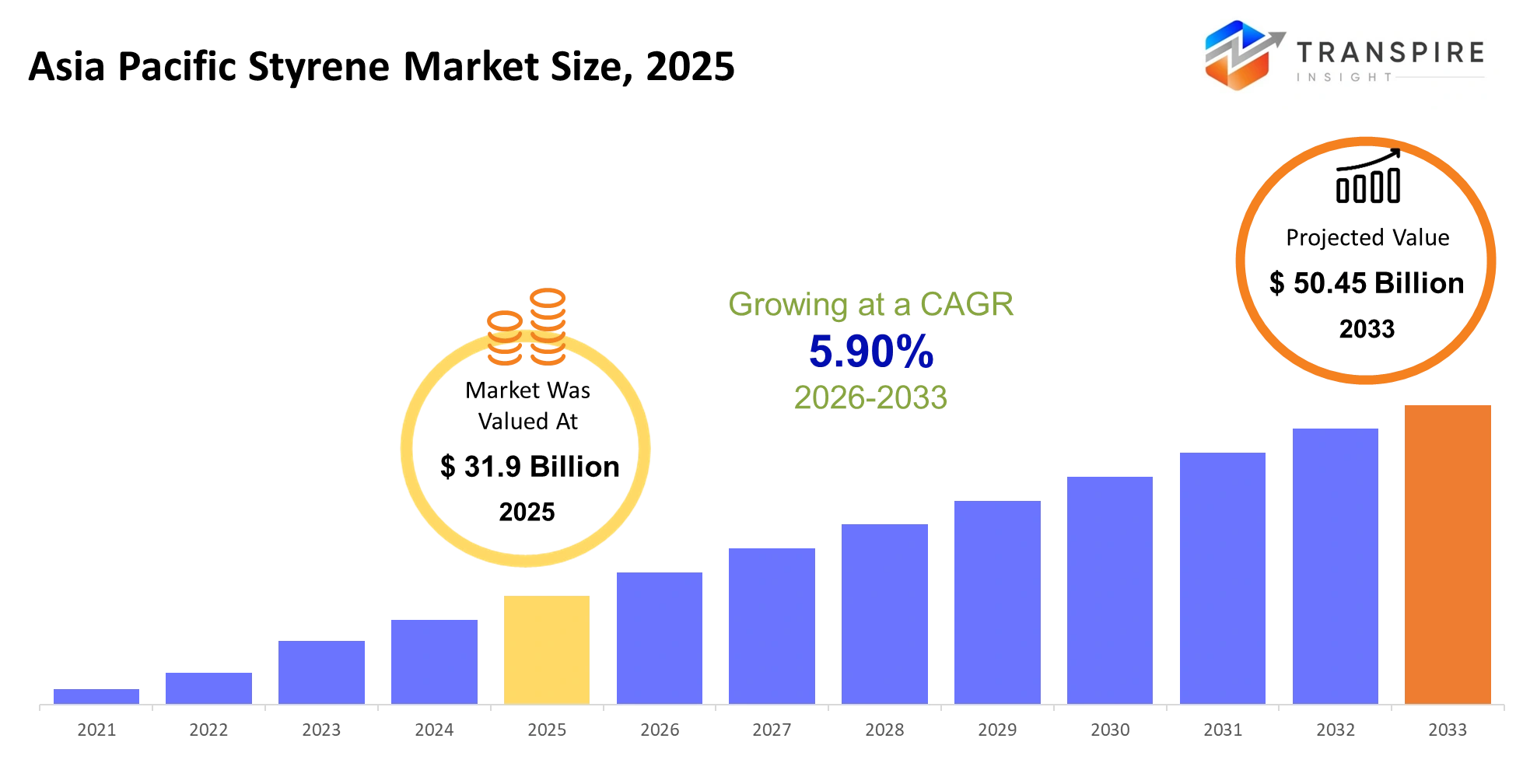
Asia Pacific Styrene Market Size & Forecast:
- Asia Pacific Styrene Market Size 2025: USD 31.9 Billion
- Asia Pacific Styrene Market Size 2033: USD 50.45 Billion
- Asia Pacific Styrene Market CAGR: 5.90%
- Asia Pacific Styrene Market Segments: By Type (General Styrene, High-purity Styrene, Polymer-grade Styrene, Copolymers, Derivatives, Others); By Application (Polystyrene, ABS, Rubber, Resins, Plastics, Others); By End-User (Automotive, Packaging, Construction, Electronics, Industrial, Others); By Form (Liquid, Bulk, Packaged, Drums, Containers, Others).
To learn more about this report,  Download Free Sample Report
Asia Pacific Styrene Market Summary
The Asia Pacific Styrene Market was valued at USD 31.9 Billion in 2025. It is forecast to reach USD 50.45 Billion by 2033. That is a CAGR of 5.90% over the period.
The styrene market in the Asia Pacific region serves as a primary source for modern manufacturing because it provides essential materials which manufacturers need to create plastics and resins and synthetic rubber materials that they use to produce packaging and electronic devices and construction panels and automotive components and insulation products. The solution assists manufacturers in developing products which weigh less yet stay strong while being inexpensive to produce and that enable them to achieve their production goals throughout their entire industrial supply chain. The market has experienced fundamental changes during the past five years because manufacturers have adopted integrated production facilities together with feedstock optimization techniques to achieve better cost management while minimizing their dependence on fluctuating benzene and ethylene market prices.
The transition process gained momentum because supply chains experienced interruptions when COVID-19 caused pandemic-related supply challenges and subsequent regional shipping route delays revealed weaknesses in systems which relied on imported goods. As manufacturers localized procurement and expanded downstream polymer production, styrene consumption became more closely tied to regional industrial output. The converters have increased their operating rates which leads to higher revenue because they support manufacturing operations in packaging and electronics and infrastructure-related production throughout the Asia Pacific region.
Key Market Insights
- East Asia controls the Asia Pacific Styrene Market because it operates multiple major integrated petrochemical facilities throughout China and Japan and South Korea.
- The Southeast Asian market will achieve its highest growth rate until 2030 because companies are moving their manufacturing operations to the region and investing in plastics production facilities.
- The Indian styrene market is growing at a rate above 6 percent each year because of demand from the packaging industry and the automotive parts sector and infrastructure development projects.
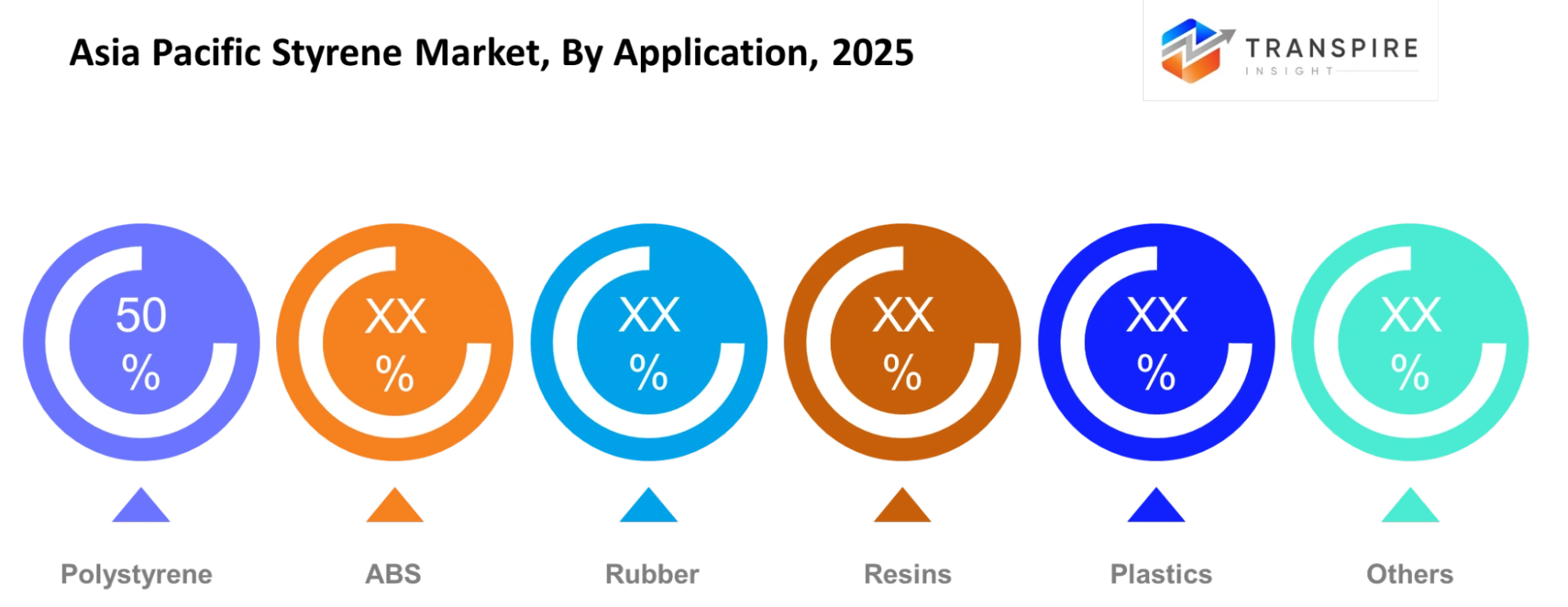
- The Asia Pacific Styrene Market shows its dominant market share of approximately 42% in 2025 through polystyrene production which companies use for their packaging and insulation needs.
- Electronics and appliance manufacturing expansion provides support for Acrylonitrile Butadiene Styrene (ABS), which remains the second-largest market segment.
- Styrene Butadiene Rubber (SBR) material will become the fastest expanding market section until 2030 because tire production and automotive manufacturing will increase.
- The packaging industry will lead all applications in 2025 with approximately 35% market share because styrene material is extensively used in food packaging and industrial packaging solutions.
- The fastest expanding market segment in consumer electronics results from rising ABS resin demand for lightweight device components.
- The automotive industry serves as the primary end-user market which accounts for approximately 29% of total market share in 2025 through its demand for interior components and lightweight plastic systems.
- The construction industry represents the most swiftly expanding end-user sector because insulation panel demand and infrastructure modernization projects drive its growth.
What are the Key Drivers, Restraints, and Opportunities in the Asia Pacific Styrene Market?
The primary factor which drives the growth of the Asia Pacific styrene market is the fast development of production facilities which serve downstream industries in China, India, and Southeast Asia. The supply chain disruptions which happened between 2020 and 2022 created more significant risks for importing polymers and intermediates, which led to this shift becoming more powerful. The governments and private manufacturers responded to this situation by spending large amounts of money on developing local petrochemical facilities and increasing their production capabilities.
The new cracker facilities together with derivative production plants, have created better access to feedstock for styrene manufacturers, which results in decreased transportation expenses and enhanced profit margins. The system enables manufacturers to achieve higher operational efficiency while establishing binding supply agreements with packaging and automotive and electronics manufacturers, which leads to improved revenue generation.
The market functions with its primary structural limitation because feedstock prices experience unpredictable changes, which affect styrene production that depends on benzene and ethylene whose prices fluctuate with global crude oil prices. The energy transition policies and existing geopolitical tensions together with refinery output patterns create permanent changes in hydrocarbon availability. The market faces price fluctuations that create financial pressure, which results in production delays while forcing downstream processors to change their buying schedules, thus decreasing transaction activity and hindering their ability to predict revenue increases.
Advanced recycling and circular styrene technologies represent the most obvious opportunity for business expansion. The construction of chemical recycling plants in Japan and South Korea enables companies to extract styrene monomer from post-consumer polystyrene waste. These systems will decrease their need for virgin feedstocks when they reach commercial operations while they will enable production of high-value products for regulated packaging and electronics manufacturing.
What Has the Impact of Artificial Intelligence Been on the Asia Pacific Styrene Market?
The combination of artificial intelligence with advanced digital systems helps Asian Pacific countries produce styrene more accurately and efficiently while making their petrochemical plants more durable to commercial challenges. Producers are increasingly deploying AI-driven process control platforms to automate reactor temperature regulation, monitor feedstock conversion rates, and optimize steam cracking conditions in real time. The systems operate continuously to assess production conditions while they modify operational settings which result in consistent styrene purity and reduced energy waste throughout the connected production systems.
Machine learning models enable improved predictive performance at major styrene production facilities. The operators use these tools to predict when equipment in compressors and heat exchangers and distillation columns will experience breakdowns. Across facilities which operate in China and South Korea and Japan, maintenance planning improvements have resulted in 10 to 15 percent reductions of unplanned downtime while maintenance planning improvements have allowed better asset utilization. AI-based feedstock analytics enable manufacturers to create models which predict benzene and ethylene pricing trends, which helps them make better procurement choices and maintain control over their profit margins during periods of commodity market instability.
The operational gains which digital optimization systems provide create important advantages. Digital optimization systems offer a range of benefits which include a 5 to 8 percent improvement in energy efficiency and a decrease in waste production and an ability to maintain stricter pollution regulations through ongoing process assessment. The implementation process encounters a critical obstacle because petrochemical companies need to invest extensively in AI technology for their existing infrastructure and they require complete access to historical operational data which remains distributed unevenly among older production sites across different regions.
Key Market Trends
- Chinese producers including Sinopec established integrated refining-petrochemical complexes after 2021 which enabled them to decrease their need for external feedstock while achieving better results in styrene production.
- Digital process automation implementation by manufacturers throughout Japan and South Korea increased between 2022 and 2025 because they achieved a 10 to 15 percent decrease in unplanned shutdowns.
- Southeast Asian buyers shifted away from spot purchasing after pandemic-era shipping disruptions because they wanted to secure stable styrene supply through multi-year procurement contracts.
- Since 2023 converters have chosen regional suppliers more frequently because this choice enables them to achieve 20 percent faster delivery times compared to their previous sourcing methods which depended on imports before 2020.
- INEOS Styrolution and LG Chem increased their investment in recycled styrenics because they needed to fulfill packaging sustainability requirements which became more stringent.
- Producers began using AI-driven feedstock forecasting tools which help them manage tighter margins and schedule their procurement activities because benzene prices have become more volatile since 2022.
- After 2023,India's downstream plastics processors increased their use of local materials as part of their commitment to diminishing risks from global price changes.
- The ongoing industrial emission regulations that started in 2024 have pushed manufacturers to update their steam cracking technology for decreased energy consumption.
- After 2022, producers established more joint ventures throughout China and Southeast Asia to achieve better operational ties with ABS and polystyrene production companies.
- Buyers in electronics manufacturing have shifted toward higher-purity styrene derivatives since 2024, driven by stricter component performance specifications.
Asia Pacific Styrene Market Segmentation
By Type :
The Asia Pacific styrene market divides into two types of styrene which include general styrene and high-purity styrene that industrial sectors use for multiple processes in their production of plastics and resin. The manufacturing industry maintains high demand for this product because it can be used with different chemicals and it remains essential for production in various industrial fields.
The product line includes polymer-grade styrene and its various copolymers and derivatives which enables manufacturers to create customized products that deliver superior performance across various industrial applications. The different types of industrial materials enable manufacturers to achieve their production quality requirements while maintaining required material strength and stability standards.
By Application :
The Asia Pacific styrene application landscape includes polystyrene, ABS, rubber, resins, plastics, and other chemical-based uses across multiple industries. Polystyrene and ABS remain key demand areas due to their strong usage in packaging, consumer goods, and molded product manufacturing.
Industrial production lines now use rubber and resins and plastic materials at an increasing rate throughout their operations. Styrene-based materials provide durability and flexibility and cost efficiency which makes them appropriate for various manufacturing methods that produce different types of products used throughout the region.
To learn more about this report, Download Free Sample Report
By End-User :
The demand for styrene in the Asia Pacific region stays constant because the automotive, packaging, construction, electronics, and industrial sectors maintain ongoing production operations. Automotive applications use styrene materials for lightweight components and interior parts which help control manufacturing expenses and product performance.
Packaging, construction, electronics, and industrial users rely on styrene for insulation materials, protective packaging, and structural components. The industrial sector experiences rising demand because manufacturing output increases and different production systems adopt synthetic materials.
By Form :
The Asia Pacific styrene market divides its products into five categories which are liquid, bulk, packaged, drums, and containers used for transportation and storage. The chemical processing and industrial manufacturing operations use liquid form because it enables simple handling and direct application.
Bulk and packaged forms support large-scale industrial supply chains, while drums and containers provide safe storage and transport options. The formats enable maintenance of product stability while they enhance logistical efficiency and guarantee continuous product availability throughout manufacturing and processing operations.
What are the Key Use Cases Driving the Asia Pacific Styrene Market?
Styrene usage in Asia Pacific markets serves as the main application for packaging materials which include food containers and protective cushioning and industrial transport packaging. The industry needs this application because manufacturers use styrene-based materials to create lightweight products which withstand impacts and enable economical production at high volumes. The automotive sector and consumer electronics industry are experiencing rapid growth in their adjacent markets. The dimensional stability and design flexibility of ABS resins which manufacturers create from styrene enable their application in appliance casings and display panels and interior vehicle components. The construction sector is developing as a secondary market for insulation boards and lightweight building materials.
Circular packaging systems and advanced medical applications are developing new use cases. The chemical recycling of styrene is becoming more popular among plastic packaging producers in Japan and South Korea who implement closed-loop recovery systems for their regulated packaging materials. High-performance styrenic polymers show promise for use in specialized healthcare devices which require precise material molding and consistent product composition.
|
Report Metrics |
Details |
|
Market size value in 2025 |
USD 31.9 Billion |
|
Market size value in 2026 |
USD 33.78 Billion |
|
Revenue forecast in 2033 |
USD 50.45 Billion |
|
Growth rate |
CAGR of 5.90% from 2026 to 2033 |
|
Base year |
2025 |
|
Historical data |
2021 - 2024 |
|
Forecast period |
2026 - 2033 |
|
Report coverage |
Revenue forecast, competitive landscape, growth factors, and trends |
|
Regional scope |
Asia Pacific ( China, India, Japan, South Korea, Australia, Rest of Asia Pacific) |
|
Key company profiled |
BASF, INEOS, Shell, LyondellBasell, TotalEnergies, SABIC, Chevron Phillips, Dow, Sinopec, Reliance, LG Chem, Formosa Plastics, Trinseo, Versalis, Mitsubishi Chemical. |
|
Customization scope |
Free report customization (country, regional & segment scope). Avail customized purchase options to meet your exact research needs. |
|
Report Segmentation |
By Type (General Styrene, High-purity Styrene, Polymer-grade Styrene, Copolymers, Derivatives, Others); By Application (Polystyrene, ABS, Rubber, Resins, Plastics, Others); By End-User (Automotive, Packaging, Construction, Electronics, Industrial, Others); By Form (Liquid, Bulk, Packaged, Drums, Containers, Others). |
Which Regions are Driving the Asia Pacific Styrene Market Growth?
The Asia Pacific styrene market is primarily controlled by East Asia which uses China Japan and South Korea as its main industrial resources. The petrochemical industry in China maintains its position as the leading market force because of its extensive petrochemical operations and extensive plastic manufacturing capabilities which the government supports through policies that improve chemical intermediate production facilities. Japan and South Korea maintain their regional superiority because of their capacity to produce advanced refining systems and high-value polymers which they supply to the electronics and automotive sectors. The port network together with the coastal logistics system enables continuous raw material movement between crackers and downstream processors which helps maintain high operational efficiency throughout the integrated manufacturing facilities.
India as the main country in South Asia controls the Asia Pacific styrene market through continuous consumption growth rather than extensive export production. The demand exists because of packaging requirements and construction material needs and the rising production of appliances which results from the expanding appliance manufacturing sector. The region which maintains stable operations through long-term supply agreements and domestic polymer capacity development follows different feedstock requirements than East Asia. The region establishes itself as a dependable demand hub for global styrene producers because of its continuous industrial policy backing and its predictable cycles of infrastructure development.
The recent increase in petrochemical investments together with the movement of manufacturing operations from expensive countries has made Southeast Asia the most rapidly developing region in the world. The countries of Thailand and Malaysia have developed their chemical networks which are connected to refineries to create more local styrene supply while decreasing their need for imports. The completion of new port expansions together with industrial park developments which took place after 2023 has enhanced the capacity for export-related polymer manufacturing in the region. The period between 2026 and 2033 will provide investors with multiple strong investment opportunities because Companies will establish cost-effective production facilities near expanding electronics and packaging supply networks.
Who are the Key Players in the Asia Pacific Styrene Market and How Do They Compete?
The Asia Pacific market for styrene shows moderate consolidation because a few petrochemical companies control most of the market supply while local producers compete based on their ability to process materials into finished products. The existing companies maintain their market share through three methods which include feedstock integration and refinery proximity and their agreements with polymer converters. The primary basis of competition has changed because companies now compete through cost efficiency and production integration while volatile benzene margins and energy costs make scale advantages essential for business success.
Sinopec strengthens its position through deep vertical integration across refining and aromatics, which enables the company to maintain control over its styrene production expenses and create reliable domestic supply agreements with plastic manufacturers. LG Chem drives its market differentiation through advanced technology which produces high-purity styrene that meets electronics-grade ABS resin standards while building its production facilities through joint ventures in Southeast Asia to serve expanding customer needs. INEOS Styrolution achieves competitive advantage through its product development process which creates specialized materials in engineered styrenics and recyclable polymer solutions for premium packaging and automotive markets.
Lotte Chemical expands through downstream ABS integration and regional capacity upgrades in Indonesia and Malaysia. Formosa Chemicals & Fibre Corporation operates cost-efficient production facilities in Taiwan while expanding its export operations throughout Asia. Shell maintains its business operations through its ability to supply feedstock and its strategic partnerships in the aromatics value chain throughout the Asia Pacific region.
Company List
- BASF
- INEOS
- Shell
- LyondellBasell
- TotalEnergies
- SABIC
- Chevron Phillips
- Dow
- Sinopec
- Reliance
- LG Chem
- Formosa Plastics
- Trinseo
- Versalis
- Mitsubishi Chemical
Recent Development News
In January 2026, INEOS and Sinopec entered into a $7 billion petrochemical partnership involving multiple joint ventures in China. The agreement includes expansion of a large integrated SECCO complex that produces styrene among other petrochemicals, reinforcing Asia Pacific capacity integration and strengthening Sino-foreign control over styrene-linked value chains.
Source: https://www.ineos.com/
In March 2026, Daicel Corporation agreed to transfer its equity stake in Toyo Styrene Co., Ltd. to Denka Company Limited, effectively exiting its co-investor role in the styrene-focused joint venture and supporting Denka’s full operational consolidation strategy in Japan’s styrenics segment. The transaction is part of broader restructuring in Asia’s styrene production base, aimed at improving competitiveness amid overcapacity pressures.
Source: https://www.daicel.com/
What Strategic Insights Define the Future of the Asia Pacific Styrene Market?
The Asia Pacific styrene market is implementing its structural changes to achieve better operational synchronization between its basic petrochemical production processes and its final polymer production activities, which results from the industry requirement to maintain stable profit margins during ongoing feedstock price fluctuations. The production hubs will develop during the next five to seven years into refinery-linked complexes located throughout China and Southeast Asia because these sites provide operational advantages that decrease vulnerability to international benzene price fluctuations. The shift will establish stricter cost control measures which will prevent smaller companies without vertical integration from entering the market.
The development of alternative engineering plastics through bio-based materials will create substitution threats which require monitoring because these materials especially impact packaging and electronics industries. Demand patterns will experience gradual evolution because this transformation requires time to produce its effects.
Companies that establish chemical recycling systems for styrene production at their facilities will find new business opportunities in Japan and South Korea, which have developed efficient waste collection systems that enable complete recovery of polymer materials.The initial access to recycled materials will give companies two major benefits because they will achieve better cost control and they will comply with environmental regulations. The market players need to focus their efforts on either downward supply chain development or establishing recycling alliances to safeguard their profit margins while staying relevant in an industry that moves toward circular value chains.
Asia Pacific Styrene Market Report Segmentation
By Type
- General Styrene
- High-purity Styrene
- Polymer-grade Styrene
- Copolymers
- Derivatives
By Application
- Polystyrene
- ABS
- Rubber
- Resins
- Plastics
By End-User
- Automotive
- Packaging
- Construction
- Electronics
- Industrial
By Form
- Liquid
- Bulk
- Packaged
- Drums
- Containers
Frequently Asked Questions
Find quick answers to common questions.
The Asia Pacific Styrene Market size is USD 50.45 Billion in 2033.
Key segments for the Asia Pacific Styrene Market are By Type (General Styrene, High-purity Styrene, Polymer-grade Styrene, Copolymers, Derivatives, Others); By Application (Polystyrene, ABS, Rubber, Resins, Plastics, Others); By End-User (Automotive, Packaging, Construction, Electronics, Industrial, Others); By Form (Liquid, Bulk, Packaged, Drums, Containers, Others).
Major Asia Pacific Styrene Market players are BASF, INEOS, Shell, LyondellBasell, TotalEnergies, SABIC, Chevron Phillips, Dow, Sinopec, Reliance, LG Chem, Formosa Plastics, Trinseo, Versalis, Mitsubishi Chemical.
The Asia Pacific Styrene Market size is USD 31.9 Billion in 2025.
The Asia Pacific Styrene Market CAGR is 5.90% from 2026 to 2033.
- BASF
- INEOS
- Shell
- LyondellBasell
- TotalEnergies
- SABIC
- Chevron Phillips
- Dow
- Sinopec
- Reliance
- LG Chem
- Formosa Plastics
- Trinseo
- Versalis
- Mitsubishi Chemical
Recently Published Reports
-
Apr 2026
Healthcare Polymer Packaging Market
Healthcare Polymer Packaging Market Size, Share & Analysis Report By Packaging Type (Syringes, IV Bottles and Pouches, Clamshells, Blisters, Bottles & Jars, Containers, Tubes, IV Parental Packaging, Others), By Type (Regulated, Non-regulated), By Polymer Type (LDPE (Low-Density Polyethylene), HDPE (High-Density Polyethylene), Homo-polymer (Homo), Random Copolymer (Random), Block Copolymer (Block), PET, Polystyrene, Polyvinyl Chloride, Polyamide/EVOH, Others), and Geography (North America, Europe, Asia-Pacific, Middle East and Africa, South and Central America), 2021 - 2031
-
Apr 2026
Hydrophilic Tape (Waterstop) Market
Hydrophilic Tape (Waterstop) Market Size, Share & Analysis Report By Type (Bentonite-Based Hydrophilic Tape, Rubber-Based Hydrophilic Tape), By Application (Residential Buildings, Commercial Buildings, Infrastructure Projects), and Geography (North America, Europe, Asia-Pacific, Middle East and Africa, South and Central America), 2021 - 2031
-
Apr 2026
Metalens Market
Metalens Market Size, Share & Analysis Report By Type (Visible Light Metalens, and Infrared Metalens), By Application (Consumer Electronics, Automotive Electronics, Industrial, Medical, and Others), and Geography (North America, Europe, Asia-Pacific, Middle East and Africa, South and Central America), 2021 - 2031
-
Apr 2026
PBT Resin Market
PBT Resin Market Size, Share & Analysis Report By Type (Reinforced PBT Resin, Unreinforced PBT Resin), By Processing Method (Injection Molding, Extrusion, Blow Molding, Others), By End-User (Automotive, Electrical & Electronics, Consumer Appliances, Industrial Machinery, Medical Devices, Packaging, Others), and Geography (North America, Europe, Asia-Pacific, Middle East and Africa, South and Central America), 2021 - 2031