
Asia Pacific Single-Use Bioprocess Market Size & Forecast:
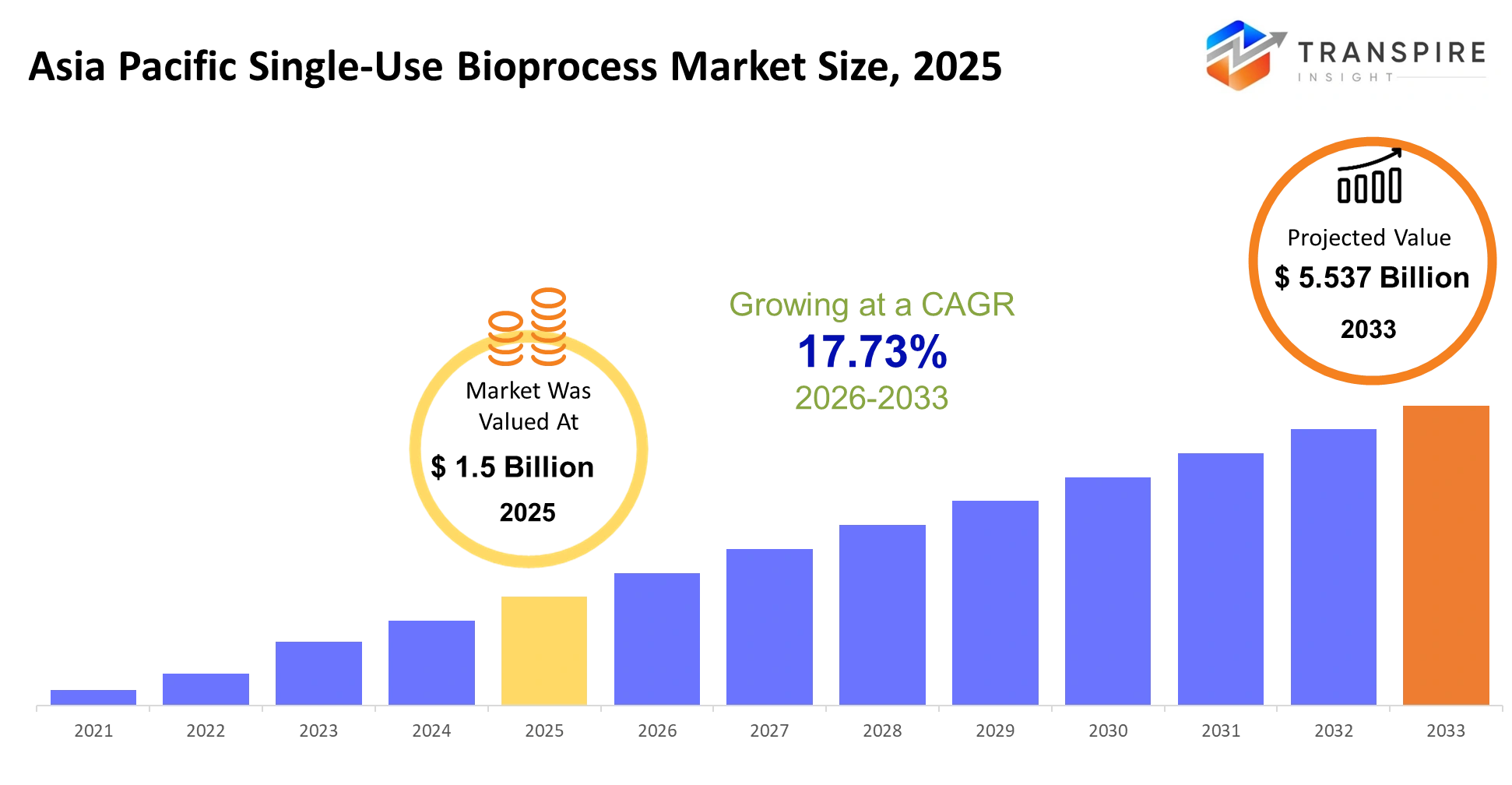
- Asia Pacific Single-Use Bioprocess Market Size 2025: USD 1.5 Billion
- Asia Pacific Single-Use Bioprocess Market Size 2033: USD 5.537 Billion
- Asia Pacific Single-Use Bioprocess Market CAGR: 17.73%
- Asia Pacific Single-Use Bioprocess Market Segments: By Product (Bioreactors, Bags, Filters, Tubing, Connectors, Others); By Application (Biopharmaceutical Production, Vaccine Production, Cell Therapy, Gene Therapy, Research, Others); By End-User (Pharma, Biotech, CROs, CMOs, Research Institutes, Others); By Workflow (Upstream Processing, Downstream Processing, Fill-Finish, Storage, Filtration, Others)
To learn more about this report,  Download Free Sample Report
Asia Pacific Single-Use Bioprocess Market Summary:
The Asia Pacific Single-Use Bioprocess Market size is estimated at USD 1.5 Billion in 2025 and is anticipated to reach USD 5.537 Billion by 2033, growing at a CAGR of 17.73% from 2026 to 2033.
The Asia Pacific market for single-use bioprocess systems within biotechnological and biomanufacturing operations will transform therapy development and production methods across both developing and developed nations. The demand for faster laboratory results and lower contamination risks will lead laboratories and manufacturers to adopt disposable systems as their primary operating solution.The demand for flexible production systems will increase because personalized medicine requires facilities to create smaller modular production environments. The advanced filtration and monitoring tools adoption will expand because companies need to meet stricter regulations which require them to achieve better sterility and traceability standards. Companies will develop new materials because sustainability requirements force them to find waste management solutions while they maintain operational efficiency.
What Has the Impact of Artificial Intelligence Been on the Asia Pacific Single-Use Bioprocess Market?
The operational intelligence and strategic decision-making processes in the Asia Pacific single-use bioprocess market undergo fundamental transformation through artificial intelligence, which brings new abilities for precise and large-scale operations. Artificial intelligence expands operational capabilities for organizations in the Asia Pacific single-use bioprocess market by enabling them to create advanced data models that extract valuable insights from their complex bioprocess datasets.Organizations use machine learning and predictive analytics to improve their market research abilities, which help them discover, new demand patterns while improving their forecast accuracy. The shift enables stakeholders to forecast changes in biologics production requirements while matching their capacity planning to current market developments.
Artificial intelligence systems enhance production efficiency through smart automation and process optimization in Asia Pacific single-use bioprocess market workflows. AI-based monitoring systems minimize human mistakes while they boost batch uniformity and speed up the validation process. Predictive analytics tools enable supply chain networks to improve their agility by detecting possible disruptions and suggesting affordable solutions. The Asia Pacific single-use bioprocess market experiences higher manufacturing customization because AI enables production systems that create patient-specific small batches. Organizations use intelligent system integration to boost their competitive edge while they develop new products throughout their entire value chain.
Key Market Trends & Insights:
- China controls the entire Asia Pacific single-use bioprocess market because it holds approximately 35% market share which will grow in 2024 due to its advanced biopharmaceutical manufacturing facilities and expanding capacity for biologics production.
- The fastest-growing area within the Asia Pacific single-use bioprocess market emerges from India because its market will grow at more than 19% annually from 2024 until 2030 through increasing biosimilar requirements and government backing.
- Southeast Asia shows developing requirements for the Asia Pacific single-use bioprocess market because foreign investment grows and contract development manufacturing organizations expand their operations throughout Singapore and Malaysia and Thailand.
- The Asia Pacific single-use bioprocess market receives its main power from single-use bioreactors which will produce almost 40% market share in 2024 because these systems provide better scalability and decreased contamination risks and lower equipment costs.
- The Asia Pacific single-use bioprocess market shows its second biggest market share for disposable filtration systems which grow in popularity because more customers need both sterile processing solutions and equipment for high-volume biomanufacturing.
- The Asia Pacific single-use bioprocess market shows its fastest expansion through single-use mixers which will achieve more than 18% annual growth until 2030 because these mixers enable flexible batch processing.
- The Asia Pacific single-use bioprocess market shows biopharmaceutical production as its dominant force because this sector will hold more than 55% market share in 2024 through increasing needs for monoclonal antibodies and vaccines and recombinant protein production.
- The Asia Pacific single-use bioprocess market sees cell and gene therapy becoming its most rapidly growing sector because this medical field advances through more clinical trials and personalized medicine development.
- Biopharmaceutical companies dominate the Asia Pacific single-use bioprocess market because they will spread their market power to approximately 60% in 2024 through their capacity to produce biologics at industrial scale.
Asia Pacific Single-Use Bioprocess Market Segmentation
By Product:
The product segments of the market include Bioreactors and Bags and Filters and Tubing and Connectors and other products. Bioreactors will hold a major share because they serve an essential function for cell culture and fermentation processes. Bags and tubing will support fluid transfer and storage with reduced contamination risks. Filters will ensure purification and separation which helps maintain product quality throughout various production phases.Connectors and other components will enable seamless integration of systems which helps organizations achieve efficient workflow processes. Manufacturers will increase their demand for advanced materials that provide both improved durability and better reliability. Product design innovation will enable companies to create products that operate in different production environments with complete operational capacity.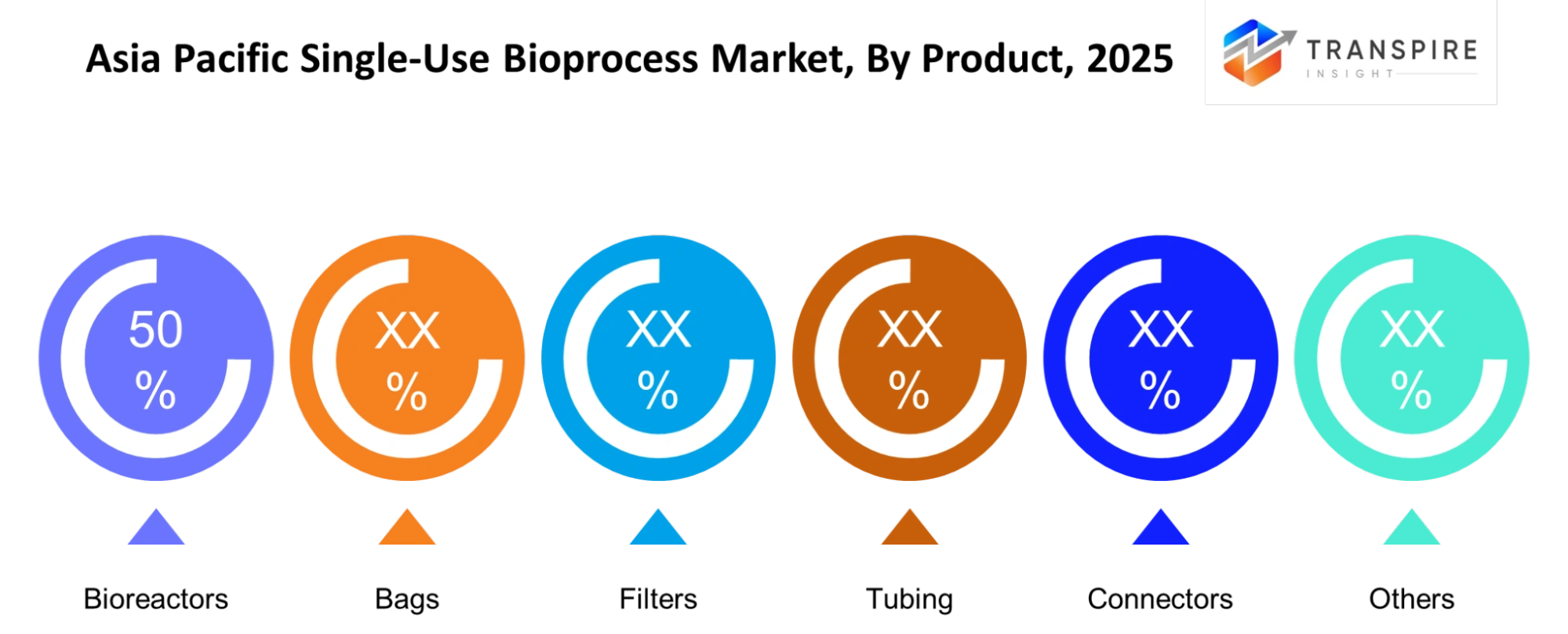
To learn more about this report, Download Free Sample Report
By Application :
The main application areas of the system include Biopharmaceutical Production and Vaccine Production and Cell Therapy and Gene Therapy and Research and other applications. The need for monoclonal antibodies and therapeutic proteins will drive biopharmaceutical production to become the leading market segment. Vaccine production will gain momentum due to focus on rapid response to infectious diseases. The development of personalized treatment methods will lead to growth in cell and gene therapy. Research applications will continue to support early-stage development and testing. The increasing number of clinical trials and experimental therapies will create a growing need for systems that combine flexible operations with efficient performance. Each application will benefit from reduced risk of cross-contamination and faster setup times.
By End-User:
Pharmaceutical companies will remain primary users of the system which operates through End-User access by Pharma and Biotech and CROs and CMOs and Research Institutes and other organizations. Biotechnology firms will implement single-use systems because they provide product development teams with both flexible operational capacity and potential for product innovation.
CROs and CMOs will expand usage to meet outsourcing demand and provide cost-effective manufacturing solutions.Research institutions will utilize these systems to conduct their experimental work and pilot-scale research activities. The increasing partnership between businesses and educational institutions will drive system adoption. Each end-user group will benefit from reduced operational complexity and improved efficiency.
By Workflow:
Upstream processing will utilize single-use bioreactors and bags for cell cultivation and media preparation. The system will use filtration and purification systems during downstream processing to maintain product quality. Fill-finish operations will benefit from sterile and disposable components that reduce contamination risks.
The storage and filtration processes will maintain stability and purity of biologics throughout their entire lifecycle. The system will enhance operational efficiency by connecting all workflow stages, reducing interruptions. The implementation of all workflow stages will establish a unified production system that delivers uniform operational results.
What are the Main Challenges for the Asia Pacific Single-Use Bioprocess Market Growth?
The Asia Pacific market for Single-Use Bioprocessing faces two main challenges, which stem from its technical and operational problems. The production of complex biologics faces performance challenges because there are material compatibility issues and product stability problems, and disposable systems have a restricted operational lifespan. The process of scaling up production facilities continues to face challenges which emerge during the transition from small production operations to full commercial manufacturing. The market faces multiple obstacles which stem from supply chain interruptions and the company's reliance on foreign-made parts, thus affecting the process of building relationships with clients.
The Asia Pacific Single-Use Bioprocess Market experiences slow development because of two main obstacles which include manufacturing problems and challenges related to commercializing products. The need to adhere to stringent regulatory requirements which include GMP standards makes production processes more complex and drives up operational expenses. The process of validating single-use systems needs extensive testing thus creating delays in product approvals and market availability. The high costs of essential raw materials and specialized equipment present obstacles to growth which primarily impact smaller manufacturers operating in regulated markets.
The existing infrastructure and workforce shortages continue to create adoption barriers for organizations. The Asia Pacific Single-Use Bioprocess Market faces challenges because many developing countries need both modern manufacturing facilities and trained personnel who can operate advanced manufacturing machinery. The technological development process faces obstacles because smaller companies have limited financial resources and low understanding of technology, which results in decreased market growth.
The future of industry development is uncertain because traditional stainless steel systems and hybrid technologies are creating a competitive market. The Asia Pacific Single-Use Bioprocess Market faces multiple challenges stemming from pricing competition, changing regulatory requirements, and waste-handling concerns, thereby impacting long-term investment strategies and technological advancements.
Regional Insights
The Asia Pacific Single-Use Bioprocess Market will experience continuous growth because regional demand sustains major economic development in China, India, Japan and South Korea. The market will grow because biologics production increases and healthcare spending rises, and the government supports local manufacturing. The market will expand when biopharma companies open new facilities and contract manufacturing organizations establish operations in developed and developing markets. The production sector will adopt single-use systems more widely because of their cost savings and ability to prevent product contamination. Local manufacturers will work to enhance their supply chain systems while decreasing their reliance on foreign products. The region will achieve its long-term development goals through increased research and development funding, which will bring about new innovations and better production methods.
The East Asia region will lead market development due to its strong industrial base and advanced biopharmaceutical production capacity. China and Japan will contribute significantly through large-scale manufacturing and innovation initiatives. South Korea will progress steadily because it concentrates on biosimilars and export-oriented approaches which government policies and technological progress help.
Recent Development News
In March 2026, Sartorius Stedim Biotech announced strategic integration of its recent acquisition MatTek into its bioprocess solutions division. The company highlighted that the MatTek acquisition (completed in 2025) is contributing to 2026 growth in its single-use bioprocessing portfolio, including Asia-Pacific expansion.https://www.investing.com
In April 2026, Sartorius AG confirmed continued M&A-driven strategy targeting bioprocessing technologies. The company reiterated that acquisitions remain a core pillar to expand its single-use bioprocessing capabilities and strengthen its footprint across Asia-Pacific markets.https://www.sartorius.com
|
Report Metrics |
Details |
|
Market size value in 2025 |
USD 1.5 Billion |
|
Market size value in 2026 |
USD 1.766 Billion |
|
Revenue forecast in 2033 |
USD 5.537 Billion |
|
Growth rate |
CAGR of 17.73% from 2026 to 2033 |
|
Base year |
2025 |
|
Historical data |
2021 - 2024 |
|
Forecast period |
2026 - 2033 |
|
Report coverage |
Revenue forecast, competitive landscape, growth factors, and trends |
|
Regional scope |
Asia Pacific (China, India, Japan, South Korea, Australia, Rest of Asia Pacific) |
|
Key company profiled |
Thermo Fisher, Sartorius, Merck KGaA, Danaher, GE Healthcare, Pall Corporation, Eppendorf, Lonza, Avantor, Saint-Gobain, Entegris, Repligen, Corning, Parker Hannifin, Getinge |
|
Customization scope |
Free report customization (country, regional & segment scope). Avail customized purchase options to meet your exact research needs. |
|
Report Segmentation |
By Product (Bioreactors, Bags, Filters, Tubing, Connectors, Others); By Application (Biopharmaceutical Production, Vaccine Production, Cell Therapy, Gene Therapy, Research, Others); By End-User (Pharma, Biotech, CROs, CMOs, Research Institutes, Others); By Workflow (Upstream Processing, Downstream Processing, Fill-Finish, Storage, Filtration, Others) |
How Can New Companies Establish a Strong Foothold in the Asia Pacific Single-Use Bioprocess Market?
New businesses that want to establish themselves in the Asia Pacific Single-Use Bioprocess Market should focus on niche markets which have identifiable consumer needs that remain unfulfilled.
Asia Pacific single-use bioprocess market's success depends on companies that develop their value propositions through new product development strategies. Companies that develop advanced materials and automation systems, and scalable systems will achieve competitive advantages in the market. The market demonstration of Getinge and PBS Biotech introduces single-use bioreactor systems which combine compact design with operational efficiency to create flexible production processes that need less downtime.
Strategic partnerships between contract manufacturing organizations and research institutes and regional distributors will enable faster market entry and business expansion. New companies will gain from partnerships which enable them to develop their businesses because these partnerships will assist them with regulatory compliance and supply chain solutions and operational growth.
Long-term success requires businesses to establish their technology differentiation and create strong value propositions. The manufacturing and healthcare production industry will benefit from companies that deliver integrated solutions which include digital monitoring and user-friendly systems. The company will enhance its market position through ongoing research investments which will complement its budget-friendly pricing approach.
Key Asia Pacific Single-Use Bioprocess Market Company Insights
New businesses that want to establish themselves in the Asia Pacific Single-Use Bioprocess Market should focus on niche markets which have identifiable consumer needs that remain unfulfilled. The company will establish itself as a distinct market player through its dedication to particular markets which include cell therapy and small-batch biologics production. The establishment of early credibility and trust will result from solving critical problems which affect contamination control and cost efficiency in the Asia Pacific single-use bioprocess market.
Asia Pacific single-use bioprocess market success depends on companies that develop their value propositions through new product development strategies. Companies that develop advanced materials and automation systems and scalable systems will achieve competitive advantages in the market. The market demonstration of Getinge and PBS Biotech introduces single-use bioreactor systems which combine compact design with operational efficiency to create flexible production processes that need less downtime.
Strategic partnerships between contract manufacturing organizations and research institutes and regional distributors will enable faster market entry and business expansion. New companies will gain from partnerships which enable them to develop their businesses because these partnerships will assist them with regulatory compliance and supply chain solutions and operational growth. Organizations in the Asia Pacific single-use bioprocess market will achieve operational advantages through partnerships which enable them to understand local market conditions and regulatory standards.
Long-term success requires businesses to establish their technology differentiation and create strong value propositions. The manufacturing and healthcare production industry will benefit from companies that deliver integrated solutions which include digital monitoring and user-friendly systems. The company will enhance its market position through ongoing research investments which will complement its budget-friendly pricing approach.
Company List
- Thermo Fisher
- Sartorius
- Merck KGaA
- Danaher
- GE Healthcare
- Pall Corporation
- Eppendorf
- Lonza
- Avantor
- Saint-Gobain
- Entegris
- Repligen
- Corning
- Parker Hannifin
- Getinge
What are the Key Use-Cases Driving the Growth of the Asia Pacific Single-Use Bioprocess Market?
The Asia Pacific single-use bioprocess market experiences its strongest growth through biopharmaceutical production which stands as its primary application. The manufacturers have started to implement flexible systems which maintain contamination-free operation because of the rising demand for monoclonal antibodies, biosimilars, and therapeutic proteins. The implementation of single-use technologies enables operators to switch between production batches more quickly while spending less time on cleaning tasks, resulting in improved production capabilities that meet the demands of increasing healthcare needs throughout the region.
The Asia Pacific single-use bioprocess market has grown as vaccine production processes have driven increased adoption of single-use systems across the region. Manufacturers require rapid scale-up and reliable processes to meet urgent demand.
The market is growing due to research and development conducted by biotechnology companies and academic institutions. The manufacturing of biologics needs flexible systems because the market requires both clinical trials and pilot-scale studies as well as innovative processes. The current trend supports future scalability while single-use technologies establish themselves as essential components of contemporary bioprocessing methods.
Asia Pacific Single-Use Bioprocess Market Report Segmentation
By Product
- Bioreactors
- Bags
- Filters
- Tubing
- Connectors
- Others
By Application
- Biopharmaceutical Production
- Vaccine Production
- Cell Therapy
- Gene Therapy
- Research
- Others
By End-User
- Pharma
- Biotech
- CROs
- CMOs
- Research Institutes
- Others
By Workflow
- Upstream Processing
- Downstream Processing
- Fill-Finish
- Storage
- Filtration
- Others
Frequently Asked Questions
Find quick answers to common questions.
The Approximate Asia Pacific Single-Use Bioprocess Market size for the Market will be USD 5.537 Billion in 2033.
Key segments for the Asia Pacific Single-Use Bioprocess Market are By Product (Bioreactors, Bags, Filters, Tubing, Connectors, Others); By Application (Biopharmaceutical Production, Vaccine Production, Cell Therapy, Gene Therapy, Research, Others); By End-User (Pharma, Biotech, CROs, CMOs, Research Institutes, Others); By Workflow (Upstream Processing, Downstream Processing, Fill-Finish, Storage, Filtration, Others).
Major Asia Pacific Single-Use Bioprocess Market Players are Thermo Fisher, Sartorius, Merck KGaA, Danaher, GE Healthcare, Pall Corporation, Eppendorf, Lonza, Avantor, Saint-Gobain, Entegris, Repligen, Corning, Parker Hannifin, Getinge.
The Current Asia Pacific Single-Use Bioprocess Market size is USD 1.5 Billion in 2025.
The Asia Pacific Single-Use Bioprocess Market CAGR is 17.73%.
- Thermo Fisher
- Sartorius
- Merck KGaA
- Danaher
- GE Healthcare
- Pall Corporation
- Eppendorf
- Lonza
- Avantor
- Saint-Gobain
- Entegris
- Repligen
- Corning
- Parker Hannifin
- Getinge
Recently Published Reports
-
Dec 2024
Cord Blood Banking Services Market
Cord Blood Banking Services Market Size, Share & Analysis Report By Type of Service (Collection, Processing, Storage), By Bank Type (Private Banks, Public Banks, and Hybrid Banks), By Component (Cord Blood, and Cord Tissue), By End User (Hospitals, Research Institutions, Biotechnology Companies, and Others) and Geography (North America, Europe, Asia-Pacific, Middle East and Africa, South and Central America), 2021 - 2031
-
Dec 2024
ELISA Processors Market
ELISA Processors Market Size, Share & Analysis Report By Type (Optical Filter ELISA Analyzer, and Optical Grating ELISA Analyzers), By Mode (Automated ELISA Analyzers, and Semi-Automated ELISA Analyzers), By Applications (Immunology, Vaccine development, Drug Monitoring, and Others), By End Users (Biotechnology Companies, Pharmaceutical Companies, Contract Research Organization, and Diagnostic Laboratories) and Geography (North America, Europe, Asia-Pacific, Middle East and Africa, South and Central America), 2021 - 2031
-
Dec 2024
Microscope Slide Scanner Market
Microscope Slide Scanner Market Size, Share & Analysis Report By Type (Portable Microscope Slide Scanner, and Desktop Microscope Slide Scanner), By Application (Biological Research, Medicine, Veterinary, and Other) and Geography (North America, Europe, Asia-Pacific, Middle East and Africa, South and Central America), 2021 - 2031
-
Dec 2024
Microwave Cookware Market
Microwave Cookware Market Size, Share & Analysis Report By Material Type (Plastic, Glass, Ceramic, Silicone, and Metal), By Application (Cooking, Reheating, and Defrosting), By End User (Household, Commercial (Restaurants, Hotels, and Cafes), and Food Service Industry), By Sales Channel (Online Retail, Offline Retail (Supermarkets, Hypermarkets, Specialty Stores), and Direct Sales (Company Outlets)) and Geography (North America, Europe, Asia-Pacific, Middle East and Africa, South and Central America), 2021 - 2031