
Asia Pacific Intelligent Virtual Assistant Market Summary
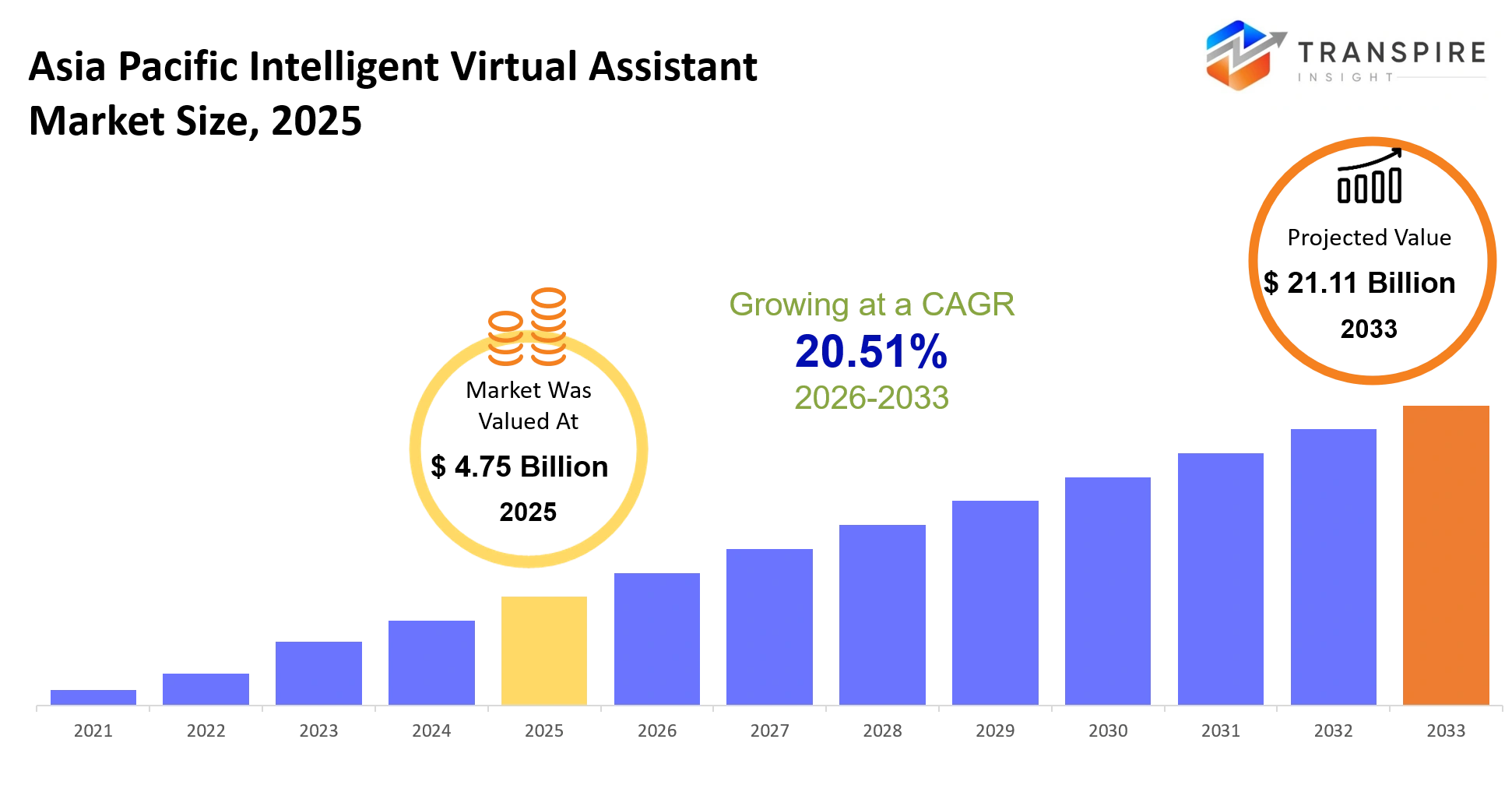
As per Transpire Insight Analysis the Asia Pacific Intelligent Virtual Assistant Market size is estimated at USD 4.75 Billion in 2025 and is anticipated to reach USD 21.11 Billion by 2033, growing at a CAGR of 20.51% from 2026 to 2033.
In the Asia Pacific Intelligent Virtual Assistant Market, organizations kinda get help by automating customer chats, employee support, task workflow management, and multilingual messaging , across banking, healthcare, retail, telecoms , manufacturing, and public services. These intelligent virtual assistants can definitely shrink response times, keep handling repetitive questions nonstop, and boost day to day operational efficiency, while still leaving human staff to deal with the tougher situations. A bunch of businesses now keep rolling these assistants into websites, mobile apps, contact centers, and enterprise software as well, because it helps service quality and it usually means lower operating costs, more or less at the same time.
Over the last five years, the market’s sort of moved away from rule based chatbots, and into generative AI conversational platforms that can take in context, handle multiple languages at once, and also catch personalized customer intent. Then after COVID-19 pandemic hit , more companies leaned into hybrid work setups, which in turn made enterprise budgets tilt more quickly toward digital customer engagement and self service automation. And at the same time, cloud adoption is climbing pretty fast too, plus the bigger AI investments coming out of China, India, Japan, South Korea, and Southeast Asia have made it much easier to deploy at scale. So basically in the end, organizations can automate higher volumes of interactions, improve customer retention , and even open up new revenue streams by offering more tailored digital experiences.
Asia Pacific Intelligent Virtual Assistant Market Size & Forecast:
- Asia Pacific Intelligent Virtual Assistant Market Size 2025: USD 4.75 Billion
- Expected Market Value 2033: USD 21.11 Billion
- Forecast CAGR: 20.51%
- Leading region in 2025:China
- Fastest Growing region:India
- Key Profile: Microsoft, Google, Amazon Web Services, IBM, Oracle, Salesforce, SAP, Samsung, Apple, Baidu, Tencent, Huawei, Kore.ai, Yellow.ai, Cognigy
Key Market Insights
- China sort of dominated the Asia Pacific Intelligent Virtual Assistant Market, with almost 34% share in 2025, and that was backed by heavy AI spending plus broad digital service ecosystems.
- India meanwhile is expected to grow the quickest from now through 2033, largely because enterprises are moving workloads to cloud, digital banking is expanding, and there are government-supported AI pushes too.
- In 2025 the cloud based deployments made up about 68% of the revenue, which basically shows many businesses want scalable, subscription oriented AI platforms.
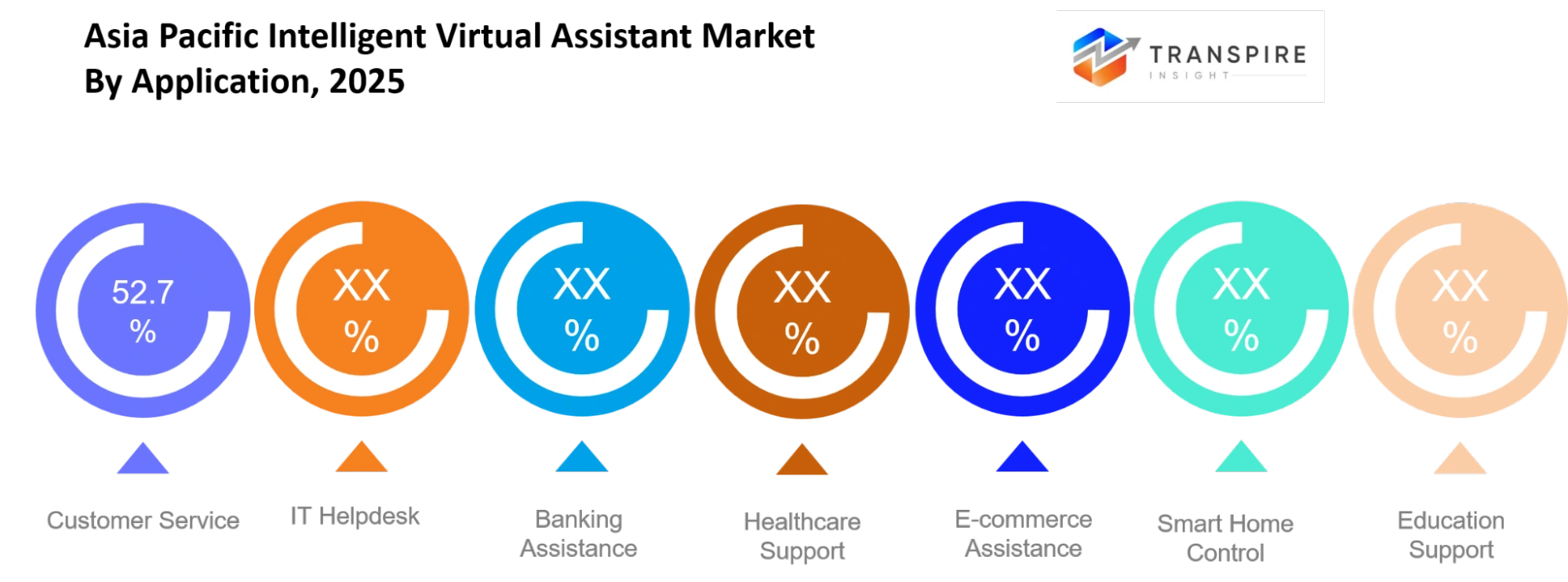
- When it comes to use cases, customer service stayed the main application, sitting near 42% of the market, while IT helpdesk automation is predicted to have the quickest growth rate across the forecast window.
- Banking financial services and insurance taken together accounted for roughly 28% of total demand in 2025, helped by automated customer support, and also anti-fraud assistance features.
- Healthcare groups have been adopting AI assistants more and more, mostly starting after 2022. Like they use them to handle patient scheduling, do virtual consultations, and manage those day to day administrative workflows.
- Generative AI features have been replacing the older scripted chatbot setups in a lot of enterprise rollouts, so the conversations feel more contextual ,and the multilingual support gets a lot better too, which matters when patients speak different languages.
- Meanwhile big names such as Microsoft, Google, IBM, Oracle, Amazon Web Services ,and Samsung SDS keep reinforcing their positions through AI innovation, strategic partnerships, and deeper regional cloud expansion.
- At the same time, some tech providers are pairing up with telecom operators, and also with system integrators ,to roll out more industry tuned conversational AI solutions across Asia Pacific.
- Overall the Asia Pacific Intelligent Virtual Assistant Market is still moving toward omnichannel customer engagement, voice enabled assistants, and enterprise workflow automation, and that is increasingly powered by large language models, rather than simple rule based systems.
What are the Key Drivers, Restraints, and Opportunities in the Asia Pacific Intelligent Virtual Assistant Market?
Honestly, the strongest growth driver is this rapid commercialization of generative AI plus enterprise cloud infrastructure all across Asia Pacific. Large language models have made a noticeable jump in conversational accuracy, multilingual support, and contextual understanding, compared with earlier chatbot tech. And now financial institutions, retailers, healthcare providers, and telecom operators are automating customer interactions that used to need human agents. So this shift brings service costs down , response times get shorter, and companies can handle bigger customer volumes without adding workforce in the same proportion. That, kind of, straight up helps revenue growth.
The big drag here is data privacy regulations, cybersecurity worries, and the fragmented language ecosystems, still the most significant structural barriers. Enterprises working with financial, healthcare, or government data run into strict compliance duties, which complicate AI deployment across multiple jurisdictions. Also a lot of organizations still rely on legacy IT systems that need costly integration, before advanced conversational platforms can work in a smooth way. These issues, push the rollout timelines out, lift deployment costs, and they also reduce adoption among small and medium sized enterprises, (kind of limits it).
Looking ahead, the strongest opportunity is in industry specific AI assistants, built on generative AI and regional language models. Healthcare providers, manufacturing companies, and public sector agencies increasingly want virtual assistants that can grasp specialized terminology and local languages properly. At the same time, growing investments in sovereign AI infrastructure across India, Japan, Singapore, and South Korea are basically setting up favorable conditions for enterprise-grade AI platforms.
What Has the Impact of Artificial Intelligence Been on the Asia Pacific Intelligent Virtual Assistant Market?
Artificial intelligence has kinda changed intelligent virtual assistant platforms in a fundamental way, mostly because conversational systems now can grab context better , figure out intent, and produce responses that sound more like humans across several languages. In the modern enterprise, assistants handle a bunch of stuff like customer support automation, employee onboarding, IT service management, appointment scheduling , document fetching and even workflow approvals with not much human involvement. At the same time, natural language processing plus large language models improve knowledge retrieval, so teams spend less effort on manual processing during day to day operations.
Machine learning models keep analyzing customer conversations to guess what the user actually wants , suggest more personal answers, spot potential service problems before they turn into escalations, and fine tune the conversation paths. Many businesses that put advanced conversational AI into production often say they see shorter handling time, better first-contact resolution, higher customer satisfaction and lower operational costs thanks to automation. And then there’s AI powered analytics, which help organizations discover patterns in customer behavior, adjust staffing needs, and refine digital engagement tactics across multiple channels, not only one.
Still, even with all these improvements, big scale deployment doesn’t magically remove every constraint. Bringing advanced AI assistants into legacy enterprise software tends to demand serious investment and technical know-how. Also performance can drop when domain specific training data is thin, or when regional language datasets are limited, especially across diverse Asia Pacific markets. So most organizations end up balancing AI innovation with governance , cybersecurity, regulatory compliance, and human oversight , just so the enterprise wide deployment stays reliable and controlled.
Key Market Trends
- Since 2022, generative AI adoption has really picked up, which basically speeds up enterprise migration from scripted chatbots to contextual conversational assistants that can manage those more complex customer issues.
- Cloud-native deployments hit over 65% of new enterprise implementations in 2025, and that momentum is also replacing old on-premise conversational platforms across big organizations, you know the ones that were pretty locked down.
- Between 2021 and 2025, regional language support grew a lot, so AI assistants can serve diverse multilingual customer groups, with better accuracy.
- In banking and financial services, deployments of AI assistants went up by more than 30% during recent digital transformation efforts, mostly to automate customer onboarding and ongoing support, like they were trying to make the whole thing feel smoother.
- In healthcare providers started leaning more into virtual assistant usage after 2023, and that helped with appointment scheduling, patient engagement, and a lot of administrative workflow automation across hospitals, at scale maybe.
- Microsoft, Google, IBM, Oracle, and Amazon Web Services also kept pushing competitiveness by launching generative AI platforms and forming strategic enterprise partnerships, so it was not just one vendor showing up.
- Buyers are now, more and more, prioritizing AI assistants that come with enterprise-grade security, regulatory compliance, and easy integration rather than standalone chatbot like features, you know the usual.
- A lot of organizations are shifting toward omnichannel conversational platforms that unify voice, messaging, mobile apps and websites inside one AI ecosystem, not scattered point solutions and fragments everywhere.
- System integrators are teaming up more often with cloud providers to deliver industry-specific virtual assistant solutions, tailored for banking, healthcare, manufacturing, and government sectors, specifically.
- And enterprises are no longer judging intelligent virtual assistant platforms by how much they talk, but instead by measurable business results like automation rates, response quality, customer retention, and operational efficiency overall, in general.
Asia Pacific Intelligent Virtual Assistant Market Segmentation
By Component
Software kind of becomes the bedrock of intelligent virtual assistant solutions , because it lets you have conversational interfaces, workflow automation, and actual task execution across several business functions. The services side then supports implementation, customization, maintenance, consulting , and ongoing refinement too , which in practice helps organizations get a smoother deployment and keep long-term performance steady. Meanwhile AI Platforms give the infrastructure you need to build , train , manage, and scale those virtual assistants, and also they help with integration into enterprise applications, so everything can talk together.
NLP engines improve language understanding by interpreting user intent, they handle multilingual conversations , and they deliver responses that are accurate enough to boost the overall user experience, both for customers and for employee interactions. Voice Recognition solutions turn spoken commands into usable digital inputs, which allows people to operate hands free across mobile devices, smart systems, and more wide enterprise settings. Analytics solutions also follow the conversation quality, customer behavior, and operational performance, and they help orgs tune assistant capabilities through practical insights, not just fuzzy numbers.
Integration services link intelligent assistants with CRM platforms, ERP software, cloud apps, and internal databases, so the full workflows seem seamless. There are also other parts like specialized software modules, security tools, monitoring platforms, and industry focused extensions that cover unique operational requirements across different business sectors.
By Deployment
Cloud-Based deployment tends to get adopted quicker because scalable infrastructure, a lower amount of upfront investment , and remote accessibility help teams roll things out faster across organizations of basically every size. Meanwhile , On-Premise deployment still matters a lot for enterprises that deal with highly sensitive data and therefore need full control over infrastructure, security, and regulatory alignment. Hybrid deployment sort of mixes the best parts: cloud flexibility stays in the picture, but local infrastructure can keep the most critical workloads right on site, while the customer-facing side can still take advantage of cloud scalability. Then there’s SaaS delivery which really smooths adoption through subscription pricing, automatic software upgrades, and less day to day maintenance, so advanced virtual assistant capabilities are within reach without requiring a big internal IT crew or heavy operational burden.
Private Cloud deployment fits organizations that need dedicated compute resources, tighter security governance, and more room for customization for mission-critical workloads. Public Cloud environments, on the other hand, make it easier to expand rapidly, keep high availability , and allocate resources in a cost-efficient way, which supports large-scale conversational AI rollouts across multiple regions. Multi-Cloud strategies also help with operational resilience since workloads are spread across different cloud providers , this reduces dependence on a single platform and improves overall service continuity. Others, include community cloud environments and tailored deployment patterns made for specific industry needs, like particular operational constraints, security expectations, and compliance rules across all those varied enterprise landscapes.
By Technology
Natural Language Processing is basically the thing under it all for intelligent virtual assistants, because it helps them correctly understand text, intent , and the overall back and forth conversation context across multiple languages. Then Machine Learning kinda “feeds” on what people do, so the system gets better over time, it boosts response precision, and even tunes up recommendations without needing the same manual tweaking again and again. Speech Recognition meanwhile turns spoken exchanges into digital commands, so communication feels quicker and more natural in customer service , healthcare, banking, and various enterprise operations , like daily workflows. Conversational AI blends language understanding with dialogue management plus contextual reasoning, so the interaction feels close enough to human talk.
Generative AI goes further by helping virtual assistants produce tailored replies, summarize what’s going on, generate new content, and handle more involved business situations that otherwise would be hard to manage. Voice Biometrics adds a layer of identity verification using unique vocal traits, so security improves during money movements, and when someone needs access to an account. Context Awareness lets the assistant remember earlier interactions, user preferences, and the conversation trail, so answers stay more relevant and accurate during an ongoing engagement. Other pieces include sentiment analysis, computer vision integration, knowledge graphs, and emotion detection technology, all of which support automation, personalization, and better decision-making across enterprise applications.
By Application
Customer Service is the biggest application area, because intelligent virtual assistants handle the routine questions, fix everyday problems , and keep providing support across digital channels. IT Helpdesk applications take care of password resets automatically , create tickets, give step by step troubleshooting help, and support employees in general. This cuts down on the manual workload while service efficiency gets better, in a very direct way. Banking Assistance also makes things easier by simplifying account questions, supporting transactions, guiding payments, and managing financial service requests. It does that through secure, conversational interactions that improve everyday customer convenience.
Healthcare Support tends to focus on appointment scheduling, patient messages, medication reminders, and basic health information, so providers can get more administrative efficiency and also stronger patient engagement. E-commerce Assistance boosts online shopping with product suggestions, order tracking, payment help, and shopping guidance that feels more personalized during the whole customer journey. Smart Home Control lets people manage connected devices by voice, like lighting, security setups , entertainment equipment, and household appliances, so life feels a bit more convenient. Education Support supports both students and educators, offering course guidance, learning help, administrative support, and instant access to academic information on digital learning platforms.
Others would include travel assistance, insurance support, hospitality services, human resources automation, and public service applications, these all improve operational efficiency and user satisfaction across different industries, even when the needs are pretty varied.
By End User
BFSI is still the main end user slice , because smart virtual assistants basically help in customer support and they also make account management smoother. They fire off fraud alerts , handle loan inquiries, and support digital banking services all at once, and that also cuts down operational costs. Healthcare orgs tend to use these assistants to take care of patient scheduling, answer medical information requests, run various administrative tasks, and do the follow up outreach, which then boosts overall service efficiency. In retail, companies deploy conversational solutions so they can offer more personalized shopping help , suggest products, support order tracking, and increase customer engagement across both online and offline channels. For IT & Telecom , intelligent assistants are used to automate technical support, service activation, billing questions, and network troubleshooting, while also improving the customer experience.
Government organizations implement virtual assistants to make citizen services less complicated, share policy related information, manage public inquiries, and make it easier for people to access digital government platforms. Education institutions use conversational technologies for admission support, student guidance, academic assistance, and campus information management. Manufacturing firms integrate intelligent assistants into production support, equipment monitoring, employee training, and maintenance coordination, in order to improve operational productivity. And then there are the other verticals like hospitality, transportation, media, insurance, energy, and professional services—here conversational automation really helps service delivery, strengthens operational efficiency, and increases user engagement across many business functions.
What are the Key Use Cases Driving the Asia Pacific Intelligent Virtual Assistant Market?
Customer service is still kinda the main use case across the Asia Pacific Intelligent Virtual Assistant market, because most orgs need ongoing help without really growing huge service teams. Banks, retailers, telecom providers , and e-commerce companies count on conversational AI to handle customer questions, move through service requests, and generally make answers more consistent, all while lowering day to day operational costs.
Healthcare support, plus IT helpdesk style tasks are starting to matter more as secondary uses. Hospitals use these virtual assistants for appointment coordination, patient communication, and admin alignment. Meanwhile IT and telecom companies automate technical support, password administration, and employee service requests, aiming for higher productivity and shorter resolution time.
On the emerging side, you’re seeing AI powered education assistants offering tailored learning directions, and government virtual assistants that make it easier to reach public services. Manufacturing firms are also examining conversational AI for production support, equipment guidance, and workforce coaching, which ends up opening up new commercial chances across the whole forecast period.
|
Report Metrics |
Details |
|
Market size value in 2025 |
USD 4.75 Billion |
|
Market size value in 2026 |
USD 5.72 Billion |
|
Revenue forecast in 2033 |
USD 21.11 Billion |
|
Growth rate |
CAGR of 20.51% from 2026 to 2033 |
|
Base year |
2025 |
|
Historical data |
2021 - 2024 |
|
Forecast period |
2026 - 2033 |
|
Report coverage |
Revenue forecast, competitive landscape, growth factors, and trends |
|
Regional scope |
United States; Canada; Mexico; United Kingdom; Germany; France; Italy; Spain; Denmark; Sweden; Norway; China; Japan; India; Australia; South Korea; Thailand; Brazil; Argentina; South Africa; Saudi Arabia; United Arab Emirates |
|
Key company profiled |
Microsoft, Google, Amazon Web Services, IBM, Oracle, Salesforce, SAP, Samsung, Apple, Baidu, Tencent, Huawei, Kore.ai, Yellow.ai, Cognigy |
|
Customization scope |
Free report customization (country, regional & segment scope). Avail customized purchase options to meet your exact research needs. |
|
Report Segmentation |
By Component (Software, Services, AI Platforms, NLP Engines, Voice Recognition Solutions, Analytics Solutions, Integration Services, Others); By Deployment (Cloud-Based, On-Premise, Hybrid, SaaS, Private Cloud, Public Cloud, Multi-Cloud, Others); By Technology (Natural Language Processing, Machine Learning, Speech Recognition, Conversational AI, Generative AI, Voice Biometrics, Context Awareness, Others); By Application (Customer Service, IT Helpdesk, Banking Assistance, Healthcare Support, E-commerce Assistance, Smart Home Control, Education Support, Others); By End User (BFSI, Healthcare, Retail, IT & Telecom, Government, Education, Manufacturing, Others) |
Which Regions are Driving the Asia Pacific Intelligent Virtual Assistant Market Growth?
China is leading the regional market, largely because solid government backing for artificial intelligence keeps pushing things forward, along with big cloud scale infrastructure. On top of that, companies are still spending heavily on enterprise digitalization and that alone makes adoption speed up, quite noticeably. Meanwhile, local tech firms are actively building advanced conversational AI platforms, which show up across finance, healthcare, retail and manufacturing. And because there’s such a huge digital consumer base, there is also plenty of language data for training, that data then helps models improve and supports more multilingual abilities. Basically, ongoing AI innovation funding plus enterprise automation efforts keeps reinforcing long-term leadership in the region.
Japan comes next as the second-largest regional contributor, mainly due to steady enterprise technology spending, but also because the priority is productivity improvement, not this aggressive market expansion. Banks, healthcare providers, and manufacturers are gradually rolling out intelligent virtual assistants for everyday business operations, often to manage workforce shortages and raise service standards at the same time. There’s also a strict cybersecurity and data governance culture, so deployment tends to be careful, even if it stays consistent. That “balanced” way of investing makes revenue more dependable, even if the adoption pace is slower than in China.
India should grow the fastest through 2033, as enterprise cloud adoption keeps rising, digital public infrastructure grows wider, and government-backed AI programs keep expanding. With quick progress in digital banking, online retail, healthcare technology, and multilingual customer engagement, enterprises are putting more money into conversational AI. Plus, there’s a growing pool of technology professionals, and startup activity is increasing too, which supports product development, iterative improvements, and fresh innovation.
Who are the Key Players in the Asia Pacific Intelligent Virtual Assistant Market and How Do They Compete?
Competition still looks moderately concentrated, but there’s this split where global cloud providers are basically going head to head with more specialized conversational AI developers. In practice, it’s not only about pricing, it’s more about tech innovation, multilingual abilities, enterprise integration, data security, and also those industry tuned solutions that tend to matter. Big tech keeps pushing its position via cloud ecosystems, while the specialized players sort of carve out room using customized conversational platforms and in many cases quicker implementation, sometimes quietly.
Microsoft leans into enterprise productivity by weaving generative AI into Microsoft Copilot and Azure AI services, so organizations can automate business workflows using what they already have in the Microsoft application suite. Google goes hard on advanced language models, strong multilingual AI capabilities, and cloud infrastructure that can back conversational applications across a lot of different enterprise settings. Amazon Web Services meanwhile increases adoption by rolling out scalable AI services plus developer tooling that helps teams deploy faster, while still supporting integration across cloud native business systems, too.
IBM puts the emphasis on trusted AI, governance, and industry-specific automation for tightly regulated areas like banking and healthcare. Kore.ai differentiates with enterprise conversational AI platforms meant for customer service and employee experience automation, and it also grows through strategic partnerships with system integrators and cloud providers. Yellow.ai boosts regional competitiveness by building multilingual conversational AI tuned for Asia Pacific languages, plus industry specific customer engagement approaches, which helps with quicker deployment in banking, retail, and telecommunications markets.
Company List
- Microsoft
• Google
• Amazon Web Services
• IBM
• Oracle
• Salesforce
• SAP
• Samsung
• Apple
• Baidu
• Tencent
• Huawei
• Kore.ai
• Yellow.ai
• Cognigy
Recent Development News
In April 2026, Google Cloud launched new Gemini-powered conversational AI capabilities for enterprise customer service through Vertex AI, expanding multilingual virtual assistant functionality for businesses across Asia Pacific.https://cloud.google.com/blog (Google Cloud Blog)
In March 2026, Microsoft announced expanded AI agent capabilities for Microsoft Copilot, enabling enterprises to automate complex business workflows and customer interactions across Microsoft 365 applications.https://blogs.microsoft.com (Microsoft Official Blog)
In November 2025, Salesforce announced new Agentforce platform enhancements and strategic AI capabilities to help enterprises deploy autonomous customer service agents across multiple industries.https://www.salesforce.com/news/ (Salesforce News)
What Strategic Insights Define the Future of the Asia Pacific Intelligent Virtual Assistant Market?
The market will move past the basic “chatbot-ish” automation stuff, toward enterprise-wide AI agent systems that can actually finish complex business steps across finance, healthcare, manufacturing, retail, and even government workflows. Generative AI, multilingual language models, plus tighter integration with existing enterprise software, will push this shift into something more structural, by letting virtual assistants turn into decision support tools, not just basic customer service apps. There is also this less obvious concern, like, data privacy rules that are still kind of fragmented across the Asia Pacific region, and that could end up slowing down cross border AI rollouts, while also raising compliance spend for multinational vendors.
At the same time, a new and pretty real opening is showing up with industry-specific AI assistants— trained using local languages and specialized business context. This seems especially relevant in healthcare, manufacturing, and public administration, across India and Southeast Asia. So tech providers should lean into secure domain focused AI platforms, with solid governance features and flexible ways to integrate into current systems, so they can keep a stronger competitive edge across the 2026–2033 forecast window.
Asia Pacific Intelligent Virtual Assistant Market Report Segmentation
By Component
• Software
• Services
• AI Platforms
• NLP Engines
• Voice Recognition Solutions
• Analytics Solutions
• Integration Services
• Others
By Deployment
• Cloud-Based
• On-Premise
• Hybrid
• SaaS
• Private Cloud
• Public Cloud
• Multi-Cloud
• Others
By Technology
• Natural Language Processing
• Machine Learning
• Speech Recognition
• Conversational AI
• Generative AI
• Voice Biometrics
• Context Awareness
• Others
By Application
• Customer Service
• IT Helpdesk
• Banking Assistance
• Healthcare Support
• E-commerce Assistance
• Smart Home Control
• Education Support
• Others
By End User
• BFSI
• Healthcare
• Retail
• IT & Telecom
• Government
• Education
• Manufacturing
• Others
Frequently Asked Questions
Find quick answers to common questions.
The expected Asia Pacific Intelligent Virtual Assistant Market size for the market will be USD 21.11 Billion in 2033.
Key segments for the Asia Pacific Intelligent Virtual Assistant Market are By Component (Software, Services, AI Platforms, NLP Engines, Voice Recognition Solutions, Analytics Solutions, Integration Services, Others); By Deployment (Cloud-Based, On-Premise, Hybrid, SaaS, Private Cloud, Public Cloud, Multi-Cloud, Others); By Technology (Natural Language Processing, Machine Learning, Speech Recognition, Conversational AI, Generative AI, Voice Biometrics, Context Awareness, Others); By Application (Customer Service, IT Helpdesk, Banking Assistance, Healthcare Support, E-commerce Assistance, Smart Home Control, Education Support, Others); By End User (BFSI, Healthcare, Retail, IT & Telecom, Government, Education, Manufacturing, Others).
Major Asia Pacific Intelligent Virtual Assistant Market players are Microsoft, Google, Amazon Web Services, IBM, Oracle, Salesforce, SAP, Samsung, Apple, Baidu, Tencent, Huawei, Kore.ai, Yellow.ai, Cognigy.
The Asia Pacific Intelligent Virtual Assistant Market size is USD 4.75 Billion in 2025.
The Asia Pacific Intelligent Virtual Assistant Market CAGR is 20.51% from 2026 to 2033.
• Microsoft
• Google
• Amazon Web Services
• IBM
• Oracle
• Salesforce
• SAP
• Samsung
• Apple
• Baidu
• Tencent
• Huawei
• Kore.ai
• Yellow.ai
• Cognigy
About the Authors

Mayur Shinde
I am Mayur Shinde, a Senior Research Analyst at Transpire Insight, specializing in the Automotive & Transportation and Information & Communication Technology (ICT) Industry. My work focuses on analyzing emerging market trends, technological advancements, competitive landscapes, and industry developments to deliver accurate, data-driven insights. I am passionate about transforming complex market information into clear, actionable content that helps businesses, professionals, and decision-makers stay informed and make confident strategic decisions.

Chakradhar Khansole
Chakradhar serves as the Research Director at Transpire Insight, bringing over 8 years of experience in technology, innovation, and strategic market intelligence. He specializes in transforming complex market data into actionable business insights that enable organizations to make informed, growth-oriented decisions. Recognized for his strategic vision and analytical expertise, Chakradhar leads high-impact research initiatives, delivering comprehensive market assessments, competitive intelligence, and forward-looking industry analysis.
Recently Published Reports
-
Apr 2026
3D Optical Profiler Market
3D Optical Profiler Market Size, Share & Analysis Report By Type (Desktop 3D Optical Profiler, and Portable 3D Optical Profiler), By Technology (Confocal Technology, and White Light Interference), By End-Use Industry (Manufacturing, Research Institutions, Automotive, Aerospace and Defense, Medical Devices, and Other), and Geography (North America, Europe, Asia-Pacific, Middle East and Africa, South and Central America), 2021 - 2031
-
Apr 2026
Depth Sensor Market
Depth Sensor Market Size, Share & Analysis Report By Type (Infrared Depth Sensors, Time-of-Flight (ToF) Sensors, Stereo Vision Sensors, Structured Light Sensors, Ultrasonic Depth Sensors), By Application (Automotive, Robotics, Gaming, Consumer Electronics, Industrial Automation, Healthcare, Security & Surveillance, Others), By End Users (Automotive Manufacturers, Consumer Electronics Companies, Healthcare Providers, Industrial Companies, Security Agencies, Gaming Companies, Robotics Companies, Others), and Geography (North America, Europe, Asia-Pacific, Middle East and Africa, South and Central America), 2021 – 2031
-
Apr 2026
Digital Manufacturing Market
Digital Manufacturing Market Size, Share & Analysis Report By Component (Hardware, Software, and Services), By Technology (Robotics, 3D Printing, Internet of Things (IoT), and Others), By Application (Automotive and Transportation, Aerospace and Defense, Consumer Electronics, Industrial Machinery, and Others), By Process Type (Computer-Based Designing, Computer-Based Simulation, Computer 3D Visualization, Analytics, and Others), and Geography (North America, Europe, Asia-Pacific, Middle East and Africa, South and Central America), 2021 – 2031
-
Apr 2026
Digital Visa Services Market
Digital Visa Services Market Size, Share & Analysis Report By Type (Individual Travelers, Group Travelers), By Application (Tourism, Business Travel, Others), and Geography (North America, Europe, Asia-Pacific, Middle East and Africa, South and Central America), 2021 – 2031