
Asia Pacific Handheld Imagers Market Summary
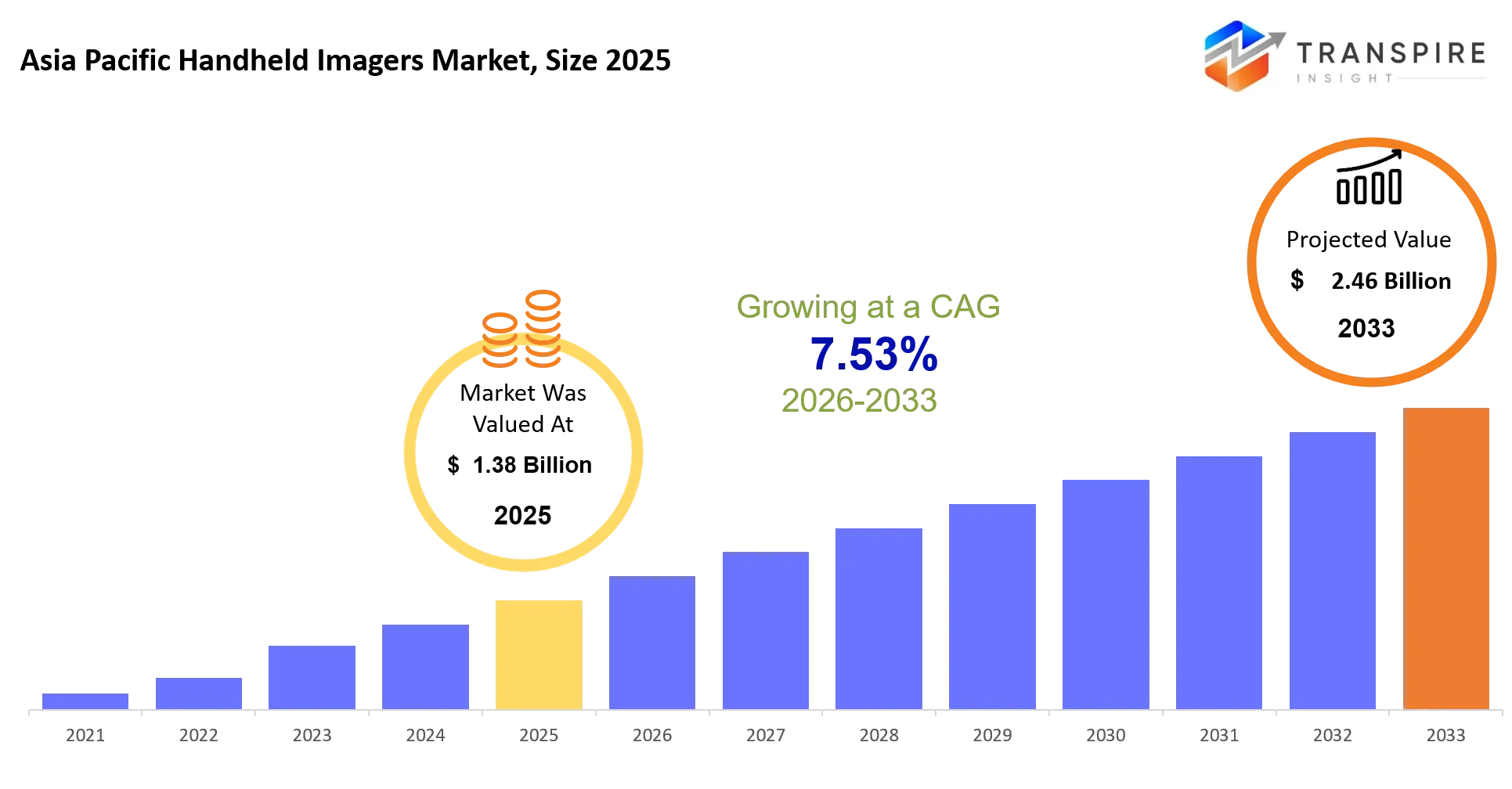
As per Transpire Insight Analysis, the Asia Pacific Handheld Imagers Market size is estimated at USD 1.38 Billion in 2025 and is anticipated to reach USD 2.46 Billion by 2033, growing at a CAGR of 7.53% from 2026 to 2033.
The Asia Pacific Handheld Imagers Market really seems to support quick inspection, fault detection and day to day operational decisions, across manufacturing plants, utilities, construction sites, logistics hubs, and public safety operations. When technicians can catch heat loss, electrical faults, equipment wear, or structural flaws without having to stop everything , handheld imagers generally help reduce the chances of unplanned downtime, keep worksites more secure, and also lower maintenance expenditures. In the past 3 to 5 years, the market has kind of shifted away from basic standalone thermal cameras and toward AI enabled connected imaging systems that plug into industrial monitoring platforms, plus predictive maintenance routines. Pandemic era supply chain problems kinda showed weaknesses around asset reliability, so many organisations pushed harder for condition based maintenance and digital inspection options. That whole change has helped drive wider roll outs in mid-sized enterprises, while lower sensor costs and better image processing capabilities have boosted commercial uptake, creating more durable recurring revenue chances via software integration, analytics, and lifecycle service offerings.
Asia Pacific Handheld Imagers Market Size & Forecast:
- Asia Pacific Handheld Imagers Market Size 2025: USD 1.38 Billion
- Expected Market Value 2033: USD 2.46 Billion
- Forecast CAGR: 7.53%
- Leading region in 2025: China
- Fastest Growing region: India
- Key Profile: Teledyne FLIR, Fluke Corporation, Hikmicro, Testo SE, Bosch, Seek Thermal, Opgal, Leonardo DRS, Xenics, Raytron Technology, SATIR, Keysight Technologies, Zebra Technologies, Canon, Panasonic
Key Market Insights
- China pretty much dominated the regional market in 2025 , with about 39% share, and that was backed by electronics manufacturing, healthcare investments, and industrial automation demand as well.
- India , on the other hand is projected to be the fastest-growing regional market during 2025–2033, mainly because healthcare infrastructure is expanding and smart manufacturing initiatives are picking up.
- For the product side, handheld thermal imagers led the segment with close to 36% market share in 2025, showing solid industrial inspection take-up and predictive maintenance adoption.
- Handheld infrared imagers came in as the second-largest segment, helped along by rising electrical diagnostics needs and building inspection uses across major economies.
- Looking ahead, AI-enabled smart handheld imagers are expected to grow the quickest through 2033, supported by edge computing and more intelligent analytics integration.
- When it comes to applications, industrial inspection led with around 34% market share in 2025, driven by factory digitalisation and preventive maintenance programmes, basically the usual “keep it running” agenda.
- In terms of the fastest application, healthcare diagnostics is forecast to be the top grower between 2025 and 2033, mainly because portable point-of-care imaging is being adopted more widely.
- For end users, manufacturing stayed in the lead at roughly 38% share in 2025, supported by ongoing quality assurance practices and asset monitoring investments.
- And finally, healthcare providers are expected to be the fastest-growing end-user category across the forecast period, since portable imaging supports decentralised care, kind of reducing the distance between patient and service.
What are the Key Drivers, Restraints, and Opportunities in the Asia Pacific Handheld Imagers Market?
The primary growth driver is the fast digitalisation of manufacturing and critical infrastructure inspection, like you know. Industrial automation programmes, Industry 4.0 investments, and tougher workplace safety rules helped speed up the rollout of portable thermal and infrared imaging systems. At the same time falling sensor costs and stronger imaging accuracy kept pushing affordability up. Now more factories tend to do predictive inspections rather than reactive maintenance. That change cuts equipment downtime, while also raising inspection frequency, and it sort of lines up with equipment replacement cycles and ongoing, recurring demand across manufacturing, utilities and healthcare.
The main restraint is the still high cost of advanced imaging sensors, plus specialised software integration, which is never trivial. Calibration duties, certification standards, and the limited availability of top tier detector components make it hard to get quick, big cost drops. Smaller businesses often delay procurement because the whole implementation goes beyond hardware buying into software interfacing and also workforce training. Based on the Transpire Insight review of regional procurement announcements and launch timetables, supply chain concentration stays the biggest execution risk. So then you get delayed purchasing choices, slower deployment timelines, and reduced revenue windows across several developing economies in Asia Pacific.
The best chance is really in AI powered handheld imaging that’s paired with cloud analytics and some edge computing on the side. It feels like semiconductor spending across China, India, South Korea, and Southeast Asia is making the ground more friendly for smarter inspection platforms. You can also connect portable imaging devices with predictive maintenance software, and then you get automated defect spotting plus real time updates. On top of that, healthcare providers are pushing more mobile diagnostic offerings, relying on compact imaging equipment. Over the next decade, these shifts should open up fresh commercial uses that go past the usual industrial inspection, not just that one narrow lane anymore.
What Has the Impact of Artificial Intelligence Been on the Asia Pacific Handheld Imagers Market?
Artificial intelligence plus digital technologies are, in a real way, reshaping portable imaging solutions through Asia Pacific, sort of making inspections faster , more accurate and more and more autonomous. AI algorithms are handling the image interpretation side of things by themselves now , they can spot thermal anomalies, sort defects into categories and even back compliance monitoring across manufacturing plants, electrical infrastructure , and healthcare settings. At the same time connected handheld imaging devices keep exchanging data with cloud platforms, which then supports centralised oversight and quicker operational decisions, in practice.
Machine learning models are also getting used for predictive maintenance a lot more often, by studying past thermal patterns and equipment behaviour before anything fails. On top of that, improved forecasting tools assist manufacturers with anticipating product demand, tightening up inventory levels, and arranging maintenance tasks in a more efficient rhythm. As a result equipment stays available for longer, fewer inspections happen “just in case,” and maintenance planning becomes steadier across industrial sites.
Then there are those digital workflows that, more or less, lift operational efficiency by trimming the manual inspection time, speeding up report cycles, and making diagnostic outcomes more consistent. AI-assisted image processing helps with quality control as well, and it can surface early fault signals, which boosts asset reliability while also pulling down maintenance spend. Still, wide adoption is sort of stalled by integration costs that can be quite high, imaging data that shifts across operating environments and, on top of that a lack of labeled datasets needed to train dependable AI models.Also connectivity can be spotty in remote industrial areas, so cloud-reliant imaging platforms don’t always perform as expected, pushing organisations to invest more in edge-based AI processing instead.
Key Market Trends
- From 2023 to 2025 AI-enabled handheld imagers kind of started replacing regular inspection tools more and more often, boosting defect recognition and making automated reporting a lot more accurate than before.
- After 2024 edge computing got folded in faster than expected ,so portable imaging devices could process thermal data locally without needing continuous cloud connectivity all the time.
- Also manufacturers began embedding wireless connectivity and cloud synchronisation into new product launches, which let teams handle inspections in real time across several facilities.
- In healthcare, organisations ramped up adoption of portable imaging devices for point of care diagnostics, especially after they expanded digital healthcare investment programmes in 2023.
- Meanwhile miniaturised infrared sensors helped reduce both device weight and power consumption, so field inspections became more practical across utilities, manufacturing, and construction ,not just in labs.
- Chinese and Japanese manufacturers increased their investment in AI-enabled thermal imaging research between 2024 and 2026, aiming to keep ( and strengthen ) regional technology leadership.
- Industrial customers also drifted away from purely scheduled maintenance toward condition-based maintenance, using intelligent handheld imaging platforms linked with predictive analytics.
- Also on top of that, those multi spectrum handheld imagers had real commercial momentum, because they bundle thermal imaging, visible light capture, and digital imaging all together in one single portable inspection unit, kind of like a field-ready “everything box”.
- Then, strategic partnerships between imaging manufacturers and industrial software providers really picked up after 2024. This helped expand connected inspection, reporting, and predictive maintenance ecosystems that not just exist on paper, but work end to end, more or less.
Asia Pacific Handheld Imagers Market Segmentation
By Product Type :
Thermal imagers keep a pretty solid position, mostly because industrial maintenance, electrical checks and public safety work need fast temperature sensing without direct touch. Infrared imagers seem to get wider buy in every year across manufacturing plants and in healthcare rooms too, since dependable thermal analysis really helps catch early faults before they become problems, or so people say. Optical imagers stay relevant as well, especially for more detailed visual inspection work, where sharper picture quality tends to boost how accurate the inspection feels. Meanwhile multispectral and hyperspectral imagers keep sliding into niche industrial, agricultural, and research use cases as image processing tech gets better and more practical.
As demand for AI supported imaging systems keeps growing, expect ongoing upgrades across multiple sectors during the forecast window. Product makers also continue tuning battery performance, improving image resolution, and pushing for more device portability, all to help support field operations. More compact, handheld form factors will give improved mobility , but supposedly without cutting performance. And new development efforts are likely to lean hard into software integration, plus faster image analysis, so inspection efficiency gets better in real life.
By Application :
Industrial inspection is probably the big one, because manufacturing places need dependable equipment monitoring and preventive upkeep, not just once, but regularly. In healthcare diagnostics things keep getting bigger too, especially with portable imaging solutions, they help with point-of-care checks and it also supports quicker clinical decisions, even when time is tight. Then there’s building inspection, which seems to be rising steadily as energy efficiency rules push for more thorough thermal evaluations of both commercial buildings and residential ones. Security and surveillance work is also a reason, since it backs wider use of portable imaging equipment around transport hubs, public areas and similar spots.
Automotive testing and electronics inspection keep on benefiting as production quality expectations climb and product complexity keeps increasing. Manufacturers end up using portable imaging equipment to spot concealed defects, before anything reaches customers. When the imaging accuracy gets better, quality control improves and inspection time drops, which sounds obvious, but it’s still true in practice. On top of that, extra industrial use cases should keep appearing, as portable imaging tech becomes more affordable and frankly more capable than before.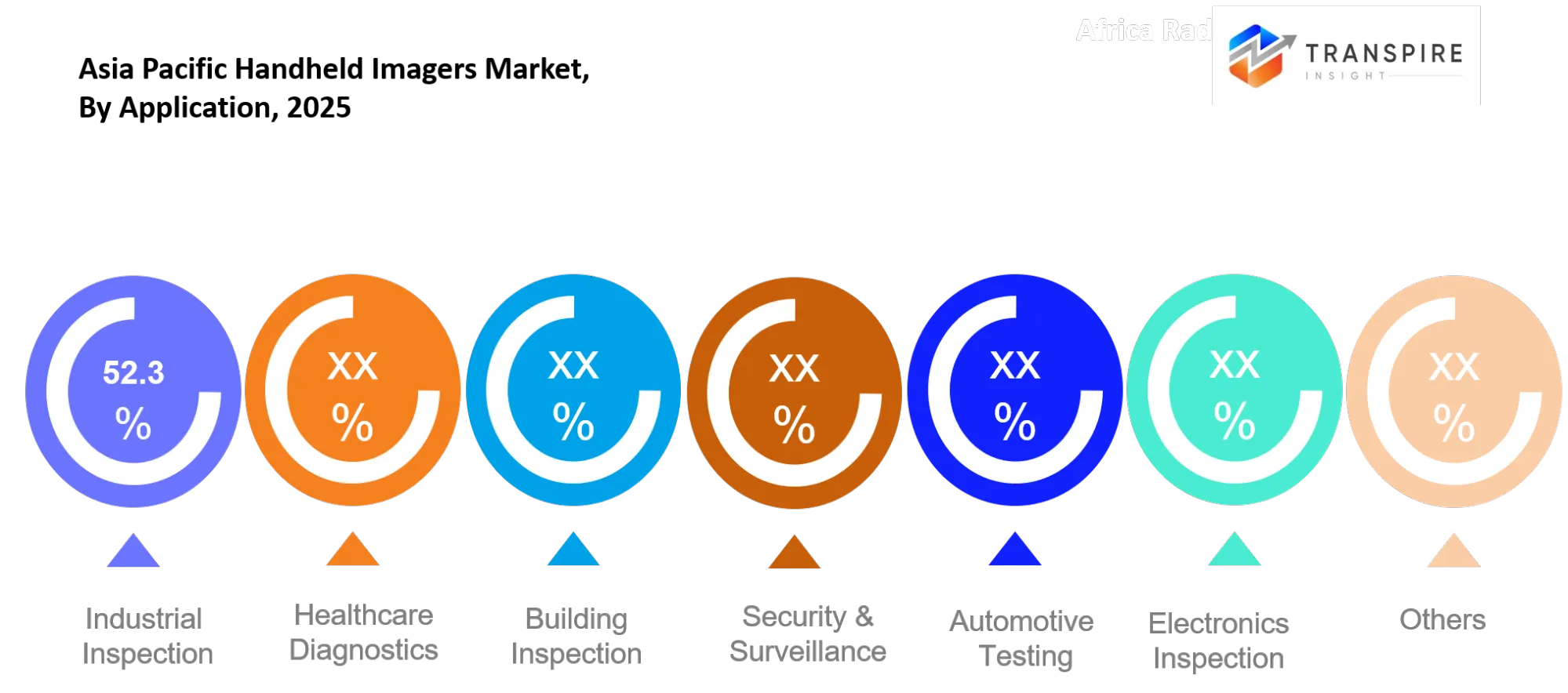
By End User :
Industrial manufacturers still end up as the top end-user group, mostly because steady equipment monitoring helps you squeeze out better output and keeps those upkeep costs down. In parallel, healthcare providers are pushing even more portable imaging across emergency care, diagnostic workflows, and outpatient settings kind of everywhere it can practically fit. Government agencies, for their part, keep putting money into handheld imaging systems for border security, disaster response, infrastructure checks, plus public safety programmes, so nothing feels too slow. Construction companies are also adopting faster, not just to streamline structural inspections, but to uncover those less visible building defects you would rather not find later.
On the utilities side, utility companies keep relying on portable imaging gear for electrical transmission, substations, and renewable energy installations, where early fault detection basically prevents operational disruptions before they snowball. Looking forward, investment in infrastructure modernisation should enable extra buying cycles across both energy and transportation. Meanwhile, inspection teams generally favor lightweight devices, since better mobility in the field matters more than people admit. And overall, broader digital transformation will open up additional possibilities across a range of end-user industries, not only one lane.
By Technology :
Infrared imaging and thermal imaging still kind of set the tone for portable inspection systems, since both technologies provide pretty reliable non-contact evaluation across industrial and healthcare settings, and that matters a lot. Digital imaging keeps getting better with higher density sensors, swifter processors, and stronger image archiving options. AI-enabled imaging is also picking up steam, because automated image recognition cuts down on manual review and helps keep inspections more consistent, more or less. Technology providers keep rolling out features like wireless connectivity and cloud based reporting, usually right in their newest product launches.
Then there’s edge computing, which should help portable image processing move along without always needing continuous internet access. Software upgrades will likely enable predictive maintenance and more automated defect finding across industrial plants. Meanwhile, improved sensor performance will boost reliability during tough operating conditions. Overall, steady technology investment continues to back higher efficiency, plus quicker inspection workflows.
By Distribution Channel :
Direct sales stay as the most preferred path, because industrial buyers usually want technical consultation and a customized solution, plus installation support, and also after-sales service. Even so, distributors are still a key piece of it they help by widening regional availability , and giving nearby technical assistance. Meanwhile online retail keeps growing, steady really, with product comparisons, digital catalogues, and quicker procurement flows that make the decision feel simpler . Smaller companies are also going online more and more, especially for standard handheld imaging products.
At the same time regional distribution networks keep getting broader through strategic partnerships between manufacturers and authorised suppliers. With faster delivery services , and better digital procurement platforms, customer access should get stronger across developing economies. Product demonstrations and technical support will remain pretty essential for advanced imaging solutions, not just “nice to have”. So overall, a balanced push between direct and digital channels should make the market easier to reach, for more customers, during the forecast period.
What are the Key Use Cases Driving the Asia Pacific Handheld Imagers Market?
Industrial inspection is still the main use case, since manufacturing firms, utilities, and large heavy industries really depend on handheld imaging devices, to catch overheating parts, electrical faults, and mechanical defects in time , before a weird failure stops production. Preventive maintenance programmes plus more strict operational safety requirements keep pushing procurement across big industrial sites.
Healthcare diagnostics and building inspection are getting bigger much faster now. Hospitals and diagnostic centres use portable imaging systems for quick patient assessment, while construction groups and property managers lean on thermal inspections to spot insulation gaps, moisture intrusion, and energy losses, which can mess with building performance and regulatory compliance.
Newer applications are also rolling out in precision farming, and smart infrastructure management. Agricultural organisations are weighing handheld imaging for crop well-being checks , and transport authorities are testing these handheld tools for bridges, tunnels, and railway checks to back predictive maintenance and also improve long term public infrastructure resilience.
|
Report Metrics |
Details |
|
Market size value in 2025 |
USD 1.38 Billion |
|
Market size value in 2026 |
USD 1.48 Billion |
|
Revenue forecast in 2033 |
USD 2.46 Billion |
|
Growth rate |
CAGR of 7.53% from 2026 to 2033 |
|
Base year |
2025 |
|
Historical data |
2021 - 2024 |
|
Forecast period |
2026 - 2033 |
|
Report coverage |
Revenue forecast, competitive landscape, growth factors, and trends |
|
Regional scope |
Asia Pacific (India, China, Japan, Australia, South Korea, Rest of Asia Pacific) |
|
Key company profiled |
Teledyne FLIR, Fluke Corporation, Hikmicro, Testo SE, Bosch, Seek Thermal, Opgal, Leonardo DRS, Xenics, Raytron Technology, SATIR, Keysight Technologies, Zebra Technologies, Canon, Panasonic . |
|
Customization scope |
Free report customization (country, regional & segment scope). Avail customized purchase options to meet your exact research needs. |
|
Report Segmentation |
By Product Type (Thermal Imagers, Infrared Imagers, Optical Imagers, Multispectral Imagers, Hyperspectral Imagers, Others); By Application (Industrial Inspection, Healthcare Diagnostics, Building Inspection, Security & Surveillance, Automotive Testing, Electronics Inspection, Others); By End User (Industrial Manufacturers, Healthcare Providers, Government Agencies, Construction Companies, Utilities, Others); By Technology (Infrared Imaging, Thermal Imaging, Digital Imaging, AI-Enabled Imaging, Others); By Distribution Channel (Direct Sales, Distributors, Online Retail, Others) |
Which Regions are Driving the Asia Pacific Handheld Imagers Market Growth?
China accounted for about 39% of the regional revenue in 2025 ,so yeah it becomes the biggest market across Asia Pacific. On top of that , national programmes for modernising manufacturing, industrial safety rules , and the continued push toward smart factory upgrades have helped handheld imaging systems spread faster across many different industries. There’s also a solid electronics manufacturing base , lots of component suppliers already in place, plus domestic developers of imaging technology, all of which really supports a smooth production and distribution kind of setup. As a result, ongoing spending on automation, semiconductor output, and industrial digitalisation should keep this momentum going over the whole forecast period.
Japan sits in second place , mainly because purchasing choices lean more on long-term equipment reliability, not so much on quick capacity expansions. Industrial policies there stay fairly stable, research funding remains consistent, and quality standards are pretty strict which backs up regular replacement cycles for more advanced imaging tools. You can also see it in the demand side from automotive, electronics, and precision manufacturing, where industrial inspection and quality assurance work need dependable solutions. Finally , predictable capex along with mature supply chains means Japan stays a steady recurring revenue source even if growth is more moderate.
India is expected to show the quickest growth between 2026 and 2033, as manufacturing expansion keeps moving forward, healthcare infrastructure spending continues, and digital industrial programmes also start to speed up equipment procurement a bit more. Meanwhile, government efforts that back domestic production, smart factory adoption, and infrastructure building have basically helped portable imaging technologies spread more widely across industrial spaces and public services. At the same time, higher spending tied to renewable energy, utilities, and construction inspections is giving extra momentum to the market across a bunch of different industries. This growing appetite then sets up really good chances for technology suppliers, distribution partners, and investors looking for long term development across the emerging industrial landscape.
Who are the Key Players in the Asia Pacific Handheld Imagers Market and How Do They Compete?
Competition looks sort of moderately fragmented, since global imaging manufacturers are out there competing next to regional technology firms and specialised equipment suppliers. The way they usually fight comes from tech innovation, image fidelity, software integration, and after-sales services, even if price still matters a lot for the more standard product lines. At the same time, the well-known players keep expanding their product ranges by leaning into research investment, while newer entrants try to stand out with more application-specific solutions and cost-efficient devices.
FLIR Systems , for example, leans heavily into advanced thermal imaging paired with AI-assisted analysis and connected inspection software , which then boosts industrial maintenance efficiency. Teledyne Technologies differentiates through high-performance sensors and imaging capabilities built for tough industrial and scientific use, and it keeps pushing by continuing product development. HIKMICRO goes for cost-effective thermal imaging products, with frequent hardware revisions and a wider distribution footprint across parts of Asia.
Testo SE & Co. KGaA strengthens its role by mixing handheld imaging tools with measurement instruments, plus calibration services. That combo helps industrial customers get extra value, rather than just raw imaging. Fujifilm, meanwhile, expands portable imaging solutions by keeping investment flowing into healthcare technologies and diagnostic imaging capabilities, supporting its presence in medical applications too. Overall, each company keeps broadening regional reach via distributor agreements, technology upgrades, and new product rollouts , all meant to match shifting needs in inspection, maintenance, and diagnosis.
Company List
- Teledyne FLIR
- Fluke Corporation
- Hikmicro
- Testo SE
- Bosch
- Seek Thermal
- Opgal
- Leonardo DRS
- Xenics
- Raytron Technology
- SATIR
- Keysight Technologies
- Zebra Technologies
- Canon
- Panasonic
Recent Development News
In April 2026, HIKMICRO launched SuperScene™ Mode, an AI-powered imaging capability for its thermal imaging portfolio. The technology simplifies thermal inspections through AI-assisted image analysis and strengthens the company's position in intelligent handheld imaging solutions. Source https://www.hikmicrotech.com/
In January 2026, Teledyne FLIR OEM launched the Tura automotive-qualified thermal camera at CES. The new thermal imaging platform expands the company's thermal technology portfolio and supports wider adoption of advanced infrared imaging across next-generation mobility and industrial applications. Source https://www.oem.flir.com/
What Strategic Insights Define the Future of the Asia Pacific Handheld Imagers Market?
The Asia Pacific Handheld Imagers Market is set to lean more toward intelligent, software driven inspection platforms, not just separate imaging devices, during the next five to seven years. The momentum here will matter a lot less like “only hardware” and more like artificial intelligence plus edge computing working together, along with smooth integration into industrial asset management systems, so that the images being captured turn into real time operational choices. A quieter kind of risk will also pop up, from the ongoing reliance on only a few advanced sensor and detector suppliers. That can leave manufacturers exposed to component shortages , price swings and longer wait times for deliveries.
On the flip side, there’s a noticeable opening for portable imaging solutions built specifically for renewable energy assets and for critical infrastructure checks. This is especially true as governments roll out grid modernisation and resilience programs across developing economies. In general, market players can gain by putting money into regional manufacturing partnerships and application specific software, because that enables quicker product tailoring, tougher supply chain stability, and a clearer differentiated value beyond bare hardware performance.
Asia Pacific Handheld Imagers Market Report Segmentation
By Product Type
- Thermal Imagers
- Infrared Imagers
- Optical Imagers
- Multispectral Imagers
- Hyperspectral Imagers
By Application
- Industrial Inspection
- Healthcare Diagnostics
- Building Inspection
- Security & Surveillance
- Automotive Testing
- Electronics Inspection
By End User
- Industrial Manufacturers
- Healthcare Providers
- Government Agencies
- Construction Companies
- Utilities
By Technology
- Infrared Imaging
- Thermal Imaging
- Digital Imaging
- AI-Enabled Imaging
By Distribution Channel
- Direct Sales
- Distributors
- Online Retail
Frequently Asked Questions
Find quick answers to common questions.
The Expected Asia Pacific Handheld Imagers Market size for the Market will be USD 2.46 Billion in 2033.
Key segments for the Asia Pacific Handheld Imagers Market are By Product Type (Thermal Imagers, Infrared Imagers, Optical Imagers, Multispectral Imagers, Hyperspectral Imagers, Others); By Application (Industrial Inspection, Healthcare Diagnostics, Building Inspection, Security & Surveillance, Automotive Testing, Electronics Inspection, Others); By End User (Industrial Manufacturers, Healthcare Providers, Government Agencies, Construction Companies, Utilities, Others); By Technology (Infrared Imaging, Thermal Imaging, Digital Imaging, AI-Enabled Imaging, Others); By Distribution Channel (Direct Sales, Distributors, Online Retail, Others) .
Major Asia Pacific Handheld Imagers Market players are Teledyne FLIR, Fluke Corporation, Hikmicro, Testo SE, Bosch, Seek Thermal, Opgal, Leonardo DRS, Xenics, Raytron Technology, SATIR, Keysight Technologies, Zebra Technologies, Canon, Panasonic.
The Current Asia Pacific Handheld Imagers Market size is USD 1.38 Billion in 2025.
The Asia Pacific Handheld Imagers Market CAGR is 7.53% from 2026 to 2033.
- Teledyne FLIR
- Fluke Corporation
- Hikmicro
- Testo SE
- Bosch
- Seek Thermal
- Opgal
- Leonardo DRS
- Xenics
- Raytron Technology
- SATIR
- Keysight Technologies
- Zebra Technologies
- Canon
- Panasonic
About the Authors

Avinash Kumar
I’m Avinash Kumar, a Senior Research Analyst at Transpire Insight, with expertise in the Electronics and Semiconductor and Energy & Power industry. My work focuses on analyzing emerging technologies, market trends, industry developments, and innovation across these sectors. I specialize in transforming complex technical and market insights into clear, research-backed content that helps professionals, businesses, and decision-makers stay informed. Through continuous industry research and data-driven analysis, I strive to deliver accurate, reliable, and practical perspectives on the latest advancements shaping the semiconductor and energy landscape.

Chakradhar Khansole
Chakradhar serves as the Research Director at Transpire Insight, bringing over 8 years of experience in technology, innovation, and strategic market intelligence. He specializes in transforming complex market data into actionable business insights that enable organizations to make informed, growth-oriented decisions. Recognized for his strategic vision and analytical expertise, Chakradhar leads high-impact research initiatives, delivering comprehensive market assessments, competitive intelligence, and forward-looking industry analysis.
Recently Published Reports
-
Apr 2026
Fiber Optic Faceplates Market
Fiber Optic Faceplates Market Size, Share & Analysis Report By Type (< 300 mm2, 300-350 mm2, and > 350 mm2, By Application (Night Vision, Holographic Imaging, Medical, and Others), and Geography (North America, Europe, Asia-Pacific, Middle East and Africa, South and Central America), 2021 - 2031
-
Apr 2026
High Temperature Superconductors Market
High Temperature Superconductors Market Size, Share & Analysis Report By Type (1G HTS, and 2G HTS), By Application (Power Cable, Fault Current Limiter, and Transformer), and Geography (North America, Europe, Asia-Pacific, Middle East and Africa, South and Central America), 2021 - 2031
-
Apr 2026
Industrial Plugs and Socket Market
Industrial Plugs and Socket Market Size, Share & Analysis Report By Type (Industrial Plugs, Industrial Sockets), By Current (Up to 32 A, 32 to 125 A, Above 125 A), By Protection (Dustproof and Splash Proof, Waterproof, Explosion Proof), By End User (Heavy Industries, Oil and Gas, Chemicals and Pharmaceuticals, Power Generation, Others), and Geography (North America, Europe, Asia-Pacific, Middle East and Africa, South and Central America), 2021 - 2031
-
Apr 2026
InGaAs Avalanche Photodiodes Market
InGaAs Avalanche Photodiodes Market Size, Share & Analysis Report By Type (1100 - 1700 nm, and 1000 - 1600 nm), By Application (Missile Warning System, Muzzle Flash Detection, Wafer Defect Inspection, Laser Rangefinders, and Others), and Geography (North America, Europe, Asia-Pacific, Middle East and Africa, South and Central America), 2021 - 2031