

Asia Pacific Essential Oils Market Size & Forecast:
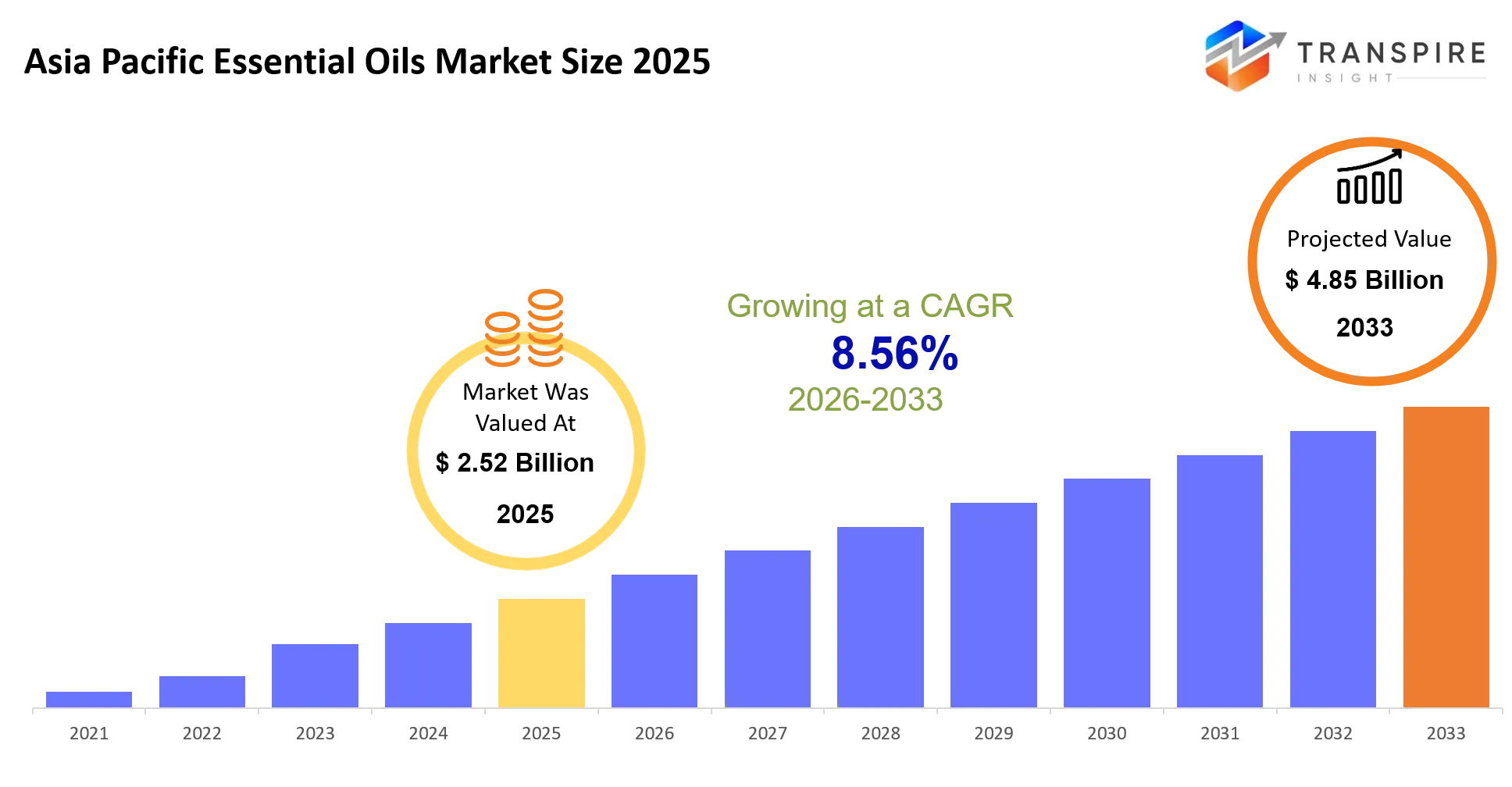
- Asia Pacific Essential Oils Market Size 2025: USD 2.52 Billion
- Asia Pacific Essential Oils Market Size 2033: USD 4.85 Billion
- Asia Pacific Essential Oils Market CAGR: 8.56%
- Asia Pacific Essential Oils Market Segments: By Product Type (Lavender Oil, Peppermint Oil, Lemon Oil, Eucalyptus Oil, Tea Tree Oil, Orange Oil, Rosemary Oil, Others); By Application (Aromatherapy, Personal Care, Food & Beverages, Pharmaceuticals, Home Care, Spa Treatments, Wellness Products, Others); By Distribution Channel (Online Retail, Specialty Stores, Pharmacies, Supermarkets, Direct Sales, Wellness Stores, Beauty Stores, Others); By End User (Individuals, Wellness Centers, Cosmetic Manufacturers, Food Producers, Pharmaceutical Companies, Aromatherapists, Spa Operators, Others)
Asia Pacific Essential Oils Market Summary
The Asia Pacific Essential Oils Market was valued at USD 2.52 Billion in 2025. It is forecast to reach USD 4.85 Billion by 2033. That is a CAGR of 8.56% over the period.
The essential oils market in Asia Pacific is the key ingredient ecosystem for personal care, food & beverage, household products, and wellness products by allowing manufacturers to substitute synthetic ingredients with natural aroma, flavor, and functional constituents. Market evolution has witnessed a paradigm shift in the last few years from a fragrance driven to a formulation driven category by the adoption of essential oils for brands aiming clean label and product differentiation after pandemic has revealed global supply chains limitations and raised consumer demands toward traceable and plant derived products.
Essential oils transformed into strategic raw material instead of niche ingredients during the reformulation process that came as a result of more rigid requirements in formulation ingredients and trends towards product premiumization. This revolution increased sourcing volume, stimulating investment in sustainable sourcing and extraction methods and resulting in a wave of opportunities for cosmetics, nutraceuticals, and functional food markets in the whole region.
Key Market Insights
- China held over 35% share of the Asia Pacific Essential Oils Market in 2025 driven by large scale production & exporting facilities.
- India is the fastest growing regional market through 2032, on the account of its growing herbal products manufacturing and investment in cultivation of aromatic crops.
- Southeast Asia has become a vital region for sourcing with Indonesia & Vietnam increasingly scaling up production for clove, citronella, and patchouli oils.
- Citrus oils segment holds the largest share of over 30% owing to its widespread applications in beverages, personal care & household cleaning products.
- Lavender oils holds the second largest share owing to increasing popularity of aromatherapy & luxury personal care products across the region.
- Peppermint oils is anticipated to register the fastest growth by 2032 due to innovative applications in nutraceutical and pharmaceutical products.
- The personal care & cosmetics application segment has gained nearly 40% market share owing to the widespread application of the oils in skincare, haircare, and fragrance based products.
- Food and beverage is anticipated to be the fastest growing application, as companies explore new applications of the natural flavor systems & alternative to preservative agents.
- Consumer goods manufacturers lead the end user segment by holding over 45% market share with widespread use of the oils in personal care, wellness and household products.
- Nutraceuticals and healthcare companies are the fastest growing end user application due to the increasing commercial as well as clinical acceptance of the botanical ingredient.
What are the Key Drivers, Restraints, and Opportunities in the Asia Pacific Essential Oils Market?
Market growth in the Asia Pacific Essential Oils Market is driven mainly by the growing trend of using natural ingredient based products in cosmetic, food processing and health care sectors. The Covid-19 pandemic highlighted the fragilities of the synthetic chemical supply chains, increasing the diversification of ingredients. Many multinational companies are reformulating their products using botanicals in cosmetics, food, and healthcare to achieve clean labels and meet high end product positioning. Essential oils are shifting from being an additional component to the key ingredient in product formulations, increasing purchasing volumes and, in turn, revenue at higher value.
The primary restriction is the supply dependence on agricultural raw materials. Yields are primarily affected by the availability of land, weather, and crops, and these conditions change from season to season. Fluctuating weather patterns, disease occurrence, and crop growing costs cannot be addressed efficiently in the short term, hence ensuring supply chain volatility and changing prices for producers. Production plans cannot be made effective, limiting revenue growth for small-scale manufacturers.
Investment in precision agriculture and new extraction technologies represents the most promising opportunity for the market. Innovations such as AI crop management, hydroponics/aquaponics, and supercritical CO2 extraction are enhancing the consistency of both yields and quality of the oil, while creating sustainable processes. India and Southeast Asia are appealing for the growth of aromatic crop cultivation and value addition in botanicals as governments support them with beneficial policies.
What Has the Impact of Artificial Intelligence Been on the Asia Pacific Essential Oils Market?
AI and other advanced digital technologies are revolutionizing the Asia Pacific essential oils market, offering benefits such as increased agricultural yields, increased extraction efficiency and supply chain transparency. Manufacturers are employing AI-powered sensor networks and image analytics to assess the health of aromatic plant crops and to optimize the timing and water requirements for irrigation. As a result of employing these tools, growers are experiencing better aromatic plant yields and can significantly reduce water and fertilizer use.
ML is also increasing efficiency in extraction processes. Manufacturers are utilizing predictive analytics and algorithms to achieve optimal temperatures for distillation and to determine best times for distillation and optimum mixing ratios of materials for highest oil extraction rates. The ability to implement AI-powered digital traceability allows manufacturers to identify raw material sources, quality characteristics, and material movements within the value chain, which fosters compliance with regulations and increasing customer confidence.
The benefits that these new technologies provide in operation include increased up-time, reduced use of raw materials, decreased quality control costs, and reported doubled digit increases in extraction efficiency and decreased use of energy. But in spite of the great potential there are many limitations to AI integration in production that include high implementation costs and fragmented agricultural supply chains which contribute to limited access to the standard data needed to build high performance predictive algorithms for many smallholder farmers.
Key Market Trends
- From 2020 onwards, there has been a substitution from synthetic additives to botanicals which means that essential oils are now a key raw material for premium consumer products.
- China gained more influence in the region from 2021 onwards in the production side, whilst India is expanding cultivation and processing capability of aromatic crops extensively.
- Demand for traceability from the buyers has pressured the suppliers to establish a blockchain and digital tracking mechanism with added benefits for product quality and transparency.
- Supercritical CO2 extraction has been steadily gaining traction from 2022 onwards by improving extraction yield up to 10-20% over conventional distillation and delivering pure oil.
- Essential oil companies are shifting from commodity market spot purchases towards direct farm partnerships for sustainable and secured feedstock across the APAC region.
- Therapeutic and aromatherapy product launch from the wellness brands has more than 30% growth increase from 2021, leading to a new source of income stream other than the traditional fragrance application.
- Climate related crop failures and uncertainties have become increasingly significant over the past 5 years and thus forcing the producers to diversify its sourcing across India, Indonesia, Vietnam.
- Investment in regional extraction facilities by major players such as Young Living, doTERRA, Givaudan, Symrise has become significant in terms of reducing the supply chain length and securing feedstocks.
- AI based crop monitoring and precise agriculture solutions are developing rapidly and have potential for higher yields with optimum input, better yield forecast etc.
- Growing demand for transparency on ingredients from the regulators have been witnessed since 2020 and therefore leading manufacturers to adopt stable and scientifically validated botanical ingredients.
Asia Pacific Essential Oils Market Segmentation
By Product Type:
The Lavender Oil is highly demanded among wellness and personal care applications due to its tranquil aroma and wide application in relaxing products. The peppermint oil is beneficial to oral care, wellness products and cooling applications, and the lemon oil and orange oil are popular among the food flavors and home care product applications.
Eucalyptus oil and tea tree oil grab the manufacturers' attention for their clean smell and cleansing properties in pharmaceuticals and personal care products. Rosemary oil is popular among hair care and wellness applications, and the other refers to those specialty oils used in niche formulations and premium product applications.
By Application:
Aromatherapy will still be a major application in light of rising demand in wellness practices across both urban and developing sectors. The Personal Care applications of essential oils can be found in skin care, hair care and fragrance products. The essential oils will be used in enhancing the products' sensory attributes, and these will be followed by Food & Beverages products.
The pharmaceuticals also apply essential oils in several medicinal and therapeutic applications, and other factors include Spa Treatments, Wellness Products etc. The industrial and specialty applications represent smaller markets but steady streams of consumers.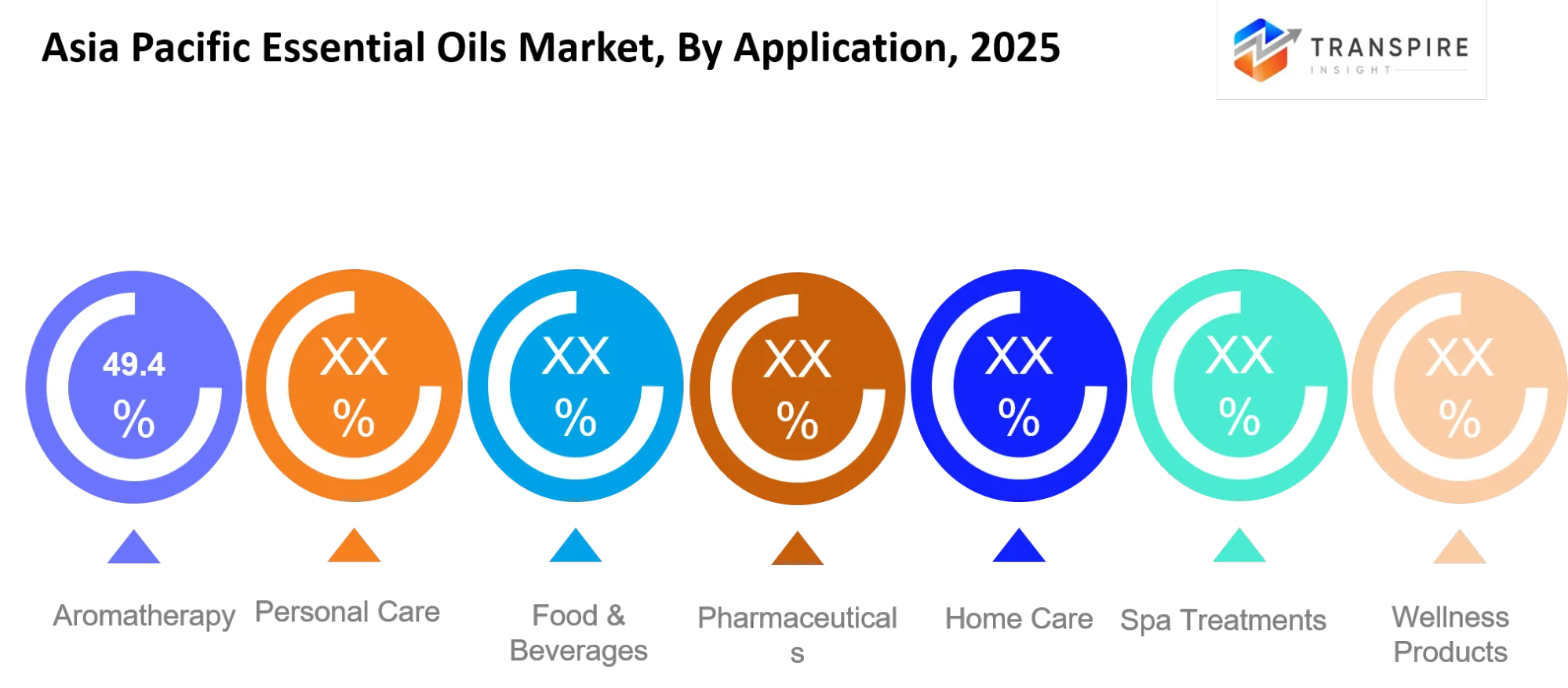
By Distribution Channel:
E-commerce has changed the consumer's shopping behavior to have a wider choice of products and prices, as well as convenient delivery. Specialty Stores and Wellness Stores always attract consumers looking for superior oils and need the expert to guide the selection and purchase.
Pharmacies still play an important role to offer therapeutic and health care oriented products. Supermarkets offer convenience to a mass consumer. Direct Selling focuses on customer relationships, and Beauty Stores is related to beauty use. Others also include independent stores, and newly developing sale methods on the different regional markets.
By End User:
Personal customers are an important consumers because people use the oils everyday to apply for home care, personal care, and wellness use. Wellness centers, aromatherapists, purchase oils for therapy and relaxations, stable demand in many types of products.
Cosmetics manufacturers use the oils to create skin care, fragrances and hair care products with natural ingredients. Food producers use it for the taste. Pharmaceutical companies and spa owners develop it for commercial purposes. Others include the small business, and specialized users to serve local and regional markets.
What are the Key Use Cases Driving the Asia Pacific Essential Oils Market?
The use in personal care is considered the largest application in the Asia Pacific Essential Oils Market due to cosmetic and skincare manufacturers sourcing them as natural fragrance and active ingredients to differentiate their products from others in this highly competitive market. In cosmetic products, the essences help the manufacturers position themselves by giving their product superior formulas that are aromatically distinctive and derived from botanical components, resulting in higher product worth and repeat purchases.
Use in the food and beverage sector is seeing continued growth with more manufacturers switching to botanically derived flavors over artificially created ones. Moreover, therapeutic and spa facilities are utilizing essential oils in their massage and relaxation therapies, leading to the emergence of new opportunities and business practices within urban environments.
Other rising applications include nutraceutical and functional beverage products made using botanical ingredients. Use in natural household cleaning and air freshener applications are other segments that are anticipated to witness a significant boost over the coming years.
|
Report Metrics |
Details |
|
Market size value in 2025 |
USD 2.52 Billion |
|
Market size value in 2026 |
USD 2.73 Billion |
|
Revenue forecast in 2033 |
USD 4.85 Billion |
|
Growth rate |
CAGR of 8.56% from 2026 to 2033 |
|
Base year |
2025 |
|
Historical data |
2021 - 2024 |
|
Forecast period |
2026 - 2033 |
|
Report coverage |
Revenue forecast, competitive landscape, growth factors, and trends |
|
Regional scope |
Asia Pacific (India, China, Japan, Australia, South Korea, Rest of Asia Pacific) |
|
Key company profiled |
Young Living, doTERRA, Symrise, Givaudan, Firmenich, Takasago, Robertet, Biolandes, Mane, NOW Foods, Rocky Mountain Oils, Plant Therapy, Edens Garden, Aura Cacia, FLAVEX |
|
Customization scope |
Free report customization (country, regional & segment scope). Avail customized purchase options to meet your exact research needs. |
|
Report Segmentation |
By Product Type (Lavender Oil, Peppermint Oil, Lemon Oil, Eucalyptus Oil, Tea Tree Oil, Orange Oil, Rosemary Oil, Others); By Application (Aromatherapy, Personal Care, Food & Beverages, Pharmaceuticals, Home Care, Spa Treatments, Wellness Products, Others); By Distribution Channel (Online Retail, Specialty Stores, Pharmacies, Supermarkets, Direct Sales, Wellness Stores, Beauty Stores, Others); By End User (Individuals, Wellness Centers, Cosmetic Manufacturers, Food Producers, Pharmaceutical Companies, Aromatherapists, Spa Operators, Others) |
Which Regions are Driving the Asia Pacific Essential Oils Market Growth?
China dominates the Asia Pacific market owing to its strong manufacturing capabilities, vast aromatic crops processing and vertically integrated supply chain. Supportive government policies for botanicals and investments in food and cosmetic manufacturing, along with large export markets, have fortified the market's leadership. Producing provinces are equipped with technologically advanced extraction and processing facilities that ensure efficiency and uniformity. A network of growers, processors, exporters, and consumer goods manufacturers have thus sustained market stability in China against fluctuating raw material prices.
Japan stands as the second largest market in the region, with the growth pattern differing from that of China. Demand is primarily driven by high-value cosmetic products, dietary supplements, and food ingredients, with a focus on the quality and tracing of ingredients rather than production scale. Stringent safety regulations for cosmetic and food products necessitate substantial investment in certified raw material sourcing and sophisticated extraction techniques. Consistent consumer spending, coupled with a strong trend for new products in these categories, contribute significantly to the country's market revenue.
India holds the position of the fastest-growing market. Expansion of cultivated aromatic crop varieties, increased utilization of natural ingredients in domestic industries, significant investment in herbal and nutraceutical manufacturing and use of digital technology for cultivation will continue to drive growth. Active promotion by the Indian government on medicinal crops and agricultural value addition will create more investment avenues for both the farming and processing sectors, consequently fueling new investment in extraction facilities, contract farming and export-driven production networks from 2026 to 2033.
Who are the Key Players in the Asia Pacific Essential Oils Market and How Do They Compete?
The Asia Pacific essential oils market is moderately fragmented, comprising global ingredient manufacturers competing alongside regional manufacturers and niche wellness brands. While price remains critical in commodity oils, competitive advantage is now dictated by quality certification, traceability and extraction technology. Incumbent players are striving to protect market share through production capacity expansion and premium formulation development, while new players are focusing on niche wellness and therapeutic products. Competition is slowly transitioning from high volume to value-added products with an emphasis on stringent quality assurances and sustainability.
Young Living distinguishes itself with a vertically integrated supply chain and its proprietary seed-to-seal process that ensures consistent quality across its entire range. The company is increasing its distribution partnerships and wellness-focused portfolio in the Asia Pacific region in an effort to build trust and brand accessibility. The company further differentiates itself through certified therapeutic grade essential oils and a direct selling business model which helps build strong customer loyalty and engagement with its product range. Farmer partnerships and investment in sustainable sourcing models contribute to a secure supply of raw materials.
Givaudan utilizes an innovative approach combining botanical knowledge with modern extraction and formulation expertise in an effort to create value added products. Symrise differentiates by creating customized ingredients to be used in cosmetics, food and wellness products and strengthening its sourcing partnerships throughout Asia and Southeast Asia. These companies compete on product differentiation through the control of raw material quality, product traceability and product differentiation according to customer needs, rather than on production volume.
Company List
- Young Living
- doTERRA
- Symrise
- Givaudan
- Firmenich
- Takasago
- Robertet
- Biolandes
- Mane
- NOW Foods
- Rocky Mountain Oils
- Plant Therapy
- Edens Garden
- Aura Cacia
- FLAVEX
Recent Development News
In April 2025, doTERRA announced the launch of operations in Kazakhstan. The expansion strengthened the company's footprint in Central Asia and widened access to therapeutic-grade essential oils across emerging Asia Pacific wellness markets. Sourcehttps://www.doterra.com/
In March 2026, Symrise confirmed its acquisition of a minority stake in Danish aroma biotechnology company EvodiaBio. The investment strengthened access to biotechnology-based aroma production and supported the development of sustainable natural ingredient solutions relevant to essential oils and fragrance applications.
Source https://www.symrise.com/
What Strategic Insights Define the Future of the Asia Pacific Essential Oils Market?
The Asia Pacific essential oils market is trending towards a more integrated, technology-enabled ingredient economy where the emphasis will be equally placed on quality assurance, transparent sourcing and functional application as well as production volumes, fueled by premium consumer products, increased ingredient disclosure, and the use of better extraction technologies. In the next 5-7 years, greater market value will be achieved by those companies which own the value chain from the supply of the raw material to the capability to formulate it.
A subtler risk stems from an over-reliance on a narrow set of aromatic crops in few locations globally. Climate fluctuations, water stress and competition for land for crop cultivation could lead to a more restricted supply of raw materials, leading to higher price volatility despite robust end market demand.
The increased use of precision farming and AI crop monitoring in India and Southeast Asia presents a new and tangible opportunity for early-stage investment and partnership through longer term crop cultivation and a digital supply chain.
Asia Pacific Essential Oils Market Report Segmentation
By Product Type
- Lavender Oil
- Peppermint Oil
- Lemon Oil
- Eucalyptus Oil
- Tea Tree Oil
- Orange Oil
- Rosemary Oil
By Application
- Aromatherapy
- Personal Care
- Food & Beverages
- Pharmaceuticals
- Home Care
- Spa Treatments
- Wellness Products
By Distribution Channel
- Online Retail
- Specialty Stores
- Pharmacies
- Supermarkets
- Direct Sales
- Wellness Stores
- Beauty Stores
By End User
- Individuals
- Wellness Centers
- Cosmetic Manufacturers
- Food Producers
- Pharmaceutical Companies
- Aromatherapists
- Spa Operators
Frequently Asked Questions
Find quick answers to common questions.
The Asia Pacific Essential Oils Market size is USD 4.85 Billion in 2033.
Key Segments for the Asia Pacific Essential Oils Market are By Product Type (Lavender Oil, Peppermint Oil, Lemon Oil, Eucalyptus Oil, Tea Tree Oil, Orange Oil, Rosemary Oil, Others); By Application (Aromatherapy, Personal Care, Food & Beverages, Pharmaceuticals, Home Care, Spa Treatments, Wellness Products, Others); By Distribution Channel (Online Retail, Specialty Stores, Pharmacies, Supermarkets, Direct Sales, Wellness Stores, Beauty Stores, Others); By End User (Individuals, Wellness Centers, Cosmetic Manufacturers, Food Producers, Pharmaceutical Companies, Aromatherapists, Spa Operators, Others).
Major Asia Pacific Essential Oils Market players are Young Living, doTERRA, Symrise, Givaudan, Firmenich, Takasago, Robertet, Biolandes, Mane, NOW Foods, Rocky Mountain Oils, Plant Therapy, Edens Garden, Aura Cacia, FLAVEX.
The Current Asia Pacific Essential Oils Market size is USD 2.52 Billion in 2025.
The Asia Pacific Essential Oils Market CAGR is 8.56% from 2026 to 2033.
- Young Living
- doTERRA
- Symrise
- Givaudan
- Firmenich
- Takasago
- Robertet
- Biolandes
- Mane
- NOW Foods
- Rocky Mountain Oils
- Plant Therapy
- Edens Garden
- Aura Cacia
- FLAVEX
About the Authors

Chetan Dhatrak
I’m Chetan Dhatrak, a Senior Research Analyst at Transpire Insight, specializing in the Consumer Goods, Foods and Beverages industry. I focus on analyzing market trends, consumer behavior, competitive landscapes, and industry developments to deliver accurate, data-driven insights. My research at Transpire Insight is built on credible sources and in-depth analysis, helping businesses and readers better understand market dynamics, emerging opportunities, and evolving consumer preferences. I’m committed to creating reliable, well-researched content that supports informed decision-making and reflects the latest developments in the consumer goods and food & beverage sectors.

Chakradhar Khansole
Chakradhar serves as the Research Director at Transpire Insight, bringing over 8 years of experience in technology, innovation, and strategic market intelligence. He specializes in transforming complex market data into actionable business insights that enable organizations to make informed, growth-oriented decisions. Recognized for his strategic vision and analytical expertise, Chakradhar leads high-impact research initiatives, delivering comprehensive market assessments, competitive intelligence, and forward-looking industry analysis.
Recently Published Reports
-
Apr 2026
Bottled Water Market
Bottled Water Market Size, Share & Analysis Report By Product Type (Still Bottled Water, Carbonated Bottled Water, Functional Bottled Water, and Others), By Packaging (PET, Cans, and Others), By Sales Channel (Supermarkets/Hypermarkets, Convenience Stores/Drug Stores, Grocery Stores/Club Stores, Foodservice, and Others) and Geography (North America, Europe, Asia-Pacific, Middle East and Africa, South and Central America), 2021 - 2032
-
Apr 2026
Color Cosmetic Packaging Market
Color Cosmetic Packaging Market Size, Share & Analysis Report By Application (Mascara Packaging, Liquid Packaging, and Liquid Face), By Type (Tubes & Bottles, Pens & Markers, Compacts & Containers, and Droppers & Pumps), and Geography (North America, Europe, Asia-Pacific, Middle East and Africa, South and Central America), 2021 - 2031
-
Apr 2026
External Microphone For Camera Market
External Microphone For Camera Market Size, Share & Analysis Report By Type (Shotgun Microphone, Lavalier Microphone, and Others), By Application (Digital Camera, Professional Video Camera, and Others), and Geography (North America, Europe, Asia-Pacific, Middle East and Africa, South and Central America), 2021 - 2031
-
Apr 2026
Foot Orthotic Insoles Market
Foot Orthotic Insoles Market Size, Share & Analysis Report By Type (Pre-fabricated, and Custom-made), By Material (Thermoplastic, Composite Carbon Fiber, and Others), By Distribution Channel (Drug Stores, Hospitals & Clinics, and Others), and Geography (North America, Europe, Asia-Pacific, Middle East and Africa, South and Central America), 2021 - 2031