
Asia Pacific ePharmacy Market Size & Forecast:
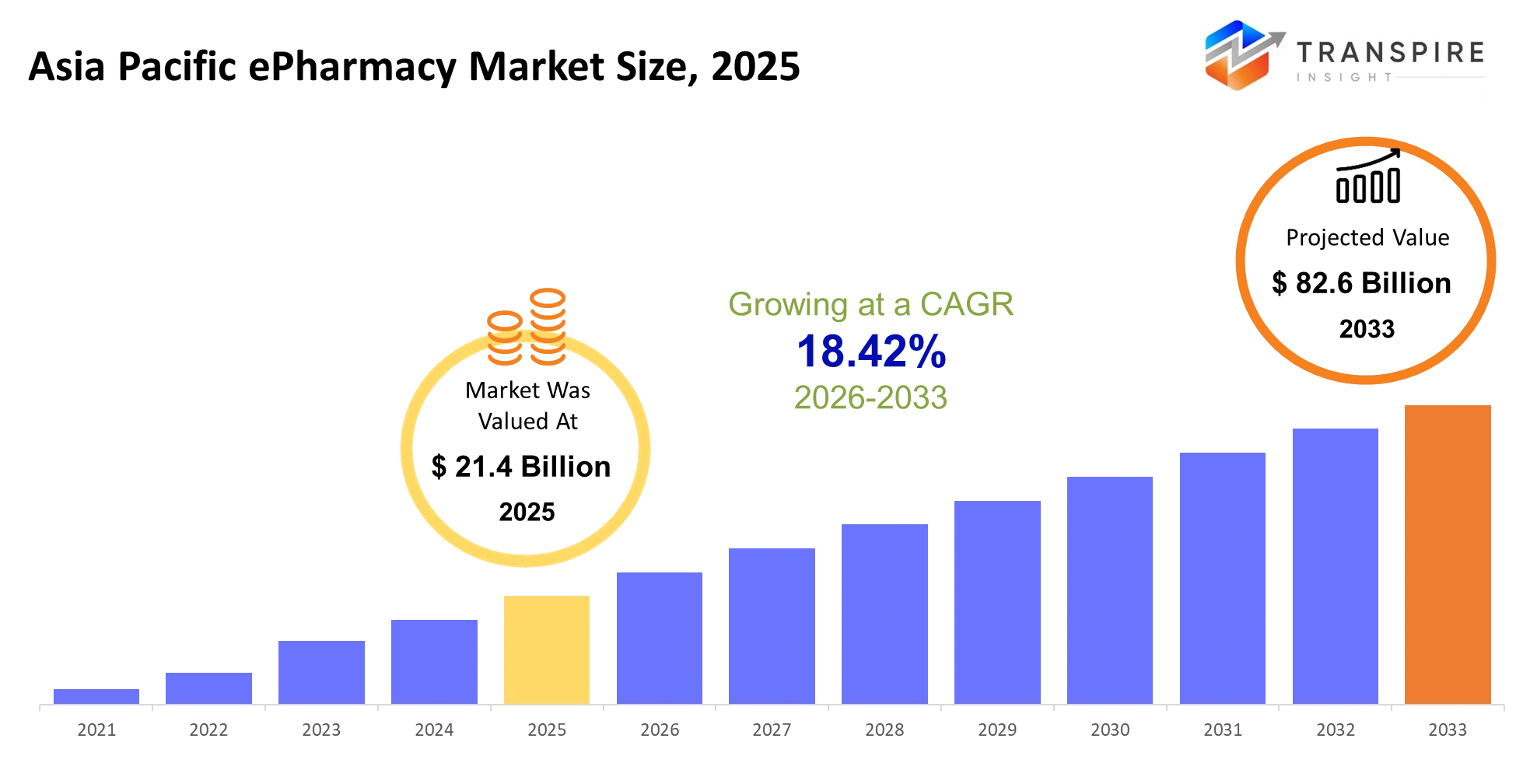
- Asia Pacific ePharmacy Market Size 2025: USD 21.4 Billion
- Asia Pacific ePharmacy Market Size 2033: USD 82.6 Billion
- Asia Pacific ePharmacy Market CAGR: 18.42%
- Asia Pacific ePharmacy Market Segments: By Type (Prescription Medicines, OTC Medicines, Health Products, Others); By Application (Chronic Diseases, Acute Diseases, Wellness Products, Others); By End-User (Patients, Healthcare Providers, Pharmacies, Hospitals, Others); By Platform (Mobile Apps, Websites, Telehealth Integration, Others).
To learn more about this report,  Download Free Sample Report
Asia Pacific ePharmacy Market Summary
The Asia Pacific ePharmacy Market was valued at USD 21.4 Billion in 2025. It is forecast to reach USD 82.6 Billion by 2033. That is a CAGR of 18.42% over the period.
The Asia Pacific ePharmacy market serves as an effective method to deliver prescription medications and wellness items and medical consultation services to people living in both urban centers and rural areas. The system connects patients with authorized pharmacies through its digital platforms which solve three major existing problems of pharmacy distribution that exist in remote areas and its resulting challenges of medicine delivery systems.
The market has evolved during the last three to five years from basic medicine delivery systems to complete digital health systems that deliver electronic prescriptions and telemedicine and diagnostic test scheduling and ongoing treatment for chronic conditions under subscription models. The COVID-19 pandemic led to an accelerated shift when governments made digital prescription rules less strict and people started to use telehealth services.
The disruption showed that standard pharmacy networks contain hidden problems while people need access to healthcare that does not require physical contact. The growth of smartphone usage together with healthcare organizations building digital systems enables ePharmacy companies to enhance their transaction volume while increasing customer loyalty and generating additional income through their health solutions.
Key Market Insights
- China controls the entire Asia Pacific ePharmacy Market by holding almost 38% of the market share which will increase until 2025 because of its well-established digital health systems.
- India represents the fastest-growing regional market which will grow at more than 20% each year until 2030 because people are starting to adopt digital health solutions.
- Southeast Asia is experiencing major market share growth because healthcare digital transformation efforts are advancing in Indonesia, Vietnam and Thailand.
- Prescription medicines lead the Asia Pacific ePharmacy Market which will generate about 46% of market revenue in 2025 through the demand for chronic disease management.
- Healthcare products which do not require prescriptions account for the second-largest market share because approximately 29% of consumers buy these products for self-care purposes.
- The teleconsultation-linked pharmacy services represent the market segment with highest growth potential which will experience substantial growth between 2026 and 2030.
- Eighty-two percent of market demand for applications. Chronic disease medication fulfillment requirements.
- The applications support their ongoing treatment needs. Healthcare and wellness applications now grow rapidly.
- The fastest growing user group exists in rural areas and semi-urban areas. Developing economies expand their logistics infrastructure to better serve their growing user base.
What are the Key Drivers, Restraints, and Opportunities in the Asia Pacific ePharmacy Market?
The Asia Pacific ePharmacy market experiences its most substantial growth because digital healthcare regulations are being established as formal rules by major economies of India, China, and Singapore. The Governments established clearer telemedicine and e-prescription frameworks after the COVID-19 healthcare disruption which permitted licensed platforms to handle prescription processing and patient record verification and medicine delivery through approved digital channels. The policy transformation created operational clarity for providers which resulted in them making major investments for platform development and supply chain operations and pharmacy collaborations. The companies are now adding more users to their systems while their transaction volume increases and they achieve greater income from ongoing healthcare subscriptions and integrated medical services.
The most significant barrier remains fragmented pharmaceutical regulation and uneven digital healthcare infrastructure across developing parts of Southeast Asia. The countries establish their own unique licensing guidelines and prescription validation standards and cross-border medicine distribution regulations. The existing structural differences between platforms create obstacles for standardization which results in increased compliance expenses for companies that operate in the market. The adoption process in rural areas experiences delays because of inadequate cold-chain logistics and low digital literacy. The process causes delays in customer acquisition while it decreases order volumes and it restricts potential revenue growth in high-population areas which would have created significant market expansion.
The most promising area of development for growth exists in AI-powered tailored medical treatment systems. The combination of predictive refill alerts with medication adherence monitoring and virtual pharmacist services allows platforms to provide more advanced medical services than standard transactional medicine delivery. India and Indonesia show strong potential to develop scalable digital pharmacy systems because their health-tech investments and mobile-first consumer behavior create an environment that supports business growth through customer retention and revenue generation.
What Has the Impact of Artificial Intelligence Been on the Asia Pacific ePharmacy Market?
Artificial intelligence along with advanced digital technologies to digital pharmacy operations across Asia Pacific for improved prescription processing and better inventory management and enhanced patient engagement. The system now uses AI-driven automation to validate prescriptions while it identifies possible medication interactions and optimizes order fulfillment processes. The top ePharmacy platforms utilize optical character recognition together with machine learning systems to process uploaded prescriptions within seconds which decreases the need for manual checking and speeds up order delivery. The automation process has helped digital pharmacy networks enhance their order processing system by 20 to 30 percent according to market estimates.
The operational decision-making process gets transformed through predictive analytics technology. The machine learning models predict future medicine demand by studying previous purchasing behavior and seasonal disease outbreaks and regional prescription patterns. The tools enable platforms to optimize warehouse inventory systems while they decrease product losses and enhance medicine access for patients with chronic conditions. The providers who use AI-powered refill reminders together with adherence tracking systems have experienced reduced stock-out rates and improved customer loyalty.
The system delivers faster delivery cycles while it decreases operational expenses and improves regulatory compliance through its automatic audit trail system and prescription verification process. The healthcare data infrastructure in emerging Asia Pacific markets presents a major obstacle for AI technology implementation because of its current state of data distribution. The combination of different electronic health record systems together with multiple prescription templates creates measurement errors for the model while smaller pharmacy networks face high costs for digital transformation of their traditional systems.
Key Market Trends
- The telemedicine reforms which India implemented in 2021 have permitted licensed ePharmacies to handle digital prescriptions which allow greater online medication distribution through urban areas.
- Alibaba Health and JD Health evolved their business model from independent pharmacy operations into comprehensive healthcare systems during the period from 2022 to 2025 which joined together diagnostic services with medical consultations and subscription-based pharmaceutical services.
- The implementation of AI-based prescription verification systems has achieved a 30 percent decrease in manual processing time since 2023 which results in quicker order confirmation and enhanced delivery precision for extensive digital pharmacy networks.
- The pandemic aftermath caused pharmaceutical companies to reduce their cross-border product sourcing because supply chain disruptions revealed their inventory weaknesses, which led companies to establish regional storage facilities and collaborate with local suppliers.
- The two-tier and three-tier cities experienced rapid smartphone usage growth when 75 percent of the population in multiple Asia Pacific countries started using smartphones.
- The companies turned their international expansion efforts to smaller cities after smartphone usage reached 75 percent in multiple Asia Pacific countries.
- The players in the market started to change their competitive strategies when Tata 1mg and NetMeds began to pursue partnerships with hospitals and insurance companies instead of just attracting new customers.
- The healthcare system introduced personalized medication management solutions which included automatic prescription refills and patient medication tracking systems after 2024, resulting in higher retention rates for patients undergoing long-term medical treatments.
Asia Pacific ePharmacy Market Segmentation
By Type :
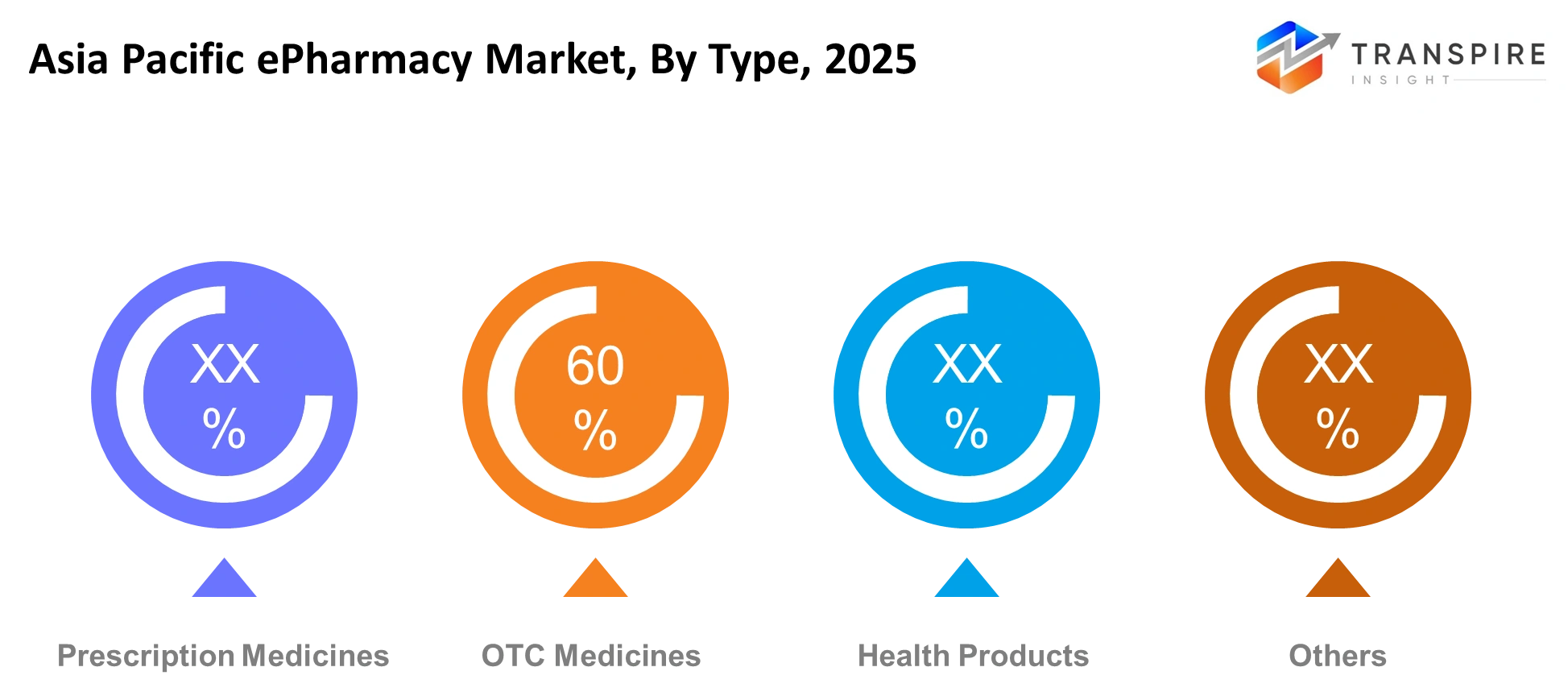
The Asia Pacific ePharmacy Market relies on prescription medicines because urban and semi-urban populations demand easy access to doctor-prescribed treatments. Digital prescription uploads, online consultations, and doorstep delivery have made the process easier for consumers managing long-term health conditions. The ongoing implementation of regulatory enhancements in multiple countries will help maintain secure distribution of these medicines through authorized selling platforms.
OTC medicines also represent a strong segment because consumers frequently demand common treatments which include pain relief products and cold remedies and digestive care solutions. Health products, including nutritional supplements, fitness aids, and preventive care items, continue seeing increased adoption due to growing awareness around daily wellness. The other category includes personal care and healthcare accessories, which add further value by expanding product availability through online pharmacy channels.
To learn more about this report, Download Free Sample Report
By Application :
The market experiences permanent demand because people require ongoing treatment for their diabetes and cardiovascular disorders and respiratory conditions. ePharmacy platforms provide essential medication access through their digital refill reminder system and their subscription-based medication delivery system and their simplified prescription management system. The application area will grow because the population of elderly people in Asia Pacific continues to increase. People who need urgent medical attention purchase their medicine to treat infections and fever and their temporary health issues.
Online pharmacies meet this requirement through their fast delivery systems. The market for wellness products continues to expand because people now value preventive healthcare as their main health approach which leads them to purchase vitamins and herbal supplements and immunity boosters. The other category includes niche healthcare requirements that are gradually shifting toward digital purchasing channels.
By End-User :
The main users of healthcare services today are patients because more people own smartphones and they feel safer using online health services. Digital pharmacy platforms attract customers because they offer easy price comparison with many products and home delivery services. Secure payment systems together with verified product sourcing have built consumer trust which has resulted in wider product adoption. Healthcare providers recommend digital pharmacy services which they trust to fulfill prescription orders.
Pharmacies use online systems to reach more customers while they enhance their business operations through digital transformation. Hospitals establish ePharmacy partnerships to create efficient medicine distribution systems which deliver medications to discharged patients needing ongoing treatment. The other segment consists of institutions and caregivers who want to acquire medicines through efficient methods which can be used in different healthcare environments.
By Platform :
Mobile applications lead platform usage because people in Asia Pacific markets can access smartphones. Mobile applications provide excellent value to customers who need urgent medical assistance through their user-friendly design and complete medical document handling and order status monitoring features. The younger and middle-aged demographic groups will drive the increasing adoption of app-based purchasing as they develop stronger digital consumption patterns.
Websites maintain their importance because users who conduct product research and order management activities find larger screens to be more effective. The importance of telehealth integration has grown because virtual consultations now work together with medicine ordering systems. The connected healthcare system enables better treatment continuity because patients can transfer their prescription needs from online doctor visits to pharmacy fulfillment, which enhances digital healthcare services throughout the area.
What are the Key Use Cases Driving the Asia Pacific ePharmacy Market?
The Asia Pacific ePharmacy market majorly operates through its primary use case which fulfills prescription requirements for patients who need ongoing treatment of chronic conditions. Patients with diabetes and hypertension and cardiovascular diseases and respiratory illnesses depend on their need for continuous medication which makes subscription-based digital pharmacy services necessary to maintain their medication schedule and receive their medications at home.
The market for secondary applications is expanding through the introduction of over-the-counter wellness products and the capability to order medicines through teleconsultation services. Urban working professionals increasingly use digital platforms for preventive healthcare purchases, while elderly patients benefit from caregiver-managed ordering systems. Organized healthcare networks are implementing corporate health programs together with insurance-linked pharmacy partnerships as their primary method for increasing system adoption.
The field of healthcare research is developing new use cases through the application of AI technology which enables tracking medication adherence and developing individualized preventive health strategies. Connected health devices and refill alert systems which notify users about potential treatment interruptions have started to become part of platform systems. The rural areas of India and Indonesia demonstrate strong potential for telehealth-based medicine distribution because digital health systems continue to develop.
|
Report Metrics |
Details |
|
Market size value in 2025 |
USD 21.4 Billion |
|
Market size value in 2026 |
USD 25.3 Billion |
|
Revenue forecast in 2033 |
USD 82.6 Billion |
|
Growth rate |
CAGR of 18.42% from 2026 to 2033 |
|
Base year |
2025 |
|
Historical data |
2021 - 2024 |
|
Forecast period |
2026 - 2033 |
|
Report coverage |
Revenue forecast, competitive landscape, growth factors, and trends |
|
Regional scope |
Asia Pacific (China, India, Japan, South Korea, Australia, Rest of Asia Pacific) |
|
Key company profiled |
PharmEasy, NetMeds, 1mg, Apollo Pharmacy, CVS Health, Walgreens, Amazon Pharmacy, JD Health, Alibaba Health, Ping An Good Doctor, Capsule, Medlife, Walmart, Rite Aid, GoodRx. |
|
Customization scope |
Free report customization (country, regional & segment scope). Avail customized purchase options to meet your exact research needs. |
|
Report Segmentation |
By Type (Prescription Medicines, OTC Medicines, Health Products, Others); By Application (Chronic Diseases, Acute Diseases, Wellness Products, Others); By End-User (Patients, Healthcare Providers, Pharmacies, Hospitals, Others); By Platform (Mobile Apps, Websites, Telehealth Integration, Others). |
Which Regions are Driving the Asia Pacific ePharmacy Market Growth?
The Asia Pacific ePharmacy market is primarily dominated by East Asia because China, Japan and South Korea together create the region's strongest digital healthcare system. China controls the market because its digital health laws permit online medical services while customers select online pharmacies that connect with extensive healthcare networks through their mobile payment systems. The metropolitan areas benefit from strong logistics systems which enable same-day delivery of medicines to customers while established companies like Alibaba Health and JD Health make ongoing investments in AI-based prescription software and platforms for chronic care management. East Asia possesses a competitive edge because its existing system offers clear regulations plus modern digital systems and consumers trust healthcare technology.
South Asia functions as a dependable source of revenue which India uses to expand its digital healthcare system through structured development. The growth of South Asia occurs through two main factors because its regulations gradually change while the region invests in providing affordable digital healthcare solutions. The ePharmacy market in India expands through two main factors which include telemedicine guideline development and better internet access and continuous healthcare investment. The business environment establishes a reliable base which enables prescription management services and diagnostic partnerships to deliver consistent revenue through their ongoing transaction activities.
Southeast Asia currently shows the fastest regional market growth because Indonesia, Vietnam, Thailand, and the Philippines invest in healthcare digitization projects. The combination of public and private telehealth infrastructure funding together with increasing smartphone-based healthcare access has driven online pharmacy usage since 2023. Regulatory agencies are developing clear digital prescription rules which will help platform operators who want to enter these markets. The region provides strong market growth opportunities until 2033 because digital health systems develop and underserved communities start using official online medicine distribution systems.
Who are the Key Players in the Asia Pacific ePharmacy Market and How Do They Compete?
The Asia Pacific ePharmacy market shows moderate consolidation because major digital health platforms control most market transactions and regional companies compete with their specific service delivery methods. Technology integration and prescription verification speed and last-mile delivery efficiency and ecosystem partnerships have become the primary factors for competition in the market while price control no longer serves as the main competitive weapon. The existing companies increase their market power by developing comprehensive healthcare platforms which include medical delivery systems and diagnostic services and teleconsultation and chronic disease management solutions. New market entrants target overlooked regional areas by using customized delivery systems and partnerships with local pharmacies to create unique market advantages.
Alibaba Health developed its competitive advantage through platform integration between its system and China's entire digital commerce network which enables users to process prescriptions and make digital payments while receiving same-day medicine delivery in major urban areas. The company operates its AI prescription review system together with its hospital network to enhance business operations while creating a preventative healthcare subscription system. **JD Health** establishes its unique market position through precise logistics operations and complete control of its pharmaceutical supply chain, which enables the company to distribute prescription medications faster than most competitors while it develops its remote medical consultation services.
Tata 1mg in India offers its customers a complete medical solution which combines their medicine ordering system with laboratory testing services and medical consultation capabilities. Customers stay with the service because they need ongoing healthcare support. NetMeds focuses on broad regional reach through pharmacy partnerships in Tier-2 and Tier-3 cities. Pharmacity expands throughout Southeast Asia by using its retail-pharmacy networks which combine offline customer trust with digital product delivery systems.
Company List
- PharmEasy
- NetMeds
- 1mg
- Apollo Pharmacy
- CVS Health
- Walgreens
- Amazon Pharmacy
- JD Health
- Alibaba Health
- Ping An Good Doctor
- Capsule
- Medlife
- Walmart
- Rite Aid
- GoodRx
Recent Development News
In February 2026, Samsung Electronics entered a partnership with PharmEasy and Tata 1mg to launch the ‘Find Care’ feature within Samsung Health. The integration enables Indian users to order medicines, book diagnostics, and access online consultations directly through Samsung Health, strengthening ecosystem interoperability and accelerating digital pharmacy adoption across Asia Pacific.
Source: https://news.samsung.com/
In September 2025, PharmEasy secured funding of ₹1,700 crore through a debt financing round led by institutional investors. The capital infusion was used to refinance existing obligations and stabilize operations, improving PharmEasy’s financial flexibility as it continues scaling its ePharmacy and diagnostics ecosystem in India’s highly competitive online healthcare market.
Source: https://entrackr.com/
What Strategic Insights Define the Future of the Asia Pacific ePharmacy Market?
The Asia Pacific ePharmacy market will develop integrated digital healthcare ecosystems during the next five to seven years instead of functioning as a separate medicine delivery service. The main driver of this transition occurs because telemedicine regulations and AI healthcare management systems now permit patients to access complete digital treatment pathways which include medical consultations and diagnostic tests and prescription services and ongoing health assessment. The market change will favor companies who establish complete healthcare facilities over businesses that focus only on fast delivery.
A less visible risk lies in market concentration around a small number of platform operators. The main market players will create stronger ties with hospitals and insurers and pharmacy networks which will make it harder for smaller companies to distribute their products and to maintain customer acquisition. The situation will decrease market competition while increasing the need for regulatory oversight.
The Indonesian, Vietnamese, and Indian rural areas present an emerging opportunity to establish digital pharmacy systems through government-sponsored telehealth expansion. The market players need to focus their resources on developing health data systems that can share information between different systems and on building partnerships with local delivery services, because the ability to develop infrastructure in areas with limited access will decide their future market success.
Asia Pacific ePharmacy Market Report Segmentation
By Type
- Prescription Medicines
- OTC Medicines
- Health Products
By Application
- Chronic Diseases
- Acute Diseases
- Wellness Products
By End-User
- Patients
- Healthcare Providers
- Pharmacies
- Hospitals
By Platform
- Mobile Apps
- Websites
- Telehealth Integration
Frequently Asked Questions
Find quick answers to common questions.
The Asia Pacific ePharmacy Market size is USD 82.6 Billion in 2033.
Key segments for the Asia Pacific ePharmacy Market are By Type (Prescription Medicines, OTC Medicines, Health Products, Others); By Application (Chronic Diseases, Acute Diseases, Wellness Products, Others); By End-User (Patients, Healthcare Providers, Pharmacies, Hospitals, Others); By Platform (Mobile Apps, Websites, Telehealth Integration, Others).
Major Asia Pacific ePharmacy Market players are PharmEasy, NetMeds, 1mg, Apollo Pharmacy, CVS Health, Walgreens, Amazon Pharmacy, JD Health, Alibaba Health, Ping An Good Doctor, Capsule, Medlife, Walmart, Rite Aid, GoodRx.
The Asia Pacific ePharmacy Market size is USD 21.4 Billion in 2025.
The Asia Pacific ePharmacy Market CAGR is 18.42% from 2026 to 2033.
- PharmEasy
- NetMeds
- 1mg
- Apollo Pharmacy
- CVS Health
- Walgreens
- Amazon Pharmacy
- JD Health
- Alibaba Health
- Ping An Good Doctor
- Capsule
- Medlife
- Walmart
- Rite Aid
- GoodRx
Recently Published Reports
-
Apr 2026
AI in Diabetic Retinopathy Market
AI in Diabetic Retinopathy Market Size, Share & Analysis Report By Type (Screening AI Systems, Diagnostic AI Systems, and Predictive AI Models), By Application Segment (Hospitals, Ophthalmology Clinics, Diagnostic Centers, and Research and Development), and Geography (North America, Europe, Asia-Pacific, Middle East and Africa, South and Central America), 2021 - 2031
-
Apr 2026
Psychometric Tests Market
Psychometric Tests Market Size, Share & Analysis Report By Type (Personality Tests, Ability/Aptitude Tests, Skill/Knowledge Tests, and Others), By Application (Talent Acquisition and Talent Management), and Geography (North America, Europe, Asia-Pacific, Middle East and Africa, South and Central America), 2021 – 2031
-
Apr 2026
Rare Biological Sample Collection Market
Rare Biological Sample Collection Market Size, Share & Analysis Report By Type (Isolation Kits & Reagent, Blood Collection Tubes, and Others), By Application (Oncology, Transcriptomics, Pharmacogenomics, and Others), and Geography (North America, Europe, Asia-Pacific, Middle East and Africa, South and Central America), 2021 – 2031
-
Apr 2026
Patient Lift Pendant Market
Patient Lift Pendant Market By Product Type (Wired Pendants, Wireless, Programmable), By Operation Type(Manual, Electric), By End-Users (Healthcare Professionals, Patients), By Application (Hospitals, Homecare, Rehabilitation Centers, Others), By Industry Analysis, Size, Share, Growth, Trends, and Forecasts 2021-2033
Our Clients
.jpg)